
All monetary sins ultimately lead to the currency. There are no miracle exits for the BOJ.
By Wolf Richter for WOLF STREET.
The 10-year Japanese Government Bond yield rose to 3.02% today, the highest since August 1996, just about exactly 30 years ago.
But Japan’s bond market “rout” – and more broadly, the global bond market rout – isn’t so much of a rout, though rising yields mean falling bond prices, as it is the bond market slowly coming back to life after two decades of central-bank engineered financial repression that has led to numerous problems and distortions, including the worst inflation in four decades. And in Japan, on the forefront of this financial repression, it also led to the collapse of the yen.
From mid-2016 through mid-2021, the 10-year JGB yield traded at slightly negative yields to slightly positive yields, an absurdity that the Bank of Japan engineered with its Yield-Curve Control (YCC), which is a specific form of QE. But then reality hit: To deal with soaring inflation and the collapsing yen, the BOJ was forced to abandon YCC and QE and veer into the opposite direction: rate hikes and QT. This has allowed the Japanese bond market to rise from the grave. That’s what we’re looking at here.
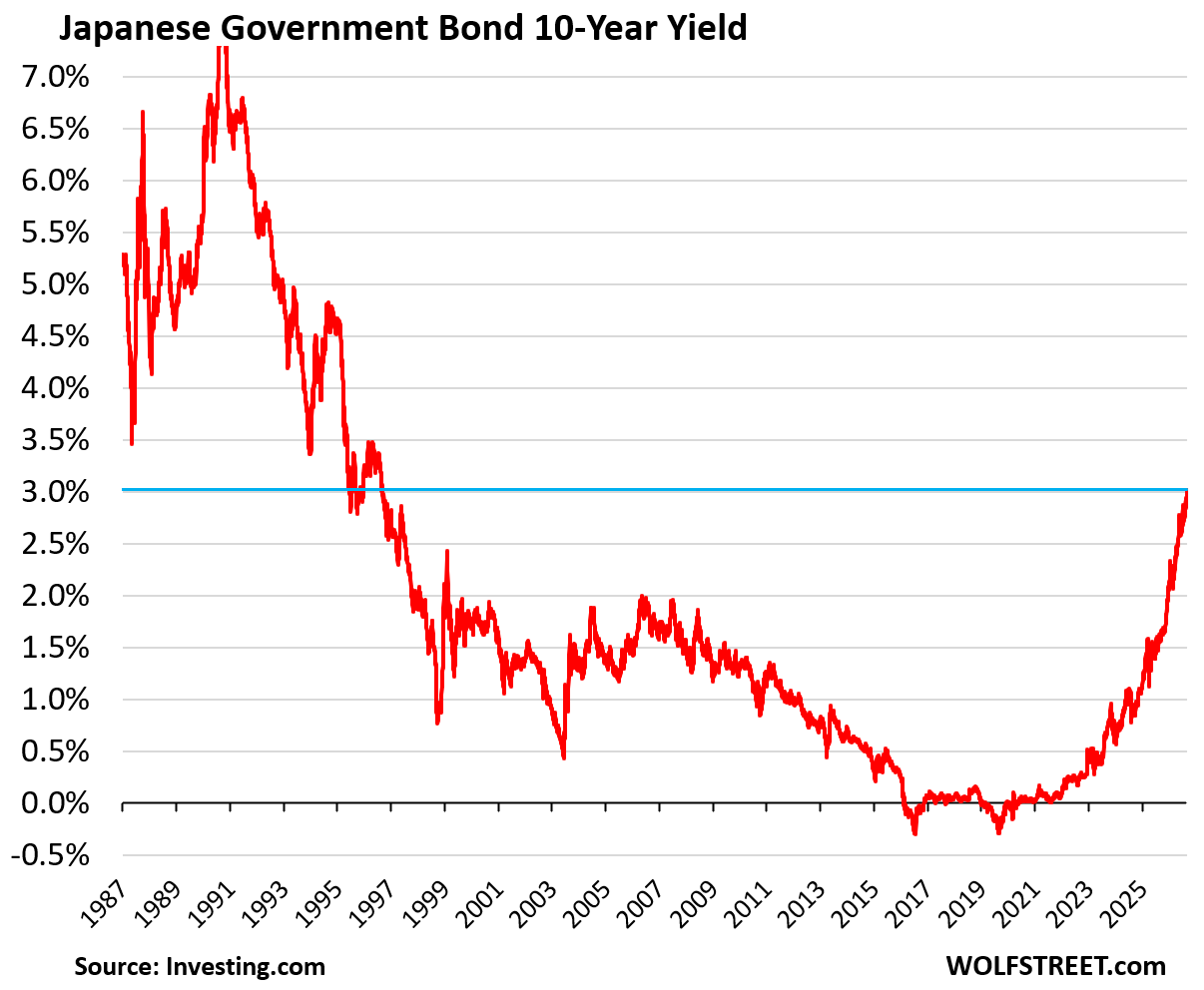
Japan’s CPI inflation was at 1.9% in July, accelerating from June and May, after the plunge in energy costs had pushed it down earlier this year. In terms of July inflation, the “real” yield (yield minus inflation) of 10-year JGB maturities is only 1.1%. Last fall, with CPI inflation at 3.0%, the “real” 10-year JGB yield was still negative! So in those terms, the 10-year yield is still very low.
The 10-year yield is also low, considering the problematic fiscal situation of Japan, and its huge mountain of government debt, measuring roughly 248% of GDP (twice the US debt-to-GDP ratio).
Japan’s credit rating at Fitch (A) is five notches below AAA, and at S&P (A+) and Moody’s (A1) is four notches below (my cheat sheet of bond credit ratings by ratings agency).
So if anything, it’s amazing that the 10-year JGB yield is still this low. It should be substantially higher.
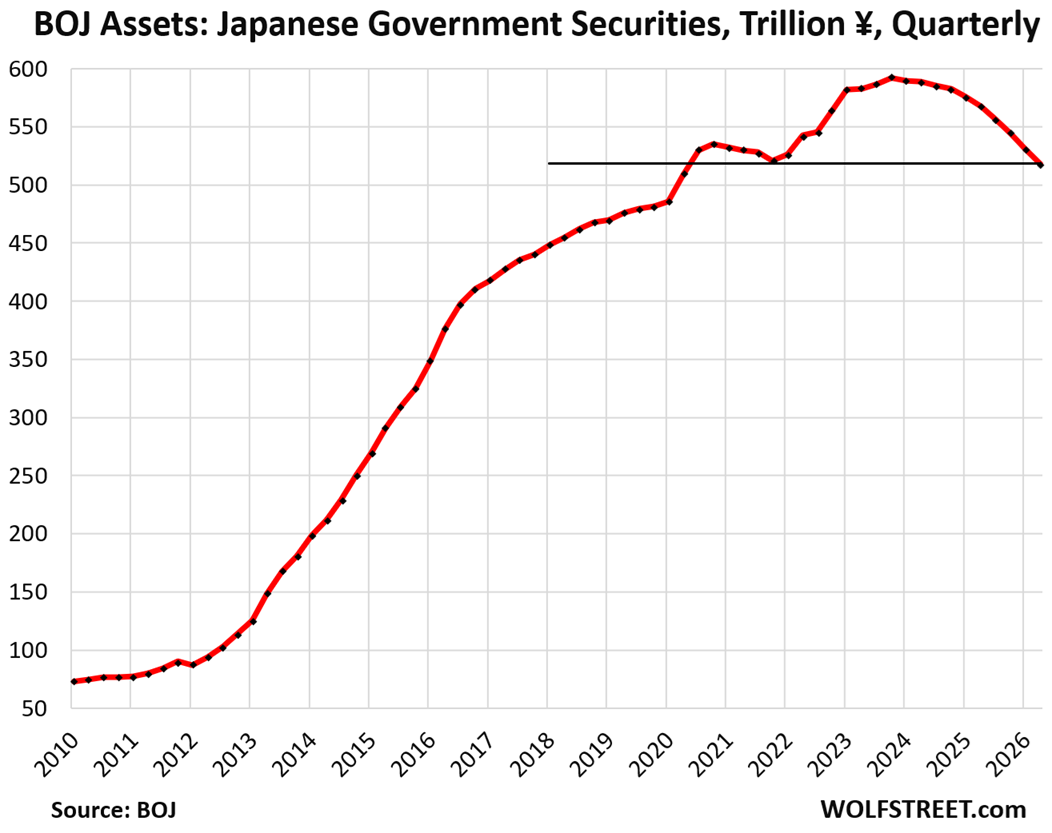
The reason it is still this low is that the BOJ still sits on a gigantic pile of JGBs, and its huge balance sheet still weighs heavily on the bond market though the BOJ has been doing QT for over two years:
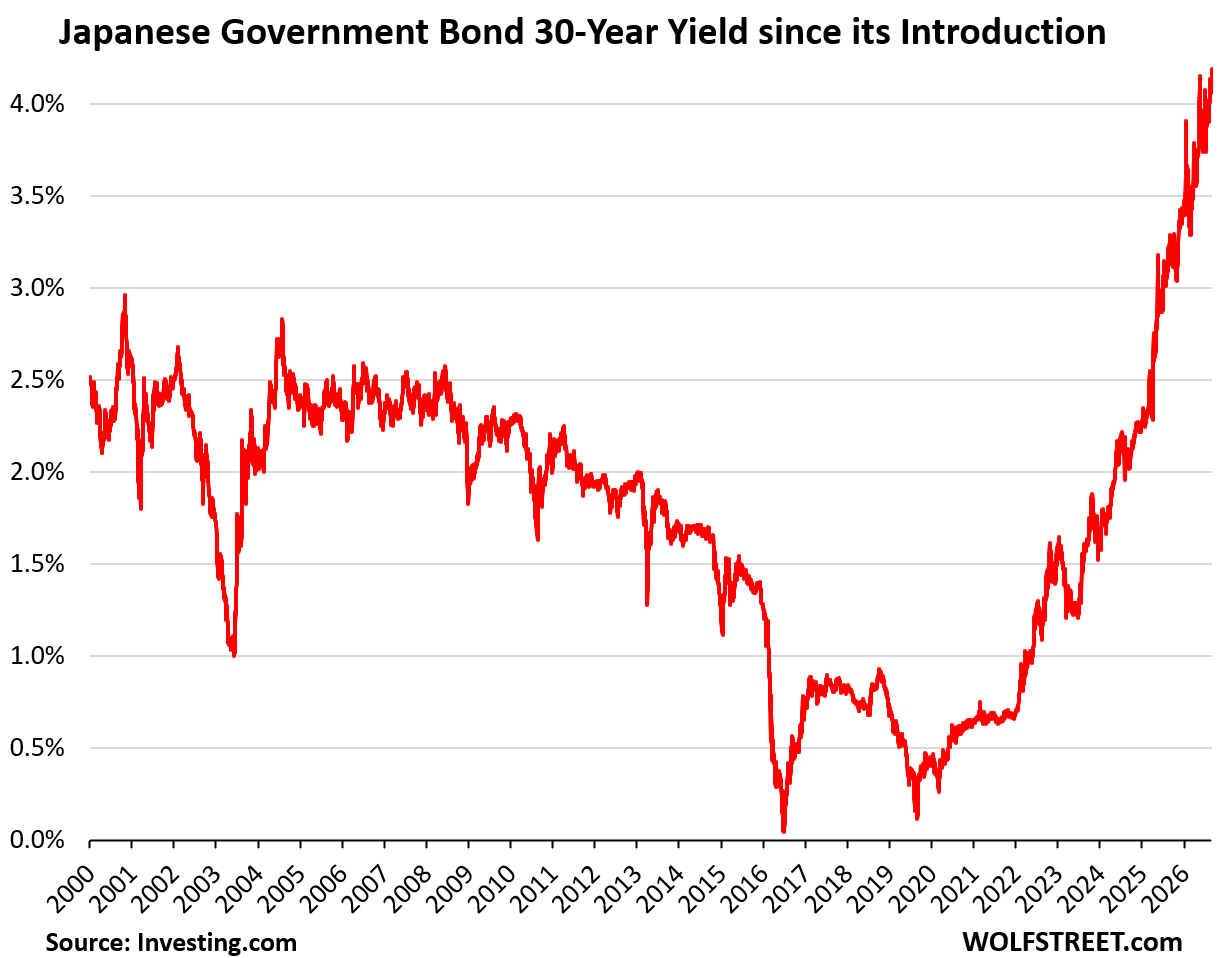
The 30-year JGB yield dipped to 4.18% today after having risen to 4.19% yesterday, the highest since the 30-year bond was introduced in 1999.
This marks the completion of the seventh year of Japan’s bond bear market which started at the end of August 2019, when the 30-year yield bottomed out at +0.12% and the 10-year yield was negative -0.29% (by contrast, in the US the bond bear market, which started in late August 2020, just completed its sixth year).

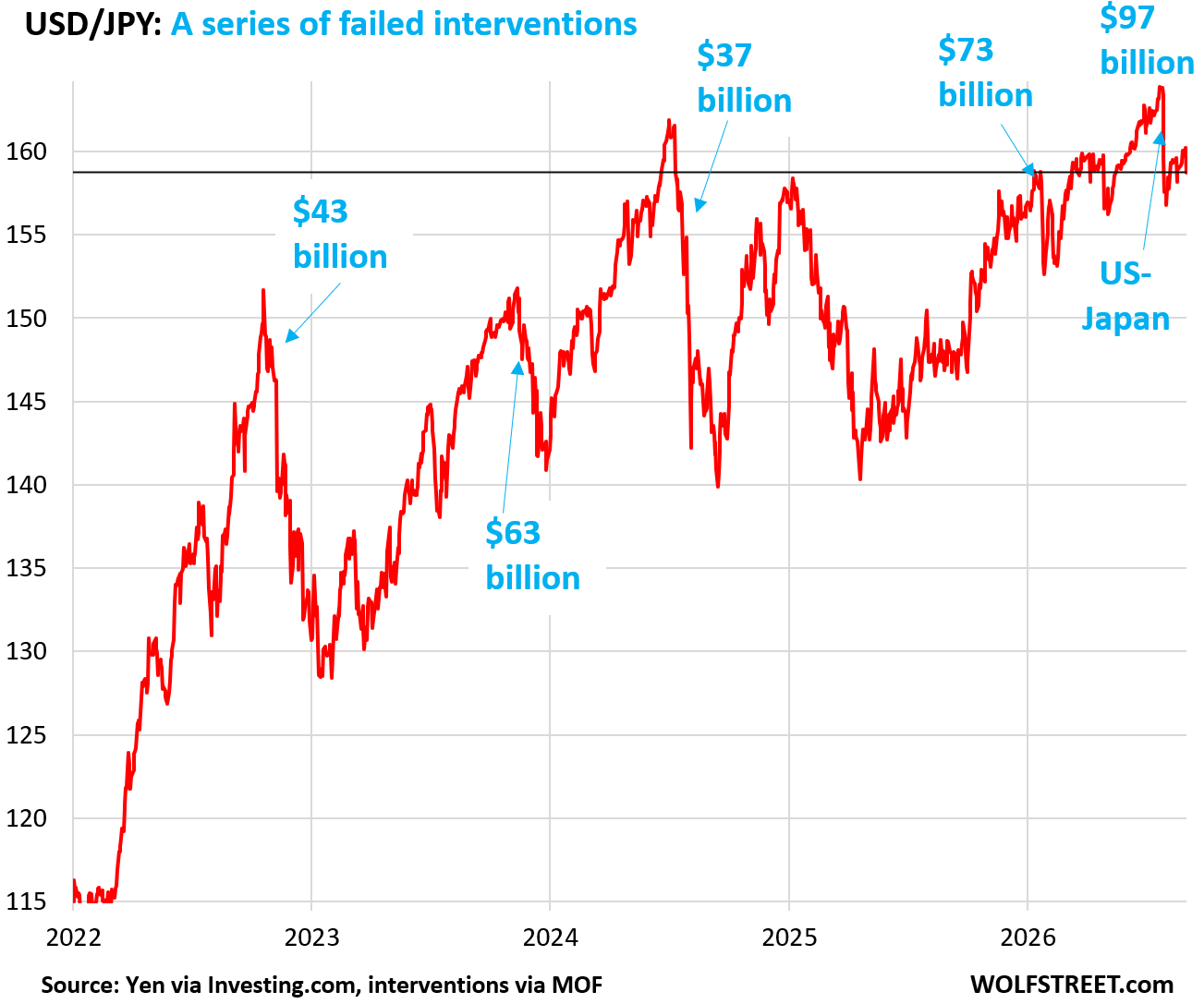
Trying to halt the collapse of the yen.
YCC to contain long-term yields is now totally off the table as the collapse of the yen and inflation are forcing the BOJ to do the opposite: rate hikes and QT. All monetary sins lead to the currency. There is no miracle exit. What is needed to stabilize the yen is much more QT and substantially higher policy rates.
The yen declined to ¥160 to $1 yesterday, and today rose to ¥159 on renewed intervention chatter.
On July 31, a Friday, with the USD/JPY at 164, the US and Japan conducted a historic joint intervention, with the US selling an undisclosed amount of euros (not dollars) and buying yen; and with Japan selling a record $97 billion of USD for yen.
The collapse of the currency of the fourth-largest economy in the world is nothing to be trifled with.
The reason Bessent got the US involved in this intervention was to prevent the problems in Japan from bleeding over into the US Treasury market.
What would normally happen is that in preparation for the next intervention, Japan’s authorities would dump some Treasury holdings to get the USD cash, and then use that cash to buy yen. But Japan’s shedding US Treasuries was a factor in pushing up Treasury yields. With this joint intervention, Bessent tried to temporarily slow the rise of the Treasury yields. This succeeded temporarily, for a few days, but two weeks later, long-term Treasury yields were higher than they’d been before the joint intervention.
In terms of Japan, the collapse of the yen has led to the wrong kind of consumer price inflation, not nurtured by rapidly growing demand and salaries, but fueled by soaring import prices of fuels, foods, consumer products, components, supplies, and materials – despite massive government subsidies at the wholesale level to contain those effects – as it takes a lot more of these collapsed yen to buy the same products. It’s the collapse of the yen that the BOJ has been forced to react to.
Enjoy reading WOLF STREET and want to support it? You can donate. I appreciate it immensely. Click on the mug to find out how:


Japan has dug itself into a deep hole. Will take years if not decades of pain to recover, and with shifting international tides to maneuver, it looks very dire.
Seems like with those yields Japanese investors will seek Japan bond markets and avoid exchange rate risk.
Unlikely for Japan to unload significantly the US Treasury but unlikely it will increase. Seems like without US changes only place for US yields is to go up.
I’m not so sure that it is unlikely. The Nikkei has been sliding for three days straight. What other short-term option would be left for the Japanese to save the Yen, other than to unload US Treasuries?
Amen. At some point, they must put their own skins first. We just lost another, major, US treasury buyer for a long time. US and Japan’s debt doom loop has started.
Don’t see how we can stop it without massive increases to US government revenues: e.g., by closing the Cook Islands (etc.) foreign trusts income tax loopholes! The increases in US wealth have mostly gone to companies owned/controlled by or via shell companies through foreign (often perpetual) trusts created specifically to evade US income taxes, not to ordinary Americans!
“Unlikely for Japan to unload significantly the US Treasury”
Really??
Will Japan sell Treasuries without US permission. And what sort of losses would Japan have to accept to sell Treasuries ? What is the average duration of it’s book.
Wouldnt it be more likely that Japan would just let Treasuries roll off without replacing them. No losses to book. No need to ask US permission.
In 2022 Hocus Pocus 2 came out.
In 2026…
😂
Wi Tu Lo.
Sum Ting Wong.
Hyperbole by Wolf: All monetary sins ultimately lead to the currency. There are no miracle exits for the BOJ.
Question for Wolf: Are there any miracle exits for USA?
No miracle exit. The officially chosen exit is “letting it run hot” – meaning higher nominal economic growth (+8.0% in Q2), higher inflation (3-5%), and higher yields. We’ve been talking about it here for a while.
Don’t worry, AI will make us so productive that that won’t have to work. It’s a win, win.
Policy makers are ignoring the big elephant in the room which is massive and exponentially increasing debt.
Eventually that problem will have to be dealt with and I don’t agree with Bessent that we can “grow our way out of it”. At least right now, the truth is very much to the contrary – federally it has increased by over 10T in only a few years !
“Letting it run hot” is a functional way of reducing the burden of the debt (nominal economic growth exceeds growth of the debt). And everyone, including asset holders, pays for it through higher inflation.
We have had several years of this strategy.
Hows it working out so far? Has the debt to gdp, meaningfully declined? Or has it stabilized. And interest rates are still climbing and working there way into the budget.
Without fiscal discipline, is this a 30 year or 100 year initiative?
This is one thing I haven’t heard them talk about.
“Were gonna let it run hot” begs the question “how longs this gonna take”. Any estimates?
I was thinking the same thing.. For how long? What if there’s another black swan event. All plans are great in the average case.
What we need are some massive tax cuts for the wealthy.
CSH
“what we need is tax cuts for the wealthy”
Trump and his people are proposing lifting the cost basis on purchases of stock (and other assets) to reflect inflation.
SO, if you bought stock at 100 a share 5 years ago, he proposes that the cost basis should be raised , say 10% to 110, to reflect inflation.
The assets appreciated because of inflation, now he wants the cost basis to be raised, taxes reduced because of inflation.
Whacky.
Wolf
You were / are one of the very few to make this point . In Aug 2020 long term interest rates were at lows that required long term DEFLATION to break even on a real basis .
The average Joe/Jane is clueless when it come to real versus nominal rates of return. Making simple concepts difficult to understand is what eCONomists do so that the CON can continue.
But what of the promise from the Fed of a 2% inflation target?
They will need that to keep inflation in the 3-5% range, where is has been for the past few years. If they say the inflation target is 4%, they’ll get 5%+ inflation. And that could get problematic.
There is no excuse for a government to mislead the population.
“The officially chosen exit is “letting it run hot” – meaning higher nominal economic growth (+8.0% in Q2)”
Just to clarify, does “economic growth” mean more and bigger loans? Basically, new currency creation from nothing, paid in the collateral of promises for future repayment?
It’s investment that triggers growth. And these investments are invested capital. There are only two types of capital: debt capital and equity capital. Investors expect to make money off their investments, debt or equity, now as ever, though it’s risky and doesn’t always work out.
“It’s investment that triggers growth.”
The details matter, is the “investment” coming from existing capital and savings or new currency and DEBT?
Where the growth is matters too. Growth in financial “services” and financial “products” (i.e. more MBS type BS) of actual productive endeavors that improve our quality of life? The problem with the latter is that real growth requires real inputs (energy, commodities, refined materials, etc.) and if you do not have access to the necessary inputs then it really doesn’t matter how much capital or savings or printed currency you have to deploy…
…all the while the debt still needs to be serviced.
Agreed, but can this possibly work without also at least somewhat constraining fiscal deficits ? And come 2032 congress will have to fund 300 billion in new Social Security funding or allow benefits to be cut 20%. Of course 2032 is forever in politics time.
yes, “at least somewhat constraining fiscal deficits” would be immensely helpful in all of this.
Somewhere, Paul Krugman is telling himself, “the problems facing Japan’s monetary wizards has nothing to do with me.”
–Geezer
What’s happening with the Dollar-Yen carry trade, and how is it affecting dollar-yen spreads?
Question is, is it time to head towards the exit. I’m thinking it is.
If and when bond yields rise enough (they’re still far from it), it’ll be time to head for the ENTRANCE to the bond market, not the exit.
The time to exit the Japanese bond market was in Aug 2019. And the time to exit the US bond market was in Aug 2020. That when their bull markets ended.
I’m looking at the stock market exit door.
A couple of quotes I remember from a movie titled “Margin Call” that might be worth watching (or re-watching):
“Sell it all. Today.”
“If you’re the first out the door, that’s not called panicking.”
China now releasing their AI versions of GPT for free. These products are supposedly being gobbled up by the public at a fast clip. Which begs the question, why invest money in US models or buildouts? Equity based financing or debt financed speculation is touted to save the world with this new technology. Gotta beat China. I think that ship sailed already.
If this is the foundation for the Market? Doesn’t look good.
I would go with hard assets and no debt. Always have and always will. Good luck.
Paul, i think you answered your own question: The world pays $$ for the premier american models, and pays $0 for the chinese models.
Will tomorrow’s chinese models be free? Will tomorrow’s american models still be worth paying for? All good questions facing someone thinking about investing in AI tech today.
It is a complex business, and it defies being abstracted down to something as simple as which country the authors live in.
It is a lot like thinking about investing in railways back in the 1800s. We know that -someone- will end up as a reliably profitable business once the dust clears… But who?
I realize this is a bit off topic, but I would be interested to know what you (Wolf) think will be the peak 10y/30y yields in the next 2-3 years. And, at which point do you think ENTRANCE to the bond market makes sense? I know, I know no one has a crystal ball and this is just a discussion for fun, but I really respect your opinion (I donate!) so I’d like to hear it. If you want to put this in a different article, of course that’s fine.
Personally, I’d be very tempted to sell equities and buy bonds if yields on long-dated TIPS exceeded 4%.
A lot of this probably depends upon your goals and time horizon.
“If and when bond yields rise enough (they’re still far from it), it’ll be time to head for the ENTRANCE to the bond market, not the exit.”
And that’s the rub, isn’t it? Trying to figure out when to time jumping into longer dated treasuries to ride the fall in yield that will come from a big recession that includes all sorts of QE to push down yields. Then you gotta time getting out which is probably a bit easier.
The market interventions are not working anymore.
Oil is ripping because no one believes that peace negotiations are going well, inflation is up and expected to rip because diesel & food is ripping with no end in sight and inventory/reverses are getting exhausted, bond yields are ripping because inflation is expected to rip, and so on.
But the great fear is with a CAPE in the nosebleeds domestically and certain countries, the bubble may pop. What usually is associated with a pop in a capex bubble? Rising bond yields.
Of course no one can time the market. But it may be an unwise bet to go too deep into expensive equities in these conditins. Bonds will bleed you too on the interest rate risk, and cash with a fed that let the bond market take the wheel instead of raising the fed rate is not that attractive in a higher inflationary environment.
Place your bets!
“Bonds will bleed you too on the interest rate risk…”
A little too broad a brush. Placing some chips on TIPS and I-bonds. Moving risk from interest rates onto CPI corruption but nothing is risk free.
I don’t believe this is the time to catch a falling knife in the US or Japan’s Bond market. The forty year bull market in American bonds ended in 2020. Today, the US stock market is really the only game in town for capital appreciation, and will be until the long bond yield forces dramatic cuts in government spending, which will tank an economy that was living a recession proof lie built on borrowing. It’s gonna be a haircut for sure.
Both equities and bonds have risks. The bottom line is that if you’re watching all the jobs data and less known things like the high yield index which usually rises to about 3.5% and stays there for 1-2 monthly reporting periods, then a recession could very well be eminent. Just as much or more than they’ve fallen, bond prices will shoot higher, especially if the next recession is nasty. And everyone I know feels like there’s pent up momentum for a big recession. I believe the 20Y topped out about $150 in spring 2020 and is down to under $82. I’m sure very sophisticated investors use bond index funds to ride theses waves. The hard part is knowing when to get in & out.
Me think, me and my friend Engles have asked the same questions.
1. Why dont you let run the inflation hot for a while?
2. May be we can “dig out of the hole” this way.
3. If rates raises, let them be, BOJ, FED or BOE, can raise the rates and still be relevant.
4. The private market, bonds, companies can have investors ready to pay for tulips, south sea ships, railroads, steamships, electronics, computers, houses, crypto and AI.
5. Let it run. Lassie Fair.
6. Am I wrong somewhere?
I think I posted this comment before here.
1. Japan became a very good nation by science and technology, they understood science better than Europeans.
2. The problem is Japan is extremely financialized now, moving away from science.
3. Japanese cars will rival that of Europeans way ahead of big 3s. Nissan Datsun was a feared car all over the world.
4. Japanse electronics were way ahead of time. Sony digital, electronics, TV, walkman, but they missed out on computers.
5. They missed the entire dot comm bubbbb
6. Toyota, Hundai do not have full electric cars. America had electric cars designed by the original Tesla and Edison back in 1912. Now Korean makes cheaper/better cars.
7. Japanase were very good with animation. Do you remember those 90s tv animations made by Japanese? Somehow now again they lost the game.
8. Think about the video games like that that little thingy, jumpy, jumpy, side side…they lost that too..
9. Also, Japanese people dont make babies no more. All Japanese babies are now lower number babies.
8. Akira Kurasova, Bonsai tree, Puffer fish, bullet trains, osaka, cat was arrested for stealing fish,
9.Only thing no one can beat Japanse. Shops without shop keepers. Imagine that in B’more. LOL. ROFL.
Everything is scripted reality…a scripted reality is profitable and extracts capital…limiting chance…every panic already had a solution…nothing was unknown…they use central casting like McDonald’s boy…this was all decided long ago….control the narrative, the definitions, control the people…
Obviously that is not what is happening at all but rather extreme chaos.
Japan has a population issue also that’s crashing…but their cities are clean and culture is better than the USA,s which is now a shell of what it was…mind control tv programming and horrible public schools and tribalism group thinks has destroyed their ability to see how abnormal 2 trillion deficits are…blame the design as it was there to be gamed by the secret societies who own this empire…
Anyone recall the BOJ under the guidance of Paul Krugman and others…..going to the throne of ZIRP?
around 2000
ZIRP ….and why not?
Well its pay up time and the geniuses who do the plate spinning and holding the beach balls under water have a problem.
Japan first as they were first to implement.
Next the followers………the EU and the US.
All these Japanese financial shannigans over the past few decades are designed to smooth out the after effects of the impulse spike of the bursting huge property bubble over thirty years ago. With the best of efforts such an impulse will have distorting effects elsewhere in the financial system. There is no escaping from the effects of a financial bubble. Smoothing just extends the distortions over a longer period of time, such the yen carry trade seen today.
The main question I have is: why the delay? Real JGB yields went negative in 2014, 12 years ago! If negative real yields lead to inflation and/or currency weakening, why did it take 12 years?
Good question. Everyone got away with it far longer than I thought they would. But then suddenly… And that’s how a lot of things are. No real problem for an amazingly long time, during which everyone learns the wrong lesson, and then suddenly…
Good answer to a good question
It’s seems like there’s some missing structural factor, especially since it happened to virtually every advanced economy at the same time. But I have no clue what it might be.
And then conversely, if you jump into the long end at the right time, the suddenly turns the other direction.
If I had to guess? It’s because the whole world started doing it as well. And the US used to be the cleanest dirty shirt.
“Bessent tried to temporarily slow the rise of the Treasury yields. This succeeded temporarily, for a few days, but two weeks later, long-term Treasury yields were higher than they’d been before the joint intervention.”
I’m just amazed that Bessent thought this would work out any better than it did. I guess that’s why you call it Hocus Pocus.
Everything is jawboning to fake out the markets, which fall for it temporarily every time. I think it’s so wealthy insiders can continue their pump and dump scams.
Wolf, you admit it clearly, but smoothly in the comment section – maybe in the article too, but I didn’t RT*DFA – that dollar holders are gonna get burned/shafted through inflation.
Applause and kudos to you for revealing the screw job.
In an ideal scenario of letting it run hot, salaries are going to rise with or faster than inflation, or else the economy cannot run hot; it will need the spending power of those salaries, so they need to grow fast. The goal for investors will be to find assets whose yields are higher than inflation, or whose capital gains are higher. But that will be tough for many assets, such as real estate, which will be handicapped by higher interest rates and rapidly rising costs.
And as the economy eventually makes that final turn towards recession a lot of the margin debt will have to be repaid, so assets like gold & crypto are going to come under a lot of selling pressure.
Under run hot which Wolf explained well, it is obvious who the most likely losers will be. It is people on fixed income and retirees who do not receive the new income levels. It will be owners of assets which said assets for whatever reason do not inflate in the new run hot economy. It will be savers whose investment returns are not near the inflation rate, or wage inflation rates or investment assets inflation rate.
When a debtor looks its creditor, say a bank, and says I am going to do everything in my power ( and I am looking at my options now) to devalue the bank’s promissory note or claim, a smart banker reaction should be to get out as soon as they can by whatever alternative they have.
When your own elected government chooses to devalue its debt , or shit on its creditors, shouldn’t that creditor who owns the government bond do the same.
So, let’s get in the mind of the investor who is considering buying a 5 year or 10 year Treasury note. What is she thinking? What is she betting? She is actually betting that besides getting her principal back, the 5% nominal yield she receives will be higher than inflation and leave her a real yield of say 3%. She makes that bet knowing that the debtor, her own government, is trying to run hot and devalue her investment, as so stated by the SEC OF TREASURY.
What am I missing Wolf?
The #1 job of the Treasury Dept (headed by Bessent now, and by Yellen before him, and by others before them) is to sell the US debt come hell or high water, and to do that at the lowest possible cost to the taxpayer, so at the lowest possible yield. The bond market is on the other side of this trade, trying to buy at the highest possible yield. And they all fight it out at every auction.
No Treasury investor got shafted more in recent memory than those who bought 30-year Treasury bonds at auction in the summer of 2020, at yields of about 1%. Those instruments have lost half their value in the secondary market. The coupon interest has been below the rate of inflation from day one, and will remain so for another 24 years. These were horrible deals.
Bessent and many others have said many times that Yellen really screwed up by not massively ramping up sales of 30-year debt during the summer of 2020 and into 2021, which would have dramatically reduced the interest costs of the US government for 30 years, and would have dramatically increased the fleecing of those investors, and would have likely caused the failure of a lot more banks in 2023.
But for investors who are not forced buyers of long-term securities, there is a time to buy long-term Treasuries from the government, and that time is when yields are relatively high and when there is bond blood in the streets. The timing is a decision everyone needs to make on their own, based on what scenario they see for the future.
People who bought 30-year bonds in the summer of 2020 saw negative long-term interest rates in the future, which were already occurring in Japan and some parts of Europe. They saw a scenario of increasingly negative interest rates for years to come. This was obviously a flawed picture of the future, and those people lost their shirts, but that’s how it goes when you get the future wrong.
From what I remember, the only ones who really lost their shirts were the investors in SVB, Signature & First Republic. The Fed’s shiny, new BTFP program made sure of that.
For thirty years we have been hearing the prediction that Japan’s bond market will be “the first domino” to fall, etc. etc.
It’s all just numbers and currencies come and go.
Hedge accordingly.
Almost everyone seems to forget that inflation is COMPOUNDING! Letting inflation run hot for years and years is going to devastate many oft-overlooked pockets and cogs (nooks and crannies?) of the general economy making it harder and harder to achieve the same economic growth everyone is hoping for.
Didn’t Charlie Munger say that inflation was the main force that destroys civilizations? So why should we believe letting inflation running hot will save civilization in this case? (don’t forget the cumulative power of compounding!).
I have a terrible feeling letting inflation run hot for much longer will give us even nastier surprises than what we’re seeing with the sudden demise of Japan’s YCC.
A low rate of inflation is no problem for the US economy, everything adjusts upward, including wages, pensions, interest rates, etc. It’s high rates of inflation that can damage the US economy.
There is a broad and badly defined transition area between “a low rate of inflation that’s not a problem” and a “high rate of inflation that damages the economy.” We saw that 8%+ inflation in 2022 was already on the other side of that transition area. But 2% inflation hasn’t troubled the US economy at all. Nor has 3%. Once you go beyond that, you’re in the transition area, as I see it. And then the higher you go, the more you can see the damage.
2-3% inflation is good. Money exists to be used. Inflation prevents people from hoarding money and refusing to work or spend (which as you can see from comments here is something that people desperately want to do).
Having money lose half its value every generation if you refuse to do anything with it (a 2.4% rate) is about perfect for this purpose, though there’s some flexibility around this mark.
“All monetary sins ultimately lead to the currency.”
Of course.
But where was this attitude in the MSM over the 55 years that the cancer was being cultivated/tongue kissed?
The very fact that Bretton Woods/Semi Gold Standard broke down/had to be exited was the loudest warning sign possible.
But what we got from the “Establishment” were haughty sneers that gold/anything resembling fixed “money” was a barbaric relic.
The so-called ‘gold standard’ was just a very brief 60 year fail experiment from 1873 until 1933 at which time the US economy alone had enormously outgrown the value of all gold ever discovered and it was unwieldy.
rubbish. gold has been money for 10,000 years. it still is.
Indeed. The fact that the Chinese did not sign off on the latest G20 communique speaks volumes. I laughed when I saw a comment on a blog saying ; ” Communism and fascism both suck, but at least with fascism taking over the US we might get some trains that run on time.”
Funny too because public transit is great in Japan…
“And everyone, including asset holders, pays for it through higher inflation.”
Golly, it is almost like the G perpetually printing “money” unbacked by real assets isn’t like some sort of miracle drug.
Isn’t this about the time that the Establishment rolls out some crack-addict Brahmin to lecture us about the evils of deflation?
I mean there are plenty of unemployed ex-WAPO and NYT columnists doing Substacks/(world’s worst) Only Fans.
MW: Dow, S&P 500 and Nasdaq rise sharply as software stocks and Big Tech rally
They rose sharply because the Fed trotted Waller out to pump stocks.
““I’m going to paraphrase John Lennon here: Give disinflation a chance. We can wait one meeting,” Waller said. “What’s the cost of waiting one meeting? Hiking 25 basis points, one meeting right now, is not going to bring the CPI down to 2%.””
What a f*cking idiot. His logic might make sense if we haven’t been running above the “target” for the past 5 years. They’ve been “giving it a chance” for years, and have nothing to show for it but inflation becoming more entrenched.
MW: Wall Street is betting on Fed Chair Warsh to keep a manic bond market from unraveling
So does this mean Japan is likely going to have to sell tbills?