
US government interest payments, tax receipts, average interest rate on the $40 trillion Treasury debt, Debt-to-GDP Ratio, Deficit-to-GDP Ratio…
By Wolf Richter for WOLF STREET.
Interest payments by the federal government on its $40 trillion of Treasury debt rose by $7 billion in Q2 from Q1, to $312 billion. Over the past 12 months, interest payments totaled a record $1.22 trillion, up by 240% since peak financial repression in Q2 2020 (red in the chart).
But interest payments don’t occur in a vacuum. They occur in the context of tax receipts that are available to pay for them.
Tax receipts by the federal government rose by $20 billion in Q2 from Q1, and by $95 billion year-over-year, to a record $952 billion. For the 12-month period, tax receipts jumped by $487 billion (+14.9%) to $3.76 trillion (blue line in the chart below). Tax receipts in Q2 got hit by the refunds of tariffs, which pushed net tariffs into the negative.
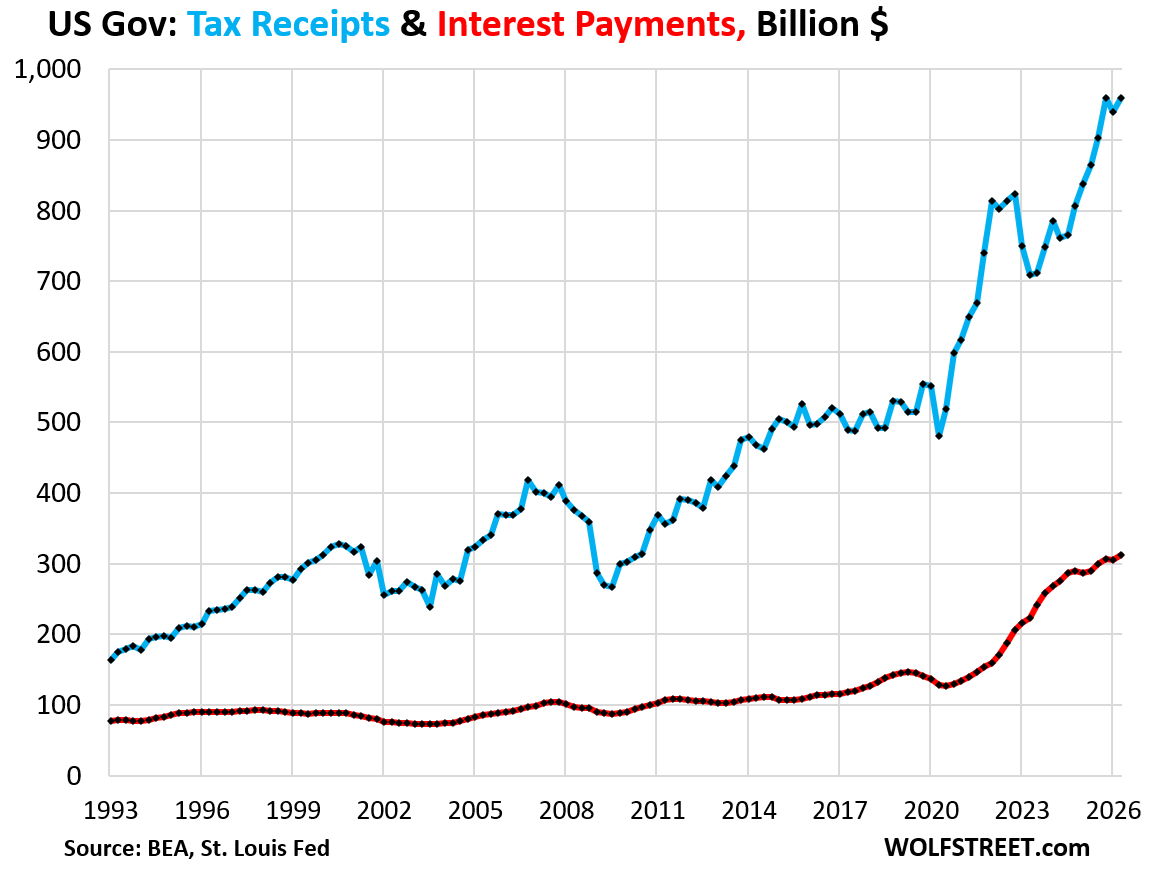
The measure of tax receipts, released by the Bureau of Economic Analysis as part of its revised National Accounts data for Q2 on Wednesday, tracks the receipts that are available to pay for general budget expenditures, such as interest payments, defense spending, government salaries, etc.
Excluded are receipts that are not available to pay for general budget expenditures and that are not included in the general budget, primarily Social Security and disability contributions that go into Trust Funds, out of which benefits are paid directly to the beneficiaries. Both the contributions that go into the Trust Funds and the benefits that are paid out of the Trust Funds are off-budget.
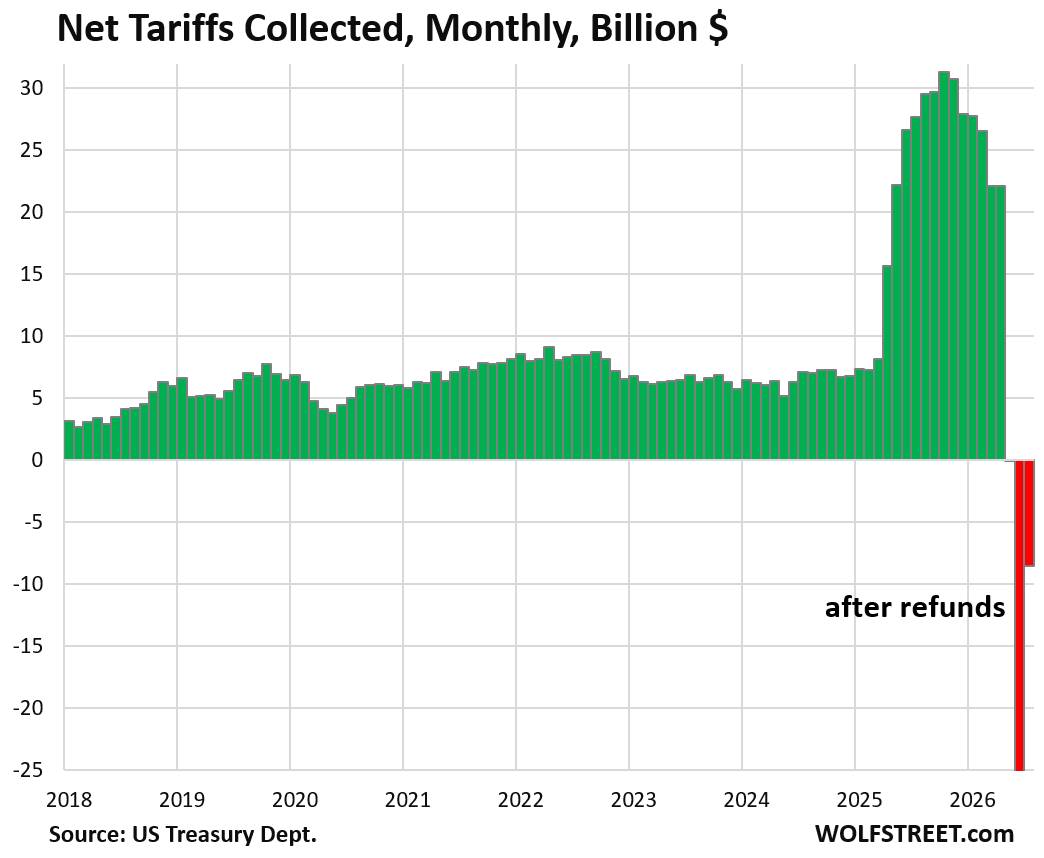
Tariffs got hit by refunds that the government paid out after the Supreme Court scuttled part of the tariffs. Refunds started going out in May. Net tariffs collected in Q2 (tariffs minus refunds over those three months) were a negative $3.5 billion, compared to a positive $71 billion in the prior quarter.
New tariffs under a different law are being imposed, so net tariffs should become substantially positive again in the second half of 2026.
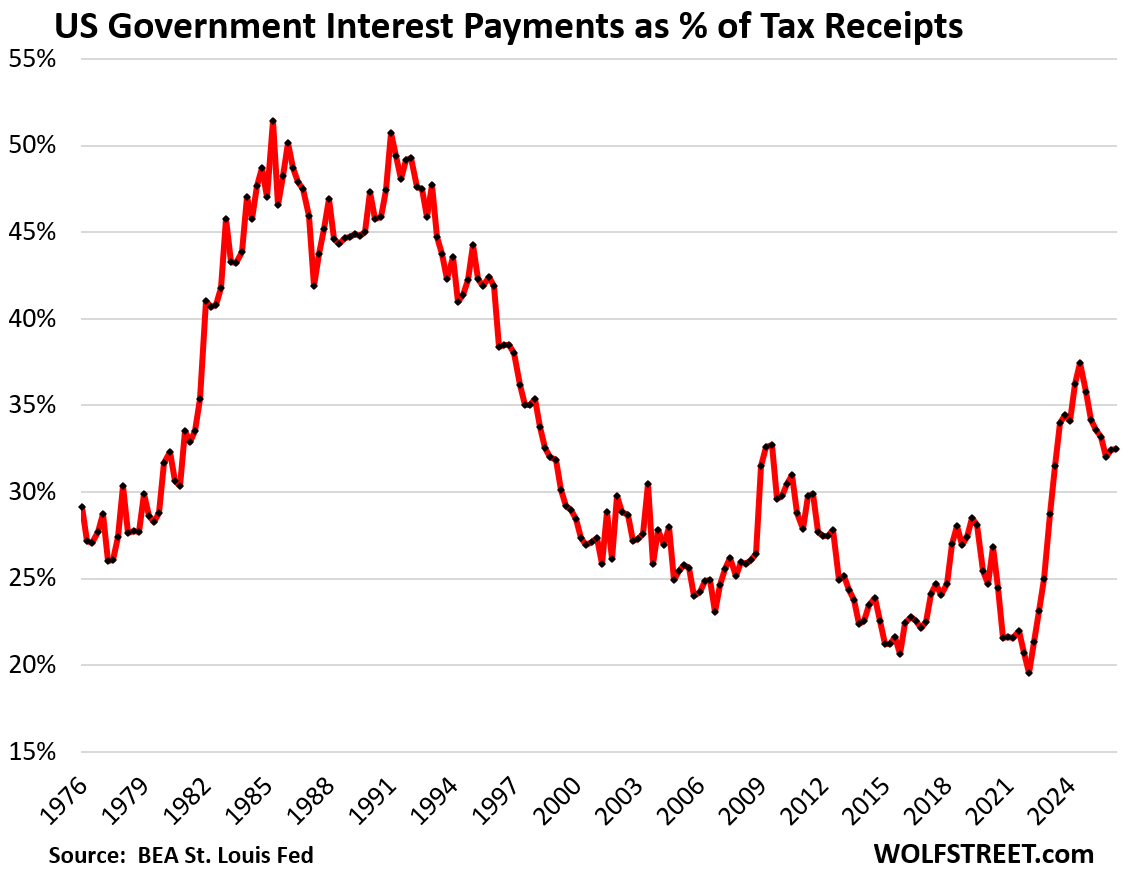
The big bite interest payments take out of tax receipts: Interest payments ate up 32.5% of the tax receipts that were available to pay for them in Q2.
The recent high, 37.5%, occurred in Q3 2024, the worst ratio since 1996 when the ratio was climbing down from the crisis times.
In the 1980s and early 1990s, the infamous “bond vigilantes” were breathing down the government’s neck. The phrase was coined by Ed Yardeni at the time to describe bond investors that demanded high yields in light of the risks posed by the government’s fiscal policies and by inflation.
A growing economy generates more taxable income and higher tax receipts from corporate and individual taxpayers, and ballooning asset prices generate capital-gains taxes. But those capital gains tax receipts can plunge in Q1 and Q2 (such as in 2023), following a year when asset prices dropped (such as in 2022). The second half of 2025 and Q1 of 2026 benefited from the new tariffs.
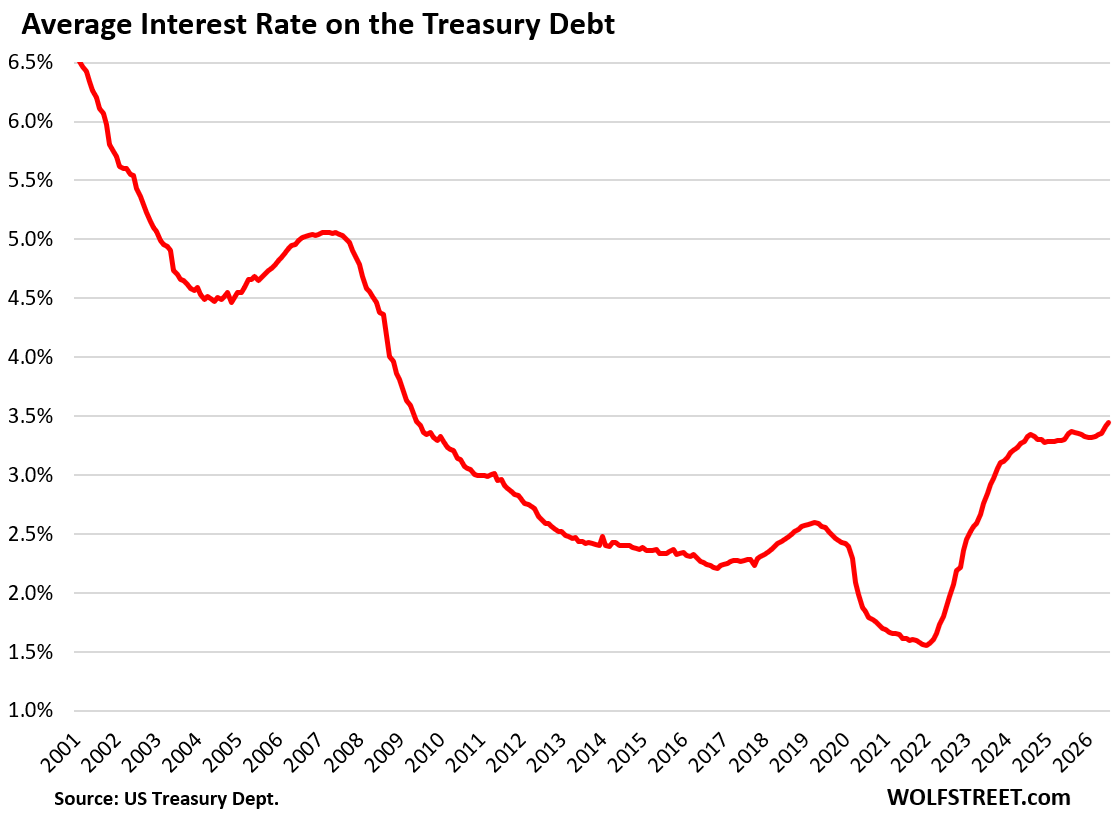
The average interest rate on the Treasury debt was 3.45% in July, 3.41% in June, 3.35% in May, 3.34% in April, 3.33% in March… slowly ticking higher as yields of Treasury bills have risen, and as maturing Treasury notes (2-10 years) and Treasury bonds (30 years) with low interest rates were replaced by new securities with much higher interest rates, and as new bills, notes, and bonds were added to the pile without replacing anything.
The ultra-low interest rates during QE were an aberration in history. Interest rates have been normalizing, but remain low compared to times of high interest rates.
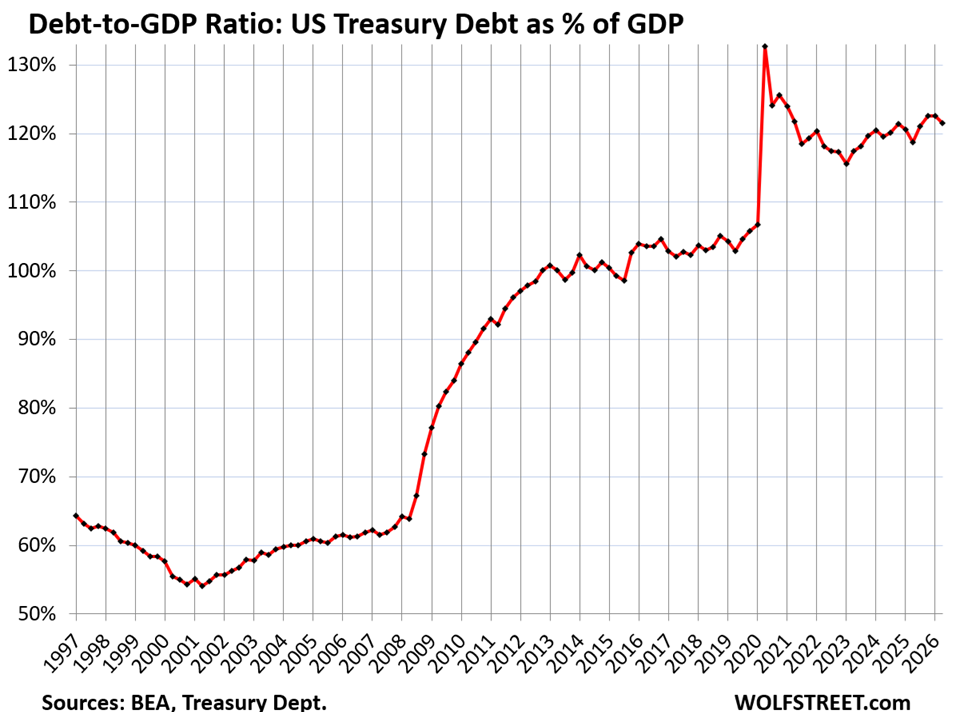
The ugly Treasury-Debt-to-GDP ratio ticked down to 121.5% in Q2, as current-dollar GDP (not adjusted for inflation) rose by 1.9% quarter-to-quarter to $32.5 trillion, while the Treasury debt (also not adjusted for inflation) rose by 1.0% quarter-to-quarter to $39.5 trillion.
So in Q2, the economy grew faster than the debt, and the Debt-to-GDP Ratio dipped a little. That’s part of the concept of controlling the debt fiasco by “letting the economy run hot,” meaning higher inflation and higher nominal economic growth would exceed the growth of the debt and over time bring down the burden of the debt, even as the size of the debt would keep growing.
The Fed seems to be on board with it de facto, despite its verbiage to the contrary: It cut rates with inflation still high in the fall of 2024 and it cut rates again with inflation high and accelerating in the fall of 2025.

Given that Congress will not address the deficit, doesn’t even care about the deficit, and if anything, keeps talking about making the deficit worse through additional spending (the war in Iran) and additional tax cuts, well then, higher inflation and higher nominal economic growth may be the only solution in sight for Bessent and Warsh.
The bond market, however, is not enamored with these policies.
Beyond the quarter-to-quarter squiggles though, the trend is still higher. During the lockdown in Q2 2020, GDP collapsed while the debt exploded, and the ratio spiked to the moon. GDP then bounced off, while the growth of the debt slowed from the explosive pace to a still very fast pace, and the ratio backed off through 2022. This phase is not indicative of a trend. The new trend starts in 2022.
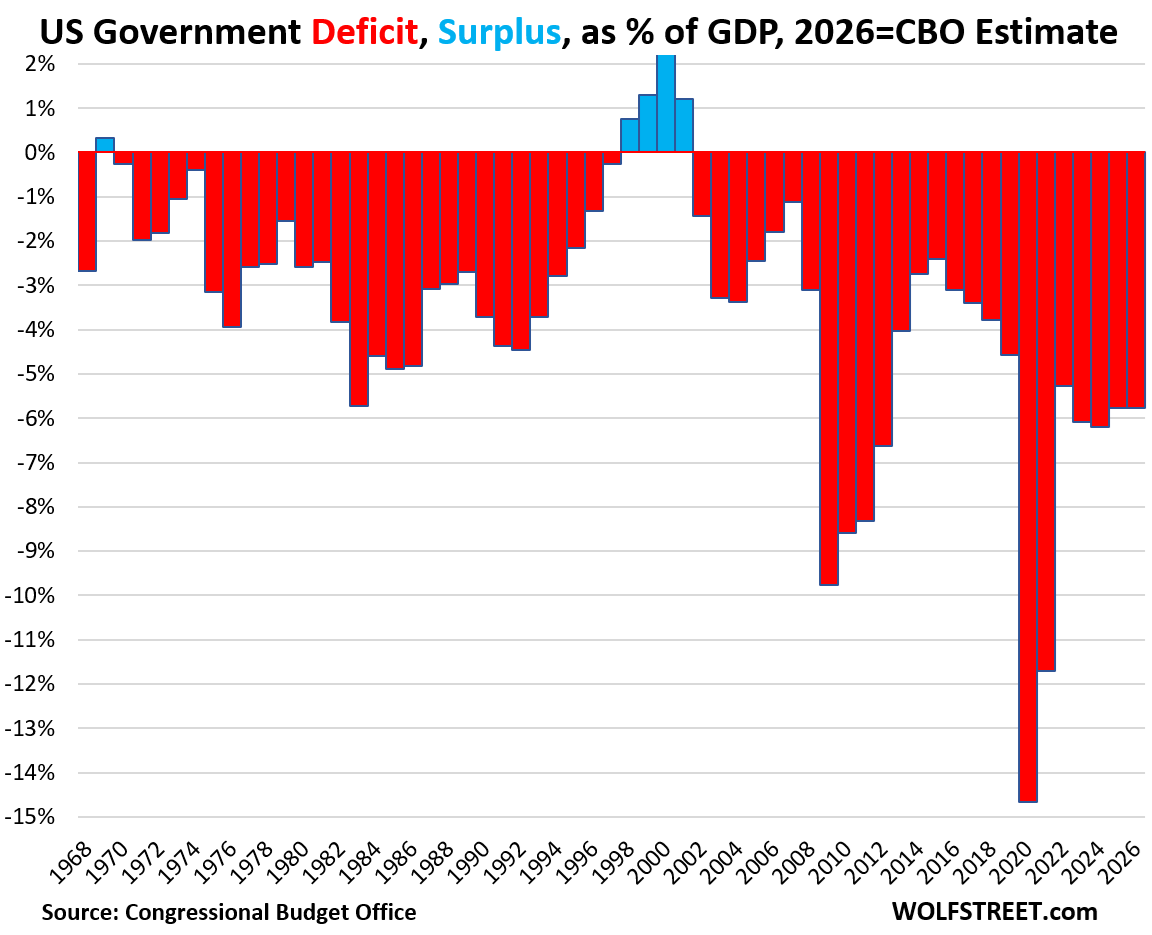
The recklessness in Congress is the driving force behind this ugly mess. The drunken sailors in Washington have been throwing money willy-nilly left and right while cutting taxes. In the four years of fiscal 2022 through 2025, the deficit hovered relentlessly at around 6% of GDP, despite above-average economic growth. For fiscal 2026, the Congressional Budget Office projects it to be in the same dismal range.
In case you missed it: Inflation Exacts its Pound of Flesh: How Americans Earned their Income from All Sources except Capital Gains
Enjoy reading WOLF STREET and want to support it? You can donate. I appreciate it immensely. Click on the mug to find out how:


Which Hocus-Pocus are we up to now? Number four?
HP-Infinity? I guess Treasury is going to have to pull a whole lot of rabbits out of hats because, yeah, Congress isn’t incentivized to deflate this balloon.
I also can’t help but notice that I haven’t gotten my tariff rebate check yet. Maybe it’s in the mail.
We are living in the weirdest possible timeline.
You didn’t pay a tariff unless you import goods.
That was toungue-in-cheek.
But I did pay the guy who paid the tariff when I bought the goods he imported. I guess I’ll have to buy stock in his company so that my rebate check gets magically transformed into a dividend check. Hocus Pocus!
Supposedly, COSTCO has committed to giving customers better deals on stuff we buy to return some of that tariff rebate to me & you.
Don’t hold your breath and don’t expect that price tag to tell you how much less you’re buying it for due to their tariff refunds.
That he was being facetious was lost on you. Of course consumers pay the cost of tariffs and should in equity receive recompense, however, to your point – that is not reality.
can we create NEW budget item
expected FRAUD PAYMENTS from govt
It’s quite clear to any accountant that importers pay the cost of tariffs.
As to whether or not an importer can pass tariff costs on to consumers via higher prices … that depends on the market clearing price: supply levels, and demand levels.
In the absence of imports, supply is low and prices are higher. Then if importers bring in more goods, the market price drops from the higher supply. In that case the tariff cost does NOT get passed to the consumer.
“In the absence of imports, supply is low and prices are higher. Then if importers bring in more goods, the market price drops from the higher supply. In that case the tariff cost does NOT get passed to the consumer.”
This is only true of commodities. The big three would love to meet the entire demand for cars in the US, and they certainly could. Thing is they aren’t going to be willing to produce Toyota Camrys under a monopolist regime. The primary thing that tariffs do is reduce competition, which is what harms consumers.
Look at Waymo using Chinese EVs to build out their fleet, despite the 215% tariff and the PR hit from buying Chinese. Because even with the penalty, the end-user value still outpaces domestic producers.
Yes disguising 2025 tariffs as 2026 corporate welfare was not on my bingo card.
You can argue the manner they were implemented or their short term benefits, but just when we were starting to see tariffs make a benefit towards the deficit, the judges decided the legality of implementation was more important than the acute matter of a ballooning debt that our next 2 generations cannot pay.
> the judges decided the legality of implementation was more important
If that weren’t the case, no one would invest in the USA.
The law is above everything else.
To fix the debt problem, the US should simply spend less and stop pushing up oil prices by creating instability in the Middle East.
“The law is above everything else.”
Seriously? Then I read your moniker. Now it all makes sense.
*Newsflash* The Middle East has never been stable. Has 911 been all but forgotten by the Trump bashers?
WTC 7.
Agreed, we should blame the courts for this situation. Sure their job is upholding the law, but in this situation they should have ignored their responsibilities and agreed with the presidential decrees of our wise leader. The president unfortunately does not have a party at his back with a majority in both the senate and the house that could pass new legislation.
Oh well, at least in the Big Beautiful Bill that they did pass they left the federal corporate tax rates intact so that corporations and foreign shareholders are still paying a fair share of the profits they make in the U.S. even when the temporary tariffs are not bringing in as much as was promised.
Stupid judges. Those leftist treehuggers just don’t have our best interests at heart.
/s
Jorg:
I hope your comment was sarcasm that I missed.
It wouldn’t have mattered anyway based on the president’s 2027 bloated budget.
It’s a Republican Congress. Why exactly can’t the admin do anything other than via reversible executive action?
Real GDP 1.5% for Q2.
But Gross Domestic Product: Implicit Price Deflator (A191RI1Q225SBEA) @Q2 2026: 6.4%
Gross Domestic Product (A191RP1Q027SBEA) @Q2 2026 8%
That looks like stagflation, business stagnation accompanied by inflation.
The ratio of demand deposits to time deposits is still rising, bolstering GDP.
The bond proxy, the 24-month moving average of the 24-month rate-of-change in monetary flows, the volume and velocity of money, won’t peak until early 2028. I.e. the interest expense on the Federal Debt should keep increasing.
I get the interest payments to GDP are meaningful in themselves but I always feel like they miss context.
For example in 2007-09 there was the popping of a real estate bubble that directly and meaningfully affected lots of Americans. In 2020/2021 there was the fallout from a global pandemic that affected every single human being alive.
We can argue about the severity of each of those events and even debate the response and it’s effectiveness. However, what us inarguable is those were meaningful and significant events. Though the argument over government intervention is mildly debatable, at the very leasr it should be near unanimous that those were significant and reasonable reasons for the government to go into debt.
There were clear extenuating circumstances. For better or worse, it was understandable. I understand giving a pass in thise circumstances.
Other than that, the fiscal record of federal spending is terrible. Right now the economy is doing at least OK. It isn’t in crisis. In any sane world, that would mean the U.S. is carefully watching spending and starting to save for a rainy day. At the very least, they should be holding budgets steady letting natural GDP growth make the spending look more and more reasonable.
Instead, we are looking at spending like drunken sailors. We want to significantly increase military spending despite spending way more than anyone else in the world.
The people who voted for this deserve exactly what they are going to get.
Everything you argue here is contestable. Just start with a tally of the dead – should be easy to examine their heads if you have a shovel.
5 years after the fact, and you are posting this? I note you give no examples of the countries that handled COVID in the optimal fashion that you imagine? “Protect the vulnerable and let it burn through everyone else” is a brilliant strategy, except that you protect the vulnerable specifically by not letting COVID burn through everyone else. Assuming that you have looked at an excess mortality chart at some point over the last five years, where does the U.S. rank? As of January 2, 2023 the US had 392 excess deaths per 100K. Who was worse? Mexico (544) and Italy (466). Who was better? Greece (382), Brazil (380), India (374), Portugal (359), Spain (329), UK (306), Belgium (280), Germany (280), France (223), Sweden (178), Ireland (169), Canada (165), Japan (128), Australia (94), Taiwan (78), New Zealand (1). Figures from Our World in Data.
Focusing on the U.S. and the different approaches to COVID responses between red and blue states, more specifically between Republican and Democratic voters in Ohio and Florida: “the excess death rate among Republican voters was 43% higher than the excess death rate among Democratic voters” after vaccine eligibility was opened.” From: Excess Death Rates for Republican and Democratic Registered Voters in Florida and Ohio During the COVID-19 Pandemic, JAMA Intern Med, Published Online: July 24, 2023. This is relevant because Republicans were much less likely to mask, social distance and take up the vaccination.
One wonders what you mean by “fared far better”. Clearly you are not referring to deaths as your measure. Why not be more specific and write: it is perfectly fine to sacrifice the old and immuno-compromised so long as the economy I enjoy keeps chugging along.
“The people who voted for this deserve exactly what they are going to get.”
Yup. Can’t argue that point. It’s pretty much all of us. Voters have never mustered significant unity to motivate gov’t to manage spending (entitlements, bailouts, etc.) responsibly.
– Nixon “temporarily” dropping Gold Standard for fiat currency with no controls set the inflation rabbit off and running
– Greenspan/Bernanke/Yellen/Powell basically moving FR into position of funding excessive fed gov’t spending (i.e., money printing) and guarantor of risk reduction for gov’t and private enterprises (e.g., banks and deposit holders regardless of $250K ceiling – e.g., SVB)
– Interest on the Fed debt now over 100% of annual GDP/$40 trillion pretty much trapping FR into continual bond purchases (unless, we shall see, Warsh decides and achieves backing to let bond markets move to true market rate “discovery”
– Global central banks moving away from treasuries/dollar while increasing gold inventories
– Many market investors (e.g., many of our friends) focusing too much on nominal dollars and not real dollars
– Will accelerated GDP growth overtake debt calamity? Doesn’t look like the will is in place to do that. The country appears to want to solve its problems the hard way.
There is growing conversation on the I-Net backwaters of an impending “reset” (dollar devaluation) next 3-5 years. That one, if substantive, is gonna shake the tree in major ways.
Dem, Repub, Prog, Marxist (whatever political grouping) – they have all failed.
The resolution is not going to be pretty.
> “Interest on the Fed debt now over 100% of annual GDP/$40 trillion”
What? No it isn’t.
Not to highlight any political preference but the one area this admin has been good is reducing our “global defense” support.
That said, the made up for it with a war and the rhetoric on how they sell that shift is so so so poor
How do you figure? The official defense budget has actually increased, plus we’ve added a bunch of unofficial defense spending on our several wars. We’ve cut foreign aid, causing millions of deaths, but that’s not defense, plus it was already a tiny fraction of the defense budget and that was totally swamped by those other increases.
The drop in revenue via OBBB is far larger than any increases in spending. As everyone knows, almost all Federal spending is dictated by statute–SS & Medicare spending are the easiest thing to predict in the world. Trump said DOGE was a huge success, so where is all this fat to cut?
DOGE claimed to have saved $215 billion. This would be a grand total of 0.7% of GDP, if it were true, but it’s not. Most of the claims were false or exaggerated, it didn’t take into account the cost of the program or the waste generated by the chaos they sowed, and the IRS cuts probably cost us much more than that.
So we killed a few million people worldwide to lose more money. Great job, DOGE.
Social Security is NOT part of the budget. It is self-funded. And it doesn’t impact the deficit. Congress can shut down SS entirely, and it won’t reduce the deficit by one cent.
Social Security is absolutely part of the budget, though it doesn’t go through the appropriations process.
From Brookings, one of many sources:
“In 2026, Social Security will collect $1,442 billion in payroll and related taxes and spend $1,672 billion on benefits and administration. That cash shortfall of $230 billion, plus $20 billion in interest costs on Social Security’s accumulated past shortfalls, increases this year’s federal deficit by $250 billion.”
That’s from an opinion piece. I went to it and read it. It’s manipulative BS, especially the lies about what is in the Trust Fund. But it’s easy to find on the internet because AI search brings it to the top. AI is polluting everyone’s brain.
The text below is from the Social Security Administration. It’s from a technical document about the history of SS’s accounting treatment. So it’s a little harder to read than that opinion piece.
https://www.ssa.gov/history/BudgetTreatment.html
“One sub-part of OBRA 1990 was called the Budget Enforcement Act (BEA), and it was this sub-part that specified this change in the law.
The BEA budget treatment of Social Security basically remains the law to the present day. Specifically, present law mandates that the two Social Security Trust Funds, and the operations of the Postal Service, are formally considered to be “off-budget” and no longer part of the unified federal budget. (The Medicare Trust Funds, by contrast, are once again part of the unified budget.) So where matters stand presently is that the transactions to the Social Security Trust Funds and the operations of the Postal Service are “off-budget” and everything else is “on-budget.”
However, those involved in budget matters often produce two sets of numbers, one without Social Security included in the budget totals and one with Social Security included. Thus, Social Security is still frequently treated as though it were part of the unified federal budget even though, technically, it no longer is.”
Debt to GDP is high, but stable. All this sudden panic is for nothing IMO.
In two years, we’ll be importing cheap foreign labor again. The labor market will unfreeze and most of these problems will go away.
The only way out of the debt problem is a significant increase in inflation to younger generations. Just another example of how the government chooses to give benefits to the old at the expense of the young. The situation is irresponsible and definitely not stable.
“the government chooses to give benefits to the old at the expense of the young.”
True but let’s acknowledge the full story – give benefits to the 1% at the expense of the REST.”
Even more general; the oligarchs OWN “the government” via K-street. As a result, these people/companies have the bad decisions rewarded (bailouts) while good decisions and good behavior is punished.
Why in the hell was goldman sachs rewarded after creating and profiting from mortgage backed securities? In a true capitalist system, they, and many other companies, should have gone bankrupt and had their assets sold to pay creditors/depositors. The stockholders and owners should have been made to pound sand. Instead, we made these criminals a primary dealer bank and rewarded them with even more billions (TARP and TALF)!!!!!
America is now quickly arriving at the oligarchy that the former Soviet Union found itself in during the late 80’s!
Hedge accordingly.
Yes you are correct, but class can’t be discussed in USofA. To keep that from happening, we see young vs old, right vs left, straight vs non straight, R vs D (even when most folks are neither R nor D)whatever can be discussed to avoid class will be discussed. It is just not proper to discuss class in USofA.
Ya, lets blame the boomers again. For the last 44 years the generations that have followed the boomers have been voting in this fiscal mess. Everyone has skin in the losing game. Give it a rest.
Baby boomers have been the largest share of the voting electorate for decades. Millennials are set to outgrown them 25% vs 24% only in 2032.
> “The only way out of the debt problem is a significant increase in inflation to younger generations.”
No, that is not the only way out.
Yes inflation as far as the eye can see wait till the deportation of all those “criminals”. Hits 10 lattee anyone
The word government means SPEND. They spend on their friend’s projects, and their friend’s pay them to get elected.
If you want to slow the spending than fire the entire government if the national budget does not balance. Then call a national election, and try again.
Otherwise, buy an inflation sensitive asset and hang in until you need the money.
I didn’t realize social security, Medicare and the military were politicians’ and their friends’ special projects.
Medicare and military definitely are. The friends are the MIC and the medical industry/health care corps lobby.
I am not debating the merits of tariffs, but strongly urging people to realize that subsidies cost consumers as well.
It is estimated that the IRA, infrastructure law, and CHIPS Act from a few years back could cost upwards of $2.0T when all is said and done.
These add to the debt; they distort price discovery and cause borrowing.
While not as obvious as tariffs on your pocketbook, they do have costs associated with them that lead to inflation.
i find it interesting that not one person in these comments has suggested that maybe we should pay more taxes even though the average rate of federal and state taxation is one of the lowest rates in the world among developed countries. (I shall now wait for the flames of righteous anger).
Maybe we should pay more taxes.
Well, come to think of us, maybe someone else should pay more taxes. Like the wealthy. If they paid their share (i.e., if all the tax breaks that make it so they pay very little were abolished), I’d happily pay more, too.
It’s fine with me to have the wealthy pay more taxes, but i am guessing that most of the people reading this newsletter are seniors who pay single digit average income tax rates.
The readership of this site skews higher-income with considerable assets, average age is somewhere in the 40s. Many of them work in finance and real estate. Many own their own companies, including manufacturing companies, distribution companies, financial advisory firms, etc. Quite a few work on Wall Street. So I suspect they’re in a fairly high tax bracket and do what they can to reduce their taxes.
Of the many hundreds of thousands of readers on this site every month, only a minuscule number posts comments. Comments are their own world. Don’t let the comments mislead you about who reads this site.
Income tax should be 0%. That’s how it was until the 16th amendment. I’m tired of government spending. It should be a tenth of its current value.
100% of the Senate and 96% of the House voted to send the 16th Amendment to the states. It was ratified by 42 states, with 36 being needed for ratification at the time. Seems like it was pretty popular. I wonder how many congressmen, and which states, would vote to repeal it today.
Planning on paying for a giant defense budget with excise taxes?
The USA wasn’t the world’s policeman before the 16th Amendment, but it most definitely is now.
@mitchv,
I agree with you.
Ha
Debt to GDP would be half what it is today if not for the Bush and Trump tax cuts, the cast majority of which went to the upper class. Everyone focuses on the spending half of the budget situation but no one cares about the revenue part.
ah but look at the outsized growth we got from the cuts! not.
Show us the math in the context of overall gov’t spending through the last four decades. The critical forces in all of this have been out of control federal spending (discretionary and entitlement) and Fed Reserve mismanagement of monetary policy. The prepondernace of which, the data shows, inordinately benefitted the upper class.
Federal revenues were averaging 18% of US GDP for the 20 years prior to the Bush tax cuts of 2001. Since those tax cuts went into effect, they have been averaging 16%. That 2% of US GDP every year for 25 years adds up to quite a bit.
Using simple math, that added 50% of GDP to our debt, which is now currently at 120%. The real math is more complicated, but it doesn’t change the result much.
And on the spending side, we see almost exactly the same thing: spending is about 2% of GDP higher over the last 25 years than the previous 25 years.
So overall almost exactly half of the increase in debt is due to increased spending, and half is due to decreased revenue.
The other big effect is aging of the population. A big cohort (boomers) living much longer earning SS checks for longer and getting Medicare for longer.
There is a reason basically every developed country is in a very similar fiscal situation and it’s not that politicians are equally profligate crooks or they have equally inept monetary controllers.
Indeed, Social Security and Medicare is where all of the 2% increase in spending is going. Everything else is completely flat as a percent of GDP.
So we gave the top 10% tax cuts that reduced income by 2%. Our expenditures increased by 2% due to our promise to support an aging population. This is the entire story of our national debt.
Social Security is NOT part of the budget. It is self-funded. And it doesn’t impact the deficit. Congress can shut down SS entirely, the whole thing, and it will not impact the deficit.
Whether US Federal taxes are high enough is debatable, but our highly progressive tax system allows about 40% to have no Federal Income tax liability.
Given that, it is pretty difficult to cut taxes for the 40% who owe none.
We have the least progressive tax structure of any developed country I’m aware of and definitely have more “loopholes” to avoid taxes for the well off (401k, lower rates on capital gains).
Not saying that’s necessarily bad and that it isn’t part of what drives our aggregate economic growth, but it’s important to benchmark vs peers.
Japan Spends Record $98.7 Billion to Prop Up Yen…
MW: Markets now view a September interest-rate hike as likely following Warsh’s speech
As yield goes up our debt crisis gets worse! We have demographics creating a cliff with more people signing up for Medicare and social security and fewer people behind us working and paying in. It’s not going to get better, instead of deporting millions on immigrants we should have gave them the option to pay 2.5x the Medicare and social security tax rate to stay, to be able to buy in to American Citizenship over time. It’s just a matter of time where the untouchable entitlements will get a big ax! 6% long bond yield will be followed by 7%. Ugly scenarios no politician wants to talk about until the bond market forces the conversation.
1. I have news for you: If Congress abolishes Social Security — the biggest of the “entitlements” — then the budget deficit would remain the same as now. Why? Because SS is self-funded and both the contributions and the benefits are off-budget and do NOT impact the deficit 🤣
2. I get really tired of manipulative billionaires wanting to cut “entitlements” for the little people while they have the biggest entitlements of them all, the deductibility of “charitable contributions,” including in-kind contributions of stock that they never even paid capital gains taxes on. The whole thing is a scandal. If billionaires want to be philanthropists, let them be that out of the goodness of their hearts, not to dodge taxes.
3. Before you talk about cutting “entitlements,” you need to emerge from your fog about entitlements; at least read the article, which would help you accomplish that.
I believe their is bigger % deficit in self funded social security than the % deficit of the federal government, 2032 it gets ugly from what I read. We need to raise revenue and cut spending. How would you reduce the deficit? Instead of selling golden passport to rich foreigners let poor foreigners work for it was my suggestion you can charge them an higher federal tax instead of social security and Medicare. My point was tax the immigrants more to let them stay!!!Out of the box suggestions for raising revenue.
Given that Congress isn’t addressing the deficit, shouldn’t they pass a law that expressly allows for the tariffs that are coming by executive decree? Rather than interpreting 50 year old laws in a way that kinda make it ok-ish to impose 50% tariffs at will? Would be better for budgeting if constant court cases aren’t periodically reversing all the tariffs collected after the money has been spent.
Congress is fully in the pocket of Corporate America and the billionaire class, and both HATE tariffs, because that’s the one tax that they cannot dodge through globalization.
Robin Williams said we should have politicians wear jackets like NASCAR drivers, with patches to show who owns them.
It’s disrespectful to actual drunken sailors to refer to Congress as “drunken sailors in Washington”.
Actual drunken sailors face limits. They can only spend the money in their pocket or their bank account. They do not spend beyond their available means.
Congress, on the other hand, can spend to infinity. They have no limits; they either borrow or print up the money they want. They can trade for profit off their own decisions. They have no incentive to balance the budget. They are worse than reckless and far more drunk than any sailor!
I’m waiting for 2032 (or earlier) when the Social Security “trust fund” runs dry and Social Security benefits are cut by 20%. To prevent those cuts the congress will have to borrow 250 billion more per year, raise taxes, or let the cuts go forward.
2032 is less than 6 years ahead. Thats forever in political time so easy to ignore until after the next general election in 2028. So, I guess, I’m really waiting for 2028 when the debate might begin.
Fixing SS will get moved to the front burner before then. Several relatively minor tweaks combined would do it.
In a recession, the tax receipts go down and the government spending goes up while the debt interest payments remain the same (on the “old” debt). When that recession arrives, and it will, the GFC and COVID deficits will look like child’s play. The QE to the moon and bye bye US$ value.
Look SCOTUS helped the consumer. Yay
No, they helped big corporations.
The government should not be allowed to issue bonds, it should tax what it needs, some taxes immediate when needed, but the government taking money from those who could otherwise invest it into stocks is hurting the economy and creating a level of detachment between their reckless spending and our paychecks.
“but the government taking money from those who could otherwise invest it into stocks…
🤣❤️
1. The government is not “taking” – it’s offering these securities, and eager buyers are outbidding each other to buy them. And there’s big market where they’re traded, just like stocks.
2. According to your theory, the government should tax instead of selling bonds. Taxing = taking. So now people would be forced to give the government the money that eager bond buyers were offering to the government voluntarily. Bond purchases would be replaced by tax collections, and in aggregate, there would be no additional money left to buy stocks with.
3. But it was a fun thought while it lasted.
Wolf
I was scuttlebutting with a coworker when we spontaneously realize the concept that the government will pursue financial repression to solve our debt issue will run into trouble because of the huge amount of government programs that are inflation adjusted. I don’t know how much it compares to the 1950’s or 70’s. But SS and cost-plus contracts were two immediate concerns. Thoughts?
“Letting is run hot” is not financial repression. Letting it run hot means higher nominal economic growth, higher inflation (but not too high, maybe in the 3-5% range), and higher long-term interest rates. And it does work in reducing the burden of the debt.
Financial repression can only be done seriously by a central bank that can print money — not the government that cannot print money. Financial repression is what the US had from 2008 through 2022, and they had to stop when inflation was soaring. It is not helpful for the overall economy because everything gets distorted.
Thoughts? Don’t listen to garbage.
People need to wrap their brains around these issues:
1. YCC can ONLY be done with money printing, and the US government cannot engage in money printing. Only the Fed can. So the government CANNOT engage in YCC. And saying so is ignorant or manipulative BS.
2. The Bank of Japan did YCC until inflation broke out and the yen collapsed, which FORCED the BOJ to stop YCC and shift to the opposite: QT, and the BOJ has been doing QT ever since, and long-term yields have soared.
3. The US government cannot print money and cannot do yield curve control. All it can do is shift SOME issuance to short-term T-bills, and it has already been doing that since Yellen was Secretary of the Treasury, and that did not do anything for long-term yields and may not do anything for long-term yields in the future. Shifting issuance around is not “control.” It does NOT control long-term yields. It’s an effort to talk yields down a little.
4. YCC in an inflationary environment will cause massive inflation and crush the currency, and even Japan was forced to give up. But the government and the Fed may want to “let it run hot,” that means 3-5% inflation and hot nominal economic growth, and higher long-term interest rates. But that’s not 20% or 50% inflation, which would destroy the economy.
Wolf, probably a stupid question but I am not from the US so have a slight excuse. I assume all the above graphs are at the Federal level? Federal tax receipts and federal debt. The states will each have their own set of similar graphs? What state liabilities eventually become federal?
Yes, all at the federal level. States are different. All states except for Vermont have balanced-budget requirements and theoretically cannot borrow to fund operating deficits. They can borrow to fund capital expenditures, etc. but that usually requires the state legislature’s approval by vote. So state and municipal debt combined is relatively small and amounts to only $4.5 trillion, compared to the federal government’s $40 trillion.