
He stated what’s been clear to everyone but the Fed: amid too-high inflation, Financial Conditions are not “restrictive.”
By Wolf Richter for WOLF STREET.
Fed Chair Warsh stuck to his guns in his Jackson Hole speech and further crushed any remaining shards of forward guidance. It creates a “hall-of-mirrors problem,” where the markets rely on the Fed’s guidance, and the Fed relies on market prices for guidance, and “we are all more likely to be blinded to new developments, more likely to be caught unprepared for a turn of events, and more likely to commit errors in policymaking,” he said, a reference to the debacle in 2021 when the Fed, with rates at 0% and QE running at full tilt, refused to react to soaring inflation. And he added:
“Perversely, market participants are unlikely to bear the biggest costs of the hall-of-mirrors problem. The most serious harm is likely to befall those without financial assets. If the Fed gets inflation wrong and judges the economy wrong, who gets the worst of it? Not the financial high-fliers. Hard-working Americans are the ones left to deal with inflation that is too high or jobs that suddenly appear less secure.”
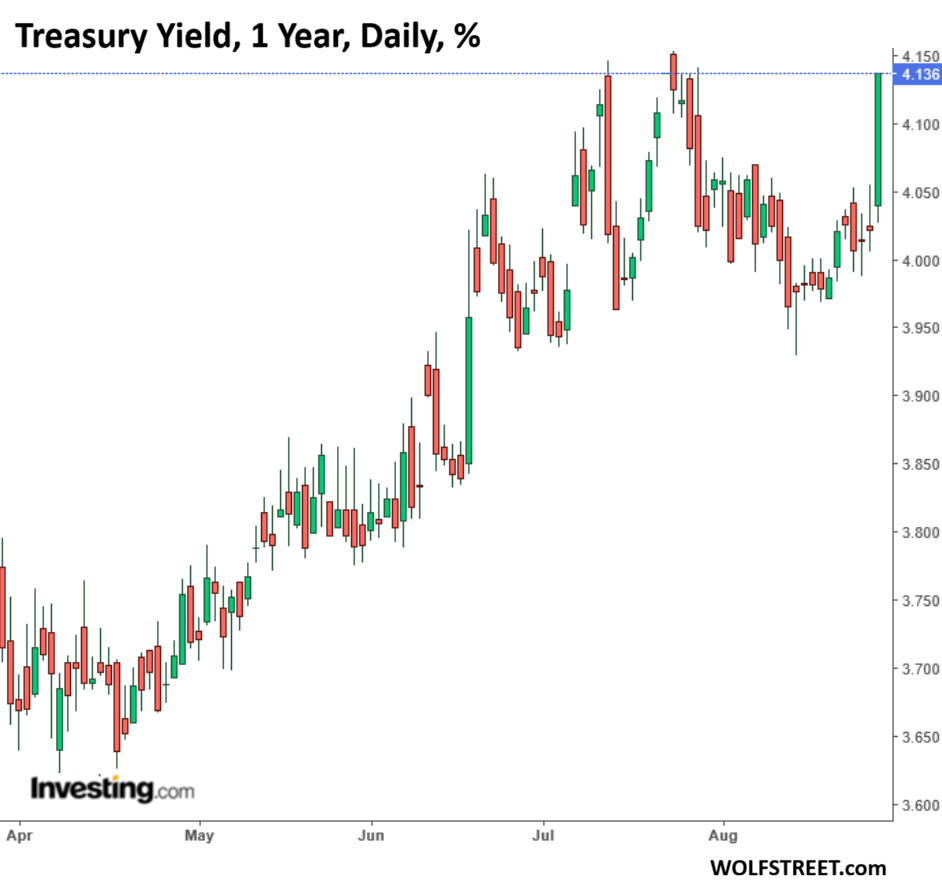
So forward guidance is dead. Markets have to figure it out on their own. And they did today, and they figured that inflation would get taken seriously, and Treasury yields jumped, with the 6-month yield spiking by 9 basis points, the 1-year and 2-year yields by over 11 basis points.
So forward guidance is still dead. But he did talk about the economy, about the boom in corporate investments in fixed assets and software, with over half of it linked to the AI infrastructure buildout. He talked about credit spreads on corporate bonds and leveraged loans being “near the low ends of their historical ranges,” while issuance volumes of these instruments “have been quite strong this year”; about how profits of the companies in the S&P 500 have ballooned, that profit margins were “quite elevated,” and that expectations for growth in cap-ex and corporate profits were “running quite high.”
“Banks tell us that standards for commercial and industrial loans are on the easier end of their historical range. That helps explain the growth we’ve seen this year in those loans. Credit and loan markets are showing few signs of policy restraint,” he said.
While housing and agriculture were struggling, he noted that “on balance, I would be hard pressed to describe broad financial conditions as restrictive.”
That’s a key issue. By raising interest rates, and thereby tightening monetary policy, the Fed tries to make financial conditions more “restrictive,” meaning that it costs more to borrow, and that it becomes more difficult to borrow, and that the spreads widen so that riskier debt, such as junk-rated debt, gets relatively more difficult and expensive to sell, compared to highly-rated corporate debt or Treasury securities.
And that financial conditions have been loosey-goosey, instead of restrictive, has been obvious for a long time in just about all measures that track financial conditions, including the Chicago Fed’s National Financial Conditions Index (NFCI), which has been bumping along the loosey-goosey bottom of its historic range, deeply in the negative, when positive values would denote restrictive financial conditions.
According to these measures, financial conditions have been ultra-loose, indicating that the Fed’s policy rates are far too low to create even balanced or neutral financial conditions.
Everyone could see that, except apparently the majority of the policy makers at the FOMC, which spent last fall patting each other on the back and cutting rates.

And Warsh went on: Consumer spending, adjusted for inflation, “has been healthy despite the shocks,” and the labor market is “quite stable,” with the relatively low turnover being “partly a result of the significant rematching between employers and employees that happened at scale in the post-pandemic environment.” And with the labor force “barely growing, monthly job gains are naturally going to run low.”
But then there’s inflation, where “the numbers are more concerning.” He cited the all-items PCE price index (+3.7% year-over-year, +4.1% six-month), and said that CPI was “also elevated,” and that “inflation remained too high.”
They all “tell a similar story: Inflation is running above our 2% target. So the Fed’s predominant focus right now should be on prices.” And the recent better-than-expected PCE and CPI readings “do not tell me that underlying trends have meaningfully improved.”
And he added: “We must be confident that underlying inflation is moving to our objective, clearly and at sufficient speed. Otherwise, we have work to do. That’s our job, our mandate, and our charge to keep.”
And he pointed out correctly and refreshingly: “There is one signal nobody can miss: The responsibility for 65 months of sustained, elevated inflation sits squarely with the central bank.” Are you listening, Powell?
So let’s see what the majority on the FOMC will decide. All policy decisions are made by a vote of 12 participants, and the majority decides. It’s Warsh’s job to build a majority for his point of view, but that might be tough. If he can’t, he’s just talking.
Enjoy reading WOLF STREET and want to support it? You can donate. I appreciate it immensely. Click on the mug to find out how:


So…not raise rates because his predecessor was bad with all that forward guidance?
Anyways, it’s still clear we won’t have a rate hike until December. The long duration bond market has the wheel.
Try making it to December first.
MW: Markets now view a September interest-rate hike as likely following Warsh’s speech
Incorrect. The Treasury Bill market has now priced in a high probability of a 0.25% Fed rate hike before December.
And possibly 0.5% increase (2 hikes) by the end of December.
Also: historically the bond market has failed to adequately anticipate rate increases. 2022 was a huge example but only one of many.
Fed has a poor track record. All words until they do something about it.
How is it “clear”?
I’m thinking that by delaying hikes
the Fed will be forced one day to
push rates higher than otherwise would have been needed. Can kicking
to the max.
Exactly this. A bunch of bullsh!t talk about how they plan on someday getting inflation down to their 2% target, how it’s too high right now, but they do ABSOLUTELY NOTHING. Scumbags.
That point has already been met. It will take more than a 1% rise in the prime rate to bring inflation down to 2%. And the point no one is talking is that the goal is to get it BELOW 2%.
The 3/4% cut that was Powell’s last was a major error and unforgiveable.
Powell will go down as the absolute worst FED chair in history. Smiling, talking about “transitory” and all kinds of “we are going to look through inflation” was gross dereliction of duty.
10 year back to where it was before the various Hocus-Poci took place. Warsh is the most hated man in the world according to Bessent.
Lots of talk this administration and the rich don’t want to hear. Intelligence world is pretty spooked with Russia as well. Iran issue is going nowhere. Window of opportunity for China/Taiwan and to a lesser extent; NK/SK, are opening.
I’m glad I have no debts and have downsized to be able to weather quite the severe storm. Maybe the party will keep going on. Who knows? Something something punch bowl…
What exactly would a structured way back to fiscal balance look like for this country? without ripping people’s faces off, or maybe just a few people’s faces. I don’t want to stop capitalism or innovation but capital gains taxes need a serious adjustment as well as the earned income cap on SS. It doesn’t have to start with drastic numbers or ideas. Term limits…we can just start with that.
Target 2% inflation.
Inflation 4%.
That’s like telling someone to order one car for you and they order you 2.
Order me 1 pizza, here’s 2! Now you pay!
Double the inflation baby! That’s our Fed.
The Federal Reserve does not control what prices companies charge.
But it can eventually sap demand in the economy by pushing up the cost of capital for borrowers of all kinds, making it more difficult and more expensive and for some impossible to borrow.
Consumers have some say on prices. Shop around. $100,000 trucks=ridiculous!
It’s crazy to me how many of these I see on the road. My wife and I gross well above the median household income for our metro area. I drive a 10 year old Mazda that I paid off sometime during trump’s first presidency. but everywhere I look on the road around me are GMC Denali HD trucks, F150s in Platinum trim, etc. Vehicles that I know for certain MSRP at 90-100k. Maybe I just am primed to look for them because I am shocked by it but
Right…?
One of the reasons trucks are $100,000 is because people keep paying that price.
Simple supply and demand.
Can’t really get that mad if you still pay for a completely loaded, all the frills, rig…. But people pay, and still get mad that they paid.
Haha… weird.
Speaking of “debacles”:
His Avatar should be giving these talks and updates from an AI generated Jackson Hole background to the other participants digital avatars. Let them also live in the world they’re building for us all.
The local events people in WY and all the hotels and what not need to be aware of what these people are facilitating and be ready for it. And the state of WY should demand its likeness be compensated.
This boom of nonsense they’re inflicting on us now will go down as the one of the greats in American capitalist debacles since who knows when.
The mighty dollar gave the Yen a hard kick in the Yen-ierre today and is back above 160. The financial Kraken have been unleashed
I don’t get the whole yen $ concern, can anyone explain it to me?
A yen intervention by Japan can cause Japan to dump US Bonds to stabilize the Yen but the Bond sales cause rates to spike higher in the US Bond market which could trigger a market crash, etc.
Wolf can explain it much better detail than I can.
Thank you!
@Waiono
I think your description is good.
China used to be #1 foreign sovereign treasury holder, and has reduced its US debt holding by about 50% from peak. Somehow people ignore that, but act like it would be a catastrophe if Japan did the same.
The US deficit in 2026 is already $1.8t, and Japan holds about $1.2t debt. I.e., Japans -entire- holdings (gathered and jeld over decades) are less than 8 months of new debt issuance.
If the US government had fulfilled even half its 2024 promises to “Cut the Biden / Harris deficit by at least $2 trillion!” then Japan could have sold all of its US debt while still leaving debt markets hungry for more.
It appears that the administration is doing a great sleight-of-hand, getting media to lay blame for rising treasury rates at entirely at the doorstep of a peripheral actor in the saga.
Japan Spends Record $98.7 Billion to Prop Up Yen…
SPENT with a T. That was the big kahuna joint US-Japan hocus-pocus show on Friday July 31, with rumors and announcements following at the beginning of August. Japan just now announced the amount it “spent.”
https://wolfstreet.com/2026/08/03/why-the-us-japan-joint-intervention-to-prop-up-the-yen-fear-of-treasury-yields-blowing-out-if-japan-becomes-a-forced-seller/
If you ask Japan nicely will they give you a free vacation?
Lol
Wolf,
A commitment without a timetable or deadline is meaningless. “Target is 2%”. OK, by WHEN? (End 2027, 2028, 2030…2050?). I’m surprised NOBODY has pressed for an answer to that question.
…and so we keep pretending the emperor has clothes.
Correct me please if I’m wrong!
It takes a long time to get inflation back into the bottle. Volcker found out the hard way. When he left office in Aug 1987, after 8 years as Fed chair, and despite triggering the worst recession and unemployment crisis since the Great Depression, CPI inflation was still over 4%, higher than today.
And he didn’t have to deal with $40T in debt. That’s the elephant, gorilla, king kong, and godzilla for that matter all rolled up into one gargantuan rates can’t go meaningfully higher without the Fed buying new debt via QE pickle. The only question is when does when does meaningful yield control start?
Interest expense crossed $1.2T in the last 12 months.
They cowboys have not been at 2% for 65 straight months!!
This is an underappreciated part of the social spending that occurred during the pandemic: millions of people were able to switch into new jobs that provide a better fit for both employee and employer.
“the relatively low turnover being “partly a result of the significant rematching between employers and employees that happened at scale in the post-pandemic environment.”
I have not seen this point made in any of the articles pontificating about the current job market dynamic of low hires and low fires.
I also wonder if it’s because no one who’s 100% remote wants to quit, this leaving a lot of desirable roles filled.
Though I’ve not been “…pontificating about the current job market dynamic of low hires and low fires,” I have made Warsh’s point many times, for at least a couple of years. For example here, in the conclusion at the bottom:
https://wolfstreet.com/2026/03/31/stasis-in-the-us-labor-market-a-peculiar-situation/
“Turnover in the labor force had exploded in 2021 and 2022 during the labor shortages. A lot of churn like that in the labor market is expensive and inefficient for employers. But it resulted in a reshuffling of the labor force, with more people switching to jobs and industries that were better fits for their aspirations, and who were better fits for their employers, which allowed for the churn to calm down in this peculiar way.“
He has to balance the reality of politics with image. Whether the Fed is truly independent is subjective but all Fed decisions have both economic and political impacts. If inflation stays as is the Fed can get away with no rate hikes until after midterms otherwise image issues. The real problem in my mind is there are zero solutions that aren’t painful for some portion of they economy. Not even sure lending being more restrictive, especially like 25 basis points, will have any impact. Even if some of the items disappear like Strait of Hormuz or trade war with Canada, or Economic Outcast results in just being empty words, I don’t think it really changes anything. Sure, $70 a barrel of gasoline would help but that would imply things were rosy prior to war of aggression against Iran.
It is okay not to raise rates if Warsh can get majority support to lower the obese balance sheet. Doesn’t look very likely right now.
Did I hear a different speech? To me it sounded like we get a hike in September
Indeed.
Like Wolf said, he still has to convince a majority to vote that way. At the very least, what he is saying publicly is giving them political cover to go that way.
I still see cuts coming. The task force is going to change the data, because the only way out of the national debt is inflation. They will say that the growth is the reason for inflation, and regular folks are only seeing impacts to gas and food (temporary). This is what Trump and Miran have both said recently. Warsh is just trying to maintain credibility until the “refined” data arrives.
I hope you are wrong about cuts coming. If something breaks, well, okay, but not just to pump markets.
Go watch Warsh’s speech. He says that they don’t have good data as well as there is room for more perspectives. There’s over 2 minutes dedicated to it. Some see this as no forward guidance, but what he is really doing is setting the stage to say the data is wrong and to create a political mess for the rest of the committee if they don’t go along. They are doing exactly what they said they would so far.
Every single move is to pump markets and asset price bubbles. That’s their entire goal. And I do not expect it to ever end in our lifetimes. The US was taken over buy wealthy corporations and billionaires.
JFMcNamara,
Austerity measures in another one. People in the US don’t think it could happen here like it does almost everywhere else.
I think there is a path to cuts but not for your reasons. Load new debt on the short end with mildy restrictive rates, slash em and dump the longer end there…. Take the demand for yield out of the long end with a buyer that doesn’t care about inflation buying a US NFT where the fed can also destroy rates….
Thank you for this, Wolf.
Even if Warsh doesn’t manage to get the rest of the Committee on board, maybe it’s good that he at least got the narrative back to the forgotten theme of… admitting reality?
After closely watching the post-2020 “transitory” inflation debacle, I do not understand why small, gradual hikes aren’t happening already. The Fed could then monitor the impact of those on the labor market and inflation, and adjust course accordingly (yes, even if there’s some delay). Isn’t that better than the current situation, with such a low unemployment rate?
That’s of course assuming the FOMC is actually mostly independent from the rest of the government, which attempts to inflate the debt down… (with or without increasing taxes and/or reducing spending).
What good would the Federal Reserve increasing any of its 5 ultra-short term interest rates do?
It would increase the rates in the $6-trillion-a-day repo market, where much of the Wall-Street borrowing occurs.
The Fed can influence the cost of credit.
I’m all for Wall Street borrowing getting a lot more expensive.
IMHO, I’d love see Warsh do a 75 BP bazooka shot.
This is the important point here Wolf. The Fed luvs inflation. Why? Because it allows companies to repay debt with cheaper dollars from the inflat6ed prices on goods they sell consumers, who, as usual, are left holding the bag.
Have we heard of many corporations crying the blues for the past few years? NADA!
Right? One hike isn’t going to substantially move markets, they could hike and monitor and then adjust up or down which is basically their job. At 4.1% unemployment the job market is stable. Until it crosses 5% they should focus on inflation.
yeah, I’ve thought the same thing many times. People act like a 25 basis point hike will trigger the economic armageddon or something, when we just live thru 500 basis points of hikes followed by some cuts, and nothing really changed from the macro point of view other than a slowing of inflation. Sure, some folks who are over levered and playing with a lot of short term debt will squeal, but those folks squeal endlessly until they have zirp so they should be ignored.
The following comment from Warsh sounds like a comment on this board, maybe even from someone like Depth Charge (but without the expletives). I take that as a positive sign from this new Fed chair:
“There is one signal nobody can miss: The responsibility for 65 months of sustained, elevated inflation sits squarely with the central bank.”
Agree. That sounded to me like Truman’s “The buck stops here.”
“He’s just talking” … exactly. Producing cover for his accommodation of continued massive government deficit spending. How else is Trump going to be able to afford his new battleship?
I found everything Warsh said, as a whole, to be wishy-washy and contradictory. He needs to be clearer, such as, “it is my job to do everything in my power to move the FOMC to more restrictive financial conditions, which will ultimately be conducive to long term growth.” What i heard instead was, “we can’t predict the future, but the overarching *trends* are in our favor (discounting *current* PCE levels), so we will wait and see before acting.” Someone needs to let Warsh know that, “perfect is the enemy of good”. ” Wait and see”, and “not enough information to make a decision yet” is for perfectionists, not do-ers. Rates clearly should have been hiked a quarter point at the last meeting, as telegraphed by the 2-yr Treasury yield, and over 5 years of PCE numbers. If that wasn’t enough to make a “right now” decision at the last FOMC meeting, then I don’t know whatever will be enough.
“He needs to be clearer…”
You 100% misunderstand what it means to end forward guidance.
You want forward guidance. The markets want forward guidance. From 2008 through 2025, the Fed had provided forward guidance; it was one of its policy tools. It has caused a huge amount of damage, as I pointed out. Warsh has sworn up and down that he would end forward guidance. And he has stuck to it, and you’re frustrated, and the markets are frustrated, but that’s what it means.
Exactly. We should expect FED rates to follow the market from now on, not the other way around.
Warsh understands the precarity of his position in this political climate and wants / needs the market to pull the chestnuts out of the fire for him. He’s taking away part of washingtons ability to permanently ruin the Dollar by returning the responsibility of the yield back to it’s rightful owners: the bond market. Good on him.
And I don’t think the market is really that frustrated. The market is finally getting the yield that better fits the risks they’ve been taking. Sure it’s not fun for the holders that bought when rates were historically low. But then again, that was their risk to carry.
My biggest complaint was Warzh’s failure to act at the last FOMC meeting, in direct contradiction to everything that was coming out of his mouth. I get that he is only one vote, but he would have had a lot of internal support if he were truly adamant in his position. His actions contradicting his words strike me that he is more of a willow in the wind rather than a man with a plan.
See my friend that’s called Co Co Corruption, ya hear?
Have you been around here since the last inauguration?
And you are surprised?
People are actively cutting our country to pieces and stuffing it into thief sacks.
Reserves are balances used to settle payments, meet liquidity requirements (Level 1 HQLA), and transmit monetary policy (via IORB and the fed funds corridor).
Warsh is still operating with an ample-reserve’s regime. Reserves aren’t binding. Reserves aren’t scarce. Reserves are above the lowest comfortable level of reserves (LCLoR):
“The lowest dollar level of reserves a bank would feel comfortable holding before taking actions to maintain or increase its reserve balances.”
Reserves serve as a buffer in the Treasury’s debt-management auctions. Temporary support measures may be necessary to maintain “orderly” conditions in the government-securities market.
Reserve balances with Federal Reserve Banks on the H.4.1 release have fallen by 301,044b since July 3, 2025. Inflation has increased in the interim. But that is not a harbinger of future inflation rates.
The shift from time deposits to demand deposits may not be over however a large proportion of those demand deposits have low turnover rates. And the 10-month rate-of-change in monetary flows, the volume and velocity of means-of-payment money, is falling rapidly.
spencer,
As a non-economist, non-finance guy, what practical advice should I take from this? To this simple caveman, “the 10-month rate-of-change in monetary flows, the volume and velocity of means-of-payment money, is falling rapidly” sounds deflationary. Is it?
There are 3 “hawks” out of the 12 members of the FOMC with voting rights this year: Logan, Schmid, and Hammack. I think all 3 will vote for a quarter point hike in September.
Warsh, for all his tough talk, * might * tip to the rate hike side if there is already a 6 vote majority lined up.
But I don’t know where votes 4, 5, and 6 are going to come from. Everyone else on the committee besides KevWar himself are the same people who were cutting rates this time last year, under similar economic conditions.
So I think the FFR futures market is a bit premature in calling for a 59.5% probability of a rate hike. I think the hawkish side will pick up one or two votes and that won’t be enough.
And for all KevWar’s tough talk at Jackson Hole, it will be the 3rd time he convinced people he was an inflation hawk, failed to round up the support, and then voted against rate hikes.
I like Warsh. At least he doesn’t pretend to know something he can’t.
It’s great to hear him discount the recent blips or noise in the incoming data that some folks take as a “here come the cuts” signal. Amazing how one report like cpi – its the “aha” when one outlier confirms a bias – that Warsh is rejecting.
The 4 most interesting points, IMO:
1) KevWar said that short term rates were the main policy tools, and that other tools (i.e. QE/QT) are only for emergency use “if ever”. So much for my theory that the Fed might try to restrain money supply growth through QT while holding rates steady. KevWar’s priority during his nomination of reducing the Fed’s balance sheet was not even mentioned. What ever happened to that? Was it just for political expediency?
2) KevWar said that he does not have a “reaction function” to guide the FOMC’s direction, “like a Taylor Rule” and emphasized human judgement and accountability. Ironically, he also ripped into the humans who were making policy in 2021 using human judgement and delaying policy tightening when the Taylor Rule was screaming to raise rates! Also ironically, the Federal Reserve’s own website describes a reaction function plan under Monetary Policy > Notes. The example says that if inflation reaches 3%, and the target is 2%, the Fed should raise rates by more than 1%. With PCE running at +3.7%, the lack of a reaction function and insistence on human judgment may be code for doing nothing. I think the doves on the FOMC know that the US needs inflation to run hot for a decade to keep the national debt from exploding, and not crashing the economy, despite the best efforts on the fiscal side, is their 3rd mandate.
3) Related to #2, KevWar said he did not see the Fed’s dual mandates as being tradeoffs. This is heresy among economists, and raises the question: If there is no employment downside to raising rates, then why hasn’t the FOMC done it already? I did not hear KevWar articulate an alternative theory of inflation, so I guess we chalk this up to populist politics: You can have it all! Low rates, full employment, high growth, and low inflation!
4) KevWar said that the eventual recommendations of his committees will have no bearing on the decisions coming up in the short term. So he’s addressing my critique that the committees are cover to not raise rates before the election. That doesn’t mean anything will or won’t happen, but it’s interesting.
Overall, it’s interesting how KevWar’s words can be interpreted by some people as hawkish and by others as dovish. He’s very general, only says agreeable things, and refuses to be pinned down by economists’ recommended “reaction functions”. He’s a populist politician, so we cannot trust our intuitions about the meaning of what he says. That means we better not place any big bets on his tone of voice or whatever.
I dont mean this in an insulting way but clearly you’ve never worked in politics. Warsh *can’t* just do these things by himself. He has to build a new consensus among a board that has been basically oriented 180 degrees in the other direction. The board members don’t give a F that he’s chair. They have their own independent reputations, and are appointed directly, not by him.
And during this time that he’s building this consensus, he can’t just go scorched earth, tell everyone what he would do if he had absolute control, and bad mouth the entire committee as a bunch of idiots. That’s not how you build a working committee.
Frankly, I’m even surprised he went so far as to say the last 5 years of inflation rests squarely with the Fed. Everyone knows that’s a shot at Powell, and more importantly, at the rest of this committee, people who have been there during those five years. It’s about the strongest statement you can say without burning bridges.
It is a very fine needle to thread, moving consensus on a committee that has been diametrically opposed to what you want to do, while not breaking it and making it incapable of functioning day to day because everyone hates each other. IMHO he has been threading this needle really, really well. Expecting that he’s going to change policy within a few months is unrealistic.
“Warsh *can’t* just do these things by himself. He has to build a new consensus among a board that has been basically oriented 180 degrees in the other direction.”
Thanks. I’ve told Chris B this many times — but not as eloquently as you. He refuses to listen and keeps posting the same stuff, essentially accusing Warsh of not being a dictator that can do whatever he wants. Chris B is naive about this and stuck in his ways.
I can 100% agree that the FOMC game of thrones is a game of political kiss-arse, and that there are coalitions, rivalries, reputations, interests, bad blood and all of that. I can imagine little smiles and winks and gossip and little scandals about who had lunch with whom. These are the idle rich, after all, and that’s what the idle rich do in every other circumstance (see state legislatures).
But that would be the problem with their leadership, and five years – soon to be six – of missed inflation targets would be the effect.
But WE can’t have it both ways. We can’t call Warsh this hero against inflation if he is working inside the system that delivered double the inflation target over the past several months. If he is good at it, he is absolutely the wrong person to demolish it.
WE cannot say Warsh “has been threading this needle very, very well” but then say Powell didn’t do the same very well even though the results of each FOMC chair might be years of well-above target inflation. Perhaps both were great at the politics of staying popular within the Fed, but will be seen as failures at controlling inflation. By one standard that’s a win, and by another it’s a failure. What’s our standard?
WE can’t say “the FOMC needs to or the FOMC should” if our highest expectation of the FOMC is to be a popularity contest, and if our highest expectation of its leaders is to give little nudges without pissing off the people with dynamite tempers and easily hurt feelers, regardless of how the dual mandate is going. If politics is all we expect, then the FOMC doesn’t have anything it “should” do because it’s just going to play political games. From our point of view and interests, the FOMC should be replaced by an algorithm.
Finally, what exactly is the leverage held by the members of the FOMC against each other? What leverage does the chair have?
By coordinating their votes, and agreeing to mainly communicate through the chair, and agreeing not to fight in public or take a stand on anything, the benefit FOMC members receive is not being a visible target of blame when they vote on the wrong side of history. For example, does anyone even remember the 11 members besides JPow who had voting rights during the mistaken unanimity of 2021? They all escaped blame. Who remembers anyone besides JPow who made the mistaken decision to cut rates in fall 2025? By moving as a herd they saved their reputations, but at the expense of making the wrong policy together.
I’ll say it again. KevWar is a populist politician. The naive thing, IMO is expecting the Fed to do what is “should” do instead of only taking action only when a sufficiently anonymizing herd can be mustered, and only doing that when things are really bad.
We talk about the “should” to draw a contrast against the “is”. In this way, we can get a sense of the FOMC’s biases, and better predict their moves. That’s not being naive about politics, it’s using the should to cast a light on the politics.
This FOMC is made up of people with a long record of voting as uber-doves, and a long record of failure on inflation. Their votes for rate hikes will have to be coordinated. In my book, KevWar doesn’t get complements until he can make arrangements that lead to the right things happening – particularly, full reversal of the 2025 rate cuts. So far, it seems the committee is leading him (See his dropping of the topic of reducing the Fed’s balance sheet. THEY shot him down on that.).
Good one L:
Only commenting to agree with Wolf’s that your comment is not only ”right arm” ,,, but right on target…
Thank you,,,
I guess it depends on whether or not you WANT to build a working committee, and be diplomatic, or just burn it down if you don’t get your way. Some years ago, I was brought on to a small private company to help restructure. It had an independent board, but they were full of morons. When I wanted to restructure some of our debt and thin headcount, the board pushed back. I forcefully accused them of bad faith and of being dishonest and said I would resign if they didn’t all leave the board. After that was done, I fired the CFO, who was a dishonest crook. After a year and a half or so, the business was mostly turned around, and I left.
I agree with you that Warsh is doing a great job if he wants to be a “leader” and build “consensus.” But that’s not the only way to govern. You can also accuse your naysayers of being self-dealing criminals and propagandize and go on the media and tell struggling Americans that they’re struggling because these rich assholes refuse to do the right thing. And if they don’t, you can always resign and say you weren’t allowed to do what you were brought on to do, and tell the people they can find someone else to clean up the mess that THEY made.
After seeing America decline for decades, I’m not convinced that “consensus,” “dealmaking” and being a “leader” is always the best way. I’m starting to see the benefits to a scorched earth approach where you use rhetoric and emotion to manipulate people who need to be manipulated to keep them out of the way. Trump’s willingness to do that is one reason I originally supported him back in 2016, but he hasn’t done so in pursuit of any positive goals this entire term.
The 30 Year treasury sold off on Warsh’s speech. If anyone believed him, it would have been bought. A 0.25 increase in the funds rate won’t do anything to stem inflation.
Who are these people kidding?
Themselves.
Mr. Wolf quotes Fed Chair Warsh: “If the Fed gets inflation wrong and judges the economy wrong, who gets the worst of it? Not the financial high-fliers. Hard-working Americans are the ones left to deal with inflation that is too high or jobs that suddenly appear less secure.”
Analysis: Mr. Warsh is simply giving his opinion of what will happen to the Proletariat; Mr. Warsh isn’t saying he is going to do anything about it.
In spite of some comments, the most definite ” losers ” from the vast and continuing debt and other manipulations ARE THE ELDERS” who have no other income than SS…
NO way elders are getting ”paid off” to screw the younger folx…
Yep. The Fed’s unspoken 3rd mandate is to deflect blame from the politicians who order the money printers to run and obtain political benefit from doing so.
KevWar is prioritizing this 3rd mandate because we will very soon be in a situation where the blame and fingerpointing will be going around. “If the Fed gets inflation wrong…” will become “the Fed got inflation wrong” and the politicians will be off the hook. That’s what all this useless non-economics rhetoric is about.
The bottom line; “According to these measures, financial conditions have been ultra-loose, indicating that the Fed’s policy rates are far too low to create even balanced or neutral financial conditions.”
Bias clearly higher rates.
Warsh will not do it. No change.
Warsh will buy time in concert with Bessent.
The real Operation twist coming. This will get us a few years. Unfortunately, Americans addicted to short solutions, not reality.
Debt will destroy US with 33 percent of tax revenue spent for interest. Yes I know Wolf, it’s been 50 before so don’t berate my ass. It’s a major problem and growing leave it at that. Frog in tea kettle.
Where are you getting 33% of US tax Revenue is spent on debt interest? And also 50%?
Where? Make an attempt to read the article just under the Warsh article 🤣
https://wolfstreet.com/2026/08/27/quarterly-update-on-the-ugly-fiscal-condition-of-the-us-in-q2-2026/
Here is the relevant picture from that article:
Nice start but not enough. The Fed cannot control inflation, nor can it control employment. The premise of a dual mandate is a farce.
In the 70s and early 80s at the height of the Arthur Burns mess cleaned up by Volcker, Business was still making investments based on the weighted cost of capital. If the deal earned the rate, you did the deal. The biggest whiners? Of course, stock and commodity traders.
The Fed once and for all needs to run off all the economic hocus- pocus and go back to its original mission, that is to open the discount window to solvent banks when needed. Not corporations, solvent banks. If a bank is not solvent, it should be put down.
The machinations used by the Fed for the past 45+ years has been the fiat of economists creating solutions to,look for problems. ZIRP and QE was the grand finale, stealing trillions from depositors and enriching the banks that led us into the 2007 mess.
The bond market needs to take the lead, period. No more Fed and now Treasury puts on stocks or debt.
If it looks like a hawk, squawks like a hawk, it’s a hawk.
Warsh is buddies with Drubkenmiller and they , like he said, want the markets to do some of the work.
“After leaving the Federal Reserve Board of Governors, Warsh became a partner at the Duquesne Family Office, the firm of Stanley Druckenmiller…”
Let the Bond Market Speak
Rising interest rates are a signal of trouble ahead. Artificially suppressing it heightens the danger.
By Stanley F. Druckenmiller, The Wall Street Journal,
Aug. 24, 2026
…
Unemployment is 4.1%, full employment by any definition. The deficit is running near 6% of gross domestic product, a number America has never before produced in peacetime at full employment. The national debt crossed $40 trillion the same week Treasury intervened. Net interest will exceed $1.1 trillion this fiscal year, more than the defense budget. The 10-year yield, even after the summer selloff, sits at or below the economy’s nominal growth rate. That means a borrower (federal government) running 6% deficits at full employment, with above-target inflation, still funds itself at roughly the rate its economy grows.
Historically, that configuration is accommodative, not restrictive, of financial conditions. …
Buying back long bonds while funding the purchases with bills shifts duration, or long-term interest-rate risk, out of public hands—economically, a small dose of quantitative easing run out of the Treasury rather than the Fed, easing financial conditions while inflation sits above target. These enlarged operations happen to run through the final stretch of a midterm campaign. Debt management that even appears to follow the political calendar spends the one asset that took two centuries to accumulate: the credibility of the Treasury market. That asset doesn’t regain its value so easily…
Term out the debt honestly and pay the price the market sets. If the 30-year must trade at 5.5% to clear, that isn’t a crisis. It is an invoice. Then do the only thing that durably lowers long-term yields: address the primary deficit. Reform entitlements gradually and honestly, through means testing, indexing changes, eligibility adjustments phased in over decades—so that the burden is shared across generations instead of dumped on the youngest. …
Governments defending prices against fundamentals always lose. The only variable is how much they spend before conceding. The U.S. shouldn’t put itself on the wrong side of that trade, not with the most important price in the world, and not when that price is trying to say the one thing Washington most needs to hear: Let the bond market speak. [end quote]
I agree with this. The bond market needs to be free to set rates without meddling by the government, either the Federal Reserve or the Treasury.
The Chicago Fed’s National Financial Conditions Index (NFCI), which provides a comprehensive weekly update on U.S. financial conditions in money markets, debt and equity markets, and the traditional and “shadow” banking systems, shows that financial conditions are extremely loose and getting looser. Monetary conditions are stimulative.
chicagofed.org
National Financial Conditions Index: Current Data – Federal Reserve Bank of…
Governments on all levels will run into a disaster if they continue increasing deficits. Will politicians address the primary deficit by raising taxes and reducing spending?
I will be the most surprised woman in the room if they do. The political penalty would immediate and targeted while the political benefit would be long-term and diffuse.
The growing deficit will cause inflation. That will cause rising Treasury yields.
KevWar certainly tries to sound like a hawk, but I have suspicions he’s not. Contrary to his assertions that the FOMC should leave markets alone, he is actively cultivating this hawkish image in an attempt to reassure people who are putting their money into 10 year t-bonds at just 4.76%, instead of holding out for the 5% or 6% that might be coming later. He’s trying to talk down interest rates and inflation expectations.
Bessent meanwhile, is smart enough to know what Drubkenmiller is telling him about governments being unable to hold back market prices. Bessent’s goal is much simpler – inflict some losses on speculators betting on higher rates on long-duration treasuries. By inflicting losses, he stops the compounding process that causes treasury-shorting bets to grow (and affect prices).
E.g. if a trader shorting TLT makes 20% in July, they can increase the size of their wager 20% in August, and if they win in August, they can increase their September wager another 20%. Net result: 44% more bet against TLT. If, on the other hand, this investor loses -20% in August, they have less money available to short TLT in September (96% of original cash) than they originally had in July (100% of original cash).
By setting back the compounding process, Bessent hopes to set back the bond vigilantes a week or a month at a time (e.g. through the midterms) before interest rates resume their spiral.
I have come to the same suspicions myself. Time will tell.
Inflation is the name of the game. As long as any government can get or make you pay taxes on inflation then you sell an asset (like a home) while they deflate the value of the money paid you when you sell an asset (like government bonds), they win. This way these con artists just keep laughing and spending your money.
How do you stop it? Fire the entire government and have an election anytime the government spends in excess of a balanced budget.
I’m hearing that there should be no tax on the income source of wealthy people, and high taxes on people who do actual work. Now, there’s a perfect incentive structure against working. How long would a society/economy survive if you herded everyone into financial engineering instead of working? Probably the apan of about one human lifetime.
The funding frequency of money is what actually drives the cost of rolling the federal debt. So, why would Bessent concentrate his funding on T-bills?
Surprised nobody commented on this from the start of his speech when Warsh was referring to the various hiking trails around Jackson Hole.
Possibly hinting at ….??
Kohn hike – strenuous death march = 50bps hike
Bernanke hike – easy stroll = 25bps hike
… snippet
“As I learned years ago, you can take two different kinds of hikes on the trails around Jackson Hole. I can sum up my hikes with former Vice Chairman Don Kohn in two words: I survived. These steely marathon death marches revealed a side of Don I wasn’t ready for.
There’s another kind of hike—one I associate with Chairman Ben Bernanke, my old colleague. With Ben, it’s a much more leisurely pace, an easy stroll along the wandering trails at the Rockefeller Preserve.
So before setting out, do a wellness check and ask yourself: “Is this a Kohn day or a Bernanke day?”
The non‑obvious insight
Bessent concentrates funding in T‑bills because:
they are the purest expression of short‑term funding stress
they are the purest expression of deposit migration
they are the purest expression of liquidity preference
they are the purest expression of NGDP momentum
they are the purest expression of the 24×24 directional operator
they are the purest expression of Treasury rollover risk
He is trading the same plumbing you measure, but from the perspective of a macro portfolio.
You’re reading the system.
We are 14% above the fabricated 2% inflation trend line (from 2020 to now)
That means we have currently and ADDITIONAL 7 years of 2% increases in prices already baked in.
Yet if somehow prices flatten, people likely will scream “deflation”….
We certainly need 7 years of FLAT just to get back on the fabricated inflation goal.
Does the Fed place much weight on the end of August preliminary job numbers that were revised down?
1. August numbers were NOT revised down.
2. What was revised down by 79K was the total 12 month period through March 2026. So it’s ancient history.
3.That downward revision was less than 1/10th the revision from a year ago (-911k)
4. Some sectors were revised up by huge amounts including information, construction, financial activities, and government; and other sectors were revised down, including retail, healthcare, etc.
Yes, knew they weren’t August numbers but the preliminary report released end of August every year. Sounds like not relevant for Fed in calculations.
Last year, when the revision was gigantic, it was relevant to the Fed in as far as it said that the nonfarm payroll data has become very unreliable, which is a problem for them because they have to make decisions based on this data. The revision now is small — data is more reliable — so it doesn’t really change much.
Everyone is mad at the Fed when, in fact, it is CONgress that is responsible for balancing the budget.
Where the hell is CONgress? Warsh is just the errand boy.