
The bond market is coming out from under 14 years of interest rate repression and is doing its thing, the way it is supposed to. And that’s what Warsh wants it to do.
By Wolf Richter for WOLF STREET.
At the 10-year Treasury note auction today, it took a yield of 5.30% to round up enough demand to sell all of the $39 billion of notes. Creating demand is what yield does, that’s its job. And it did.
That was the highest auction yield since November 2000, when yields were coming down because the Dotcom Bubble was imploding by that time, dragging down the economy that would skitter into a recession by March 2001. In 2000, there were four 10-year note auctions; the last two had yields in the 5.8% range, the first two in the 6.5% range.
A month ago, at the 10-year note auction on September 9, it took a yield of 4.834% to sell all $39 billion of 10-year notes. Two months ago, it took 4.683%. Three months ago, it took 4.58%.
Higher yields today mean lower prices for existing bond holders who bought at those prior auctions, or bought anywhere, at lower yields. That’s the bond bloodbath of rising yields: they’re appealing to buyers but crush existing holders.
The 1.7 basis point negative tail. The new “when-issued” note started trading after the note auction was announced, and continued trading until the auction closed at 1 PM. The when-issued trading allows for some price discovery in the market before the auction. When-issued trading ended at a yield of 5.317%.
But at the auction, the yield stopped out at 5.30%, a lower yield than the when-issued yield, so a negative tail of 1.7 basis points. This stop-through, the biggest since April last year, indicates that there was more demand for the notes than traders in the when-issued market had feared.
In the secondary market, the stop-through was a relief.
The Bid-to-Cover Ratio was 2.77, not exceptional, but better than a month ago (2.71), and above the six-month average (2.54), with $108.07 billion in bids and $39.00 billion accepted. This was also a relief for the secondary market.
Indirect Bidders purchased 80.3% ($31.1 billion) of the total, above the six-month average of 74%.
These are buyers that placed a competitive bid through a primary dealer or direct submitter, and include foreign central banks that bid at the auction through the NY Fed. While the auction results lump foreign bidders together with other indirect bidders, the high ratio suggest that there was substantial interest among foreign buyers for the 10-year notes at that yield.
That was also a relief for the market that feared that foreign investors would turn their backs on US debt.
It was a “reopening” auction, the second “reopening” auction of the notes that had originally been sold at the auction in August, with the same CUSIP number, the same coupon interest rate (4.625%), and the same maturity date (August 15, 2036). So the notes sold today mature in 9 years and 10 months on August 15, 2026.
The difference was the price established at the auction. Today’s auction price was 94.86 cents on the dollar. The lower price with the same coupon interest produced the yield to maturity of 5.30%.
At the original sale of this 10-year note issue on August 12, the auction price was 99.54 cents on the dollar, for a yield of 4.683%.
The long-used practice of selling the same issue over three auctions, therefore selling only four 10-year note issues per year, the Treasury Department puts three times as many of the same notes with the same CUSIP number on the market, which provides better liquidity for trading later.
Yield creates demand but is not free for the debtor. Yield rises until there is enough demand to sell the whole batch, which is what a Treasury auction accomplishes. There will always be demand, but the yield has to be high enough, and could get shockingly high, which might be what it would take to get Congress and the White House to pay attention and deal with the deficit.
But not yet. A 5.30% 10-year yield at the current rates of inflation and the fiscal nightmare Congress and the White House keep concocting is still on the low side. What’s shockingly high is the deficit.
The secondary market breathed a sigh of relief. The 10-year yield had risen this morning as high as 5.36%, on expectations of an ugly 10-year auction, but then eased to 5.32% just before the auction, in line with when-issued trading, and then after the auction, the yield eased further to 5.28% at the moment.
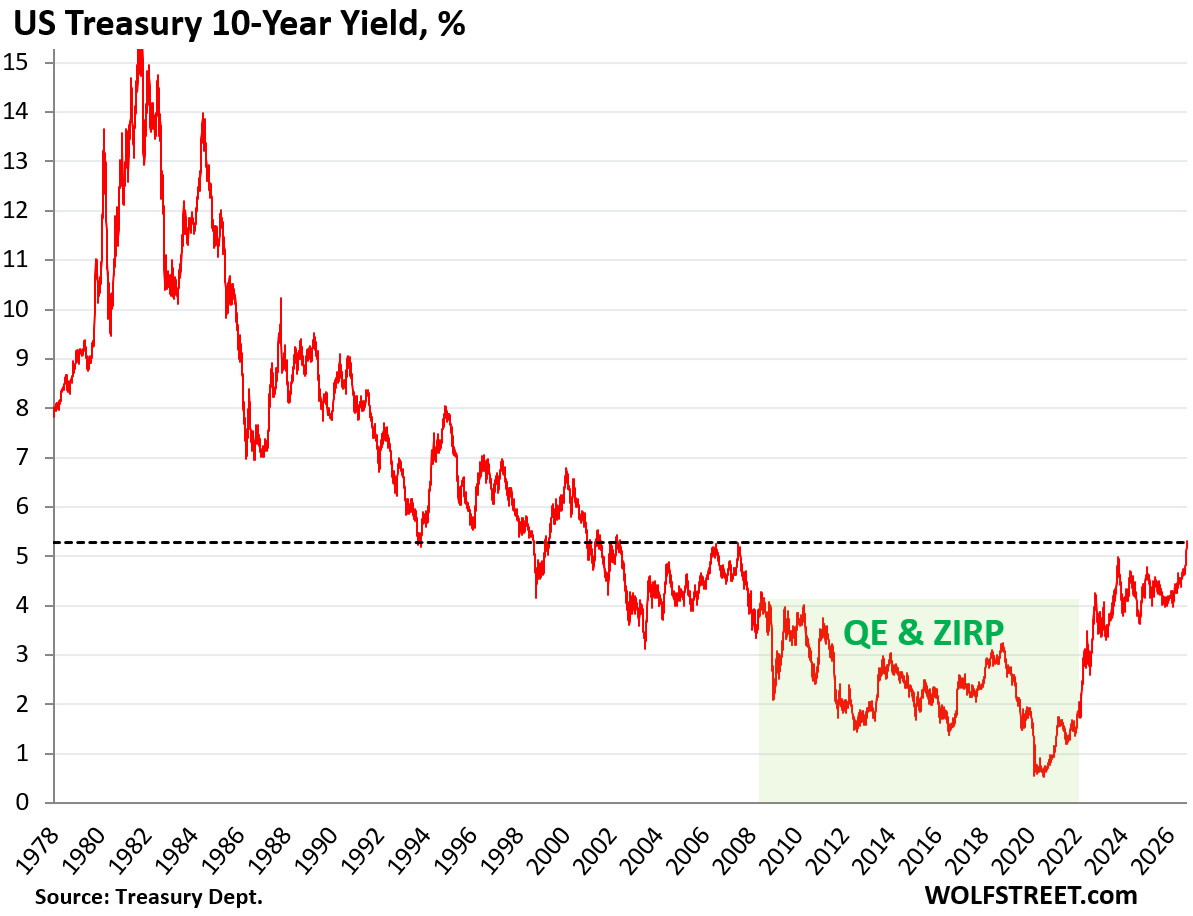
What this long-term chart of the 10-year Treasury yield shows is that the bond market, starting in 2022 amid the worst inflation in 40 years, has been coming out from under 14 years of interest rate repression by the Fed, and is now on its own and doing its thing the way it is supposed to. And that’s what Warsh wants it to do.
Enjoy reading WOLF STREET and want to support it? You can donate. I appreciate it immensely. Click on the mug to find out how:


Five years ago, my partners and I were happy to get NNN properties at a 5.5% CAP rate.
NNN sounds great but there is always risk and soft costs – attorney fees.
5.3% without the risks and headaches sounds pretty good right now.
Yeah except your 5.5 cap has a good chance of rising over time, which is why you took those deals. These bonds ain’t rising in yield….for you, ever.
Nice interesting analysis. I agree that Warsh wants the bond market to be on its own. But I think he would definitely prefer the rates “go down by their own” – which is not happening and I don’t expect it to happen.
In contrast, I expect the rates go higher from here. Current levels may be the new floor. I see no way of going back to low rates from here in next several years.
The bond market is now doing the heavy lifting for the Fed.
But if the bond market ever gets to where you can’t buy and sell bonds quickly. Then some poo will hit the fan!
As is what happens in a financial crisis, everyone starts protecting themselves and the market freezes up.
Then everyone freaks out! Then we all get losses.
Then people come to wolf street to place blame! Ha
What Warsh wants…
I thought Warsh wanted QT. A smaller balance sheet. Forget about any more short term rate increases – how about $100B a month of Treasury QT that forces the Federal government to borrow all that rollover + the new deficit on the open market at 5, 6, 7%? Want to really sop up all the excess cash and stop inflation cold? Knock a trillion off the balance sheet by next Labor Day. I’ll gladly buy 10 year notes at 6%+ to help out.
OL’B –
People bought ten year bonds under Volcker for 15%.
Just sayin’ ………..
Wolf should have titled the chart: “Wolf’s frying pan”
In another year it might be Out of the frying pan and into the fire….
Later these blogs will be compiled into a series titled “Bondfire of the Vanities” and taught to aspiring economists.
He’s very good. Reminds me of my professor of macro economics.
if the 10-year yield fell at auction, then are bondholders selling off right before the auction to increase their yields? Then purchasing?
The 10-year yield did not fall at auction, it was at 5.30% at auction.
And that’s where the yield in the secondary market is now, at 5.30%. But yields spiked in the secondary market this morning, then fell off that spike just before and after the auction, before reclimbing a bit.
The Fed doesn’t influence long term rates. The 10Y Treasuries have a rate determined by the market, not the Fed.
The Fed NO LONGER tries to influence long-term yields.
But the Fed had long-term yield in its iron fist via QE, when it purchased trillions of dollars of Treasuries in the secondary market, which massively pushed down yields. At one point, it held something like 20% or 25% of all coupon securities. I have no idea how you could have missed that.
Which is quite weird, as it puts the US in the same situation of emerging markets, where central banks have little credibility.
Opposite. You’re thinking of Soviet-style central planning? Emerging markets are high-inflation areas. The Fed did the same with QE which helped generate the worst inflation in 40 years and destroyed its credibility, and turned it into an enabler, and the result is huge government deficits and debts. The bond market is the ONLY discipliner in town, and central banks that let bond markets do their thing have a lot more credibility, and that might force governments to get their fiscal house in order.
The Fed and Treasury (especially) *do* influence long term rates, it’s just that they don’t determine them.
It’s strange that they are giving up the ability of influencing the market.
I suppose that’s what they want, but I don’t understand why.
You’re thinking of Soviet-style central planning? Emerging markets are high-inflation areas. The Fed did the same with QE which helped generate the worst inflation in 40 years and destroyed its credibility, and turned it into an enabler, and the result is huge government deficits and debts. The bond market is the ONLY discipliner in town, and central banks that let bond markets do their thing have a lot more credibility, and that might force governments to get their fiscal house in order.
The Fed should be covered in hop sack and ashes for their incompetence over the past 20 years in implementing QE. A poncy scheme by design
Perhaps we are about to get our just deserts
Or the house survives
Which calls to mind a conversation I had with my father-in-law, a successful WW2 veteran investor
I explained to him about what I thought should be done to punish the obvious financial malfesance
His dry mid=west reply was
they’re not going to do that
Your father was a very wise man.
Samsung announced a blockbuster quarter based on AI, and Wall Street is supposedly going to have great bonuses.
It seems that the tech companies and financiers love the economy, everyone else, not so much.
As a taxpayer, this is all very distressing. “How will the US government pay the extra bi/tri-llions of dollars of interest on the debt engendered by rising rates?” you might ask.
“Oh, we’ll just take the money Steve earns in the future which is currently barely covering his living expenses while breaking his aging balls.”
But what if I don’t get a raise in the future to cover the increase? “Then we’ll just take it from the money he spends on essential needs like infrastructure, healthcare and maybe tap into his paltry retirement (Social Security). But we’ll definitely lower taxes on the wealthy and others buying the bonds.”
That ain’t me. The only bonds I have are with family, friends and neighbors. How do I influence this quandary that is directly debilitating my future? Once every two-to-four years, I get to pick between a guy and gal that started this dire mess to continue it.
I know this is a superb financial website that provides information for investors, academics and others in the game. I just want you all to know that I feel like I’m getting played until I die from it. Nevertheless, I wish you well.
You might get a raise, but lately wage increases are not keeping up with inflation.
I think it will take real collective fear for any politician to actually address the ballooning deficit. There should not be debt increases in good times, rather, gains should be used to smooth over and weather tough times. Nowadays, deficits increase in tough times and elevated tax cuts add to the debt in growth periods. Warsh might be too little too late. Debt increases based on the assumption the economy will always continue growing is just plain stupid.
What you describe is an approach that Keynes advised. Back off on the spending in the good times, spend more during recessions. Or even going back further in time to the agrarian Egyptian economy, store surplus grain in good harvests years to cover for bad harvests.
The CBO just released a report saying the country would have to have an 8% nominal GDP growth to “grow” its way out of Its current debt. Good luck with that.
Already there. Nominal GDP growth in Q2 was 8.5% annualized.
I’ve been telling you all this stuff for months in my articles and comments. This is not new. That’s what it means to let an economy “run hot”: Lots of nominal economic growth, lots of inflation. And it does manage the debt.
Since current quarter real GDP is 2.22% (annualized), wouldn’t this imply that the current inflation rate is at least 6.27%? Isn’t that higher than CPI or PCE?
Yes, and I have been saying this for months and I don’t remember how often I posted the chart below.
CPI and PCE are only consumer-facing inflation indices.
Businesses face much higher inflation rates… tracked by PPI: 5.5% yoy.
https://wolfstreet.com/2026/09/10/ppi-shows-surging-inflation-across-prices-that-companies-pay-each-other-the-fed-should-stop-dilly-dallying-around/
And then there are inflation rates for stuff government buy that we don’t track in an index.
All of them are included in the GDP “deflator.”
So the inflation rate in the overall US economy — the GDP deflator — was 6.4% in Q2 annualized (blue line) and 4.4% YoY (red)
Great post.
Start a side business, create an LLC. The tax code works for businesses, not individuals. Over time, grow that business until youre in a position to quit your W-2 job and work your business full time.
Easier said than done, but the American Dream is to own a business, IMO.
Unfortunately you either play the game or get played.
Not sure there is much of a third option.
You write today’s auction:
“was a ‘reopening’ auction, the second ‘reopening’ auction of the notes that had originally been sold at the auction in August.”
I believe today’s auction was the third (and final) reopening of CUSIP 91282CRF0.
This CUSIP was auctioned Aug. 12 (10-Year Note), Sep. 9 (9-Year 11-Month Note), and today, Oct. 7 (9-Year 10-Month Note).
Here are Treasury’s news releases for those three auctions, each listing the same CUSIP, same coupon, same Maturity Date, same Dated Date, and of course different Issue Dates:
https://treasurydirect.gov/instit/annceresult/press/preanre/2026/R_20260812_2.pdf
https://treasurydirect.gov/instit/annceresult/press/preanre/2026/R_20260909_2.pdf
https://treasurydirect.gov/instit/annceresult/press/preanre/2026/R_20261007_2.pdf
The next 10-Year Note auction will be Tuesday, Nov. 10, 2026. It will get a “fresh” coupon; it’s Dated Date (Settlement Date) will be Nov. 16. It’s coupon & cusip will be re-used (re-opened) in for the December and January 10-Year Note auctions.
Fwiw, it looks to me like “retail” bought an inordinately large share of today’s auction. We’ll see if they do so again tomorrow.
“I believe today’s auction was the third (and final) reopening of CUSIP 91282CRF0.”
No. It was the second “reopening” auction, I stated correctly. The original auction is NOT a reopening auction. A reopening auction “reopens” the original issue. It’s: original auction in August, 1st reopening auction in September, 2nd reopening auction today, three auctions in total, same cusip.
On the schedule, reopenings are designated with an “R”. You can see it right here, look for the Rs in the second column, and note how the August auction did not have an R:
https://home.treasury.gov/system/files/221/Tentative-Auction-Schedule.pdf
I’m wrong. You’re right. We agree: There are three different auctions of a unique 10-year (and 30-year) Note’s cusip. The first auction is a newborn bond; the two follow-up auctions are “reopenings” of that same unique cusip.
Btw, glancing at 10-year auction results for the last several years there are very few instances when the auction price is below 95 cents on the dollar, which means today’s auction buyers got a little bit of positive convexity, nothing to sneeze at because it costs a few basis points. Who knows. Maybe the convexity accounts for why the auction price was almost 2 bps richer the “when-issued” trading price.
OT: I think the BoJ recently sold 10-Year JGBs at 3.01%, a high rate in historical terms but still too low, just like their Fed Funds rate, so UsdJpy is still under pressure, which means the BoJ or MoF could still take a giant dump on the US Treasury by selling another few tens of billions of their Treasuries.
And — my two-cents — since the quantity of AI-related debt coming to both US and Euro bond markets is mind-bogglingly large, there’s good reason to think yields will continue drifting higher until after those price-indiscriminate debt-seller’s finish their selling. I’ll now get off my high horse.
I don’t think Warsh is super happy that his tenure begins with a bond bloodbath, especially as his boss appointed him to lower, rather that raise, interest rates and the fed board made him go along with a hike right before the midterms.
But that’s what happens when you say “Bond Market, Take the Wheel!” And so it did.
I do think that after the midterms, Warsh is freed up to raise rates to try to limit inflation expectations. Better to be late than never, I suppose. I think that inflation was more government policy than monetary policy driven, so we’ll see if the next Congress can reign in policy as we are entering a lame duck period.
Long term, elections should be wild as we move on from the deficits don’t matter era to the interest expenses seem to matter a lot (!) era. The budget is pretty simple. Our options are (1) cut military spending, (2) cut SS, Medical and Medicare spending, or (3) raise receipts (aka Taxes). Kicking the can will likely only increase the interest rates which increases the slice of the budget going to paying thr interest, and trying to print your way out means you can find out what it is like to live in Turkey or Argentina (not fun). So, pick one or, better yet, all three.
No. They will continue to choose option (4).
Borrow more money.
I call it the Inflation Tax.
The problem with this approach is that investors expect yields to cover inflation.
If they foresee higher/uncontrolled inflation, they will require higher and higher returns.
There is a 5th option, though: higher economic growth.
Sure. That’s why I referred to finding out what it is like to be Argentina and Turkey, who did a bunch of soft or implicit defaults.
Not fun.
There is plenty of room to raise taxes. In the first instance dealing with the legal, but not morally acceptable tax loophole via Luxembourg et al. Corporate tax has been reduced significantly over the past decades. And yet they still do this stuff. It just isn’t on.
Nate and Happy Boomer-
________
“The inflationary movement must come to an end either by a complete breakdown or by voluntary restrictions on the part of the banks involved.
If people were not so optimistic, the crisis would not be so bad, for people would prepare for it. The problem WHEN the boom comes to an end is decided by accidental factors. But it cannot be avoided. And the later the crisis comes, the more capital has been squandered, and the worse the consequences.”
— Mises, summer 1951, Mises Seminar Lectures, vol. 1, “Money, Credit, and the Business Cycle,” published by FEE as The Free Market and It’s Enemies (2004)
________
Governments and banking leaders continue making the same mistakes in “managing” the credit function, ending in debilitating inflation, or depression.
Could the “accidental factors” this time around be an intersection between the rise in interest rates and the extraordinary capital mountain built around AI?
I think the general consensus is that we dodged a bullet from the Great Recession, avoiding a depression, by engaging in tons of rate suppression. Some would disagree. But some also simply hate the Fed and wish we didn’t have central banks and/or were on the gold standard with currency debasement a capital offense against the people.
But the problem was that once something works, people overuse it. Like penicillin. Or classic Keynesian economics. Or a cocktail of rate suppression to create “free money” as a stimulus that creates asset bubbles. (You want a real, controllable, short term stimulus? Give poor and middle class people checks, they will pump it into the economy like heroin. They can’t help themselves! But too much…inflation!)
We probably didn’t need rate suppression during COVID, and especially for so long when we should have immediately engaged in QT once the market had stabilized. And we certainly didn’t need the Fed delaying tightening because of the executive applying political pressure.
Now the bill comes due. Some businesses based on the logic of free money and endless cheap credit will die, but new enterprises will be born. Hopefully some in the USA.
“we dodged a bullet from the Great Recession…by engaging in tons of rate suppression.”
Bankrupt-u-Bernanke was too worried about inflation. The price of oil was being driven by outsized trade deficits that lowered the exchange value of the U.S. dollar.
He emasculated the FED’s open market power.
BuB maintained his “tight” (actually contractionary) money policy [i.e., credit easing, or mix of assets, not quantitative easing –injecting new money and excess reserves].
Then, as George Selgin pointed out: “The 2006 Financial Services Regulatory Relief Act gives the Fed permission to pay interest on reserves. The IOR rate was always higher than “the general level of short-term interest rates” which is imposed in the Law. “A Legal Barrier to Higher Interest Rates,” The Wall Street Journal, Sept. 28, p. A13.
This policy bankrupt 1/2 of the home builders. It decimated the nonbanks by 6.2 trillion dollars while the banks grew by 3.6 trillion dollars.
Honestly not that they go hand in hand, but I’d rather just earn half a percent on bonds in exchange for 0 inflation.
The inflation game is ridiculous, it is literally the distrust of the dollar.
Sure people get rich in all this mayhem, but lots more get broke.
I feel like Warsh is the “fall guy” for Trump’s ever higher stock market. “I want lower rates”.
I imagine Trump wants reelection, whatever interest rates help that, is what he’s for, which historically is lower rates.
It could be the plan is to keep a steep yield curve, moving the overall distribution higher in tbills with issuance and some buybacks at 50 cents on the dollar on longer bonds. With short term rates lower, this let’s Inflation run hot for the debt, with a lid coming from higher long end yields.
And by re-election I mean winning in November, didn’t mean to pose a 22nd amendment question, lol
RISK continues to reprice globally. No surprise really as America’s corporate owners continue to loot the treasury via their political puppets in D.C.
hedge accordingly.
Wolf, your articles on treasuries have been exceptional. I’ve learned so much. I’ve talked to my brokerage about this investment but they never mentioned these important dynamics.
Questions: Other than the 10y, what other treasuries are typically subject to the ‘reopening’ process?
On the original issuance, how does the price discovery phase work before the auction? What is being traded in that phase?
1. “what other treasuries are typically subject to the ‘reopening’ process?”
Regular 10-yr, 20-yr, and 30-yr Treasuries; All TIPS; and the 2-yr Floating Rate Notes (FRNs)
2. “On the original issuance, how does the price discovery phase work before the auction?”
Same, no difference. The when-issued trading takes place regardless of whether it’s an original sale or a reopening. They’re trading in securities that have a CUSIP but have not yet been issued, but will be issued sometime after the auction.
Crude Oil Nov 26
92.22
+3.94 +4.46%
Inflation expectations are higher due to oil rising. A supply shock. Feeds back into interest rates. The FED is behind the curve.
Not to worry
Looks like long end is getting bought as an escape hatch.
A test of 5.2 for the 30 would be technically reasonable.
“You’re thinking of Soviet-style central planning? Emerging markets are high-inflation areas. The Fed did the same with QE which helped generate the worst inflation in 40 years and destroyed its credibility, and turned it into an enabler, and the result is huge government deficits and debts. The bond market is the ONLY discipliner in town, and central banks that let bond markets do their thing have a lot more credibility, and that might force governments to get their fiscal house in order.”
Well said. The bond market is the only hope that the current trajectory gets altered. Discipline isn’t a bad thing. Off topic but cool article in WSJ today about an ex NFL lineman who is now an MIT math prof.
Complete hogwash. So long as the Fed, and their central bank proxies, can buy U.S. debt, there is no “market”.
Remove all central bank buying, including the Fed and let’s see what the real demand for U.S. debt is.
long long term trends seem to be about 20 or so years of rising rates and 40 years or so of lowering rates. of course if you take into affect currency purchasing power and put the bond prices in old fashioned money used from ancient egypt to romans to usa pre 1932 and 1971 USD to gold, we get a whole new outlook on IOU bonds. i miss the days of bearer bonds. had piles of them even through the 1990s.
i called charleston SC my home for a wonderful decade. the old families there that kept their downtown mansions and 1000 acres of plantations up the rivers all sold their confederate USD and converted to gold before the recent unpleasantness came to a surrender.
Interest‑rate spreads measure risk, term structure, and funding stress.
Interest rate spreads have increased:
10-Year Treasury Constant Maturity Minus 2-Year Treasury Constant Maturity (T10Y2Y)
10-Year Treasury Constant Maturity Minus 3-Month Treasury Constant Maturity (T10Y3M)
Credit spreads have also increased
ICE BofA US High Yield Index Option-Adjusted Spread (BAMLH0A0HYM2)
Real Interest rates have increased
10-Year Real Interest Rate (REAINTRATREARAT10Y)
Otherwise, nominal interest rates should be feeling the pressure. However, rates are falling
10-Yr Bond
5.23
-0.05 -0.87%
The FED is accommodating the money market.
Indirect bidders bought 80.3% of the notes, but you explain that this category combines foreign buyers with other bidders. What evidence beyond that combined share supports your inference that foreign buyers showed substantial interest at 5.30%? The distinction matters because you describe the result as reassurance for a market worried about foreigners retreating from US debt.
You can get the actual amounts that foreign buyers bought when Treasure publishes its Auction Allotment Report on October 22.
At the prior 10-year auction, which had fewer indirect bidders, foreign investors bought 28% of the notes, as per the last Auction Allotment Report.
The relationship between indirect bidders and foreign buyers — and what conclusions you can draw from it — goes back forever and is pretty well established as a predictor of what the Auction Allotment Report will show.