
Mortgage applications to purchase a home plunged and to refinance a home collapsed.
By Wolf Richter for WOLF STREET.
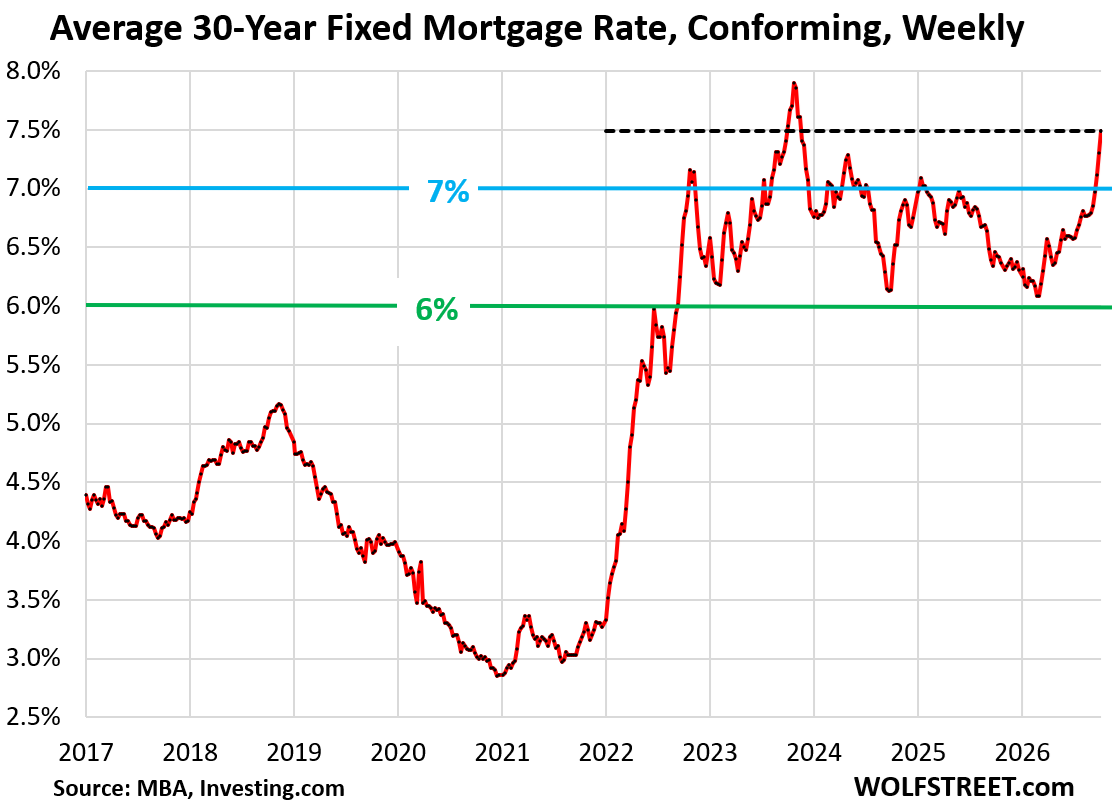
The average weekly mortgage rate for conforming 30-year fixed mortgages rose to 7.49% in the current reporting week, the highest since mid-November 2023, according to the Mortgage Bankers Association today.
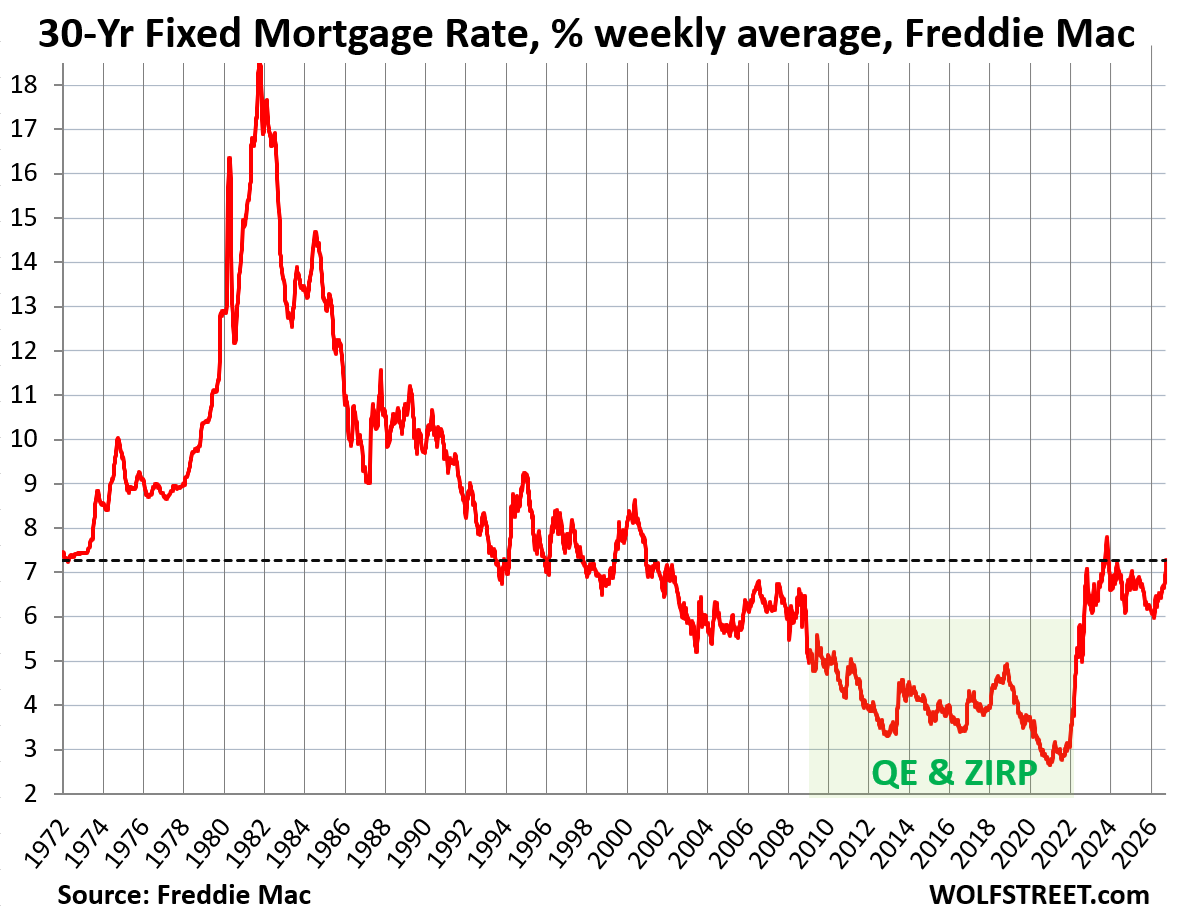
This measure of the average 30-year fixed mortgage rate had been in the 6-7% range for over four years, but briefly broke out in late 2023. During the normal times, before the Fed’s QE and interest rate repression started in 2008, 7.5% mortgages were considered normal and for many years low (see 50-year chart at the bottom of this article).
In terms of demand for home purchases, that above-7% range is triggering demand destruction at current prices – further demand destruction of already weak demand – given how overpriced the housing market still is.
Mortgage rates track long-term Treasury yields but are higher, and that spread between them varies over time.
Given the jump in the Treasury yields this morning ahead of the 10-year Treasury auction, the daily measure of 30-year fixed mortgage rates jumped to 7.63% this morning, according to Mortgage News Daily.
Mortgage applications to purchase a home – a forward-looking indicator of demand by home buyers – fell further in the current survey week, from already beaten-down levels, the fifth week in a row of declines, according to data by the Mortgage Bankers Association today.
Purchase mortgage applications have been wobbling along near rock-bottom levels for over four years. In the current reporting week, they plunged by 15% year-over-year, by nearly 50% from the same week in 2021, and by 42% from the same week in 2019.
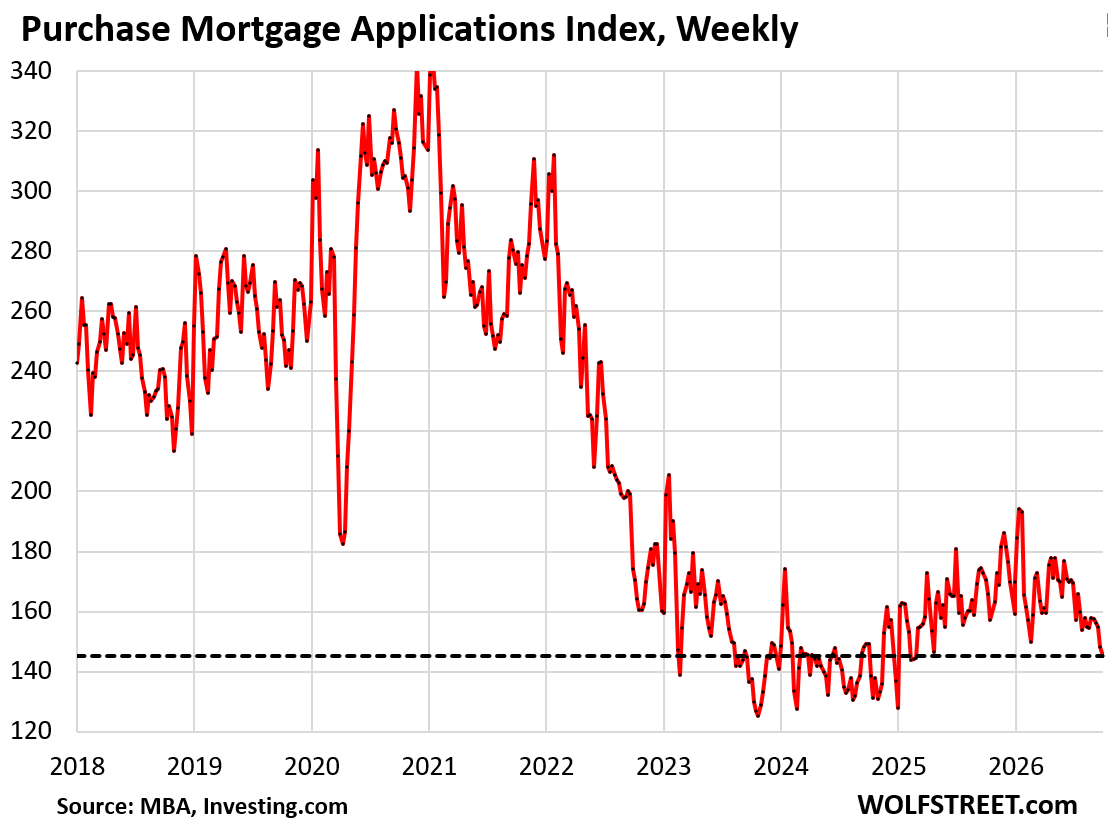
If homeowners want to sell their homes, there is a market, but they have to get real on price. That’s what this says.
In many markets, it’s now far cheaper to rent an equivalent home, than buying it, and home-price increases can no longer be taken for granted to occur and make up the difference. In many markets, home prices started declining in recent years, and we track some of the bigger markets with the biggest home price declines here.

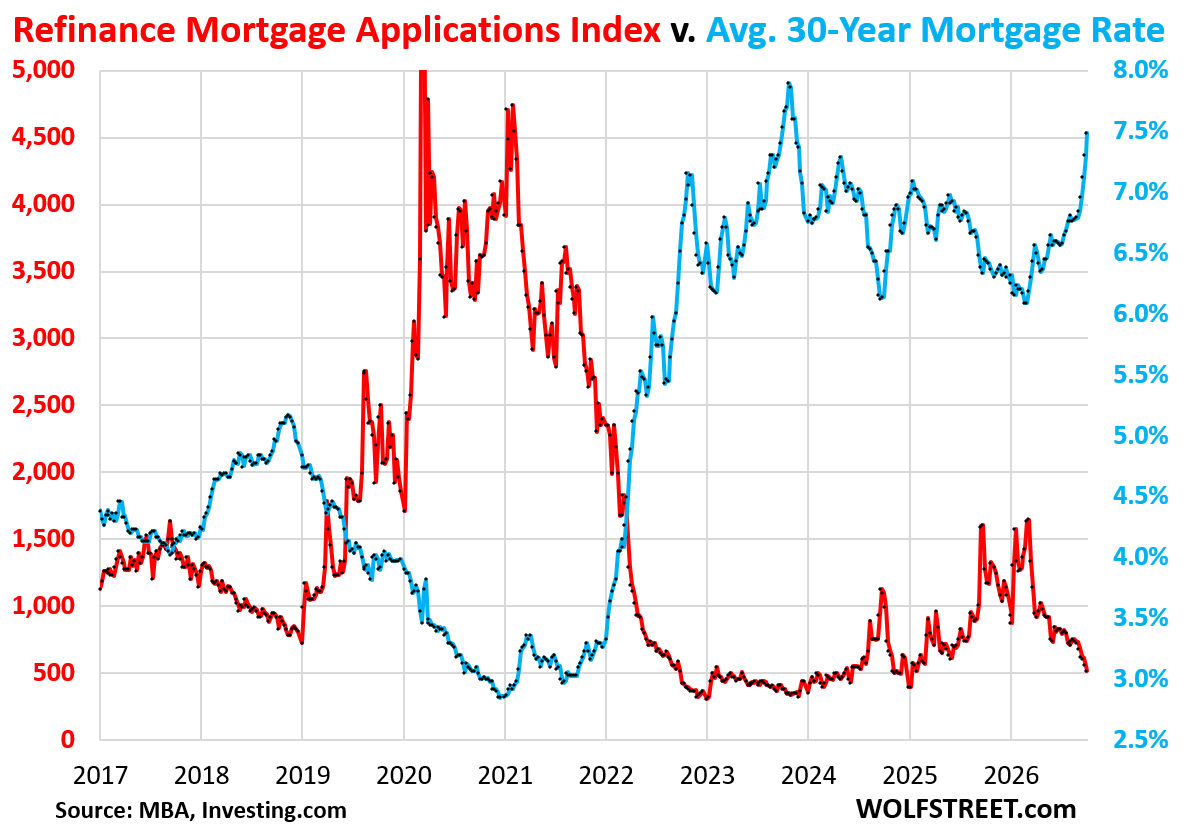
Mortgage applications to refinance a home collapsed by 60% year-over-year in the current reporting week, by 83% from the same week in 2021, and by 79% from the same week in 2019, according to the MBA today.
Refinance applications react strongly to changes in mortgage rates: When mortgage rates dip, homeowners eager to refinance pounce. And when mortgage rates rise after that dip, demand dries up again. Now, with rates at 7.5%, demand for refis has collapsed.
This chart shows that inverse relationship between mortgage rates (blue) and applications to refinance a mortgage (red):
Refis have little impact on the housing market but generate substantial fees for the mortgage-lending industry.
And refis can boost consumer spending when they lower the mortgage payments to leave more money for other stuff, or provide cash that borrowers can spend on remodeling projects, etc.
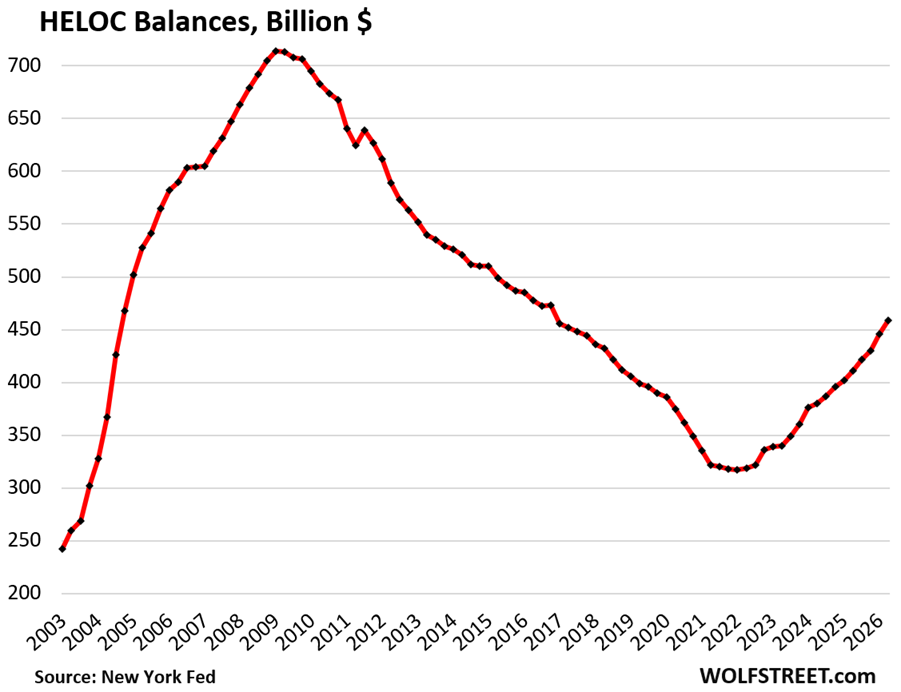
Some of the cash-out refi demand has shifted to Home Equity Lines of Credit. Amid higher interest rates, HELOCs may be the less expensive and more flexible option for many homeowners that want to get some cash out of their home, and HELOC balances have surged. So consumers are still taking equity out of their homes, but via HELOCs rather than cash-out refis:
HELOC balances spiked by 11.6% year-over-year in Q2, and by 45% since the low point in Q1 2021, to $459 billion. These are actual balances drawn on HELOCs and do not include the unused portion of those lines of credit.
The problem with the housing market, why it has frozen, is home prices that exploded by 50% or more in many markets in a two-year time span, which has triggered demand destruction.
Home prices exploded because, among other reasons, the Fed repressed mortgage rates below 3% with trillions of dollars of purchases of Treasury securities and mortgage-backed securities. This recklessness started in 2008 and went completely out of control in 2020-2021, leading to a massive home price explosion and the worst inflation in 40 years.
Before 2008, 7.5% mortgages were considered normal to low. But as a sign of things to come, the Greenspan Fed pushed its policy rates down too far, for too long, as a result of the 2001 recession, dragging mortgage rates below 6% by early 2003, at the time the lowest in Freddie Mac’s data going back to 1971, and inflation resurged, and home prices soared, and everyone went nuts amid FOMO, including the mortgage lending sector, leading to garbage mortgages at overinflated home prices, leading to the housing bust and mortgage crisis that then morphed into the Financial Crisis. Low mortgage rates are a scourge.
The pandemic iteration of too-low mortgage rates – now taxpayers are backing most of those mortgages, not banks – has not only triggered the home price explosion that annihilated affordability but has also caused homeowners’ insurance, property taxes, HOA fees, and other expenses to surge with home prices, further crushing affordability.
This chart, with data from Freddie Mac, is through Thursday last week, and does not yet include the most recent increases in mortgage rates. The new data will be released tomorrow:
In case you missed it: Homeowners Are Clinging to their Below-4% Mortgages for Dear Life as Mortgage Rates Went over 7%
Enjoy reading WOLF STREET and want to support it? You can donate. I appreciate it immensely. Click on the mug to find out how:


Plunged and collapsed? Is one better than the other?
Yes, it’s like in that order: ease, dip, decline, drop, fall, sag, plunge, collapse, kathoomph.
5 D’s of dodgeball dodge dip duck dive dodge
We are looking at specific type home
nothing special, but prices have NOT DECLINED
and these are ready to go ones
still selling but slower
and most buyers are either cash or have 1/2 down
Dodge, duck, dip, dive and dodge.
Wonder how many sellers in SoCal are thinking this “high” mortgage rates will pass soon and start pulling their house off the market hoping for better time right around the corner…..aggressive price cut they are not doing that’s for sure..
I just bought in SOCAL.
Couldn’t rent any longer. Landlord/Property owner were bad people and it wasn’t good for my wife and kids. Locked in 6.8% interest rate two weeks ago. However, I did convince the buyers to pay a 2-1 rate buydown so that lessons the sting a little bit.
That being said, I do think the market has shifted in SOCAL. The houses are much much nicer for the price compared to 5 years ago and some (not all) buyers are being reasonable and taking offers. No property is getting a bidding war and getting $300K over list as far as I can tell.
At least the weather and beaches are nice…
So the weather in Southern California is nice
Maybe
But according to US Geological Survey
Southern California has the highest level of earthquake risk in the United States, with half of the expected financial losses from earthquakes in the Nation expected to occur in southern California.
USGS go on to say that scientists warn that stress levels along parts of the Southern San Andreas and San Jacinto fault systems are at their highest in 1,000 years. There is a 93% chance of a magnitude 6.7 or greater earthquake striking Southern California within a 30-year window.
At what cost then ?
Formal state projections , such as the U.S. Geological Survey / ShakeOut scenario, estimate a magnitude 7.8 earthquake on the southern San Andreas Fault could cause $213 billion in losses, while recent expert updates from the Statewide California Earthquake Center warn that total economic and infrastructure damages could easily range from $500 billion to $1 trillion.
This IMO means doing due diligence when buying in CA , when renting you still might die but the landlord takes the financial hit. Plus the renters family always then can find ways to sue .
How many US homebuyers look at earthquake issues and how many houses carry insurance that covers it ?
In the US, you get to pick between earthquakes, hurricanes, tornados, blizzards, brutal killer cold waves, land slides, nuclear contamination (even in San Francisco) from the Cold War years, forever droughts and lack of water… your choice. But it’s going to be one of more of the above.
Seven Steps to Breakup with your Home – by Jack Handy
yah, we’re in no hurry with our 3.35% mortgage
still have 9 years to go but nearly 1/2 mortgage paid for in 6 years
will wait, hoping to buy another home we can fix up – ie lots cheaper
LOL! At all the fools who are losing their homes by raking on home debt at 2,3 4% and now can’t afford current rates. As funny as the fools whoo bought imploudded stocks! America the land of the homeless.
“At all the fools who are losing their homes by raking on home debt at 2,3 4% and now can’t afford current rates.”
I’d say that’s a generalization not necessarily grounded in fact. Many of those that re-fied or purchased between 2020 – 2022 are probably feeling pretty good with their rate as well as with the price they paid. Especially those that just re-fied existing mortgages that are far and away beloe prices paid by buyers in 2023/4.
went from high 5% to 3.35% 15
now 3/4 mortgage payment goes to debt reduction
I thought of getting a 15 but the day I re-fied was a Friday and on Monday the 2.5% 30 yr ARM had jumped to 4%….over the weekend!
Even on the 30 year my payment pays down over 50% monthly for the past two years towards principal.
30 years fixed mortgage rate is generally about 2% more than the yields on prevailing 10-year Treasuries. Why is this 2% premium on mortgage rates while the mortgage is secured with a collateral. Does it mean default risk premium and risk of having to sell short to recover in case of defaults is 2%. Is this not a bit high?
This isn’t a complete set of reasons, just a start that I could come up with on the spot:
1. there is a lot between your mortgage and the 10-year Treasury note, including the entire apparatus, hassles, and fees to turn your mortgage into MBS and sell them to investors.
2. to get a step closer, look at the spread between MBS and Treasuries.
3. You can pay off your mortgage anytime without penalty and prior notice (call feature), but the government has no call feature in its Treasury securities. Once you buy a 10-year Treasury note, you know the maturity date, and you can rely on that. The government cannot call your 5.30% 10-year Treasury in five years when 10-year yields are 2.3% and deprive you of 5 years of 5.3% income in a world that pays 2.3%. Debt with a call feature always has a higher yield, especially if the call feature is unlimited with not protections at all.
don’t forget that AI is financing big time
so we’re competing for debt $$$ with big guys
Wolf – any idea how much in MBS came off the [FED’s] balance sheet in Sept? Mortgage spread seems to be in the normal long term range around ~2% and interestingly well below the recent 3%+ peak in 2023 when FED was hiking and tightening.
About $16 billion came off in September, which is in the $15-18 billion range that has prevailed since 2022. MBS come off via pass-through principal payments, but these MBS are backed by low interest rate mortgages, and people are hanging on to them, instead of paying them off.
@Wolf – following up on the MBS that came off the balance sheet in Sept, barring a reversal in rates, is this just the natural rate at which we can expect mortgages to mature/refinance when people need to move/divorce etc? 15-18B a month is that “natural” rate? Thoughts?
As bond rates increase, I’d speculate that less people(retirees) will pay off their houses so the MBS rolloff will slow further.
For example,
If someone refi’d 500K in 2021 at 3%.
Principal and interest monthly payments: $2108/month.
500K in a 6% 30 year bond: 30K/year = $2500/month.
I’d just set up an account for the 6 month bond payments and have the house payment auto-paid from that account.
The remaining $400/month could go toward paying federal taxes on the bond income. It wouldn’t cover it completely.
It’s like watching a slow motion car crash.
Considering that energy inflation is likely to accelerate for at least the next 12 months, RE construction costs and maintenance costs are likely is rise, perhaps dramatically!
“the Greenspan Fed pushed its policy rates down too far, for too long, as a result of the 2001 recession, dragging mortgage rates below 6% by early 2003, at the time the lowest in Freddie Mac’s data going back to 1971, and inflation resurged, and home prices soared, and everyone went nuts amid FOMO, including the mortgage lending sector, leading to garbage mortgages at overinflated home prices, leading to the housing bust and mortgage crisis that then morphed into the Financial Crisis….”
“The pandemic iteration of too-low mortgage rates – now taxpayers are backing most of those mortgages, not banks – has not only triggered the home price explosion that annihilated affordability but has also caused homeowners’ insurance, property taxes, HOA fees, and other expenses to surge with home prices, further crushing affordability.”
Can we say, as an economic rule, that if real interest rates are held too low by a government, we have an increased risk of asset price bubbles?
And if we accept the above as generally true, and we accept that asset price bubbles can be causes of recessions on their own, then it makes less and less sense to cut rates for years at a time in order to stimulate an economy out of recession.
Just as doctors have medicines that can only be taken for a fixed amount of time before problems occur, central bankers can only keep their overnight rates below the neutral rate for so long, before the toxic effect start to pile up. Then they can only raise rates at the risk of causing the recession they were trying to prevent.
The root problem is, central bankers and their monetary policy are forced into a compromise by the government’s fiscal policy. Congress has an interest in borrowing as much money as possible to dole out tax cuts, pork, and increasing benefits to their campaign donors. But even if central bankers try to stay in their own lane and only look at the evidence related to inflation and employment, they are still constrained by the growth of the US debt. If central bankers raise rates in a highly indebted country, then the government has to pay a lot more in interest, reducing its credit metrics, requiring painful cuts, and draining some larger percentage of GDP away from productive uses and toward debt financing.
Thus any effort by central banks to control inflation runs the risk of causing a recession or causing a debt spiral, and thus we have this situation in the U.S. where the Fed has not hit its inflation target for over 5 years because they have had to be too cautious.
This is mostly the fault of fiscal policy by our elected representatives. They are the ones who put the central bankers in a bind, and imposed a “third mandate” of “try to keep the country out of a debt spiral despite our ever-increasing debt”. As the debt/GDP goes higher and higher, central bankers steadily lose the option to do something about inflation. A popular compromise by central bankers has been to suppress rates, allow price bubbles to inflate, and accept above-target inflation for years at a time.
re: “Can we say, as an economic rule, that if real interest rates are held too low by a government, we have an increased risk of asset price bubbles?”
You nailed it. Paying interest on reserves lowers the real rate of interest.
Amen! Your last paragraph says it all.
So was it Congress who forced the central bankers to hold 0% rates for 15 years? Or was it the consequence of the previous bubble created by.. wait for it.. the central bankers?
Twelve unelected bureaucrats = good. 500+ elected bureaucrats = bad. Is that that the problem?
More like tens of millions of voters selecting the leaders who will loot the country the fastest and put more public assets and debt into their wallets without a care in the world about the eventual consequences.
Non-democracies tend to do much worse on inflation than the core CPI of 3.0% that we’re all enraged about. But democracies need to figure out how to have an apolitical system for keeping inflation down when they have a political system that pushes inflation and debt up. Maybe automating the Fed with some kind of Taylor Rule is not so bad an idea after all, but we’d just elect representatives to override such a system.
The representatives will get a lesson next month. Out of control deficits lead to inflation, which hurts re-election chances.
Kick the incumbents out, no matter which party they come from, unless they’ve taken a hard line against deficits.
Voting is inconsequential in the Banana Republic. Uniparty wins.
There isn’t a central bank mandate to accommodate fiscal spending that is out of control. They do so by choice, with weak, inept, dependent leadership. Congress didn’t force them into harmful dovish monetary policies for decades.
Central bankers hold the power. When they act prudently and independently, they can force Congress to change its ways.
It’s an illusion that the Fed is independent. It never has been, and it never will be. Why is that? It’s because the Fed was created by the Congress. The Fed reports to the Congress. During WW2, the Fed did whatever the Treasury Department wanted it to do. It’s a strange organization. It’s owned by the Banks and the Chairman is chosen by the President.
The Fed is many things, but it is not independent.
End the Fed!
Thank you, Chris B, for stating the root of this decade’s long problem so eloquently. Responsibility clearly lies with the elected CONgressCritters for the reasons you state (Fiscal Policy). Completely enabled by the Banksters (Monetary Policy). Anyone who doubts the accuracy of this analysis, simply audit the CONgressCritters net worth entering office and upon. The multiplier digits shall clearly reveal the Grift. They are all corrupt beyond repair. It’s chiseled in stone in their job description. Sorry TaxDonkeys, you’re on the hook. Keep voting for your fave team.
–Geezer
“Real” mortgage rates appear to be a bit high by latter 20th Century standards though.
Treasury auction seemed to go pretty well today. Buyers starting to crawl out of the woodwork. Shorts better get ready for a few squeezes by end of year!
Atlanta’s and St. Louis’ gdp reports out on the 8th and 9th. Should see whether the economy is slowing and bonds to be bought.
I don’t really see house prices going down so long as owners can keep up with their mortgages, in general.
So, the housing market will probably be even more dependent on local economics. We saw a bit of that as a lot of jobs went from WFH to more WFW. Areas that keep humming along economically will stay around the same as inflation eats real ROI, other areas that lose economically will see declines.
So, housing doesn’t seem like a great investment to go long in. Oh, and I wouldn’t touch a home in Florida, pretty close to any coast, or anywhere wildfire prone. Insurance costs will eat you alive as climate change settles in due to the obvious warming period we are in.
“Insurance costs will eat you alive as climate change settles in due to the obvious warming period we are in.”
insurers-score-record-profits-while-consumers-pay/
Facts DO matter. Insurance companies have a regulatory moat around the real estate industry. Climate change is the scare tactic they use. I think your comment or one similar pops up here every time Wolf updates his real estate posts.
Yep. ZERO Atlantic hurricanes this year. Crickets from the mainstream media. I haven’t ever seen any trustworthy empirical data that shows hurricanes have increased the last 100 years. But there is lots of data available about coastal population growth.
Lots of coverage about that, but under the title of “El Niño,” which is messing things up globally, and we feel it right here in San Francisco, with the Bay water level 2 feet above predicted tides. I swim in it, I pay attention to that. As a side effect, El Niño changed stuff in the South Atlantic, which has had that impact on hurricanes in the Atlantic that you describe — but there have been lots of hurricanes in the Pacific this year, including those that hit Hawaii, Southern California, and Mexico. So read up on El Niño, and you’ll find your answers on hurricanes in the Atlantic.
Re: “HELOCs may be the less expensive and more flexible option for many homeowners that want to get some cash out of their home,”
The Tax Reform Act of 1986 eliminated the tax deductibility of interest on other forms of consumer credit, e.g., auto loans, personal loans, and credit card balances. This boosted the popularity of HELOCs.
1. HELOC interest in only tax deductible if you use the funds “to buy, build, or substantially improve the residence,” says the IRS.
2. HELOCs bottomed out in Q1 2021. Neither the decline until 2021, nor the rise since then has anything to do with the tax reform act of 1986
Anecdata: 1600 sq ft house near me listed 2 months ago at 400k. Quickly took a cut to 385. Then to 340. Now under contract for a bit less than that.
Before 2020, tax basis on the house was about 138k, with about 750 annual tax.
Annual tax is now a bit north of 2k.
Wow, I would love that tax rate.
I own a 1600ft2 house in a blue midwest state.
House is valued around 350K. Taxes last year were over 5,500.
Just for comparison and fun – house appraisal @ $850k and annual tax bill @ $3500 ( annual insurance bill @ $2500 ).
Home buyers need to get more aggressive on their bidding and be willing to walk away from sellers who don’t budge. A $500k selling price would have a monthly P&I of $3,500/Mo at 7.5%. An equivalent value at 6.0% rate would be $429K so a 14% price drop. Not an out of the ordinary drop from a listing to sale price. An equivalent value at 5.0% mortgage rate would be $383K so a 23% price drop, and to get an equivalent value at 4.0% a price drop of 32% would be necessary. These levels of deflated prices are apparent in the condo market which is the canary in the coal mine. So don’t get hung up on absolute or nominal Mortgage rates. Supply/demand dynamics would argue that house prices must fall from the exceedingly high appreciation experienced in ’20 to ’22. The “lock-in rate effect” will extend the time it tales for sellers to realize they need accept a price where they are still making a huge tax free gain, if they’ve owned for 10+ years.
Think of this. If I sell my four bedroom home for 500 k it will cost me 400 k to buy a new 2 bedroom home in this area, Then there is the property cost, taxes and capital gains taxes and moving costs. So why bother.
I never get that heloc thing. Finally you need to pay it back with interest. I can understand that people use heloc to pay of debt with higher interest rates like credit card debt or maybe what is in vougue now buy now pay later loans. But i assume that after that you want to pay it down. Ergo you must reduce consumption today.
My niece wants to move closer so her husband can commute closer to work, young family locked in at 3 percent…not going to happen..
40 % of homes in the US are mortgage free, wonder what the difference is compared to 2008. Plus so many are locked in at 3% rates. Very interesting time!
Thank you for the data about mortgage applications. I wonder when, during the process, the application counts as completed.
I bought a house recently. I provided loads of info to two banks that had told me I would have no problem getting approved. Then they ghosted me. The third bank actually did approve me with a 6.25% interest rate.
Thank you Wolf for pointing out that inflation should be taken in to consideration when thinking about the mortgage rate. 6.25% seems like a blessing when inflation is 3-4%.
I pretty much agree with everything in this article. In 1989, when I purchased my first home, I was paying 10.5% on a 30 year loan. That tracks with the graphics on mortgage rates going back to the 1970s. When I moved to Florida 30 years ago, I was paying 7.5% on a 15 year loan. My 5th and final retirement home, which I purchased 9 years ago, had a 15 year loan at 3.99%. I paid it off a couple of years ago and I am sitting on a quarter of a million dollars of equity in my tiny, retirement bungalow.
This brings us to housing prices. I had put my house the market 18 months ago thinking I would take the equity and pay cash for a house in Southern Illinois where my sister is preparing to retire. I am retired. However, despite dropping the price and offering closing cost incentives, my house did not sell. I took it off the market in July 2026.
My house is my entire retirement wealth. I don’t need to sell it and I love my location. Remember, it is paid off and I have only utility, maintenance, taxes (arrgh) and insurance. The latter 2 items have gone ballistic over the past 9 years since I purchased my little bungalow thanks to hurricanes and crazy pandemic era valuations.
Here in Florida, we have Amendment 3 on the ballot, which if it garners 60% of the vote will allow for a 150K exemption off the market value of the house in 2027. It rises to 250K exemption in 2028. Last year the county appraiser’s office appraised the market value of my homestead at 273K, which I thought was overinflated and they taxed me on that. This year it has dropped to an estimated value of 237K. This is more realistic since I had my home priced at around 250K when I had it up for sale.
Here in SW Florida, existing homes are competing with new development, where developers are offering freebies, discounts and financing incentives through rate buy-downs. The current 7.5%, is the old normal from decades ago. People’s expectations have been unrealistically elevated due to QE and the Feds interruption in the economy to prevent collapse during the pandemic.
Interest rates have normalized to their historical levels. It’s everything else about home ownership that is challenging affordability. The median home price is a little over 350K here in SW Florida. Rule of thumb math indicates that a working couple would need to make a combined income of around 120K to afford the median home. Unfortunately, the median income in SW Florida is far below that threshold. Now, throw on top of that rising insurance costs and rising property taxes and a house becomes out of reach for many prospective home buyers.
Home ownership is wealth-building through tangible property and an appreciating asset over the long term. The 60 plus years of tracking data indicates that home values tend to either keep up with or beat inflation during normal times. We are 3% inflation and home prices are tracking with that. Mortgages at 7.5% are not the problem. Here in SW Florida, home valuations distorted by pandemic era craziness have not yet subsided. So, now we have amendment 3, which will increase our homestead exemptions up to 250K by 2028 if the voters pass the amendment. We need 60%. I already voted. Can you guess how I voted on amendment 3? Cheers.
I hope you voted no. That’s what I’m doing.
Everyone thinks they can vote away all tax burdens and still get the services they desire.
NC has an amendment this year to give the state power to limit local tax levy increases and it’s sure to pass even though no one has a clue what they would actually do with it; and that’s ignoring the other legislation they are pushing related to property taxes.
There is one that requires notification if the rate is above neutral which is another tax payer expense but also waives that for schools and public safety. If that passes you’ll just see every local gov peel those out as separate taxes while maintaining the general rate and likely leading to higher overall taxes.
So if it’s now cheaper to rent in many current markets than buying an equivalent home, does that mean that the landlord is losing money?
If the landlord bought the property 10 years ago and refinanced at 3% in 2020, they’re not losing money. Their costs are low. They got a good deal.
If an investor buys now and finances at 7%, they’re likely losing a lot of money in those markets.
The big single-family landlords have all stopped buying individual homes a few years ago because the math doesn’t work anymore, and they have turned into sellers of those individual homes that they bought in 2012. But they’re building their own rental developments where their costs are a lot lower per home, including property management and maintenance, than buying used homes in the resale market.
We have already seen lots of HUGE multifamily defaults because rents were not enough to cover ongoing expenses, including interest, and because maturing loans cannot be refinanced because the rents are not enough to pay for the ongoing expenses, including servicing the new loan.
In terms of single-family residential, we’re seeing rising foreclosure rates (though they’re still low), some of which are landlords with big negative cash flows that are throwing in the towel.
Landlording is a risky business, and people can lose their shirts.
I’ve brought up my son’s situation with renting in Denver a few posts ago. Being a nosy Dad, I looked up his rental house history in Denver.
2010 – House sold for 240K. If the landlord refi’d the entire amount in 2020 at 3%, the 30 year payments are $1012/month (~1500/month with current taxes and insurance)
2022-present – My son is renting at 2200/month. Rents were stable during this time. The landlord is likely making $500+ per month profit (after tax, insurance, and maintenance costs.)
2026 – Zillow estimates the house is worth 540K. To buy the house at 7.5%, the payments would be $3800 ($4300/month with taxes and insurance).
My son is paying approximately half in rent vs buying.
The landlord is making ~$500/month profit by not selling and continuing to be a landlord.
The housing market is frozen.
A $500/mo or $6k annual net profit on an asset worth $540k comes out to a 1.1% return.
That will be / should be hard for the landlord to justify in an era of 5.3% treasury notes, 6% corporate bond fund yields, and preferred stocks yielding around 7%.
So anyone still landlording at this point is doing it for the tax benefits, the supposed inflation hedge, and the hopes of further highly leveraged appreciation. But it’s hard for all those factors combined to beat a completely passive 6%.
Chris, I agree. I don’t have any idea on the landlord’s finances.
It depends on how much the landlord is leveraged with his 3% financing and how much the cash he would receive if he sold.
Considering taxes, the $2200/month in rent is likely tax free since property taxes, insurance, interest, and depreciation are fully deductible on a rental.
For the case I described above, if the landlord sells the house for 540K and they have a 240K 3% loan, RE commissions at 6% + sales costs are about 35K. If the basis is 240K, the profit is 300K-35K = 265K. Capital gains tax are about 25% (State+Federal) so the actual cash return after taxes is 200K.
200K invested at 5% is 10K/year which is taxable. State and federal taxes at 30% would yield 7K/year which is close to his actual profit with renting.
The landlord has little motivation to sell.
If their crystal ball worked better than mine back in 2020. They should have maxed out the LTV on the 3% refi loan and invested in the stock market or 5% Tbills so they would have not only made a profit on rent, but also a profit on the rate spread.
In response to the comments above regarding CA earthquakes, the only damage I received in CA from an earthquake during the nearly 25 years that I lived there was that my crystal ball fell off a shelf and broke during the 1994 Northridge quake and I have been lost ever since. :-)
Also, a consideration is the age of the landlord.
If the landlord is older and has heirs, due to the stepped up basis tax laws, their heirs could inherit 540K-240K(loan) = 300K tax-free if the landlord keeps the house and the heirs sell it after the landlord passes.
If the landlord cashed out and sold, their heirs would only inherit 200K tax-free from the after-sale amount.
I’m of an age where I think about these things.