
Its QT is substantial and ongoing and impacts long-term yields of Japanese Government Bonds.
By Wolf Richter for WOLF STREET.
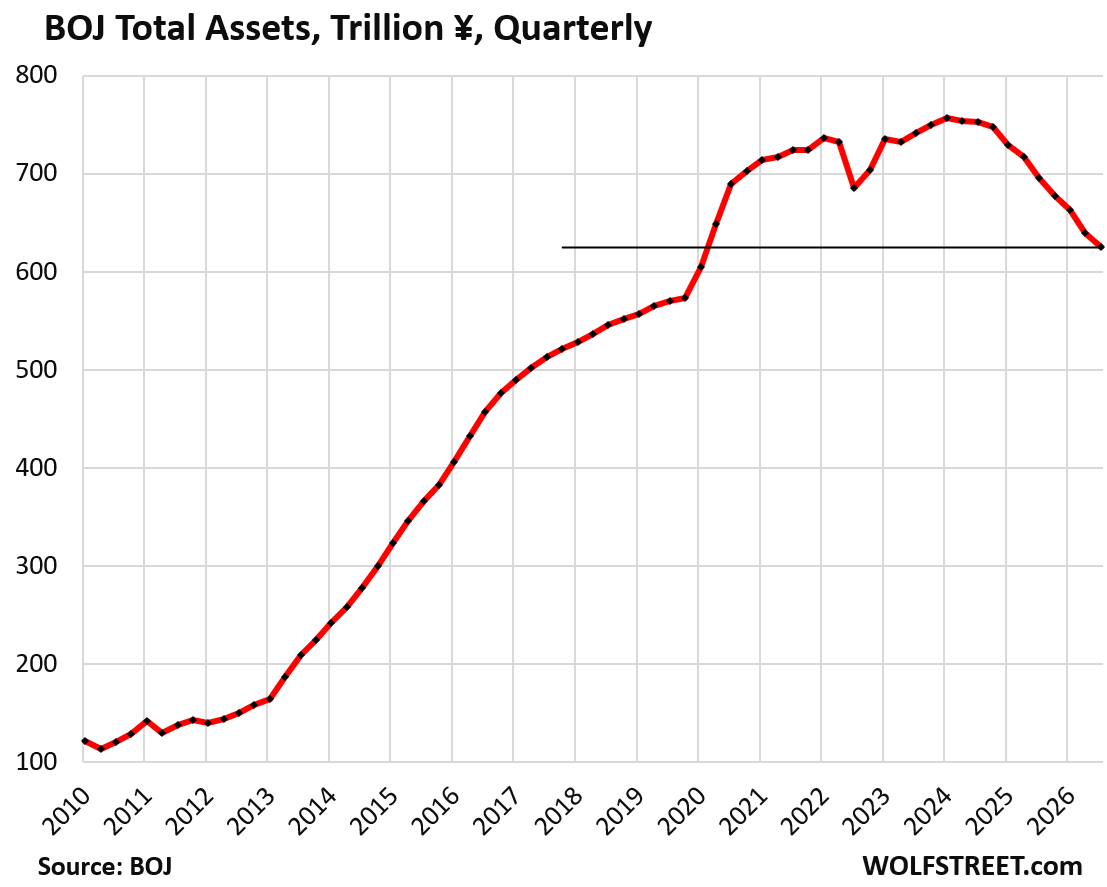
Total assets on the Bank of Japan’s balance sheet fell by another ¥15.5 trillion (-$98 billion) in the quarter ended September 30, and by ¥70.8 trillion (-$445 billion) year-over-year, to ¥625 trillion ($3.95 trillion), the lowest since March 2020, according to the BOJ’s balance sheet today.
Since the peak of its holdings in Q1 2024, the BOJ has shed ¥131 trillion, or 17.4% of its total assets – a substantial amount of QT in a relatively short period of time. The BOJ started QT about two years after the Fed, but the Fed stopped nearly a year ago, and the BOJ keeps going.
QT instead of rate hikes: The BOJ has raised interest rates at a pace of one baby step every Blue Moon, roughly. Since its first rate hike in March 2024, it has hiked its policy rates all the way to a whopping 1.25%, the highest whopping rate in 31 years, OMG! If this sounds ridiculous, it’s because it is ridiculous.
It shows how stuck the BOJ has been on free money, and it seems the only reason it is hiking at all is to keep the yen from collapsing further.
But it is using QT as primary tool to prop up the yen and deal with inflation that has been flourishing in Japan.
QT impacts long-term yields, and long-term JGB yields have soared: the 10-year JGB yield to 3.09% today, from negative in 2020; and the 30-year yield to 4.21% today.
As much as the BOJ is pussyfooting around with rate hikes, its QT, even if it started belatedly, is substantial and impactful on long-term yields.
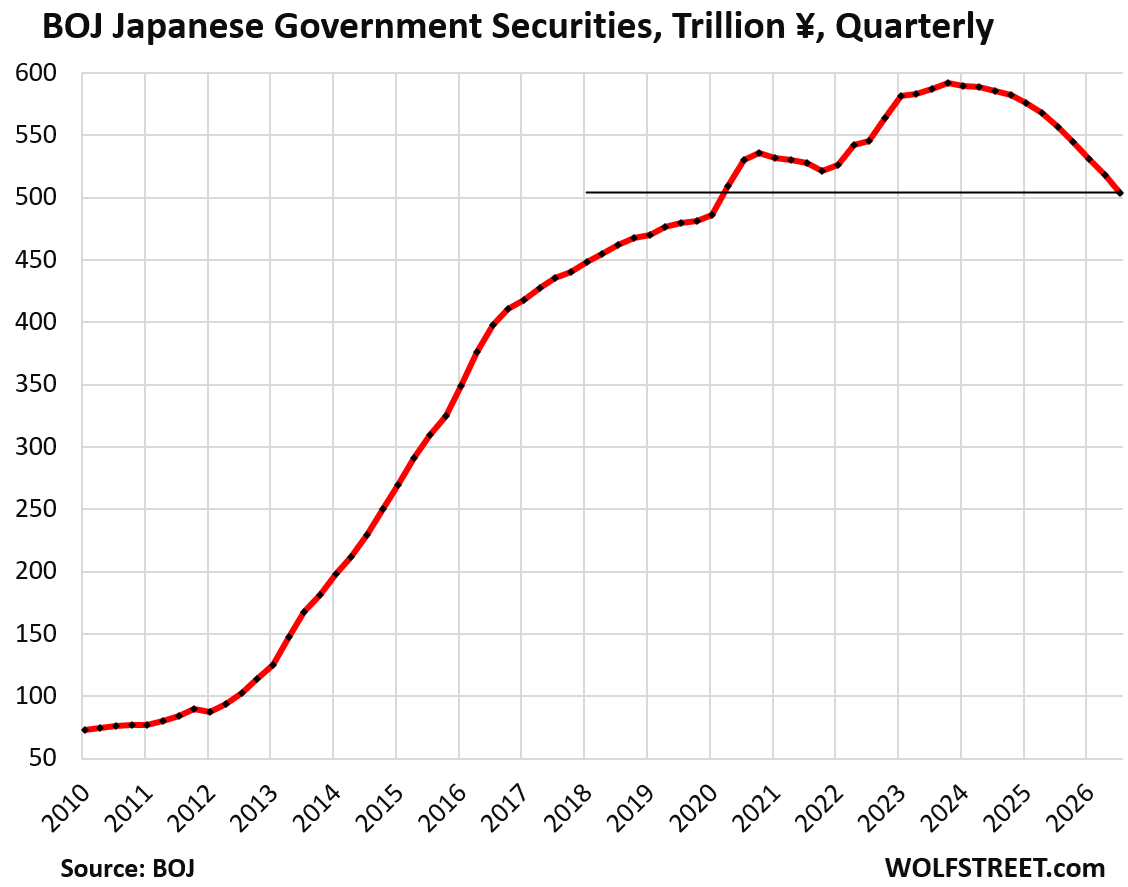
Japanese Government Bonds on its balance sheet declined by ¥14.3 trillion in the quarter, the biggest quarter-over-quarter decline since the BOJ started QT, to ¥504 trillion, the lowest since March 2020.
It no longer holds any short-term Treasury bills.
Since the peak in 2023, its holdings of Japanese government securities have dropped by ¥88.2 trillion, or by 14.9%. They now account for 79% of the BOJ’s total assets.
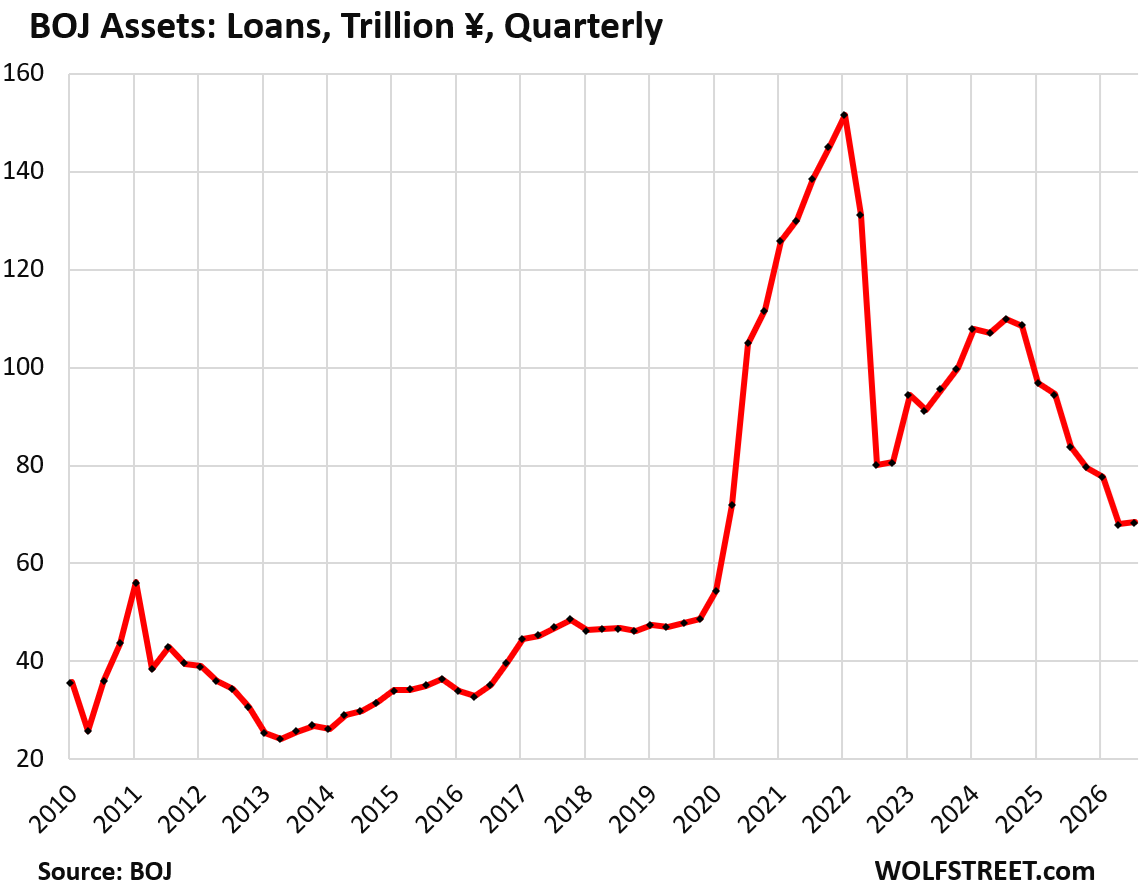
Loans remained roughly unchanged in the quarter at ¥68 trillion, after the plunge in the prior quarter.
Since the peak in Q1 2022, the outstanding loan balance has fallen by ¥83.1 trillion, or by 55%.
These loans now account for 11% of the BOJ’s total assets. The BOJ provided loans to banks and other entities under several programs, including the pandemic-era loans:
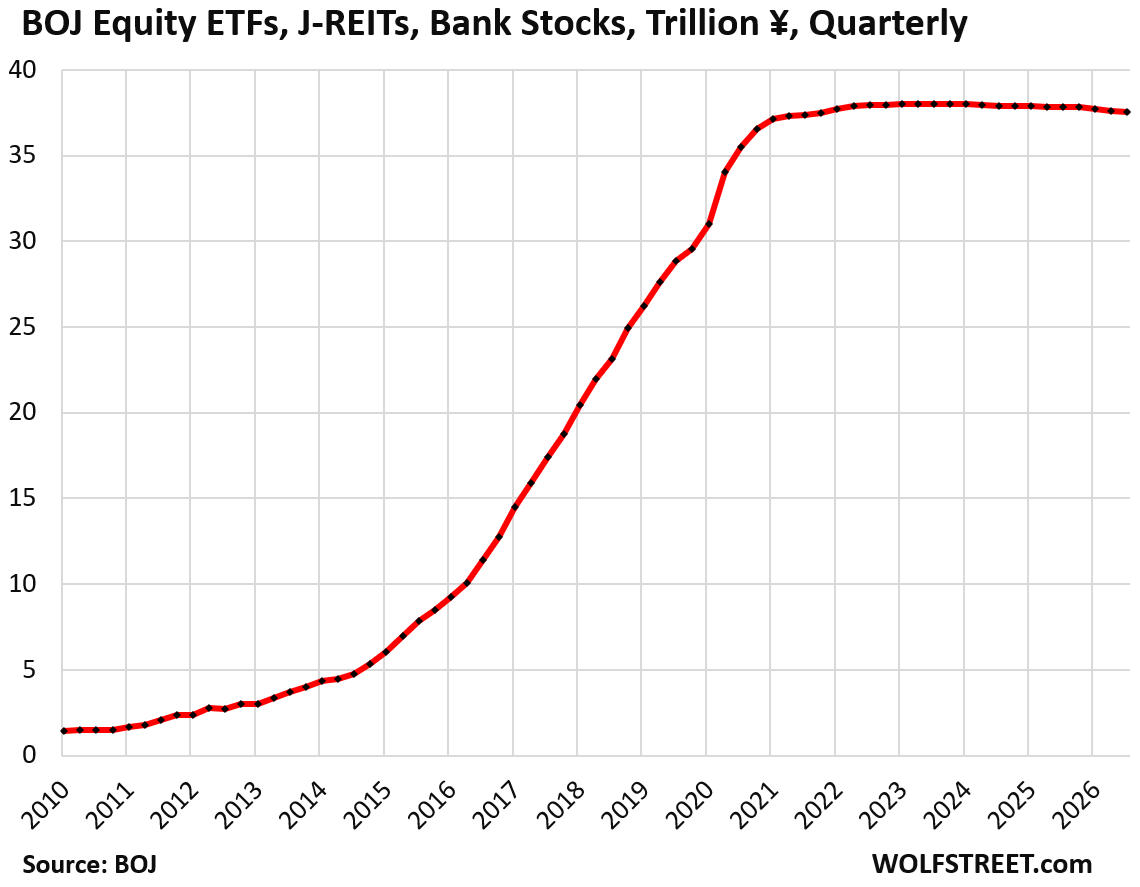
The BOJ started selling its equity ETFs and J-REITs this year. Unlike bonds that come off the balance sheet when they mature and are redeemed by the government, ETFs and Real Estate Investment Trusts are traded on the stock market, and they don’t mature, and to get rid of them, the BOJ has to sell them outright.
And it started doing that at a glacial pace. In Q3, it sold ¥90 billion ($568 million), of ETFs and J-REITs.
But that pace of sales is multiple times faster than it seems: The BOJ started buying the ETFs and J-REITs in 2011 and carries them at acquisition cost, and has not marked them up to market, while the Nikkei 225 has soared by about 500% over the period.
And the ¥90 billion in sales in Q3 were at acquisition cost. But measured in current market prices, the sales were by multiples higher.
The BOJ sold off its last bank stocks in Q3 2025. It had purchased them in the early 2000s and again in 2009-2010, and started selling them in 2016. It took nearly 10 years to get rid of them.
Its combined holdings of ETFs, J-REITs, and bank stocks (now at zero) have declined by 1.3% from the peak – so slow that it looks like a flat line on the 16-year chart.
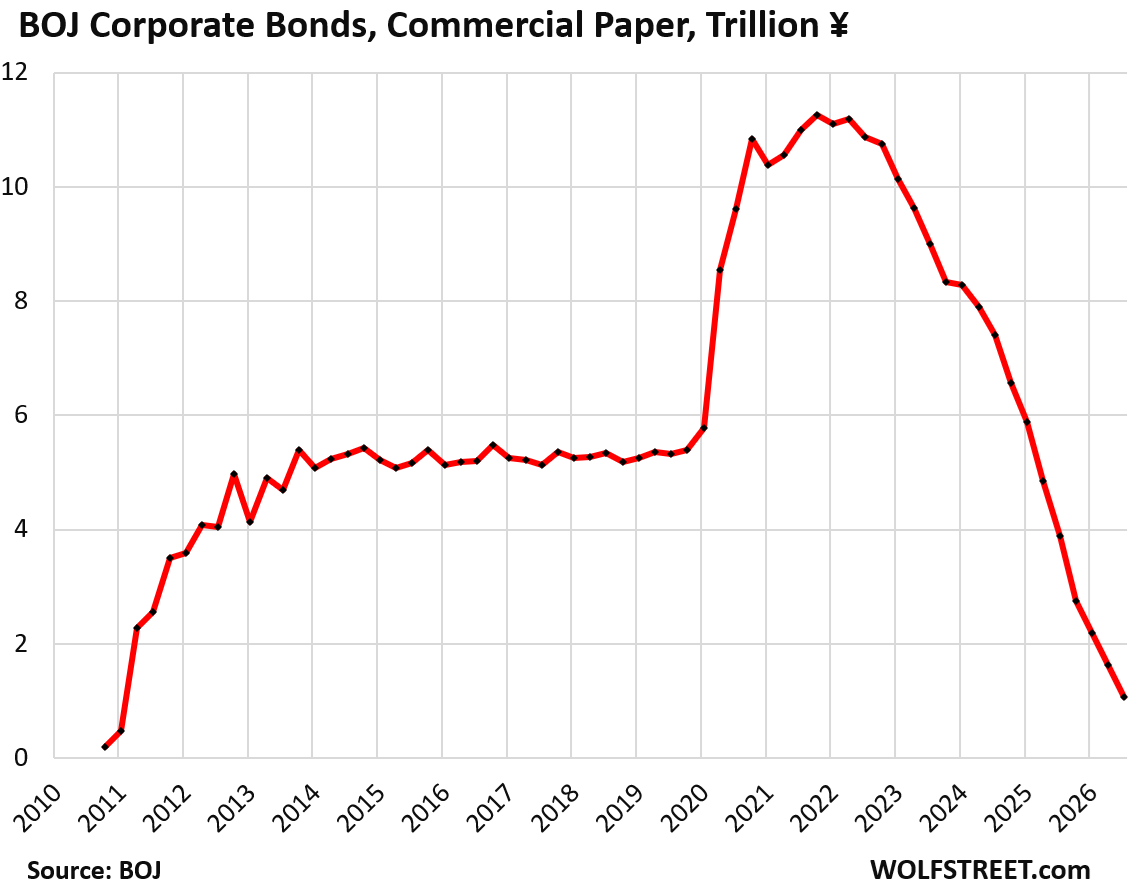
Corporate bonds fell by ¥560 billion in the quarter to just ¥1.07 trillion. The BOJ already shed its last commercial paper earlier this year, and they’re down to zero. They were always just a minuscule part of its balance sheet. Combined, they have declined by 91% from the peak.
Enjoy reading WOLF STREET and want to support it? You can donate. I appreciate it immensely. Click on the mug to find out how:


Google Gemini AI Slop
The Bank of Japan’s (BOJ) aggressive quantitative tightening (QT) and efforts to prop up the yen have a direct, unfolding impact on the US financial system. Because Japanese investors are the largest foreign holders of US debt, changes in Tokyo’s monetary policy reverberate heavily across American bond markets, corporate borrowing costs, and equities.
——————————
## 🏛️ Impact on US Yields and Borrowing Costs
The unwinding of decades of cheap Japanese capital directly alters the supply-and-demand dynamics of US fixed income.
[BOJ Pulls Back Liquidity] ──> [Japanese Investors Repatriate Capital] ──> [Fewer Buyers for US Debt] ──> [US Treasury Yields Rise]
* Downward Pressure on Treasuries: As the BOJ shrinks its balance sheet and yields rise domestically in Japan, US Treasury bonds become relatively less attractive to Japanese institutions on a currency-hedged basis.
* Higher American Yields: A reduction in Japanese buying forces US Treasury yields upward to attract alternative buyers. This increases the cost of borrowing for the US government.
* Consumer Credit Tightening: Because US mortgage rates, auto loans, and corporate credit are benchmarked against the 10-year US Treasury yield, American consumers and businesses face higher borrowing rates.
——————————
## 💱 The Unwinding of the Global “Carry Trade”
For years, investors borrowed cheaply in yen to purchase higher-yielding US assets—a mechanism known as the Yen Carry Trade.
| Mechanism | Past Regime (Cheap Yen) | New Regime (BOJ QT / Stronger Yen) |
|—|—|—|
| Borrowing Cost | Near-zero or negative Japanese rates. | Rising Japanese benchmark rates (1.25%). |
| Currency Risk | Yen steadily weakening against USD. | Yen strengthening or stabilizing sharply. |
| Market Action | Borrow Yen ➔ Buy US Tech / Treasuries. | Sell US Assets ➔ Pay back Yen debt rapidly. |
| US Market Impact | Fueled asset bubbles and high liquidity. | Triggers localized equity volatility and sudden sell-offs. |
When the yen strengthens rapidly or Japanese interest rates rise, this trade becomes unprofitable. Investors are forced to sell their US assets (especially highly liquid tech stocks) to pay back their yen-denominated loans, sparking sharp, sudden corrections in Wall Street equity markets.
So the question is; who or what entities are buying these ETFs and REITs?
they’re traded on the Tokyo stock exchange, and like anything that is traded on a stock exchange, investors are buying and selling this stuff during trading hours.
I would certainly love to see the Fed start to reduce its balance sheet more substantially. it seems that is part of Warsh’s plan, but i wonder if he can convince the rest of the committee that is the best way forward.
I think it’s a better idea than more rate hikes.
Note that in 2022, QT started before rate hikes got off the ground. Inflation immediately turned the other way and started falling fast. It wasn’t rate hikes that reversed the tide – not when the Fed Funds Rate was 0.5% or 0.75% anyway! It was the QT that started in March-April and accelerated through the summer of ’22.
QT is strong medicine, and the Fed has plenty of assets to spend on it. The question is, why has KevWar ruled it out, when it was a key part of the plan that got him nominated?
My guess:
QT would drive up the supply of treasuries for sale, and therefore push up rates. The Fed is operating under an implicit third mandate: to prevent an interest rate spiral. The sudden increase in rates makes KevWar unable to execute his QT plans without taking the blame for contributing to the interest rate spiral.
Scott Bessent’s volcanic temper laid bare: Trump’s money man hurled binder at wall and screamed profanities at deputy as SEVEN top officials exit
Treasury Secretary Scott Bessent once grew so enraged over the way his daily briefing book was laid out that he grabbed the binder and hurled it at a wall.
At least the man has some minimum standards. Hand him stupid trash, win stupid prizes.
Wolf, what’s your opinion about the effectiveness of QT (and it’s impacts on long term yields) in propping up the yen? In one hand, it would reduce the incentive of japanese savers to send their money abroad (in terms of yield diferentials) but it would do nothing to deter those who borrow in yen to leverage a position in US Treasuries; only short term rates would disincentivise that. On the other, the risk of more currency devaluation and surging us rates keep Ms. Watanabe sending her savings to the US… and Bessent’s sleight of hand tricks and the MOF interventions murk the picture even further.And as a second question, do you know any indicator that could track how the market evaluate those trends?
The yen used to be very strong within the exact scenario you describe.
The yen is now weak because the BOJ diluted it with its mega QE, and because the BOJ’s interest rates are way too low compared to other countries. It’s the collapse of the yen that put an end to the BOJ’s free money policies. All monetary sins ultimately lead to the currency.
2011 was a bold year for rescue, 2012 was more of a bold year with “ Within our mandate, the ECB is ready to do whatever it takes to preserve the euro. And believe me, it will be enough.”, we here in the USA are in denial of the current situation. The bull market in equities is hanging by a thread, when that thread gets severed we will have a week like October 24 to October 29, 1929, or a day like Oct 19. The yield of the 10 year will be the catalyst, 3 days in a row of closing yield above 5.32% will spike the $vix and create the input for the trading algorithm to sell, we will have a historic Oct drop like 29 and 87. We will get some story of why this fear is spiking but it’s really about the yield of the 10 year(and the reason behind the selling of the 10 year). Just not sure when day 1 will happen, maybe today it’s like people are throwing billions to suppress Vix and keep yield under trigger level to unload trillions in global equities. Oct 2026 will be remembered as the start of the great unwind, even though as wolf article shows the unwind started earlier, when you tap on the brakes of a run away semi not much happens, the 10 year yield will be the runaway truck ramp! Thanks for the articles as always and the format for discussion!
“The bull market in equities is hanging by a thread, when that thread gets severed we will have a week like October 24 to October 29, 1929, or a day like Oct 19.”
It doesn’t appear to be hanging like a thread at all. In fact, it’s rocketing higher. I have been hearing about this imminent stock market collapse for years, yet it continues to rocket higher.
When Jerome Powell paused rate hikes, I said at that time here on Wolf’s site that the DOW would be rocketing to all-time highs. Even Wolf himself said “how?” because of the fact that QT remained. The DOW is up 20k since then.
There is nowhere left for this market to go except down. The only good thing that can happen to it is an end to all the tariffs, and that is the one pro it has. More cons than I can list-the biggest of which is Japan’s QT!
False. It just went up bigly today, and will go up bigly some more. New all time highs, coming right up. The billionaires and their political puppets have completely rigged everything for their own personal enrichment.
“The yield of the 10 year will be the catalyst, 3 days in a row of closing yield above 5.32% will spike the $vix and create the input for the trading algorithm to sell, we will have a historic Oct drop like 29 and 87.”
Today’s VIX is 15.16, near the low end of its historic range.
What, exactly, makes 5.32% a number that will cause a sudden reversal and market crash, when all previous numbers did not?
Yeah I’m not a technical trader, but the 10 year in the 5-6 range doesn’t seem that terrifying.
What’s the term for that corrupt practice of the Japanese government rewarding a select group of top companies in the country, which lead to the “Japanese miracle”. American business dweebs where studying Japanese, American pundits were encouraging business types to study the Japanese techniques to bring the same golden era of prosperity to the USA.
A system based on corruption does have its limits and while the chosen few enriched themselves, the rest of the patsies who fell for the scam suffered the consequences of the lost decades, yet unto this very day.
I seem to recall Milton Friedman having been duped by this crooked approach or perhaps he was in on the sucker play himself and profited thusly.
Anyway, I seem to recall this being called “guided something”.
Wolf? Anybody?
Don’t forget to go to the dojo kids. (Heian 1?)
O yah, and eats lots of raw fish. You can see what it did for Gollum.
You are very informative and have a great way with words. I had not realized QT was doing the heavy lifting for Japan, versus rate moves. Thanks, Donald
When the US Fed pushed “QT too far,” there was a spike in the REPO rates; the Fed used one of its facilities to dampen the spike, and then stopped QT.
Is there any obvious limit to the Bank of Japan’s QT, or are they so far away from anything like a limit that nothing is visible for the currently foreseeable future? Does Japan have anything similar to the US’s reop market?
The September 2019 Repo Crisis (where the remuneration rate vs. SOFR rates, Secured Overnight Financing Rate – a broad measure of the cost of borrowing cash overnight collateralized by Treasury securities) was inverted. I.e., the FED’s artificial remuneration rate interest rate inversion.