
Some thoughts on how I’m easing back into a bond portfolio after 14 years of interest-rate repression.
By Wolf Richter for WOLF STREET.
The 10-year Treasury yield, after one heck of a ride, closed the week at 5.28%. Eight trading days ago, the 10-year yield had blown through the 5% line after bumping into it for days, and on Thursday, it hit 5.36% intraday, bounced off and fell, and Friday morning, when the employment headlines were blurted out, it dropped to 5.15%, and it was like, here we go again, the floodgates of demand have opened, and the massive buying has started again, the way it did on October 23, 2023, when the 10-year yield hit 5% intraday briefly, but then plunged amid massive buying from tickled-to-death investors, and then they kept buying and the 10-year yield kept plunging for the rest of the year until it bottomed out at 3.79% at the end of December.
But not this time. This time, the bond investors started looking at the jobs data Friday morning and found that beyond the headlines in the media, the data was pretty decent – private-sector employers created 46,000 jobs, governments shed 17,000 jobs. And they remembered that the other issues were still hanging over the bond market: The deficit and the flood of supply of new bonds that the market will have to absorb; the debt racing to hit $41 trillion; the nasty inflation that refuses to go back into the bottle; the competition from AI bonds that are luring investors with much higher yields at much higher risks; the economy that’s running hot… It was still all hanging over the bond market.
And the 10-year yield began re-climbing Friday morning, hit 5.30% again in the afternoon, and then settled at 5.28%. During the week, it rose 11 basis points. But on Thursday and Friday, the yield spanned a trading range of 21 basis points; that was a lot of volatility in two days, and the yield ended on a high note.
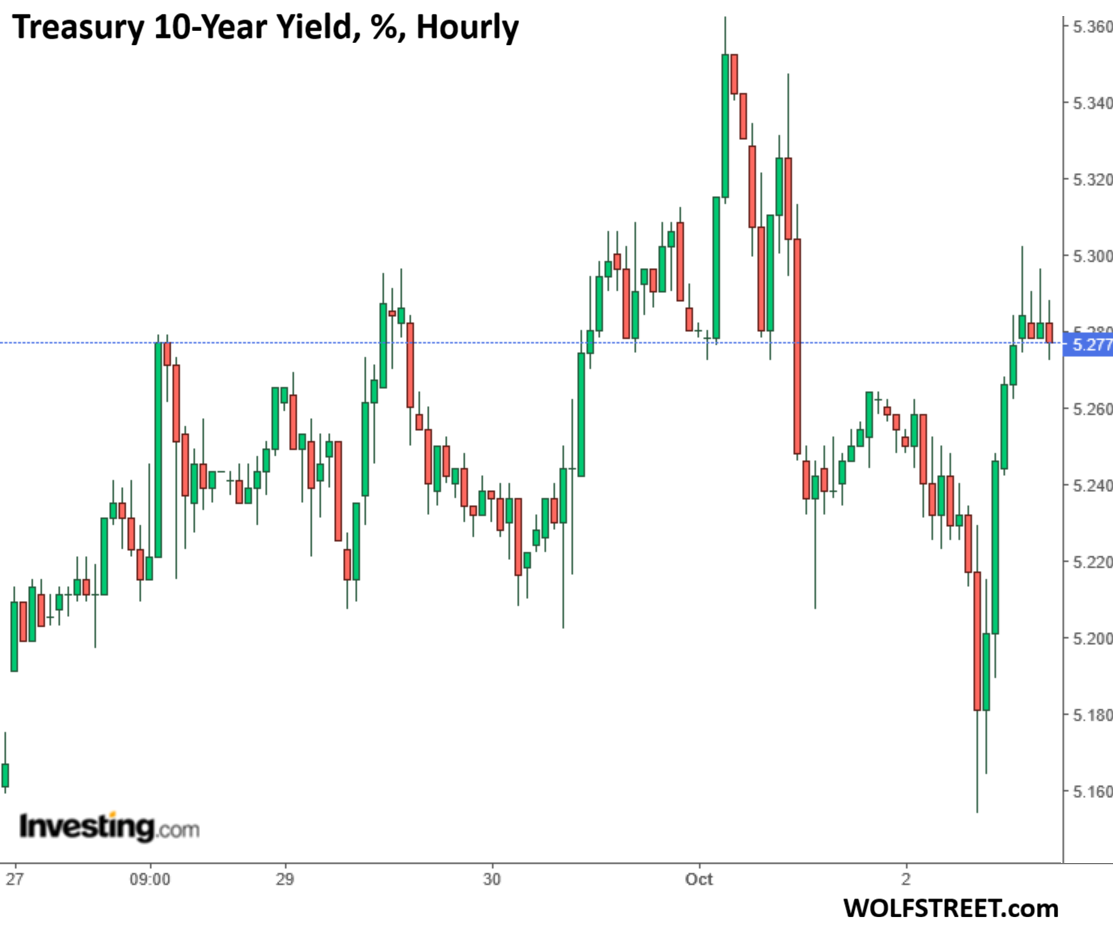
Rising yields mean falling bond prices for existing holders. In price terms, there was a big rally on Thursday through Friday morning, with investors smelling the opportunity and piling in, and thereby driving down yields, but then the rally fizzled and prices fell again, and yields rose.
This bond bear market started in August 2020, following a 40-year-long bond bull market, when yields kept zigzagging down.
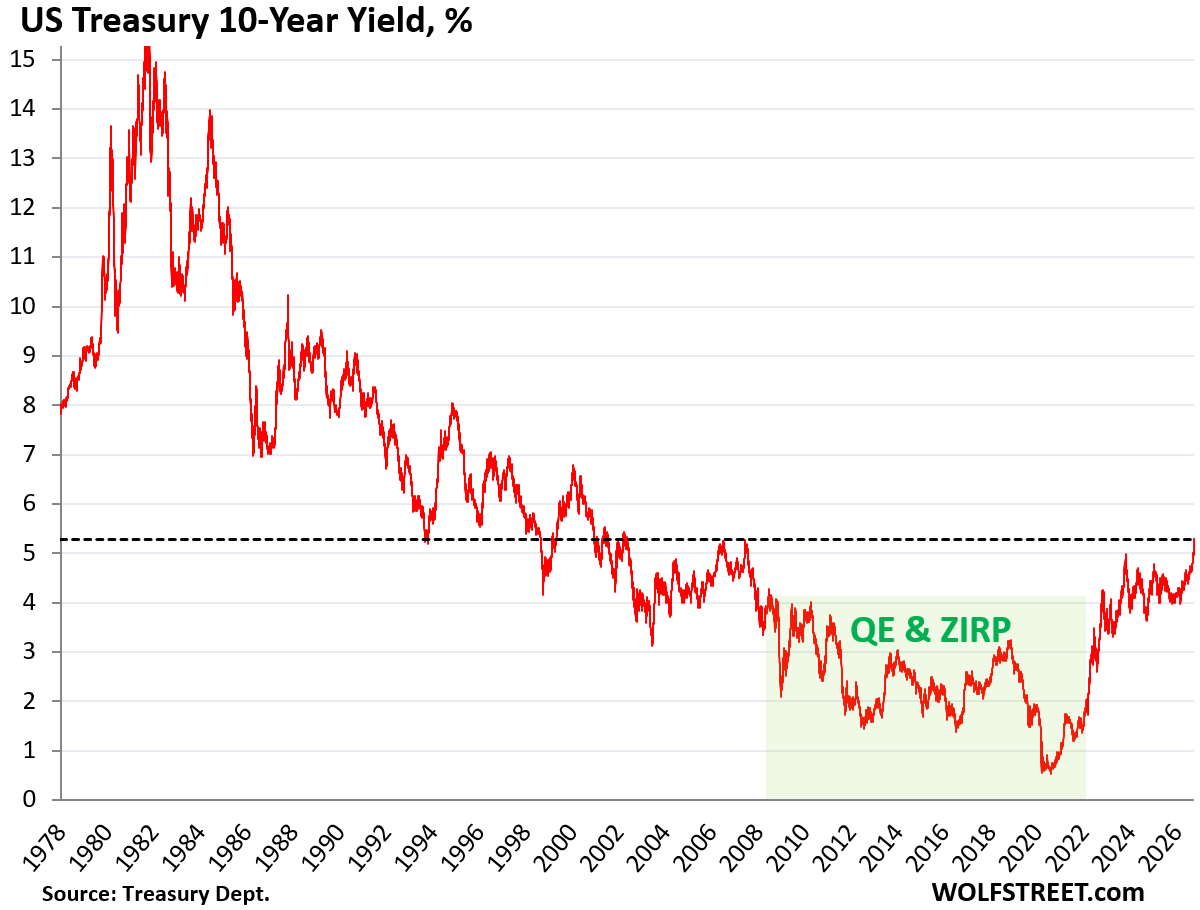
We’re now six years into the bond bear market, during which time the 10-year yield has risen from 0.5% to 5.28%.
Yet, long-term Treasury yields are only back in the lower end of the range that prevailed before QE had killed the bond market.
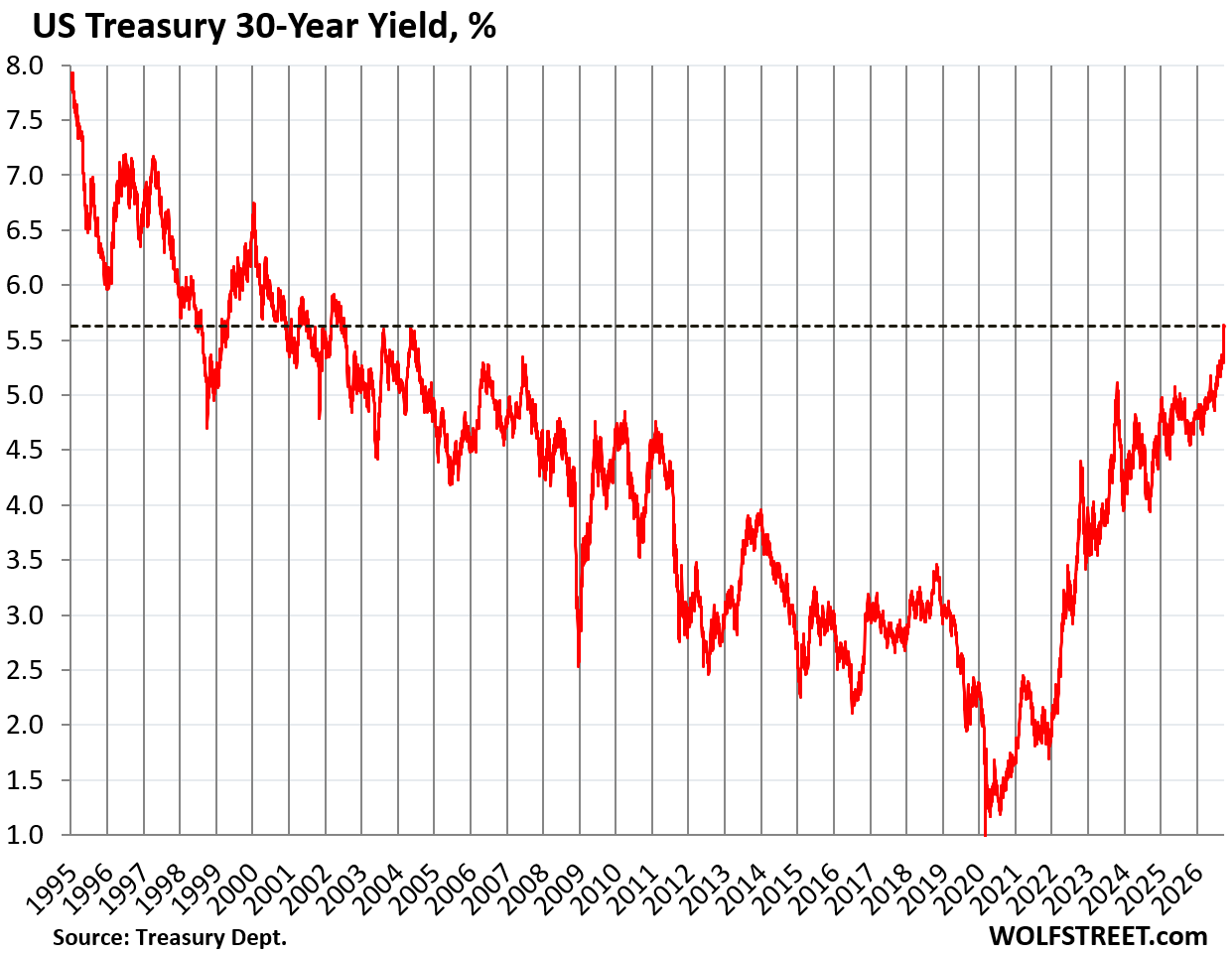
The 30-year Treasury yield closed the week at 5.63%. On Thursday, it had briefly kissed 5.69%, the highest since 2002.
Why would anyone ever do something like that?
Investors who buy 30-year bonds at the Treasury auctions take the substantial risk that the market price of the bond will plunge during its 30-year life if yields rise a lot further than at the time of purchase. Investors who bought 30-year bonds at the auctions in the summer of 2020 are now looking at a decline in market value of over 50%.
Here’s a real price: The Treasury Department, as part of its Treasury buyback auction on September 24, bought back $1.5 billion face value of a 30-year bond (CUSIP 912810TB4) that had been sold at the auction in November 2021, after yields hear nearly doubled from the low in the summer of 2020. People who bought that stuff thought they got a deal, locking in a big-fat coupon interest of 1.875% and a yield of 1.94%.
The price now: 50.6 cents on the dollar. That’s what the Treasury paid for it at the buyback auction. 30-year bonds that sold at auction in the summer of 2020 sell for less than that.

If an intrepid investor bought $1,000 face value of this bond in the secondary market on September 24, also at 50.6 cents on the dollar, they would have paid $506 for it, and when that bond matures in November 2051, they will receive the $1,000 in face value, for a capital gain of $494, and they will have collected $18.75 in coupon interest every year for 25 years, for $469. So the return on the $506 investment is $963 over 25 years.
And if something bad happens a few years from now, such as a massive recession, long-term yields will plunge, and if that something morphs into something even worse that causes the Fed to restart QE to push yields down further and re-inflate asset prices, those bonds with lots of years left to run will spike in price as yields plunge. That intrepid investor who bought that bond at 50.6 cents on the dollar might then sell it for more than face value for a big capital gain many years before maturity.
So that sounds pretty good unless there’s a lot of inflation over those 25 years, with the economy running hot. All kinds of inflation could happen over those 25 years.
Inflation eats up the purchasing power of investments. And either yield or price gains or both are supposed to make up for that loss of purchasing power, plus some.
But note, there were periods in the US when inflation spiked to 15% or more. If you buy a bond with a yield to maturity (which includes the capital gain at the end) of about 5.6%, which is what this bond bought in the secondary market at 50.6 cents on the dollar last month roughly produces, and inflation averages 2% or 3%, it’s a pretty good deal.
But if inflation averages 5% a year over those 25 years, the bond is not a good deal anymore. And it could be a lot worse. So that’s a big risk, and the probability of this occurring is something that buyers need to figure into their calculus.
To this observer, inflation will remain a major issue, and an average inflation of 2% or 3% over the next 25 years seems unlikely.
Is there “Blood in the Streets” yet?
Buy when there’s blood in the streets, is the old axiom for investors. There was Blood in the Streets of bondland in the late 1970s through the mid-1980s when the 10-year Treasury yield was over 10% and as high as 15%, and inflation was raging, and you had to have brass cojones to buy this stuff. But that was the time to buy long-term securities. Those turned into good deals.
At a yield of 5.6%, the 30-year Treasury yield is not at the blood-in-the-street level, nor is the 10-year yield at 5.3% They’re just sort of normal yields after 14 years of interest rate repression, and they’re somewhat low given where inflation is.
But for me wanting to ease back into a bond portfolio, there is a lot to think about – after not holding bonds for a long time as 14 years of interest rate repression turned that generation of bonds into toxic un-investable waste. And I’m going to share some of those thought here.
This is obviously the furthest thing from financial advice ever. I’m just sharing some of my own strategies and thoughts concerning my own portfolio.
“Good enough to nibble” for this observer?
As I mentioned a few times in the comments last year, I started nibbling on TIPS in the second half of 2025 and in early 2026. That was too early.
I will likely nibble at the 10-year Treasury auction this coming week. And that will also be too early, as I expect yields to rise further.
I’m kicking some tires in the secondary market to look for deals in the 20-year range, such as a 30-year bond issued 10 years ago, or a 30-year TIPS issued 10 years ago, roughly. And those buys, if they materialize, will also be too early, as I expect yields to rise further.
I’m not ready to nibble on a 30-year bond at the auction. That’s just too risky. I’m not even sniffing on it. 5.6% might sound tempting, but it’s not very tempting to me because I fear inflation will be worse over the next 30 years than the bond market expects.
But the 30-year TIPS auction in February might be worth sniffing on if the TIPS yields move higher.
I’m sniffing on maturities in the 3-7-year range, which would be a bet that longer-term yields will be higher in 3-7 years than now, and I could replace those maturing securities with longer-term securities at a higher yield than now. If I nibble on them, it will also be too early as I expect yields in that range of maturities to rise further.
“Too early” means that the market values of these securities will fall below the purchase price for a period of time, as yields rise above the yield at which I bought the stuff. But I intend to hold to maturity, so market value is not an issue.
The issue is whether yields are “good enough to nibble.”
And to this observer, some of the yields are good enough to nibble – but not good enough to do more than nibbling. They’re just mildly appealing. They’re far from the Blood-in-the Streets moment where you’d want to back up the truck and load up.
And they come with very unappetizing risks, as mentioned above.
Because every buy will be “too early” unless proven otherwise, I will just nibble here and there over the years. There is no hurry. There will be better buys in the future, in my opinion.
But it’s not really possible, except with a massive amount of luck, to pinpoint in advance that one day when yields peak and then during that one day build a bond portfolio from ground up. So to nibble here and there over the years gets that process going.
I’m funding these buys by cashing in T-bills and money market funds. “T-bill and chill” was designed 1. to get through the years of long-term yields being insufficient to compensate me for the risks; and 2. to have some cash available when there is “blood in the streets.” T-bill and chill was never a forever-investment strategy.
Corporate bonds are off the table for now, because the spreads to Treasuries are still to narrow to compensate me for the credit risk they pose. But once corporate bond spreads widen enough, I might be sniffing on them too – investment grade only.
Junk bonds have a substantial amount of credit risk (the risk of default where unsecured bonds tend to get wiped out) and tend to have Blood-in-the-Street moments more often. I consider them in the same risk category as stocks. And there’s a time to do that, but that’s not on my horizon.
What’s on my horizon is very slowly easing my bond portfolio back to life after 14 years of interest-rate repression had turned that generation of bonds into toxic waste.
Enjoy reading WOLF STREET and want to support it? You can donate. I appreciate it immensely. Click on the mug to find out how:


Fantastic perspective, Wolf. I understand your thought process. It is thoroughly rational and fact driven. We are kindred souls. However, I have lost all faith in both political parties (Democrats and Republicans) to do the right thing… to do the heavy lifting of managing government fiscal and monetary policy responsibly… and to protect all of us (rich, poor and in the middle) against inflation. We are at a crossroads. I was fooled more than once by both parties, especially by the Democrats under Biden and the Republicans under Trump. Shame on me for being the fool. I will not be fooled again. I will not buy U.S. Treasury bonds again (although I will buy Treasury bills in the short run because often they are a better deal than the banks offer).
I look forward to reading the comments on your analysis today!
I’m watching the SPV of AI companies – around $800 B today
remember they are holding assets of depreciating kind
in 2026 they might be cutting edge – A rated
in 2027/28 they start getting older(non-cutting edge) and become B rated
if I was lending $1 to these guys I would want no longer than 4 year terms at 10%+ rates
don’t think companies can withstand coming debacle of enron era
I’m sure there are good sources for this but I can really never comprehend what number I should be looking at in secondary market yield I will get. I tend to do auctions but if anyone has insight on how to easily explain what number is relevant it would be appreciated. I use Fidelity if it that matters.
In terms of notes and bonds: “Yield to maturity” in the secondary market is what to look for. It’s the yield calculated from the interest payments over the life of the bond, plus the difference between the price you paid and face value. I gave you an example in the text.
This is also what the auction yield shows. The auction price is usually not face value, but some amount slightly above or below face value. The auction determines the price.
If I follow your example correctly, that 2016 30-year with a sub 3% coupon must carry a substantially lower price to justify buying it versus the current 20 year at 5.6%.
Correct.
In DrgTX’s example above of buying a 3% coupon treasury at a discount, when that 3% bond matures at (par) value, is that differential taxed at the capital gains rate? (Or if it sold closer to maturity at a higher value)
I.e., is there a tax advantage to buying a discounted bond (assuming it’s held in a taxable account)?
Sorry if this is a nerdy or obvious question…
Thanks
Yes, that’s called “original issue discount” when it starts out that way from the issuer.
I’m not a pro but I have some experience. Here’s what I do:
First, I look at the credit rating and gauge the issuer. (Not so critical for Treasuries, but matters for most other issuers.)
Then I look at “Yield to Maturity”, AND “Yield to Worst” (which matters if the bond is callable).
Third, I look carefully at the price. If the price is below 100 (below par), then some of my yield is coming via capital gains rather than interest, and the tax laws are different for each of those. For a given “yield to maturity”, my after-tax yield can be quite different depending on the coupon interest rate and the price vs. par.
P.S. For many years, a big chunk of my kids’ college funds was in muni bonds. We had bonds from about a dozen issuers, half here in California and half in more-sensibly-run locations around the country for diversification. So then on travel when we passed through one of those towns, it would remind me about the muni bonds, and I’d tell my kids how bond lending worked: we’d helped that community fund a school or library or university construction, and in return they were helping pay for my kids to go to school.
Munis are no longer worth it for me tax-wise, and I regret that because I never, ever get that same warm fuzzy feeling about owning Treasuries…
Yup, I like the warm fuzzy aspect of munis. None of these cities or counties are buying bonds.
I meant to type bombs
For finance nerds only, with apologies in advance. Here is the brutal math behind translating the Treasury’s “Discount Rate” (that isn’t comparable to anything that matters) to the “Interest Rate” that actually does matter…
The Treasury’s reported “Discount Rate” is a rough under-approximation of the actual Interest Rate:
Issue Price = {Par} x (1-[{Discount Rate} x ({# days to maturity}/{360 days}])
Interest Rate = ({Par}/{Issue Price})^[365/({Issue Date}-{Maturity Date})]-1
Well, since the bond market is in a generational bear market
I would say don’t buy long yet
With full disclosure that my financial advice has been a winning signal for placing a bet against my prognifications
I hear ya dang!
Found out long ago that I could make the stock market drop simply by buying some stock(s)…
Told friends that, and they hired me when they wanted to short something.
Worked well — for them, eh? LOL
There is a lady on YouTube diamond savers or something.
It’s all incredibly boring but she goes over that selling regular treasuries gets you xyz amount of $.
Obviously If you bought at 2.5% and now we are at 5.5%, you’re gonna take a nice hit if you sell. Now if you wait until rates nose dive to 0%, maybe you’ll get more favorable terms?
It’s prob best just to ladder and hold to maturity if you can. Let the beans fall where they may. It’s kinda like gambling on the most boring instrument on earth. Lol
I dont understand why anyone would buy a 30 yr bond when the 10 yr rate is not much lower.
I myself buy munis and I was impressed by the yields friday. Liquidated a Money market account and was able to get higher muni rates tax free. Good returns because the bonds sell at a discount. At my age I need to transition into more bonds anyway. Timed to mature when I expect to need senior care.
The obvious answer is that they expect long term rates to drop. They think that you will not see these 30 year rates again in the next 10 years.
I don’t agree with that thinking, but it is why they are buying the 30 year.
Yeah usually they are plugging a need.
I need 20,000 for 30 years, so I will put down so many millions and rake in my 20,000.
Not many people have that problem. Haha
Now in 10 years your 17,000 you get will end, and rates could be depressed the 20 years after that. Then you’ll be pining for that old 30 years after.
With irresponsible fiscal policies and incompetent monetary policies (I know Wolf will disagree the monetary one), I totally agree that inflation will be elevated in coming years. The genie is out of the bottle. Everybody should get used to over 5% rates.
Wolf,
This is a great article. I appreciate it a lot. The reason I think it is so good is that this is one of the rare “prediction” articles you produce.
One of the things I have always appreciated about your articles is that they are very straightforward, filled with facts about what is going on RIGHT NOW. You never speculate, you never tell the reader about what to think about the future. So many people in the media poison their viewership by telling them what today’s events mean for the future. You do not do that (and it is greatly appreciated).
So to have the occasional article about what you are doing and why you are doing it which belies your future thinking is refreshing and informative. What makes it great is that younare not telling readers what to think, you use the right words to let them know what you are thinking and where you putting your money.
Subtle, but a huge difference.
Very good.
Well said. Yes, Wolf is a gem!
Re “Investors who bought 30-year bonds at the auctions in the summer of 2020 are now looking at a decline in market value of over 50%.”
No, it’s far worse than that, because they also got hit by a substantial loss of purchasing power. They lost half their vintage-2020 dollars and on top of that, they cannot reinvest into anything at 2020 prices. Stocks, gold, houses, cost of living – everything now costs at least 20% more and in many cases much more than that. That makes the compound loss more like 60-80%. (Who knew that you could lose almost as badly in bonds as in stocks?)
The Treasuries sold in 2020 should’ve revived the 1970s nickname for bonds: “Certificates of Wealth Confiscation”.
Also, you mention quite a few times in this article about “being too early” with your purchases. To me, that is the nature of “laddering” into a position. By definition, a ladder targets a range of entry points. Ideally, some will be to early and some will be too late.
I won’t start buying anything other than T-bills until I see a 5.5% yield on a 5 year Treasury note. After that threshold is crossed, I will look accross all bond categories and maturities is search of best value.
You’re doing better than me, I started nibbling in 2025….
For yields to have any meaningful decrease, either the supply has to drop or demand has to increase, and I cannot see how either of those will happen anytime soon. I’m sticking with shorter durations until the 10/20/30 is in the 7.5% range and at that point I’ll start backing up the truck.
Wolf
Until after midterms there will be no resolution in the ME or Ukraine. That is as sure a ‘lock’ as currently exists. All the participants are still squabbling and now the EU is sword rattling at Russia and Xi is ditto over Taiwan. Call 2026 the Year of the Taco Bar in honor of Trump. If this keeps up, oil could be much higher next year and bonds have been trading in lockstep with crude. It wasn’t long ago we were bumping in the upper fives with the 1-3 month Bills. I actually slipped in a purchase just over 6% on a 4w when the auction spiked one day. I will be very happy if Bills get back in the mid 5’s next year because I think rates are headed that way. Looking for 6.8% on the Ten year in 2027 and perhaps 6% on Bills.
Bullshit.
Exactly when did 28 day t bills go above 6?
The highest I ever remember them being recently was about 5 and a half and that was a while ago.
I was as surprised as anyone. I had my 4 week on auto pilot an just checked it one day and the investment rate was a hair over 6. Pretty sure I posted it here back then but don’t know how to search for it. Literally a one day blip.
Look at a 5 year chart of the UST1M
Look at May – Jul 2023 on Stockcharts
No need to apologize. We all make mistakes and jump the gun.
I haven’t seen 6 and I look at it a good bit.
Just look up the treasury rate curve.
1 month treasuries are at 4
Just want to toss out there that if you like Treasuries at these yields, you might enjoy getting a much higher yield on lower-rated bonds. Spreads just widened out quite a bit – lower-rated borrowers are getting squeezed.
See these FRED series:
BAMLH0A0HYM2 (BofA high yield index OAS just leaped from 2.7 to 3.2%)
BAMLH0A3HYC (CCC & lower Junk spreads surged from 10.8% to 12.1%)
Even vanilla corporate BBB spreads are poking up after being dormant…
Hold out until the BBB spread is 3%. That’s the historically best time to buy.
P.S. I know you covered spreads briefly in the article, just thought more color might be valuable to the readers. Personally I don’t touch lower-grade credits, but if I did, I’d also trade those bonds like stocks.
It also looks like mortgage spreads are widening, which is potentially good news for those contemplating buying mortgage bonds, although bad news for those wanting to buy a house or condo.
Meanwhile, Series I bonds look like a terrible deal right now.
The one thing I want to add to your point is that junk bond investment requires credit analysis of the company whose bonds you’re buying. You cannot go by the credit rating. You will have to determine on your own what the chances of a default are, and then what your recovery is if there is a default. If you buy an unsecured bond of a company with more debt than assets, and possible hidden debt (such as factoring of receivables), you could lose your entire investment. That’s why junk bonds are more like stocks.
Probably a good point to remind readers that if you try to dodge the “issuer risk” by investing in a fund or ETF (like JNK or HYG), then instead you have the risk of a “run on the fund” leaving you high and dry.
Been a long time since you had an opportunity to write about runs on the funds!
Most recent article I think was October 28, 2019:
https://wolfstreet.com/2019/10/28/first-mover-advantage-run-on-the-fund-liquidity-mismatch-big-risk-of-bond-loan-mutual-funds-what-smart-investors-do/
Thanks for the blast from the past. That article is still valid. Everyone should be aware of that risk There have been runs on the fund in the world of private credit recently. And investors have found out what “gating” means.
ETFs have a much smaller risk of a run on the fund than mutual funds because the liquidity is provided by other investors, and not the fund itself, and a lot has shifted to ETFs in recent years. But a run on a bond ETF can cause of other problems.
Wolf, do you ever consider stocks with Qualified Dividends as an intermediate investment between treasuries and junk bonds. They have very significant tax benefits depending on your tax bracket and due to the recent sell off in non-AI related stocks, there are some quality stocks sporting dividend yields of 6-7%. Thoughts?
Stocks that pay an enticing dividend often cut their dividend or eliminate it altogether as their stock price crashes, and then you lost your income and got bashed on your principal. That’s the risk. If a company tries to not pay the interest on a bond, it’s a default, and companies will only do it if they’re approaching bankruptcy. A dividend can be cut at any time, and there is nothing to stop the company from cutting it. So dividend-paying stocks are NOT like bonds. They’re stocks. And that’s fine if you want stocks. But they’re not a replacement for bonds.
I for one think that the 10 year is extremely overpriced.
The interest paid, and the risk, and inflation suggests that the long term interest rate is priced for suckers
Unaware of the financial leverage that interest rate increases have on their savings that were invested at 1.5 pct back in the massive monetary injection with the advent of QE
Certainly worthy of a fake noble
Congress is running up over $2 trillion in annual deficits now. Problem is, neither party has proposed anything near serious enough to attempt to balance the budget, little lone cut back or damper spending. Recent chatter from the Trump government that a certain amount of inflation could be a good thing is definetely an issue to keep an eye on. That kind of talk is the last thing our country needs. Trump’s wide-scale and blatant “checks” for votes not only kills the thought of any meanifull restrait to temper government spending. Trump has created new levels of government corruption and he unabashedly brags about it.
If this administration had a policy goal of pushing inflation as high as they could and ending the reserve currency status of the USD, in exactly what ways would they be doing anything differently than they are now?
Oil wars, tariff wars, political pressure on the Fed to lower rates, Bessent’s hocus pocus credibility destruction, the Big Beautiful Bill leading to multi-trillion annual deficits, partial socialization of corporations, semi-annual reporting, and erosion of rule of law and democracy itself… and that’s just in the first two years!
The billionaires running the ruling party in the U.S. act like they are billions in debt. Oh wait, they are!
But it’s OK, I’ll just keep voting for whomever puts the most ads and influencer content in front of me.
Where are the Zero Coupon Bond funds?
The province of the annuity market I suppose
The larger question is why would anyone consider buying long term US bonds at the current interest rate.
The answer is: humans have weird decision making logic.
I suspect money managers are allocating into IRA’s and the stooges(er, benefactors) are typical workers trusting wall st. to take care of their retirement for them.
Long-Term: Treasury STRIPS
Secondary Market Creation: The Treasury does not sell long-term zero-coupon bonds directly at auction. Instead, long-term zero-coupon Treasuries exist through the STRIPS program (Separate Trading of Registered Interest and Principal of Securities).
How They Work: Financial institutions and government bond dealers take standard fixed-coupon Treasury Notes and Bonds (such as 10-year notes or 30-year bonds) and “strip” the semi-annual coupon payments from the principal payment. Each isolated cash flow becomes an independent zero-coupon security backed by the full faith and credit of the U.S. government.
How to Buy: Treasury STRIPS can be purchased in the secondary market through major brokerage firms (e.g., Fidelity, Schwab, Vanguard, Interactive Brokers). They are not available for direct purchase on TreasuryDirect.
Note : even though you don’t receive any coupon payments or any other form of income until maturity, you are TAXED on the “phantom income” (i.e. increased value of the STRIPS) each year if you hold them outside a tax deffered account.
Same goes for TIPS outside a tax-deferred account – not only are you taxed each year on the coupons, you’re also taxed on the unrealized gain in the security due to inflation. So you only want to hold TIPS in an IRA etc
I just don’t know. I don’t have the confidence I used to with a new time series. But I hesitate to buy bonds when the 6th seasonal inflection point ends in the middle of October.
Large time deposits are still growing. I use that statistic as a proxy for velocity. On the other hand, bank credit fell in the latest reporting week.
It all depends on whether the distributed lag effect of money flows, or AD, is still operative. Short-term money flows are decelerating. But means-of-payment money has been diluted. So, are the rates-of-change conterminous anyway?
One thing looks promising. Retail Money Market Funds (WRMFNS) | FRED | St. Louis Fed
Retail MMMFs peak at the beginning of a recession. Interest rates should come down.
Leonardo Da Vinci said it best: “Before you make a general rule of this case, test it two or three times and observe whether the tests produce the same effects”. The FED seems convinced. Time to nibble.
10 year TIPS at almost 3% are attractive. The coupon, or yield (over inflation) is going up because the Treasuries of the comparable length are going up, not because of increased concern about inflation.
30 year at 3.4% might be worth a nibble if I were much younger, but I’m not sure the additional 0.4% is worth the term risk. OTOH, some people may look back in a year or 5 and regret NOT locking in 3.4% for 30 years
If you buy tips you are a prisoner of inflation statistics, which can be manipulated. Tips are better than straight bonds though.
Maybe that’s why the yield on TIPS is so high now? That has occurred to me, and that’s how I’m thinkin about it.
POTUS said in a Time Magazine interview that inflation could “pay off that [40 trillion] debt very rapidly”.
That seems to me to be not helpful in lowering interest rates nor inflation expectations. Unclear what the strategy is here. Forbes seems to think the statement was designed to push crypto higher. Or perhaps he’s serious about it. POTUS also said the current interest rate policy was hurting the country more than inflation.
I guess the key lens would be to understand what the goal here is. Personal enrichment? Certainly. Anything else? Unclear.
@Alphachicken,
Trump mostly cares about GDP growth, and I don’t think he understands much about economics or even math beyond that (e.g., reduced drug prices 600%….). It’s probably just a matter of time before he starts quoting nominal GDP growth and ignoring the deflator, because it sounds so much better!
So what he said about inflation, likely just repeating something someone said, and that we all knew was/is what suffices as a “plan”. This admin, and likely the next, will grind along at the max tolerable inflation rate, not try very hard to cut spending, and hope/pray that GDP/revenue grow faster than debt. If GDP/rev were to outgrow debt for even a brief period, bank on new spending to quickly fill that gap back up.
I can’t attribute the comment to stupidity. Trump is many things (narcissistic, grandiose, impetuous, etc), but I don’t think stupid is among them. He’s a Wharton grad, billionaire, two-time president, with model/athlete wives and many children. He’s a hyperachiever. And he is laser-focused on advancing his interests.
I agree.
Additionally he is smart enough to code switch and act in a way so that the lowest IQ people among us – the ones who are constantly being offended by being talked down to by their conventionally-smarter peers all their lives – see him as one of their own or even as their inferior. He’s a walking, talking self esteem vibe for a certain demographic. It takes talent to pull that off.
CEO George W. Bush pioneered the strategy and won two terms by constantly baiting Democrats into saying condescending things. E.g. if I’m an undecided voter and Dems just said only a stupid person would vote for the other guy, then what are they saying about me as a voter who might do that?
A brief extrapolation: If the wealth of the world’s wealthiest and most powerful people will grow due to inflation (most of their wealth is in assets, not cash), that would also provide a force to keep inflation elevated. They certainly don’t want to break the currency but the highest “tolerable” inflation would be desirable.
Let’s not forget about UMBS 6.5 at a slight premium currently to deliver approximately 6.4% yield to average life using street consensus prepayment speeds.
Yes, and as you point out, MBS are self-liquidating (holders get the passthrough principal payments) and callable, so you will not have a 30-year bond, but a bond that is constantly shrinking and is constantly throwing your own cash back at you, until it gets called. But that may be a good thing when yields are rising over time.
Your thinking is much like mine. Although I jumped the gun big time, moving into intermediate and LT bonds in February, because I thought around 4% was pretty good. (Laughable in retrospect). Now they’re down 10% and I can’t decide whether to loss harvest them (tax loss might defray the pain) to roll into higher rate intermediate terms.
Every time I think bonds are priced well, they continue to drop more. So it does feel like trying to catch a falling knife.
I would harvest the tax losses and reinvest.
Few massive points, max real yield on long TIPS has been around 4.4. They are 3.4 right now. TIPS can catch a bad case of the NIRPies, when real yields go negative, which happens not rarely.
TIPS have a Future / CPI accreted DVO1 in terms of duration, which conceptually is very hard to get straight, but you will see some amazingly high duration / volatility as their coupons essentially thus far vary only between 0.125 and 3, though a 3.5 might be on the horizon.
TIPS also only allow state tax exemption on the coupon, not CPI accretion, giving a smaller state tax break.
Don’t buy random TIPS. When it comes to treasuries in general, your best bang for the buck is between 20 and 15 years out as there is annual role down that can add a lot to your carry.
Lastly, if you don’t like trading the bonds, iSHARES now has bullet TIPS ETFs with an expense ratio of 0.1%. IBIM is for 2036 maturities, for example.
Don’t look at breakevens as inflation expectations. They serve as a liquidity and inflation insurance signal, not inflation expectations. The 20 year TIPS has a high artifactual break even because the 20 year nominal is usually unloved and trades at a high yield.
If you wanna play it safe, go with a 70/30 combination of 70% TIPS 3 years out, 30 percent TIPS 20 to 30 years out. This will give you a duration of 7 to 8 and lots of optionality, with a real yield carry of 2.9.
TIPS, along with deeply busted high quality preferred shares, which are really perpetual bonds, are super cheap right now.
How high do you think inflation-adjusted risk-free rates can go? 4? 4.5? Not much higher, unless you think Warsh can go full Volcker on a massively leveraged economy.
Ugh. I just trade futures.
“TIPS also only allow state tax exemption on the coupon, not CPI accretion, giving a smaller state tax break.”
Not really relevant, as you should only hold TIPS in a tax deferred account. Outside of that, you get taxed each year on the phantom income of CPI accretion, not just the coupon. Plus it’s an additional headache to keep track of
A general rule is that you should plan on holding TIPS to maturity, so tax considerations are the same as with any other withdrawal from a tax-deferred account.
Actually, the phantom income is CPI accretion coupon and is taxed exactly like a coupon on a nominal. In fact, if you hold a TIPS in an ETF, it distributes phantom income as ordinary income, just like a regular bond. Look at the IBIM example.
Most IRS rules regarding bonds are to stop you from capital gainifying the coupon, which the IRS really wants taxed as ordinary income. Phantom income is no different. All you can get away with is what’s known as an OID de minimis exemption, which lets you capital gain only about 0.25 percent of a coupon.
TIPS are essentially no worse than any other bond in a non-tax advantaged plan.
And if you buy long bonds, not holding to maturity is the whole point. Not rolling down steep curves makes one miss out on a lot of gain.
If you really wanna avoid paying ordinary income on bond coupons, you are stuck with non-REIT preferred shares, or BOXX, BOXA or BNDI. The first 2 use box spread yields and options, the last uses heartbeat trades inside an ETF wrapper to do a return of capital.
Look at this projection from the CBO, whichassumes no adverse events:
https://www.cbo.gov/sites/default/files/styles/1500/public/full-reports/2026/61882-fig1-8_debt.png
I’m looking at a neutral rate of 3.5% or higher, coming soon. Caveat Emptor.
An interesting, well thought out post.
My question is:
Why not just buy STIP, get the vast majority of the benefits of inflation adjustments, and leave behind almost all the duration risk?
The best reason I can think of for taking the risk to buy any duration in a potentially rising-rates environment is to lock in retirement income.
The second best reason to take the risk is to wager on a recession and falling interest rates, but I would use STRIPS with very high duration for that.
“TIPS also only allow state tax exemption on the coupon, not CPI accretion, giving a smaller state tax break.”
See 31 U.S.C. § 3124. The CPI accretion (OID income) reported annually is exempt from state/local taxes. Look at a brokerage 1099. You’ll see a line for Treasury Obligation OID income, box 8, as distinct from ordinary OID income. The Box 8 amount will be subtracted from your state return if you use one of the standard tax preparation packages.
Money is getting itchy to jump out of ny cash market.
During the 1970s, 1,000,000 tax paying NYC residents left for greener pastures in the suburbs, one of the many factors contributing to NYC’s near brush with bankruptcy in 1975
Among other contributing reminders of that fiasco, NYC STILL does not have the legal authority to set their own income tax rates, NY State does
More immediate effects back then were a tripling of subway fares, a loss of 570,000 jobs, tuition at the City University (when I attended 1965-1969, there was no tuition and fees were a total of $50 per semester) and severe austerity lasting decades.
Mamdani is trying his best to bring those “bad old days” back
Why should NYC have its own authority to set tax rates? All municipalities, NYC included, are creatures of the state.
Drugs, crime, pollution, and freeways are what decimated ALL US cities in the 1970s.
What exactly is the mayor doing to bring back these factors?
10-year U.S. Treasury yields were continuosly higher than 6% from 1967 to 2000 , so 33 years. 6% would likely mean a 30 year fixed rate mortgage of over 8%.
There was a reason that they hit over 15%.
There is a reason that home buyers are sitting on the sidelines.
30yr fixed rate mortgages hitorically have been around 1.75% higher than the 10-year U.S. Treasury yield , though just lately as the economy gets hotter and consumer spending starts to go hyperbolic mainly due to increasing Healthcare costs associated to people living longer but nowadays more unhealthier this 1.75% hos gone past 2% indicating that things are not looking good.
Folks are now talking of 9% 30 yr fixed rate mortgages in 2027
Which would mean the 10-year U.S. Treasury yield would have to be around 6.9%
Historically speaking this looks like a walk in the park
Could we be looking at another round of QE coming for a reset ?
I think you mean QT.
KevWar talked about selling down the Fed’s balance sheet but then nothing came of it.
That’s a shame, because if the Fed sold off some assets that would reduce the supply of money and thus reduce inflation.
I’m guessing that is off the table because the Fed adding to an already over-supplied bond market would only contribute to rates going higher.
In this way, the Fed is not following either side of its dual mandate. It is instead working with the treasury to mitigate the interest rate spiral caused by massive deficits.
I.e. monetary policy is now devoting to patching up up the consequences of fiscal policy, which represents a loss of control and the end of Fed independence.
One additional factor to consider: the U.S. debt ceiling as increased by the One Big Beautiful Bill ($41.1 trillion) is expected to be hit by next spring or summer, with extraordinary measures (if employed) keeping the government running for 6 to 9 months longer that.https://bipartisanpolicy.org/article/when-will-we-reach-the-debt-limit-again/.
We should not rule out a U.S. debt default. My fear is that Trump threatens a default unless Democrats agree to some outrageous legislation he demands, such as the SAVE Act or cutting Social Security benefits. If that happens, I think it’s probable that Democrats don’t blink and we go into default.
That would certainly check off one item from Putin’s long-standing wish-list: destroy the reserve currency status of the U.S. Dollar and Treasuries. Relative to Wolf’s article, I don’t think U.S. Treasuries can be considered risk-free from an investment perspective.
If the US defaults during a debt ceiling standoff, it would be first, on payments not related to debt, and second, on T-bill redemptions, meaning that it will not redeem certain maturing T-bills, but that holders will continue to earn interest on them, and they will be redeemed above face value when the debt ceiling is resolved. You can see this fear in the bond market when 1-month to 3-month maturities suddenly go haywire for a week or two, before Congress lifts or suspends the debt ceiling.
Treasury redeems about $500-600 billion of T-bills per week, so maybe $50 billion of them might not be redeemed during that week. But this has never happened.
Good insights, Wolf.
When do you think the next credit rating agency downgrade of U.S. debt will occur? The last two seem to have caught everyone off guard, but maybe the political fury from those events has discouraged the ratings agencies from addressing reality?
No matter by which means the US government will try to get rid of its overwhelming debt and corresponding interest payments, bond holders will pay the price, presumably.
Consumers and everyone else, including bondholders, will pay the price through higher inflation.
That there is even discussion of default on US debt shows how far the decline has advanced. Sure, no country that prints its own money can actually default, but still…… Full faith in what? More printed/created dollars that buys less everyday? Alliances? Leadership? Stability?
Crazy times.
I still believe the wild card in the credit markets is the off the books AI debt which is now looking at a pretty good paper loss unless it is struck at floating rates.
Add in the China shedding US Treasury holdings and the BOJ choking on what they own as Bessent tries to dissuade them from selling.
Dicey.
The answer really depends on what the real inflation numbers will be moving forward and whether or not the corporate puppets in D.C. are going to act in a fiscally responsible manner. Either way, be sure to hedge accordingly.
“There was Blood in the Streets of bondland in the late 1970s through the mid-1980s when the 10-year Treasury yield was over 10% and as high as 15%, and inflation was raging, and you had to have lots of cojones to buy this stuff.”
I remember 1980. I was 25 years old and got in my car and drove across state lines to buy a money market fund paying over 10% with my limited savings.
I recently read that the Treasuries of that era had a call feature. And thus they ended up being redeemed much earlier. Even investors savvy enough to lock in the historic high rates, still didn’t reap the full rewards. Treasuries are no longer callable. But some callable CDs are still being marketed. You should only buy them if you think rates have peaked.
For people who had jobs and savings, the 70’s and 80’s were wonderful. Double digit, risk-free returns.
LOL… Not after inflation, and absolutely not after inflation + taxes.
The S&P500, including dividends and CPI inflation, but not taxes, lost 33% (total) from the high in 1968 to the low in 1982. If you stayed invested from 1968 onwards, you didn’t get your purchasing power back until late 1983, with no gains at all to show for the 15 years of financial agony.
That nadir of the old guard capitalists was also the high point for labor.
After 1982, the high-and-falling interest rates and declining inflation were a huge tailwind for capital. But that was AFTER the pain of the 1970s.
See wtfhappenedin1971.com for mountains of data showing the transition in progress.
Thank you for your musings: fascinating stuff.
I’ve only once plucked up the courage to buy bonds: in late 1999 when I sold all our equities. I invested in Gilts (UK govt bonds) and Convertibles. That all worked out well.
For years now we’ve been disproportionately in gold. It’s done well too. But what next? Western Civilisation – at least in Britain, France, Germany, Sweden and so on – is on its last legs. Would an Islamic Republic of Great Britain even pay interest? Isn’t that contrary to Sharia Law?
Yet we are too old to flee. And obvious asylum countries have adopted mad policies too, so no Australia or Canada for us. Oh dear.
Holy Jeebus!!! You really need better sources of information. Ones that do not take advantage of you.
I cannot imagine being afraid and outraged 24/7.
Wow.
Europe does appear to be in a bit of a rough patch. Especially GB.
@ Waino
Economically speaking, yes, the UK has serious problems. But the talk of an Islamic takeover and “civilisational erasure” is just far-right propaganda.
There are useful charts out there that show mass demographic change in western countries is real. Also, note how no similar change exists in other eastern/3rd world countries.
Regarding clickbait information sources and influencers, it is no coincidence that most of the world’s English speaking countries have made disastrous decisions and gone into steep fiscal decline over the past 15-25 years.
Social media was essentially invented in English speaking countries, was adopted there first, and even now most content is in English. Nowhere else is safe, if the rest of the world is just a decade or two behind the early adopters.
Howdy Youngins. ” Tbill and Chill ” . Spend your entire life by that motto for a wonderful life. Never saw a boat in a funeral procession. Not sure what the Vikings were thinking too…
Thanks Bubba Buffet. That insightful comment is going in my personal investor notebook.
T-bill yields were for many years near 0%, 0%, and sometimes negative, when the Fed’s policy rates were at 0%. And investors’ cash flow from T-bills went to zero. Savers had the same issue. People who needed the cash flow in their retirement got screwed royally.
Even under Greenspan, who cut to about 1%, T-bill yields were in the 1% to 2% range for quite a while.
Investors who held long-term bonds purchased previously got through at least a portion of these periods pretty well. That’s the risk you’re taking sticking to T-bills when long-term yields are in the normal range. I don’t see that as an issue on the horizon. But this stuff can come suddenly (see the pandemic).
That is a solid perspective of the situation, stated in a manner that is easy to understand and provides enough insight that can be used to make some actual decision on how to proceed with potential treasuries investment.
Tbills forced to 0%……
As Hayek said “When central planners decide, they assist one group at the expense of another.”
Promote moderate interest rates was the Fed mandate, and they drove rates to immoderate all time lows.
Our head Executive said the quiet part out loud this week…
The national debt will be “inflated away”.
I wish someone would have our Fed chair weigh in on that one.
“They’re just sort of normal yields after 14 years of interest rate repression, and they’re somewhat low given where inflation is.”
And who received a Nobel Prize?
Wolf probably wont print this.
As for moving into treasuries, stay safe in the 3, 4, 5 maturities, the 10 yr does not currently give the pop on spreads. https://fixedincome.fidelity.com/ftgw/fi/FIYieldTable?popupMode=Y&yldTabSelected=H
As those burn off and rates have been increasing then hopefully the ten will be more attractive and you havent locked up your near term liquidity to take advantage.
And as usual, treasuries pay off at par, we hope, so ignore the market once you jump in.
I’m thinking Wolf should wait a bit. ha Guess we’ll see ……
“Paul Volcker’s tenure as Federal Reserve Chairman (1979–1987), the peak market yield on the 30-year U.S. Treasury bond reached an all-time high of approximately 15.21% to 15.68% in October 1981, while standard U.S. government constant maturity data recorded a monthly peak of 14.68% in October 1981.”
Wolf, thanks for your articles. They are well written and interesting. If you have a moment, please define “nibble” and describe why you would do this. Many investors use this term, and it has me perplexed. Does “nibble” mean application of minimal funds on a risky investment strategy using a short-medium term time horizon? I can understand why one would do this, but wouldn’t it also mean if the thesis proved correct, one may have missed the investment window? Perhaps it makes most sense in the bond versus equity market due to long time horizons and laddering. Thanks, again, for all that you do.
Nibble = an amount that represents a small portion of your overall portfolio. What does “small” mean? I don’t know, maybe 1% to 3% of your portfolio per nibble. For example, if you “nibbled” 10 times spread over 1 year (I’m not doing that many), you might have bought 20% of your portfolio.
And if you bought 2-5 year stuff currently, by the time you have nibbled enough, the shorter stuff is maturing and you can replace it with new stuff.
When there is blood in the streets, you’d want to use everything you got liquid plus some (margin) to buy stuff. These are rare opportunities.
I believe the axiom “blood in the streets” was originally related to real estate during times of war when there was literally blood in the streets.
I thought it referred to multiple cases of investors jumping out of skyscraper windows during the great depression.
Splat!
Time to buy!
Many thanks for the detail, Wolf. Quite helpful. A useful scenario and context.
For me, it’s a question of whether real interest rates have risen — a buying opportunity for both par bonds or TIPS — or whether the market is catching on to the effective Fed target rate of 3-5% inflation. I think it’s both. Real rates are up due to AI capital expenditure, and nominal rates are up as well. I don’t buy the TIPS to par bond spread as a good measure of real rates, because the inflation measure is CPI, which I think it under-stated. I don’t trust CPI will accurately compensate for inflation. I don’t think even the current yields are there yet for nibbling, at least not longer than a couple years out.
What was Unimaginable is now imaginable for tail risk right now for US sovereign debt. For instance what happens to our UST yield if an insurrection act is declared before the election? or if the results are declared fake and not accepted some time post election? This is real risk that is being priced in from now until Jan 11 2027. I am not being political this is real risk that smartest money and people around the world will try to hedge against. We are living in uncharted area of what has been always expected that the UST was backed by “we the people” and our constitution. Risk management should never be in denial!
That would be the buying opportunity of a lifetime? (blood in the streets, may be literally?)
Yes, if you know what’s coming after — always the trouble with blood in the streets. Timing.
This black swan has no precedent.
Prices would fall, but in this scenario one’s desire to own assets in a dictatorship, or the currency of a dictatorship, should fall as well.
Russian and Turkish bonds have high yields, but due to their form of government they have toilet paper currencies.
Unimaginable? Only since this world war stuff back in the day.
We are witness to the end of the global dominance we’ve had. That Ain’t no small thing. And as you point out, it is very, very possible America could decide to burn it’s own ship down along that way.
My take is “the markets” are mostly way behind on where the world actually is. Real Estate is telling us something. That Bond market is trying to find the right words too.
They may still reflect more of a 1990 America. Markets and the making of them are only one thing ahead which will have to be sorted out.
My thoughts on why I am NOT easing back into a bond portfolio.
In the short term, bonds may go up or down. I could buy the 10-year with the expectation (hope?) that yields will collapse and I will reap capital gains. I am not talking about that. I am talking about long-term, buying and keeping to maturity. In my view this would be a lousy investment.
The real enemy of bonds is inflation. In the 19th century when effective inflation was 0 and income was not taxed, receiving 6% was a great investment. After 1945 when the effective inflation rate has been about 3.5% and income is taxed, you would need 8% to say that the bond is a decent investment.
Now, what will the inflation be over the next ten years? Who knows? However, with a huge government debts in the developed world, inflation about 3.5% is needed to keep the show going. Thus, I find 5.3% on the 10-year not in the least enticing.
At tight money policy initially raises interest rates but in the longer-term lowers interest rates. So, you have to guess what the FED will do to Reserve balances with Federal Reserve Banks.
Reserves are still down 277.890b from July 3rd last year. The FED is not adding to its mess.
In yesteryear, pre-March 26, 2020, you’d always ignore Fridays as reserves counted for 3 days.
Cleveland Fed’s October’s CPI is now headed down.
https://www.clevelandfed.org/indicators-and-data/inflation-nowcasting
Wolf –
Did you have any stock holdings during the past 14 years. A few of your thoughts on the “looking forward real time recognition” of the risk/reward of the stock market over those years would be appreciated. I mean how you viewed the stock market and what actions you took during those 14 years, not what you see looking back.
I hold no stocks now. I’ve traded some and held some intermittently and will continue to do so if see an opportunity.
I wrote 1 article on Dec 31 2019 before the pandemic crash about shorting the market:
https://wolfstreet.com/2019/12/30/i-who-vowed-to-never-ever-short-stocks-again-just-shorted-the-entire-market/
I wrote 1 article on March 12, 2020 about covering that short position at the end of the pandemic crash and about what stocks I bought to go long.
https://wolfstreet.com/2020/03/12/stocks-crashed-i-covered-my-short-positions-spy-qqq-because-nothing-goes-to-heck-in-a-straight-line-out-of-spite-bought-some-crap-for-a-bear-market-bounce/
In June 2020, I wrote about a new short position (which turned into a bad trade that people will never let me forget LOL):
https://wolfstreet.com/2020/06/19/i-who-hates-shorting-just-shorted-the-entire-stock-market-heres-why/
With hindsight, it was a mistake to write these three articles — the first two trades worked out, and the third which did not. And I swore that I will not do it again.
I’ve traded and held all kinds of stuff. But I should never write about it. That’s just not what I do.
I was very reluctant to write this article. But this is more about an approach to fixed income and strategy that kept coming up in the comments, and I kept talking about this stuff in the comments, so I now wrote an article about it.
In the King James Version (KJV), it reads:
“Iron sharpeneth iron; so a man sharpeneth the countenance of his friend.”
Wolf-
I do remember those articles and thought they were excellent. Even though you missed the third call, I thought the reasoning was sound and agreed with your outlook. Sometimes proper reasoning gets drowned by market manipulations, changing conditions, etc.
A persons actions and reasoning for those actions are typically a true tell.
I have very little retirement funds in equities.
I had some college savings accounts in 100% dated portfolios for the years 2028/2039. I adjusted those leaving 40% in the dated acount and moved 60% to a “guaranteed” 3% yield.
My actions show that I currently have low expectations for stocks.
Wolf — thnx so much for this article and being so open. I agree with @JimL’s above comments. In the spirit of openness, here is how I am “nibbling” on those TIPS — a ladder of 5 year TIPS. Fidelity has a nice tool to easily create one. I have bought one and intend to buy another early Nov. after the Oct. auction (to get that much higher coupon). This has re-investment risk vs. the 10yr or 30yr but helps with your issue about the high probability of future higher rates. That’s 2.6% real yield + 3-5% inflation = 5.6-7.6% — not bad for a “risk free” investment.
The O/N rrp facility is open to money‑market funds, GSEs, and primary dealers. There is plenty of liquidity as the trading desk had to suck up 329b in o/n rrps on the latest H.4.1 release.
No, the ON RRPs where US money market funds, GSEs, etc. put their cash is a near $0.
What you’re seeing is anther reverse repo facility, for “Foreign Official and International Accounts” where Japan, China, and other countries keep their USD cash liquid.
Those two accounts are combined in the summary figure on the H.4.1 balance sheet, but then detailed out. Look for “Foreign official and international accounts”
My bad. They drain eurodollars and support the exchange value of the U.S. $. So, this would make Treasuries more attractive to foreigners?
Long-term money flows are still falling, but the bond proxy is still rising. Have to wait for Octobers’ CPI.
Why would you buy nominal Treasuries when TIPS seems strictly better right now? Unless you’re talking about taxable (non-retirement) accounts, where TIPS are undesirable due to tax treatment.
For within retirement accounts, I’m surprised TIPS aren’t more popular than they are. It seems there are multiple reasons (structural and psychological) that have caused people to underutilize TIPS. For the bond alloc in retirement accounts I’m thinking 100% TIPS makes sense now. Especially if you think inflation is going to rise more.
aren’t the limits on TIPs purchase pretty modest?
No, but you might be thinking about “series I saving bonds,” or “i-bonds.” You’re limited to $10,000 in purchases per year. But they’re not “marketable securities.” They are marketed strictly to retail investors and have to be bought at and held at TreasuryDirect.gov. You cannot buy them at brokers. You cannot sell them to third parties. The government will buy them back from you at face value plus inflation compensation and accrued interest (penalty free after 5 years). So those can be big advantages over TIPS. But their yield is now lower than TIPS yields.
Wolf, thanks for clearing that up.
Any forecasts of what the rates on iBonds will be when they are reset at the end of this month?
Thanks for writing. Unfortunately for tax purposes, any incremental gain on a bond purchased at a discount is not treated as a capital gain but as income.
This wasn’t about taxes about about how bonds work.
2 yr ladder for me
Wolf, Jeff Gundlach says that there is no difference between a 30 year bond and a 30 year TIPS. He was quite adamant about it in a recent interview. Except for a few years in 2020-2022, he says that they tracked exactly the same. What is your view?
That’s stupid bullshit. When the 30 years are up, there is a huge difference between the two during a period of high inflation.
He probably said something else, and you just misunderstood. Maybe he meant in daily trading.
Gundlach also said on CNBC in mid-2020 that the 10-year yield will go negative and that the bond bull market would continue forever, with yields falling further and further into the negative. That was the precise end of the bond bull market, and 10-year yields have soared since then.
TIPS are very much unloved right now, which is why the yield is so high. But that’s good for buyers.
Privately Jeff thinks and says super bearish stuff that he doesn’t say in public, for example
– This won’t be a credit crisis like 08 – it’ll be a fiscal crisis
– Thinks we’ll increase the age on SS very soon
– 30% to 50% probability we restructure our Treasury debt, people credit holders will get hosed to save the government from defaulting or printing. –
– Private credit won’t be able to make capital calls within the next 6 months. Liquidation will occur!
He is super bearish! The definition of fiscal crisis is; A fiscal crisis typically refers to a situation where a government cannot meet its financial obligations, leading to a sudden increase in interest rates and potential default,
Yeah he is expecting the worse!
The most important to my ears; is if we restructure our government debt it will create deflation. Deflation will return with restructuring of US debt
Good luck trading that!
For clarification Gundlach believes the restructuring will occur by bond holders accepting 1% yield, so no capital haircut. Just a forced voluntary or agreement for yield reduction to 1% to have your capital returned and with a new coupon payment of 1%.
Will we have Day 1 of $tnx close above 5.32% today? I think so!
I forgot for bond holders who bought the 10 year for .4% during covid or all bonds sold for less than 1% yield they will get bump up to a 1% yield payout too, fairness at the aggregate! This is what smart people are talking about to other smart people.
Who knows what’s going to happen? God only knows!
Great article. Very informative
“Corporate bonds are off the table for now, because the spreads to Treasuries are still to narrow to compensate me for the credit risk they pose.”
Bingo. Spreads are unnaturally low given the background economic environment. Maybe spreads will widen when some AI players blow up.
PS I suspect just about every bond going forward at these higher rates will be callable, removing most of the benefit of owning a longer maturity. I’m pretty sure that was not the case around 1980.
I really appreciate these bond columns. I’ve learned more about how bonds ACTUALLY work for most people than i have in years of textbooks and other articles.
Everyone talking about buying when blood in the streets is lying to themselves. Almost no one does that, everyone is too scared “oh it’s still going to go down, it’s going to zero, we’re going bankrupt, whatever” That’s why those few people make such an enormous return. This is why buying a little all the time (laddering, nibbling, whatever) can be so effective, it takes your emotions out of it. up/down you’re always buying at whatever price and and not just backing up the truck at the exact wrong moment.
BTW if some big high flyer loses 80% of it’s price and you buy in, cuz it’s back up the truck time and then it goes to 90% off the original high, you’ve lost half your money.
Until we actually get back to bear markets and everyone hates whatever investment it is, then we’ll know. When everyone is still talking about buying (real estate, stocks, bonds, whatever) cuz they got their powder dry or 10% off or 30% off or whatever, well we’re not there. When everyone and I mean everyone hates the investment, all talk everywhere is about “avoid this” and all the news is bad, that’s the bottom. Then you sack up and hold your nose and roll the dice and pray,
What will a Democrat sweep of the midterms mean for bonds?
If the GOP Congress can’t/won’t cut spending…????
Divided government would be seen as slowing the pace of fiscal decline (neither spending nor tax cut bills get passed) and it would be an improvement in terms of governance and corruption as opposed to a one party state. The risk premium for US treasuries that has recently appeared would go down.
Thus if Dems won both houses I think rates would fall and we’d have a big bond rally.
I’m tempted to go into the election holding SGOV and…
Dems win one or both houses: buy EDV
Reps hold both houses: futures or options on other currencies like the Aussie dollar, Swiss franc, Euro, or Brazilian Real. Consider shorting EDV or TLT.
I believe if you want to buy buy bonds in the next 2 years you can average down a lot from here…I get that its a flight to quality etc but this has room to me as it took forever to start to correct so don’t jump to the party cause they came off 10 points 3-4 months…in ’87 they cam eoff 10 points in what seemed like minutes…. slow boat to china me thinks…
Even Bill Gross says now to avoid bonds. See Fortune Magazine story.
NOW he says it, and not in 2019-2021???? Bonds have crashed since then.
So Wolf, in your scariest dreams / nightmares how high could rates go? I know you cannot predict outcome of wars / gas price / election / inflation / etc. but I am wondering how bad / good it could get? As mentioned by you many times current rates are not historically high, my first mortgage in 2001 was 7 3/4%, but do you think it goes back to double digits?
At this point, I do not see a reason why the 10-year Treasury yield would go back to double-digits. We’re not going to have that kind of years-long double-digit inflation that we had in the late 1970s and early 1080s. My conviction level on this is not huge, tho.
My bet is inflation in the 3-5% range, and forget 2%. So there is a chance that the 10-year will go over 6%.
Mortgage rates will be about 1.5 to 2.5 percentage points higher than the 10-year yield.
Allocating 100% to cash, ST bonds, etc, seems very risky to me, because of the reinvestment risk. Sitting in cash while stocks and other assets shoot higher produces a relative loss of purchasing power. I think a person has to put at least 40% in stocks, metals, and LT bonds to stay somewhat diversified. I thought everything was overvalued, but I plugged my nose and added this stuff 5-10 years ago, and I’m damn glad I did. I still keep a sizeable cash position.
You mentioned that T-bill and chill isn’t a longterm investment strategy. It got me thinking about Warren Buffet (I know he’s not involved anymore, but…) saying in interviews that he’s happy collecting the interest on T-bills while he waits for something to buy. He also gave a number around $100B as the sized deal he’d jump at. With financial distressed buying opportunities BRK would have to move fast, and that would move the treasuries market equally fast. I no expert, but $100B coming out of T-bills and not rolling forward anymore would be a big hit in a week, even if they used some as collateral and didn’t sell right away, they still are selling.
All this to say a bailout by BRK might give bond investors the buying opportunity they are waiting for. Especially if this happens after Notways oil fund has started its announced switching to corporate debt.
When BRK considers buying another company in the $100 billion range, it’s not the click of a mouse kind of thing. They will do research on it, and then contact the company, and it’ll involve weeks of negotiations and lawyering, just to get to the merger agreement, and then they will still have many months before the deal closes. So they have time to ease out of $100 billion in T-bills.
Nibble?
Let’s see how France plays out…..and the BOJ
Both of their 10-year yields are way below the US 10-year yield. It’s just that they have come up from negative yields. They should be ABOVE US yields.
Well the market thinks the French (as well as the Spanish, the Italians, the Portuguese, and even the Greeks) have a more credible government and currency than the United States.
The markets have thought so for a while now, so this is not some blip in the data.
Maybe we should consider that the market is probably right.
French 10-year yields have spiked by about 528 basis points from the low (-0.41%). US 10-year yields have spiked by about 482 basis points from the low (+0.50%). But since French yields started out in the negative (-0.41% at the low), they’re still below US yields, but are catching up. So the market is losing confidence faster in France than in the US, by your logic.
I’d stay away from anything longer than 2 years. TrumpUSA is unpredictable, he might just tell us all we only get 10 cents on the dollars or he will nuke us all.
It’s funny that people are into Bonds now.
Bonds are back baby!
I should have been in the market these past 14 years, missed the huge bull. I was in bonds, cashed out early ‘26 and hid in 5% cd’s.
Imo ai and much of market can’t justify p/e’s, and Iran war will eventually be recognized as a disaster, crashing confidence and markets. Apollo just early. So imo peak rates won’t arrive until market starts whispering recession.
The black swan some Cassandras have been sounding the alarm on for years is a Chinese invasion of Taiwan. Most military analysts agree the risk peaks now through 2027.
If China attacks, vast quantities of very scared money will flee into US treasuries and yields will plummet further than they did in October 2023. The yield curves would invert in anticipation of a worldwide recession.
This positive risk alone is a good reason to buy bond duration. We’re talking 15-20% capital gains on bonds in the span of weeks.
Looks like at the prices in the long end buyers are “nibbling”….
You said, “If an intrepid investor bought $1,000 face value of this bond in the secondary market on September 24, also at 50.6 cents on the dollar, they would have paid $560 for it.” Wouldn’t the cost be $506, not $560? Just want to make sure I understand the math.
The $64 question about this week’s $119 billion in Treasury auctions:
Will investors who thought they were getting bargains at the recent auctions catch a falling knife with both hands, or will they be timid bidding in the realistic expectation (which you share) that yields will be higher if they wait?
With 10 and 30 year Securities, you’ve got plenty of time to wait, and it’s a costly decision to be wrong. With the 3 year Tnote, the cost of being wrong is a lot less.
1PM tomorrow could be an interesting tell. If the 3 year auction doesn’t go well, I’d expect the 10 and 30 year auctions to be disasters – and if they are, they set the tone for future auctions as well
Sitting on your hands for the recent August 10-year auction for 28 days and waiting instead until Wednesday’s auction was good for an average 2 basis points A DAY increase in yield
That’s something you don’t see every decade.
He who nibbles last nibbles best?!
Just fyi, the 3 year today auction ended up at 4.932% high rate.
Woo.
I feel like I just woke up this minute
The Treasury is auction a total of $504 billion in paper this week. “Only” $64 billion is “new money,” the rest is rollover.
Moreover, $47 billion of that “new money” is additional issuance of long dated paper, 10 year Tnotes and 30 year Tbonds
Same numbers for new money in long paper last month
Is it possible that the 50 basis point increase in 10 year and 30 year yields in the last month is due ENTIRELY to a massive injection of an additional supply of $47 billion in long Treasuries that is overwhelming demand (as noted, foreign governments are REDUCING their holdings, not increasing)?
If so, could another 50 basis point increase each month become “the new normal?”