
Construction companies are now facing the second wave of inflation.
By Wolf Richter for WOLF STREET.
The amount spent on the construction of data centers spiked by another 7.5% in August from July, and by 73% year-over-year to a seasonally adjusted annual rate of $85 billion, according to construction data from the Census Bureau today. Since the beginning of 2021, the annual rate of construction spending on data centers has spiked by 823%.
These amounts only reflect the construction costs of the buildings, the improvements around the buildings, and the equipment integrated into the buildings, such as HVAC systems. But that’s the cheap part of a data center.
Not included here is the expensive part: equipping the completed data center buildings with servers and racks, with electronic and optical equipment to connect the servers to the internet, and with the electrical equipment that supplies the servers with prodigious amounts of power, including in many cases onsite diesel or gas-turbine power generators.
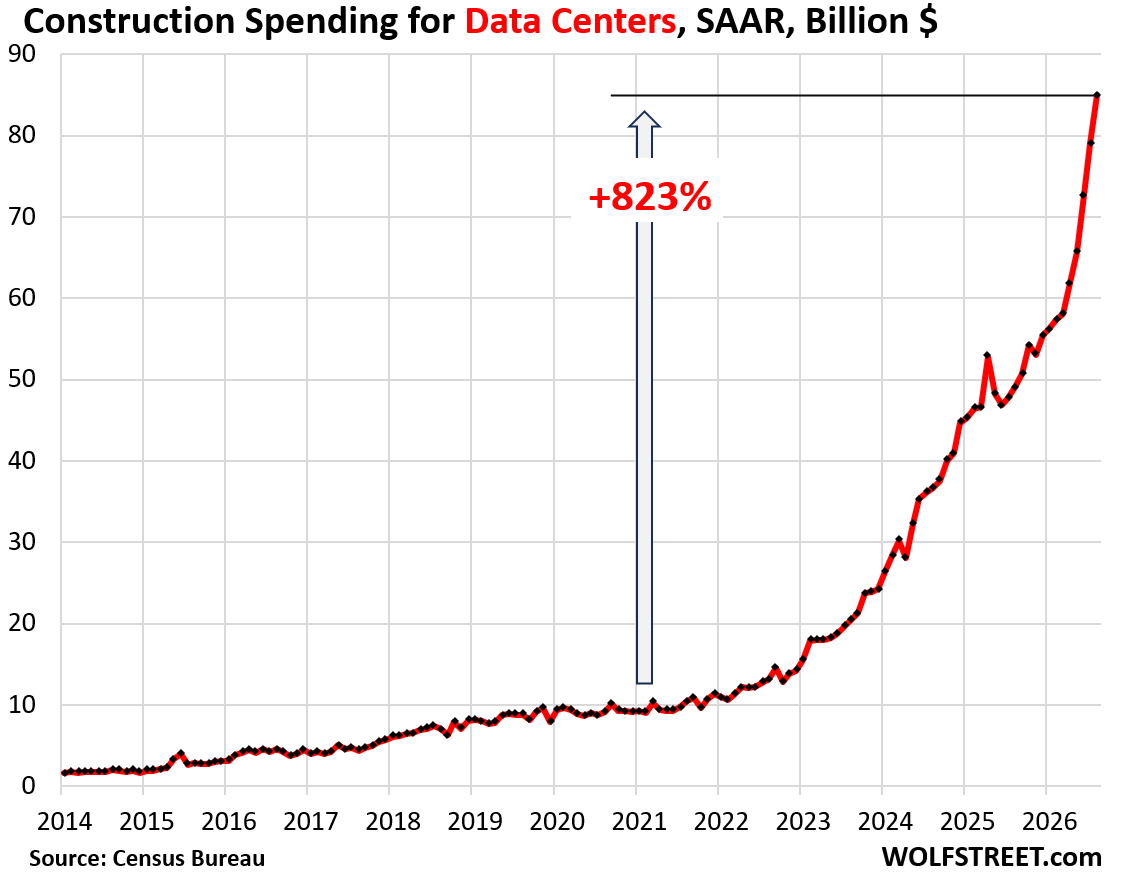
Though nothing that needs to be funded can grow on an exponential curve for long, the AI data center construction mania is continuing along a near-exponential curve for now, despite increasing efforts on the ground by people, municipalities, and state governments – including in Texas! – to slow it down or block it. Data centers, their demand on power, their effect on electricity prices, and related issues have entered midterm election rhetoric.
Building the data centers and purchasing the equipment has sent shockwaves of demand through big parts of the industrial economy: WHOOSH, Go Orders at US Manufacturers of “Core Capital Goods,” Fueled by the AI Infrastructure Boom:
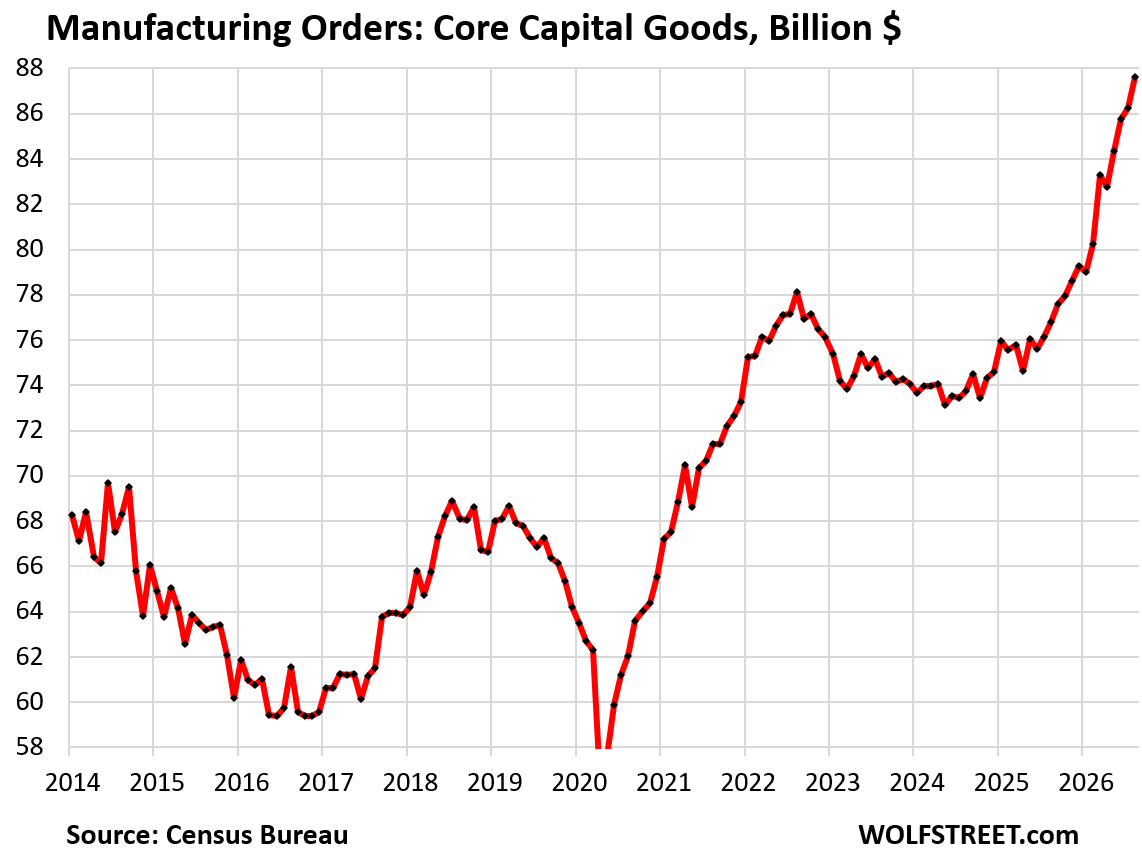
Attracting the skilled labor to build the data centers and install the equipment and get it up and running has sent shockwaves of demand through the labor market, with reports of labor shortages emanating from other projects, as specialists get pulled away by data center projects’ whatever-it-takes approach to spending, including on salaries for highly skilled labor.

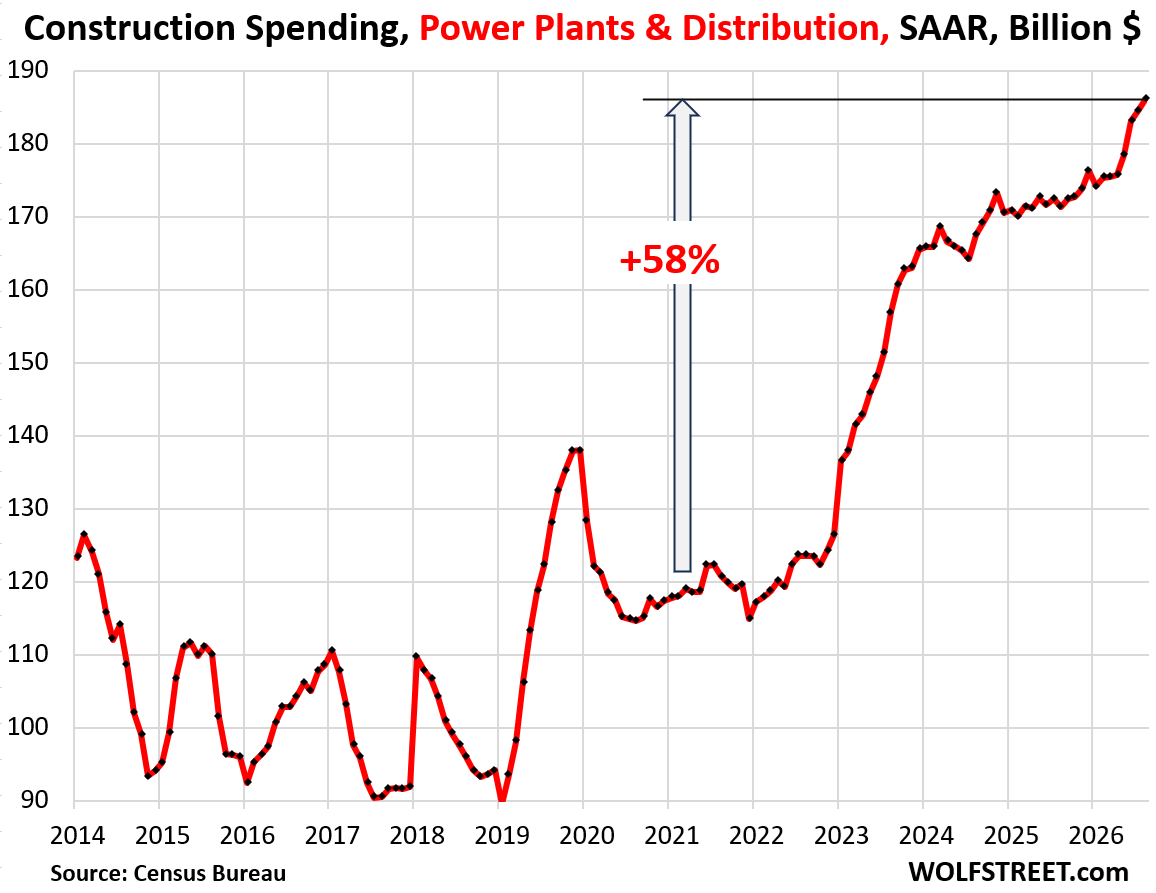
Construction of power plants and distribution infrastructure has also taken off, though planning and permitting takes years before construction can even start.
Construction spending in the power sector rose by 0.8% in August from July and by 8.5% year-over-year to an annual rate of $186 billion. Since the beginning of 2021, the spending rate has increased by 58%.
Power plant construction spending includes the costs of the power generation equipment, unlike data center construction costs that do not include the servers and related equipment, which are the most expensive part of a data center.
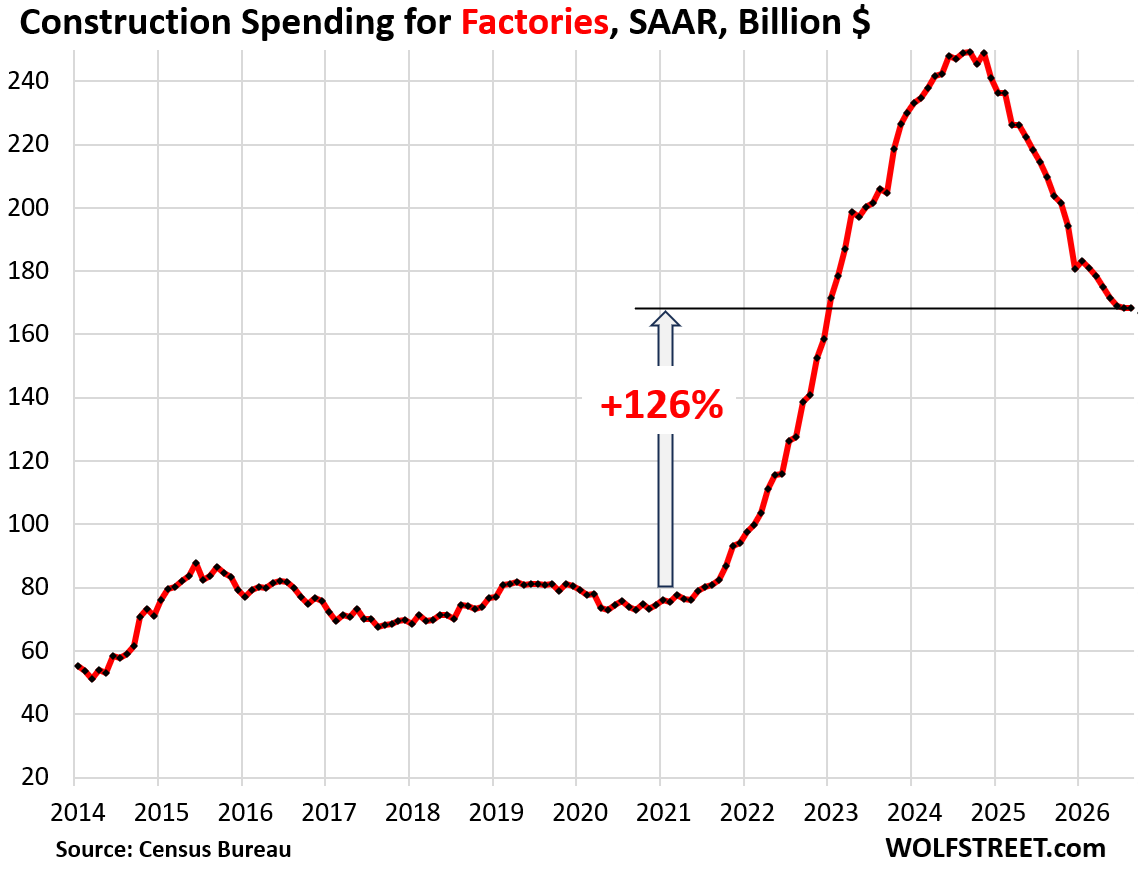
Factory construction spending growth – “growth,” not actual spending – has taken a backseat to the mania of data centers; “actual spending” on factory construction ($168 billion annual rate) is still nearly double the spending on data centers ($85 billion annual rate).
Spending on factory construction at an annual rate of $168 billion in August was unchanged from July, and down by 19.8% year-over-year.
But it was still 126% higher than what it had averaged over the six-year period 2015-2020.
The costs of the production equipment inside the factory – such as industrial robots and systems that produce semiconductors – are not included in these figures here, though they can dwarf the costs of the building.
Once the factories are built and equipped and production starts, their real contribution to the economy and employment begins and continues for decades. Building a factory is not a one-time shot but a long-term contribution to US production. It’s not the construction spending per se that matters but the future production that will come from these factories.
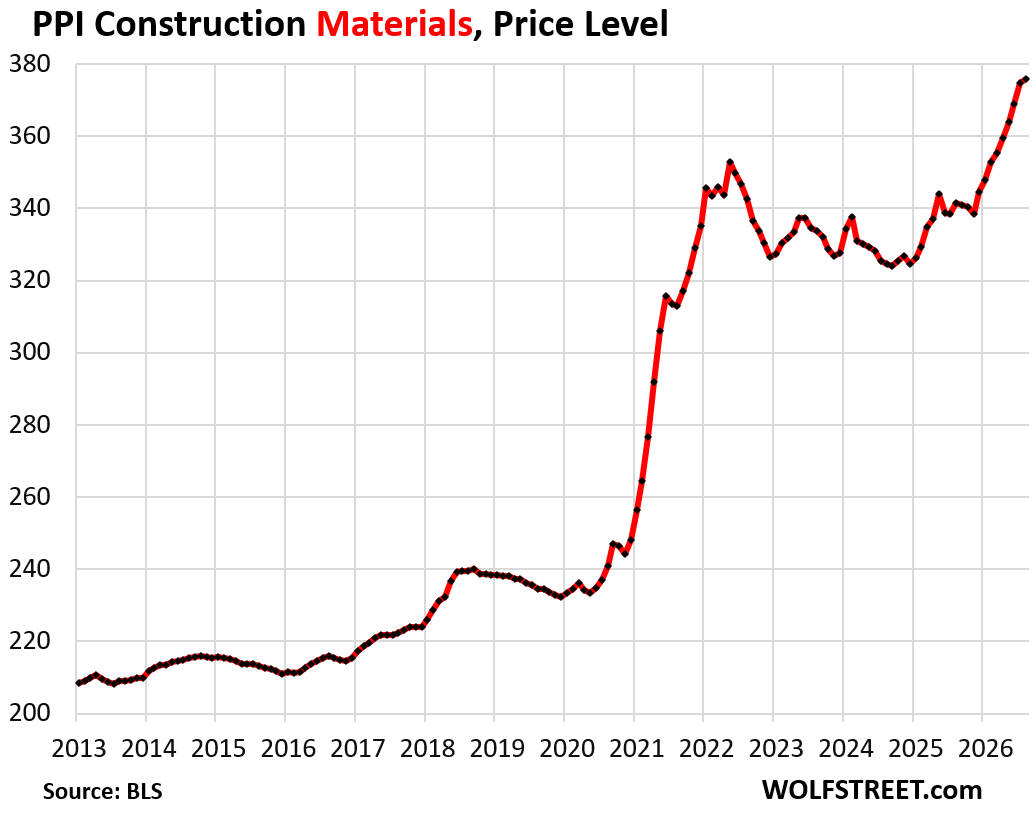
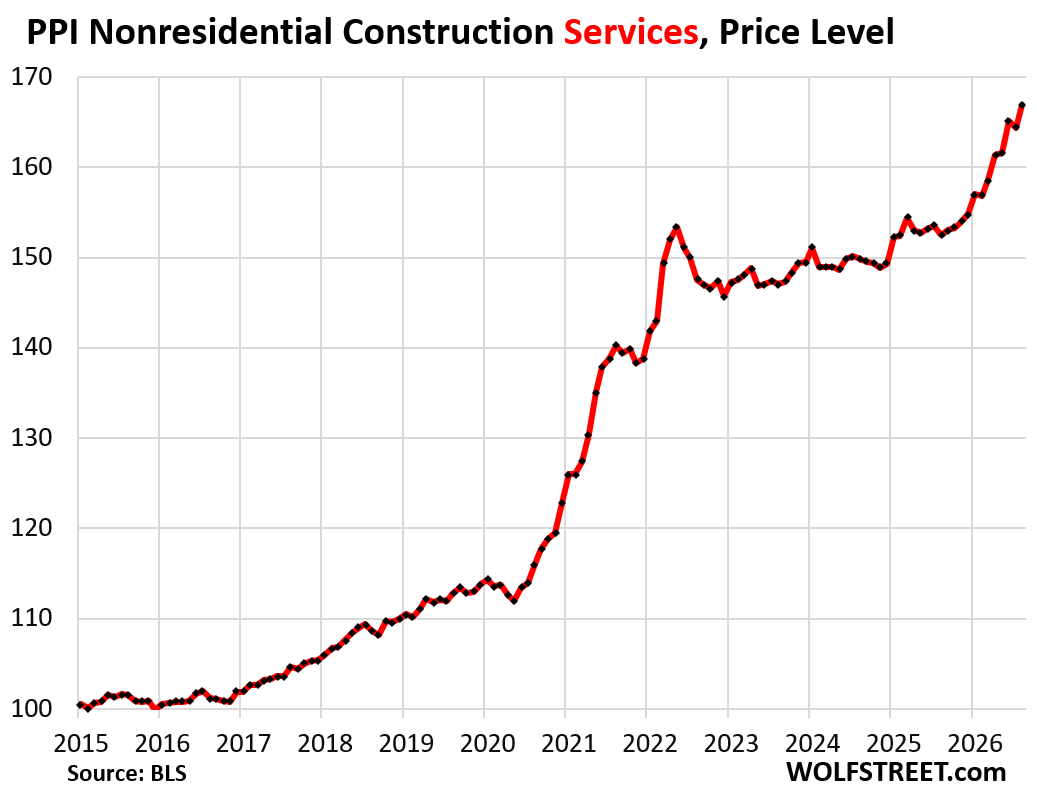
Construction companies face the second wave of inflation.
The Producer Price Index (PPI) for construction materials – steel mill products, concrete, lumber, gypsum, etc. – spiked by 10.1% year-over-year in August.
And since the beginning of 2025, when this second wave of inflation started, this PPI has spiked by 15.8%.
The PPI for nonresidential construction services spiked by 9.4% year-over-year and by 11.8% since the beginning of 2025.
In case you missed it: Not Even the Massive Changes of Methodology Can Get PCE Inflation Back into the Bottle
Enjoy reading WOLF STREET and want to support it? You can donate. I appreciate it immensely. Click on the mug to find out how:


I looked in my crystal ball and saw big empty cavernous buildings dotting the land, turned into mini apartments for the proletariat
“Data for what?” Winston asked
Orwellian
Yeah, I had to pay a construction worker an extra $20 to whistle at me when I walked by.
I’m looking for an inflation caused bust as this is all being funded by ever increasing expensive debt. In all sectors.
30-year mortgage rate posts biggest jump in 4 years — to nearly 7.3%
saw paramount debt CDS exploded in 1 day
and AI #’s are going to make lots of AI projects either convert to equity worth $0 or make zombie companies as they payoff worthless data centers
we won’t even mention the spendthrift grifters in CONS gress
These numbers are firm commitments. Eventually, compute and inference efficiency will dramatically reduce the volume of servers required. Right now, their internals will be mostly provided by NVDA ecosystem providers.
And those servers will be on line for many years 5+, etc. (Compute will be made more efficient on current technology).
Inference efficiency will reduce the average load on each server. (Relative Compute capacity increasing)
The slow down in construction will come later than the installed capacity becomes adequate. (Late 2028 earliest)
Two principles:
1. Close the gap with haste.
2. Drive efficiency once the gap is closed.
We are in the gap closing phase and will be for at least the near term.
Now, here’s the best part. The installed servers have D&A schedules that are specified when the Capex was approved. They will OCCUPY space (even at significant relative inefficiency to latest models) and drive new green field construction for frontier model server technology. This is due to space AND architecture gaps between prior gen and next gen hardware.
As a result, we MUST over build. The question is BY HOW MUCH?
That is unless there is no value in the product. (There is)
BH – thank you so very much for your AI slop…
It didn’t sound like AI to me, so I ran the comment through the ZeroGPT AI detector, and ZeroGPT said it was 100% human.
I’ve been running the same text through Pangram and GPTZero. They often disagree, with Pangram being more aggressive on labeling 100% AI and GPTZero more likely to label as 100% human.
One interesting result: Pangram often classifies text as 100% AI that GPTZero classifies as 100% human, but the reverse *never* happens. GPTZero never classifies text as AI when Pangram classifies it as human.
commenter
In this instance, they agree. Pangram also says 100% human.
Wow. First time being accused of being a bot. Interesting. I tried to keep the summary level logic high level as to not distract the reader from quibbles. Of course, it’s a forecast so balance between broad strokes and fine details are in the art.
So we just used AI compute to detect the veracity of human input vs AI suspicion? Congrats, even if AI is useless we have found a demand for AI compute! Next we can use AI compute to detect if the request for validation was AI or not.
It’s turtles err compute all the way down.
🤣 Not only that, but when I was searching for and testing AI detectors a few weeks ago, using my own carefully crafted article, one of them came back and claimed my text was 66% AI-written and that for a monthly subscription, it would help me make my texts more human. So I carefully craft some text, then AI tells me what to do to make my text less AI and more human. Think of all the compute and monthly fees! If there is a new way to scam people, it will be found. That has been the #1 rule since Adam and Eve.
Interesting.
Given that inter-angstrom limits have been hit, where are these efficiencies coming from from a physical pov? From a math pov, there is nothing new about AI. AI is all about scale – massive data inputs, massive processing infrastructure supporting N-dimensional space transformations. At a more fundamental level, AI reduces the “noise”/entropy in information discovering patterns, relationships, etc., that can be modeled for prediction, decision-making, etc. Where in all of this are the game-changing efficiencies? They may very well be there, but I believe you need to provide more depth in support of your claim.
And who is going to be paying for all of this?
Apparently someone thinks there is a big payday down the road.
Perhaps Software As A Service That You Can Only Buy From Us!
SAASTYCOBFU
sounds about right
Investors already paid for it and are continuing to pay for it. They already kissed their money good-bye, so if it doesn’t come back, fine.
Technology companies like Microsoft, Alphabet and Amazon fund their datacenters using their profits. The money comes from their existing search, advertising and software businesses.
Besides that, they make money from these investments immediately.
Cloud revenue recently grew 48% for Google Cloud, 39% for Microsoft Azure, and 24% for Amazon Web Services. The companies sell new datacenter capacity as soon as they install it.
They do not rely on future predictions to finance this construction.
Yes and no. A data center for cloud services has a massively different composition than a data center for AI compute and inference. The former is more akin to a byte warehouse, the latter is closer to a supercomputer. Refitting for cloud upon an AI crash would be quite expensive.
you are pretty off with massive difference it is about a 20% difference new tech has closed that gap while computes are faster and more efficient with a gpu vs traditional “rack server” they are both are usable the only difference is needs for flash and DRAM memory over size of storage and why other sectors of these firms are getting squeezed and why say anthropic is using AWS or Azure for most of its computes exaclty what you call cloud computing.
More like FOMO. LLM is the first major tech Big Idea since the smartphone in 2007, which means we have been in a technology drought for nearly 2 decades. Everyone is terrified if they don’t grab their piece of the AI pie now, they will be extinct in 5 years. Certainly the case at my employer. But the reckoning is already coming. My employer booted us all off of Claude with just 1 week’s notice; we are now all on Copilot. They already see the exponential token spending curve and taking steps to flatten it out.
come on man that is just stupid … this bubble FOMO whatever you are saying … AI risk reality is actually very minor compared to other tech surges and it is quickly being captured by profit companies that were buying back their own stock out of boredom and market capture; that make is far less risk sure the memory gpu etc all sectors will show devalue but the only ones imploding are probably anthropic and open ai that went all doom hype and have no built in systems to plug this into … and where have you been since 2007 guess that is the only tech YOU USE since then there have been many huge advancements you just can not hold in your hand …
The spending spikes on all these different categories make me wonder how much the overturning of Trump’s tariffs is affecting all this.
A lot of these materials and electronics are being imported – but at what tariff rate I wonder? What does a made-in-China server rack, metal cutting saw blade, or electrical box cost to import nowadays?
Could the perhaps-temporary drop in tariffs have led to a surge this year, from buyers trying to get supplies in before the next bout of the trade war?
So buy a field in the country and sit in your tent for a while, and AI will walk right up to you in the form of a new phone. The data center next door will be empty, and the phone will have it all. Just kidding, this is years away.🌴
Factories showing true economic gains for a decade after may not happen this time. A lot of this is to support data center construction. When the data center construction falls off, a lot of factory capacity will be idled. Especially the construction equipment and backup generation industry. Think companies like caterpillar and Cummins. At some point the hyperscalers are going to back off when hundreds of data centers are waiting years to get power. The additional money they are spending each month is driven by inflation to build out these data centers (including the equipment and servers inside). The one thing they don’t want to do is use bonds to build them out even further. It’s the companies providing everything the data centers need taking the debt that could come back to bite them.
How much of the factory build out is new build out trying to meet the AI data center demands?
Great question.
I wondered same after reflecting on the very large new steel plant investment/agreement made the other day.
one of your best analysis. thanks. i do remember being in high cotton as the late 1990s tech bubble was blowing. trailing stop orders saved my skin and i remember how delicious the pickings were after the bust. for some reason i remember buying RJR with a yield handle in the teens. it was obvious the states attorneys wanted pound of flesh but not to kill the beast, entirely. i remember schwab was trading like a .com stock. fun memories. hope this goes the same way. the tech was so great that came from the bubble and bursting, too. made my life much easier.
Look for a boom in commodities, the markets last gasp, then hold on…
A number of AI generated YouTube vids showing up.
The audio tends to be overly wordy and repetitive.
Graphics have a stylized, obvious appearance too..
Are you surprised?
I have seen/heard/read similar discontinuities from LLMs and other AI architecture. Then again there was the Model T that eventually grew into Corvettes, EVs, etc. There is always a trajectory for technology innovation. AI is even more interesting since it is viscerally tied to the volume and quality of data used for training models. This is one of the more interesting aspects of AI evolution for me in the AI world: whose models will eventually prevail? Who will develop the better model building algorithms? Whose models will have better long-haul records when it comes to the probability aspects underlying all of it? How will the competition for data evolve?
There are always losers and winners at the early stages of business adoption of new technology. As Wolf highlights, what catches one’s attention is the volume of money trading hands at the moment while delivery of product is still in its infancy. Don’t want to be on the wrong side of that one – if it fits one’s investing strategies.
We have to remember to that a portion of this growth was the crazy strings that the Biden Administration put on plants and even construction eco rules day care DEI hiring quotas etc that stopped much of this – not to get political just facts