
Workers quit quitting and settled in, after the epic rematching of workers and employers.
By Wolf Richter for WOLF STREET.
Turnover in the labor market is a result of people who quit their jobs, got fired, or retired, or separated for other reasons, thereby leaving behind job openings that employers then attempt to fill with new hires. This churn is constantly going on but morphed into a huge wave in 2021 and 2022, that then settled down in 2024, and has been at normal levels since then.
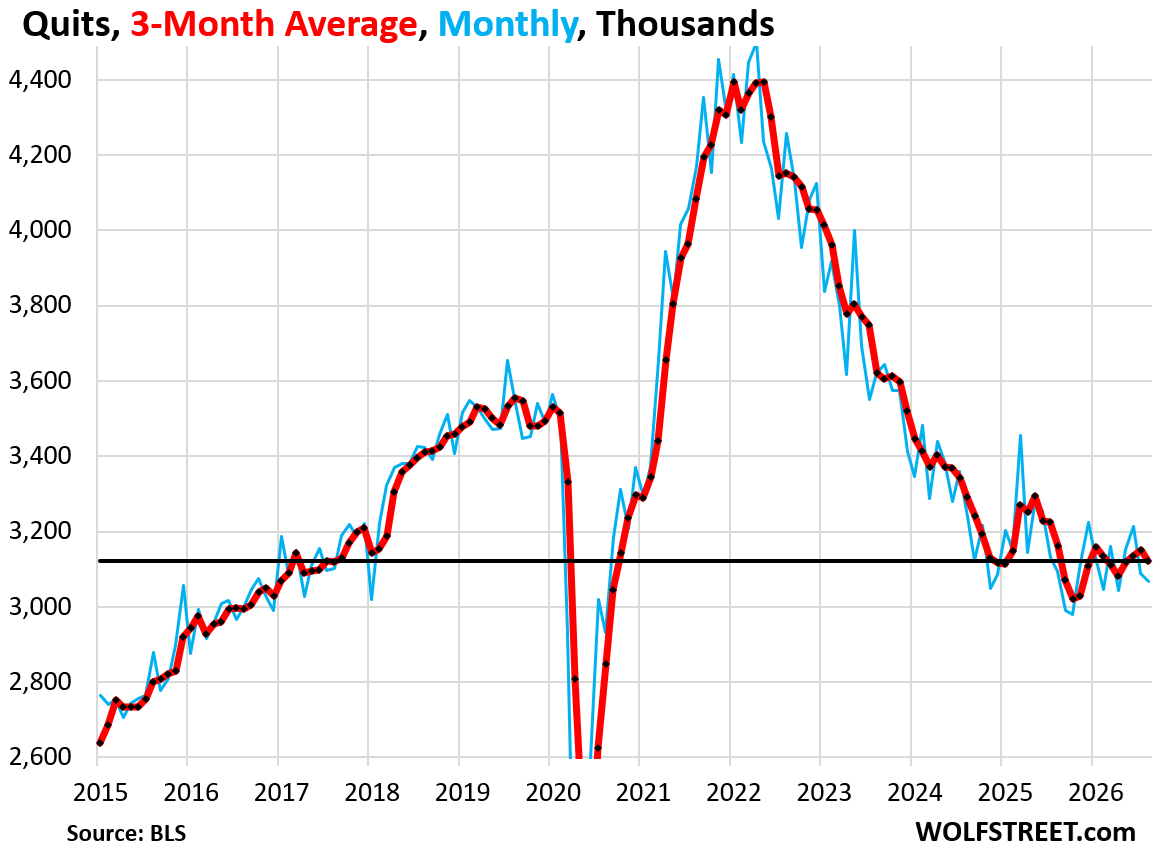
Voluntary quits declined by 23,000 in August, from the upwardly revised July quits, to 3.07 million workers (blue in the chart). The three-month average, which irons out some of the month-to-month squiggles, dipped to 3.12 million (red).
Quits are the biggest source of labor market turnover, accounting for 60% of total separations. Fewer quits mean fewer job openings left behind that need to be filled and fewer hires needed to fill them.
These stages of turnover in the labor market are tracked by the “Job Openings and Labor Turnover Survey” (JOLTS) by the Bureau of Labor Statistics. The turnover data for August were released today. The data is based on surveys of a large number of business locations. Net job gains, the unemployment rate, etc. for August had already been reported in the August jobs report on September 4.
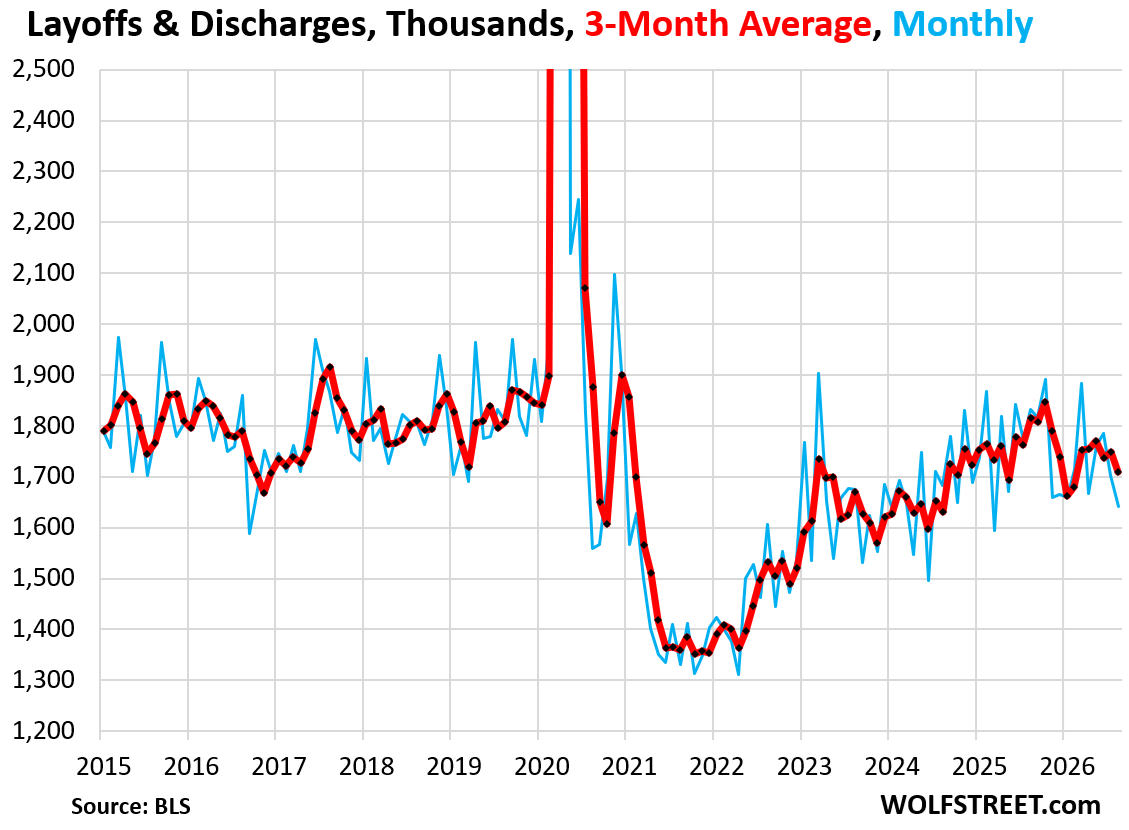
Layoffs & discharges declined to 1.64 million in August, the lowest since March 2025. Getting fired for a variety of reasons, or for no reason, is a standard feature of the US labor market.
The three-month average declined to 1.71 million. These levels are at the very low end of the range of the prepandemic years.
Layoffs and discharges accounted for 33% of all separations.
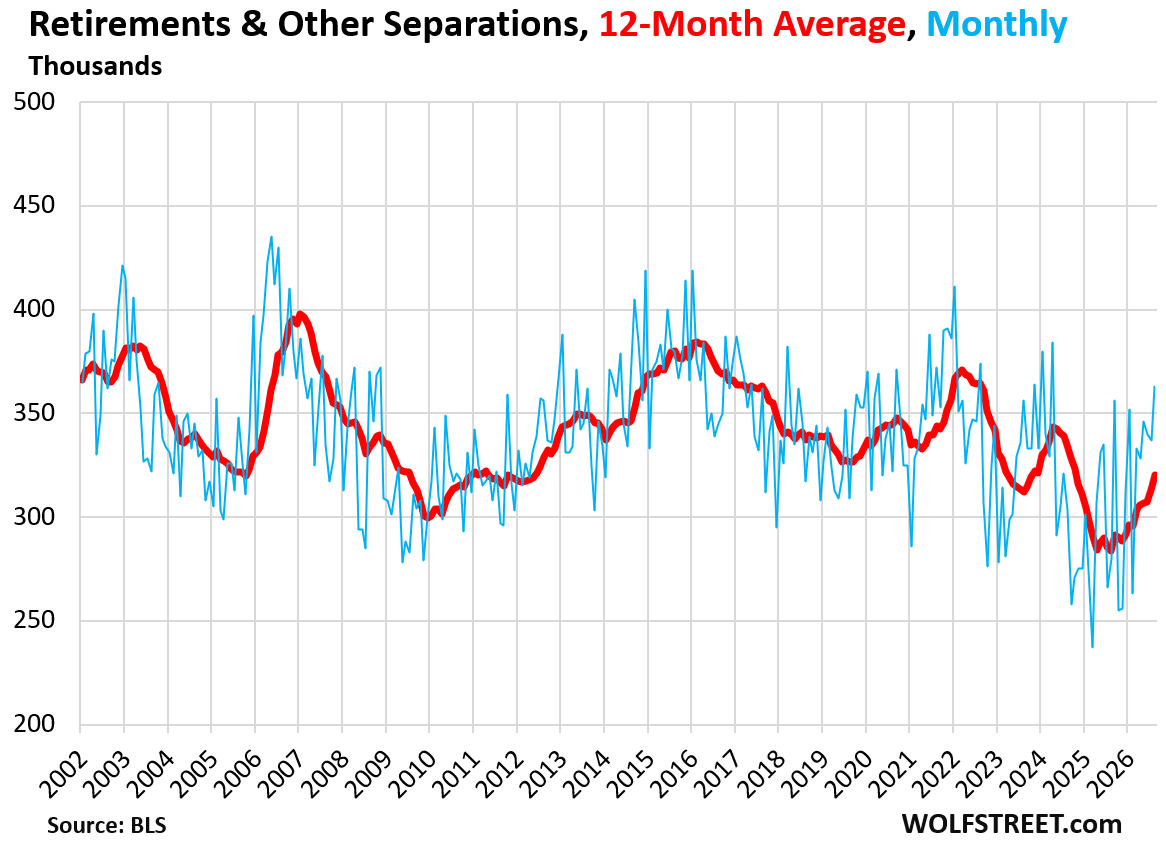
Retirements and other separations (including deaths while employed), accounting for 7% of total separations, are only a small factor in the turnover equation.
They rose to 363,000 in August. The 12-month average, which irons out the month-to-month spikes and plunges, rose to 320,000, further climbing up from the low in 2025. The JOLTS data only goes back to 2001, but within that time span, retirements and other separations had booked a record low in 2025.
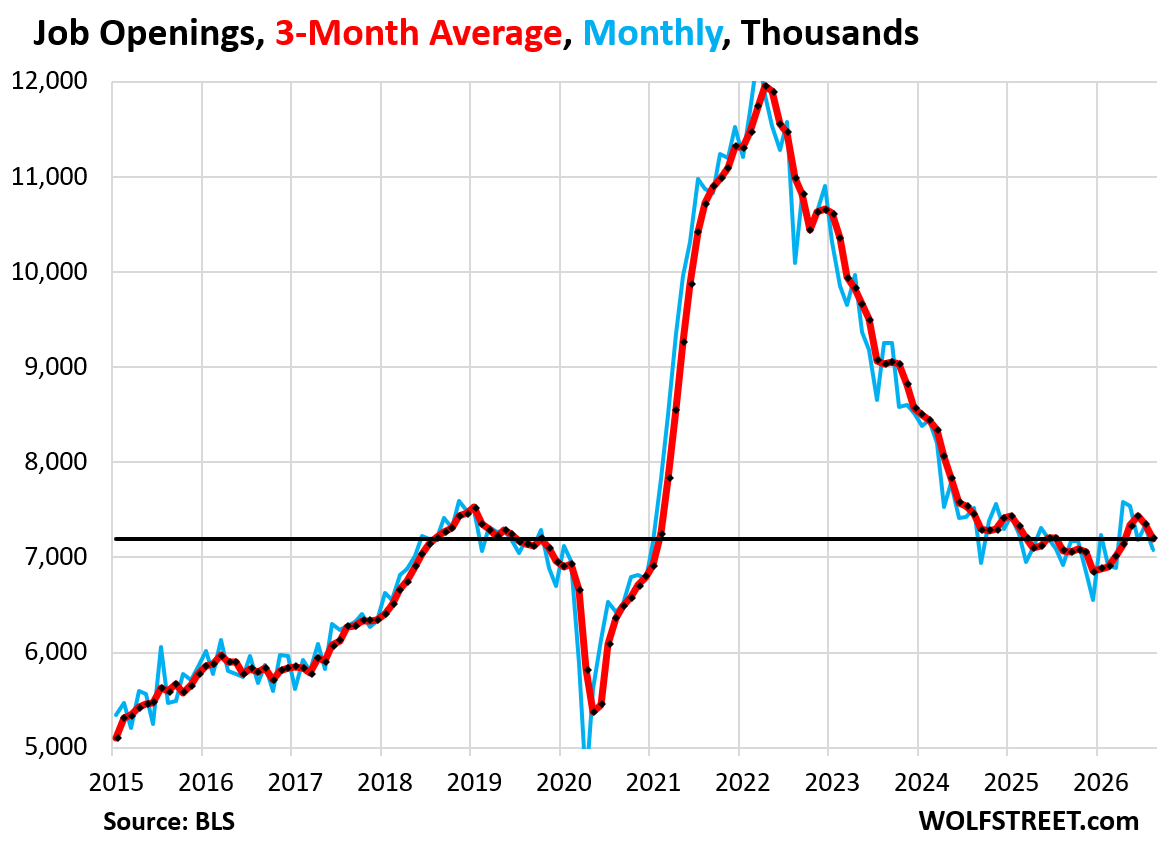
Job openings fell by 256,000 in August from the upwardly revised July openings, to 7.08 million. The three-month average declined to 7.20 million.
Compared to a year ago, job openings rose by 160,000.
The data for job openings is based on a survey of HR departments at 21,000 business locations, not online job postings.
A job is “open” only if it meets all three conditions:
- A specific position exists, and there is work available for that position.
- The job could start within 30 days.
- The employer is actively recruiting workers from outside the establishment to fill the position.
Excluded are positions open only to internal transfers, promotions, demotions, or recall from layoffs; positions for which employees have been hired but have not yet started; and positions to be filled by employees of temporary help agencies, employee leasing companies, outside contractors, or consultants.

The number of hires to fill fewer left-behind slots rose by 46,000 in August from the upwardly revised July figures to 5.19 million. The three-month average dipped to 5.22 million.
Nearly all of these 5.19 million hires in August filled slots left behind by previous separations (quits, layoffs & discharges, and retirements & other separations). The number of “Hires” does not speak to job creation; the nonfarm payrolls report on September 4 already addressed job creation in August.
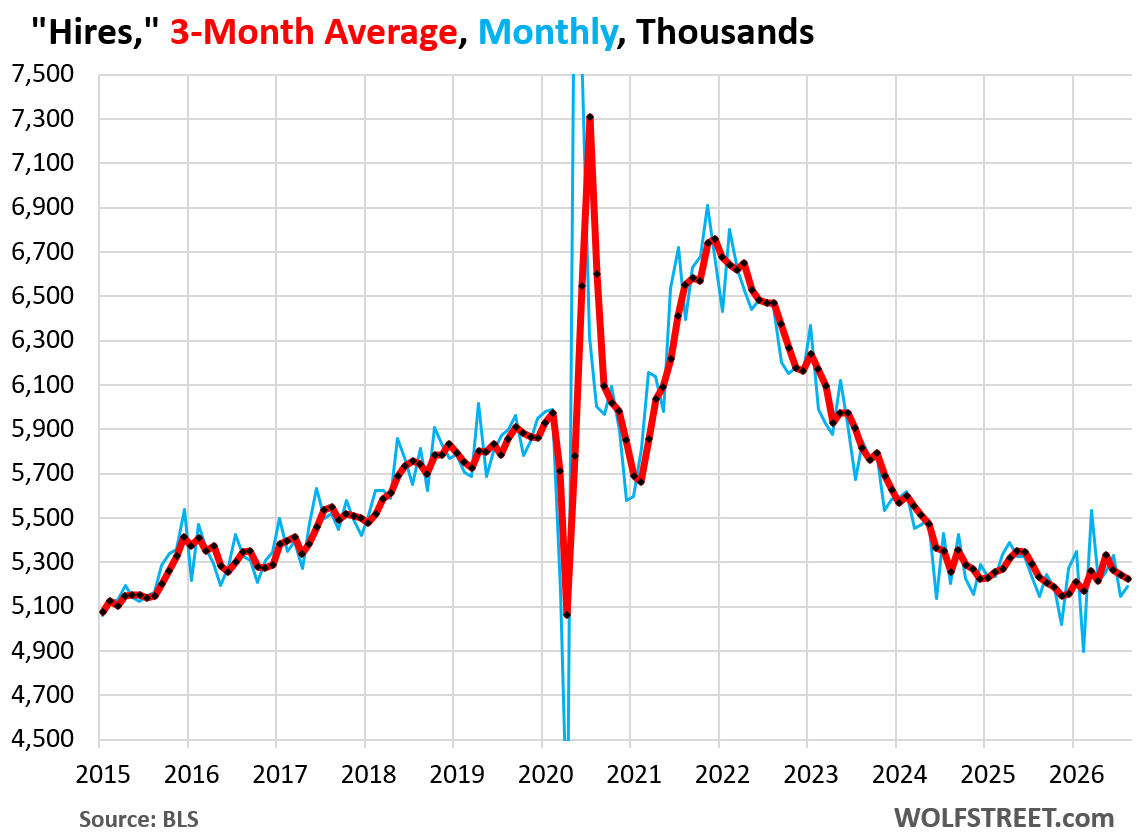
The low number of quits, layoffs and discharges, means that the number of left-behind job openings is also low, and fewer hires are needed to fill those openings.
This means that labor market turnover has normalized from the chaotic churn in 2021 and 2022, driven by a massive wave of quits, which had reshuffled the labor force and led to a rematching of workers and employers that was very costly for employers at the time, triggered large increases in wages for workers at the time, but likely resulted in a better overall fit between workers and employers.
This calmed-down turnover is not a sign of a weak labor market but of a settled labor force that is more productive for employers, after the massive and costly churn of 2021 and 2022.
In case you missed it: Tech, Science, Social Media Jobs in San Francisco & Silicon Valley Plunge to 2019 Level: AI Magic-Money Boom Is Paper Thin
Enjoy reading WOLF STREET and want to support it? You can donate. I appreciate it immensely. Click on the mug to find out how:


Inflation still not at target. Jobs fine and packing demographics.
See no reason not to keep trying to get the inflation bug completely knocked out with more tightening.
Monetarism wasn’t cool for a long time, but seeing some commentary that 7% Divisia M4 isn’t exactly “restrictive”. Some recent analysis that money supply was again a leading indicator of post covid inflation (which I think is logical, I think M2/3 just have weighting/tracking errors, not that money supply can’t induce inflation).
Our current fed chair seems to agree.
pacing*
paying $25 hour for landscaping labor
another guy quoted me at $75 hour
$30 per plant x 20 + state/county/city grift of 9.1%
another 25 hours to plant, setup drip system X $25
HOPING only $1,500
cost $3,500 to cleanup after tenant left place wrecked
I think the most you could say for the correlation between M4 and inflation is “kinda?”. Yes, there were spikes to 10% yoy preceding the 1974 and 1979 inflation episodes, but it also spiked to 10% in 1998, 2002, and 2008, none of which resulted in any significant inflation. The COVID episode was extreme, hitting almost 30% yoy, but the inflation in 2022 was much weaker than 1974/1979 with much larger M4 increases.
Even if you did want to make some kind of case that hitting 10% at least had some small potential to be bad, 7% is not 10% and is well within the normal range since 1967.
Two of those are a result of recessions and severe monetary easing to keep them from becoming deeper.
The first lead to the inflation the fed doesn’t directly care about, asset prices, as is currently happening.
Asset bubbles instead of direct inflation aren’t as painful, but they are systemic risk to the banking system that should at least partially influence policy.
Ah, there’s always so many exceptions to monetarism! How is one to know when the exceptions count, other than by just explaining them away?
Assets bubbles aren’t painful, except of course, to people starting out who don’t have a lot of assets, and have to buy them with salaries that haven’t kept up.
And I think the better key word in my post was “not restrictive”. After 30% M4 growth, we need to be restrictive, not just neutral to get this rat back in the bag.
It’s not about levels it’s about rates of change.
The next step in improving productivity by increasing employer-employee fit: separate healthcare from employment, so people can quit bad jobs without fear of medical bankruptcy.
That would help out the low end without health insurance too. Insurance is expensive, and the Obama era requirement that all full time jobs offer health insurance has left a dearth of full time jobs on the lower end. My college jobs were very strict about keeping below 27 or so hours a week. A consistent forty hours of regularly scheduled work would be a godsend for so many retail workers.
I heard that big corporations are going to stop offering healthcare and pushing cost to employees
well except for inner circle of exec’s
that should push majority into state sponsored medicaid
I agree. But, I used to think that this was why health insurance was such a racket, because most individual consumers don’t have the choice. “Why can’t we buy health insurance the same way we buy car or homeowners insurance?”, I asked. Well, now my car and homeowners insurance are a racket too.
This is mostly solved in the middle class with the end of the “pre-existing condition” loophole closed by the ACA push. Yes, you can get worse insurance during job transitions or at a new employer, but no longer are you fully trapped at an employer for fear of never being insured again.
Insurance being tied to employment is still a problem, but it’s not in the stratospheric level it was from 2004 to 2009
I see a lot of job listings on Indeed.com
But I suspect most of them are bullpoop
The job descriptions have all kinds of errors, requirements that don’t make sense in the real world.
Once again, I am drunk as a skunk. Bessent is heaven sent.
6 week T-Bills are over 4%
Job listings have ZERO to do with the data in this article. RTGDFA It explains what this data is.
It’s just another symptom of too low unemployment.
Writing job descriptions is getting delegated to inexperienced administrative assistants and AI with minimal oversight from HR or hiring managers. The job descriptions end up being word salad with inaccurate responsibilities.
I recently came across one that required “Administer collective bargaining agreements” for a non-union small business!
The people who know better – company subject matter experts – are too overburdened with revenue-generating work to bother.
It’s a catch 22 situation because those same SMEs desperately need help, but they’re too busy to find and/or train useful help.
I doubt these job posts are fake. They’re just poorly written and unicorns that require no training are the only people getting hired.
It’s also a symptom of many employers abandoning professional development or involving the job vacancies’ manager in the hiring process. Good onboarding, training, and development plans are only seen among companies with long term vision or companies who understand the value added over time from training up your own people. The companies who take the letters HR in the literal sense are among the worst. As someone who works closely with HR in my line of work, the difference between my prior employer and current one is wider than the Grand canyon, but it’s not quantifiable on a balance sheet so most companies won’t care.
How is the WFH vs RTO playing out for the employer side?
It is a struggle. My company forced RTO on everyone regardless of position in December. The struggle to find candidates is insane. There has been some flexibility. However, it’s few and far between. The $ is not there when you break down transportation costs compared to salary offers. However, the CEO has a lot of money parked in CRE around town. He has 2 years left and we believe hybrid will make a return.
That’s been my experience too. If you want good people to come in 5 days a week, you need to pay more than “average.”
The IT job market is in bad shape with big layoffs in the last few years
My company has mandatory 5 days back to office
If a job can be done remotely then company is seriously thinking moving it to cheaper countries
“If you want good people to come in 5 days a week, you need to pay more than “average.””
This is hilarious. The post COVID distortions are still alive and well, especially in the psyche.
“Coming in 5 days a week” is called HAVING A JOB. If you can’t make it in 5 days a week, you are unemployable.
President Trump: President Trump bringing all kinds of good jobs back to the USA has resulted in happy workers. These workers know that the USA has the best labor conditions in the world and they want to stay put at their jobs knowing that President Trump is going to make all our industry immensely better.
do people in 2026 rich world actually go into work?, 5 days per week? most likely they have shitty home lives and just need some entertainment from a dreary life. i’m for sure out of touch with the proles and lumpenproles.
In my littlevcorner of infotech, there is still churn. The Oracle layoffs put many into whatever role they could get and those folks are now looking to switch jobs. This put a damper on the gig market for awhile. Companies are still unhappy with productivity of internal employees, but that’s not a new development. On the bright side, AI hype is starting to die down.