
It would make sense for the bond market to take a breather here and digest a little. But the dynamics are in place for yields to rise further.
By Wolf Richter for WOLF STREET.
The 20-year Treasury yield rose by 17 basis points during the week, and by 37 basis points since Warsh’s Jackson Hole speech on August 28, to 5.55% on Friday, the highest since June 2004, and higher than the 30-year Treasury yield (5.50%). During the day, the 20-year yield had traded as high as 5.59%.
At the already lumpy 20-year Treasury auction on September 15, the government had to pay a yield of 5.42% to sell all $13 billion of bonds. That was the highest auction yield since the re-introduction of the 20-year bond in 2020. And it got lumpier still in the secondary market.
During the Fed’s maximum interest-rate repression in the spring and summer of 2020, when it purchased over $3 trillion of securities to force down long-term interest rates and inflate asset prices, the 20-year yield was at around 1.0%. Rising yields mean lower bond prices for existing holders, and bonds purchased at auction at the time have lost roughly half their value in the secondary market. And ever since then, courageous investors, trying to lock in those yields as they rose, have caught falling knives.
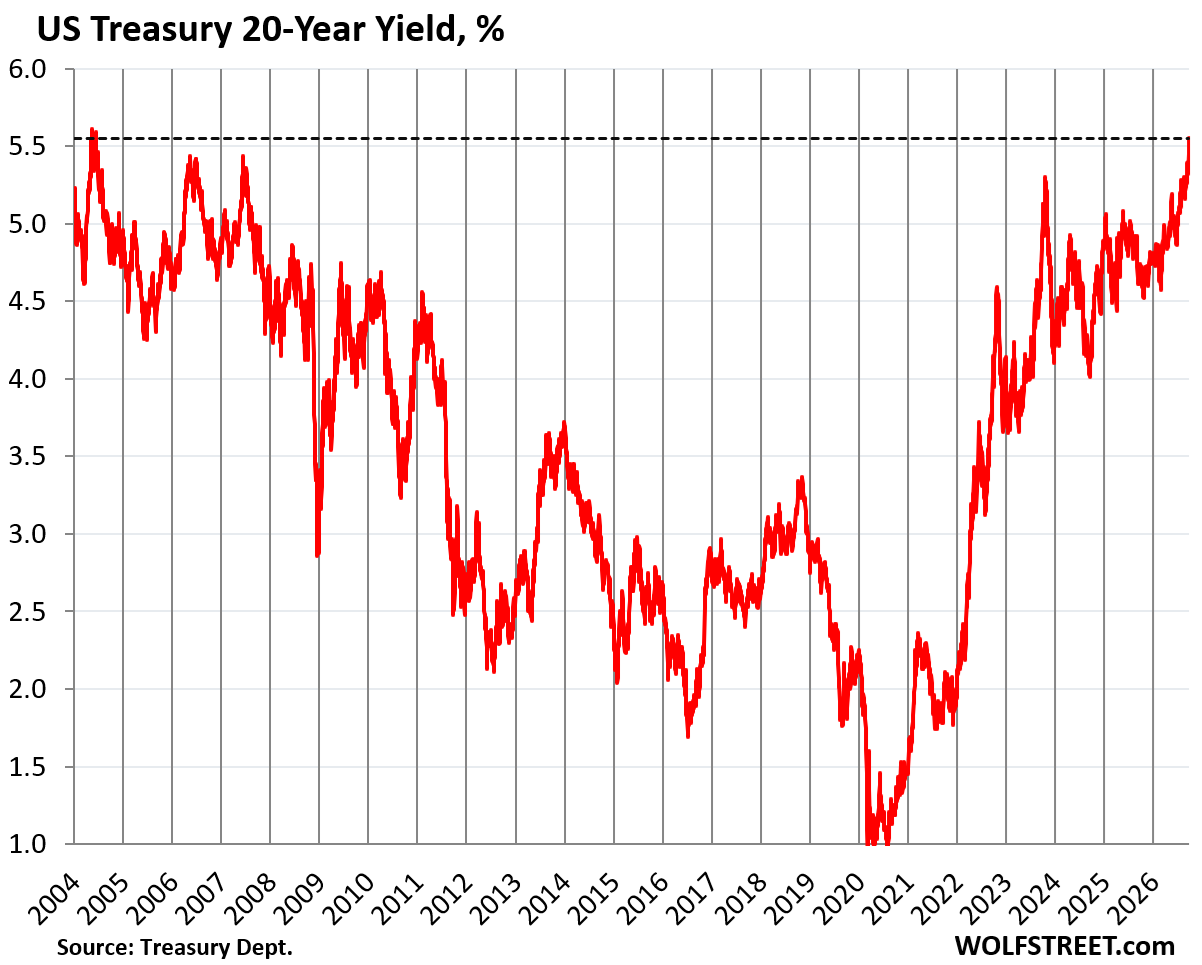
For some bond fence-sitters, a 20-year yield north of 5.5% is starting to look tempting, and some have come off the fence and bought, but not enough of them to push the yield back down, and the yield continued to rise during the week.
That’s the function of yield; it creates demand.
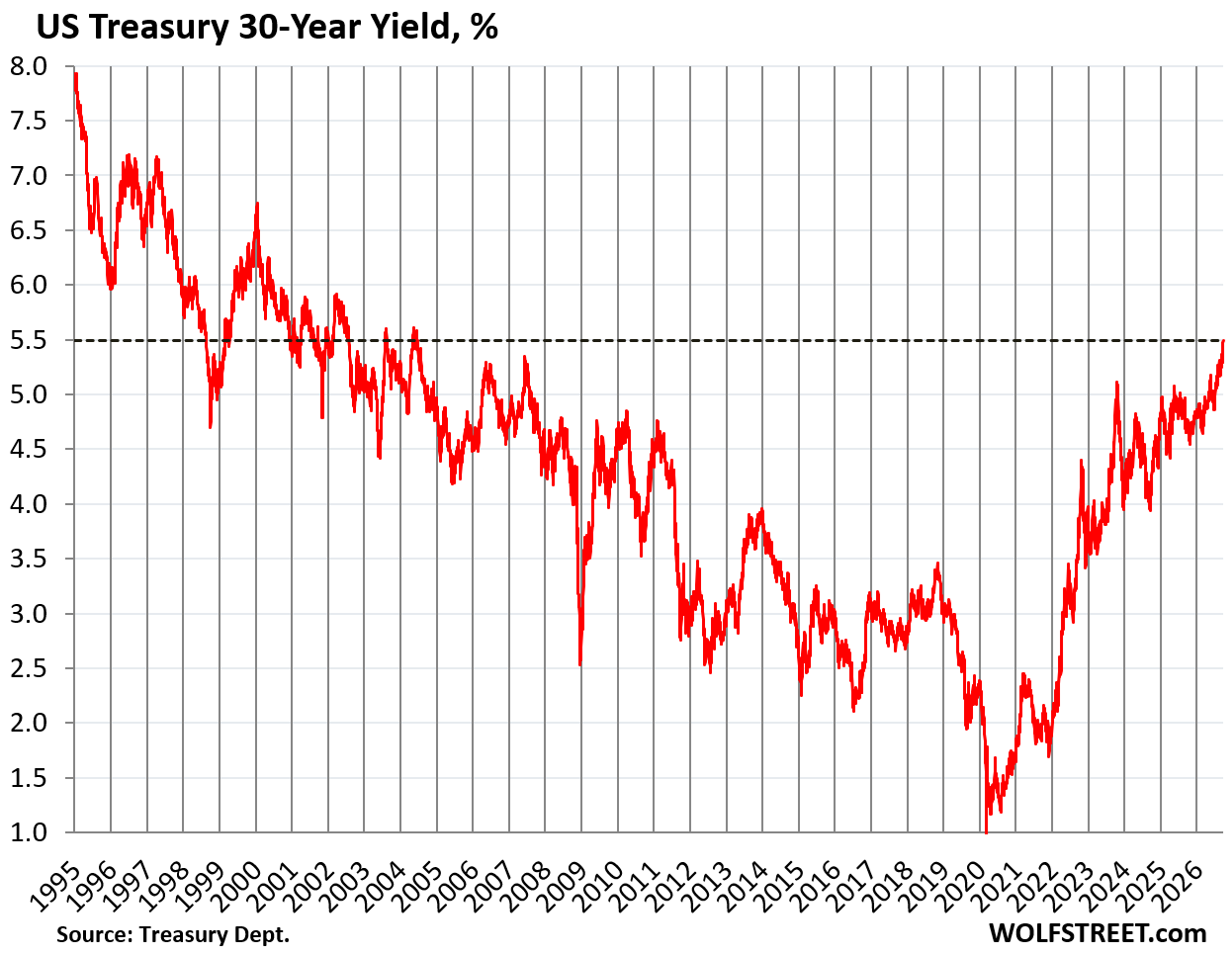
The 30-year Treasury yield rose by 15 basis points during the week and by 30 basis points since Warsh’s Jackson Hole speech, to 5.50%, the highest since May 2004.
The chart below shows the last 25 years of the 40-year bond bull market when yields kept zigzagging lower through mid-2020, and the first six years of the bond bear market.
Bloomberg’s Markets Pulse survey of 173 macroeconomic and market participants revealed today that over 50% of them expect the 30-year yield to be higher than 6% by the end of 2026.
Why buy now if you think you can get a 6%+ yield in a few months? This would be the highest yield since the roaring Dotcom Bubble year 1999. Those fence sitters are going to stay on their fence.
Why those yields? Long-term yields have surged to two-decade highs, the costs of borrowing have surged, and mortgage rates have surged, and that should have put a damper on the economy and inflation, but the economy isn’t slowing down, on the contrary. Corporate borrowing has ballooned despite the higher costs of borrowing as the historic AI boom needs to be funded. And this debt issuance is competing in the bond market with Treasury debt for investors. And inflation is accelerating amid this historic infrastructure investment boom, a massive geopolitical mess, very high energy costs, a tight labor market with labor shortages in some special areas, solid consumer spending growth, and reckless fiscal policies with deficits running at 6% of GDP despite the strong economy.
So part of the story of those bond yields is economic growth. Not adjusted for inflation, “nominal” or “current-dollar” GDP grew by 8.1% annualized in Q2.
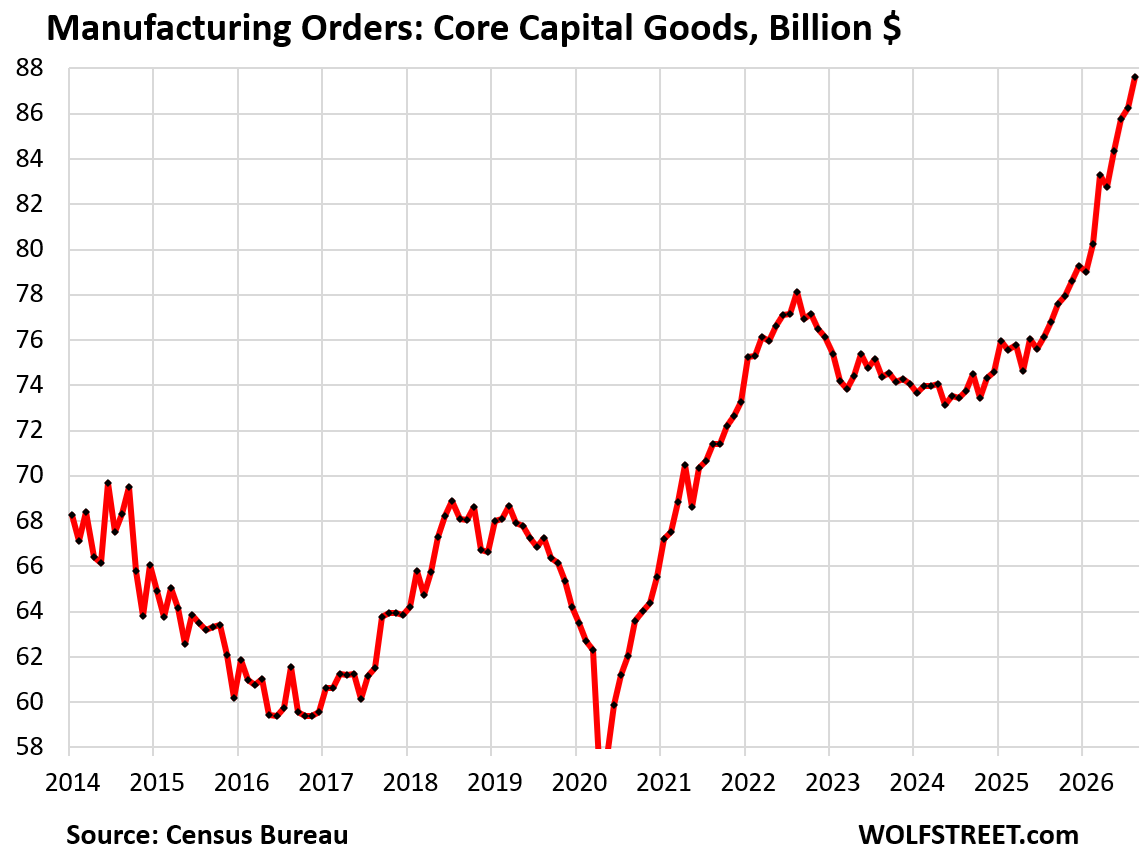
Just on Friday, the August data was released for orders at US manufacturers of “core capital goods,” which are an indication of business investment. They soared by 14% year-over-year, driven by the AI infrastructure investment boom (details and more charts here):
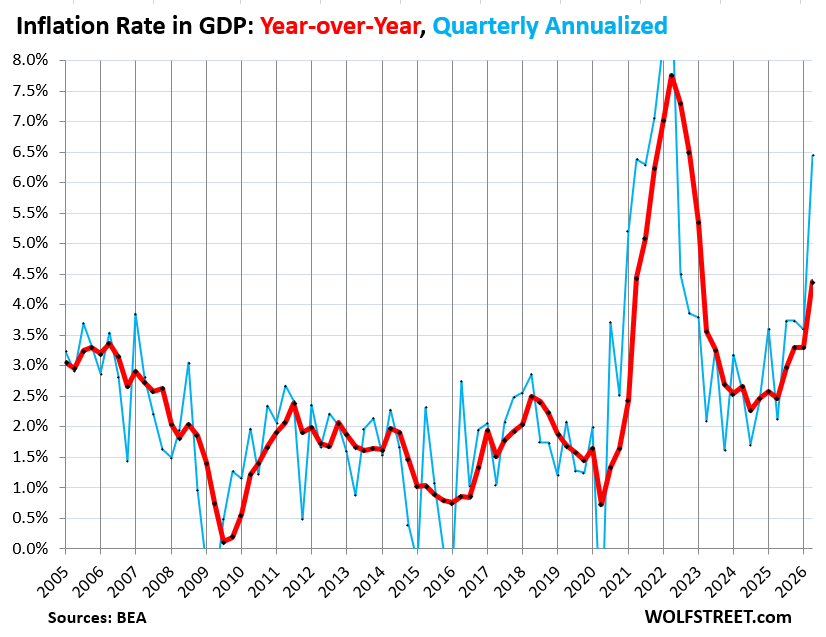
Another part of the story is inflation, even if the bond market is still in partial denial about it. Inflation in the overall economy, faced by all participants – including consumers, businesses, and governments – as tracked by the GDP deflator spiked by 6.4% in Q2 from Q1 annualized, and by 4.4% year-over-year.
We’re looking straight at the beginning of the second wave of inflation in the overall economy. This is nothing to be trifled with:
Another part of the story is huge demand from Corporate America for funding the AI investment boom via debt issuance. Those AI bonds pay higher yields but come with much higher risks than Treasuries. And they’re putting pressure on the Treasury market.
And another part of the story is the ridiculously huge amount that the government needs to borrow to fund its ongoing deficits. The government has been adding $1 trillion to its Treasury debt every three to five months, and that $1 trillion needs to be enticed from investors with higher yields.

But wait a minute… Those 5.5% long-term yields just take the bond market back to the decades before the Fed’s interest rate repression and QE that started with the Financial Crisis.
In the second half of the 1990s, the economy was strong, the Dotcom Boom reigned, stocks were soaring, inflation in the overall economy was a lot lower than today (GDP deflator), Treasury yields were higher than today, the Fed’s policy rates were much higher than today, mortgage rates were between 7% and 9%, the labor market was tight, and unemployment was low.
The US economy can boom with higher yields. We’re seeing that now. And that’s part of the Fed’s problem. But now inflation is also booming.
Yields have come up a long way fairly quickly, and I expect buyers to come out in larger numbers at these yields, and take bigger bites, and it would make sense for the bond market to take a breather here.
But the dynamics are all there for yields to go higher still, and the expectation revealed in the Bloomberg poll of the 30-year yield to go over 6% by year-end does not sound unreasonable to this observer.
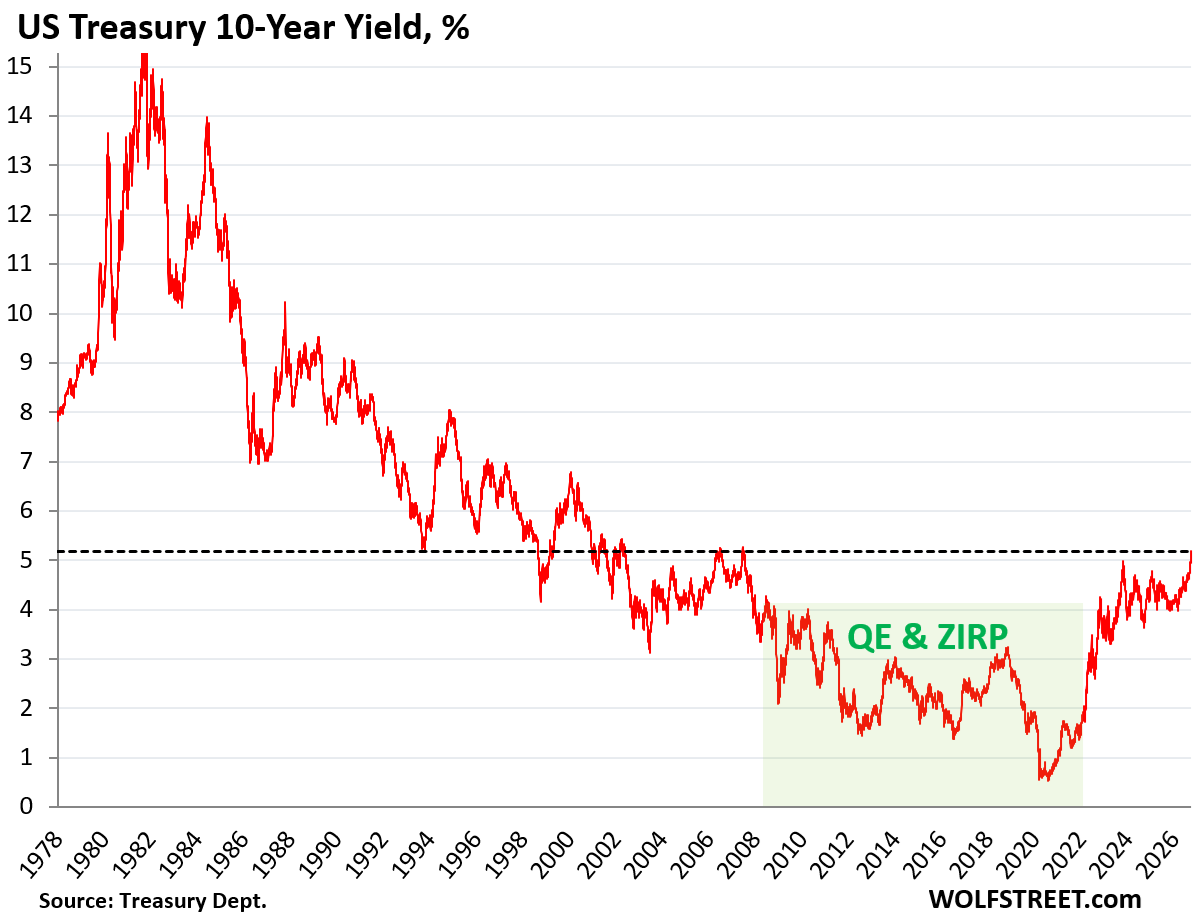
The 10-year Treasury yield rose by 16 basis points during the week and by 50 basis points since Warsh’s speech, to 5.17%, having traded as high as 5.23% on Friday intraday.
Since the end of February, it has soared by 120 basis points. But beyond the era of the Fed’s interest rate repression, beyond the era of QE and ZIRP, those 10-year yields are not high:
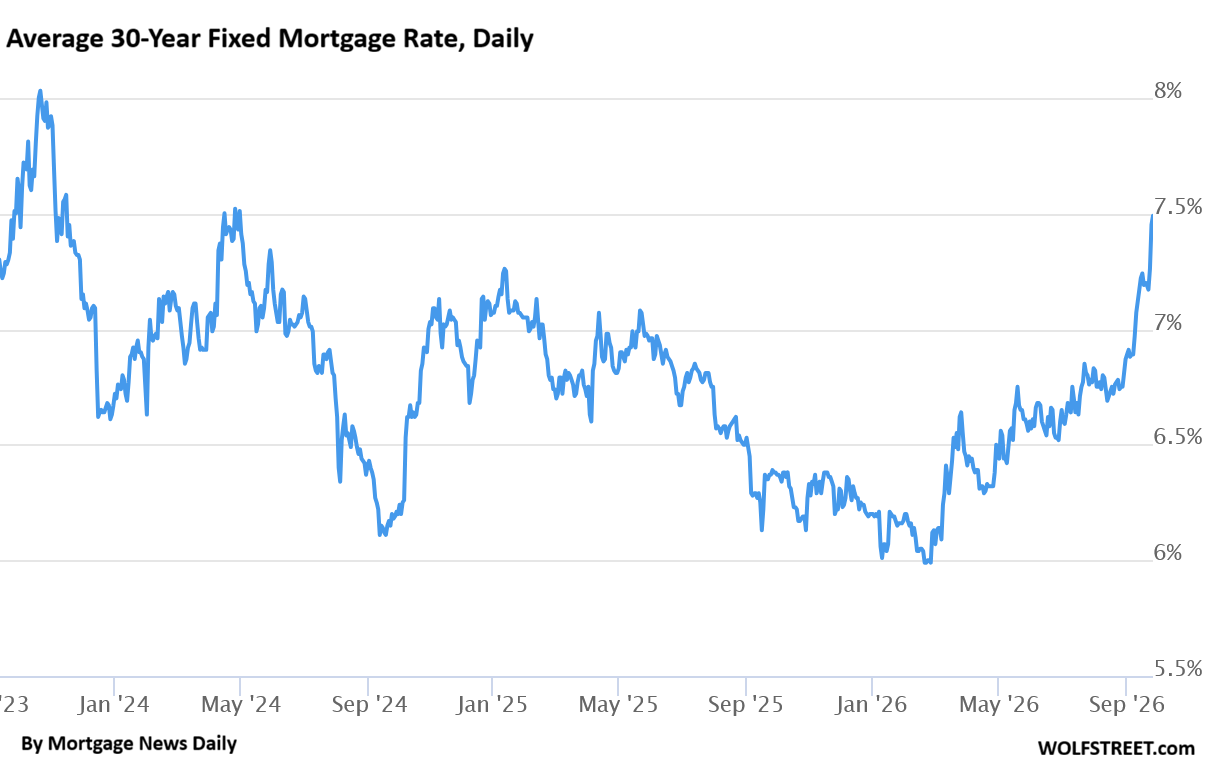
The average 30-year fixed mortgage rate rose on Friday to 7.5%, according to the daily measure by Mortgage News Daily, but this is not unheard-of territory.
Mortgage rates exceeded that level in April 2024, and before then, from late September through early November 2023, and before then, for most of the decades before the Fed’s interest rate repression.
Mortgage rates track long-term Treasury market yields, but are higher. And the same dynamics that drive up long-term Treasury yields also drive up mortgage rates.
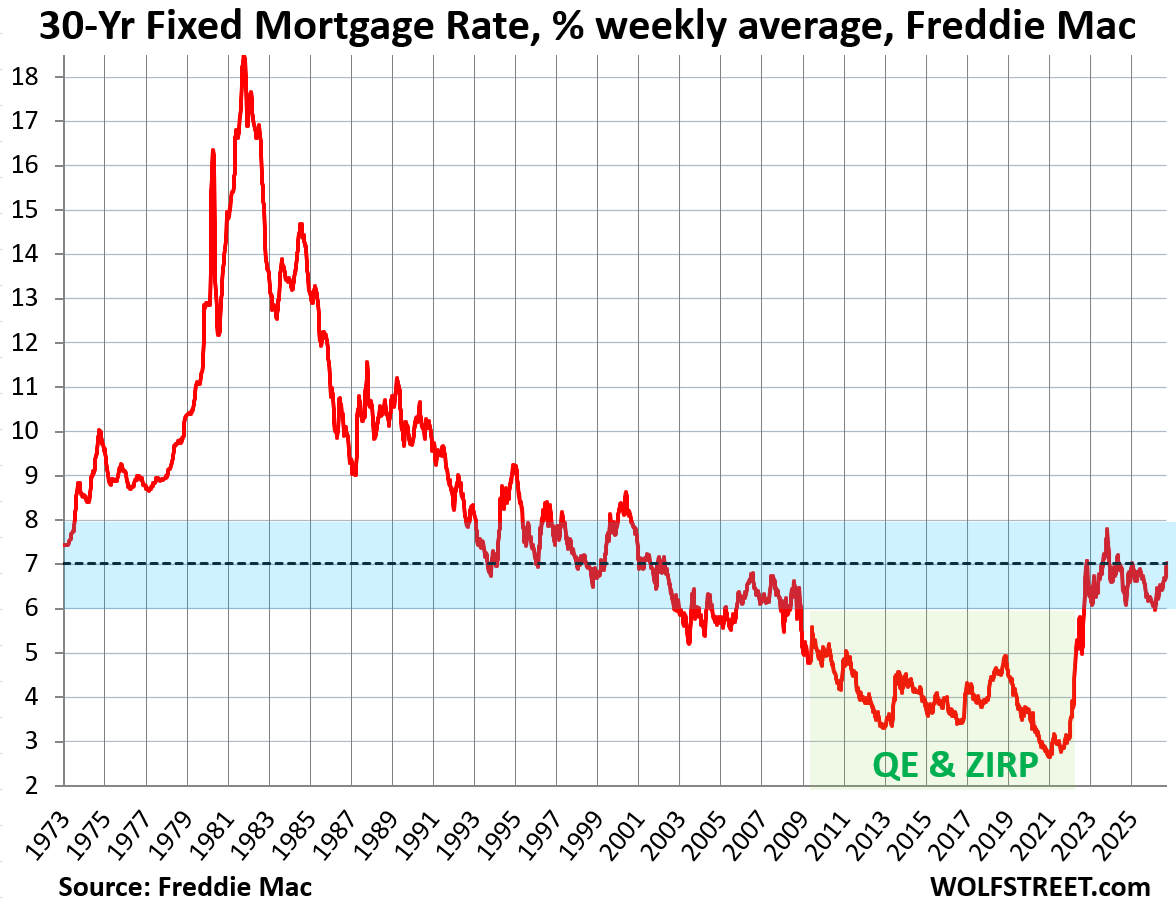
7%-plus mortgage rates prevailed in the 1990s. In the prior decades, rates were much higher, with double-digit mortgage rates being quite common between 1979 and 1991.
Those higher rates did not freeze up the housing market back then. What’s freezing up the housing market now are the too-high prices, following the price explosion from mid-2020 to mid-2022.
Enjoy reading WOLF STREET and want to support it? You can donate. I appreciate it immensely. Click on the mug to find out how:


I’m hoping to rotate all my money in short term treasury ETFs to ultra long term ETFs like GOVZ if 30yr treasury rates go 6%+
It will be a once in a generation opportunity to lock in at such high interest rates and get huge capital gains if markets correct and interest rates drop. 🤞
And then the 30-year yield goes to 10%? Or never reaches 6%? These are gut-wrenching decisions when you get there. That’s why people ladder into this stuff.
With such a reckless fiscal policy and a monetary policy terrified of slightest panic in the markets, I think that 30-year yield goes to 10% is not a very distant probability. In contrast, I think it may be the new norm.
Everybody knows that 40T deficit will grow nonstop. Only way to make it manageable is to reduce its real value with hyperinflation.
“With such a reckless fiscal policy and a monetary policy terrified of slightest panic in the markets….”
That’s the entire problem in a nutshell. The FED panics when there’s a single big down day in the stock market. The FED should not even be watching the stock market.
Well at least Warsh is slightly better on that front than Powell was. For Powell, priority number 1…n was placating Wall Street. What a disaster, and absolutely not the guy we needed after Greenspan, Bernanke and Yellen.
LOL! You contradict yourself. If you are convinced that hyperinflation is coming then you know that even a 10% yield will be a losing proposition.
In the hyperinflationary case. Reliable food and power sources will be your primary concern
WR,
Like many people, “Jason” doesn’t know what “hyperinflation” is. He seems to think it’s higher-than-normal inflation, so 10% a year would be higher-than-normal. Hyperinflation is something like 50% per MONTH, and if it lasts a whole year, that would be 12,000% a year. In other words, your money loses half its value every month, which makes a normal economy impossible. That’s not going to happen in the US. But higher-than-normal inflation is here.
My understanding was that hyperinflation is qualitatively different from regular inflation in that it’s basically a loss of faith that the currency is worth anything at all, or at least a loss of faith in anyone’s ability to say what it’s worth.
By the way I’ve always loved Wikipedia’s summary of the Zimbabwe hyperinflation:
“Zimbabwe’s peak month of inflation is estimated at 790.6 billion percent month-on-month, 89.7 sextillion (8.97×10²²) percent year-on-year in mid-November 2008. At that time, a $100 trillion banknote could not pay for a simple bus fare.”
One rung at a time – buy a bit at 5.25%, if it goes to 5.4% buy a bit more, if it goes back to 5.25% and you expect it to rebound liquidate your 5.25% to cash, goes to 5.5% buy again, etc. At least, that’s been the game plan so far!
Huh?
To me, the WR money shot quote, ” During the Fed’s maximum interest-rate repression in the spring and summer of 2020, when it purchased over $3 trillion of securities to force down long-term interest rates and inflate asset prices,”
is classic truth falling on deaf ears
It looks like we are going back to the year 2000 with 6.74% high on US 30 year bond.It did not last long but it did hit that level.
I remember 10 year CD rates at 8.00% to 8.25% which we bought a bunch and retired quite nicely with $75,000 interest income in 2007 from our IRAs,CDs.
Since then interest rates at overall 5.12% we averaged over the years since 2000 on all our IRAs,CD’s,US savings bonds,US bonds and 26 years later we are now pulling in $165,000 in interest income and in our late 70s.
Wolf, On a Macro Level, because of the Services Inflation and Iran War Oil Inflation, and AI / Data Center Buildout of $5 Trillion over 5 Years…please confirm these buildout numbers…means the Long Bond Rate will keep rising for these next 5 years…due to world wide demand for capital for AI.
Krugman’s initial first-take thinking is that demand for AI capital is pushing up interest rates… Are we in Year 1 of a World 5 Year Bond Bear Market? Please comment as to your first-take thinking.
The problem with fixed income in this scenario is that we expect the government to keep issuing debt at *accelerated rate*, which will require even higher yields.
Americans are no longer used to it, but 10%+ yields were not uncommon historically. In fact, they were quite normal.
10 year US Treasury yields were only 10% or higher for 6 years in the late 70s/early 80s. That’s it in the 250 year history for as much as we can find data for such things.
Pretty much irrelevant, as we’ve also broken the social covenant that ran for 250 years that in times of boom (yes, due to AI investment, this is one, despite what normal people may feel at street level…even then look at Wolf’s posts on consumer spending).
The last time debt-to-gdp was this high (post WW2) we responded with running years of 1.5% type surpluses. To put that into perspective, we’d have take everyone’s effective tax rate today (r) and raise it by 40% (r*1.4). Or we’d have to stop social security payments tomorrow and still raise taxes by 10% (r*1.1).
Oh and we had a major demographic boom. With birth rates at 1.2…that ain’t saving our bacon this time.
Oh and AI? Sure it could add growth, but it’s a small segment of tax payers, and a lot the the gains are in existing capital holders. We’re bad at raising revenue from capital gains….much less unrealized capital gains.
Well let’s just say at the outset that the bear market in bonds is probably just beginning.
The public demonstration of the incompetence of our government disgraces the fundamental basis of American society.
If you want to lock in a long nominal rate, buy STRIPS. If you want to lock in a long real rate, buy long dated TIPS with low coupons.
An ETF like GOVZ continually sells and buys bonds. Its underlying composition is always a mix of maturities and rates.
While working at a bond house in San Fran back in 2006, I was tasked with examining historical spreads between govies and other types of debt issuance. If I recall correctly, measured over 40 years, the average yield for the 10-year was 6.76%
A precision of two decimal points (6.76%) does not make much sense when you consider the actual values varied from 0 to 12%…
Would love to see the look on everyone who pulled their house off the markets face right now…
Hopefully rates stay high through spring.
Or the “marry the house, date the rate” crowd. How’s that “refinance at the lower rates that are coming” looking now?
Yes, waiting for lower mortgage rates before putting the house on the market has been a frustrating game. Vacant homes come with big carrying costs and risks.
@Wolf – It seems like the carrying costs of vacant homes don’t matter, at least for the corporate residential landlords. Apparently, some of the major ones use software like RealPage to collude on fixing rents. The landlords dont meet in smoky rooms to collude. The software does it for them (“allegedly”). The algos also keep some units off the market to push up the prices of the listed units. I guess the big landlords make enough money to overcome costs of carry with multiple tricks like these. Why else would they pay for such software & why would RealPage try to settle cases against them rather than fighting?
This rent fixing etc has effects on the broader market because artifical supply shortages cause mom & pop landlords to also increase their rents. Of course there are other reasons for rent increase too.
Wolf, are you aware of the cases against RealPage ? If not, then i suggest you read them.
I wonder if TECH mom & pop landlords have made so much money off rent in the good months and still have enough price appreciation that they can take the risk of keeping units vacant longer. E.g. Your total cost of home is 500k (price, repairs, interest so far) and todays market can give you 600k for it (i.e. 100k gain), then you could keep it off market for long like 6 months plus instead of a few weeks. Even better if this is your invetment property (tech people have a few). However, its a bit harder if its your 1st home. Then you gotta pay these high market prices and with high interest rates.
“It seems like the carrying costs of vacant homes don’t matter, at least for the corporate residential landlords.”
Nonsense. Corporate residential landlords try very hard to keep their units occupied and collect rent. If the units are vacant, corporate landlords or any landlords lose money on their vacant units, and they cannot do that for long. If too many units are vacant, the landlord defaults on the loans, and the banks size the properties.
The RealPage thing has zero to do with carrying costs of vacant units. This is software to manage multifamily properties (apartments), and the software was alleged to have allowed rent comparisons of other properties on the system to coagulate into collusion. That was the legal issue of RealPage, not vacant properties.
No reason it can’t run, but it does feel a little spikey at the moment. “Geopolitical easing” sending oil lower could drop it at any moment 🤷♂️
Maybe time to put a foot in the door. I am still nibbling around the edges…
Long term supply of treasury bills and bonds are not going down and its a structural issue
Agree completely. And this is not even the beginning of the end, with public debt at 122% of GDP. Anyone remember 2007 when it was only 60%? We’ve been on a 20 year booze cruise of cheap money – and we’re hearing last call, with the hangover about to hit.
I would rather waiting for the first rate drop, than buying now and risking a huge devaluation (similar to the post covid).
Under the “floor system” banks would refuse to lend reserves at lower rates than the IORB. And with a 3.9% IORB rate vs. 6mo T-Bill 2026-09-24: 4.22% = Investments are more attractive than IORBs. So, the FED’s too easy.
About 11 trillion dollars of the Federal Debt will have to be rolled over in the next 12 months, rolled over at higher interest rates.
And my bond proxy, the 24-month moving average of the 24-month rate-of-change in monetary flows, the volume and velocity of the means-of-payment money stock, peaks in November 2027.
My bond proxy’s “arrow of time” depends upon the preceding long-term drop-in rates. Since rates declined for more than 2 years, November 2027 is a possible peak.
Is this the start of the housing meltdown?
It’s long overdue medicine.
HELOC Margin calls!
😆
If you read Wolf’s other articles, the housing meltdown has already been running for a while in many/most markets.
Meltdown is not the right word. Meltdown implies a sudden and rapid collapse, which is definitely NOT what is happening in housing.
We dont want meltdown
We want control price down for years to come like low bleeding so that government does not come to rescue
Speak for yourself. I love a good sale…
Crash only hurts housing speculators and people who thought they’d hit rich by turning housing meant for actual people to live in into hotels.
Most housing transactions are 1:1, sell when prices drop, you’re also buying when prices have dropped.
MM
Smart housing speculators would like a crash.
Buy low… sell high
That is what I heard anyways
What I was thinking was the set up seems like 2006.
Overpriced housing assets that are abandoned because no one on the deed is able to make the mortgage payment. Like now, they meant too flip it before they actually had to make a payment.
Seems like 2006
As I told many here before, this isn’t going to happen because unlike 2006, very few homeowners are underwater, and so there’s no reason they will need to default. They can just sit in their homes. And if they are forced to move due to life circumstances, they can eat the loss.
85% of mortgage holders have at least 30% equity in their homes. Plus, everyone who has a mortgage now has great credit. So no one has a reason to just walk away, unlike in 2006
Those home sales that are already in the dumps are going to get decimated!
Devastated not decimated. Decimated literally means a loss of 10% Comes from how Romans would decimate a group of soldiers who would not fight or deserted or were not useful in some way. So 1 of every 10 would be executed, a term they described as decimated. Something I learned quite recently on social media, so it may even be true LOL….
Etymology can be amazing for cultural understanding but meaning changes over time. Now it pretty much means devastated.
Wolf, or anyone else, is there an affordability comparison metric that is useful at comparing different eras? Some of my conversations around home prices usually follow the same path: a friend complains that rates are high to which I respond that rates are historically average, the friend replies that home prices are much higher than earlier eras to which I counter that income is much higher than earlier eras. At this point, we’re stuck. Is there a metric that can help conclude these types of conversation? Not that I believe WAR is perfect as a metric to compare eras in baseball, but something like that.
The NAR affordability metric goes back to the 70s. It simply compares the average monthly payment for a new house at the current mortgage rate with the average income. We’re about where we were at the top of the housing bubble and the late 80s, which is a bit worse than the 90s, a lot worse than the 2010s, but not as bad as the early 80s.
Forget the metrics. In areas with high home prices that exploded in 2020-2022, the solution is lower home prices. If buyers stop buying homes, prices come down — and there are lot of markets where that’s happening already, and we track some of them here. Buyers set the transaction prices. The sellers set the asking prices. It’s the buyers that drive up prices. Quit buying, and prices will come down. Let the boomers sell their houses to the angels in the sky.
An “angel” just bought my boomer older brother’s home in Silicon Valley for 20% over asking price. I should probably do the same (younger boomer in Silicon Valley), but I hate to move. In addition, we have a good team of doctors and dentists. No complaints. I was a lucky hard-working guy now retired.
Yep. If you like where you live and your house is paid off, why sell? You’ll have to rent waiting for the prices to fall and buy back. Or move somewhere cheaper that you don’t like? No thanks.
re: Howard comment;
Evaluating renting until housing prices fall back should also include rent paid. Every month your rent costs more than a paid off home. The renter always pays the taxes and upkeep too….built in.
I tell people it is all relative providing you are not moving to a pricier area. And to assume your move to a lower cost area is not where you really want to be is also relative.
22 years ago I sold my peekaboo view home in a smallish city and moved to a rural junker. The new place was 1/3 the cost of the old. Took the 2/3 left and bought more property, then renovated the junker myself. Along the way met lifelong friends who appreciated we moved here because we wanted to…it was an affirmation for them in a sense. 22 years ago I would drop into the local pub in town for an after work brew, and my buds would twang hum the theme from Deliverance until they came up for a weekend fishing trip. (1 hour drive). Then they said, “Oh I get it now”. The town peekaboo view home now looks at some new builds and to the right a 5 plex. Traffic noise. I now look over a river full of salmon and drive to town only when I absolutely have to. The only noise is the wind and wildlife (barred owls, elk etc).
Work usually decides where people have to live. Solution? Pick a career or trade that is portable or required everywhere. Your job is often the only decider of everything, and then you scramble your entire life to get set up enough to choose the dream retirement, or any retirement at all these days.
You can start that deam early if you lose the debt.
regards
Paul S
Your assumptions about rents always paying for the landlord’s expenses are beyond wrong. Landlords default on their loans ALL THE TIME, and lenders are foreclosing on these properties and seizing them because the landlord could NOT earn enough in rents to pay for all the costs. There have been lots of huge cases, and I’ve reported on some of them, and the default rates for landlords are very high now. In terms of history, during the US housing bust and mortgage crisis, it was the mom-and-pop investors walking away from their money-losing rental properties – they couldn’t cover their costs with the rents they could get – that caused the most damage.
Shame,your brother probably could have gotten more for the home if he sold it to a “angle”,especially a obtuse one as they have deep pockets!
yea, and let’s remember the pain of a combined federal and state cap gains knowing that California taxes them at marginal ordinary income rates. I could see it with a 1031 rental reprieve but otherwise no way. Swap till you drop!
Paul S,
It sounds like you moved to a rural area in Oregon or Washington. Home prices to median income for rural areas were chump change when you moved. Decent rural housing prices are competitive to city prices in those states at this point. I think that the ship you got on has sailed, and is not pervasively available for today’s buyers.
“…my peekaboo view home…”
I’m not sure if there’s a more annoying realtor term….
Depth Charge, I’ll see your “peek” view and raise you “just a stone’s throw from X”. I’ve seen some where that stone thrower would have to have been an NFL QB using a killer slingshot with a 200 mph tailwind. And it would still fall 1/4 mile short.
To Howard:
“Or move somewhere cheaper that you don’t like? No thanks”
Somewhere cheaper does not necessarily describe a place that is less than, does not have quality, or somewhere that someone would not like.
It is just less expensive. Plenty of less expensive places are are still high quality… just less expensive…
Which is good, as far as I can tell. Pay less for the same or more.
Once you are retired for awhile, you learn to quit even looking at the market value of your home.
Unless it’s Denver, where supply of homes listed is very high but prices have not dropped commiseratively or even remotely close to expectations because sellers in (certain neighborhoods) are able to hold the line.
My friend in san Diego sold his home for 1.8m and rented a similar home for 6k per month
Now he has an opportunity to buy similar home for 1.4 but he is waiting for 1.1 m
It is insanity to buy homes here when you can rent much cheaper
Landlords are really eating the losses on monthly basis
Another friend bought a home in 2023 for 1.2m and he is renting it out for 4k per month
The math simply does not work
We also need people to stop being willing to rent or airbnb….
Personally I now stay at hotels as a mini protest, and also because Airbnb has gone the way of Uber quality is down, there’s no oversight, you really do not know what you’re getting. I recently booked one in Raleigh that had a 4.9 rating but upon arrival reeked of mold and had visible water damage. I left and went to a hotel.
The issue at hand is that there is a leadership vacuum in the US. Blatant corruption and manipulation of the Treasury by Bessent does not inspire confidence. Why would it? But where to go? Higher for longer might as well be printed on the US dollar at this point.
WG-
Respectful question: what is it that you are proposing the U.S.Treasury should be leading on?
Seems to me that Fed’s federal “leadership” on interest rates over the 10 years before 2024 represents a large portion of blame for today’s supersized deficit, debt, and bulging inflation signals…
The Fed and the Treasury should follow the markets (as Warsh proposes), rather than “lead.” IMHO
John H
“The Fed and the Treasury should follow the markets (as Warsh proposes), rather than “lead.” “
I agree.
But Congress MUST deal with the deficit. But they won’t until there’s a crisis.
If we accept that Congress won’t address deficits until there is a crisis, then we are predicting a crisis, are we not?
Similarly, if we attribute rising rates to a rising supply of treasuries that, at a rate of three trillion in new debt per quarter, is exceeding worldwide demand, then we can assume the trend will continue.
Put these ideas together and there is no rationale for being in anything fixed income. The ten year yield reaching 10% is a question of “how soon” rather than “if”.
The new money being attracted to 5% yields is suffering from a mental anchor on an idea of “normal” rates. But if we are in the late stages of a Ray Dalio cycle, printing money to keep the declining empire afloat, then it is irrelevant what rates were back in the days of sub-100% debt-to-GDP ratios and annual deficits measured in the billions rather than trillions.
All it will take is a Democrat to win the Presidency. Once that happens, Republicans in congress will suddenly remember they are supposedly deficit hawks (they somehow always seem to forget when a Republican is in the White House). Then there will be 4 – 8 years of near flat spending, and the economy will outgrow the deficit back into a more comfortable range.
Agreed. Congress controlled by Republicans, Democrat in the White House, and suddenly the Republicans are fiscal conservatives.
I agree we’ll see a sudden outbreak of fiscal conservatism among the drunken legislators IF there is mixed governance.
But what if that doesn’t happen and R’s hold both houses of Congress? This would mean even more massive deficits than we’re struggling with today, and possibly another “bigger, more beautiful” tax cut bill being proposed in 2028. Throw in another forever war and some more tariffs, and we have a recipe for rising yields and a falling USD index.
More to the point, the D party has been in decline for a couple of decades. The “blue line” keeps moving back with each election cycle. I can remember when Missouri, Florida, and Ohio were competitive, and nowadays we talk about Pennsylvania and New York. Even worse for the D’s, they have practically no grassroots operation in most states, no support from large donors, and no control of the large media outlets where most people get their news, like Meta or TikTok. There is a case to be made that D’s have shrunk to being a regional party representing large coastal urban centers, and we have at least a full generation of Republican governance ahead.
If anyone is thinking about buying bonds over the next 2 years, maybe hold off until after the midterms. Because if the R’s hold Congress, 6% could be merely a speed bump on the way to 7, 8, 9, and beyond.
“July 30, 2026 – A nearly 30% jump in the number of Same Day ACH payments and a nearly 10% increase in business-to-business payments helped drive the ACH Network’s second quarter 2026 growth.
For the quarter, volume on the ACH Network totaled 9.3 billion payments valued at $25.9 trillion, respective increases of 6.2% and 11.1% over the same period in 2025.
Same Day ACH handled 435.7 million payments in the second quarter, up 29.5%, while the value of those payments climbed 28.1% to $1.3 trillion.”
https://www.nacha.org/news/large-gains-same-day-ach-help-drive-ach-network-second-quarter-2026
More evidence of economic strength – transaction’s frequency.
Thanks for posting this.
I think I’m wrong due to misclassifications in DDs.
I asked chat gpt about the growth.
Banks choose DD classification because:
it improves liquidity ratios
it simplifies reporting
it avoids savings‑account rules
it makes balance sheets look more liquid
it reduces compliance overhead
None of these reasons have anything to do with velocity or payments.
The psychological barrier of 5% has been broken. Next stop, 6%?
The pundits have been harping all week that 5%+ indicates bad things are coming…..the old normal downturn cycle called recession. It used to slide in without so much fanfare, some people just lost their jobs. Then, you found something else when you could. Happened to me and we just endured. Now the drums are pounding away and folks are pissed off big time. I think it is personal debt and social media pounding out the rising anger as inflation ramps up more everyday. It could be ugly.
We are fine at 5 percent and we should he fine at 6 percent
I remember in 2022 when people were scaremongering that fed cant raise rates and now fed rates are close to 4 percent and gdp growth is still quite high
Wisdom is fake.
Fools making statements about the future
Long bond yields are approaching that for dividends from stocks. So when will the big money rotate from stocks to bonds thus lowering stock prices?
Probably still a way to go yet before the big rotation. I think the rotation will occur when short term bond yields exceed stock dividends.
Even if the short term bond yields are less than inflation it will happen rapidly when one of the big players prefers safety to potential capital appreciation and moves first, the rest of the herd will follow immediately like wildebeest on the Serengeti plains.
Short term rate: 4%
S&P dividend: 1%
I don’t follow
Captain, you mean corporate bonds?
REIT and Utility stocks are already taking a beating due to higher bond yields vs now-inadequate dividends.
Utilities are 15% off peak already although some of that is due to wildfire liability / legal issues.
Since I’m generally too lazy to do the math myself, I got AI to run some numbers. Looked at the effects of USA money managers returning to a 60:40 portfolio model, SPX fair value estimates based on the 10yr returning to 6%, how much new debt is being sold by the treasury. It all matches up nicely, just under $5T could come out of stocks, which matches the fair value, and the treasury needs an additional $1T every 4 months. Just need to wait 20 months.
I didn’t look at the effect of the “shrinking” of the treasury market because current value of existing debt keeps decreasing. Might make it harder to achieve the 60:40 ratio, and maybe this is why the rush is on to get the older bonds and notes off the books.
I’m never quite sure what is meant when someone says a certain amount of money will “come out” or “go in” to stocks. If money “comes out” when people sell, they are selling to buyers, whose money simultaneously “goes in”. Do you mean that the total market cap will decline by your stated amount?
More demand than supply -> prices up
More supply than demand -> prices down
Balanced -> prices stable
If money more money wants to leave the market, than wants to enter that tips the supply and demand balance.
Yes there’s always a buyer but what price that buyer is willing to buy at may change.
Fund managers in aggregate have to own every bond and every stock. The bond market is substantially larger than the stock market.
The 60/40 portfolio is a myth, and it’s as big of a lie as the “money goes out of stocks when you sell” myth.
On balance the average portfolio has to have more bonds than stocks, because that’s what’s in the market, and someone has to own all of it at every point in time.
am i doing this right?
5.42 percent of 13 billion is $704,600,000 in interest fees the guberment has toupee to finance the bonds.
Math is correct. Investors are making $704 million in interest income a year on their $13 billion investment.
I think it means they are borrowing an additional $705 million on top of that $13 billion every year just to keep this charade going.
“Another part of the story is huge demand from Corporate America for funding the AI investment boom via debt issuance. Those AI bonds pay higher yields but come with much higher risks than Treasuries. And they’re putting pressure on the Treasury market.”
What is the risk, if the strong precedent now is that we all know that the government will backstop Corporate America one way or the other? We have established that too-big-to-fail is how it works–so in talking about “higher risks” and a distinction between private and public debt, are the risks real? Say we have an economic implosion because of the AI craze? I see a bunch of corporate executives going to DC and getting bailouts, not defaults and major companies failing because they got out over their skis. Plus we have arguments coming out of the government that we are in an AI race with China, and thus the AI industry is strategic–if the industry is strategic, what is the risk in buying its bonds?
There is nothing even remotely strategic about the Abysmal Idiocy (AI) ‘industry’ and all of its bond are very high risk default likelihoods.
Agreed on the price of houses being to high. Interest rates were high in the 70s, 80s and 90s. Home prices were reasonable. My tiny, starter home with only the first floor finished, a HUD requirement, cost me 110K in 1989. My interest rate was 10.5% for a 30 year mortgage.
Today, home prices are through the roof. In addition to that, young home-buyers seem to want the biggest, perfect house now rather than use a starter home as the stepping stone to building real-estate wealth. I have retired and am currently living in my 5th and final house, which happens to be a tiny bungalow, perfect for a retired person. When I bought it a decade ago, I carried a 15 year loan at 3.99%. I paid this house of early some years ago as I planned for my retirement.
New homes are ridiculously priced. I think I came across a number of a national median home price of 429K. This means that the prospective buyers need to have a household income of around 150K. Mortgage payments aside, there is always maintenance, repairs and upgrades, which are necessary in order to maintain the value of a home. I constantly see homes that have not been maintained selling for far below their market value. A home is usually the most expensive investment, which is also an appreciating asset unlike a car.
Bite the bullet, lower your expectations and buy an older home that needs some TLC. Home Depot is your friend and will ship most things to your home within 2 days for free. Roll up your sleeves and start working on a home that needs some love and attention. Cheers.
Vadertime:
I completely agree…
There are still opportunities if a person is willing to work, live on a beer budget, and not have the instant dream home right now, right now.
Forego instant gratification, be patient, put in work… it will most likely pay back long term.
Think the hoo-hah about US and G7 bond yields is slightly overdone. Keep in mind that we live today in the Debt Age. Almost everyone in the Western world is drowning in debt. Consumer debt, biz debt, govt debt, everyone loves debt. It’s not going away. It’s here to stay. Debt is the new normal. Don’t get too stressed about it. The world already has trillions of debt, and there’s still trillions of spare cash sitting on the sidelines ready to fund more debt. Times have changed. We live now in the Debt Age.
Lots of readers here are not “too stressed” about the high yields, but are looking at them as a current or future opportunity of locking in some income on their investments. We’re back in the era when bonds can actually make a decent amount of money with relatively low risks.
There is a catch, it is called exponential growth. If anything grow by the same percentage each year, the growth is bound to go to infinity. Actually, any continuous growth head to infinity.
When it comes to money, if there is an infinite amount, the money is worthless. Well, maybe not quite, but in the end the cost of even the cheapest item will be a silly amount of money.
It will take a very long time to reach infinity.
Do you know the story about the chess player that requested one wheat grain for the first square on the chessboard, two for the next and doubling for each next?
Exponential growth do not look bad at the start, but over time the growth accelerates.
From a quick internet search:
“The total number of wheat grains required for all 64 squares of the chessboard is 18,446,744,073,709,551,615 (about 18.4 quintillion grains), resulting from doubling the amount on each square!
Even a 5% growth is a doubling every 15 years or so.
@ Sams,
Exponential growth is, indeed, exponential. My previous comment still stands. I admit I was being a bit of a smart-aleck. The interesting thing about exponentials isn’t that they go to infinity, but pointing out that it goes to infinity has dramatic flair. (Linear functions with a positive slope go to infinity too.) It’s that their rate of increase (slope) also increases exponentially, and so on. But the kind of function you are talking about will still take a very long time to reach infinity. Infinite time.
Infinity is not a destination; it’s a journey.
Why do you think that “trillions of spare cash sitting on the sidelines” is something other than debt? Those T-bills, money market funds, and bank balances we perceive as “cash” really…aren’t.
Re “Almost everyone in the Western world is drowning in debt.”
No, because one person’s debt is another person’s loan or bond. Or pension fund asset.
All debts net to zero, literally nothing. It’s just a question of who lends and who borrows.
The Western World is drowning in exactly nothing.
But for a while here it will be more expensive to be a borrower and less of a ripoff to be a lender.
Earlier in week I commented on participants comment about their expectation that the 10 year UST Bond yield could reach 6.8% next year. I mention I would be a buyer at 6.75 but at the same time equities would look attractive for the first time since Covid lows. I believe my analytics were wrong, stocks will get cheaper in price with higher rates but their earning will disappear, companies have been living in and off the credit bubble. The world borrowed and spent 360 trillion in debt of course profits went up during that credit expansion but when the credit growth slows with higher yields, earnings will plunge, the pretend and extend and rollover debt game gets real scrutiny and will require real cash flow from operations not creative financing. Leverage of private equity will collapse. De leverage creates de risking creating de listings of public co and defaults. Perfect storm is coming! It’s going to be exciting to watch the historic events un fold. Inflation rate inversion above the unemployment rate in October reported in November. Yeah I think so.
For clarification 5.3% was my previous buy the 10 year. 5.332% is 2X above the 200 monthly simple moving average of $tnx that is currently 2.666%. That’s the line in the sand above yield of 5.332% the panic occurs after buyers gets exhausted. IMO that will happen after the unemployment rate comes out on friday or even the day before when PCE comes out this Thursday unless a rabbit is pulled of hat with a data save. The data trend is pointing the way
“Bloomberg’s Markets Pulse survey of 173 macroeconomic and market participants revealed today that over 50% of them expect the 30-year yield to be higher than 6% by the end of 2026.”
Can I assume that the 10y will also rise proportionally? I never understood the dynamic of who buys 10y vs. 30y, and how much. Now, if the 10y goes up, the mortgage interests will follow immediately with a spread of 2….2.5% on top of it. Dang, we will be soon looking at 8% or more. If the RE market is frozen now, what’s next?
Good questions, no answers. But some thoughts: During times of a normal yield curve, the 30-year yield is higher than the 10-year yield, but the spread between them varies a lot. When the yield curve is “steep,” the spread between them can be wider than 2 or 3 percentage points. Other times, the spread can be narrower. So the assumption that the 10-year yield would follow the 30-year yield higher is normally correct, but it’s not going to be in lockstep. The spread might widen, with the 30-year rising 60 basis points and the 10-year rising 20 basis points, for example. Or it could be very different (which is what makes a market).
“reckless fiscal policies with deficits running at 6% of GDP despite the strong economy.”
I would argue that this is The Problem in the US economy right now, sort of like ZIRP was a few years ago. A recession is necessary at this point to avoid a Bronze Age Collapse a decade or two from now (tounge in cheek… sort of).
A collapse to a Bronze Age is a stretch goal. If a collapse happens we’re going to be mostly left with plastic to rebuild with.
Look up “Bronze Age Collapse”. The world was highly financialized and based on global trade, then all of a sudden most of the civilized world simply disintegrated into the ether. Many/Most major cities were literally abandoned, much like in the movie, “I Am Legend”, despite their favorable geographic features that made them prosper.
As we know various factors are driving up inflation. Meanwhile politicians running for federal offices are still selling (out) the voters with promises of yet more tax cuts.
The end game here is likely to be the abolishment of the IRS, and its replacement would be a federal flat tax of 25 to 35% or so on everything. Additionally each state having lost its own ability to collect income taxes would also now need a big flat tax of its own. Guessing another 10% or so.
If the poor are floundering with the current system, imagine taking away an additional 40% of their income with every purchase. Hovervilles, here we come.
Hey, we gotta pay off that 40 trillion somehow. It’s not like the wealthy or the corporations they own are going to do it.
The only remaining alternative here is to inflate the debt away. But my money is on the flat tax, just out of heartless spite, if nothing else.
The notion of a ‘flat tax’ is incredibly stupid and there will never be any so-called ‘flat tax’ imposed in the US to substitute for income tax, and the fact of the matter is that income tax rates need to be increased substantially.
Agreed
BeachDude:
I will gladly pay more tax… when the blatant in your face waste and fraud are cut back.
I know waste and fraud has always existed, but it is so blatant now.
The waste and fraud is getting fairly outlandish, and there seems to be no way for the average taxpayer to hold elected and non-elected officials accountable for spending and fraud.
So as of now…. I pay the least amount of tax legally possible.
I currently and gladly pay a higher property tax were I live than surrounding areas. It supports the counties schools. With that said, the schools have top notch newer facilities for the kids, and most importantly the scores to prove that the investment was worth it.
The area that I lived in California, the property taxes were high….
But…
the school facilities where I was were old, falling apart, and supplemented with old saggy modular “temporary for 15-20 years” buildings and the kids scores definitely did not reflect money spent.
And this was on the fairly affluent central coast of california.
I know because my kid was in that school system.
I pay least amount of taxes possible, unless more taxes can be justified with actual real life tangible results.
Seems like the possibility of ever increasing rates might actually help the housing market by getting sellers who need to sell for one reason or another, to drop their prices, as rising mortgage rates just eliminates more buyers. I suppose that is good for cash buyers but obviously has some huge downsides.
If warsh is really serious then he can also sell mbs fed bought few years back in large quantities
I can assure you warsh will side with asset holders on this as well
This is Powell’s fault. Warsh just inherited a bad policy.
Jerome Powell continues to be one of the 12 members of the Federal Reserve FOMC and none of the policies set by the FOMC are any of the fault of Jerome Powell who is a single voting member just like Warsh.
Powell:
#1 “there was a time when monetary policy aggregates were important determinants of inflation and that has not been the case for a long time”
#2 “Inflation is not a problem for this time as near as I can figure. Right now, M2 [money supply] does not really have important implications. It is something we have to unlearn.”
#3 “the correlation between different aggregates [like] M2 and inflation is just very, very low”.
#2 and 3 are unambiguously correct, despite the simple story everyone desperately wants. Money supply measures of all kinds, including M2, correlate poorly with inflation.
@numbers.
The correlation between means-of-payment money supply and C-19 was perfect. Just study the G.6 Debit and Deposit Turnover release discontinued in September 1996.
Contrary to Nobel Prize–winning economist Milton Friedman and Anna J. Schwartz’s “ A Monetary History of the United States, 1867–1960, “there is no “Fool in the Shower”.
Monetary lags are not “long and variable”. The distributed lag effects for both #1 real output and #2 inflation have been mathematical constants > 100 years.
But the current environment is different.
This is either gobbledygook or just completely wrong, and I can’t tell which. So I’ll just repeat what I said about M2. The correlation, which looked like there might be one for a while, and then completely disappeared, is totally dependent on a constant velocity of money. No one has ever once explained why money velocity should be a constant, other than it looked kinda constant from 1960-1990. And since 1990 it has been completely non-constant.
Powell should be removed from the FOMC. The revolutionary & disastrous implications of his acts are clearly not recognized. The FED has obfuscated the difference between money intended for spending from money intended for savings.
The means-of-payment money stock can never be properly managed by any attempt to control the cost of credit. It’s Dr. Scott Sumner’s “Never reason from a price change”.
I find it fascinating that it took relatively little time and effort of Warsh’s Fed for the bond market to finally start normalizing. The market pressure to return to reality is enormous. Perhaps it’s so high that the Fed doesn’t even have a choice at this point, unless they’re willing to risk even greater disruptions in the near future. Not that that stopped them in the past.
Let’s see if the country can tolerate this, or will opt for total interventionism (aka socialism). As somebody who lived behind the Iron Curtain I’m terrified of that prospect.
Perhaps you’ve noted the US government taking equity stakes in dozens of corporations?
But you’re speaking in the future tense as if socialism isn’t already here.
What you are describing as “socialism” in the USA ain’t like living behind the Iron Curtain. If Tight Purse came from or, lived in an Iron Curtain country he knows he has a right to be fearful. If you haven’t then don’t compare gov’t purchasing 10% of Intel or, whatever it was to Iron Curtain “socialism” ( actually communism ) as, the economic impact is just a tiny feature of gov’t control of every aspect of a person’s life.
You confuse authoritarianism with socialism. The Iron Curtain had absolutely nothing to do with socialism.
Besides, in reality the U.S. has already lived under socialism for decades/centuries.
Regarding, “Corporate borrowing has ballooned despite the higher costs of borrowing as the historic AI boom needs to be funded. And this debt issuance is competing in the bond market with Treasury debt for investors.”
In the finance world, from the perspective of a company needing capital, what is the hierarchy of capital preference?
Does it go cash, then equity, then debt?
Hyperscalars were using cash flow. Then, they turned to issuing new equities. Now they’ve turned to issuing bonds.
Is there something after bonds?
“Is there something after bonds?”
Junk bonds.
Thanks, makes sense.
And junk are basically defined by high risk and high yield, so an increased supply of them will put continued upward pressure on Treasury rates.
So reasonable to expect AI buildout and rate increases to continue until we see trouble in junk bond market from hyperscalars?
Long-term treasuries will be terrible investments until the Fed gets serious about dealing with inflation and congress gets serious about reducing the deficit.
So what I’m hearing is short TLT.
What happened to that Guy?
Depending on execution, he’s probably living in an oceanfront mansion with an orgy scheduled for today. No time to reply to wolfstreet comments.
I am talking about investing, not trading. In the short term, TLT will likely go up and down several times. I would not short TLT.
I agree there’s no telling what it will do in a week or two, but the option chain on TLT goes out 39 months, all the way to January 2029 currently.
Seems like one could make an “investment” out of shorting TLT rather than merely making a “trade”.
Wolf, any thoughts about the impact of this surge in yields on the unrealized losses of banks and other financial institutions? By what I could clean from FDIC’s latest reports, it seems that the banks have kept the long bond positions and intend on mantaining them to maturity, but if this surge extends into the 6.3-6.5% range then they would be roughly back into the position they were when SVB failed, or a little worse.
I could’nt find any overall sector report more detailed then FDIC’s about those positions, so I had to guess a lot. And there is a lot of new long term loans and funding to the IA build boom that’s new to the picture also.
Interesting. What your talking about is when do the banks holding these toxic bonds break. This is a needle that will be tough to thread. Even though I am vibe analyzing. Wolf?
There is nothing “toxic” about those bonds. Banks hold them to maturity, get face value back at maturity and collect coupon interest along the way. Most long-term bond investors don’t give a fuck about market value of a bond because it’s completely irrelevant when you hold to maturity. People just don’t know what bonds are.
Wolf, just to clarify, I’m not implying that those bonds are toxic. Just that because they make up 13-25% of total assets, a decline of over 10% of market value of those bonds, even unrealized, could make some banks more vulnerable. Sure, now the Fed has set up a repo facility, but the loans to the banks use the bonds at market value, so an hypotetical surge on yields (to 6.3%) and a simultaneous fall on stock value still could create quite some stress, no?
Yes we do know what bonds are and also what bonds were. Bonds were a very good investment with 5 percent more or less interest. Usually they paid a point or two above inflation. Now bonds are a very bad investment particularly the long bond. The best known way out of the governments overspending is to inflate out of it..So when the long bond comes due and you get paid in full the money has lost all its value. Should you want to sell meantime and the rate is above your purchase rate the bonde value has tanked. Short bonds are also bad because the interest rate does not cover the inflation rate. At this rate, to make a pun, the government may go broke, and that would be the biggest disaster of all. Please do not think America is the only bad bond deal, many governments do this.
I read a lot of comments here. Although I am 74, I am no wiser than anybody else, but let me say a few things. My mother was born in 1918 and has now past. She use to say that life was so much slower when she was young. Even when I was young in the 1950s, there were no supermarkets. My grandmother drove about 8 miles to a grocery store that was was about half the size of today’s Walgreens. She knew the butcher, and they had a gardener who grew vegetables for them. For all you people who think they cannot afford a house, yes it seems tough, but think how much money you could save in five years if you lived similar to the way they did. Over the next four to five years, prices for homes could be more reasonable. So what if interest rates are high as long as you have a large down payment? Home ownership also means maintenance. But with all of the self help videos on the internet you can do pretty much fix anything yourself(except for a new roof). Better that than sit in front of the idiot slab all pissed off at the news(we use to call it the idiot box….). One person I know says he has not watched television in 30 years. When I was a kid, television was free. Point is, save your money, at least for awhile.
i agree. we unplugged our idiot box in the 1980s in our twenties. i built a slate roof with my brother in our twenties. cut the slate and drilled the holes in each piece, too. unless you were an adult in great depression, being an amerikan has been easy street for past 2 generations. first 2 houses i hate notes. the last 14 houses i payed cash. watch for free on youtube, 4 part documentary, “century of self” to understand what happened. i’ve been a stock trader for decades. i call it work like activity. it ain’t real work.
Over the air television is still “free” as in no monthly cost, subsidized by advertisements. My parents have never paid for television. When over the air TV switched to digital, my brother and I put a bigger antenna on their roof with an amplifier so he could watch football on a channel that was harder to pick up where they lived.
TV ads started to bother me when I was pretty young, and the internet was becoming more mainstream, so I started reading things online and making little websites instead of watching TV.
>think how much money you could save in five years if you lived similar to the way they did
Many have thought about it. Some of us, unlike you, have even thought it all the way through; and some, unlike you, have actually done the math. Living “similar to the way [your grandmother] did” for five years wouldn’t save anywhere remotely near to a down payment on a house at today’s prices, even if it were possible (How, precisely, are people living in a two-bedroom apartment supposed to have “a gardner who [grows] vegetables for them”? For that matter, how on earth would driving eight miles to a small grocery store rather than one mile to Costco save any money at all?). Neither would living that way for ten years. Or fifteen.
If the fed thought that a 25bps rise in short rates would do anything meaningful to slow the economy, they would not have done it.
grimp-
“If the fed thought that a 25bps rise in short rates would do anything meaningful to slow the economy, they would not have done it.”
Decades ago there was a common “rule-of-thumb” meant to correlate stock market declines to sequentially rising interest rates (was it Marty Zweig who first coined it?):
—“three steps and a stumble”—
You can’t get to the “stumble” stage without the initial and incremental rate increase. Warsh said he would do it, and he did.
We’ll see about the second incremental “step” as 2026 progresses…
LOL at all the idiots who bought uncle scam bonds when they ere yielding 3 to 4% and they were getting a deal!
Just imagine a few years from now:
“LOL at all the idiots who bought uncle scam bonds when they ere yielding 5.5% and they were getting a deal!”
Indeed, that “transitory” but not was the turning point.
What you gained in yield you lost against inflation.
It’s basically still zirp/nirp for h0dl’ers
TIPS at 3% real are a reasonable deal.
Not if you have to pay one of the higher tax rates on them.
They could lower interest rates by making all the government bond interest non-taxable for individual investors, as is already done with municipal (state/local) bonds.
Next manufactured crisis is a big bank reported as undercapitalized if its bond portfolio is marked to market.
It’s been awhile but there’s a couple things…
Only unrealized losses in investments classified as trading securities hit the P&L.
Unrealized losses in available for sale or long term investments by pass the P&L and go straight to OCI.
This will also impact all their privately held investments like private company stock, warrants, convertible debt because it changes the discount rate in their calculations by a significant amount. Which will also run through OCI.
So what we’ll see is balance sheet decreases.
September’s annualized percent change in the PCE is currently estimated by the Cleveland Fed to be 3.97%
https://www.clevelandfed.org/indicators-and-data/inflation-nowcasting
Wolf, what’s going on in the repo markets? Liquidity still ample?
Looks like it. SOFR at 3.88%, right in the middle of the Fed’s range of policy rates.
It is the summer of 72′ again, this time without the cool cars and a debt:GDP of 120%…
..and the most criminal CONgress of corporate whores America has ever had.
Hedge accordingly.
The bond market doesn’t seem to be taking a breather and digesting this morning.
WOOSH… 5.27% for the 10-year, 5.64% for the 20-year.
Some of the yields were up 1% or more an hour into the day
This can be confusing: you mean 1% of the total yield, i.e. 0.05% or 5 basis points, not 1% in yield.
My end of month Vanguard MMA should come in at about 3.75%. Looking forward to the October rate hike hopefully it will bring us to 4.0%. Free money compounding monthly in my 401k retirement plan, with zero fees attached. Liquidity is piece mind, without a decline NAV. I will never buy a 10, 20, or 30 year bond. The short end of the stick has more options. My ears listening for Trumps next stock tip, SMCI and HPE could be the run up.
I suspect it will be hard to control inflation expections with the president continuously clamoring for lower interest rates.
IF a lot of incumbents are removed this November, that would be a sign the Fed would act strongly against inflation. If not, then no. The medicine for inflation is bitter (recession) and it requires a strong public desire for it.
The TLT bond ETF had never closed below $80 since it began trading in 2002. Until last week.
Now it looks attractive to some investors, but I have a much better trade for investors who are willing to take a little bit of risk. You sell Dec 31 $70 puts for .32.
For each contract it costs you $700 in buying power. So let’s say you sell ten puts, it costs you $7000.
If it doesn’t fall below $70, you earn $320. That’s a profit of $320 for an investment of $7000 for 94 days. That’s a gain of 4.57 percent in just 94 days. And 365/94=3.88; 3.88 x 4.57 = an annual rate of 17.73 percent(!!!) If it were to fall below $70 in the next three months, which I don’t see happening, well so what? If you buy it now at just under $79 to earn the interest and it falls below $70 you’re going to lose a lot of money anyway, probably a lot more than you will lose if you short the puts.
I like the Dow and the S&P equal weight ETF here. The RSP has had only five green candles in the last 21 trading days. The Dow and the S&P equal weight are both very oversold here relative to the SPY and the QQQ. And if oil goes down the Dow could have a really big rally.
5.24% on the ten year. A rate first seen in June 1993 on the way down from the early 80’s peaks.
Life was actually not bad 33 years ago. No internet except for a few slow text based servers and no cell phones except those hooked to your car battery.