
I’m worried about the inflationary mindset taking off again. It’s the Fed’s job to step on the brakes before inflation turns into a runaway train.
By Wolf Richter for WOLF STREET.
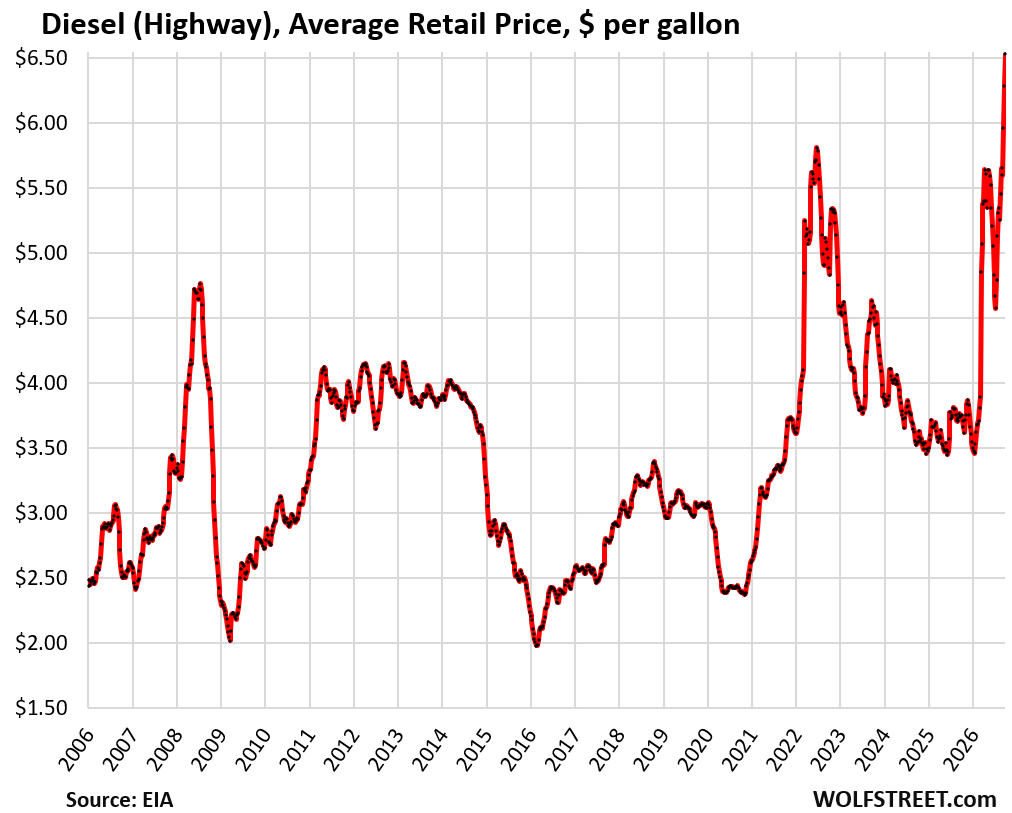
The average retail price of on-highway diesel spiked by 24 cents in the latest week, and by 88 cents in four weeks, to a record $6.529 a gallon at gas stations on Monday, and that’s for the US overall, according to the EIA this morning. Year-over-year, the price of diesel has spiked by 74%.
California diesel prices spiked to $8.246 a gallon. While driving by gas stations, we’ve seen over $8 a gallon for weeks.
These are sobering sights, setting off the inflation alarm bells.
Republicans called for a diesel export ban. There is a shortage of diesel in the rest of the world, and US refiners provide much needed supply.
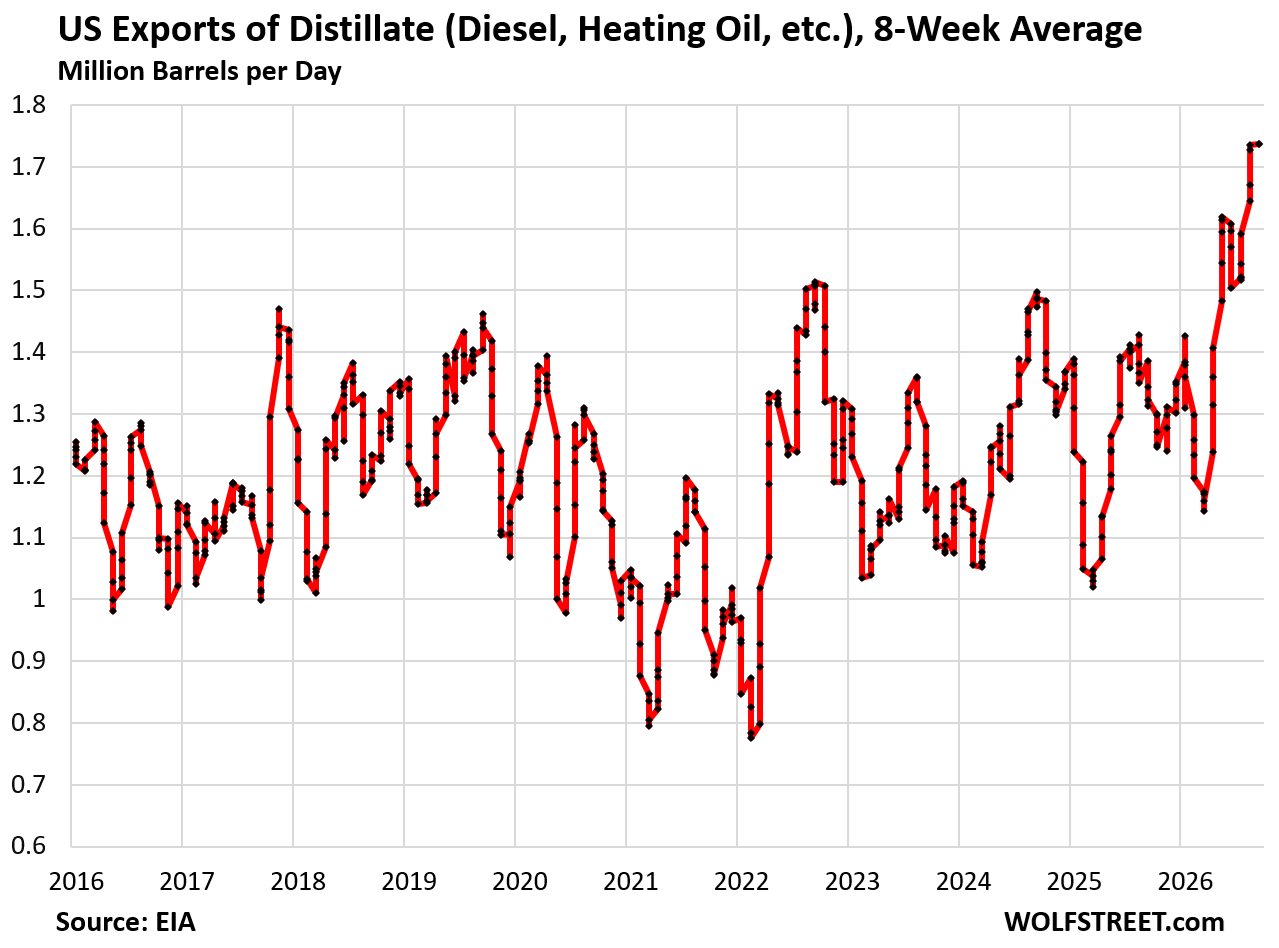
Year-to-date through August, the US produced 5.1 million barrels per day of distillate fuel oil (mostly diesel); imported almost none; and exported a record average of 1.74 million barrels per day over the past two months.
Diesel crack spreads, which are a rough measure of US refinery profit margins for diesel, are at record levels. And they come on top of the high price of crude oil. The result is a record high retail price of diesel.
So Iowa Sen. Chuck Grassley (R) urged President Trump on Saturday to impose a temporary diesel export ban, with the hope that such a ban would narrow the crack spread and thereby allow diesel retail prices to cool before the midterms. Trump today endorsed a diesel export ban when talking to reporters. A decision, he said, is coming “fast, one way of the other.”
The weekly diesel export data from the EIA is the most current measure, but also the roughest most incomplete estimate, and very volatile from week to week. And it’s seasonal. The 8-week-average provides a sense of the recent trends:
Diesel impacts inflation in the overall economy. Only a small portion of consumers drive vehicles with diesel engines (some pickups and SUVs, and some older European imports), so diesel prices impact only a small number of consumers directly.
But diesel prices – along with jet fuel and gasoline prices – feed into all kinds of transportation costs that consumers pay for directly, such as ecommerce shipping charges and airline fares.
And they’re also part of the input costs for a broad range of businesses, directly or via higher prices of goods and transportation services. And businesses will then try to pass on those higher costs via higher prices for their goods and services to consumers, other businesses, and governments.
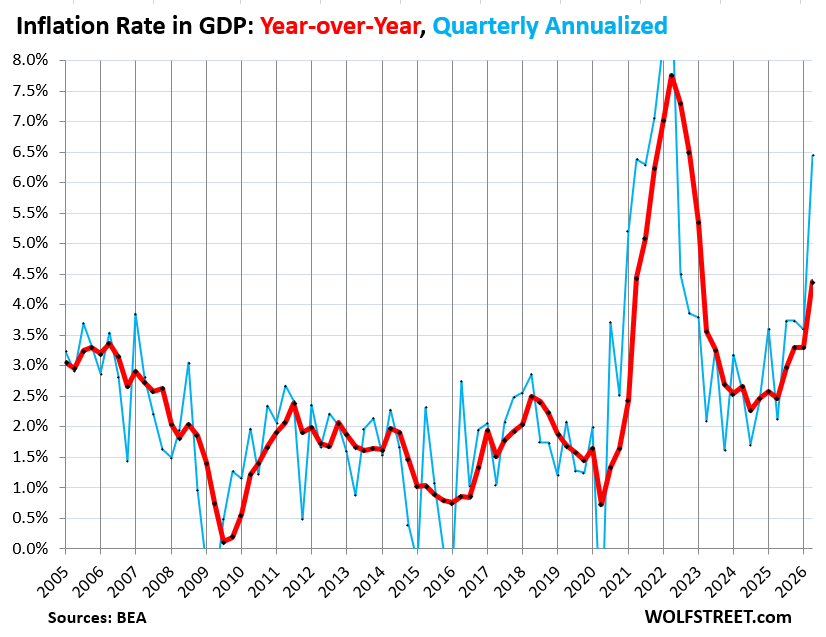
The GDP price deflator, released by the Bureau of Economic Analysis, tracks inflation facing all economic entities: consumers (separately tracked by the CPI and the PCE Price Index), businesses (separately tracked by the PPI), and governments. It tracks inflation in the overall US economy and is the broadest inflation index in the US.
Inflation has been worse for businesses than for consumers as businesses could not fully pass on the cost increases without losing sales. This has shown up in the much hotter PPI inflation (overall PPI +5.4%; services PPI +4.5%; core goods PPI +5.0%; energy PPI +24%). So inflation in the overall economy has been worse than inflation that only consumer face.
Inflation in the overall economy had already spiked in Q2 by 6.4% annualized from Q1 (blue) and by 4.4% year-over-year (red). For Q3, at the current pace of those fuel-price increases, these overall inflation measures will look even worse.
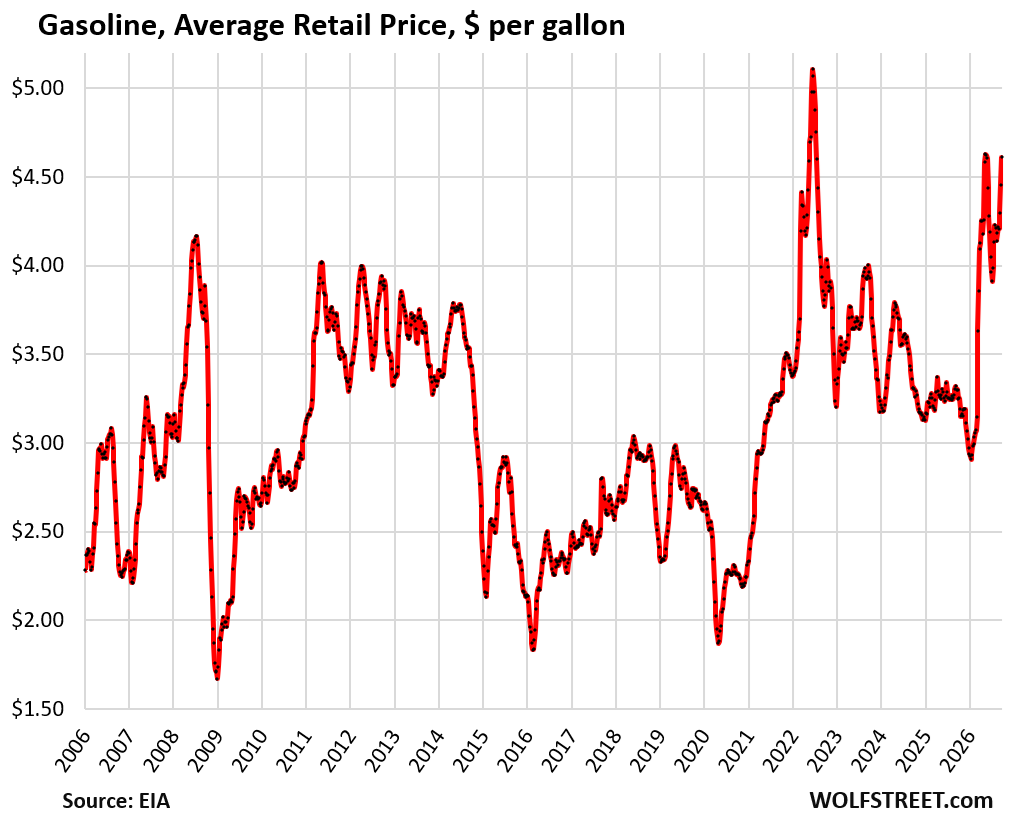
The average retail price of gasoline, all grades combined, at gas stations on Monday spiked by another 16 cents from the prior week, by 39 cents in four weeks, and by $1.31 from a year ago, to $4.61 a gallon, nearly matching the May highs.

The average price in California rolled over $6 a gallon this week. But many gas stations have been charging over $6 for a long time.
These price increases of gasoline will enter directly into the inflation calculations for all-items CPI and the all-items PCE price index for September, to be released in October.
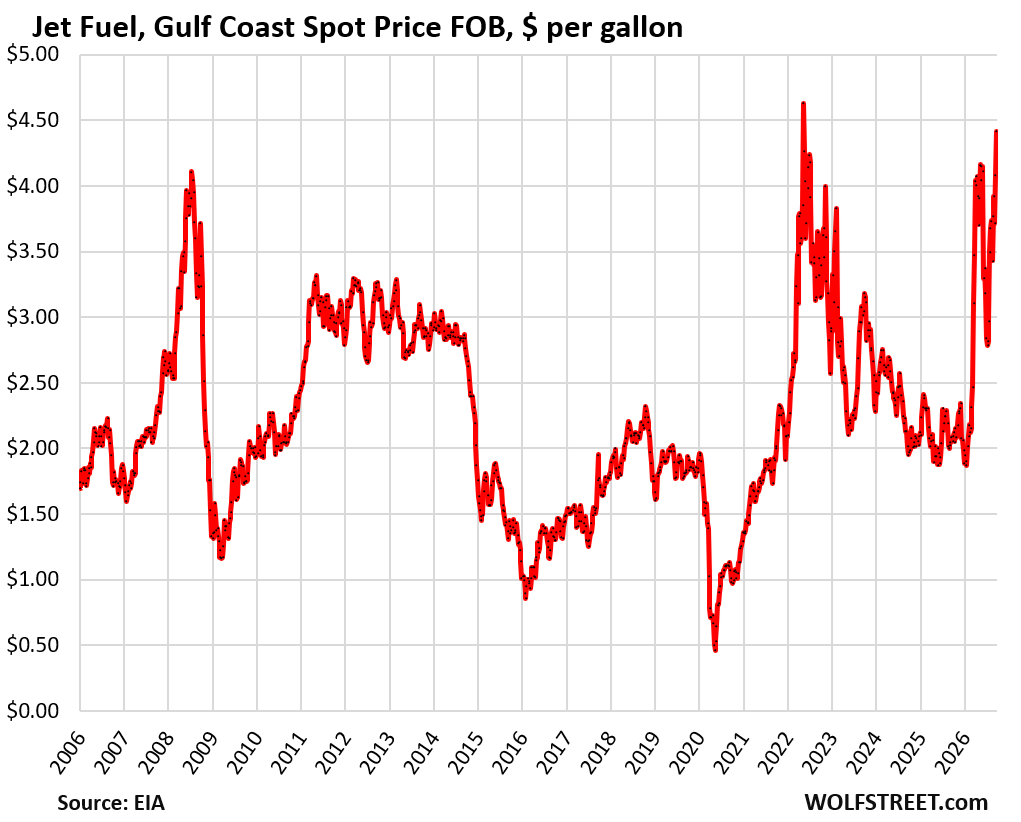
The spot price of jet fuel spiked by 34 cents over the past week, by 65 cents in four weeks, and by 115% from a year ago, to $4.418 per gallon, just a hair below the record of May 2022, per the EIA’s weekly measure of the Gulf Coast Spot Price.
Many airlines hedge part of their fuel purchases – a substantial part of their overall costs – and Delta operates its own refinery. So their cost increases don’t exactly track the spike of the spot price of jet fuel. But they are trying to pass those cost increases to flyers via higher ticket prices.
Airline fares are a component of the core inflation measures, and are a component of “core services” inflation. This is one of the ways that higher energy costs drive up inflation in services.
Air freight also faces higher fuel costs, which impacts all kinds of transportation costs that filter over time into prices of goods and services.
Repeated fuel price spikes can trigger the inflationary mindset, a phenomenon where consumers are willing to pay those higher prices because they’ll demand higher wages, and companies are willing to pay higher costs to their supplies and higher wages to their workers, confident that they can pass on those higher costs “plus some” to their customers and clients. This “plus some” factor was an important contributor to the inflation spike in 2021 and 2022, leading to a historic spike in corporate profits.
If and when the inflationary mindset takes off, inflation threatens to morph into a runaway train. It’s the Fed’s job to step on the brake early to prevent bigger damage. But lightly tapping the brakes might not work very well.
Enjoy reading WOLF STREET and want to support it? You can donate. I appreciate it immensely. Click on the mug to find out how:


I totally get the “plus some” inflationary pressures from insanely low interest rates and a hot economy, but these current inflationary pressures are “government caused”. Whether they be tariffs, taxes, higher employment and payroll taxes, higher costs due to wars or the sanctions on suppliers – the higher costs aren’t necessarily the fault of the supplier or manufacturer. I just lost my wonderful pet food delivery supplier who just packed it in as the tsunami of additional costs and rates killed his ability to go on. I agree that raising rates will reduce much of the “plus some” increases, but small businesses don’t hedge and are facing unbelievable headwinds which raising rates will only add to. I do fear for the small businesses. Should we raise rates when they are “government caused”?
Generally speaking the Fed only has control over short term rates & historically as inflation trends up, so do rates. Yes it’s true that recent government policies have made inflation much worse than it needs to be. But I wouldn’t expect rates to really head downward again until inflation as a whole cools off. And it has been above the Fed’s target for over 5 years. We appear to be in a prolonged spell of inflation like the 70s-80s.
Note: I haven’t followed the situation in Canada as closely.
paid $5.19 yesterday in Tucson
that’s with $1 off via Fry’s fuel points
still was $150 for 29 gallons(I wasn’t empty but figured better fill up)
They want to destroy small business and replace them with large corps
So it’s all going according to plan
Yes, I also expected an average household to cut back and tighten the belts. But, the average man will keep on shopping, buying, driving and living using salary, savings, credit and loans.
Even in my case, i did not yet cut back on anything. In my defense, I was frugal even before, only necessaries. God forbid, no debts yet. Do I have to stop driving because gas $5? that means not going to work.
When I read about the 70s-80s with bond rates in around double digits, I often wonder how did people manage with that much inflation? History is going to repeat itself. The entire world will see double digit rates sooner, higher, longer. Just as in Physics, there is no free lunch in economy also. The ivory tower pundits will still hang on to the modern monetary theory and low rates.
Only time will tell.
Here’s my examples of how you can’t compare then to now which is much worse. The minimum wage in Pennsylvania is $7.25 and has been for 17 years. There is no path anymore to home ownership and children together unless you are high high earners. Home ownership will no longer provide appreciation wealth over a decade. The morals of a family structure including both parents is fading away.
Jeesus, this ignorant goofball BS about the federal minimum vs inflation needs to stop. Try to hire someone with a heartbeat at $7.25 an hour! The median household income in Pennsylvania is $78,000 a year, which means 50% make more than that, and 50% make less than that, and that includes young singles starting out at their first job, widows, retirees on SS, etc. The Median married couple income (primary home buyers) is $118,500, which means that 50% of married couples make over $118,500 and 50% of married couples make less than $118,500.
I’m paying around $25-30 an hour
doing some concrete work so need skilled
$250-350 per day
The percentage of people earning $7.25 or below is 1%.
The lowest 10% of full-time workers make $650, which would be $16/hour if they all work 40 hours.
Which is consistent with another BLS stat saying that about 10% of workers get paid under $15/hour, but most of these are above $12, and almost none are below $10.
The economy of the last decade totally wiped out any companies who still want to offer $7.25
AZ min. wage tied to inflation – started at $12 over 5 years ago
now just over $15 and going to $17 next year I bet
I’m bidding out landscape job – guy quoted me $75 hour plus another worker
concrete finisher – 1 day $400 each per person
To paraphrase our leader, “What me worry?”
Tax cuts for Billionaires will fix everything (sarcasm).
Tax increases on billionaires will fix everything (sarcasm)
for about 1 year before they flee to cayman, puerto rico(4%)
then they’ll watch until time to come in and hoover up cheap assets
And he hasn’t even bombed Pickaxe Mountain yet.
I think diesel is close to inflation adjusted 2008 prices, while gas is still lagging. Summer 2008 prices were brutal.
under obama we got most expensive oil on record $145 circa 2008/9
And then he unleashed the frackers, and they started producing, and the price of natural gas collapsed, and then in 2014 the price of oil collapsed under Obama, triggering the Great American Oil Bust, as I called it in 2015 and 2016. WTI futures contracts eventually dropped below zero, and that was the end of that oil bust as the export limits were lifted and the US became a huge exporter and found an outlet for all this shale production.
“So Iowa Sen. Chuck Grassley (R) urged President Trump to impose a diesel export ban, with the hope that such a ban would narrow the crack spread and thereby allow diesel retail prices to cool before the midterms.”
This, right here. Pick your side… Neither of them cares. It’s about them. Always and first. All of them are the same. The exact same. Go eat your cake, peasants.
An export ban will hurt the EU far more than anything else. If Putin can make NATO flinch as per his plans according to the intelligence world then Europe is in for a rough go.
POTUS doesn’t care about Europe so that’s not a problem for him. You are correct…Europe has a serious energy problem to resolve and the US is going to get smashed in the face with energy inflation. This is just the beginning!
chevron CEO said ban will actually cause refiners to CUT PRODUCTION
seems refiner on west coast has plenty diesel for area, but cannot ship to midwest
so it sells to asia
can’t sell to asia then cut production, do maintenance, etc.
That’s Big Oil propaganda. Those are the same Big Oil people whose companies are now engaged in blatant profiteering – see the record diesel crack spread. These people belong in jail. The refinery cartel in California is the worst. It’s run by the guy you cite.
Be careful about spreading Big Oil propaganda here.
But an export ban would cause global issues because that US supply is sorely needed.
Wolf – Can you explain how its blatant profiteering? The crack spread is not set by US refiners. US refiner utilization is very high and was pushed there to meet demand (and yes capture profits as any company does).
They are trying to supply the demand on a global market. Why do they belong in jail?
Crack spreads are the calculated result of prices charged (such as for diesel) minus input costs (crude oil). Crack spreads = approximation of gross profit margins of US refiners = at record high = profiteering. Everything else is BS.
Global demand has dropped due to high prices. But global supply has plunged do to two wars. Making record high profit margins in this situation is called “war profiteering,” and Congress tried to make it crime in the US, but it never passed:
“War Profiteering Prevention Act of 2007 – Amends the federal criminal code to impose a fine and/or prison term of up to 20 years for profiteering and fraud involving a contract or the provision of goods or services in connection with a war, military action, or relief or reconstruction activities within U.S. jurisdiction. Prohibits: (1) executing or attempting to execute a scheme or artifice to defraud the United States; and (2) materially overvaluing any good or service with the specific intent to defraud and excessively profit from the war, military action, or relief or reconstruction activities.”
https://www.congress.gov/bill/110th-congress/senate-bill/119
Thanks. I disagree that the war profiteering law applies in this situation but I appreciate your response.
But the weakest European country is totally handing Russia their hat on the battlefield.
That’s 1 European country.
Not to mention there are like 8 powerhouse euro countries!
Russia is just delaying their inevitable fall and eventual absorption by Europe and Asia.
Dunning–Kruger + Napoleon complex is quite a cocktail.
Years of corruption and embezzlement definitely weakened the Russian military, but if you’re suggesting that Ukraine is handling them alone you are far from reality.
They are getting intelligence from everyone, weapons from almost everyone. They get starlink connectivity and high tech that they didn’t create.
If you’re talking about getting whooped – look what a nation with drones and ballistic missiles can do to our 1 trillion dollar a year military. And we don’t even share a border!
The system is rigged, always was but people still felt they could get ahead a bit, now, forget it, the last 20 years blueprint of gangsters extracting everyway possible on the herd…sure they moved enough folks with the financialization gimmicks after outsourcing industry to China…got to love their loyalty unto themselves…my historical hero is Napoleon who almost flipped these inbreds, gave the people land and took out the Pope and orders in France…he almost pulled it off, but we get the Ledger and their ilk…
I’ll be sure and report here if I see people filling garbage bags with gas in the boots and beds of their cars. Remember, we don’t need a shortage to have a shortage.
Haven’t seen that (yet).
What I did just experience was someone asking me if I could spare some cash for them to put gas in their car. They were out and trying to make it 20 more miles to the next town. Last time I had people asking for money to pay for gas was during the GFC. Things are bad for a lot of people.
A portion of the population is poor. Life is tough if you’re poor. But it’s not permanent on an individual basis. People sink into poverty while others rise out of poverty. The US poverty rate dropped to a historic low of 10.2% (and the “expanded” poverty rate dropped to 13%) in 2025. Poverty means earning $16,330 or less for a 1-person household in the US overall (differs by state), and $32,970 for a 4-person household. For bigger households, the poverty income is higher. A retiree just living on $1,300 a month in Social Security benefits falls below the poverty rate if they have no other income, and that’s not uncommon, especially for people who got paid under the table for a big part of their life.
I know you are just quoting data but I could not imagine living on that little income in California, even if you’re just above the poverty line.
The poverty income in California for a single person is $22,045 or less, about 35% higher than the national figure I gave you above ($16,330 or less). Like I said in my comment above, it depends on the state. Each state has its own poverty income level. Also the median household income and the median married couple income are much higher in California than their national equivalents.
I would think gasoline would dissolve a plastic trash bag. I only use steel gas cans. Even the made for gas plastic ones are suspect to me.
Gas does not universally dissolve plastic. Almost all fuel delivery parts these days are made of polymers of some sort.
Why would you put gasoline in a trash bag lol
I use baggies—with just enough gas to get me to work and home. I stack them in the fridge so they don’t get stale.
That’s smart in this economy!
It’s like meal prep. But different.
There are some infamous fuel-trashbag videos out of Russia. No idea who thinks thats an idea. But yes, those bags tend to desolve rather quickly.
Firefighters generally recommend against turning your car into a giant napalm bomb and driving it down the highway at 80 mph.
Seems to me that we are about to go back into a jawboning the oil market down phase- Brent back below $100 because of random “chatter” given to the press.
The market since the Iran War began just takes whatever words it’s given and runs with it like a dog regardless of whether there’s any kernel of truth. I guess someday the “chatter” will be “true”.
Most school buses use diesel, which will increase school budgets and taxes.
Banning diesel exports could cause even more global unrest by triggering protests where diesel prices soar.
Such protests could bring down governments.
About the only country with spare refining capacity unconstrained by active war is China.
They have not ramped up refinery output, possibly because doing so could cause the price of crude to spike upwards.
Will be interesting to see how China reacts if a US export ban sends demand soaring.
That’s already happening. People have died during recent protests over the price of fuel spiking. So they don’t need to ban diesel exports for that to happen.
I was driving up the 99 and someone hung banners on the overpass that said ‘we love truckers’ which was kinda nice, because we know politicians sure don’t
It seems like the new Iran war strategy is to cause max pain on the rest of the world so they get involved since America clearly cannot fix the mess we made on our own. Meanwhile, the US oil industry is making a mint and the US government appears to be further strengthening the Petro dollar, at least for now. I haven’t heard much talk lately of the BRICs bringing their own currency to be the global standard.
Raising interest rates doesn’t drill for oil or refine diesel—it just crushes the rest of the economy until people are too broke to buy fuel.
Raising interest rates doesn’t “crush” anything, as we have see, the Fed already raised to 5.5% in 2023 and the economy did just fine, but it did bring inflation down a bunch, just not far enough. Instead of “crushing” the economy, higher rates might bring a modicum of normalcy back to the economy.
I’m starting to suspect the rate cut crowd has a learning disability or something.
There are lots of “crowds” out there with learing, I mean learning disabilities.
They never lear.
Another part of domestic fuel prices (mostly gas and jet fuel but also some diesel) is the waiver of the Jones Act that has increased within-USA transport of gasoline, crude, jet fuel, and other petro products, mostly by increasing flows from the Gulf states to the West Coast states.
From Reuters: “The Jones Act requires cargo moving between U.S. ports to be carried on ships built in the U.S., owned by U.S. companies and crewed by American workers, and the waiver aims to lower gas prices by increasing shipping flexibility and reducing transport bottlenecks.”
Waiver’s impact on prices is estimated to be in the range of a few cents. But maybe it is keeping prices from spiking in some parts of the country.
The trade group for American maritime opposes the waiver.
I finally cut back on pop. $15 per case for sugar water. I can afford it but just on principle I’m not paying that much.
“I finally cut back on pop.”
Having been raised in the Midwest, I’m qualified to translate this for the rest of y’all:
pop = soda
I think he meant tonic.
Definitely not bubbly.
Airfares are now up 23% in 2026 way beyond the ‘inflation rate.’
Ex airline guy here. Senior captain now makes $450k. Senior cargo loader (my old job) now makes $50.00 per hour. Wages + fuel = $$ fares. I have to travel SA, but its free.
$9.09/gal at Tiburon Blvd and 101 today. Do they have another digit on their signs??
I have a vague childhood memory around 1980 of gas stations displaying “99” cents and being flummoxed that their signs didn’t have a third digit. Those enhanced signs went up eventually. So now we’re pushing four digits. I wonder if I’ll live long enough to see them regretting they didn’t add a fifth.
They could also switch to metric and start charging per liter. They won’t need new digits until after we win the Iran war in 2037.
Saw diesel for $7.30 at a truck stop on I75 in Michigan, up 20% 2 weeks.
Old expression “ you can’t print barrels of physical oil” However you can flood the Brent future markets for months out with cheap contracts and claim Force Majeure on date of delivery due to war. Physical oil market for Brent is $30 more than then option market. Should get a 1 2 punch with high PCE and low unemployment rate to close out the week sending $Tnx yield to new highs for the year! It’s getting interesting
My bad, I got my weeks confused. Have to wait a week for the big PCE and unemployment reports.
Sorry
Yeah price of diesel sucks!
I said it AT THE TIME, and I will say it again: Jerome Powell should have never, ever, ever paused rate hikes when he did, and he had absolutely NO BUSINESS cutting rates. He was and absolute arsonist heading the fire department – the worst FED chair in history, hands down. He makes Arthur Burns look competent.
Agree. Should have never stopped QT either. Their reserve management increased balance sheet by more than 200 billion and given Wall Street more liquidity to pump up the bubble.
Interestingly enough, in hindsight he likely just needed to raise it a touch higher at the time and it would’ve paid dividends.
I like the new guy.
Worse than Ben “The Fed will never monetize the debt” Bernanke? LMFOA! I don’t think so. Ben bailed out his buddies on wall street and enabled the greatest theft of wealth on the planet by purchasing all those toxic MBS on the taxpayer’s dime!
Give me a break. Jerome is a very distant second when it come to his crimes, maybe tied with Greenspan.
ABSOLUTELY worse than Bernanke, The Godfather of QE. Not only did Jerome Powell engage in massive QE, he stood up in front of the nation and said “inflation is transitory” when it was raging out of control, boldly proclaimed “we’re not even thinking about thinking about raising rates,” and then said “we’re going to let it run hot.” This was not only gross malfeasance, it was diabolical.
Look at the Fed’s balance sheet. Ben Bernanke increased it the most. Full stop. He also did nothing but lower the FFR during his tenure.
Yes. If he had wanted to do his job, he should have made very clear that supporting the stock and housing markets was not the Fed’s goal, and that if a decrease in the “wealth effect” spending caused a recession, so be it.
But he and his cronies were so terrified of this, that they’d rather continue wealth inequality and inflation than have a mild recession.
Predictions are easy, especially about the past.
Powell did achieve the first Trilionaire under his term. They will probably give him the Nobel prize before long.
When inflationary expectations take hold, inflation becomes like a rain away train that becomes difficult to stop without drastic measures that have far reaching negative impacts on the SOL.
You can stop inflation dead in its tracks. Just drain reserve levels from ample, to abundant, to scarce. It would depress asset prices.
As the Nattering Naybob coined: “Elephant Tracks”.
Some people think Feb 27, 2007 started across the ocean. “On Feb. 28, Bernanke told the House Budget Committee he could see no single factor that caused the market’s pullback a day earlier”.
In fact, it was home grown. It was the seventh biggest one-day point drop ever for the Dow. On a percentage basis, the Dow lost about 3.3 percent – its biggest one-day percentage loss since March 2003.
ME -flow5 (2/26/07; 14:34:35MT – usagold.com msg#: 152672)
Suckers Rally. If gold doesn’t fall, then there’s a new paradigm
Watched the gas price jump 50¢ this week in northern New Mexico. Can’t imagine the cost increases coming up due to diesel. Even with an export ban, our imports would become even more expensive offsetting any decreases domestically. The best solution for this is to end the war by just walking away like nothing happened. The GCC and Iran will eventually return to the status quo because it benefits the region.
As for the ‘and then some’ increases, I completely understand. If inflation is unpredictable, better to pad now than lose. It’s bad for consumers because they will demand higher wages exacerbating inflation.
“I’m worried about the inflationary mindset taking off again.”
I’m afraid the train has already left the station. 🚂
There’s nuffin stopping that diesel locomotive now.
Wolf man – one very short but pertinent question – what if this is all intentional? Are you willing to address that question?
As the Joker said in Batman “It’s all part of the plan!” Is it?
your question shows a fundamental misunderstanding and naivete about how a company operates. Everything an oil company or any other company tries to do is “intentional.” They make decisions and plans and run their companies and set their prices as they see fit. But they might occasionally make a mistake, such as a fat-finger trade that costs them a few billions, and there might be accidents and spills and other stuff that happens that can get costly, and that stuff is not intentional or is an unintended consequence of something intentional.
In terms of countries, wars are intentional. Someone starts them with an intention. Russia, after long planning and preparation, invaded Ukraine. The US and Israel bombed Iran. Those were by definition intentional.
“The U.S. Bureau of Labor Statistics (BLS) and the U.S. Bureau of Economic Analysis (BEA) are the primary federal agencies that monitor and report on inflation in the United States.”
If inflation numbers do not please the president, I would expect him to either fire most employees of those agencies, or to just outright close the agencies altogether. Problem solved.
You guys need to pull yourselves up by your bootstraps. I don’t see Howard Hamm crying about prices. People at work asked me “I thought we where “Energy Independant”? I said that’s a political term.
If the US government successfully imposes an export ban on crude oil, diesel, gasoline, and jet fuel — it’s US exports that link US prices to global prices – watch US diesel and gasoline prices plunge. But that’s a horrible solution for many reasons and not likely to happen.
One problem I heard an oil analyst mention at the start of the war was that export bans could result in an excess of some refined products while trying to fix a scarcity of others, and that excess would end up filling up storage tanks if it couldn’t be exported. He said that theoretically the government could try to “kind of stick-handle their way through that” by continuously changing the export restrictions, but he didn’t think that sort of central planning would work out, especially not with this government.
Export bans cause all kinds of issues and unintended consequences, especially if they last. Republicans are talking about a 90-day export ban to get them through the midterms, so that might be short enough to not cause too much upheaval. I think election politicking is absolutely the wrong reason to impose export bans.
In theory central planning always works. In reality, well not so much.
I do see the Dow jones transports cracking. Down 15-17% recently. Finally some sanity reflecting reality in the ground. Kinda refreshing.
All of these price increases were completely avoidable. Trump is a compromised president enriching himself along the way. The response to 2008 confirmed the death of capitalism. Trumps actions confirms that the republic is dead.
Wolf’s data confirms that the second wave of inflation is just getting started. Summer of 72′ again, this time with 120% debt/GDP.
Interesting times.
The republic is not dead. But it is banana.
Wanna bet the price of oil drops radically after the mid-terms? Like many commodity markets the price is being manipulated by traders, bots, gov’ts etc. Global energy markets have not met perfect market fundamentals for a long time. Almost guaranteed oil selling outside Western controlled (futures and spot) exchanges is selling cheaper. There is literature on this.
This being orchestrated.
LOL! The exact opposite is happening. Another conspiracy nutter. Commodity prices are actually higher outside of the western ring fence. Look, its not that hard to understand why this is the case. There are over 8 billion souls on this rock all competing for the energy and very real commodity inputs that are required for a decent standard of living. How many of that 8+ billion are Americans? LOL! TRADE and demographics matter. RISK matters, and right now risk is being repriced globally. I don’t see CONgress balancing the budget anytime soon either, which will only make things worse for the average slob in America. They have no representation and I don’t see the corporate oligarchs that own and control the country to suddenly change their ways.
Hedge accordingly.
I heard that if diesel exports are banned, refiners will refine less crude, and gasoline and jet fuel prices will then potentially increase. I don’t know enough about the industry to know if there is any truth to this, or if it is just more CNBC noise.
That’s Big Oil propaganda. Those are the same Big Oil people whose companies are now engaged in blatant profiteering – see the record diesel crack spread. These people belong in jail. The refinery cartel in California is the worst.
Be careful about spreading Big Oil propaganda here.
But an export ban would cause global issues because that US supply is sorely needed.
Is there enough storage capacity in the US to store diesel being sold to EU and elsewhere here?
Storage levels in the US have been drained to substantially below normal levels.
FYI according to Dr. Anas Alhajji (global energy expert) banning diesel exports now when refineries should be doing fall maintenance might only cause a price SPIKE in diesel.
+ US SPR has less than 20MB of medium sour crude — so that is going to be the other bottleneck
Dr. Anas believes refinery capacity output will decrease if there is a ban.
That’s Big Oil propaganda. Those are the same Big Oil people whose companies are now engaged in blatant profiteering – see the record diesel crack spread. These people belong in jail. The refinery cartel in California is the worst.
Be careful about spreading Big Oil propaganda here.
But an export ban would cause global issues because that US supply is sorely needed.
Agree that big oil is part of the price manipulation in place.
Busy in Italy at the moment or wld add more.
As someone else posted….interesting times.
The question then is, could Big Oil pull it off?
In case of an export ban, shut down refineries for maintenance and do other moves to reduce supply.
Stopped reading at Dr Alhaji the expert..
10 year blew through 5% today. Fed Futures think Fed Funds will rise by 1% by a year from now.
Good luck to anyone who wants a mortgage.
That $1 Million 3% mortgage on $400K house is going to look like a steal
Based on what other macro and financial trends is this long run argument based on?
Not disputing your claim…..there is just a lot going on at the moment.
Wolf,
You’ve said several times that claims that production would decline if exports were banned is oil company propaganda, but isn’t it correct that refineries have finite storage capabilities and more diesel is produced than consumed domestically? Presuming that’s true (and they’re not lying about storage) how could they continue producing with nowhere to put the product they create? Second, if they would have to reduce diesel output to match demand, is it not true that that reduction would impact gas and jet fuel (as well as other petro products), too?
Refiners refine a specific barrel of oil into various products… some diesel, heating oil and other distillates, some gasoline, some naphtha, jet fuel, propane and other gases, bunker oil, bitumen, etc. But that allocation is not fixed. They can choose to get more of one product but end up getting less of another product. They have some flexibility. So for example, they could produce a little more gasoline and jet fuel, and a little less diesel.
Storage of diesel is now very low in the US, and an export ban would help bring storage up to normal levels.
They will cut production only after the crack spread plunges below where it makes sense for them to produce, which is a lot lower than now. If diesel drops by $2 a gallon, the crack spread would still be substantial, and they would still profit from it and produce to the max. So diesel prices would have to collapse before they’d cut production.
Late to the discussion but jawboning only worked in the incorrectly popular crude futures because there was inventory and reserves (including Chinese reserves) to provide supply. If you wanted to get indicators on where inflation was going during the Energy Wars, you needed to pay attention to diesel and other distillates.
All of this is horrible for large is equities long term because the trigger event isn’t usually the bubble indicators, it’s the cost of credit that cuts off the mania money.
Ironically, the impact of tariffs would likely pale in comparison to a US diesel export ban where global supply would shrink by 20%, causing energy prices to skyrocket, making everything more expensive.
Korean and Chinese refineries may eventually fill that gap, but they have their own export bans they would need to lift. China produces very little crude oil domestically so its not in their interest to supply the world.
Iran won’t back down. They will suffer through it. I don’t think we have personalities in the US that can either and I am not sure the US/World wants to suffer. Interesting times.
My old truck got 10 miles per gallon. Got a car now getting 45,6 miles per gallon. Most American cars now get a lot more miles per gallon, so the gas price can double just do not drive the old vehicles.
Got a nice home in florida on a golf course but could not sell it. Got offers when I said I would self-finance it at 3 percent.
Isn’t this all self-correcting?
Inflation up, debt costs up, fuel costs up, surely this all will slow the economy and cause the required recession?
Even in 2021/2 the bond market was a bit blind, never mind the preceding 12 years or so… but today they’re not asleep and there seems to be no easy (QE/MMT) way out of the impending recession that’ll come.
I recall Wolf saying many times in 2021/22 ish how a recession is good for the majority and bad for the few who lose jobs, whereas high inflation is bad for everyone, even businesses.
I see a bad recession looming.
The Fed could stop inflation immediately, by doing QT, no matter what the expectations are.