
The local economy and housing market have become immensely dependent on unsustainable AI magic-money.
By Wolf Richter for WOLF STREET.
San Francisco is the epicenter of the AI boom. OpenAI and Anthropic, both headquartered in the City, have hired aggressively and rewarded their employees with huge salaries and stock compensation packages whose values have been rocketing to the moon. Anthropic is targeting a $2 trillion valuation for its IPO, and OpenAI is targeting a valuation in the $1.2-1.5 trillion range. In terms of hiring, those two are just the tip of the AI iceberg. Countless smaller AI-related companies have piled into AI related activities, and hiring in the AI sector overall has been brisk. But the AI-related hiring in terms of total payrolls is small.
For the rest of the payrolls in tech and engineering, in other professional services, and in finance, the situation has resembled that of a continued bloodbath.
In San Francisco and San Mateo County (northern part of Silicon Valley), massive years-long job losses continued in the categories of “Professional, Scientific & Technical Services” and in “Information,” which is where most of the big tech, social media, and bio tech companies are.
Employment in those sectors had dropped to the lowest since 2019.
And job losses accelerated in “Financial Activities,” and employment in that sector dropped to the lowest since 2014.
In “Leisure & Hospitality,” payrolls have been rising at a brisk clip, but they’re still far below where they had been before the pandemic. The only major private-sector category where employment has been growing from record to record is in the category of “Healthcare Services and Private Education.”
This is how the booming economy in San Francisco, along with its re-spiking home prices and rents, has become dependent on the newest gold rush, the breathless and ridiculously unsustainable AI-money boom.
The jobs bloodbath amid the AI-money boom.
There is no official industry category for “AI.” Jobs in AI are spread over numerous industries, with a concentration in the huge and broad sector, “Professional, Scientific, and Technical Services” and in the “Information” sector. The general bloodbath in those sectors overpowered the specific AI hiring boom in those sectors.
“Professional, Scientific, and Technical Services” include architectural, engineering, and design services; computer services; consulting services; research services; legal advice and representation; accounting, bookkeeping, and payroll services; advertising services; and many other professional, scientific, and technical services.
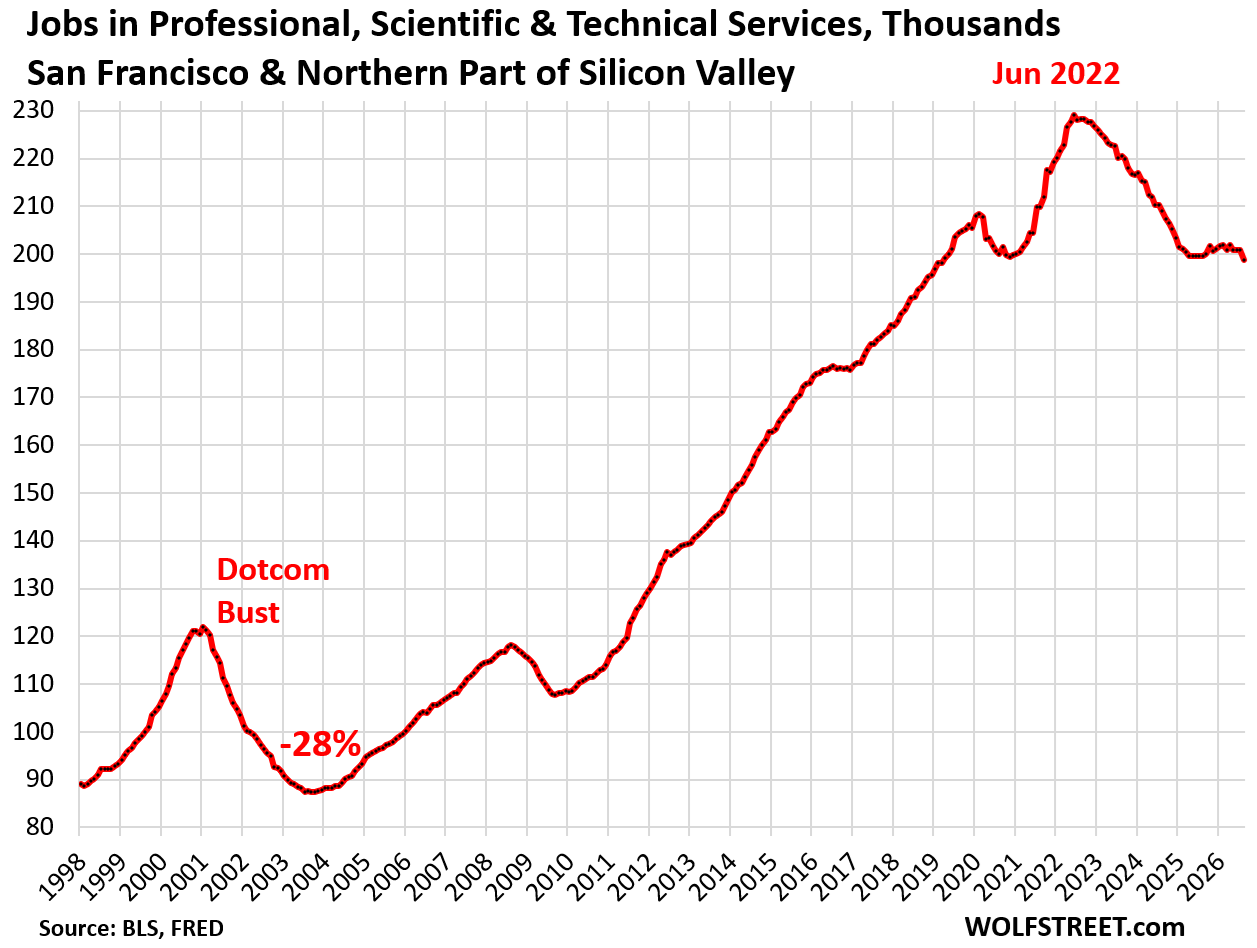
Companies in this category in San Francisco and San Mateo County have shed 35,500 jobs since the peak in June 2022, or 13.2% of their employment.
Payrolls in the sector dropped to 198,800 in August, the lowest since March 2019 and below the lockdown lows, according to the Bureau of Labor Statistics.
This sector accounted for 17.6% of all payrolls in the two-county area in August.
During the Dotcom Bust through October 2003, the sector lost 28% of its jobs. The percentage job loss through August (-13.2%) is nearly halfway there. The number of jobs lost through August is all the way there.
This metro-level data on nonfarm payroll jobs from the Establishment Survey was released by the Bureau of Labor Statistics on Friday. These jobs are tracked by business location to which the employee is assigned, regardless of where the employee lives. If a worker commutes 60 miles to an office in San Francisco, it counts as a job in San Francisco. Same with remote employees who are assigned to offices in San Francisco but live far away.
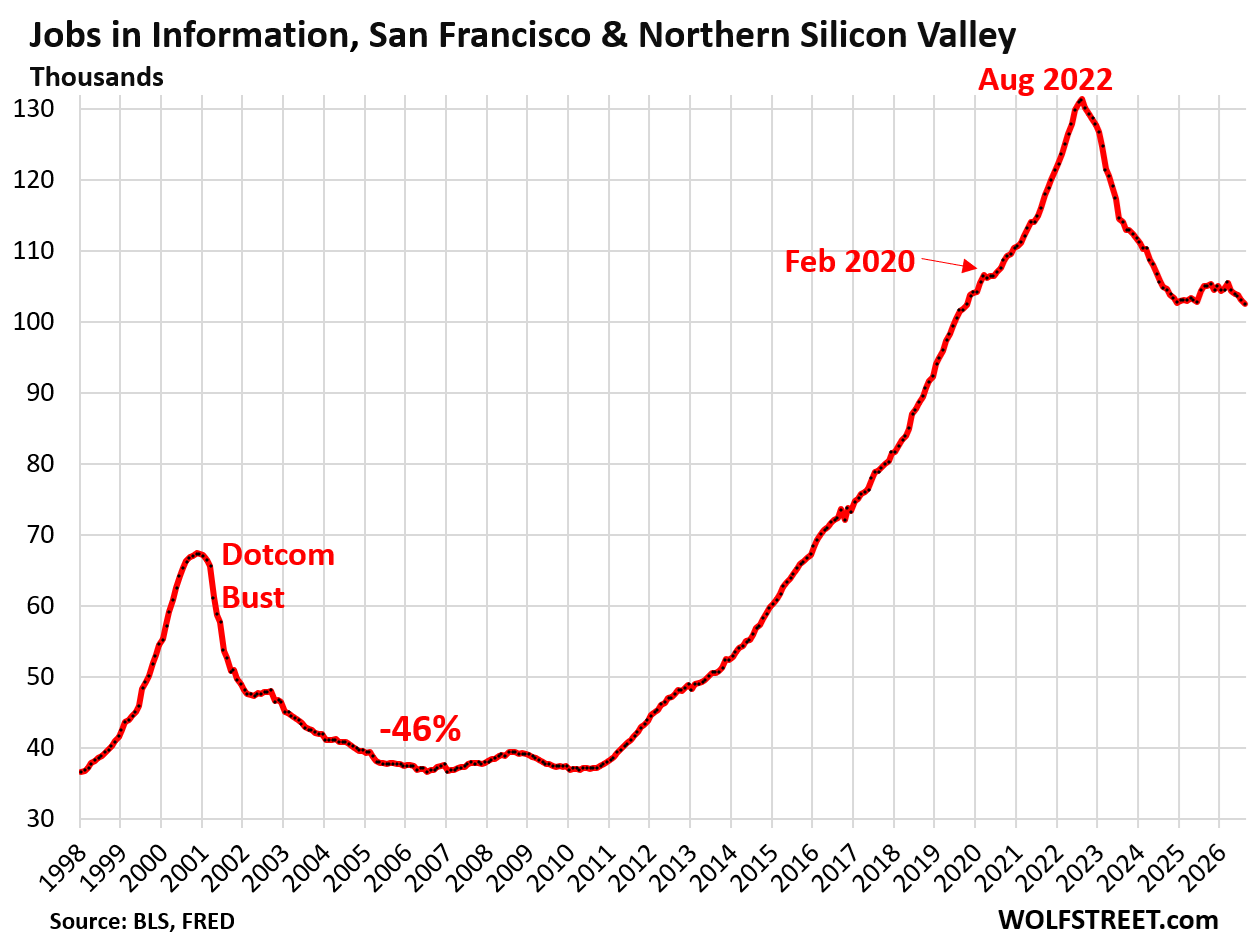
Jobs in “Information” fell to 102,530 in August, the lowest level since October 2019, having undone the entire hiring boom plus some in that industry during the pandemic. That hiring boom had peaked in August 2022.
Since that peak in August 2022, the Information industry has shed 28,900 jobs, or 22% of its total jobs.
During the Dotcom Bust, the Information sector lost 46% of its jobs in San Francisco and San Mateo, beginning in late 2000 and bottoming out in mid-2006 – an industry depression. The percentage job loss through August is nearly halfway there. The number of jobs lost through August is just about all the way there.
These jobs are at facilities where people primarily work on web search portals, data processing, data transmission, information services, software publishing, motion picture and sound recording, broadcasting including over the Internet, and telecommunications.
Information still accounted for 9.2% of total payrolls in April. For the US overall, jobs in Information account for only about 2% of total nonfarm payrolls. That’s how tech-heavy employment in the area is, compared to the US overall.
It could be that part of the jobs that got axed in those two sectors were held by remote workers assigned to offices in San Francisco or San Mateo County, but living on a Thai beach. Those job losses wouldn’t be felt in the local economy, though they would show up in the numbers here. But even if there were a meaningful number of those remote jobs that got axed, it would not explain payrolls dropping back to 2019 levels.
“Financial Activities” include finance and insurance, real estate (commercial and residential), and rental, and leasing.
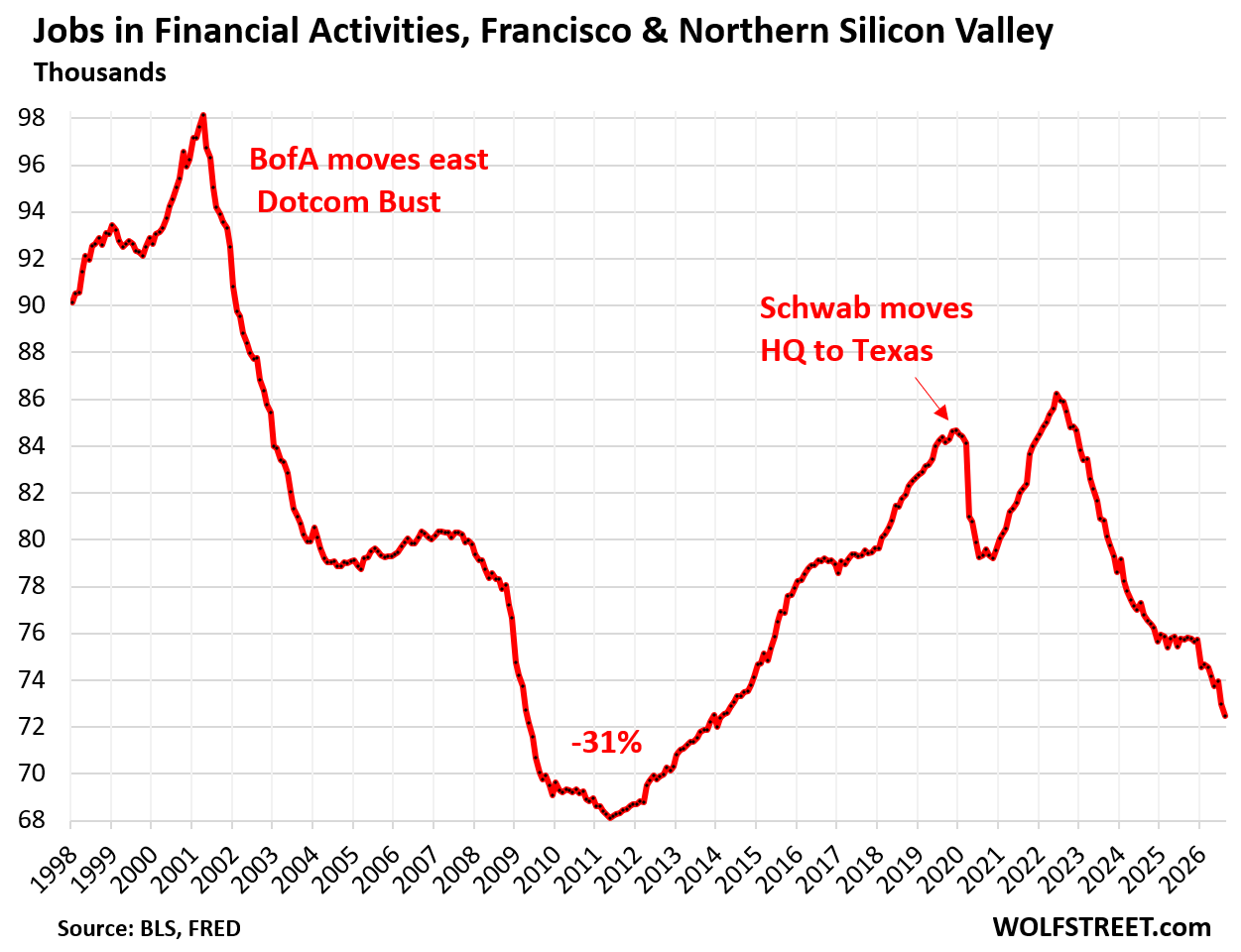
Payrolls in that sector dropped to 72,500 in August, the lowest since January 2014.
Since mid-2022, payrolls have plunged by 13,780 jobs, or by 16%. And they zigzagged down by 26% since the absolute peak in 2001, before Bank of America moved its headquarters to the other side of the country. Schwab moved its HQ from San Francisco to Texas in 2019. Wells Fargo’s corporate HQ is still in San Francisco, but its executive HQ, where all the action is, moved to New York City in 2019.
Where employment is growing:
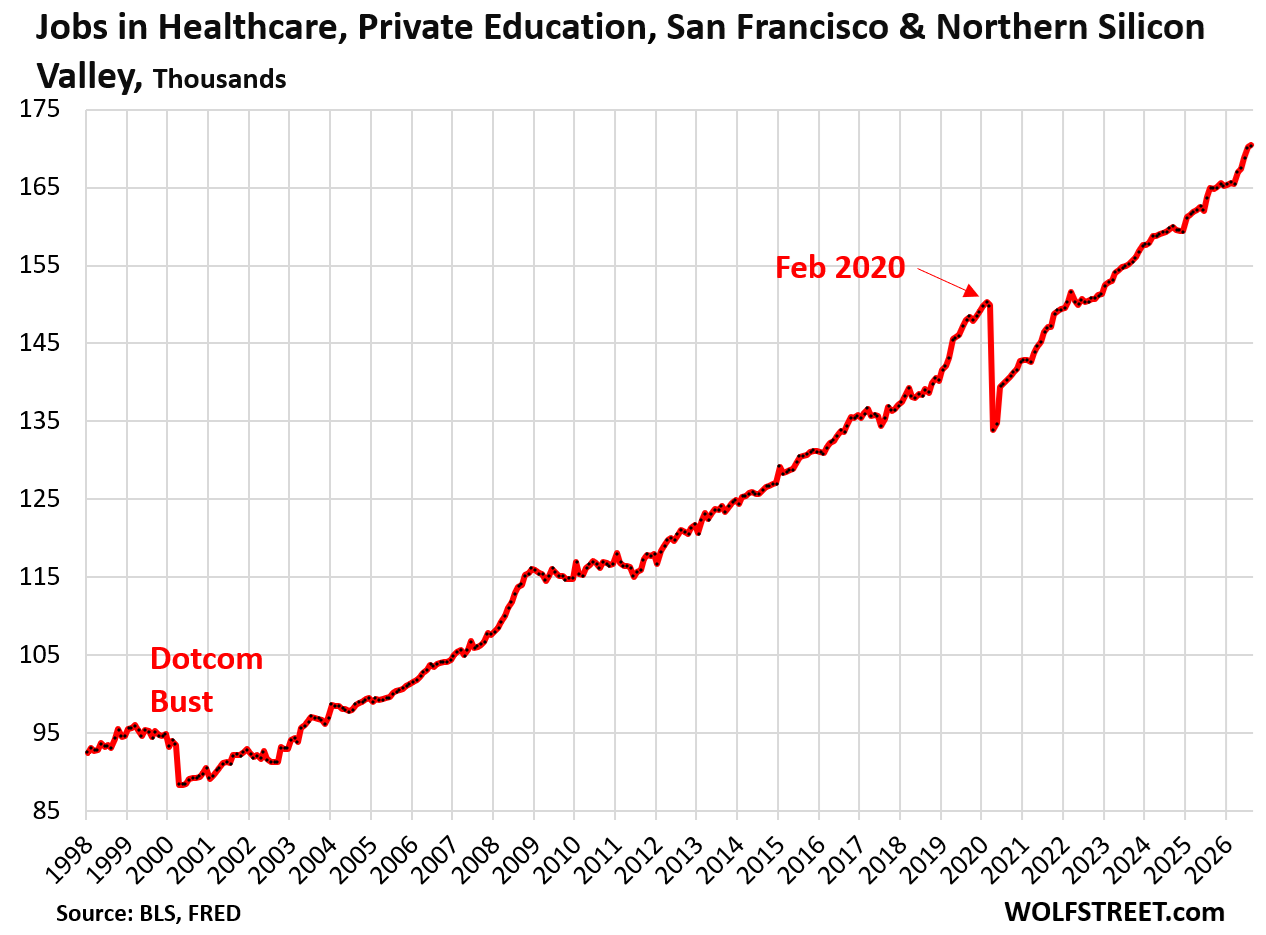
Jobs in “Healthcare services and private education” have been rising from record to record and rose to 170,400 in August, up by 5,500, or by 3.3%, from a year ago. Over the past two years, the sector has gained 10,680 jobs.
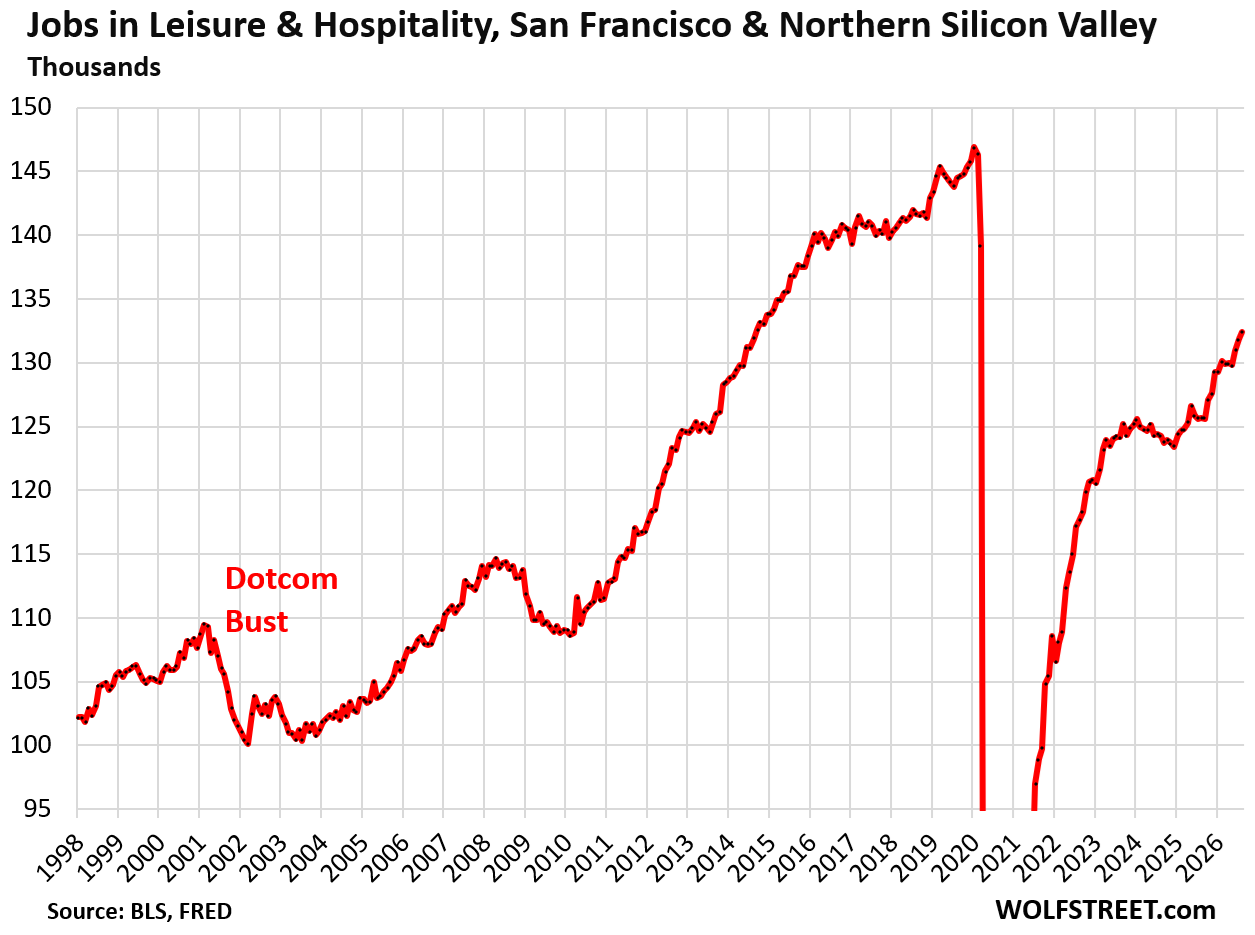
Jobs in “Leisure and hospitality” rose by 5.4% year-over-year and by 6.6% from two years ago, to 132,400. They’ve spiked up from the pandemic lows when local lockdowns crushed this industry, but remain 9.5% below the February 2020 high.
The sector includes Arts, Entertainment, and Recreation; and Accommodation and Food Services.
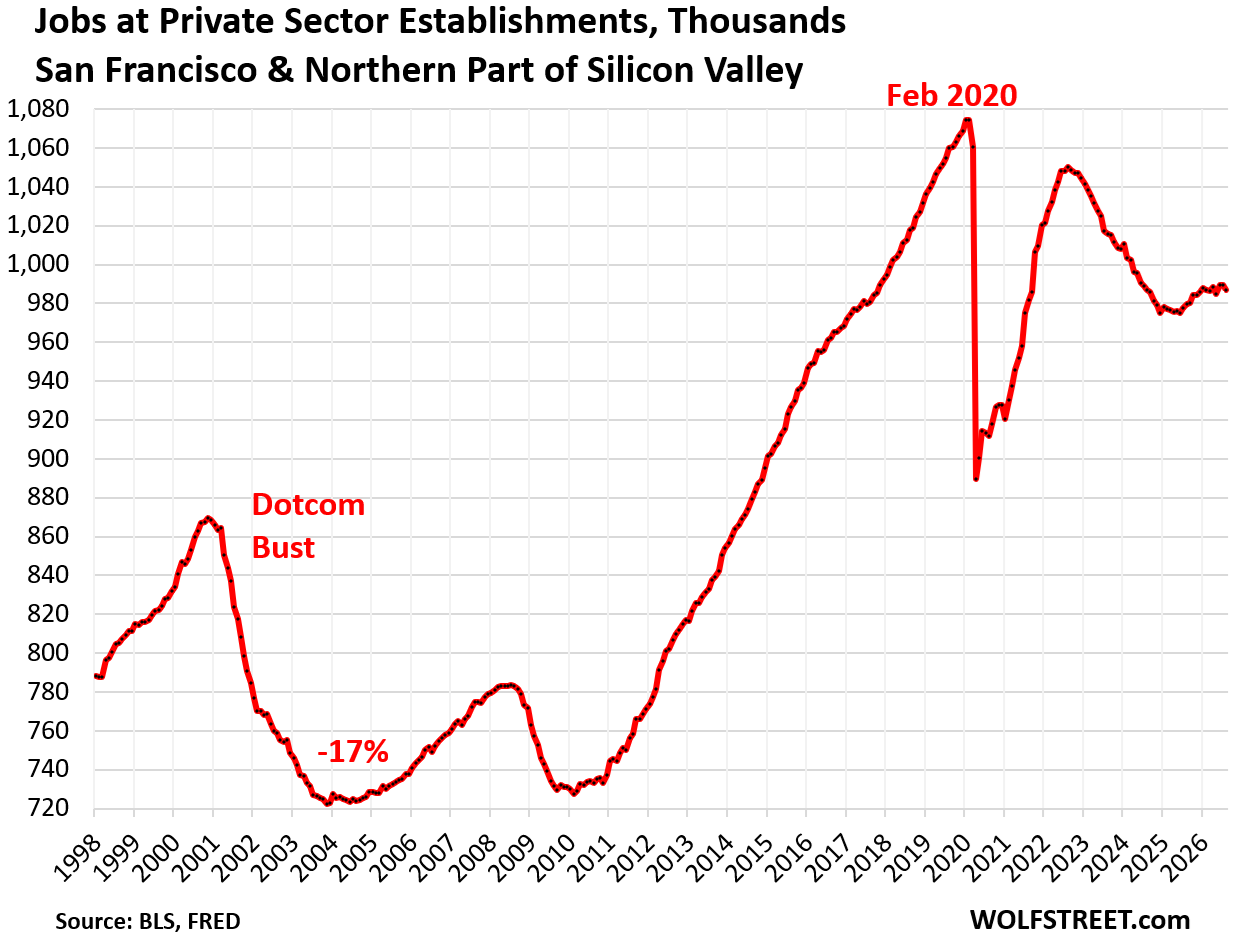
Total private-sector payrolls edged up by 7,000 jobs year-over-year in August, or 0.7%, with the strength in healthcare services and leisure and hospitality barely making up for the bloodbath in the other sectors.
But since the peak in February 2020, private sector payrolls are still down by 87,600 jobs, or by 8.2%.
During the Dotcom Bust, the area lost 17% of its private-sector payroll jobs, a depression-type decline.
This is how the AI boom, with its huge pay packages and exploding stock-based wealth, but relatively small number of workers, has been papering over the employment bloodbath in tech and finance in San Francisco and San Mateo County — though part of the bloodbath hit remote workers that don’t matter to the local economy.
The increasing use of AI across businesses over the years may have accelerated the job losses in “Professional, Scientific, and Technical Services,” “Information,” and “Financial Activities.” At the same time, AI-related activities have created only a relatively small number of jobs, but with huge pay packages and stock-based wealth that the relatively small number of workers are now spending.
This is how the economy, including the housing market, in San Francisco and San Mateo County, has become immensely dependent on the ridiculously unsustainable AI magic-money.
Enjoy reading WOLF STREET and want to support it? You can donate. I appreciate it immensely. Click on the mug to find out how:


Be interesting to see if the same dynamic is happening in the other three tech hubs: Austin, Boston (more pharma I know) and Research Triangle in North Carolina.
You forgot Seattle and Denver
RTP (Raleigh, Durham, Chapel Hill) in North Carolina (with NVIDIA, Google, IBM, Red Hat, Cisco, SAS, Pryon, Infinia, Levitate, Automated Insights, and Bandwidth) is still bubble world. But signs are showing of trouble (high end apartments buildings only 60% full with more being built and recent (<3years) college engineering graduates underemployed at Home Depot).
My bet is YES…..see below if Wolf allows……
Even though the hardware depreciates and turns into obsolete electronic scrap within three to four years, the accounting rules allow them to put that equipment on the company’s ledger as accumulated wealth.
Wall Street rewards CapEx because it looks like an investment in infrastructure, while it punishes high OpEx because it looks like a bloated workforce.
The bean counters have argued about these definitions so intensely that they recently broke the tech industry’s tax model.
For decades, the pay of the engineers writing software was treated like a standard, immediate business deduction. But a massive tax code battle changed the rules (specifically under IRS Section 174…TCaJAct 2017), forcing companies to treat software development labor like a long-term capital investment that has to be amortized over 5 to 15 years.
Suddenly, small tech startups that weren’t even profitable were hit with massive tax bills because they weren’t allowed to write off their human payroll instantly anymore. It forced a massive wave of layoffs and restructuring across the board, purely because the bean counters shifted the boundary of a definition.
Your intuition is entirely right. They invent the vocabulary to create an artificial map of the business, and then they treat that map as more important than the actual human beings on the ground doing the work. They would rather write a massive check to Nvidia for a rack of silicon than pay an ET or a developer a steady wage, simply because the rules they invented make the silicon look better on a spreadsheet.
This is the AI machine kissing my ass as an old time Elect Tech….but it is STILL damned good info……Sec 174 is buried in the drumpf Tax Cuts and Jobs ACT of 2017…sec 174 “turned on’ in 2022……
It relates to my long time beef with advertising being an instant write off like payroll (with exceptions…as seen) or the FN roof…..that just kinda happened, but it is secured in law somewhere by ANA? (Nat’l advertiser’s lobby) and of course tacitly by media……Capex vs Opex is MBA/CEO talk/”logic”, I think……
I’d clean it all up but am too lazy…..the damned info is there.
“Even though the hardware depreciates and turns into obsolete electronic scrap within three to four years, the accounting rules allow them to put that equipment on the company’s ledger as accumulated wealth.”
Opposite. This equipment can run for years, maybe not as efficiently as new products, but it’ll work fine for years. Data centers are that way. But the value of the equipment on the financial statement (balance sheet) is depreciated over 5 or 6 years to $0, meaning that the entire cost of the equipment is written off as an expense on the income statement spread over 5-6 years. And thereby becomes a cost that drags down earnings, and vanishes as an asset and gets subtracted from “cumulative wealth.”
The hardware never added to “cumulative wealth” to begin with because it was purchased and paid for, and not a free gift. It was an exchange of assets, $1,000 cash for $1,000 worth of hardware, and so on the balance sheet, the $1,000 moved from the cash account (asset) to the equipment account (asset), and the net worth or “cumulative wealth” or whatever didn’t change with the purchase at the time of the purchase, but it will get dragged down by the depreciation over the next 5-6 years.
Check to the editor…..:-)
RTP is also got a lot more pharma than tech.
So Wolf, I guess that when the “ridiculously unsustainable AI magic-money” becomes the next tech bubble burst, San Francisco and San Mateo county will become the mid-California version of LA’s Skid Row.
LOL, no, more like during the Dotcom Bust. We’ve been through this a few times, starting with the gold rush bust. We know how to do this.
Amen. We know how to do this. Just lost my job in this field last Monday, but well prepared to ride out the bust for a long time.
@Tenderloin – Its safe to bet that most dual income tech couples have enough money to survive complete job loss for ATLEAST 2 to 3 years. For the big tech couples, its probably closer to 5 years. But they will get jobs easily in lesser companies like home depot tech or whatever, just to pay the bills.
I feel like housing wont get affordable easily and quickly due to such reasons. Those big tech couples have like 2 or 3 houses and mosy wont have to give em up, certainly not with deep discounts.
How many years can you survive total job loss?
Tech-
I came up with a wider definition long ago (early 70’s) for the “Econ (or money/net worth as a yardstick) game”…
“How many people can you put between yourself and starvation ?”
Also…money NOT SPENT is 100%+ return…….we don’t NEED much, really.
I could survive total job loss indefinitely, but I admit I’m in a unique situation. I’ve lived in a rent-controlled Tenderloin apartment for 24 years, haven’t owned a car for nearly 30, and saved up my money for decades. I know this boom and bust town well and since I hate driving I’ve squirreled away my money obsessively so I can keep it that way. Some of my buddies in the burbs are quite overextended and I think your timeline is pretty accurate for them. I’ll probably also take a job in tech at a non-tech company once I’m bored, but right now enjoying not working the 60 hour weeks.
This time it’s different, dude. Always is.
Technology has already gone from the “mainframe” to the “PC” (Personal Computer). It makes no sense to invest in huge AI mainframe data centers to perform tasks that eventually will be back at the enterprise level. Sure an AI “chip” cost billions to develop, but they sell at about $30,000 to $40,000; well within enterprise level. Unless those huge data centers are storing North Korean level individual privacy invasive data and movements like conspiracy theorists, there is no economic benefit to time sharing a data center. If one is going to use AI to sift through other data, the copyright holder or data aggregator (for public domain) can have a website and their own AI server sifting and searching their data.
To add my thoughts to this: eventually all the “knowledge” will be decentralised into specialised hubs. Some will be general, but still decentralised over several nodes. It’s dangerous to keep things in one place. So redundancy is a must. It’s also dangerous to have this under control of a few tech-lords. It should come under public rule and scrutiny.
Does this sound like something familiar? Public libraries? Accessible to anyone with the urge to learn something?
Meanwhile some spooky tech people dream of burning all the books in the world, so everybody would be dependable on their tech and their ‘truth’.
I am very confident that the latter is not going to happen. But they will try how far they will be allowed to. And preferably with public money. For the children of the future for certain.
CRV-
Yep….even the AI machines will almost tell you that if you shape your identity and pose the questions well….FOR RIGHT NOW….anyway.
Therein lies the most AI danger…in addition to the AI copying AI “content” rabbit hole……NOT in Matrix-like takeovers of the world
Why is the AI boom unsustainable?
💔
This is all a bit cryptic (is NiteFlight serious? What exactly does Wolf mean?) but I’m assuming that it is along the lines of,
“You break my heart, Fredo”
(you big dummy).
If NiteFlight is serious, basically it boils down to,
1) companies spending/saying they are going to shortly spend hundreds of billions/trillions,
2) on a not-particularly-100%-reliable/useful/cost-effective technology with
3) a very poorly proven revenue model (really “Underpants Gnome Grade” in many ways) while
4) using incest-grade circular financings many times to cover up #3.
It may all work out – but long financially weakening nations probably should not be dicing with trillions over “maybes”.
Again.
(In other words, how many times does the US have to get hit itself in the head with a baseball bat?)
How many “e”s are there in seventeen? AI says three.
dearieme
So I asked Gemini, “how many letters e in the word seventeen”
And this is the AI’s answer, and I kid you not, I could “literally” see the AI smirk:
“There are 4 letter ‘e’s in the word “seventeen” (s-e-v-e-n-t-e-e-n). If you want, let me know if you are testing an AI’s token counting limits or if you need help with another word spelling or letter breakdown!”
🤣 I ❤️ AI
Maybe because building vast Heating Units that drive up the cost of electricity and use of limited resources like water might not be a good idea when this summer was too hot for everyone already.
“AI” uses an absurd amount of GPU. OpenAI’s Astra is 1 trillion parameter model. Which is roughly 110 GPUs at 40k a pop. So roughly $4.5 Million in hardware and datacenter costs are about 1/3rd the cost of GPUs. Roughly $6 million in costs excluding training, salaries, and marketing. They need to make $4k a day every day for 4 years to break even.
Thats assuming people aren’t using those GPUs. Electricity costs for single GPU is 700W or 77kWh. At $0.1, your electricity costs to run Astra per month for that cluster is $5.5k.
Those 110 GPUS that cost you $6 million? Only supports one person at a time.
What are customers paying? One person did an experiment and ran $200 in 2 hours or equivalent to $2k a day. So assuming 100% paying customers. They are negative $2k a day away from GPU break even. Most users don’t pay. Most users aren’t burning $200 day and can’t afford it.
What does a true breakeven for the business look like on 110 GPUs plus training plus salaries plus taxes plus future investment costs plus a 80% profit margin? The next cost of Astra is functionally $10k a day user costs break even. Then, for 80% profit that’s near $20k a day.
$800/hr is what Altman is claiming they can provide for the majority of the population. Even at the current money losing costs it’s $100/hr which is what most human experts don’t make. You’re asking why it’s not profitable is almost a joke.
Some people drive in a Ferrari.
Others in a Civic.
80-90%, i.e., Pareto-ville is provided by the, e.g., a Honda Civic.
The same choices exist in “AI” land and are the reason why the American titans face business viability questions when compared with open model competition from elsewhere.
“incest-grade circular financings”…….
I like that phrase….will likely steal it.
Ah, yes, I remember investing in 3Com when the Palm Pilot was all the rage. Lost my shirt. The current action reminds me very much of that Dot-Com hype.
I think once OpenAI’s S1 is released the market will wake up and the magic will disappear.
I believe most software companies are a fraud. Their operating income is pathetic. I don’t believe they have pricing power. They employ armies of sales people which eat up their gross. They issue equity to themselves like bandits.
BB-
“I believe most software companies are a fraud.”
Perhaps, but in fact you suck up software and have thousands of chips in your life, helping you feel comfortable…
That has nothing to do with their valuations.
More dangerous effects exist that will make AI investments uneconomical, because laws are changing that allow wider investment, e.g. in stocks or “investments” in crypto-garbage. Due to such laws, pensions, etc., will chase higher yields.
The consequences: crypto-garbage’s illusionary value (because it allows drug cartels and other criminals to transfer money to Mexico or hidden, Bermuda or Cayman Islands or Cook Islands’ trusts’ bank accounts) will evaporate in one week when AIs hack crypto-garbage wallets. As to stocks, companies are overvalued (particularly those gullible enough to hold crypto-garbage “assets”) and higher interest rates will make huge numbers dead due to their inability to roll over debt. Government treasuries or bonds will have to pay much higher interest payments= governments with limited powers to help.
If AI is not destroying oodles of jobs, then it’s not doing its job.
Why the hell does one think it was developed.
Get out, you’re all fired.
We’re told by the world’s richest human, Ego Musk, that we won’t need money or jobs in the future, yet he’s busy fighting for every last dollar he can get his hands on. Many, many hundreds of billions are not enough. He wants trillions. And nobody has stopped to ask him why he doesn’t just give every dollar away himself if money is no longer necessary…
The world’s billionaires and hundred millionaires are destroying society. Over the past 2.5 decades they have distorted and destroyed every single system and price that we had relied upon for decades, all in the name of greed. There is never enough for their pig faces.
“Tech bros” are traitorous government contractors who harvest(ed) your personal data for the police state, which you did not vote for or agree to, in exchange for obscene wealth and at the expense of your privacy and standard of living. They should be in prison.
Amen. This reaction is so true.
LOL Wolf. I asked Gemini AI about the reasons behind the job losses in the San Francisco Mateo County area, and it answered by quoting Wolf Street. Oh no, you will have to stop criticizing AI slop!
Gemini is catered to your web browsing like ads are.
You paint a very dramatic picture. We do not feel it here in most of Silicon valley/ the Bay area.
SanFrancisco county and San Mateo county are just 2 of the 9 counties of the Bay area.
Santa Clara county alone has as many jobs as those 2 counties combined and we are adding jobs despite heavy layoff due to AI usage this year. Same net job additions in Contra costa county.
Sure, certain SF neighborhoods real estate might be going over the top, but most people have seen this movie before, so no one I know locally is alarmed or celebrating this AI magic money.
I’m showing you the numbers. If that’s a “dramatic picture” for you, then fine.
In terms of San Jose:
1. The area that San Jose is included in is the Census Division of San Jose-Sunnyvale-Santa Clara, CA, which is Santa Clara County and San Bonito County.
2. “Santa Clara county alone has as many jobs as those 2 counties combined”: The COMBINED counties Santa Clara and San Benito have slightly more payroll jobs (1.180 million) than the combined counties of San Francisco and San Mateo (1.131 million).
3. The San Jose-Sunnyvale-Santa Clara metro area has a broader economy than San Francisco, and San Benito County partially rural with ag jobs. For example, the San Jose area has 4X as many jobs in manufacturing than the SF area. But the SF area still has 2x as many jobs in Finance than the San Jose Area. And the SF area STILL has more jobs in Information (103,900) despite the plunge than the San Jose-Sunnyvale-Santa Clara (97,900).
4. In the San Jose-Sunnyvale-Santa Clara area, both Information and Professional Business services have lost jobs since mid-2022 but not as many as the SF area: the San Jose metro has lost 10.5% of its jobs in information; and 7.5% of its jobs in Professional and Business services.
5. Across the entire US, these two sectors have lost lots of jobs since mid-2022, all you have to do is read the f**king articles here. Jobs in Information have plunged to 2015 levels. Where is your sense of outrage and denial. The chart is from that article I linked below:
https://wolfstreet.com/2026/09/04/where-are-the-jobs-winners-and-losers-by-industry/
For the ENTIRE US:
6. Total Private sector jobs in the San Jose area are barely up from December 2019. In April, there were still below December 2019.
7. As in the SF area, and in the entire country, jobs in Healthcare and Private Education have boomed in the San Jose area. That’s where the job growth is in San Jose.
8. Talk to people who are in tech who’re looking for a job other than in AI, you’ll see.
9. Also, if you had actually read the article, you would have seen the sections about remote employees, including this paragraph:
“This is how the AI boom, with its huge pay packages and exploding stock-based wealth, but relatively small number of workers, has been papering over the employment bloodbath in tech and finance in San Francisco and San Mateo County — though part of the bloodbath hit remote workers that don’t matter to the local economy.“
It always amazes me that people show up here with low information BS not realizing that they’re going to get schooled. This is not ZH.
I remember arguing with my brother-in-law, who is of a certain mind set. I set out the numbers and supporting information proving my point. No bias, no opinion, just raw facts.
His response? “I know that, so what. I do not care about the facts.”
From that point on I stopped discussing anything with him as it was a clear waste of time.
Kudos for Wolf for continuing when I quit.
In this century if you are explaining then you have already lost.
Almost haiku, grasshopper.
“It is difficult to get a (wo)man to understand something, when his (her) salary depends on his (her) not understanding it.”
Pure GOLD
Meta’s price movement today (up 11%) because “investors” are excited about Muse is a great example of the AI mania magic. I know people who have used Muse. They think it’s fun and works well, but I sincerely doubt that most people would pay for it.
Therein lies the problem. AI has some great applications, but right now, it’s being funded with BigTech and other investor money. I still am not seeing where all of this revenue and profit is going to come from.
Apparently many of the young people with money around you are using hocus pocus!
I still do not understand how all of this AI is going to benefit me the consumer. Yes I can go on the internet and Google all sorts of information, which is nice, but is it really worth all the money being spent? Do I really need to have some entity write papers and fill out forms for me so I can just sit around and watch the grass grow? I already look at videos when I need to fix something which is cool enough. And the other day I Googled a question: Will all of this AI data center expense be passed on to the consumer(me) perhaps in the form of increasing my internet service provider fees? Strangely the answer was no. So who will pay for all money being spent. Much of it is loaned money. Where is the ROI? Corporations? They may be more reluctant to spend on AI than everyone thinks. Corporations already run quite efficiently. What am I missing? The military and maybe the IRS certainly will pay though….oh my.
TreasureDirect has a new login (ID.me), see how that is going.
It took about five minutes to set up, and it’s going fine. And no, the government didn’t take all my Treasuries out; they’re still there 🤣
It took me about an hour to setup ID.me. My browser didn’t support the motion controls, so they forced me to setup a Google Meet chat with a support person. I didn’t have Google Meet installed, nor did I have a Google account which is required to login to that. Once I got an account and setup the video conferencing app, I got the meeting to work, and the person I talked to was friendly and got me through the verification quickly. Unless the elderly have the latest phone with everything setup correctly, I don’t see them being able to set this up without help from a friend.
Yes, browsers can throw you for a loop. I learned not to use Firefox when doing certain things like this. You’re almost done with your application, and then the website you’re on doesn’t go to the next step, and you have to mess with it and try and waste time, only to abandon it, and choose a different browser and start all over again.
If you use something like Chrome, it generally works. Just make sure to delete the entire browsing history for “all time” before and after.
But will they change the website menu and all the good info one can get there? (like auction postmortems?)
You of all people should know the value of good INFO…
Of course they fucking will.
The hype around AI is starting to remind me of Elizabeth Holmes at Theranos. Obviously AI is a real thing that is helping companies in all sorts of ways. But there’s a pretty big mismatch between what it’s capable of doing today and what we’ve been told it will do tomorrow. A few years ago I heard someone say it will cure cancer. Ok, when can we expect that to happen?
The entire stock market bubble is based upon hype – and cheap money sloshing around. Jerome Powell never did his job to clean up all this slosh. He will go down as the most reckless, derelict FED chair in history.
Wall St is just another member of the “Casino Biz”….like Fanduel and Kalashnikov, or whatever that new online gambling outfit with the weird commercials is.
I like the analogy. I work in analytical chemistry, but unlike Elizabeth Holmes, I don’t fabricate results, and I’m working in a very different funding model than her. Around the same time her success, followed shortly by her downfall was in the news, I had developed a couple of methods for some human biomarkers, a couple you’ve probably heard of, and the methods can make the measurement with less than a microliter of blood plasma. These methods were intended for biomedical research, not clinical testing of patient samples, which is more tightly regulated. They also use instrumentation that’s more expensive than what clinical labs use to test for these. For us, the high sensitivity of these methods was a side-effect of their intended purpose, which I won’t go into here.
Could such methods be adapted for clinical testing? I think so, but it wouldn’t be cost effective. It can be done where there’s a need, like with newborn screening. But the reason you are giving 10 mL (or more) of blood for routine labwork is that it’s a better balance of cost, quality and speed. After the dust settles, the AI of the future will have to achieve the same balance.
I was just reading an article from Nature titled:
Moderna cancer vaccine stops melanoma returning: what’s next for personalized treatments?
So I guess the answer is, now.
@JRAY,
In some respects, it is indeed like a highly advanced google search. A couple of weeks ago, I asked ChatGPT in Pro mode to look up boiling points for a list of about 20 chemical compounds a 1 atmosphere, and told it what constituted good or acceptable quality sources. I asked it to use estimated or calculated values only if it could not find a good quality source. I also told it that “unable to determine” would be a better answer than an incorrect value.
It took 42 minutes. It found values for all of them, and some of these were obscure compounds. I didn’t ask it to, but it provided a high-mid-low quality ranking, and gave a reason for each. I didn’t ask it to, but in a few cases where no value was available, it looked up other physical constants and calculated an estimated boiling point, based on known physical chemistry relationships. I checked the calculations, and they were right. I checked the references for all the others, and all but one were right. For the one it got wrong, it cited Source A which in turn cited Source B, but Source A had pulled the wrong value from Source B. So the mistake it made was in not noticing the discrepancy, or not just going to the primary source.
How much time was saved? Not as much as if I could totally trust it, like I could a smart trustworthy intern or grad student. But if it keeps doing well like this, at some point I may feel like I don’t need to verify the results. And even with the verification, some busywork was saved.
Thanks for this. Refreshing to hear stories of valuable real work that AI is capable of doing. Scepticism abounds, but I judge it comes from some quirk of human nature that makes people want AI to be a big scam. I agree that trust is an issue as I have found several mistakes, enough to know that you can’t trust it completely. But I probably wouldn’t trust the work of most people completely either … and they aren’t getting better month after month.
I wonder how much of this is just thinning the heard of jobs that are very low productivity. One of the trends in IT that I haven’t really seen mentioned outside of specific niche circles is the multiple job holders in tech using WFH. I have a coworker trucker who has another job in secret that is WFH that basically amounts to writing emails. In addition to that he also has a very flexible pentest WFH job. It’s illegal with trucking HOS laws but he doesn’t care.
I have heard of a few other people personally in IT that have 3-4 “Full Time” jobs and are raking in 10k+ a week after taxes. The covid/ai hiring frenzy in tech brought in a lot of fat that could be trimmed. Good work if you can get it. Sit in a few conference calls on mute in the morning, answer a few emails, and bake up some spaghetti code by lunch for 2-3 outfits and call it good.
@Trucker Guy – I think your post brings up many questions. Its unlikely that people can do 3-4 remote jobs, unless they are all 2 to 3 hour tasks in some contract work. How would you even deal with calendar conflicts if there is a lot of overlap between the 3-4 jobs?
BUT doing 2 part time or full time jobs sounds more plausible than 3 or 4. 2 part time jobs is not a big deal because its like 1 full time job. 2 full time jobs can be doable if 1 job is low skill and can be mostly automated but the team has not figured it out. Even better if you are the smartest in the room. You can milk such a company knowing fullt well they will be gone soon.
Anthropic and OpenAI can easily be the next Pets.com.
There is nothing proprietary about what they’re doing. They’re just first. Any company can train their own foundation model. It’s AGI/first-to-singularity or bust for the big shops.
Hopefully those IPOs happen soon before the tide goes out.
WHICH “singularity”…?….(or WHO’S…..?)
Dotcom 2.0. Having been through this while working in Palo Alto I know that even the “winners” will be loser from the standpoint of their equity shares…
Still being employed will be your only victory.
Two big issues with AI.
It has no QA so it is helpful but can’t replace human intelligence. No company is going to accept work that has the possibility of a hallucination that can cause massive damage or legal liability.
The models run by the big players steal people’s data. See the recent math model breakthrough. Turns out it was stolen from a human who did the majority of the work. Companies will realize they need a local LLM running on their secure network and that loading your company’s data into the cloud for it to be stolen is not the answer.
@AI steals – How do you know no QA or testing has been done?
QA is a human being looking at and interpreting the results of an LLM. No sane person is going to sign their name to whatever a model spits out and hope for the best.
At the end of the day. LLMs are computer programs just like a calculator. The outputs are the result of inputs and a person needs to be responsible for and interpret it all.
Ai data centers are due to shrink soon. Just like the giant IBM 360 machines they will be miniaturized to the size of my iPhone. So what are we going to do with the huge buildings, about 3500 of them? We already have huge abandoned shopping centers. Shopping is now largely done on the internet. Stop building these monstrosities now. We already have way more data centers than other countries.
I agree with you the huge datacentres will shrink but timing is the question . The huge 360 datacentres turned into even more huge 370 data centres, until they started to disappear, and that process took 20? Years. In the meantime a lot of fortunes will be made and lost.
White collar job loss is by design. The AI magic money is going towards datacenter buildout.
A good one is All Employees: Manufacturing in Dallas-Fort Worth-Arlington, TX (MSA) (DALL148MFG).
DFW is a major hub for power distribution and electrical equipment manufacturing.
Also Electro-Com (Arlington) making machines under license from AEG Telefunken for the Post Office…….lot’s of piecework and cold solder joints…..parts designed to wear out….etc….good busyness model.
From when I quit in ’02….some things change…some things don’t……..
Maybe all the programmers and code writers can transition into appliance repair jobs? Many (remaining) repair shops won’t even look at new appliance crap and tell you it is cheaper to toss new high tech stuff into the landfill.
I just wish I could buy a new fridge and stove without all the electronics crap. My last fridge made 4 years and now the stove is crapping out at 5. Will they incorporate AI to average out how long we peer into the open door, or if we use the stove to broil? You can buy a fridge that tells you what is inside. Meanwhile, my 40 year old beer fridge rescued from a motel reno job is still chugging along just fine. Throwing in a new motherboard may or may not rectify the new junk at $300 per, or I could try and test every damn circuit and sensor. Then see? No thanks.
If this is the brave new world of computing and AI leaking into everyday life no thank you please. And heat pumps? More crapola. Just bought a new project house and pulling out the heat pump to install in-wall electric fan heaters with individual (analogue) room thermostats. I won’t need the suppliers to access any data/controls remotely….because in walls don’t crap out. Ever. My 4 year old truck tells me to check the brake fluid every 500km. I have to cycle through the GD menu to reset, or enter off the irritating message every startup. I managed to survive 20 years flying and doing inspections before every flight, but apparently now can’t even suss out a fluid check or a vehicle maint sched without some screen telling me what is wrong? The more electronics are relied upon in society to think for us, do research, and schedule or days the dumber people become. Are. Problem solving skills? nah the phone will tell me what to do and when to do it. Map reading and spatial awareness? Nah, the GPS decides the best route for us and when to turn. And friendships? Let’s sign up for a virtual.
It’s bullshit, imho. Get off the treadmill and smell the roses.
This morning I caught a salmon at daybreak, then sat out by a fire with my dog. Listened to the fish jumping and the robins feeding on berries. Soon the sandhill cranes will be flying over and then the snow geese. I wonder how they do it without GPS? And many humans now get their news from Tik Tok, podcasts, and youtube. They let someone else tell them what to think.
Insanity by request.
Sounds like Vancouver Island representation is back at WS. Good.
Paul S
I have also observed a decline in the average person’s problem basic solving skills.
It might be partially due to the decline in attention spans.
…or not knowing when to quit?
Nice rant, but the fact is heat pumps use 1/3 of the electricity used by your wall fans.
Tech jobs are all fungible and are in great supply which allows the tech industry to scale up and scale down primarily with the tech they develop. Tech employees for the most part are entrepreneurs that jump into hot spots, Internet development, Y2K, sports betting, AI, make a ton of money, watch the bubble burst then sit on the sidelines waiting for the next boom/bust. The current risk isn’t tech jobs declining but the 100s of thousands of regular paying jobs that will become fungible and replaced by AI technology. A mentor told me long ago, the first rule of research is, find out if it’s already been done. Well, AI creates a lot of “already been done” research so that part of the job force goes away. Most analyst jobs evolved into managers of information but that too will go away as AI provides multiple outcomes with which to make decisions for senior managers. The Internet got rid of the middle man like manufacturers reps. AI will replace middle management in many cases with jobs that provide better scenario analysis and probability management of potential solutions.
I find what people call “AI” today to be a very useful tool. But it is just a tool. It can be right or wrong, and I need to be smarter than the tool to realize when it’s wrong and when I need to step into fix it. Just like using a calculator, you need to learn how to use this tool.
Ai is cool but it isn’t a calculator.
A calculator gives you the same correct answer every time you enter the same calculation. You can depend on its accuracy.
If you ask AI the same question that you asked your calculator, it will give you same answer as your calculator.
But people ask AI garbage questions and get garbage answers. You cannot do that with a calculator. You can only push buttons. Human brains are garbage in general, making up stuff as they go, and then spread it, as you just did.
Great points.
My child has a masters in AI data science and works for a leading AI company as the manager of Data Analytics. Their team is the only one allowed to access sensitive data and reports directly to the SR VP under the COO and CFO. They only process request through this network. The reason is few understand how to logically interact with AI to get the correct data so the company smartly limits access.
The team also is testing the restricted Claude. With a non-disclosure all I was told was it is worrisome.
The “data” constantly reinforces the idea that the US has a strong economy (and mainstream market participants expect Fed rate rises).
But (at least in the Bay Area) the two growing sectors are “Healthcare Services & Private Education” and “Leisure and Hospitality”, both lower-paying sectors. This is quite likely true elsewhere too.
It seems that not only the “AI magic money boom” is paper-thin. The real economy might be, too.
Healthcare is one of the highest-paying sectors with one of the most advanced education requirements. And it’s packed with advanced immensely expensive tech that has been incorporating AI on a large scale for years.
Wondering the reason that healthcare jobs are increasing alongside their “large scale use of AI for years”?
We are constantly told AI eliminates jobs…
AI does eliminate jobs, even in healthcare. But we don’t know what employment growth in healthcare would be like without the efficiencies of AI.
For example, when I get a scan done at my healthcare provider, I can look at the results online by the time I get home. AI eliminated the human labor needed to interpret the scan and write up the results. Then I have a video or telephone conversation with a human doctor about the results. This second step eliminates the human labor and man-hours for doctors and staff that go into dealing with in-person appointments. My healthcare provider has been doing this for years and has been spreading it across the services.
we were using “AI” in the 1980s in GIS and remote sensing and computer cartography at NASA and other .gov agencies. i was taught back then it was developed by the medical field, to diagnose people. got bored with that and went to wall street. more financially rewarding, easier, and way more fun. trend following is so damn simple, it is genius. hat tip thorpe and ed seykota……..
OCRs at the P/O used AI to read mail back then, also…..Then masking and lithography (NVIDIA) got EVEN SMALLER…..those info packets really shoot around thru the registers FAST now.
Reuse of ELIZA for human interface purposes is new, though……just more sales and marketing shit…..wonder if the law lets them carve out a tax write-off somehow, using incestual circular accounting.
Uptick rule…….?