
Homebuilders have been doing their job creating lots of new housing stock, but demand is weak, and supply sky-high.
By Wolf Richter for WOLF STREET.
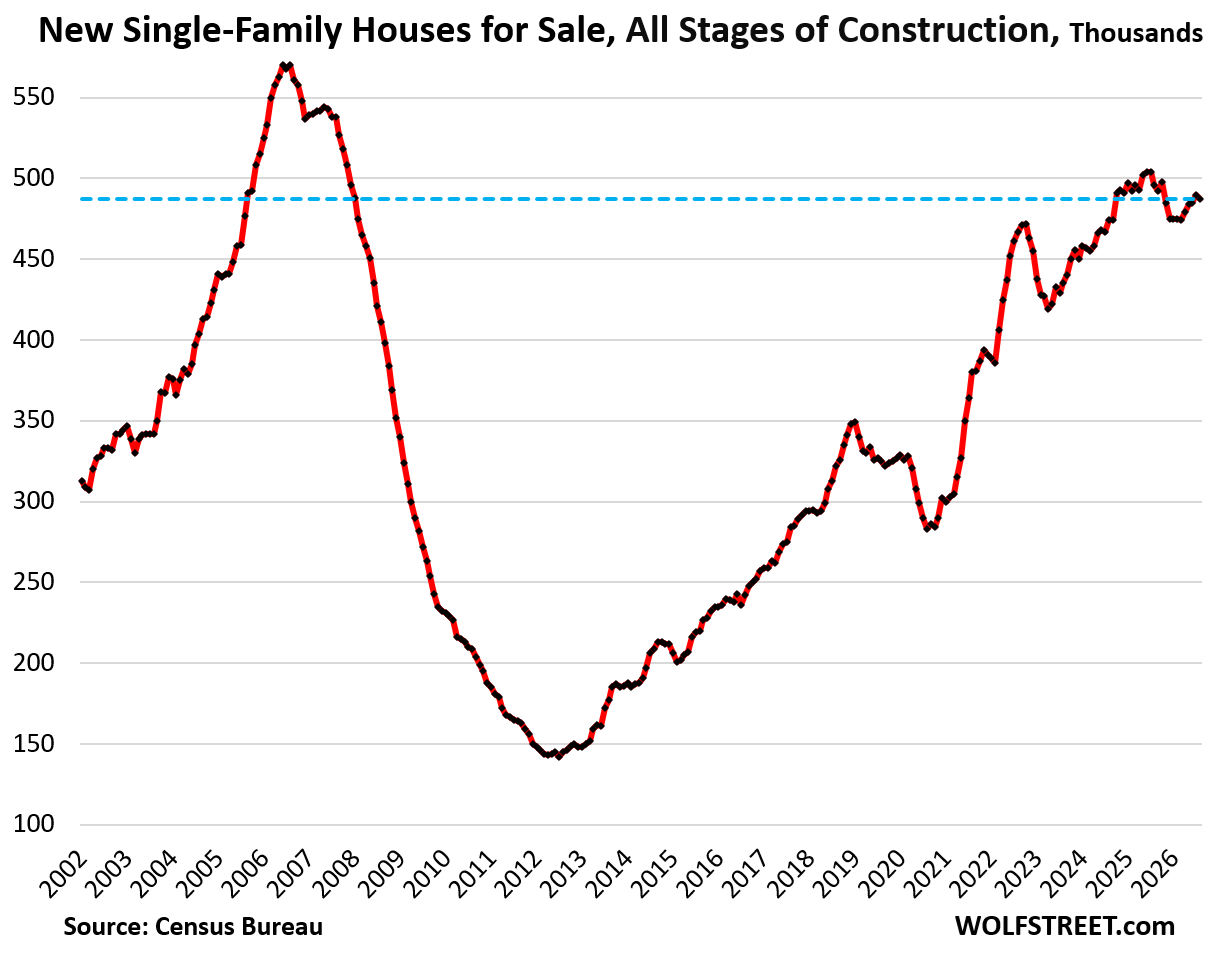
Inventory of single-family homes at all stages of construction rose year-over-year to 487,000, not seasonally adjusted, up by 50% from August 2019 and up by 72% from August 2020, according to the Census Bureau today.
These inventory levels over the past two years are the highest since the peak of the housing bubble in 2005-2007, even as sales of new homes have been far below the sales in 2005-2007. This is the infamous “Housing Shortage” that the housing industry constantly proffers to manipulate up prices.
These new additions to the US housing stock waiting to be bought are precisely what the housing market needs, and homebuilders are building them. In August, they sat on 8.5 months of supply at the current rate of sales. Build them, and they will come, maybe, if the price is low enough and incentives high enough – and we’ll get to that in a moment.
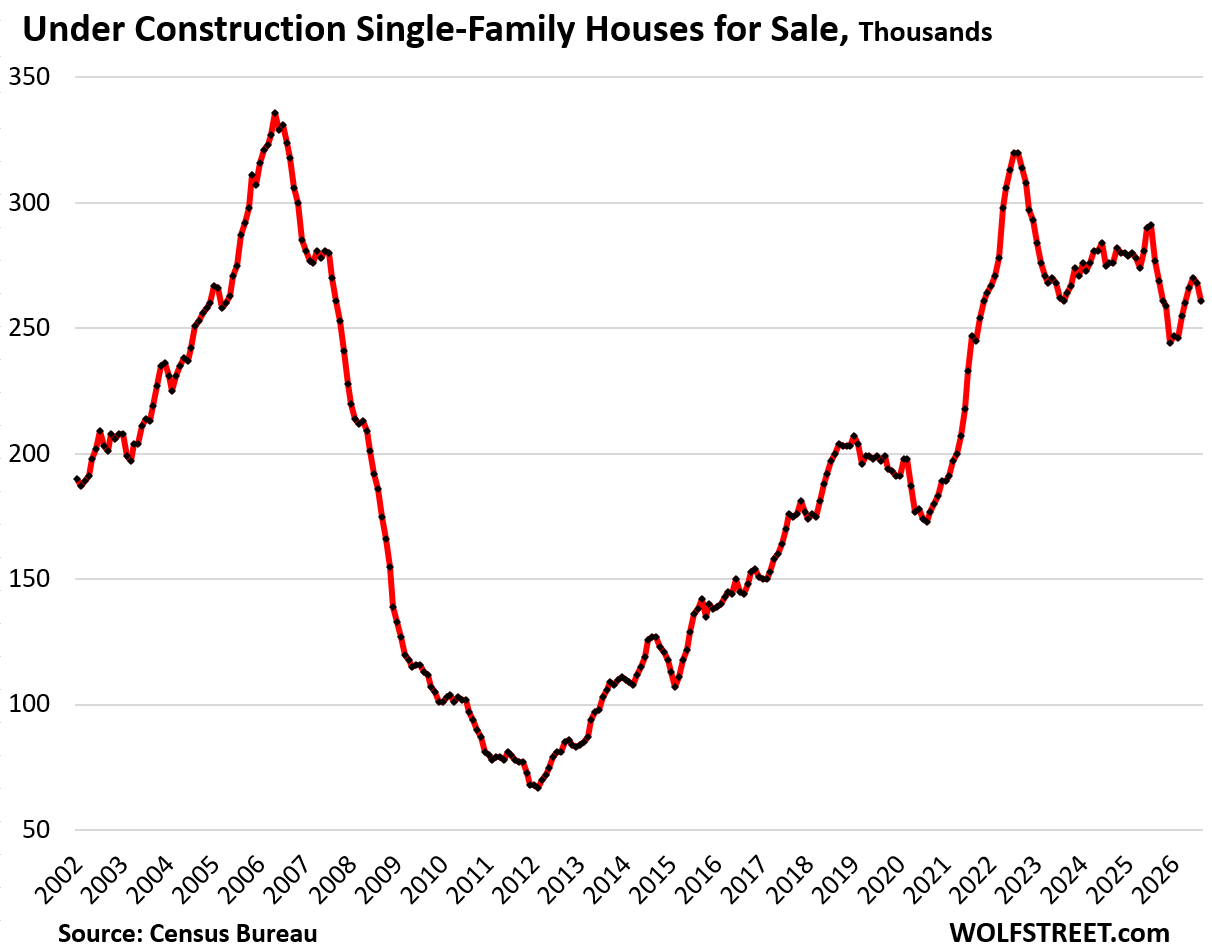
Inventory of under-construction homes declined by 5.8% year-over-year to 261,000 homes. The decline occurred in part because some were sold, and in part because some were completed without being sold and moved into the next category, “completed homes for sale.”
Compared to July 2019, inventory was up by 32%, and compared to August 2020 by 50%.
Under-construction inventory for sale is what is in the construction pipeline, and is for sale, but hasn’t been sold yet. Homebuilders have quite a bit of capital tied up in this inventory and are motivated to sell it.
Inventory of completed homes for sale remained at 112,000 after getting sold down from the very high levels at the end of last year.
Builders have a lot of capital tied up in these largely move-in ready “spec homes” and are very motivated to sell them.
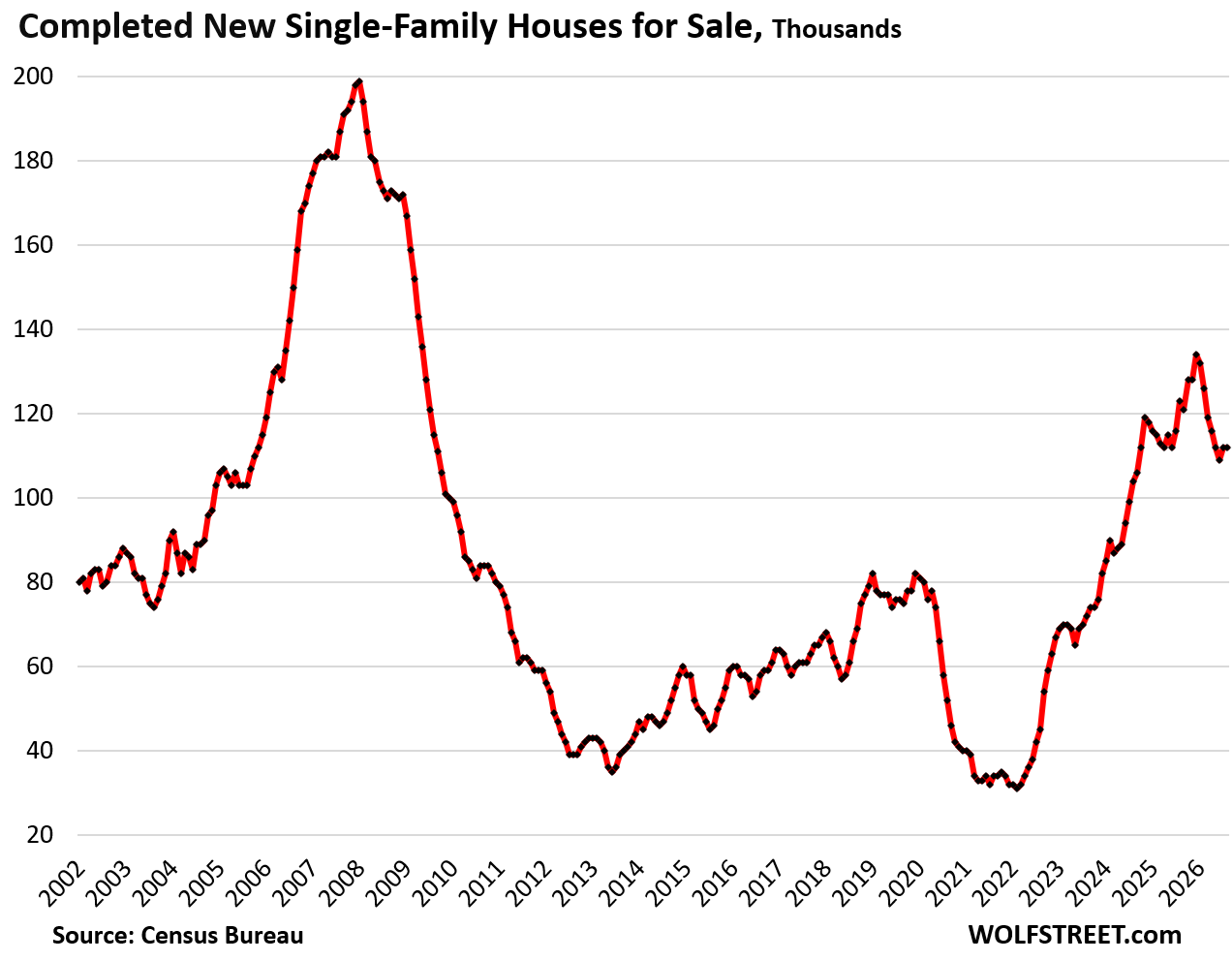
Compared to August 2019, inventory of completed homes was up by 47%. Compared to August 2021, inventory was up by 230%, and there was a shortage of completed homes in 2021 and into 2022, as buyers, armed with below-3% mortgages and suffering from massive FOMO attacks were suddenly swarming all over the place buying up homes that were move-in ready, and paid a huge price for them, as homebuilders exacted their pound of flesh.
Big homebuilders have adjusted to reality. They have to build and sell homes to stay in business, even if they make less money or lose money, and so they brought their effective prices down to sell those homes, and they did it by lowering prices, piling on incentives, buying down mortgage rates (which is costly for builders), and developing lower-cost, more efficient construction methods to bring their own costs down.
Homebuilder gross margins have plunged, net profits have plunged, shares have plunged, but they’ve adjusted to this market and are building and selling homes and are adding new housing stock.
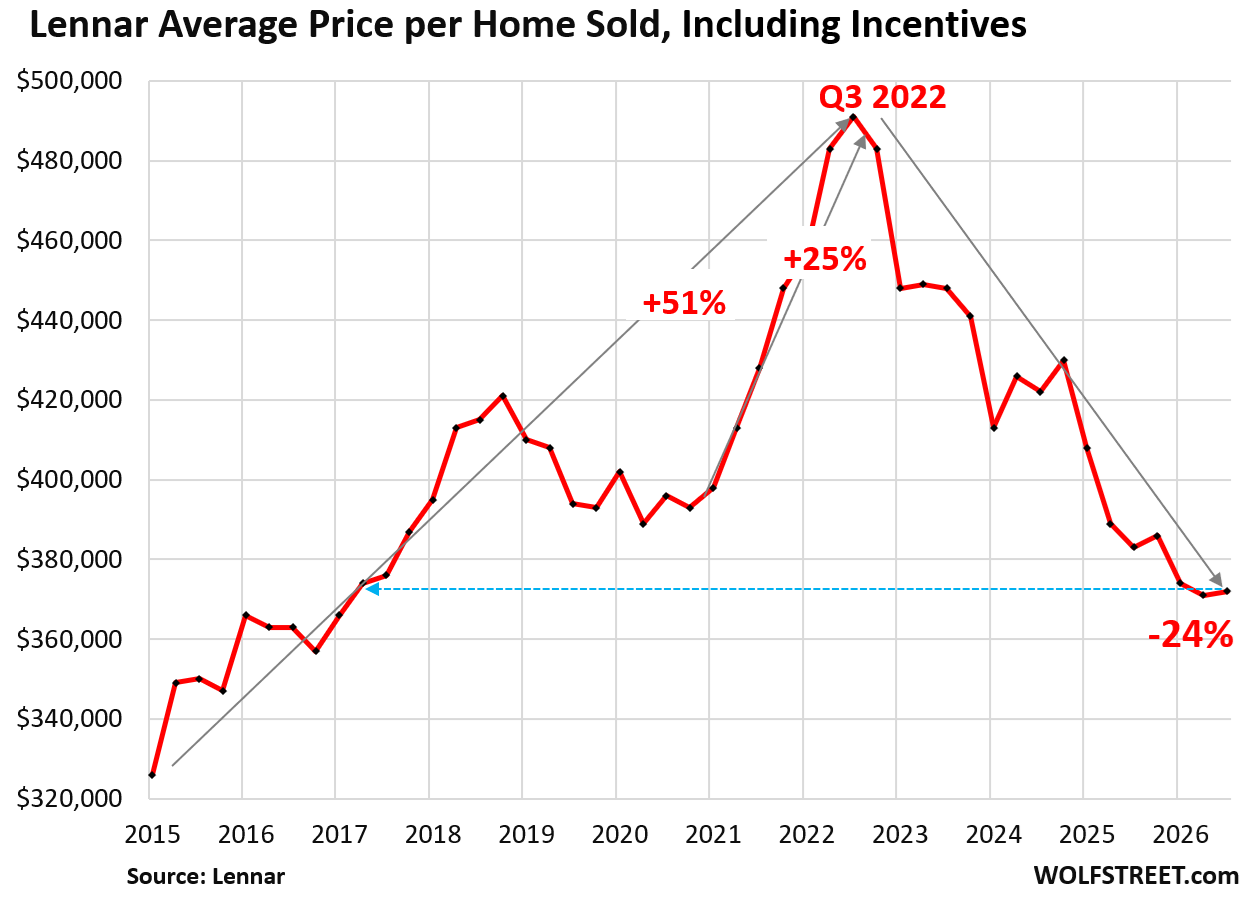
Lennar, gunning to be the #1 homebuilder, has been aggressive in its pricing. It discloses its quarterly average selling price that includes all incentives and mortgage-rate buydowns. It shows how buyers in the FOMO moments of 2021 and 2022 were taken to the cleaners because they begged to be taken to the cleaners, and how reality has set in since them.
Since the peak in Q3 2022, the average selling price of homes Lennar sold has dropped by 24%, to $372,000, the lowest since 2017, as it reported for its Q3 on September 16.
Lennar’s gross margin has plunged by nearly half, to 15.8% in Q3 2026, from the big-fat 29.2% in Q3 2022. The Q3 2026 gross margin was about 1 percentage point below the 2018 gross margin. Net profits have plunged. And shares have plunged by 56% from the high in September 2024.

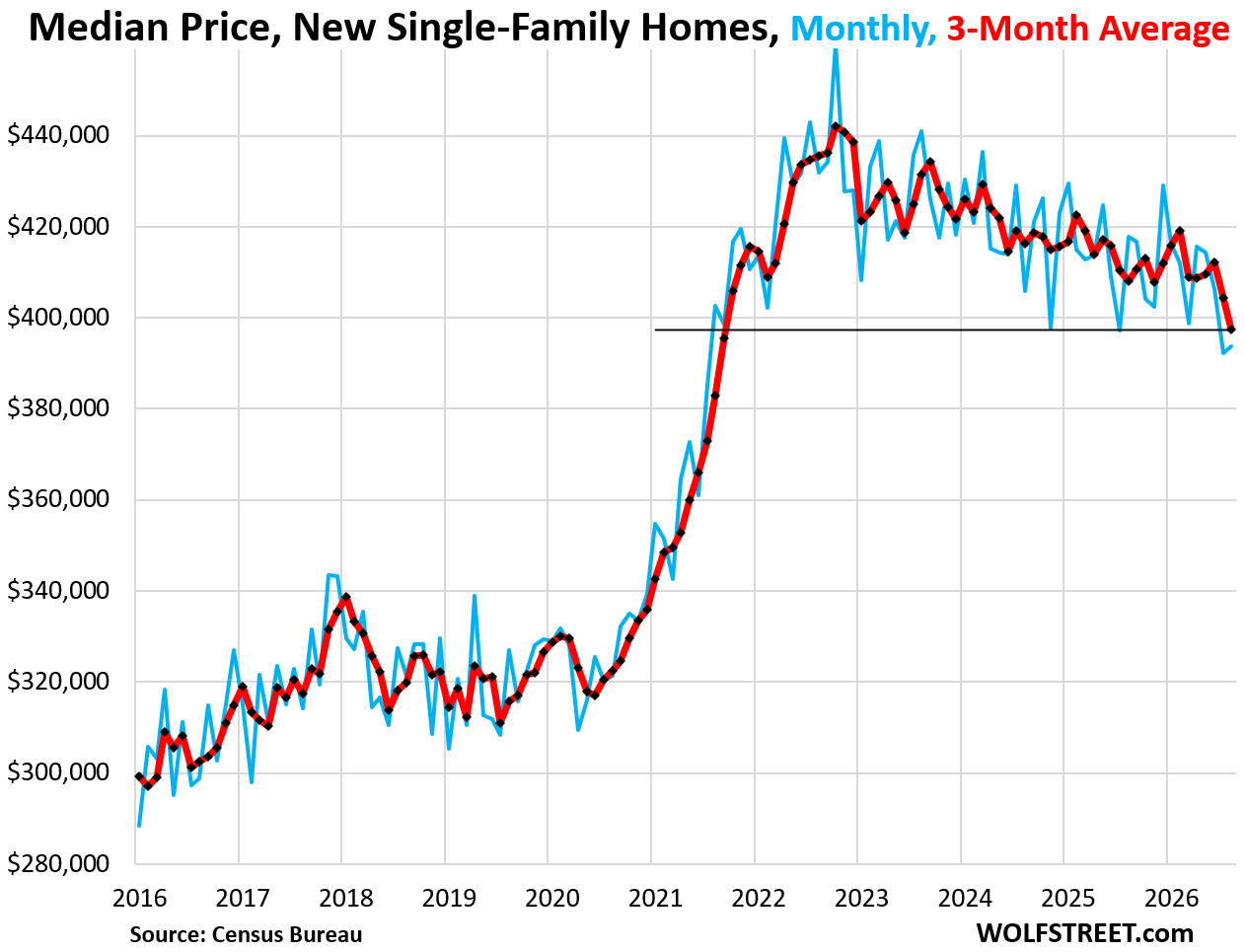
The national median price of new single-family homes sold does not reflect the incentives and mortgage-rate buydowns. It only reflects prices written into sales contracts.
It declined by 14% from the peak in October 2022, and by 5.8% year-over-year, to $393,700 in August (blue in the chart below).
The 3-month average, which irons out the month-to-month squiggles declined by 10.1% from the peak in Oct 2022, and by 2.6% year-over-year to $397,400, the lowest since September 2021 (red in the chart).
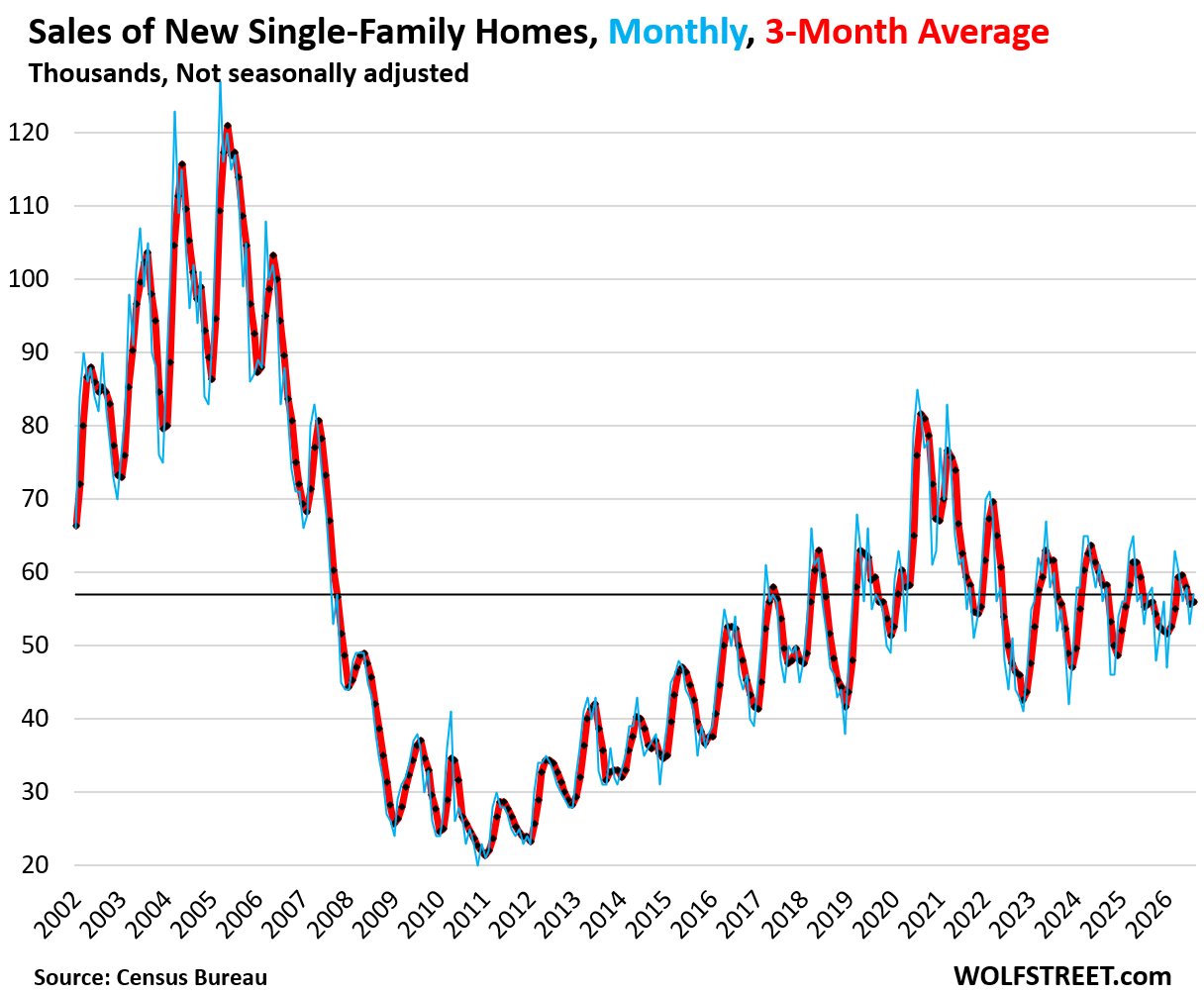
Sales of new single-family homes at all stages of construction were unchanged year-over-year at 57,000 homes in August, not seasonally adjusted, and prior months’ sales were revised down. This is also where sales had been in August 2019.
Three-month average sales edged up year-over-year by 0.6%.
But compared to the Housing Bubble sales in the Augusts 2005-2008, sales have plunged by 45%.
These current sales, about 45% below where they’d been in 2005-2008, make the current sky-high inventories that are where they’d been in 2005-2008 that much more of a glut, see first chart above.
By region: inventories & sales.
A map of the four Census regions is below the article at the top of the comments.
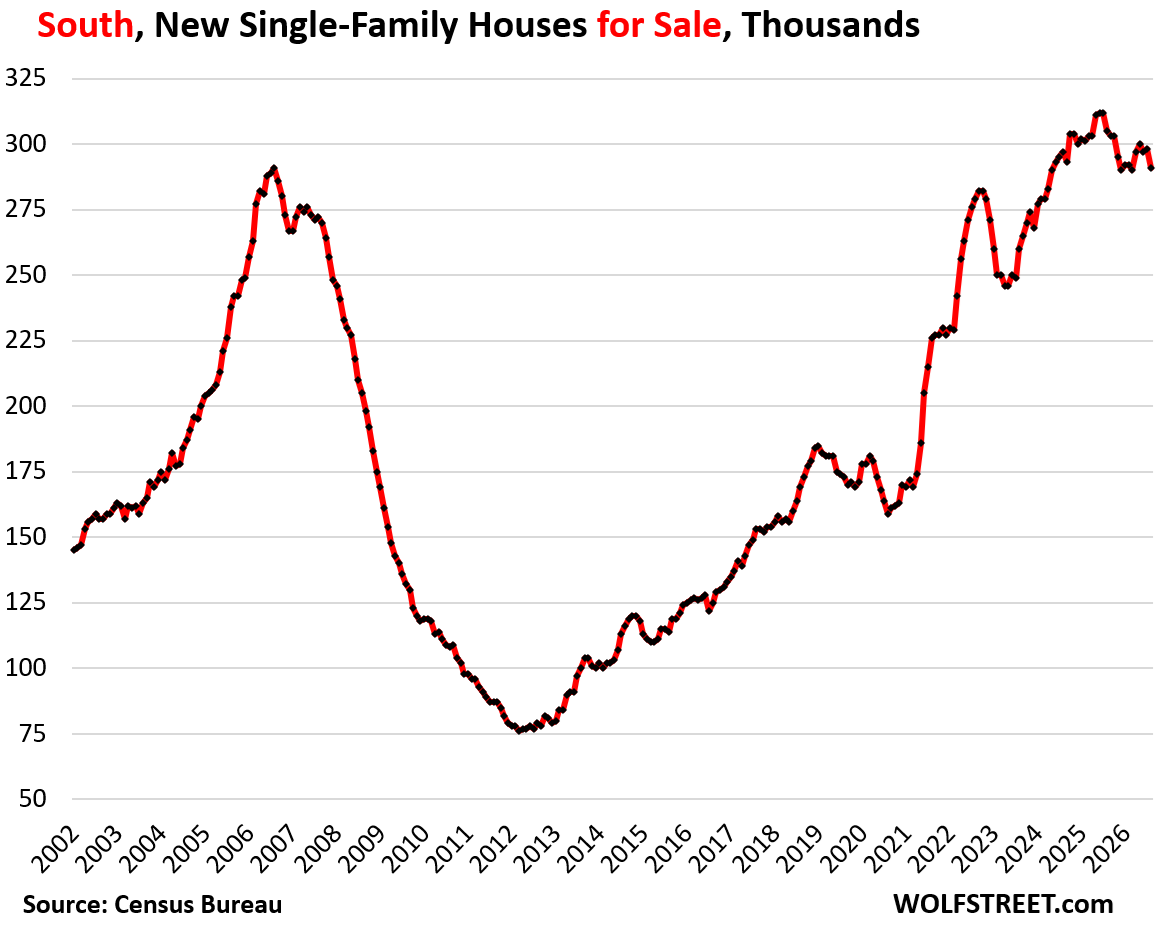
In the South, inventory for sale declined to 291,000 new single-family homes at all stages of construction, not seasonally adjusted, but that was up by 68% from August 2019.
Inventories in August were level with the very peak of the Housing Bubble in mid-2006, but sales have plunged by 35% since that time. So a lot of supply for only moderate demand despite aggressive pricing action by homebuilders.
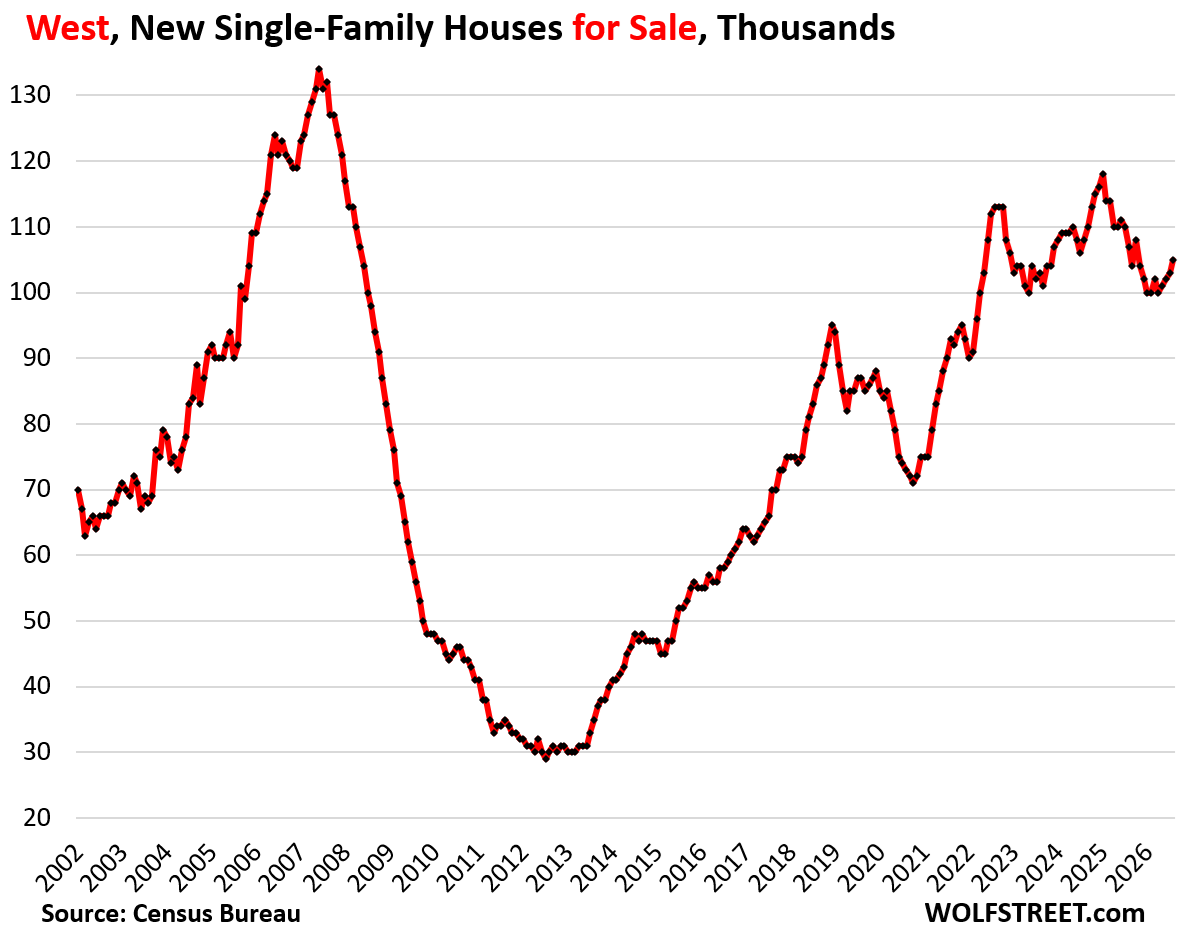
In the West, inventory rose to 105,000 new single-family homes, up by 21% from August 2019.
These inventory levels are right back during the housing bubble peak years of 2005-2008.
Sales plunged by 30% year-over-year in the West, and by 40% from August 2019. This shows the supply situation: Inventory up by 21% from August 2019, but sales down by 40%!
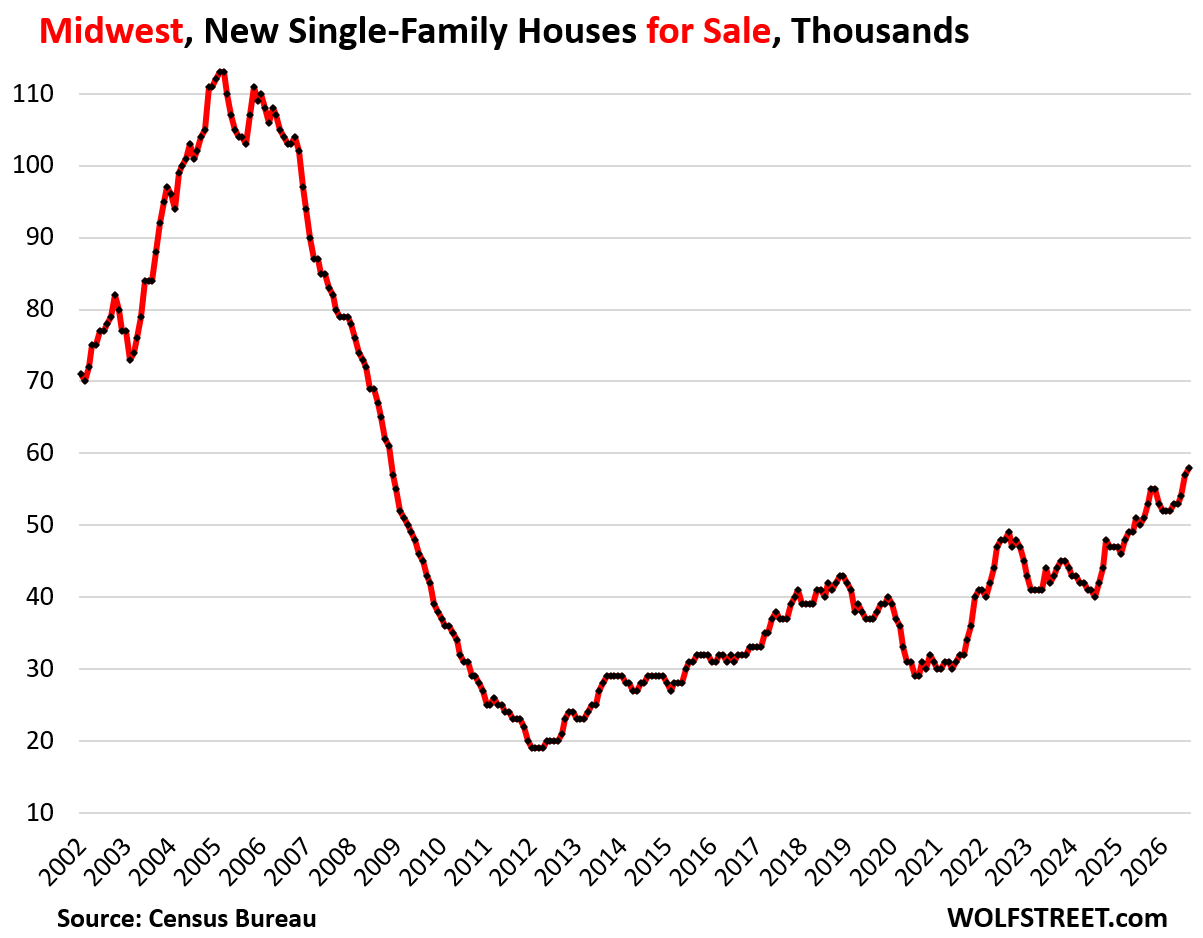
In the Midwest, inventory for sale rose to 58,000 new homes, the highest since 2008, up by 14% year-over-year, and up by 57% from August 2019.
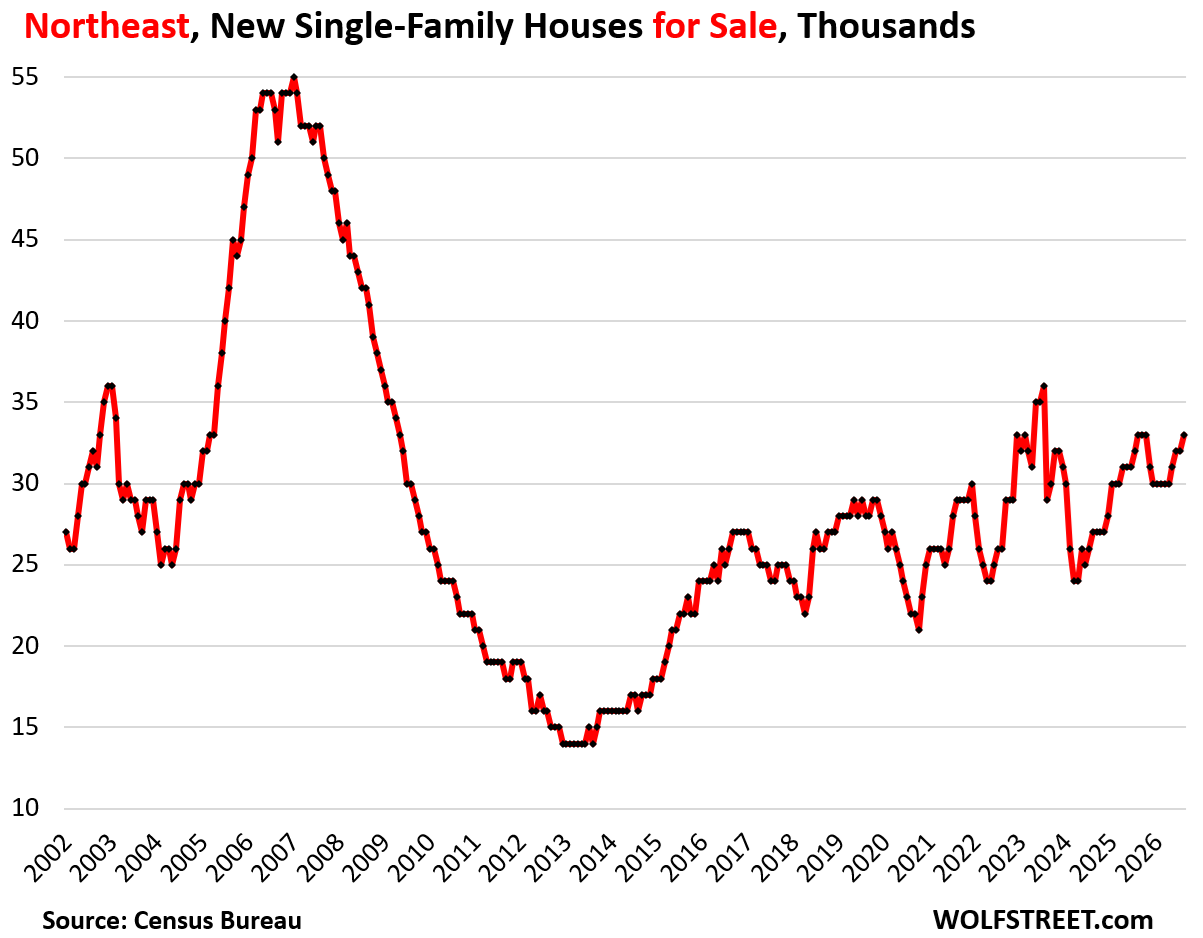
In the Northeast, inventory for sale rose to 33,000 new single-family homes, up by 18% from August 2019. This is a very small market for new single-family homes, as most new construction in the densely populated Northeast is multifamily (apartments and condos).
In case you missed it: Oh Dear, Condo Prices Dropped by 15% to 34% in 34 Bigger Markets. 6 Plunged Back to Where They’d Been 20 Years Ago
Enjoy reading WOLF STREET and want to support it? You can donate. I appreciate it immensely. Click on the mug to find out how:


The map of the four Census regions of the US. Click on the chart to enlarge it:
“buying down mortgage rates (which is costly for builders)”
Interesting to see how that plays out going forward.
I’m a mortgage broker in Colorado. I have had 2 clients this month bid over the asking price and lose out to higher bids. One at $450,000 and one at $1.75 million. If priced for the current market (not 2023) and in pristine condition, homes are selling quickly.
Yes, if the price is low enough, it will sell quickly.
But “over asking” is a bullshit meaningless figure and should never be cited. The sole reason why real estate brokers use that term is to create hype.
So the asking price gets lowered three times, then the home gets pulled off the market, and then it re-appears on the market with an even lower asking price, and then it sells for “over asking,” but $200,000 below the original asking price and $100,000 below where similar homes sold year ago?
My son is in Denver. He was part of the mania back in 2022 when overbidding was expected. He never overbid enough so “lost out” on owning.
On the bright side, Denver rents have stabilized and in some areas dropped slightly. He is currently paying in rent about half of what he would pay for buying the same house in the same neighborhood (PITI).
The mania has worn off for him and his friends and I have told him to be patient. With such a large monthly spread between renting and owning today, the market is still not healthy. IMHO, there is a very high premium to owning today.
“He is currently paying in rent about half of what he would pay for buying the same house in the same neighborhood”
Rent from a landlord without the headache of maintenance, plus mobility. Or, rent from a bank for twice as much, plus maintenance, no mobility, and HOA Karens. These are difficult choices for a young man.
Yeah, as if these are the only two options. No Karens around when renting. Right. Everyone has to buy in an HOA. Sure. Every home costs twice as much as renting. Got it.
Fortunately young men have many more choices than that. I shouldn’t be this grumpy on a Friday.
“He is currently paying in rent about half of what he would pay for buying the same house in the same neighborhood (PITI).”
In the demento world fostered by 20 years of ZIRP/money printing…this constitutes a “tragedy” – unless everybody pays the maximum humanly possible for everything, the horrific specter of “deflation” (always threatened, much more rarely seen) looms.
As opposed to the omnipresent visible, visceral damage wrought by inflation. Which our betters tell us is much less of a threat.
Expect a “learned” NYT editorial finger wagging any day now.
You’ll get no “learned” editorial from me. I’m just a caveman. You’re right that we almost never see deflation. It could be that that the reason for this is that it’s the thing that the People In Charge (PIC) of such things fear the most, and so they engineer everything to ensure that whatever else happens, deflation doesn’t happen. And so they bail out banks, send out checks to everyone, or they buy up used cars and shred them, to stave off deflation when it threatens. Maybe it’s a boogeyman excuse, but consider the alternative that the fear is very real, and for good reason.
Most of the people who remember the Great Depression are dead. The further we get from that, the more likely we are to forget, as a people, the lessons learned from that period. My grandmother was a child during it, and wore shoes with cardboard stuffed in them. She said everything was so cheap, but no one had any money. My other grandmother, whenever the subject of the Depression came up, would say “FDR saved this country.” Saved it from what? Downfall of some sort. Socialist revolution. The problems were serious.
In 2008/9/10, we got a little taste of deflation, but the PIC bent over backwards to arrest it, for better or worse. And the lesson we learned, the thing that so many were rightly pissed about, was that the rich folks who caused it shouldn’t have been bailed out but they were. And the same grandmother of mine who reminisced about the cardboard in her shoes, lost a crap-ton of money when her Wachovia stock was wiped out. (The CEO who caused it went on to other well paying roles. That’s life.) But I guess when things are bad but could have been a whole lot worse, we don’t always even realize that we should be grateful that the worst was prevented.
Sometimes being a good contrarian is to first doubt the mainstream narrative and explore alternative narratives, but in some cases, realizing that the mainstream narrative was right all along. A contrarian’s contrarian, if you will. But yeah, inflation sucks too.
It is a truism of humanity that we must relearn our mistakes on a regular basis. No one alive has seen significant deflation, so no one remembers what it’s like.
Perhaps it’s noteworthy that the last times it happened were the 1920 crash, and the 1930-33 Great Depression, and that deflation often occurred during recessions and depressions throughout the 19th century. It’s also well-documented that significant periods of deflation cause debts to blow up out of control, leading to mass bankruptcies and ruining lots of families. Plus, people horde cash waiting for prices to drop further, which further reduces economic activities, causes further deflation, and pushes more businesses into bankruptcy.
Deflation helps creditors and hurts debtors.
Everyone is worried about HYPERINFLATION!!! (which has never happened in the US) but no one cares that deflation is also prone to spiral because, again, no one alive remembers.
On the other hand, small predictable inflation causes really only psychological damage. The majority of people get raises that match or exceed inflation, so people really do have more buying power. They just often don’t realize it.
But, no, you’re mad that you paid 10 cents more on your coffee this year, so here we are.
numbers,
do you have a phd from Harvard?
In the short history of the United States, hyperinflation has happened more than once. People still have these worthless currencies in their collections.
If you’re talking about the official US dollar since 1860, no, 15% inflation for a year or two is not hyperinflation.
If you’re talking about some of the currencies put out by states and individual banks pre-Civil War, then yes, the “Continental” put out to fund the revolution in 1775 did in fact lose most of its value. Doesn’t seem relevant, but it is technically correct (the best kind of correct!)
Numbers, interesting comparison about worrying about hyperinflation and getting deflation. It reminds me of worrying about global warming only to get a a nuclear winter. all above example are bad!
Cheers
Well renting right now seems too cost at least half of the cost of ownership.
Well, the myth of the bliss of home ownership versus the acrimonious reality of renting
In my humble opinion the fair market for buying a house should have a monthly payment about 10% over the going rent for an identical house in the same area.
ie A potential homeowner should add up the monthly costs for current mortgage interest, property taxes, insurance, and expected repairs and maintenance (the older the house, the higher the expense). The sum of all of the expenses should be about 10% higher than the going monthly rent in the area.
There is an advantage to buying a house since long term your PI payments will go to zero. Your taxes, insurance, and maintenance will likely rise and track inflation. Rents will also rise at this rate (barring any mass population decline or addition, or change in the quality of the neighborhood. )
Currently, the monthly cost to buy in the neighborhood referred above is about 80-100% higher than the going rent.
My son is paying about half in rent than it would cost to buy.
I’ve always enjoyed Wolf’s excellent charts and and still admire his chart comparing house prices vs OER or Zillow rent prices.
In 2012, at the darkest bottom of the housing crisis, housing prices/costs were about 10% less than renting.
I should have bought a fleet of houses then and saved them for my kids.
When buying a house today, I would use this as the floor on purchase price. I might pay a 20% premium over renting if inflation is high (>3%) knowing that in 5-10 years I would be on par with renting if I did much of the maintenance myself.
I don’t believe that prices will fall below 2019 levels unless rent also falls and we have massive deflation. Rents also increased drastically 2020-2022 with high inflation but not as much as house prices.
Wolf should publish his chart regularly so I know when my son should buy.
Denver is in free fall my man, some good places are reverted to 2021 price, in 1-2 years Denver is back to precovid price
To me a big bunch of financial gimmicks propped up new home sales for years and years, including low low interest rates, and now we are faced with a big glut of houses and new home builders that continue building into the glut. Because that’s what new home builders do. They build homes.
I can’t read into the tea leaves with this, but a solution awaits.
The solution is lower prices, which brings out the buyers, and homebuilders have been doing that. Homeowners have to compete with that. But homebuilders are running circles around them.
Yes, one lowers the price, the buyer shows up. Thats the lay of the land.
@Yappymutt,
Correct. Assuming a seller is willing to lower the price. Among the existing home listings, I now see some more realistic initial pricing. But I also observe some sellers who seem to be convinced the 2022 selling environment/pricing never ended. It did, and they need to wake up.
Why can’t house prices simply be the cost of replacement for any house?
Perhaps because there are so many gaming the system to get a piece of the action.
A builder builds a house, then sells it at a price that covers the cost to build the house and a reasonable profit.
Never gonna happen in the cesspool of the american economic system.
And the true value of a house is x times of the household income of the community in which it is located.
There’s the replacement cost of the building, but the land is still there. The price of an old rundown house is the price of the land; the house itself is worth zero.
What I see is a collapse in the asset values which are currently sitting at the precipice of the failure of a mega bubble signaled by the Oracle claim of the act of God clause as a reason to not pay up for a wrong bet
Interesting note. Berkshire Hathaway bough lots of stock in home builder recently. They certainly expect to make a profit from selling new homes!
Lennar was the company Birkshire bought.
Berkshire didn’t buy the whole company. It added to its existing stake and now owns roughly 10% of Lennar. The stock only got a little bounce out of that announcement, and sold off over the past 2 days.
Definitely overbuilding in northern Texas.
Yes, dirt moving everywhere here, it is disgusting
Joyous times here, felt like this day would never come! So my awful neighbor is getting the boot, finally, 5 years is all it took.
So +1 more to soon be on the market in the Midwest.
Original mortgage was for 310k. Current amount owed is 308k (so maybe they made a couple payments in 5 years?), plus about 150k in liens so around 450k owed. Current property value is 280k and guessing with the damage they’ve done 200-250k is more realistic. FHA/HUD loan, so I guess we’re all going to pay for it.
Just like during GFC1, the negative-equity rats will start jumping ship en masse once used house prices finally begin crashing and they realize that continuing payments on depreciating assets is no way to build wealth. Combine that with the realization that renting costs half as much (or less) and we’ll finally see a return to normalcy.
Certainly sounds like we’re getting closer, especially with bond yields blowing out and death-pledge rates following closely behind. Once consumption drops and unemployment spikes (still a ways off, unfortunately), we’ll see what GFC2 has in store.
I’m still hoarding cash and waiting for fire-sales so I can “buy all the things” during the next Great Liquidation.
The negative equity rate is very low right now (2.5%), far lower than the housing bubble. It’s also unlikely to rise much; people have plenty of equity and prices haven’t dropped at all.
The only exception is some frothy condo markets in Florida and Texas (Gulf Coast and the Austin area).
Half of adults under 30 live with parents today. I couldn’t get out fast enough, even before high school ended. With less kids or no kids and fewer marriages with younger generations I am guessing builders will have to keep sizing down, 750 to 1000 SF home will be the sweet spot soon. HOA and condos don’t offer what a single person home in a nice walkable neighborhood full of pets does
They hate us for it. Living at your parents home is the inexpensive life style option that most of the little rebels choose.As scary as they appear they really are rational and capable of feeling your understanding of love.
A friend of mine has two of her adult children (30+), along with their respective partners, living at home. Fortunately there’s plenty of space for all. Their aim is to save up to buy, but will we all live long enough? For now it’s a win-win, they have cheap rent and mom has help with her mortgage
A bonus of all the McMansion built is you can have 3 generations living at home. That may be more common in the future. Make America closer to the ones they love!
I will state loud and clear what Wolf may not care to say – the current housing market is a severely manipulated con game. It’s hardly a market and it certainly isn’t free. It’s a travesty, pure and simple. No PhD needed to recognize that fact.
Academically I agree that asset price inflation was the purpose of QE
the current housing market is suspended like Wiley E Coyote above obvious disaster
Housing buyers should offer 50 pct less than the asking price
What if housing prices were simply the replacement cost. If a house burns down, how much would it cost to replace it?
It’s definitely a big con game to suck money out of the folks who simply want a house to live in.
There’s the replacement cost of the building, but the land is still there. The price of an old rundown house is the price of the land; the house itself is worth zero. Buyers for the land only and will tear down the house.
If you’re paying $1.5 million for an old shack in San Francisco, you’re paying $1.5 million for the land and $0 for the building.
Is there any plausible data of prices including those special deals and mortgage supplements?
There is, but only per each publicly traded homebuilder. I posted the chart for Lennar’s average selling price in the article; this average selling price includes everything. But I have to fish out the average selling price from each quarterly financial report, so it’s not something you can just download. D.H. Horton also releases an average selling price, and I collected some of that data. It has also dropped but not as much. Other publicly traded homebuilders may also release average selling prices that include everything, but I have not tried to collect that data. It’s a lot of work.
This is exactly where AI shines! Per Claude:
Using each builder’s most recent quarter (Lennar’s Aug quarter 10-Q isn’t on EDGAR yet, so its figures come from the 8-K release filed Sept 16). “Net margin” here is home sales gross margin minus SG&A, the homebuilding operating margin, applied the same way to all five so the numbers are comparable.
Builder (qtr end) Closings Net ASP Gross SG&A Net
D.R. Horton (6/30) 23,983 $362.9k 20.7% 8.3% 12.4%
Lennar (8/31) 20,840 $372.0k 15.8% 9.2% 6.6%
PulteGroup (6/30) 6,997 $544.0k 25.0% 10.1% 14.9%
NVR (6/30) 5,058 $450.7k 19.2% 6.6% 12.6%
Toll (7/31) 2,662 $996.4k 23.9% 10.0% 13.9%
Weighted total 59,540 $423.2k 20.0% 8.9% 11.2%
🤣💔
This is exactly where AI FAILS (or rather humans fail). You asked a vague questions and got the wrong answers.
Your AI figure for D.R. Horton of “$362.9k” referred to the average for the first three quarters (9 months) of the year, not Q3 by itself. This is how AI fucks with people who don’t know what they’re doing.
The figure comes from this reference in the quarterly filing:
“Homebuilding is our core business and primarily includes the construction and sale of single-family homes with sales prices generally ranging from $200,000 to more than $1,000,000, with an average closing price of $362,900 during the nine months ended June 30, 2026.
Your Lennar average selling price was correct, I have that already. I didn’t check your other figures. You’d have to check ALL of them.
You have to ask AI exactly the correct and precise question, and then you have to dig up the quarterly financial statement and check it to see if it is the correct figure. Yeah… That’s why there’s so much slop out there.
When I needed a 10-year time series of quarterly complicated data that exists in lots of different versions where it’s easy for AI and humans to pick the wrong version and then mix and match, it took me about an hour: Digging up a sample of original quarterly filings so I had a sample of actual numbers I was looking for; asking AI in different iterations; checking the answers against the figures in my sample of the original filings; refining the question until AI nailed the answers every time. And then it produced 10 years of good data. And now when I ask that exact same question, I get the correct answer, and I can do that for any time period. So after the initial investment of time, AI does save me time. But if you don’t do that, you get slop.
AI ‘shines’ like a new moon..
To judge how far residential real estate prices are from normal currently, it would be instructive to look at a graph of the mean annual rate of appreciation of residential real estate vs the actual annual rate of appreciation of the mean price of resedential real estate prices. Index it back to 1975. Then another graph to adjust the same for annual CPI to see how far above and below mean prices vary relative to the average annual appreciation. If mean prices, adjusted for inflation, are getting closer to the average mean price, then prices are becoming reasonable and if they are below the avergae mean price then they are attractive. I assume that since real estate has a local bias, then each region could be analyzed to get a sense of the relative value today and at various times over the last 50 years.
Nonsense. If you want to know “affordability,” you can go look at an affordability index for each local market. An affordability index is based on a formula of local home prices, local wages, current mortgage rates, local property taxes, and local insurance costs. The Atlanta Fed has an interactive affordability index for each market. If that’s what you want, that’s what you need to look at. According to this affordability index, UN-affordability is at record highs in many markets. And then go check the stock market’s affordability index.
That afforability tracker is interesting. For most cities, it says affordability is the same as at the top of the first bubble. But for some of the key southern cities you have been highlighting (Gulf Coast Florida, Austin/Houston/Dallas, Charlotte, etc.) things are much worse now than then (in part because these places didn’t participate as much in housing bubble 1).
Kudos to Wolf, you have been saying for a couple years that there was no shortage of housing. My builder friends were always pushing the shortage narrative, but they have gone silent on it the last couple months.
Wolf, thanks again for all the great information you provide.
“Kudos to Wolf, you have been saying for a couple years that there was no shortage of housing. My builder friends were always pushing the shortage narrative, but they have gone silent on it the last couple months.”
It’s always funny how there’s a permanent shortage during the bubble, then when the bubble pops, the shortage miraculously disappears.
There’s never a permanent housing shortage, only a temporary housing-for-sale shortage, fueled by FOMO and financial illiteracy.
Shortages get rectified toute de suite when the cheap money dries up, a lesson dearly learned for many.
Yes, production builders will run circles around production home builders which are typically on the outskirts of town. Don’t disagree. These types of homes truly never build equity because they’re cheaply made on cheap farmland.
In Austin, the speculative custom home building is and continues to dry up in the central part of town. The land is still expensive and the construction costs are not significantly going down. It’s too risky of an endeavor.
The central Austin Boomers aren’t selling in droves because they can’t afford to move into expensive elder care communities. Therefore they’re locking up that significant and premium centrally located housing stock.
I am in the north east. A credit union helped me get my first mortgage in 2014. I had o cough up minimum 25% and was grilled on my funds for awhile. Now 2026 the same credit union is sending me pre approval letters, no closing costs, minimum 3% down. This credit union is my primary bank. I paid off my first home during COVID. Homes are priced to high for us to be non interested in upgrading at the time. We also have had stagnant wages for two years while costs have gone up. Several friends and family improving in place.
If you lower the price… they will come !!
Over the years I have bought and sold cars, trucks, motorcycles, equipment, properties, houses, etc.
It is all only worth what someone is willing to pay….
With that said….
Good luck to people buying and selling 👍
“It is all only worth what someone is willing to pay….”
Almost the exact same words my dad told me years ago when I was telling him how much my comic book collection was worth. Never forgot it…
Mr. Wolf writes: “…developing lower-cost, more efficient construction methods to bring their own costs down.”
The importance of housing was taught even in preschool childhood; with the story of “The wolf and the three pigs.” The houses were built of bricks, sticks, and straw. This is also the spirit of the basket of goods downward substitution for inflation rate calculation taught later. The sticks are under Trump’s Canada lumber tariffs, forcing the demand for “straw” that will nicely transition into the cardboard of the homeless.
Brick houses collapse in an earthquake as the shaking turns bricks into sand. Fairly tales don’t work.
I’ll take a brick house in a hurricane over studs any day. -g-
Where you live the real problem is you’re built on what is essentially sand. A good 8.0 shake and it will all tumble down.
The one thing I’m not seeing in new builds is the 2 bed, one bath home of less than 1100 sq ft. And yet that should be an easy way to lower the prices and get your people out of like sized apartments. And I can see the attraction of such places for the downsizing empty nesters also. Not everyone wants, or needs, a 3,000 sq ft place.
I bought such a home in 1981 at the 13% interest rates; consisting of 927 square feet, 2 bedrooms 1 1/4 baths (1/4 being an extra bedroom sink (outside of bath, etc.), on standard 4 lots per acre in a California central valley worthless scrub land suburb of the hood. This house was $54,000, the maximum a young engineer could qualify for. Regular 1,600 square foot houses were $65,000 to $70,000 in middle class neighborhoods; i.e. neighbor +(a better) “hood.”
Bottom line: The “investment” was not worth it, housing price increases stopped. inflation plus pay increase, lower interest rates and all that happened was an “early” adopter of a tool shed home in a suburban hood.
When the supply increases and homes sit empty, the builders eventually stop building. They run out of options. For a while they keep on even if they just break even. Some will even build at a loss to keep their crews working….they don’t want to lose good people. Gradually, the only guys at the Christmas party will be relatives, some office staff, and foremen. Maybe an old timer carpenter. Before all this unfolds the crews lose OT, then OT is expected at straight time, then spotty work until even that fades away. The go-getters on the crews line up their own work even if it is cash under the table and this further competes in the market.
I’m 71. I started working for my brother doing renos and new builds at age 17. Worked for big companies and small ones over the years. Worked in aviation when I got sick of pounding nails, went back to school, and even taught construction for pre-app for many years. I have been through many of these downturns and this is what happens. Plus, I live in a small rural area where we know well every house that comes up for sale. I’ve seen them sit for years, waiting for a buyer. Finally, any buyer at whatever price they can get. And when used houses don’t sell, only damn fools build new spec homes.
What contracting niche that does keep going is high end renovations. You have to have a rep and also work in an area that people wish to live. On Vancouver Island, (my home) it is towards the bottom half of the Island where people with money wish to retire. Near the ocean, too. They come from all over Canada because of the good climate. Then, through word of mouth they contact a builder to make the new place their own. My brother in law does this work. He works with one other carpenter and they are booked up for the next 2 years. Anyway.
In my redneck more north coast area…unfortunately, we have been discovered during Covid. One forest company now has some private lands being worked that are not part of a tree farm license. They are developing ‘estates’, 5 acre – 7 acre lots with hydro and a well installed at each. Blue chip driveways. I expect these properties will now sit vacant for years until the next boom (if there is one). And that ‘boom’ would require lower interest rates and fewer empty homes for sale. Why buy a 5 acre lot ready to build the ‘dream home’ on when you can buy the same size piece of property already landscaped, with a good home, for $150K more? Then, do a reno.
I have always had a question about transparent financing for these big builder corps. I met a millionaire biker from Vancouver who bought distressed properties and then rebuilt them. He paid cash for everything he could get away with. Everything was hidden and he was never questioned. On one property the city finally denied a liquor license. It has sit empty, finished and primo, empty for at least 5 years now.
I also worked for one decent sized builder when starting out. It was a very good union company. He mostly built apartments. Good owner. In the 70s crash he owed a swack of money to banks and they called their loans. He then sued them. It was in the courts for years and he finally got a settlement that made up all his losses. The courts agreed he was set up. Meanwhile, most of the crew moved on and he survived by building houses. Lost his shirt, lost his hair, lost his son, and still kept building houses.
You as an individual can stop building. But if you try to extrapolate from you personally to the big publicly traded homebuilders, you’ll fall off the ladder and vanish along with your hammer in the black hole beneath you.
A publicly traded big company cannot just stop doing business and let everyone go and fuck the shareholders. Big homebuilders stop building when they get liquidated in bankruptcy court, and that’s not happening any time soon. They’re still profitable, and if in the future they’re no longer profitable, they can afford to lose money for years. Lots of big companies lose lots of money for years, and nothing bad happens.
I have no idea why this is so hard to grasp. The same nonsense keeps getting posted here about big builders will stop building. Get a grip!
My Dad, a mechanic bought and sold a lot of cars.
My Mother gad a great sense of humor, related the story of coming out of the grocery store and couldn’t remember what car she had driven there
?
@Wolf – The new home market is so manipulated. The builders prop up prices by offering incentives & rate buydowns. So, its hard for price discovery to happen quickly. Everyone is going off the inflated comps of these new homes.
Btw, there is a new feature on Zillow called “First look” which essentially lets sellers give a preview of their home without listing it. That way, they dont rack up days on market & thus enable price discovery. I am sure other real estate apps will make this feature too.
Who knows what other tricks the home sellers and their side have made to prevent price discovery of their often overpriced shacks.
All sellers try to get the highest possible price, in any industry. If that’s “manipulation,” fine. But it’s the BUYERS that decide the transaction price. Without BUYERS there is no transaction and no transaction price. All you’d have is a fantasy “asking prices.” It’s the BUYER’s job to NOT overpay.
If prices are high, it’s the buyers’ fault. If they refuse to buy, transaction prices wouldn’t be high. Don’t blame the sellers.
@Wolf – I dont think its fair to blame the buyers entirely. Some buyers are so wealthy that they can make dumb mistakes, overpay for a home & still thrive.
How can most buyers arrive at a reasonable price when most are not even sophisticated enough to value assets? Their realtors can help with the valuation part. Thats why people hire “experts”. But the realtors usually wont because their incentives are to jack up home prices as much as possible. They might call out a few major problems to make it look they are on your side, to avoid lawsuits or bad reviews. But thats about it. They will tell you to buy a home for 1.5 mil when you should really be paying close to like 1. I have seen this happen to tech couples. Of course the realtor & their in house inspector will call out the broken water heater so that you get a tiny discount & think you got a deal.
Of course, my understanding could be flawed. So the bigger question to you is how do you do valuation of homes as an ordinary buyer, besides looking at comps that might be inflated by overzealous buyers? Are there any books you’d reccommend to learn that? I am not going to leave this to my realtor entirely when my turn comes.
You don’t get it. By being in the market and buying, buyers set the transaction prices, and if transaction prices spike, it is 100% the buyers’ doing. If no one buys, there are no transactions, and no transaction prices. And if sellers want to sell, as no one is buying at those prices, they have to cut their asking prices until the asking price is low enough to entice a buyer. That’s how buyers set transaction prices. Buyers always set the transaction prices, and when prices spike, it’s their fault.
Then you can ask, What motivates buyers to buy at very high prices? There are lots of answers, including free money from the Fed, the entire real estate industry conspiring against buyers, FOMO, etc.
It seems like the trend from the graphs is more housing on the market. Perhaps that trend will change when prices drop. I’ll be waiting for the trendline to reverse—perhaps then I’ll finally be a homeowner.
Wherever Builders are building new homes, prices have come down. In Bay Area outskirts like Mountain House, Tracy, River Island prices have come down by 20%. But in core Peninsula prices are still holding up for Townhomes and SFH. Townhomes have not gone up or may be 5% correction. SFH have gone up or stayed. Because of low rates lockin, owners are holding on to the properties. This year Rent increases were 10% in San Mateo and nearby cities. There are few new homes in this area. New condos and Townhomes are selling for 15-1.75M.
What we need is crash in Stock prices only then we can see some sanity in those core areas where tech folks have huge equity assets.
I have lived in Florida for the past 30+ years since moving down here from the Northeast. Lennar is the largest homebuilder in Florida, based out of Miami I think and also among the top 5 homebuilders in the nation. As pointed out in this article, homebuilders need to build and sell homes in order to remain a viable business. This includes either losing money or barely breaking even after discounts and incentives. Here in SW Florida where I live now, existing homes are competing with new developments where builders are offering financial incentives and buy-down mortgage rates. Earlier this year my young neighbor, who was renting, bought a new home in Cape Coral, which offered incentives that were too hard for him to ignore. The cost of materials keeps going up and an unnecessary war in the middle-east if forcing fuel costs to astronomical heights not seen since the oil embargo of the 1970s. The whole world runs on diesel, which is averaging above 6.50/gallons and everything needed for home building is transported on vehicles that run on diesel. Also, earthmoving equipment runs on diesel. Do the math. Margins will shrink to zero or go negative until their is relief in the oil markets. Cheers.
Oh but don’t worry, Washington DC is smarter than everyone with AI and the golden age, or the end of the age depending on which click you make.
But back to the point, none of this stuff you see is real, prices are fine, the higher cost of food is temporary and could ended overnight once the elections happen. $9 diesel is just us winning around the globe.
Financial people – them who have made money – tend to be smart. I guess they are in bunkers about now, which won’t protect us either from what is coming. This was all knowable before it occurred which means this isn’t a bug but actually a feature of the American political system.
8% mortgage now inevitable?
History shows calamities occur when rates rise rapidly like this…
History shows no such thing. History shows that 5% Treasury yields and 8% mortgages were low. Same fear-mongering nonsense about higher yields over and over again. Rates rose much more rapidly in 2023, and mortgage rates already hit 8% in Oct 2023, and nothing bad happened. And mortgage rates of 8% used to be considered a good deal. Those fear-mongers just want their free money back.
What’s going to hit the economy and markets isn’t high yields, but an implosion of the AI investment mania, à la Dotcom Bust — about a year into the Dotcom Bust, we got a run-of-the-mill recession. But we’re not there yet. No AI bust yet. And then after the AI bust starts to take down stocks, a year later, a year into the AI Bust, with stocks down 30-40%, we might get a recession. But stocks are still near all-time highs and people are still riding the mania.
Ditto, 7 to 9% is about what a mortgage should be on average.
It’s the home prices that will fall down to the level’s to support the region in which they are sold vs the median incomes in those areas.
Oracle is my guess for bankruptcy in under 24 months. :)
Indeed, one has to remember way, way back to… 6 years ago to find a time when rates rose much, much faster (from 3 to 7% in just two years). This caused monthly payments to increase by 50%.
To get an equivalent increase in monthly payment from 7%, rates would have to rise to 11.5%. A measly increase from 7 to 8 is much, much smaller (10% increase in monthly).
CNBC: History shows financial calamities occur when rates rise rapidly like this: ‘Something always breaks’
The yield on the 10-year Treasury note is rising to levels not seen in years. But it’s not necessarily the outright level that’s most concerning for those on Wall Street, it’s the speed of the move.
When rates climb at such a rapid pace, history tells them something bad tends to happen.
The 10-year yield saw its most rapid one-day increase since April 7, 2025, on Wednesday, rising further on Thursday to top 5.17%, quite a move considering two weeks ago it was below 4.8% and at one point in August, it was below 4.6%.
“Something always breaks,” proclaimed a recent note from John Roque, head of technical analysis at 22V Research.
The 10-year climbed a lot faster in 2023, from 3.30% to 5.01% (+171 basis points) in less than 5 months, and by 400 basis points in 2 years, and nada blew up except for a few badly managed banks. The current spurt is only 123 basis points from the February low and 180 basis points in two years.
CNBC needs to get a grip.
Most rapid increase since one year ago is not the flex they think it is. Unfortunately, it’s quite common in reporting about finance.
If anyone thinks that housing prices have inflated way too much over the years let me share this. In 1971, my parents bought a 4/2 waterfront in Tampa for $32,000. Last year my mom passed at 100, and we sold that house for 850k. Roughly that’s 25 times increase after cost. Now gold in 1971 was 32 an ounce. today its 4400 give or take. which is roughly 125 times 1971 cost. While stated inflation is roughly 10 times over the same period. Point being certain items certainly appreciated way more than houses, and I don’t know what all this means other than inflation must be taken into consideration while planning major purchases these days, and the cost of letting cash earn pittance elsewhere.
good point but we dont pay for homes with gold.
“We don’t pay for homes with gold”…..,yet.
Soon perhaps, a bill of sale on a sheepskin/a bag of gold/bottle of whiskey and a hand shake will close the deal.
I BOUGHT a 100 year old craftsman bungalow in downtown phoenix, in 2004. on the deed chain, it was purchased originally by a trust for a spinster woman, priced in gold coin. i did the calculation at the time and the price was the same in gold coin far far away on other side of globe in OZ. i’ve generally kept half my net worth in gold coin, too. and always buy my properties for cash, once i reached 40 years old and could afford to. glad i sold the dozen properties i had in 2022.
It’s kind of news to me that “homes are getting cheaper” at all. I suspect homes are mainly getting cheaper in exurban sprawl locales where there are few jobs (and other attractions) but the usual suspects can easily build cookie-cutter single family tract homes.
You should read more articles about the housing market here.
There are thousands of short term rentals in the Coachella Valley. Additionally, Canadians own around 7% of SFRs and condos. It will be interesting to see what happens if there is a soft tourist season. My best guess is that there will be a flood of rentals coming on the market next year. The last time this happened, post 2008, there was a half price sale for affordable homes, with prices holding at around $100 per sq ft for the better part of 2 years. It will be interesting to what happens this time around.
Good that a lot of new supply is here but gotta get rid of these ridiculous HOAs. Some wont let you work on your own vehicle at home, or even wash your own car at home. Some people may not mind but I’m not buying one of those. Sad how the developers bulldoze every last tree too. How the heck did people let theses HOAs take over? We can still get plenty of new housing without all that.
This may end up making the 2008 to 2012 period feel like a minor bump in the road. That one guy called the current housing and stock markets ‘super-hyoer bubbles. That’s a lot of deflating to do.
The peaks of many of Wolfs charts occur around the crash time of US property market circa 2007 , new home inventory still built for a while as properties went unsold then crashed along with the rest of the property market.
It looks to me as though these charts are telling the same story as 2007 , we are at the start of another circa 5 year slide coming.
What has made this happen ?
Prices of homes have gone up too much to the point now that potential buyers can’t afford to buy them .
Inflation has pushed up costs on everything and jobs and wages have not kept up. Folks are now tapped out on credit and employers are starting to stop hiring because AI is coming and employers are planning for redundancies in many areas not hires.
Under 24 year olds effectively now have zero chance of buying a new home .
Unless mam and dad and also granddad and grandma help them. AI says this when asked, how many first time buyers of houses received help from family members in the last 20 years ?
Historical Trends (2006–2026)
Survey Period / Year Share Receiving Family Help Primary Source / Context
Mid-2000s ~15% – 20% Early historical tracking via housing surveys
Pre-Pandemic ~33% National Association of Realtors (NAR) estimates
2023 ~23% NAR data for first-time buyer down payment gifts/loans
2025–2026 ~24% – 40% Rising sharply for Gen Z and Millennials (up to 80% for youngest cohorts)
So my point here is that in many developed countries the bank of mum and dad PLUS the bank of granma and grandpa is now also tapped out and on the hook if the property bubble goes pop .
In other words it might not just be first time buyers going into negative equity but dad and mums house and grandma and grandpas house could also take a hit and go up for sale
why ?
Because many have taken equity out of there houses to help their sons daughters and grandsons and grand-daughters
Exhibit B AI
Over the past 20 years, an average of 25% to 40% of all first-time homebuyers received financial help from family members to secure their homes. Furthermore, recent macroeconomic housing data reveals that approximately 1 in 5 (20%) first-time buyers had parents who explicitly extracted equity from their own homes (via cash-out refinances, home equity loans, or HELOCs) to fund that assistance.
So if we do see AI put circa 10% of younger people out of a job over the next couple of years , which is a reasonable assumption both in the US and in the UK, AI says far worse , this will exacerbate an already weakening property market in late 2027 and lead to a fully fledged property crash the likes of which have never been seen , 50% plus to the bottom .
Financial institutions are already now trying to sell parts of their property portfolios ( debts ) that are not performing.
I put it to anyone reading this longish post , that many US Banks are going to be already in trouble in 2027 due to over exposure to AI and Data centers becoming a bust . A property crash on top of that = A BIG depression .
Not I have avoided comment on the $40 Trillion Debt payments.
This sector is the short of a lifetime through 2028 – Wolf any pushback to modeling 7.5% mortgage rates next year?
No pushback from me.