
The function of yield is to create demand. And it did.
By Wolf Richter for WOLF STREET.
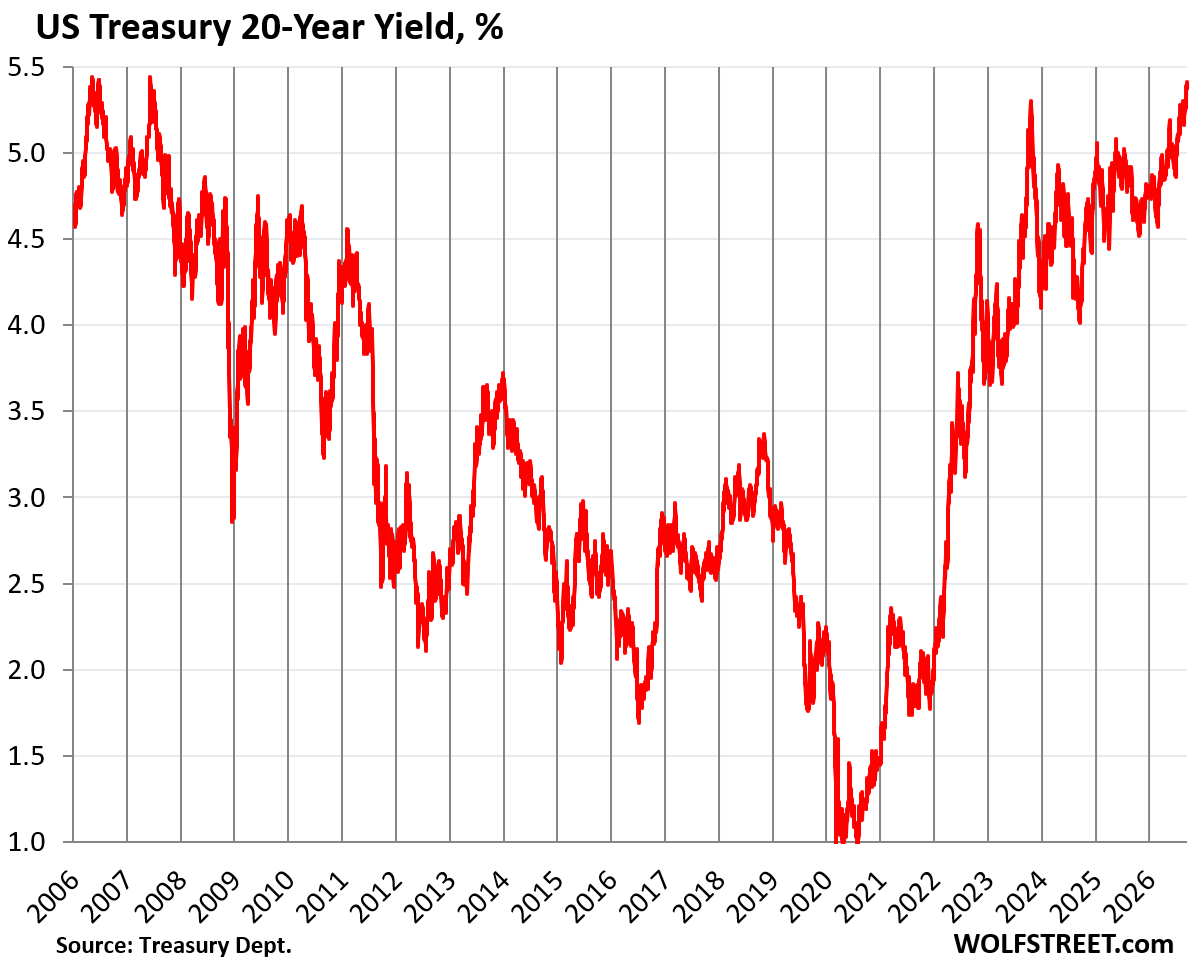
The 20-year Treasury bond auction today was a doozie. It took a yield of 5.42% to find enough demand to sell all of the $13 billion of bonds, the highest yield since the 20-year bond was re-introduced in March 2020.
A month ago, at the 20-year auction on August 19, the bond had sold at a yield of 5.204%. At the auction in July, it took 5.163% to sell those bonds.
Today’s auction yield finally broke the record set at the auction in October 2023, so three years ago just before the peak of the prior yield spike when the 10-year yield broke through 5% briefly. At that auction, the 20-year bond had sold at a yield of 5.245%, after which the 20-year yield plunged in the secondary market by about 130 basis points in 11 months.
The 2.0 basis-point tail: not the worst ever, but substantial. When a bond auction is announced, the new “when-issued” bond starts trading before the actual auction and before it is actually available for sale. The when-issued trading allows for some price discovery in the market before the auction.
This 20-year when-issued bond traded at a yield of 5.40%. But then at the auction, the yield was 5.42%, so 2.0 basis points higher than the when-issued yield. This 2.0 basis point “tail” indicates that demand at the auction was substantially weaker than the market had expected. Since the 20-year auctions were re-introduced in March 2020, they experienced bigger tails, including over 3 basis points, but 2.0 basis points is substantial.
The Bid-to-Cover Ratio was a middling 2.57, with $33.38 billion in bids and $13.00 billion accepted. It was better than a month ago (2.53), but below the the July auction (2.64).
Indirect Bidders purchased 52.5% ($6.78 billion) of the total, which was the lowest so far in the six-year existence of the modern 20-year bond auction.
These are buyers that placed a competitive bid through a primary dealer or direct submitter, and include foreign central banks that bid at the auction through the NY Fed. While the auction results lump foreign bidders together with other indirect bidders, the low ratio suggest that there was severely lacking enthusiasm among foreign buyers for the 20-year bond.
The function of yield is to create demand, so the yield rises until there is enough demand, which is what an auction accomplishes. There will always be demand, but the yield has to be high enough, and for the government it may be shockingly high, which would be appropriate given its shockingly high fiscal deficits and its shocking inaction about the shockingly high deficits. And the whole thing is topped off by inflation that has been high for a shocking five years.
At some point, investors find the yield attractive and buy. But at some point, the yield may be too high for the government… And that would be a good opportunity for Congress to sit up straight and pay attention and get its fiscal mess in order. But we’re not there yet.

In the secondary market, the 20-year bond yield rose to 5.44% this morning before easing a bit and currently is at 5.41%, all the highest since 2007, and roughly 4 basis points higher than the 30-year yield (5.37% currently).
The 20-year maturity is the unloved newcomer. It generally sells at auction at a higher yield than 30-year bonds. The difference in 2020 was as high as 20 basis points but has narrowed since then to just a few basis points. There is only a relatively small number of 20-year bonds out there; the auctions are small; and liquidity for the 20-year maturities is low. They also feature high on the Treasury buyback list, in part to provide some liquidity in this low-liquidity corner of the market.
The 10-year yield (5.0%) and the 30-year yield (5.37%) are also the highest since 2007.
That year 2007 was the last year before the Fed’s QE and interest rate repression killed the bond market. The Fed eased out of that monetary experiment starting in 2022, amid the worst inflation in 40 years, and the bond market has slowly come back to life. These 5%-plus yields were considered normal to low in the decades before 2007.
Enjoy reading WOLF STREET and want to support it? You can donate. I appreciate it immensely. Click on the mug to find out how:


When are the credit spreads going to widen?
Credit spreads = risk perception, so I think low credit spreads are reflecting the fact that all the economic metrics that matter are looking very good:
-unemployment and initial claims
-NFCI
-yield curve
-corporate profits
-durable goods and manufacturing orders
-inventories
-consumer debt to income ratio
-etc. all good news
Meanwhile, the federal funds rate is near the rate of inflation, so policy is loose/stimulative. In practical terms, that means banks and companies can borrow cheaply and invest the money into things that earn healthy profits. As long as they can do that, their risk is low.
Wolf,
Does that mean market doesn’t care if Federal committee doesn’t act and raise rates? If bond yields continue to go up? Does it really matter? Mortgage rate is tied to 10 year yield any way.
Can you explain why federal interest still matters and how it will have any impact?
The Federal Reserve only control 5 very short term (overnight) interest rates but many are tied directly to stock speculation.
There is no dial in the over-budget remodeled Eccles Building that the Fed can turn left for less inflation and right for more inflation. It has interest rates that affect short-term market rates, such as the repo market rate, and it affects bank prime rates, CD yields, Treasury bill yields, etc. So all short-term and variable-rate debt sooner or later moves with the Fed’s rates.
About $6 trillion of repos trade every day in the repo market. It’s huge, it’s where Wall Street and hedge funds borrow for leverage. SOFR is one of the rates that track the repo market rates. SOFR is now 3.62%. After a 25-basis-point rate hike, it’ll jump to about 3.87% give or take.
So these higher repo borrowing costs and the higher bank prime rates then tighten financial conditions a little (making leverage more expensive) and ricochet out into loans. For example, many bank loans are based on SOFR plus some percentage (such as SOFR +5.0%). If you have a SOFR + 5% loan that adjusts every six months, you might pay an interest of 8.62% currently, and then after a rate hike, when the rate resets, you might pay 8.87%. After four rate hikes, you might pay 9.62%. So now your business is paying more in interest and may try to borrow less, and cut back some marginal expansion plans. Consumers might buy fewer cars or buy less expensive cars because car loans get more expensive when short-term rates rise. If that plays out across the country, it’ll reduce demand a little, maybe enough to cause inflation to ease. But that relationship is tenuous.
Anyway, that’s the tool the Fed has.
Higher long-term interest rates do a lot of heavy lifting for the Fed in the inflation fight. And Warsh has essentially welcome those higher long-term yields for that reason.
“Higher long-term interest rates do a lot of heavy lifting for the Fed in the inflation fight.”
Excellent point, and to that end, they help bring on a recession which then has the potential to bring about deflation and the opportunity for prices to return to their mean.
Warsh and his FMOC cast have the opportunity to bring these five years of inflation insanity to an end.
You lived through four recessions from 1970 to 1983. We haven’t had one now for going on 17 years.
It’s time. The Fed has the hard work to do as Warsh points out.
They don’t have the confidence or common sense to take a recession. They don’t even have the confidence to bring inflation down to 2%.
By manipulating rates to prevent a recession, we will have a depression. It’s not personal, it’s math. Recessions allow the BAD debt to clear and the BAD behavior to go bankrupt. This facilitates DEFLATION allowing others, presumably with new/better ideas to step into the market. Price discovery is paramount to a functioning market in a representative republic. The most important “price” in that system is the cost of the currency itself.
I still don’t understand why the FOMC doesn’t take a baby step of increasing QT by a few billion each month. KevWar promised us he’d like to reduce the balance sheet, and here we are not doing it at a time when the quantity of money in circulation needs to be reduced.
Was KevWar unable to sell the idea to the other FOMC members – the same ones everybody now expects to vote for rate hikes instead? Or has the run-up in yields been interpreted as indicating a market that barely has enough demand to accommodate the rapidly growing supply of treasuries, so throwing more assets at such a market would further fuel the rise in treasuries? If it’s the latter, so much for “price discovery”.
I was asking Google that question and all I got was obscure statements about how even the smallest interest rate hike can signal a prolonged hiking cycle because that’s always what happens.
I check relevant history and although that does happen often (because of major, acute economic events), I also found cases where small adjustments or a few consecutive hikes were done and that was it. It looks like corporate and political actors addicted to loose conditions to me.
Of course it cares.
It’s like “Do your Jobs you Dumb MothaF*€%ers”
Hence it going in the opposite direction that any rational person would want.
I think the Fed will disappoint for longer bond yield. 25 basis points isn’t going to hit the breaks on yield rise. Now 50 points hike should give confidence that they are serious about inflation. Will see soon. TLT etf is trading above it Oct 23 low, that’s weird to me since the 20 year yield. Go figure ;)
The horse has left the barn. The Fed’s tiny lever cannot move the bond market now.
The Fed now is the little, Dutch boy and his fingers are too tiny! Competent bond investors realized many factors that will continue for at least two years (e.g., they noticed smoke over the burning refineries and how long it will take to build more oil/rare earth refineries) will cause academically “non-real” (non-CPI) inflation which will in reality nevertheless significantly erode their purchasing power over time if their bonds pay too little.
Cynics suspect that is the plan.
Foreigners/investors may have realized this before but probably sought debtor-stability, imaginary-return-constancy, and legal security first, which is not how this economy is now being run. It was fine to use CPI which excluded most, real costs faced by companies and consumers in real life (particularly energy), to consider what is the “real” CPI inflation rate academically.
(Some think CPI was monkeyed around for very non-economic reasons. :-)) Only a fool considers it or minor, Fed antics in investing in an unreliable, unstable company’s/government’s bonds/treasuries as opposed to investing in more stable, real assets: e.g., real, physical gold or fertile, productive land that does not require a fertilizer bath to produce, etc. To mix more metaphors: karma or we “hit the iceberg”, or our “gravy train* has derailed. LMAO
To be more succinct, the Fed has children’s toy plastic tools in its bare hands and it being asked to fix one of those 20 tom, sixty foot mining trucks while it is rapidly burning! It is like a tiny monkey in a zoo throwing something. LMAO
This made me laugh so hard and loud that the entire office is wondering what happened :)))))
Wolf, do you (or anyone) have a sense for what fractions of foreign Treasury holdings are currently held in the different bills, notes, and bonds? Historical figures for the past 10 years or so? And their approximate maturity dates? I understand that’s an incredibly complex picture which requires a TON of data, some of which may not be public.
The reason I ask is because with the 2.0 basis point tail on the 20-yr bond auction yield, it seems as you suggest that demand is on the lighter side. As the bills/notes/bonds mature, particularly for foreign holders, they may decline to purchase long-term Treasury debt, and instead opt for short-term bills. Or something else entirely. This wouldn’t bode well for the Treasury as it would be less demand for long-term bond issuance, which would drive up yields all else being equal.
Personally, I think that would bode well for getting Congress to act.
I’ve really enjoyed your more frequent articles on everything bond market related, too. Thank you.
“I’ve really enjoyed your more frequent articles on everything bond market related, too.”
Not to go all “timing the market” but maybe Wolf is feeling like things are coming to a head. We sure seem to have painted ourselves into a corner from my ignorant point of view. Not to put words in Mr. Wolf’s mouth of course.
I wonder if the bond market will scoff at tomorrows likely piddly .25% raise and keep turning the screws. Things will get ugly if they hold or worse yet, Trump gets his way and cuts come to pass in the near future.
MC Bear,
The government’s TIC data does not detail what Treasuries foreigners hold exactly, but it splits out longer-term securities (2 years and more, blue line) from the total (red), the difference being T-bills.
So about $9.29 trillion total, of which $7.78 trillion in longer-term notes and bonds and $1.43 trillion in T-bills. So they have about 15% of their Treasury holdings in T-bills, compared to 22% for the overall market.
https://wolfstreet.com/2026/07/14/largest-foreign-holders-of-us-treasuries-incl-us-hedge-funds-in-the-basis-trade-us-companies-with-overseas-entities/
Looking at DC’s/Fed behaviour during the Long Dark Night of ZIRP, DC/Fed seems to care less and less about what any potential Treasury bondholder might think (including massive foreign sovereign holders).
Otherwise, 1 year rates would not have been pinned to less than 1% for year, after year, after year, after year. Ditto the 10 yr and its pathethic/absurd spread to the 1 yr.
If you really care/fear what normal/sovereign Treasury holders might think/do/long remember, you don’t run ZIRP for most of the 21st century.
More than anything, that tells you the only “buyer” the Treasury ultimately cares about – the money-printing/inflation-ensuring Fed.
Which despite all the civics-lesson-mythos, in practice operates as a slave arm of the long fiscally deranged Treasury/DC.
With a guaranteed, money-printing buyer of first/last resort, the Treasury has long been giving less, and less (and less) of a sh*t about any other buyer. (Btw, this is basically how many nations have destroyed their macro-economies, from Rome to Weimar).
The only thing that triggered unZIRP was that 20-50 years of “stealth” inflation (sub 5%) turned into wildfire inflation (15-20%+) and the consequences of endless fiscal abuse/monetary ratification of said abuse could no longer be lied about/hidden.
One element of perspective — consider this from WR’s analysis today:
“That year 2007 was the last year before the Fed’s QE and interest rate repression killed the bond market.” Now, what happened in 2008 that launched the period of “interest rate repression?” Well, a financial crisis and Great Recession that could have become a 2nd Great Depression absent that repression, that’s what. Of course, avoiding a global depression by that policy choice came with lasting and severe side effects on real estate prices and other asset prices and many other dislocations and distortions. Free money isn’t free. But we avoided a 2nd Great Depression, and that’s something.
Maybe since 2007 the Fed has erred by leaning its policy too much toward the full employment part of its dual mandate, and too little toward the anti-inflation part. But it is a dual mandate, and we shouldn’t forget the context that led to the long period of interest rate repression. I don’t think the U.S. or the world economy came out the financial crisis and Great Recession as badly as could have been, and that the Fed’s semi-success at least avoiding a deflationary depression should be reckoned into the context when judging the interest rate repression era.
That said, I’m pleased that the bond market is working again. I’m a saver, not an investor, and the higher yields now available for risk averse savers are a small comfort in truly weird times.
“But we avoided a 2nd Great Depression, and that’s something.”
Given the insane building boom Hawaii experienced in the cen-tillionaire and billionaire class from 2008 till now, you could fool some folks. In reality, the puppet masters on Wall St. nearly always “win”. It’s the plebes that fear the recession, not the 1% of the 1%.
I beg to differ. Even if the Fed did not have the rates at 0 for a decade economy/employment would have eventually recovered. There is a myth that unusually low rates lead to more employment – it does not. It just makes balance sheets of businesses ugly by relying more on debt. Inspite of 0 rates and no QT for a decade the unemployment did not fall like a rock. It took nearly 7 years to recover – none of the businesses actually used it to hire much like today’s AI related employment losses – even if you keep it at 0 it won’t lead to more hiring.
For any recessions I wish the central banks would go back to basics and keep currency or inflation as top priority instead of dual mandate crap which never works. Thanks to constant currency fiddling we have not had a recession since 2008 (barring a brief COVID induced one) and this is one the primary drivers of 40trillion debt and drunken sailor spending our politicians love. Nothing gets solved in easy money. Just keep the net neutral rates positive at 1-2% businesses will eventually adapt and thrive. In case of over leverage let capitalism do its job and not beg central banks for interference
You are letting the politicians off the hook by blaming the Federal Reserve. That’s exactly what the politicians want you to do. The Federal Reserve does not vote to have a government deficit every year. Congress and the President set the budgets.
Also, you’re letting voters off the hook. For the past 40 years, voters have consistently voted for higher deficits, particularly from tax cuts, considering the government expenditures as a percentage of GDP is down over that timeframe.
He’s not letting them off the hook. He is pointing out that the dual mandate and interest rate manipulation are bad policy. The Fed needs to be called out when they are doing things wrongly. Luckily Warsh is aware of (some of) the mistakes which is more than can be said for any of his predecessors.
Jeff-
“But we avoided a 2nd Great Depression, and that’s something.”
Many would object to your use of the word “avoided” when referring to the next recessionary cycle. “Postponed” would be more accurate, unless the FED is to be credited with the ability to suspend the business cycle.
Postponing the inevitable is what led to the worn-out term: “Kicking the can down the road.” Postponement ultimately magnifies the eventual downturn exactly because the cathartic pain was suppressed, IMHO.
Jeff, this is really going to set off the whiners. I guess they wish the US had gone into a Great Depression 18 years ago. It always sets them off when I point out what a great bargain it was to escape such widespread suffering. I guess the ascetic suffering would have been more pure per their economic ideology if we did.
The good news is that anyone can cosplay the Great Depression, starting right now!
-eat one can of beans per day, as if that’s all you can afford
-walk everywhere as if you can’t afford to drive
-wear the most worn out clothes and shoes you own for the next 5 years
-move your entire family into one bedroom of your house, and move roommates into the other bedrooms, if you can even find anyone.
-spend most of each day looking for a job, even though you have one. Apply for jobs with all your leisure time.
-turn down your annual raise – people didn’t get those during the depression!
Side Benefit:
When you’re done cosplaying the GD for a few months, you might find that you saved so much money and are so much wealthier that you don’t have to worry so hard about the future.
Why were we still avoiding the Great Depression #2 fifteen years later?
Ok I admit I failed math in high school. What does 5% bond yield mean to me, Mr Average American?
It means: If you invest $100,000 in a 10-year Treasury note, you collect $5,000 a year in interest for 10 years = $50,000 in total, and then get your $100,000 back. If inflation averages 4% or less, you come out ahead. If it averages 5%-plus, you’re getting ripped off.
Is inflation not relative to your situation? At 5 percent, all of my bills are paid with a lot left over to save or spend on travel.
Yes, but you’re talking about income from yield that you spend, not loss of purchasing power of your capital. Your 5% yield on a fixed amount will also lose purchasing power over the years, and what you can buy with that 5% will decline as prices rise. What you’re describing is the principle of a pension that is not indexed to inflation: at first it’s OK, and then every year, the monthly pension stays the same, while the prices rise. But if you have enough capital, that’s not an issue; just relax and enjoy — which you seem to be doing — because you can’t take it with you. YOLO
“you’re getting ripped off.”
Amazing how this question was so rarely asked during the sub 2-3% years/decades post 2000.
Savers were expropriated of most/all/more than all of their earning power for years/decades on end.
Perhaps we weren’t worried about it because we knew they were ripping themselves off? Any individual investor who was mostly in treasuries and bank CDs knew exactly what they were doing – earning a slightly negative rate of return because they were afraid of losing money in the stock market.
The question now is whether today’s “savers” are ripping themselves off? 5% is a lot better than 1.5%, but government policy seems to be to let inflation run 3-4%.
Chris B,
“ripping themselves off”
By
1) Not trusting a vastly inflated US stock mkt
2) Not sprinting away as fast as humanly possible from currency (USD) who central controllers have not be able to formulate a balanced fiscal budget for over half a *century*.
And that’s fine, except…
1) 20 years of ZIRP was treated as “oky-doky” whereas equity fall-offs of 20%-40% (from all time highs) were treated as national, money-printing emergencies. Welcome to the hopeless banana republic of Weimar America.
2) Bitcoin, etc. are just the start of the exit from the USD. If the “store of value” function of the USD is habitually betrayed (and it has been) there will be a never-ending-series of exits to a multitude of alternatives that offer something less than self-liquidating savings and perpetual betrayal.
LOL! It means home prices will continue to get cheaper, and overleveraged companies with BAD management will F-off and die, well in a truly free market that’s what it would mean…
We see the federal debt instruments.
But what of all the private credit instruments.
It is reported there is around $3 Trillion in AI financing debt out on the street, off balance sheet.
The holders of that are getting it from both sides………the sudden concern over AI and the movement to regulate and slow its development……and the AI related debt they own which is dropping in value each day.
Reminds one of the 2008 sub prime fiasco……out of sight road mines.
It feels like there just might be a domino ready to topple
Investors are going to lose some money.
Understatement always brings a smile to my face. I wish there was a “like” button.
Nobody is an ‘investor’ in AI, but rather are a bunch of speculators who had no valid reason to ever put any money in that stuff.
Yet somehow the AI “investments” are so big that they are affecting treasury / stock purchases. Those people prefer to give their money to AI instead of buying 10y Treasury or SP500.
Yes, I agree.
But how much of this $3T is somehow going to affect banks? It can’t be zero, because the private credit companies loaning out money are somehow doing business with regular banks, right?
So if there is contagion to the banking system, it’s obvious that the Fed will come up with some lending facility to backstop, if it gets bad enough.
The real question for someone like you who’s very knowledgeable about all this is do you think the Fed will do something directly with private credit? During COVID, they bought distressed corporate bonds, as an example, correct?
That’s going to determine who & by how much investors take haircuts.
The administration is now considering reducing bank reserve requirements / capital requirements in order to free up more lending capacity?
Why do we need more lending capacity when banks can’t make as many loans as they’d like right now? I suspect it is to keep the AI investment money snowball rolling for another couple of years.
Great read, keep learning a little more about the bond market, even if I am a slow learner when it comes to bonds!
Also intrigued by the new round of ads, off to a fascinating start.
BESSENT BOND BUST
YIELDS NEAR INFLECTION POINT
INFLATION UP, UP, UP
MW: Dow clinches its worst September start since 2008 as history repeats itself
By how many percent has the DOW collapsed from its all-time high? 4%? 5%? 🤣
But the history repeating or rather rhyming might be 1999/2000, not 2008.
Fed rate hikes and Federal funds rate during the dot com boom:
May 16, 2000 +50 6.50%
March 21, 2000 +25 6.00%
Feb. 2, 2000 +25 5.75%
Nov. 16, 1999 +25 5.50%
Aug. 24, 1999 +25 5.25%
June 30, 1999 +25 5.00%
I don’t think the stock market is concerned too much about a 25 basis point rate hike tomorrow, especially now that it is “baked in.” I think the market will go up, Friday is dividend day for the SPY and DIA, Monday for the QQQ. And if oil would come down you would see the Dow have a big rally like what occurred from July 29-Aug 5.
We have always know the “what” about what will happen, ( the Fed and treasury losing control of rates).
We have never known the “when or how”, or if this is even it.
But the “what” is not in dispute.
There should be a buyers strike for bonds like the housing market, until yields go up sharply 😂
Either there already is or the government is issuing more debt than the market has the capacity to absorb.
We’re 15 days from another gov’t shutdown. The fiscal year starts 1 October and nobody is talking about the budget. How long this time? And what’s that going to do to inflation, bonds, and the Fed?
Perhaps the assumption is that the ruling Republican Party will come together this time, since it is a few weeks before the midterm elections, and they’d look like buffoons if they couldn’t get a budget passed while in control of both houses of Congress plus the presidency. More to the point, it would pull incumbents off the campaign trail to have to have that fight.
Last year was a post-election year, so a shutdown was allowed to occur. Similarly, a shutdown could happen anytime starting right after the November midterms.
I don’t recall seeing a shutdown aligned to a fiscal year transition. They always seem to be aligned to the theater of debt ceiling panics.
i remember investing in the 1970s. really separated the men from the boys. lots of family businesses and fortunes were lost. and a handful of winners.
You’re right. My money and banking teacher told the class that the DJIA then at 1000 in Dec. 1978 would be at 600 when we returned in the fall.
Hawaii’s cheapest lender, American Savings Bank, posted its 30 year conforming purchase mortgage at a hair over 7% today.
Bye bye Miss American Pie…..
Hot take. Oil won’t stay high forever. High yields spiking into the start of a hiking cycle is signaling the end of the bond bear market. BlackRock, JP Morgan and Pimco are all hawking their latest bond ETFs.
Doom and gloom, or opening leg of the Bond bull market? Volatility may sound like a revving engine, inflows to active bond funds buy high yield, sell it as stable income as they fall.
You won’t get the opportunity to buy at the top much longer. When they stake it’s staked.
They’ve been saying this since 2022. Some day it’s going to be right.
2022 was a pretty bad year for equities 😆
The fun news is we are definitely closer than we were then 👍 Don’t think about it too much
Not any day soon, I’d wager…
LOL! Pretty bold picking a top in oil with a war escalating!
Fine, then buying puts on my oil positions will be very profitable, but I think you are a bit early.
If you are going to hold me to my words hold me to my words. I said we are signaling the end of the bond bear market by starting a hiking cycle. The end of the hiking cycle would then be the start of the bull market – that’s earliest January 27, 2027 if we hike three 25 basis hikes which seems the current baseline prediction.
Volatility until then is just getting the engines running.
Oil prices are still low when adjusted for inflation and compared to previous periods when the economy kept growing despite “high” oil. I think we’d need to see $200-$250 a barrel to really worry about it causing a recession. IIRC, Wolf might have posted something similar earlier this year.
There’s also an issue with calling today’s 5+% long term treasury bond rates “high”. They are not historically “high”. Except for the post-GFC era, they are still in the low end of their typical range.
10-year treasuries could be yielding 7.5% in 12 months, and then what would we say about the time when they were 5% and we thought that was high? 7.5% is not a historically unusual rate to loan money to the government for 10 years.
If you are like me, you spent many of your formative investing years in the unusual ZIRP era. One must be VERY careful not to succumb to the anchoring fallacy and say some number is “high” or “low” based on the past 17 years of unusual experience.
The past 17 years has been a disgusting anomaly that we have yet to pay for.
Agree 100%
The problem is not that we pay 5% now; the problem is we paid .5% then.
We had a bad product, MBS, and when it collapsed they traded that bad product for another bad product – a bond with an absurdly low nonsense term premium. And it worked so well post-GFR, they took it to the extremes during COVID. And no one was the wiser it seems – cept you ofc you see it
7.5% 🤔
A boy can dream!
But don’t worry – the volatility is the thing. It’s not whether it goes to 7.5% first, it’s whether it goes below 4.25% first before it goes back up.
The volatility is the thing exactly. It’s not just Buy; we Buy and Sell.
$100 oil is somewhat above the long term average (inflation adjusted), and it’s only rarely been higher (1979-1984, 2005-2014). $200 is the all time high, and $80 the long term average since we started relying heavily on it, but around $150 it starts to have an effect.
It kind of depends on what you call “normal”. Pre-1960, the average was somewhere around 4-6%, and the very long-term average (since 1800) is 4.5%.
But if you want to argue that anything before 1960 was a completely different world, well, that’s fair. Since 1960 the average is somewhere in the mid 5s.
I’d say we’re getting pretty close to the average.
Great post. And nicely framed comments.
The zeitgeist feels more like 1999 than 2007. Position reduction rather than institution reduction.
The “animal house” generation is in control. I can see Otter holding abond auction now – “Trust us”…
then later…
“You f%$&ed up, you trusted us…”
I will stand by a statement thate I made back before the tech bubble imploded. America’s real owners have long wanted Americans to work for Chinese wages.
Hedge accordingly.
Safety is a very expensive illusion.
It can be sold to people too!
I guess what I’m saying is that “hedge accordingly” during inflatinary times should not necessarily mean putting everything in a bank CD earning 3%. Similarly, during rate hiking times it may not necessarily mean putting it all in precious metals.
Informative article and comments, as always.
What I want to know is what exalted person or group gets to put their name on this? Who gets the blame for the day of reckoning that everyone says here is overdue? Even a recession will be seen as cataclysmic these days.
From an outsiders perspective it seems like extreme volatility is lurking just under the surface and positioning for the blame game is already being tested in the media as much as forcing rate policy. When I walk into my Credit Union I don’t hear the manager going off, or the Board fighting in public, or any possible disruption to secure and stable business. Let these guys do their job, imho. They were hired, let them do their work. Today will be interesting. Otherwise, the Bond Market will be stepping in and do it for them.
Bummer, I’ve been put on the moderation list.
How do I get off the list?
Stop replying to your posts?
Stop having an alternative opinion?
Stop spreading BS and lies on my site, you did a whole series of it yesterday, including 7% annual inflation is “hyperinflation” — not an “alternative opinion” but a lie. Make an all-out effort to understand the difference, that would help.
Tip: an opinion here in the comments could be for example, “I like hiking.” A lie would be something like this: “the Earth is flat” or “7% annual inflation is hyperinflation.”
Nice to see this article highlighted on Nobody Special YouTube channel today.