
How much of that foreign demand for US Treasuries is actually “foreign?” Less than it seems. Here are some clues.
By Wolf Richter for WOLF STREET.
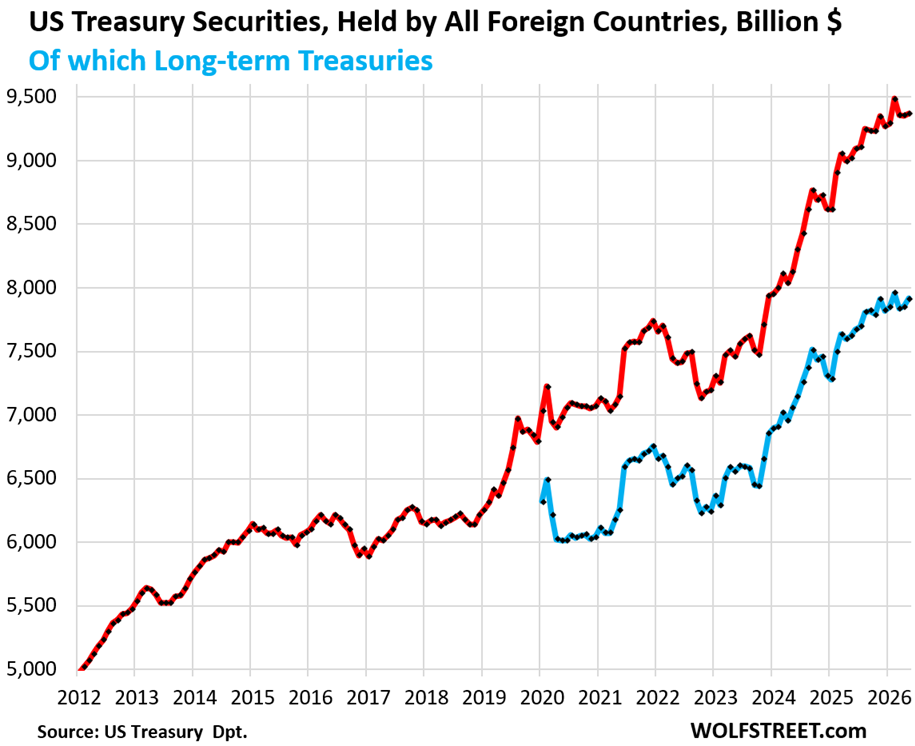
All foreign investors combined added $18 billion of Treasury securities to their holdings in May, bringing them to $9.37 trillion. Over the past 12 months, their holdings increased by $549 billion (red line in the chart). $7.92 trillion (84.5%) were long-term Treasury notes and bonds with terms between 2 years and 30 years (blue). The remaining $1.45 trillion (15.5%) were short-term Treasury bills, according to Treasury Department data today.
The $7.92 trillion in notes and bonds are valued at market value in this data. The record was in February at $9.49 trillion, after which bond prices dropped substantially through May as yields surged, including the 10-year Treasury yield which surged by 50 basis points.
So the dollar valuation of those $7.92 trillion of notes and bonds dropped by $203 billion in the three months of March, April, and May, according to the Treasury Department data. Despite this $203 billion drop in valuation, total holdings dropped by only $118 billion over this period, indicating that foreign holders added to their holdings over this period even as prices dropped.
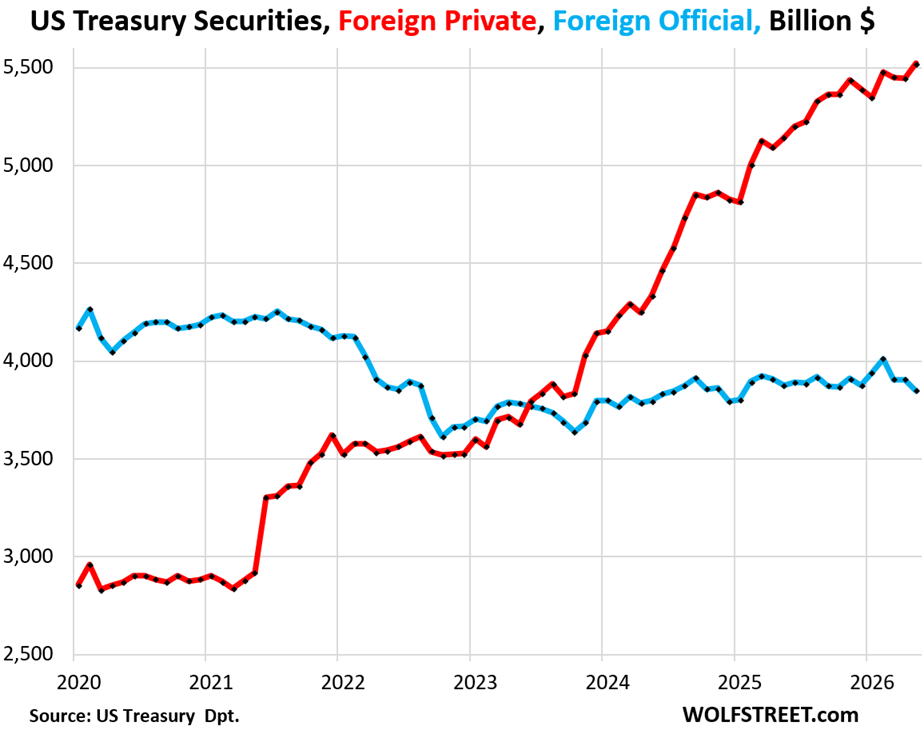
“Private foreign” investors were the driver behind the multi-year surge in foreign holdings: in May alone, they increased their Treasury holdings by $77 billion despite the valuation decline in May, to a record $5.52 trillion. Year-over-year, their holdings have surged by $378 billion, or by 7.4% (red in the chart below).
These private “foreign” investors include huge US hedge funds domiciled in the Cayman Islands, such as those engaged in the gigantic “Treasury Basis Trade,” and US companies with financial entities registered in Ireland and other financial centers, to legally dodge US federal income taxes.
“Foreign official” holders, such as central banks and government entities decreased their holdings by $58 billion in May and by $29 billion year-over-year, to $3.85 trillion – well below their holdings a few years ago (blue line).
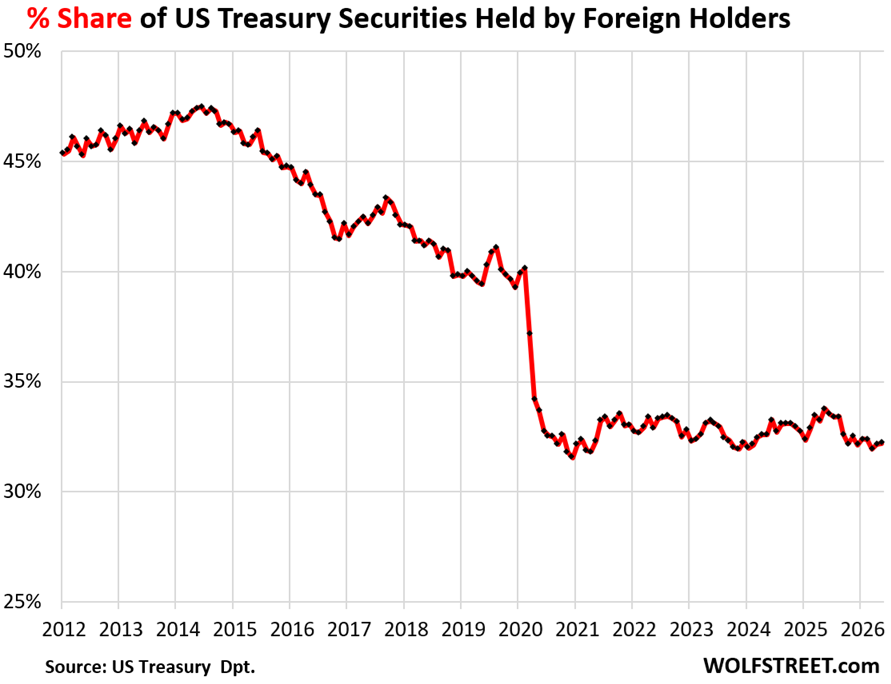
The percentage-share of marketable Treasury securities held by foreign entities, including US hedge funds domiciled in the Cayman Islands and US companies with entities in Ireland, has been wobbling along between 31.5% and 33.8% since early 2021. In May, the share inched up to 32.2%.
In other words, these foreign entities – including the US hedge funds and companies – have kept up with the ballooning US debt, but no more than that.
The plunge in the share of holdings during the first three months of the pandemic was the result of the US government issuing over $3 trillion in Treasury securities in March, April, and May 2020, while the Fed purchased over $3 trillion of Treasury securities in the open market at the same time. As a result of the debt increasing, but with the Fed taking that increase on its balance sheet, foreign entities’ share plunged from 40% to 33%.
Treasuries held by entities in the US keeps the interest that the Treasury Department pays on those securities in the US, and that interest supports spending and investment and economic growth in the US. That’s the benefit of Treasuries being held by domestic investors.
When foreign entities hold Treasuries, the interest paid goes to these foreign entities and may not contribute much to the US economy. However, foreign demand helps keep the yield low, and lower yields slow the blistering growth of the interest expense.
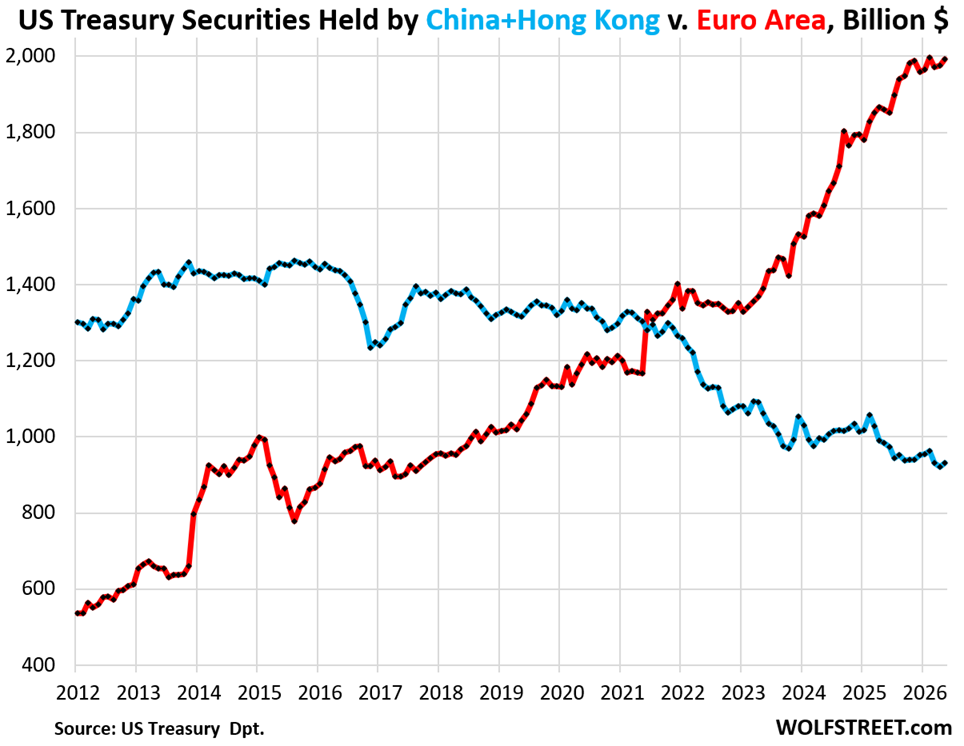
China & Hong Kong ease away, Euro Area piles in.
Mainland China and Hong Kong combined added $11 billion in May, but shed $54 billion year-over-year. Their combined holdings are now down to $931 billion. The long-term trend is very clear (blue linen in the chart below).
Hong Kong has long served as a global financial center. $272 billion of the $931 billion of Treasuries were registered there; and $659 billion were registered in Mainland China.

The Euro Area has been loading up on Treasury securities year-after-year. In May, holdings rose by $17 billion, to $2.0 trillion. Year-over-year, holdings rose by $133 billion (red).
Most of this occurred in financial centers – and thereby includes US entities with accounts in these financial centers. The three financial centers Luxembourg, Ireland, and Belgium, and France, whose banking system also has functionalities of a global financial center, accounted for 82% of the Euro Area’s total holdings. More in a moment.
But Germany, a big exporter to the US and the largest economy in the Euro Area, only held $102 billion.
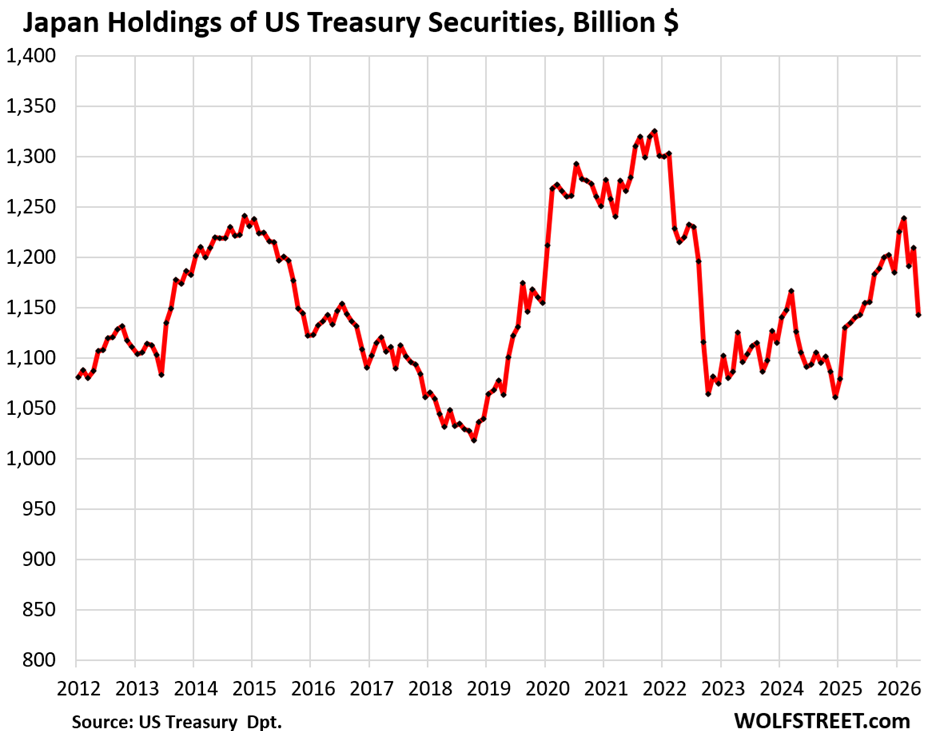
Japan’s holdings of Treasury securities plunged by $58 billion in May, when the Ministry of Finance engineered a record market intervention of ¥11.735 trillion ($72 billion), selling USD assets and buying yen with the proceeds, to put a floor under the yen, which worked only briefly, before the yen re-skidded further.
Japan’s holdings of $1.14 trillion in May were the lowest since May last year. But its holdings have remained in the range between $1.0 trillion and 1.3 trillion for many years, amid wild fluctuations.
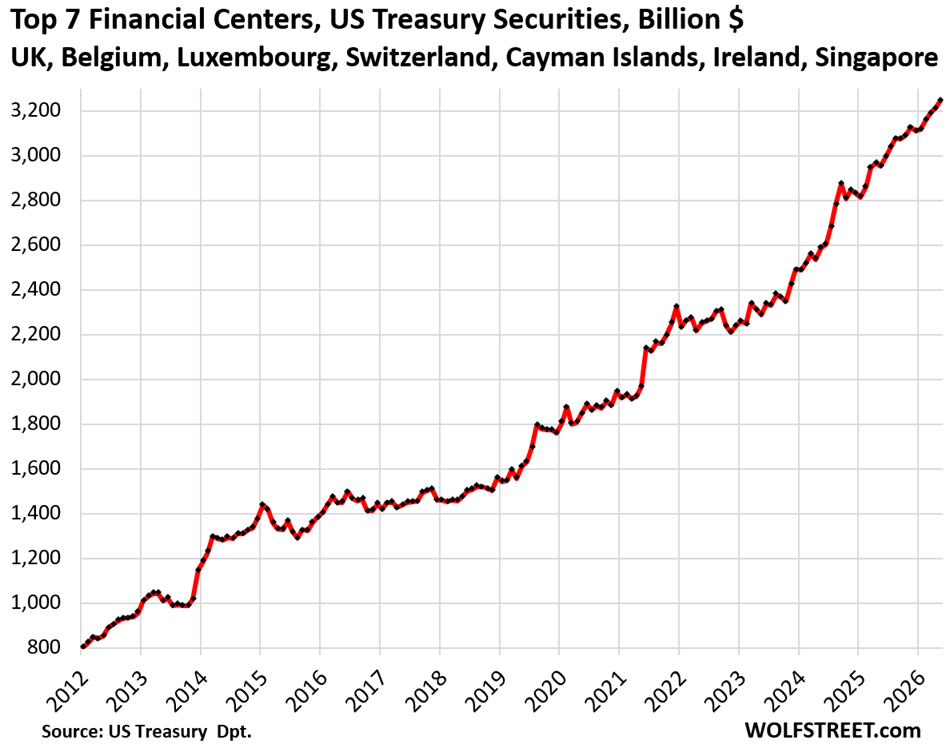
The seven largest financial centers added another $33 billion in May and $293 billion year-over-year, to bring their combined Treasury holdings to a record $3.24 trillion. They more than doubled their holdings over the past 10 years. A big portion of Treasuries at these financial centers are held by US entities.
The Cayman Islands are where US hedge funds are domiciled, including those that are engaged in the huge “basis trade.” More on that situation in a moment.
Ireland is a favorite for US Big Pharma and Big Tech to store their profits. Belgium is home to Euroclear, which has $40 trillion in assets under custody for companies, governments, family offices, wealthy individuals, and other entities around the world.
Changes in May, and holdings:
- United Kingdom: +$11 billion, to a record $949 billion
- Cayman Islands: -$0.4 billion to $471 billion… but wait, it’s actually closer to $2 trillion, according to the Federal Reserve’s analysis of the basis trade (see below).
- Belgium: +$12 billion to $472 billion
- Luxembourg: +$5 billion, to $436 billion
- Ireland: +$12 billion to $357 billion
- Switzerland: -$7 billion to $281 billion
- Singapore: +$0.5 billion to $278 billion.
The “basis trade” and the Cayman Islands.
We’ve discussed this before: Many US hedge funds are domiciled in the Cayman Islands, and their Treasury holdings would normally count as holdings in the Cayman Islands. But the Treasury Department’s Treasury International Capital (TIC) System, on which these numbers here are based, fails in properly attributing all the Treasury securities held by Cayman-domiciled US hedge funds to the Cayman Islands. Instead, they show up as Treasuries held domestically in the US.
This was revealed by a Federal Reserve Bord of Governors analysis last October, which showed that Treasury holdings by Cayman-domiciled US hedge funds were undercounted by $1.4 trillion at the end of 2024.
At the end of 2024, the TIC system attributed $379 billion to the Cayman Islands. The Federal Reserve analysis showed that the total was actually close to $1.8 trillion. The report relied on other government data that was better able to track the Cayman-held Treasuries, according to the report.
These Cayman-domiciled US hedge funds engage in the highly leveraged massive “Treasury basis trade.” They’re long (they buy) Treasury securities and are short (they sell) Treasury cash-futures and make money off the spread.
In normal times, the basis trade provides liquidity to the Treasury market. During times of turmoil, such as in March 2020, the basis trade caused the Treasury market to seize – and the Fed ended up stepping into it to get it going again.
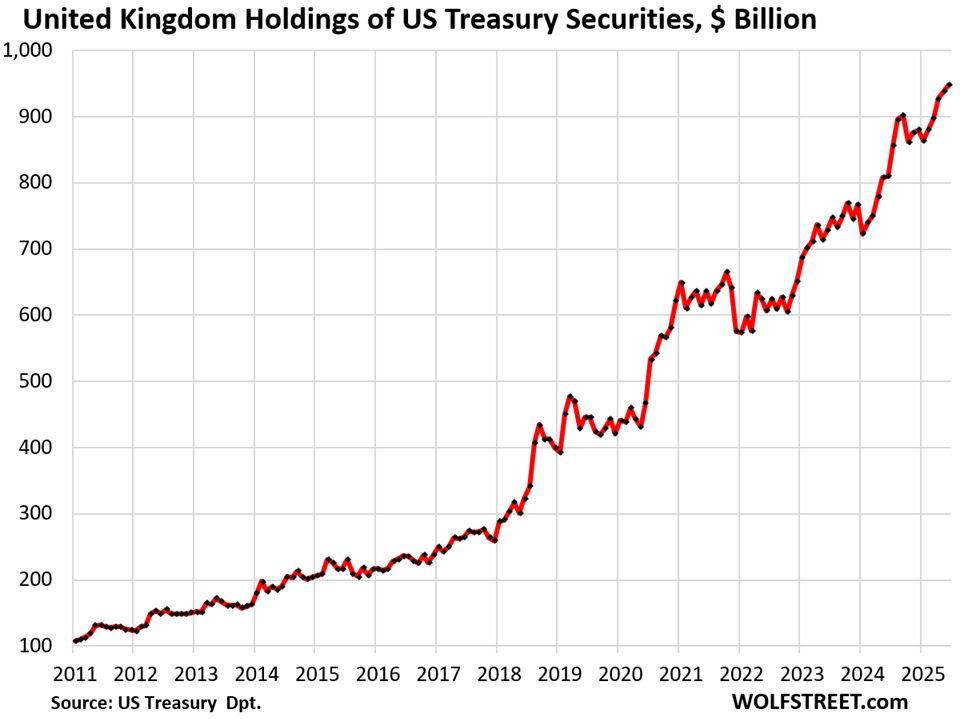
The United Kingdom is actually the “City of London” financial center that holds assets of global entities, including US entities. Its Treasury holdings rose by $11 billion in May, and by $139 billion year-over-year, to a record $949 billion, despite the drop in valuations of Treasury securities.
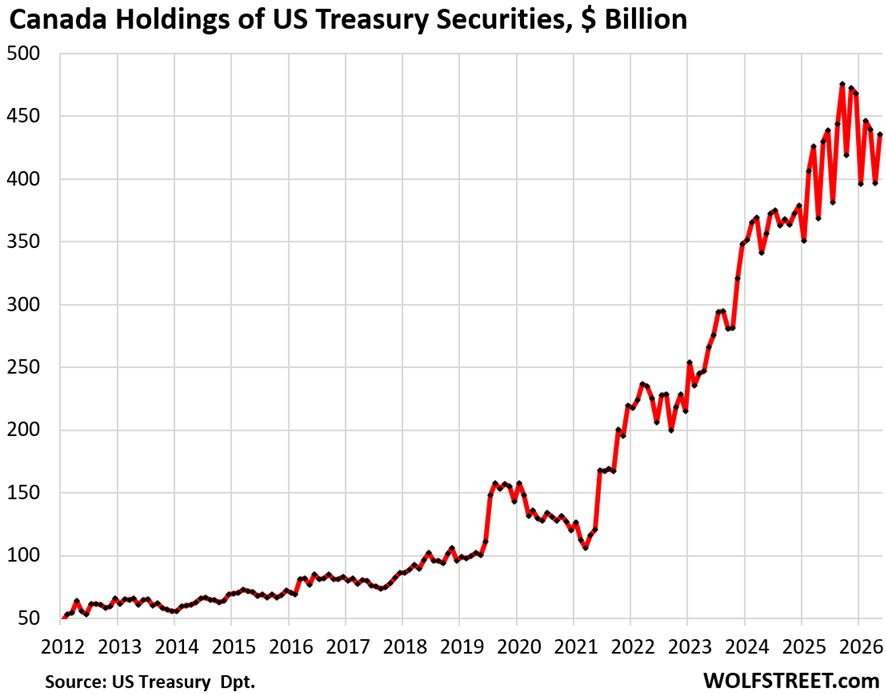
Canada’s holdings have been yoyoing up and down since early 2025. In May, they jumped by $39 billion, to $436 billion, after the plunge in April. The high was in September last year ($476 billion).
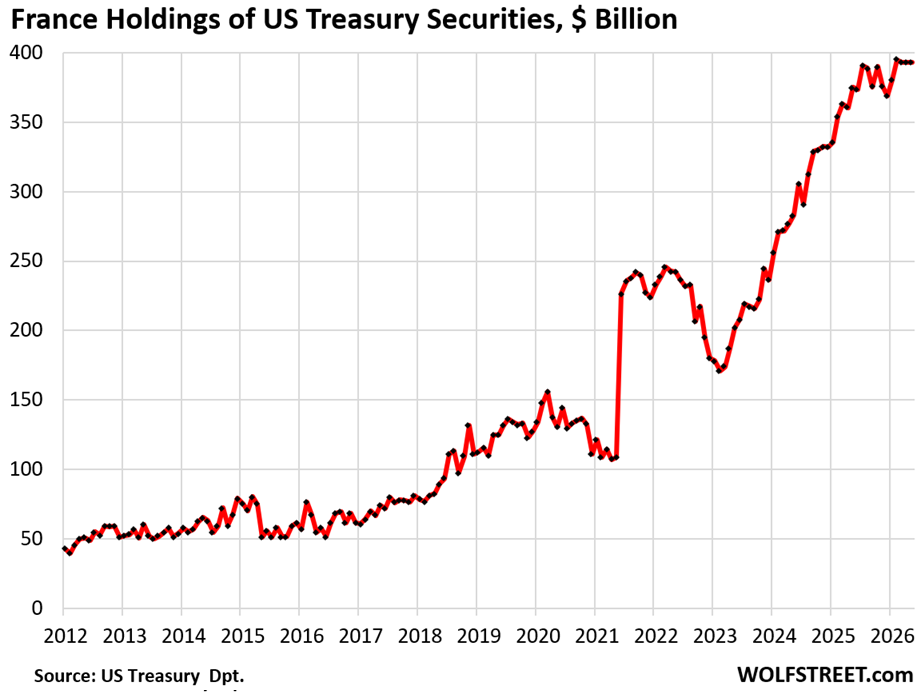
France’s holdings were roughly unchanged in May at the near-record level of $393 billion, up $18 billion year-over-year.
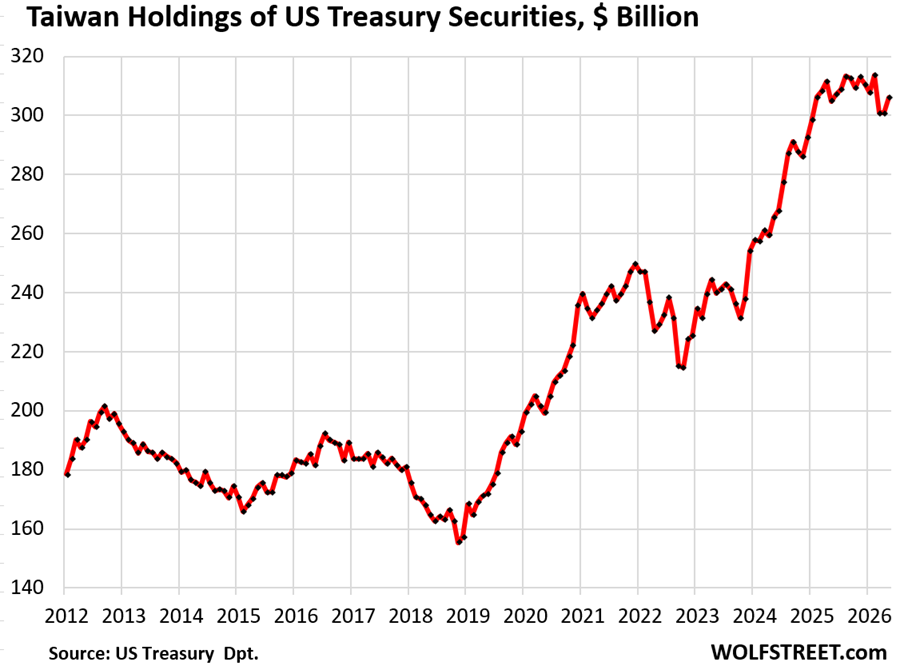
Taiwan’s holdings rose by $5 billion, to $306 billion, were roughly unchanged year-over-year, and down a little from the peak in February:
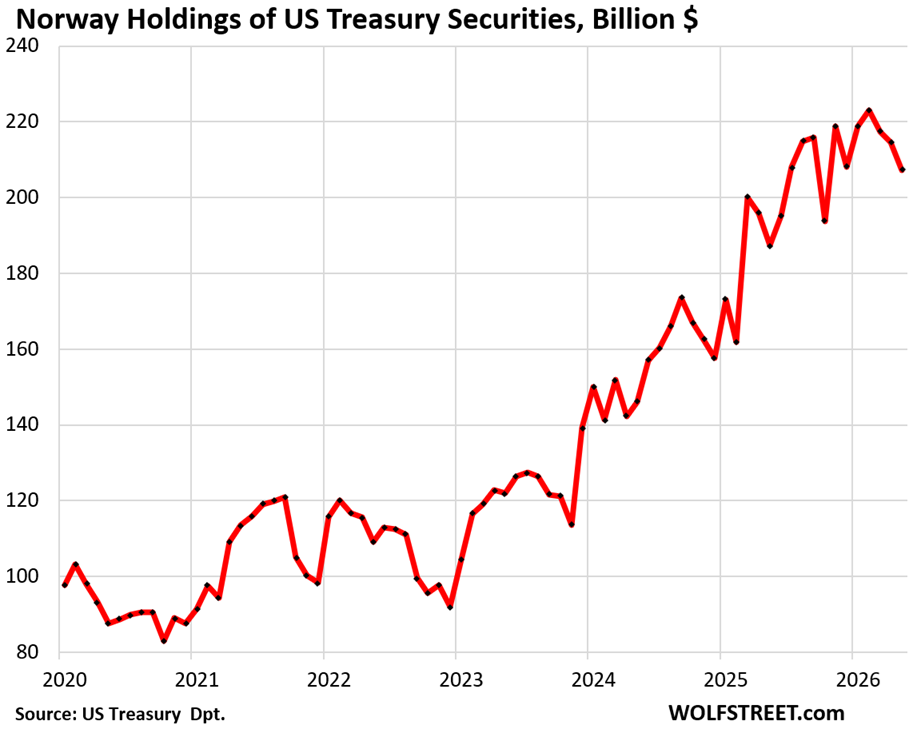
Norway’s holdings declined by $7 billion in May, to $207 billion, up by $20 billion year-over-year. The tiny country of Norway is home to the world’s largest sovereign wealth fund, the Government Pension Fund Global, also known as the Oil Fund, which has over $2.1 trillion in assets under management.
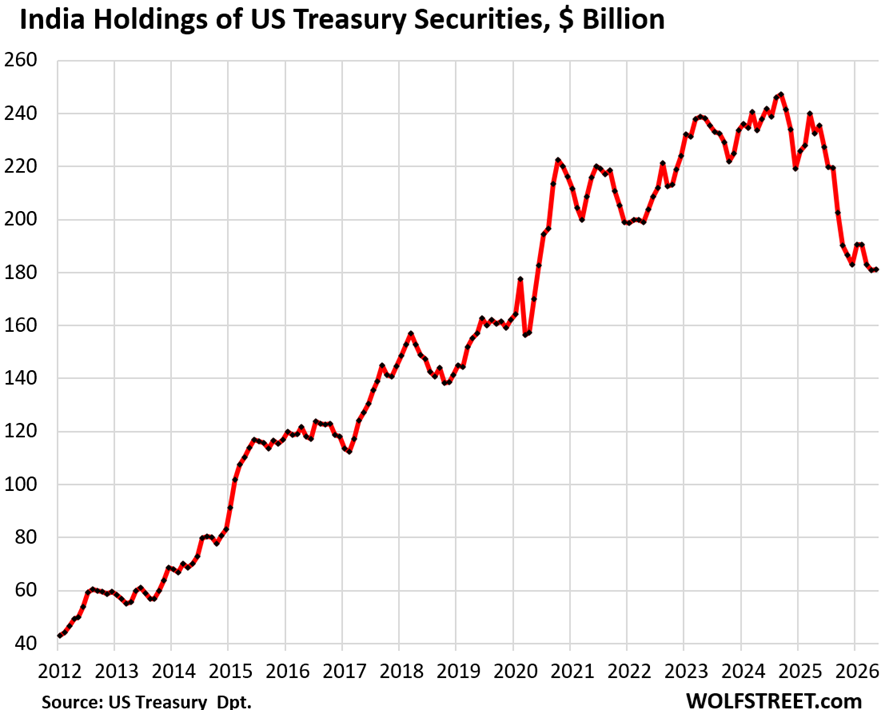
India’s holdings were roughly unchanged in May, at $181 billion, down by $54 billion year-over-year.
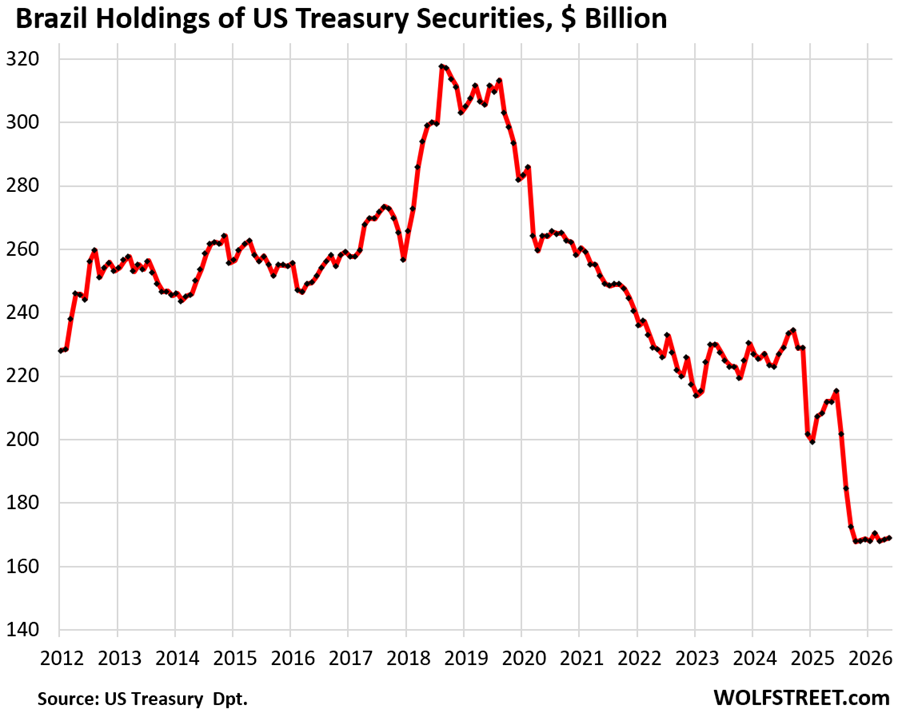
Brazil’s holdings have been roughly unchanged since October last year, at $169 billion in May, down by $43 billion year-over-year, and down by 46% from the peak in 2018.
In case you missed it: Inflation & Nominal Economic Growth to the Rescue: The US Government’s Ugly Fiscal Mess
Enjoy reading WOLF STREET and want to support it? You can donate. I appreciate it immensely. Click on the mug to find out how:


I’m puzzled about the emphasis on hedge funds domiciled in Cayman. My job for 20 years was to help U.S. traders set up offshore hedge funds, particularly funds that focused on the carry trade you described. We domiciled many in Cayman, where I spent considerable time, but also in various other tax haven countries, such as BVI, Channel Islands, Bermuda, and Bahamas. Some of those funds were quite big.
Though you’re certainly correct that many offshore funds have U.S. investors, particularly U.S. pension plans and similar tax-exempts, because they can generally avoid incurring UBTI tax (unrelated business taxable income) by using offshore funds.
Great article and first comment!…..good food for thought. If I only had better accounting skills (the “logic in use” by practitioners of that trade), which I don’t, and am unlikely to acquire.
But I will throw it in my big knowledge pot for digestion.
Why are the gulf countries not listed?
Do they hold inconsequential amount of our sweet sweet debt?
They better be buying up our shit, I wana buy a 4th SUV
Too small. The US is the largest oil producer in the world and a huge exporter and the oil trade has reversed.
https://wolfstreet.com/2026/03/03/oil-jumps-but-its-not-the-1970s-anymore-us-crude-oil-production-hits-record-net-exports-soar-imports-decline-further/
Among the countries in the Middle East, Saudi Arabia is the largest holder of Treasury securities, #18 overall, behind Brazil, with $140 billion in holdings. UAE is #19 with $119 billion. Israel is #20 with $117 billion.
I can’t shake the feeling that the huge amount of money in the basis trade is assuming that inflation will be beat, but is so far out in front that they are holding long rates too low to actually beat inflation. Might be another intervention coming if they all decide to exit at the same time again.
I wonder how much of these holdings from real foreign nations is more of a political issue than anything else . . .
A lot of these countries – the big ones: China, Mexico, Japan, Germany, Taiwan, Ireland (trade invoicing), Vietnam, South Korea, etc. – export huge amounts of goods to the US. The US imports over $3 trillion every year, and those $3+ trillion in USD flow from the US to those countries year after year for this trade with the US, and companies and banks in these countries have to do something with those dollars. Some of the dollars are used by these counties to buy imports from the US and other places around the world, such as raw materials (crude oil, LNG, ag commodities, metals), components, machinery, aircraft, defense equipment, software and other IP, consumer products, motor vehicles, etc. Everyone takes dollars for their trade, which is one of the advantages the US has. And some of the dollars are used to buy, finance, or develop real assets in the US, such as office towers (LOL, China’s Oceanwide). And some leftover portion of the dollars has been invested in USD-denominated securities, including Treasuries, corporate bonds, stocks, etc. And what you see here is the small portion of all of the dollars allocated to Treasury securities. These dollars generated by one-sided trade flows have to go somewhere.
Wolf,
Hasn’t US fiscal pathology and Fed ratification of said pathology (buyer of “last resort” for ever engorging US federal debt, whenever T rates get “too high”) basically rendered this sort of T bond ownership analysis kinda a side show?
In the end the Fed will simply be deployed to sop up whatever US Treasury issuance the free market won’t touch (be it foreign governments, individuals, US buyers, etc.).
Has happened before (all the flavors of QE) and will more or less inescapably happen again (if DC can’t control itself after 55 years of deficits, it never will – short of collapse).
Of course, the Fed printing money to buy up DC’s slop is terminally toxic (while DC pretends it is all a gigantic mystery where inflation comes from…) but that doesn’t matter to the pathologicals in “control”.
So doesn’t it kinda become less and less relevant as to who specifically the “free mkt” buyers of Treasuries are? Even if they continue to evaporate, the Fed will just step in to keep the sham of an imposture of a fraud rolling for another week.
1. “In the end the Fed will simply be deployed to sop up whatever…”
In the end, we’re all dead.
2. Now there is inflation. There wasn’t a lot of inflation in 2010. And QE didn’t trigger inflation until 2021, during which time all the wrong lessons were learned. But now here it is, big and fat and sitting right there and not going away, and eating out lunch, and the last thing anyone at the Fed is going to do is print money in this environment. Even Japan is doing QT now. Inflation is the only thing that can keep a central bank honest.
CAs 127.
Great comment. It is relevant who, and how much demand from various sources, but you are correct, unfortunately the FED WILL BUY if the market forces too high an interest rate. They will even break the law…..because they always conclude that they cannot let the country implode. The FED, AIG, PAULSON,BERNANKE AND TARP is the playbook.
Perhaps instead of invading Cuba, the U.S. should invade all these Caribbean tax cheating havens. By seizing those assets and taxing them under US law, the war would pay for itself instead of being a boondoggle.
But I’m guessing the people invested in the tax havens are the ones making the wars happen, aren’t they?
The bitter irony is that if I, a US citizen, wanted to go do honest work in another country for a while, the US government would double tax me because Uncle Sam claims dominion over his subjects worldwide. That’s somehow considered fair while setting up an account on some island is a perfectly legal way to not pay any taxes at all.
True true true
Wolf – were you a little tipsy when you wrote the headline to this article? I read it three times and am still scratching my head. 🤔
The country labels are useful, but they can hide who is actually taking the risk. The UK, Cayman Islands, Luxembourg, Belgium, and Ireland often function as financial hubs or custody locations, so a rise in “foreign” holdings may reflect hedge-fund trades, multinational cash management, or global investors rather than a government making a geopolitical bet on the U.S. Foreign Treasury holdings reached $9.305 trillion in January, with Japan, the UK, and China the largest reported holders.
That makes the basis trade worth watching. It can support Treasury-market liquidity in calm conditions, but it is built on leverage and short-term funding, so a sudden rush to unwind can turn an apparently deep market into a stressed one very quickly. The important issue is less “who owns America’s debt?” than how concentrated, leveraged, and flighty the marginal buyer has become.