
Crude oil exports hit a record of 5.7 MMb/d in May, exports of ultra-low sulfur diesel hit a record 1.54 MMb/d, etc.
By Wolf Richter for WOLF STREET.
The global spike in prices of crude oil and of petroleum products such as diesel, gasoline, and jet fuel, has cranked up the US production and export machinery, supplemented by the massive releases of the Strategic Petroleum Reserve (SPR) that were either directly exported to the rest of the world, or refined and exported as value-added product. At the same time, imports of crude oil and petroleum products plunged further.
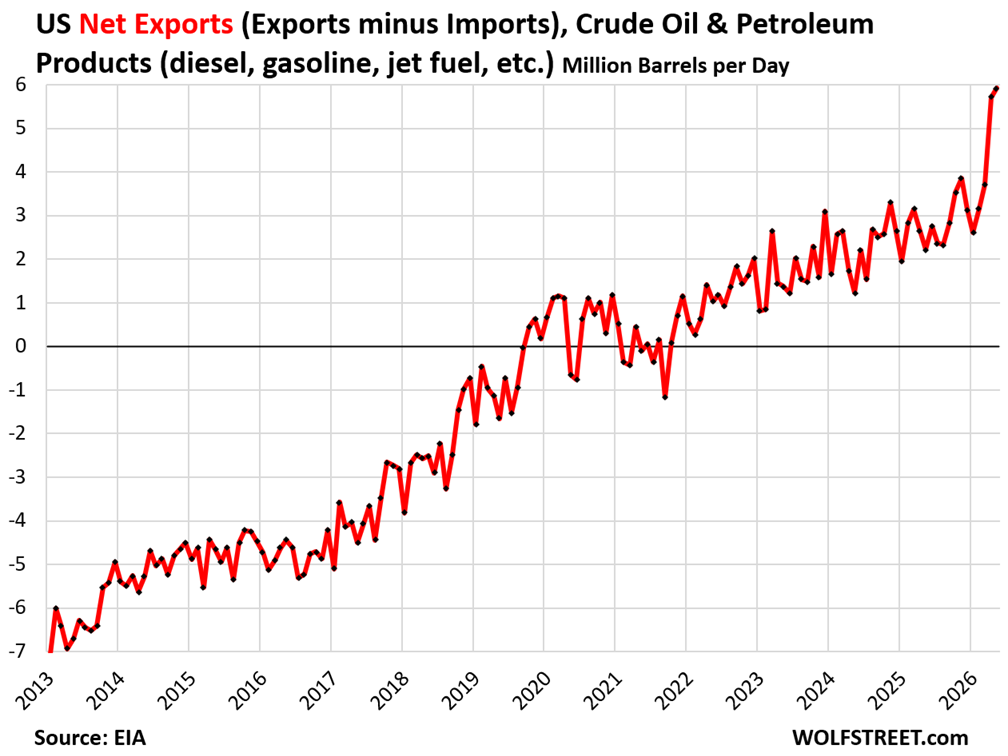
Net exports (exports minus imports) soared to a new record of 5.9 million barrels per day in May, according to EIA data today.
The US became the largest crude oil and lease condensate producer in the world in 2018. In 2025, it produced 37% more than Russia and 42% more than Saudia Arabia (our analysis is here). On an annual basis, the US became a net exporter – exporting more than importing – in 2020, and the gap has soared since then:
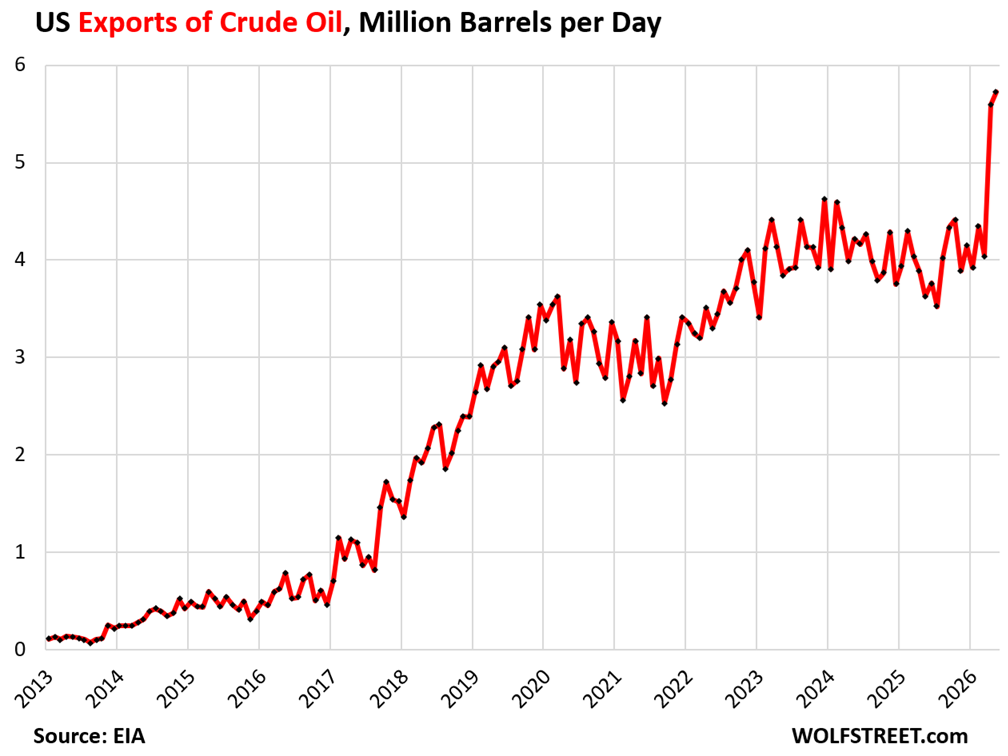
Exports of crude oil spiked further in May to a record 5.73 million barrels per day (MMb/d), up by 58% from a year ago, helped by a massive burst of supply from the SPR.
The releases from the SPR went overseas and helped push down the global price of crude oil. There is nothing sacred anymore about the SPR. The Biden and Trump administrations have used it to beat down the global price of crude oil (buy low, sell high). And that’s the only thing it’s still good for, since the US is awash in its own production.
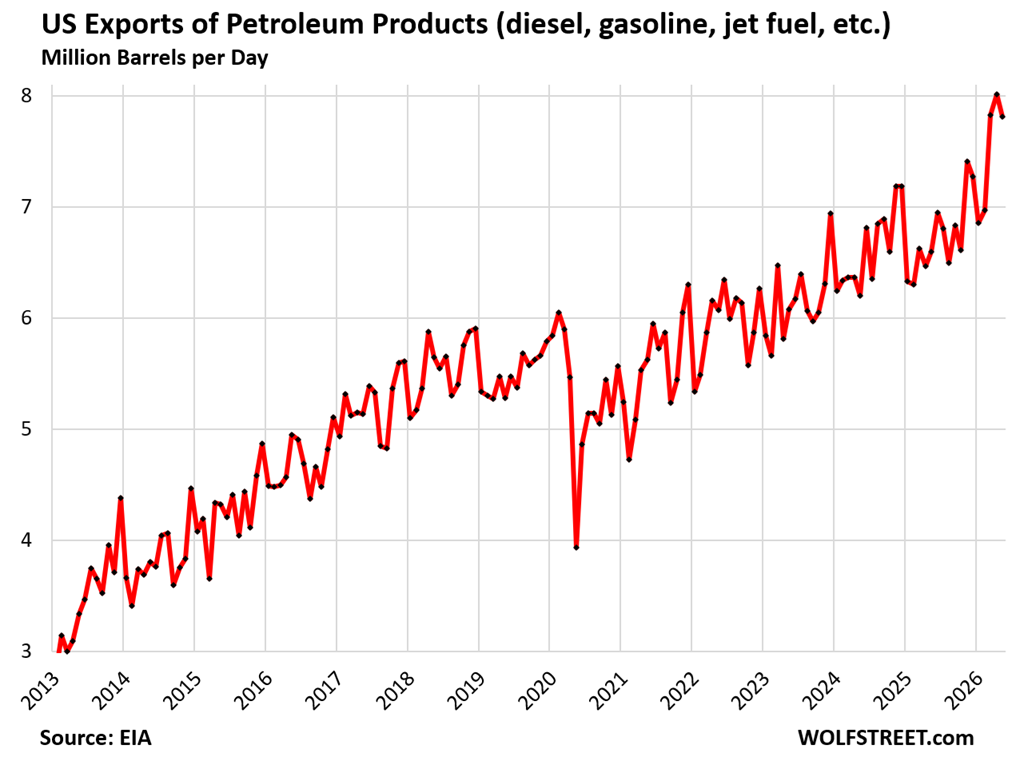
Exports of petroleum products, such as diesel, gasoline, and jet fuel, dipped in May from the huge spike in April and March, to 7.81 MMb/d, up by 18% year-over-year.
The US has been the largest producer of diesel in the world for years, but consumes less than Europe because nearly all passenger vehicles with internal combustion engines in the US run on gasoline, whereas in Europe, the vast majority of passenger vehicles with internal-combustion engines run on diesel.
Exports of ultra-low sulfur diesel spiked further to a record 1.54 MMb/d in May, up by 36% year-over-year.
More broadly, of the exports of petroleum products:
- Distillate fuel oil: 1.65 MMb/d, incl. 1.54 MMb/d of ultra-low sulfur diesel
- Finished Motor gasoline: 806,000 b/d
- Jet fuel: 336,000 b/d
- Propane: 2.02 MMb/d
- Butane: 893,000 b/d
- Ethane: 717,000 b/d
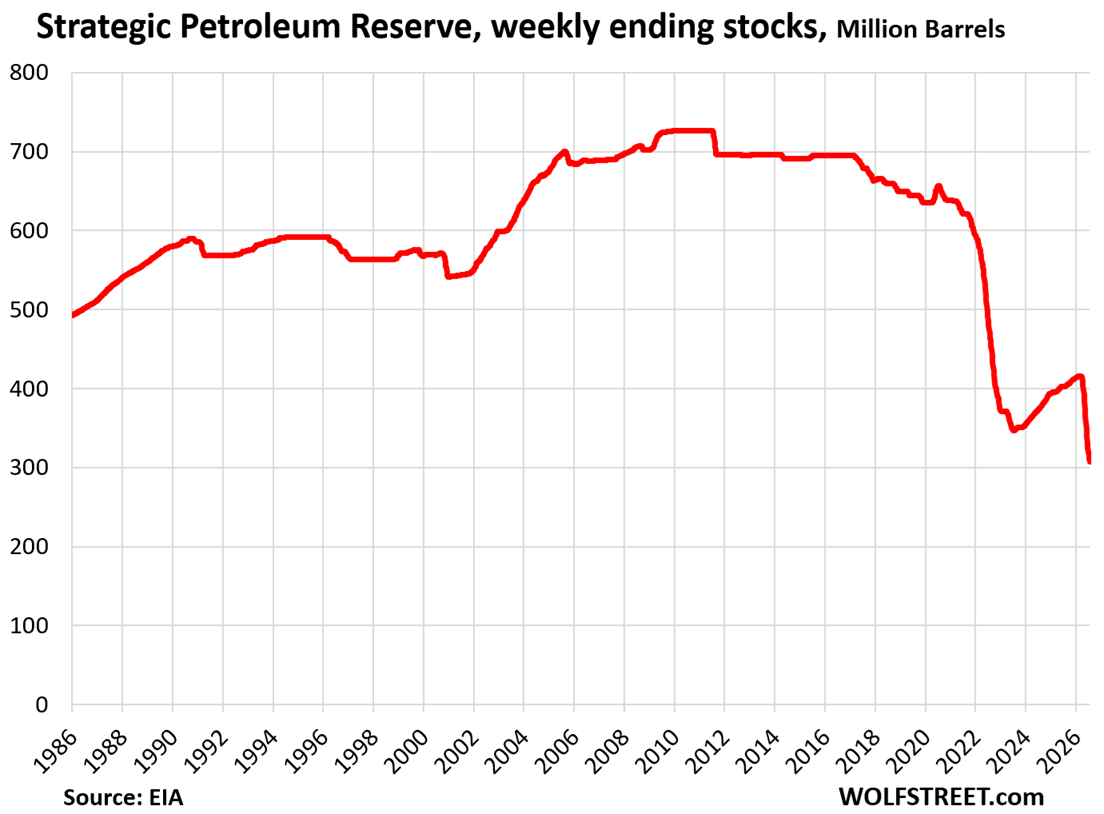
And the SPR has been getting drained to dump US crude oil and petroleum products on the global markets and help push down global prices.
In the week of July 24, the SPR was down by 107.8 million barrels since the Iran war started, to end the week at 307.7 million barrels.
Enjoy reading WOLF STREET and want to support it? You can donate. I appreciate it immensely. Click on the mug to find out how:


Not sure if this is logical but the US has a decent amount, not abundant of proven reserves, and a huge amount of unproven reserves. The challenge seems to be having a significantly high price to encourage the investment of those reserves and ideally more refineries to process sweet crude. However that seems problematic without growing oil demand. Obviously huge opportunities for export but this primarily benefits oil companies rather than consumers. Our SPR is typically filled with at least half sour crude that is imported and used by South Coast refineries so not clear how they address filling it. Canada I guess can supply a lot of the sour.
…or people could just buy EV’s that run off clean electricity. That too. But it sounds like the US is just going to roll over and give that entire market to the Chinese. Chinese EV producer BYD just passed Ford in 2025 to become the 6th largest car manufacturer in the world (in unit sales). BYD is setting its sites on overtaking Toyota and becoming the largest car manufacturer in the world within five years. Currently about 2/3rd’s of all new cars in China (the world’s largest auto market) are EV’s.
“sounds like the US is just going to roll over and give that entire market to the Chinese”
Auto manufacturing hasn’t been a leading industry for decades now, and EVs have accelerated that trend. We should be focused where we are–on autonomous technology that will be far more impactful to mobility.
So can Venezuela – both sour and heavy – which is used by Gulf Coast refineries!
Glen,
The US doesn’t need sour crude. it buys oil where it cheapest, and it’s cheap when imported from Canadian regions that are badly connected to the global markets and export mostly to the US. There has been a lot of investment on both sides to make that trade work for both sides, and it’s in everyone’s interest to keep it going.
That Canadian heavy crude (Western Canada Select) trades at a discount of around $11 to $16 per barrel to West Texas Intermediate (WTI), to the endless chagrin of Canadians. Currently, WCS is about $71 and WTI is about $85 (discount of about $14 per barrel).
That discount tells you Canada “needs” to sell it more urgently to the US than the US “needs” to buy it. If the US were really dependent on it, the price would be far higher.
Pipelines get built to profit from price differences or arbitrage price differences, in addition to connecting producing and consuming regions, including pipelines from Canada to the US because everyone wants cheap oil, everyone except Canada. And so Canadians keep spending bazillions on expanding their pipelines across the Rockies to ship this oil to global markets to push up the price of WCS. But that low price of WCS — $14 lower lower than WTI — is why US refiners continue to buy Canadian crude and why pipelines get built to import it.
Stein,
Gulf Coast refineries import very little crude oil from Venezuela, just 144,000 barrels per day in 2025
“Gulf Coast refineries import very little crude oil from Venezuela, just 144,000 barrels per day in 2025”
For long periods of the aughts, this was over a million barrels a day. Since June 2026 we’re back to over half a million per day. There are gulf coast refineries just primed for the Maracaibo sludge to generate maximum profit.
Those refineries have long ago updated their equipment to profit from US crude.
Good info, good show, Wolf….if true.
The profits from draining our reserves will be shared equally by the American public….right….right?
(I do think a SPR is a dated model when production outstrips consumption. Overall inventories aren’t huge globally, I laugh when people are like 20MMBBL drain…..so you mean a day?….the supply chain is pretty inventory efficient when it comes down to it)
Strange moves are multiplying – selling down the SPR, Venezuelan oil money going missing, trying to take 20% of anything going through Hormuz, suddenly new round of tariffs destined to fail in a while. These are very short term desperate moves not helping but shifting the problem a few months down the road. It almost looks like they are afraid of straight numbers and going to the bond market.
It’s almost like an unlearned, inexperienced, easily distracted leader turns to impulsively announcing “fixes” and “deals” without even having those smarter than him brief him on even the second order consequences.
SPR oil is being borrowed by oil companies who must repay each barrel in kind with 1.24 barrels. This will result in an increase in total barrels in the SPR.
Warsh Considers Reducing Frequency of Fed Policy Meetings…
Maybe he should reduce them to zero and cut out the entire media circus? No more chance for the internet to say, “Warsh was dovish.”
They are draining the SPR to reduce current budget deficits.
As for exports of distillates like diesel, gasoline etc. They could have embargoed their export to reduce our domestic prices.
That’s not really how it works because the SPR oil isn’t sold, it’s an exchange agreement and has to be repaid in kind with a premium. But theoretically, in terms of reducing the deficit: since early March, they drained 108 million barrels from the SPR. If they get an average price of $90 per barrel, it would bring in less than $10 billion over a five-month period, so about $2 billion a month in deficit reduction. You’d have to look at it with a microscope to see it in the overall deficit running at a rate of about $2.2 trillion a year.
If the FOMC isn’t going to do anything about inflation, then why bother wasting time in some sleepy, yawning meeting just to endlessly agree that they are going to do nothing.
It’s called “attention-whoring.” The FED loves to preen in front of the cameras.
Some percentage of the investing public still gives them and the 2% target some credibility – even after all these years. As long as they go through the motions, they’ll continue to earn that reverence.
Just wondering, would 5.7M barrels of US not leaving the country lower gas prices here in the USA?
The US is one of a small percent where the nation doesn’t own and benefit from resources. In fact the current Iran war dates back to that very issue. It doesn’t mean that oil companies providing oil services doesn’t make sense however.
In short, you don’t get to benefit for the collective natural wealth of your country.
Export bans are very much a thing, and one that America is not shy to use.
I wouldn’t be surprised to see the Trump admin considering an export tariff.
It’s another way of extracting revenue from foreigners, and it would lower gasoline prices in the U.S, which is apparently all the average US voter cares about.
Chris B,
Export tariffs are unconstitutional. The federal government can ban or limit exports, but it can’t tax them.
Trump is indeed likely to do some kind of export limitation to force prices down. Also helps that having a strong differential in energy prices between yourself and the global market does improve your economy when you’re not dependent on exports. I just don’t see any political way for America to go except export bans. Too easy, too popular.
Crack spreads have widened, which benefits refiners but not consumers. One might ask why has crude not responded and gone higher to narrow the spreads. It may suggest manipulation by those in high places, of which releasing the SPR is but one arm, jawboning on Truth Social a second, and early morning dumps of futures contracts a third. Just remember what Bessent’s background is.
Who exactly are you going to get to produce petroleum that they can’t sell at a profit? Or are you just planning on draining the strategic petroleum reserve and never refilling it?
Yes. There is an arguement to not refill it. We made the reserve because it was a different time when we needed a strategic reserve. It is literally being used for what it is worth using it for now. Buying it low, and selling it high to offset high prices. I bet your face is melting off reading this with the public zeitgeist swirling around that the reserves are going to zero, and the US will implode because of it lol.
Almost anyone in the US can lower their gas prices tomorrow by selling the overpowered Shopping Utility Vehicle (SUV) and buying a more fuel efficient vehicle.
There are multiple models of vehicle that get 50mpg and very few people are buying them. There are also lots of EVs on the market now. The best selling vehicles are gas guzzlers, and the people who buy them shout the loudest about gas prices being too high.
Gas prices are such a weird phenomenon anyways. A brodozer getting 15 mpg divided by the average yearly mileage drive is paying ~400 bucks a month in gas at 5 dollars a gallon. At 2.50 a gallon it halves but it is only 200 dollars a month. Likely paling in comparison to the hundreds of dollars a month car note+insurance they are paying. Not even accounting for the money lost due to depreciation.
From today’s WSJ:
“America’s largest oil companies reported a blockbuster quarter after the Iran war caused a historic dislocation in global markets that sent energy prices soaring.”
Exxon more than doubled profits. Chevron had its highest quarterly earnings ever.
“Margins for making products like jet fuel, diesel and gasoline climbed to record highs. Oil prices eased toward the end of the quarter on hopes for a lasting peace deal between the U.S. and Iran that would fully reopen the Strait, but prices for products kept climbing—allowing refineries to profit from the difference between the cost of crude and the revenue generated from refined petroleum products.”
Yes, that’s what I’ve been saying since early March. The entire price increases went to profits. There was never ever any reason in the US other than profiteering for gasoline prices to jump.
Sounds like we need price controls on energy.
That was the point of the Iran war. The US oil industry paid a lot of money to elect the sort of people who would launch it, and they will pay a lot of money to get them re-elected.
With enough media spending, funded by the oil companies, the Reps will successfully convince tens of millions of people that high fuel prices are the fault of the Dems.
That’s the entire economy. Our public corporations are making record profits that soar, quarter after quarter, and the disproportionate benefits of those go to a relatively small group.
“A relatively small group”. You mean working people and retirees like myself and my wife who have significant savings parked in the market? Not crazy about what these companies did and would like to see gas prices lower but these issues are not black and white.
You can talk all you want about how 60% of Americans have exposure to the stock market, but that doesn’t change the fact that the top 1% own 50% of stocks, and the top 10% own 93%.
Society as a whole would be better off if these companies gave decent raises to their employees, rather than keeping it all as profits.
“Society as a whole would be better off if these companies gave decent raises to their employees, rather than keeping it all as profits.”
The raises would then be consumed by the inflation they cause.
ChS, and instead, we have inflation because the top are spending their stock gains, and the bottom feels squeezed. If we’re going to have the inflation anyway, better to at least make a little more money.
Yes, it’s been a very good time to be invested in the oil patch. However, because all of those new profits have been going to shareholder and not capex, the oil coming onto the “market” is not going to increase, so prices at the pump will remain elevated.
The paper games continue, but unlike the precious metals “market” oil is required for many real things.
Interesting times.
It shouldn’t increase, because big oil has a demand problem, not a supply problem. Many countries have identified petroleum supply needs as a strategic weakness, and are aggressively moving towards an EV future. China, the world’s largest auto market, is currently up to 2/3rd’s of all new vehicles being EV’s. Global production has more or less plateaued, and depending who you ask (differing of opinions of “when”, but not “if”), global petroleum demand is going to start contracting within the next five years.
Complete bullshit. Oil is an input for numerous processes. With 8+ billion people on the planet, there is still plenty of demand. Unless you are predict a massive extinction of humans, then there will be plenty of demand moving forward.
@WB an extinction of humans is not required. All that is required is for electric vehicles to be cheaper to own than comparable ICE vehicles. That is already happening. The teenage boys zipping around my neighborhood are riding electric motorcycles, not the old 2-stroke scooters of my youth. Friends who bought Teslas in the late 20-teens talk about battery degradation as if it was some kind of media myth. The Chevy Bolt is arguably the Volkswagen Beetle of the current generation, aside from being much bigger, much faster, and much more durable. And the next generation of EVs is moving beyond cost and range parity.
Again, you are ignoring all the other demand for oil. Transportation use is minor, electric cars won’t get it done.
People are going to lose their minds when/if we drain out the reserves and discover what demand destruction means. (You can’t afford it so don’t have demand anymore)
Going used EV with those sweet subsidies was worth every penny rather than deal with the Chinese water torture of refilling at the pump.
I fueled up today with a large gas can for my motorbike’s tank (which has no fuel gauge, so I like to keep it topped-up in the garage) and my hybrid SUV in St. Paul, MN.
91 octane that’s non-oxygenated, meaning just gasoline with no added ethanol was $4.46. Of that, 29 cents is Minnesota gasoline tax. And there’s 18.4 cents for the U.S. gas tax too. Less taxes, that is $3.985 per gallon for the best unleaded gasoline that I can buy in the Twin Cities that’s not been mixed with corn-based moonshine.
I filled my EV in SoCal from 50% to 83% since it was Friday. Despite having the highest electricity costs in the nation, it cost $5. Total. And it recharged while I worked.
Cali is cheap compared to Hawaii
Move to NC. To charge my EV to drive 300 miles costs me $8. And I charge in my garage.
The Cushing’s is at a record low with only 18.6 million barrels. Pretty soon it will be at an inoperable level, and we’ll have to stop exporting anymore crude until it’s replenished.
Yep, and an Executive Action by a sitting President could have stopped or slowed down exports, reducing the price the minions pay. The Art of the Deal just backfired on U.S. Citizens. Saudi Arabia and foreign countries Strategic Oil Reserves would take up the geographic slack. Oh Well?
Export bans drop the price of crude to a level that bankrupts the oil companies sounds like a terrific idea . Why not just confiscate the oil on the private lands take over their production pipelines and refineries and shut down the refineries , ban the pipelines , ban the petroleum engineers from working for them , nationalize the exploration portion and hire more politicians to run the business like Pemex and Venezuela. Then the oil business can end up like the coal business .
Wolf has been reporting on the boost in exports since the war began . Unfortunately Iran has not surrendered and the regime is still in power.
I don’t think profits from the oil companies are less important than any other industry that benefits from the world stage .
“Unfortunately Iran has not surrendered and the regime is still in power.”
And Iran should surrender why?
@waiono I agree. “A wise general wins the war before he fights a battle. A losing general rushes into a fight blindly and tries to figure out how to win while the chaos is happening.” Of course, that is sound wisdom that has been around for 1500 years, so it is unlikely that our current administration will be familiar with it.
Exactly. There are intelligent ways to do things and dumb ways to do things. Trumpty-dumpty only knows thee dumb way, but no one should be surprised when, as a country, we have been rewarding bad behavior for 50+ years.
Freedomnowandhow,
Who could have ever expected that big real estate deal strategies work differently than geopolitical deals?:)
Government control of private industry, what could go wrong?
The sugar market has two prices, the domestic price and the world price. Perhaps the us should have two prices for gasoline and diesel . Then we could have a lower domestic price.
US natural gas is kind of that way. Overproduction in the US as a lot of it is produced as byproduct at oil wells, but exports are limited by pipeline capacity to Mexico and by the capacity of LNG export terminals (though new ones are coming on line nearly every year).
The domestic price of sugar is higher than the international price. The facts run contrary to your argument…
That is because the US Government protects the domestic sugar beet industry. (A lot of people don’t know we get the majority of our sugar from sugar beets) We pay a HIGHER price for sugar than if we could import from the international market.
The “Government” negotiated an exchange vs a sale of oil from the SPR. This oil will be paid back in tranches beginning after the November election and last two years. There is a 28% premium to be paid in additional barrels which will only add to inflationary pressures. Such a Deal!
Wolf – Thanks for pointing out that the US does not need a strategic reserve and that the SPR’s current function is to influence prices in the world market. I continue to be puzzled by why oil prices are not higher. We are told that 20% of the world’s crude oil passes through the Straits of Hormuz. Many people predicted that there would be several shortages. Perhaps you could discuss this in a future post.
1. The first thing you have to understand is that refiners buy oil where it’s the cheapest. There is a lot of overproduction globally, which is why OPEC restricts output. The oil coming through the Strait of Hormuz just happened to be cheaper, and so it got bought, including by refiners in California. But they can buy anywhere, including those in California, and they did, and other countries have ramped up production, including the US, plus oil was routed via existing pipeline away from the Strait of Hormuz, which makes that oil more expensive, but it’s still going to market, etc.
2.I already discussed the US role in it right at the beginning:
https://wolfstreet.com/2026/03/03/oil-jumps-but-its-not-the-1970s-anymore-us-crude-oil-production-hits-record-net-exports-soar-imports-decline-further/
We need to be careful in our discussion. US refineries are not well matched to what US produces. US “imports” heavy sour crude (in huge quantities) and exports light sweet (in even greater quantities), along with distillates.
Important nuance to keep in mind.
That’s just zombie BS that refuses to die no matter how often it gets killed. It just keeps getting regurgitated over and over again. And I’m really sick and tired of having to waste my time on this clueless BS. NO, NO, NO. US refineries are among the biggest and most efficient in the world, they constantly upgrade their equipment to maximize their profits DUH. The US is the biggest producer of distillate in the world, and exports about 20% of its production, most of it obtained from light sweet crude.
AT LEAST Google: how many gallons of diesel from a barrel of light sweet crude. Any moron can google stuff.
WB,
My understanding is 20% is a huge overstatement given several countries have pipelines. China and US have also drawn down reserves significantly. Reality is we won’t see any of this in the US like other parts of the world will, which is unfortunate since we are the ones who created this issue to begin with. The consequences of other oil products is not insignificant either like fertilizer but that won’t show up any time soon and of course the US won’t be the worst hit there either.
China also reduced their petrodollar demand by a very large amount, likely buying direct from russia off market, and shifting to other fuel sources. A bit of a flex? A favor to the flatulent orange snoozer, or just preventing a slowdown or cost increase on their own exports of goods? Who knows.
A report from the EIA, which consolidated shipping data by private sector sources and import data by the Chinese government, showed that imports plunged as China cut imports via tanker while roughly maintaining imports via pipeline from its neighbors.
CNBC: How Leopold Aschenbrenner built a $45 billion AI hedge fund — and lost most of it in days
Former OpenAI researcher Leopold Aschenbrenner’s AI hedge fund, Situational Awareness, collapsed from $45 billion to around $10 billion in assets on falling semiconductor stocks and mounting margin calls.
Driven by reported leverage of up to 400%, the 20-something manager was forced to sell off all his leveraged public stock bets — including hard-hit names like SK Hynix and CoreWeave — to Ken Griffin’s Citadel at a discount.
The crash marks a dramatic turn for Aschenbrenner, who launched the fund after gaining Silicon Valley fame with his 2024 AI manifesto, drawing scrutiny from critics over his lack of money management experience and his past ties to FTX.
A would-be “sign of the top” complete with a front page mention on a MSM site.
Too bad the hype is so loud and the scale so exaggerated that nobody even notices a few 10s of billions.
I mean it’s not even a Tril, bro.
Huge collapse that will go down in history, almost unnoticed by the masses.
The astonishing foolishness of American policy is simply impossible to fathom.
The ruling Republican party pursued a strategy that would line the pockets of their biggest donors in the O&G industry, ensuring an influx of hundreds of millions of dollars right before the midterms.
The question is, stupid for whom?
Why not stop exports of crude and use the oil for domestic use only? This would keep the price down for us pions instead of boosting the profits for these big oil companies who are making a killing over this war.
SC I think you answered your own question..
Producers don’t want to keep the price down! They want record profits.
They used to have a partial restriction like that, and the price of oil collapsed in the US due to overproduction and no outlet, and hundreds of oil and gas drillers went bankrupt in 2014-2016. Those restrictions were lifted at the end of 2015.
Consumers do not buy crude oil. They buy refined products.
The problem would be that suppliers of our crude would likely parallel the change, meaning that some of our refineries would not have supply and need to shut down while they short over to refine the domestically produced stuff. We would also have to figure out how to transport our domestic stuff to the refineries that used to get fed by maritime shipping rather than pipeline. In 2025, I believe we were 10.7 export and 7.9 import.
This would spike the price of gas, maybe bk some drillers, and due long term damage to our oil & gas industry as we would be seen as less reliable producer when the deluge of oil comes back to market.
While oil producers and refiners are making bank, there is a reason why they are not significantly increasing well counts.
In a normal market we’ve already probably passed “peak oil” and “peak gas” due to competition coming on-line, like renewables / batteries and EVs, that, in general, beat oil & gas on price for many use cases along with being less sensitive to political risk. That doesn’t mean that oil & gas will quickly go away – there are many use cases where oil & gas are more advantageous, and they should go down in price to compete with electrons, but we are probably past the peak.
Oil will be needed as a chemical feedstock until it becomes cheaper to make hydrocarbons from CO2 using renewable energy.
Is this one of those moments like when we learned with social media that we are not the customer, we are the product?
“The price elasticity of oil refers to the responsiveness of oil supply and demand to changes in oil prices. Generally, short-run supply elasticity is low, often estimated around 0.25, while demand elasticity can vary significantly, with some estimates around 0.05 to 1.0 depending on the context and time frame”
I do not understand how the money works out with respect to the SPR. The U.S. government has a bunch of oil tanks, fills them up by buying oil (demand), and then sells the oil (supply) in an effort to accomplish something strategic (which could be either creating demand for or supply of oil). So does Congress approve the funding explicitly for the buying, in a budget? Then the Executive Branch decides the strategic use of it, with Congressional oversight? And then the money from SPR oil sales goes back into the Treasury, and in effect is taken out of circulation, i.e. it is not available to buy more oil until Congress approves? Or do the funds remain with the Executive Branch year-over-year?
Also, the article says “The releases from the SPR went overseas and helped push down the global price of crude oil.” So the U.S. sold oil to select overseas buyers, such that by picking those specific buyers, it would most efficiently push down the global oil prices? But since it is a global commodity, what difference does it make whether it is sold overseas, or domestically, in pushing down the price?
Perhaps fracking has its limits. I don’t know, but one would think we will surely know when those basins start burping water only. It could be like 1974 deja vu all over again.
V3ne5uAla
Evil corporate profits from the government missteps . Sounds like the folks commenting want to switch to a Venezuela model economy
I don’t think we get a choice.
In the vast majority of oil exporting nations on Earth, government essentially merges itself with the O&G industry, and democracy collapses. Then, with control over all that money, there is no way to dislodge the regime. It’s the Oil Curse that many people have written extensively about.
Look at the decline in the US’s quality of governance since it became a major oil exporter. We are now a one-party state.
I hear what you’re saying, but there is a big difference between Venezuela and Norway. I happen to have a number of Venezuelan friends deeply knowledgeable of the economy (KPMG audit lead for pdvsa, etc.).
The factor they point to above all else is lack of education, and more importantly, a sense of realism among the voting public leading then to falling for populist appeals. While they are to a person supportive of the intervention and frankly pro-Trump, they also all point to the danger posed by the populist support for Trump and explicitly compare him to Chavez. To summarize how they put it, Americans have it easy, like we did when oil prices were high, so we got lazy about thinking through things thoroughly and instead went for easy, emotionally satisfying appeals.
We have plenty of oil in the US. If they produce more though price falls. Most E&P companies used to have a break even point between $60-70 bbl for oil. If they produce a lot more it may fall to 40-$50bbl…. Since the price spike is geopolitical investing in new wells which typically produce of 10+ years doesn’t make sense for something that was supposedly going to be over is 1-2 months.
My bigger question is where are the hedges in all these oil price sensitive industries? The airlines should have been hedging a % of their jet fuel costs….
The 2014–2016 shale oil bust
Peak (June 2014)
Bottom (Jan 2016)
U.S. rig count down ~75%
Bankruptcies 80+ producers
Oil fell from over $110 per barrel in June 2014 to about $26 in January 2016. U.S. drilling activity collapsed and many shale companies went bankrupt. Analysts generally view this as the last true industry-wide oil bust.
It had a part 2 that came in 2020.
I had a small play in the stock of one of those oil companies going into that time…that turned into a $0 play.
A co-worker was just starting to fool around with stocks at the same time. He had a quite sizable play in that same stock. He was asking what the “weird” description for the stock on his account meant.
Haha…. I said that it means we lose.
Live and learn.
I feel that a deep dive exploring the current record crack spread would be valuable.
You can literally see the oilfields from your car as you pump your gas for $6.19 a gallon. Gavin says you should just shop around. While he commutes 100 miles from Marin to Sac.
The oil and gas industry will have a harder and harder time responding to price spikes due to a lack of people. The core discipline of petroleum engineering had only 755 graduates last year. The starting median salary is 20% above the next highest 4 year degree, due to demand. It will grow higher as less and less people graduate in petroleum engineering. Because that degree pays so well, people retire comfortably, and are far less likely to be lured back to work. This is mainly a result of a belief that there will be no need for oil and gas within a career of a starting petroleum engineer. It is becoming self fulfilling, due to inability to function rather than from lack of demand for oil and gas.
Reminds me of how, some years ago, high salaries were available to software engineers who could still write COBOL.
The high pay wasn’t a sign of growth, it was a sign of very few people seeing a future in the field worth investing in.
Or you could just ask the thousands of laid off employees from Schlumberger and similar firms from a decade ago about the long term career prospects.
Oh yeah? And who is responsible for constructing the hundreds of millions of barrels of storage capacity required to store this 24% increase?