“While at some level, we haven’t done much in 42 days, the markets have done quite a bit”: Warsh.
By Wolf Richter for WOLF STREET.
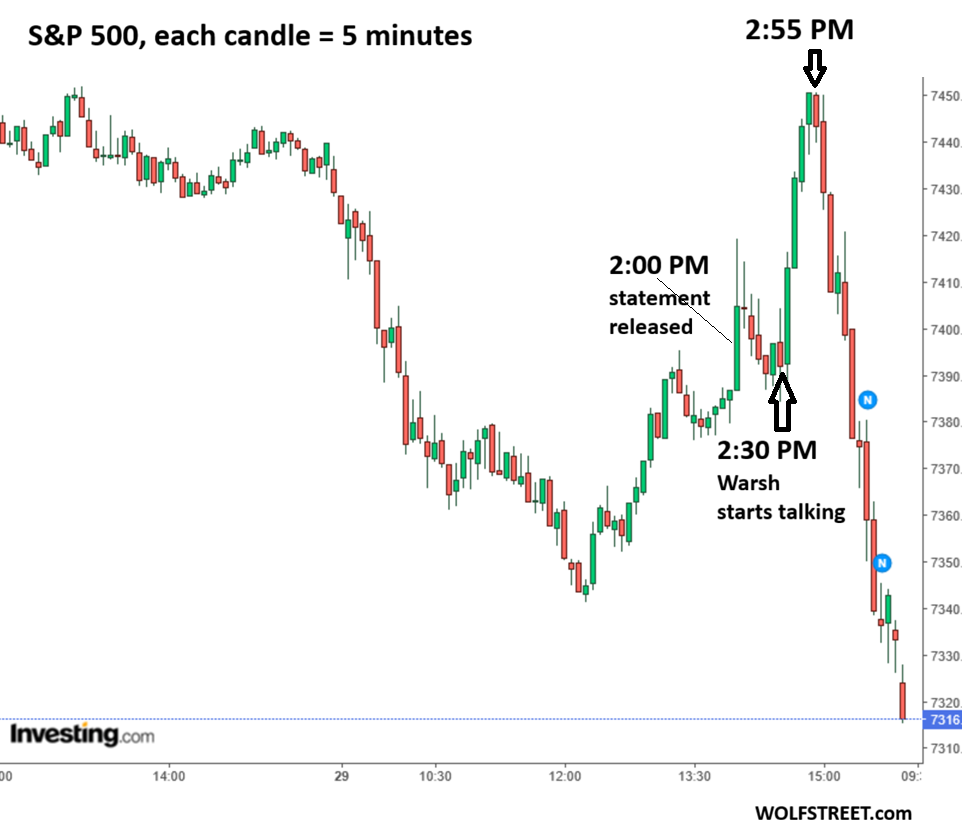
Between 2:55 p.m., halfway through Fed Chair Warsh’s press conference today, and the close of the market, in those 65 minutes, the S&P 500 fell 138 points, or by 1.85%. That was a fast reversal from green to deep red.
For the day overall, the S&P 500 dropped 1.52%, the Dow 2.19%, and the Nasdaq 1.74%.
Warsh clearly made an impact at the FOMC press conference after the meeting today, though the Fed left rates unchanged, with three members dissenting and wanting a rate hike. Even if he had preferred a rate hike, he was another three votes short (chart by Investing.com).
During the press conference, Warsh wasn’t hawkish or dovish, assiduously avoided saying anything that could be seen as forward guidance, gave no clues where the Fed might take its policy rates in September or anytime, gave no clues about where he stood, and shot down all efforts by the reporters to lure some kind of forward guidance out of him.
But what struck me, the only thing that struck me, and what must have struck markets when it began to sink in, was his repeated, detailed, over-and-over again discussion of how ending forward guidance was already working, that Treasury yields had already surged since the last meeting as markets had begun to sort through the data and not the Fed’s comments, that buyers and sellers in the bond market were doing the hard work, that markets have already raised rates and tightened financial conditions, and that this “has provided us some comfort that we’ve got the ability and capability to deliver.”
Treasury yields of 3 years and longer rose, with the long end spiking. The 10-year Treasury yield jumped by 9 basis points for the day, to 4.69%. These are the rates that matter to a big part of the economy: For example, 30-year fixed mortgage rates and most corporate bonds track the 10-year Treasury yield.
The 30-year Treasury yield jumped by 12 basis points to 5.21% today, the highest since July 2007.
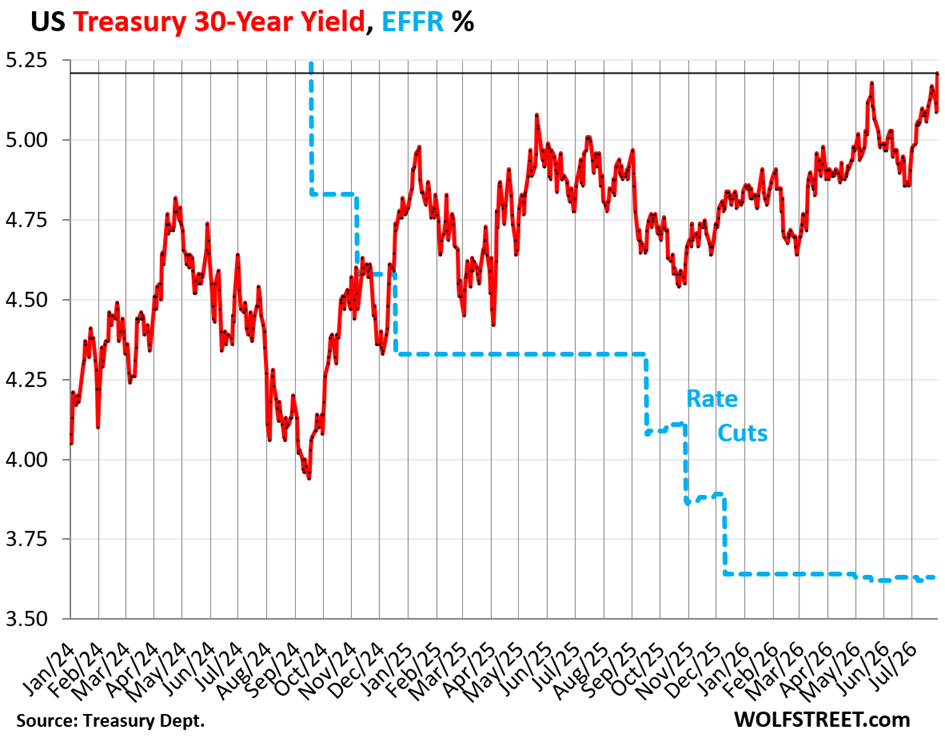
The Fed’s policy rates bookend overnight rates, such as SOFR. For example, floating-rate loans and Adjustable-Rate Mortgages that are in the adjustment phase are impacted by changes in the Fed’s policy rates via SOFR. If the Fed hikes, those rates go up and borrowing gets more expensive for those borrowers.
Short-term Treasury yields reflect a combination of current Fed policy rates and expected future policy rates within their window. Short-term Treasury yields declined today, thereby undoing whatever portion of the rate hike had been priced in for today.
The 2-month yield fell by 9 basis points, undoing the rest of the spike last week that had fully priced in a rate hike at this meeting, that didn’t happen.
The 6-month yield dropped by 8 basis points, to 3.95%, still pricing in a rate hike in its window, but not more than one.
Warsh on how the bond market is already doing the heavy lifting and tightening financial conditions, now that it’s on its own without forward guidance:
“Nominal and real yields are materially higher across the Treasury curve. In fact, some of the increases in market interest rates between FOMC meetings are among the most significant in the last two decades, ranking around the top decile or so, but if the committee didn’t change its policy, what happened?
“In the intervening period, market attention centered on real data and real economic developments. Prices [of bonds] reacted in real time to incoming information, and the reduction in forward guidance may have been a factor.
“Market participants are learning to play the ball, not the referee, and market prices will continue to respond in the direction and magnitude they see fit. This is, in my view, a change for the better, and we’re just getting started…. We need to observe market reaction to developments, direct and unfiltered.”
-o-
“What I’ve really been trying to do is getting an unfiltered message from markets, getting a direct message, letting buyers and sellers meet at prices for Treasuries, for the foreign-exchange value of the dollar, and then trying to judge for ourselves: What does that mean about our remit? How are we doing on inflation? How are we doing on employment?
“We’re trying not to interfere with that market signal. It’s part of the reason we’ve been somewhat spare in our words and pulled back from forward guidance, so they’re reacting to events much more directly over the 42 days since we last met.
This is a good thing. As I mentioned in the prepared remarks, we’ve seen material tightening not just in nominal rates but in real rates too, and we’re observing it, we’re trying to stay out of that because … we’re interested in the reaction of financial markets.”
-o-
“First, as we said in the FOMC statement, the economy output is solid, CapEx and productivity are strong, labor markets solid, steady. The Treasury market seems to be saying that as well… and that’s why we’re seeing a tightening both in nominal rates and in real rates. While at some level, we haven’t done much in 42 days, the markets have done quite a bit.”
-o-
“So rates are higher today than they were 42 days ago. Markets have made decisions in part because we stepped back from trying to influence those. Market judgments have moved up on what nominal rates are across the Treasury curve…. Markets are reacting in real time.”
-o-
“If you were to try to force a description that this [no hike today] was a pause, I would say financial market [bond] prices would take the other side of that. Financial market prices, in this intervening period, didn’t pause. They reacted to the inflation data in one direction, strong economic growth in the other direction, and nominal and real rates went up.”
-o-
“I was comforted that markets in the intermeeting period weren’t reacting to us, they weren’t reacting to dots or to speeches. They appeared more than ever to be reacting to real-time events so they’re gauging themselves how restrictive the Treasury curve should be, and that I think has been a useful development.”
-o-
“By not spoon-feeding markets, by not previewing our decisions, by not sort of giving nudges and leans, my colleagues and I have found in the intermeeting period, what we’re getting is the views from a very accomplished economist. That’s the internals of financial markets. Instead of just repeating or echoing back to us what we’re saying, they’re giving us somewhat, not perfect, their own judgment.”
-o-
“If you look broadly at [bond] market prices, they are certainly not saying “all clear” but they are working in concert to keep us on our toes, and they have tightened financial conditions in this intermeeting period and that has provided us some comfort that we’ve got the ability and capability to deliver.”
-o-
“We’re not going to be constrained or take verbatim from what the markets are doing, but I think it’s useful to understand that markets can be a very good source of information, not a determining source, not a perfect source. But if we’re trying to land the plane and deliver 2% inflation, and we take a very useful source of information and get it all fogged up by giving it our own forecast, by providing rolling commentary, I can assure you that we’re going to have less information, less ability to land the plane successfully, and deliver price stability. We’re just trying to make sure that that source of information is as direct and unfiltered as possible.”
Enjoy reading WOLF STREET and want to support it? You can donate. I appreciate it immensely. Click on the mug to find out how:


Although refreshing, this is a dangerous new monetary policy direction for the financial markets. The sole reason we have the Everything Bubble is because of the 20-year Fed Put. Bringing doubt to long-standing QE and interest rate repression by claiming that the Treasury Market is doing the work for the Fed is the opposite of what risk markets need to continue higher.
The whole financial system and zombie economy has been built on low interest rates. Let the debt markets go by letting yields rise everywhere is how you blow on the house of cards.
Warsh and Co. will have to cry uncle, reverse course and flush the debt markets with cash, including the Treasury. There is no way this new policy directions ends well.
Are you worried about getting pushed off the gravy train? And to prevent that, you want the Fed to step in and start QE all over again so that you can stay on the gravy train? You’re not alone. Lots of people are pushing for QE for the very same reason. (If I read you comment correctly).
But Warsh is at the opposite end of that logic. He even mentioned again today bringing the balance sheet to the inflation fight, yessir, said that today. He wants to reduce the balance sheet as a tool to bring down inflation. He said that for a long time, and it came out again today. That’s the opposite of QE. But for now, he is far from having a majority on that and cannot do anything in that direction until at least 6 of the remaining 11 voting FOMC members come over to his side.
I get the feeling he’s saying the Fed likely can talk tough now (and should imho) but would have to eat crow and monetize next downturn. The debt math is ridiculous as your posts often highlight. It’s getting the economy/government off the tear after the crisis that’s the tricky bit… ergo the last 20 years. 🙈💵💵💵
So… First the fed forces everyone into risk assets to maintain the purchasing power of their savings, then the fed rug pulls all those savers just trying to keep up… The Fed has a responsibility to those of us who are simply trying to escape the punishing effects of their irresponsible policies. You can’t save for a house using a savings account any more.
The Fed has no such responsibility. The Fed’s responsibility is price stability and employment. Gambling, betting, FOMO, YOLO, etc. are outside of the Fed’s responsibility. The Fed failed in its responsibility to maintain price stability. But that doesn’t mean that it now has to shift responsibilities to protect gamblers and betters.
Of course the fee has responsibility, Wolf. They artificially suppressed interest rates for a decade. You either went into risk assets or lost big time to the real rate of inflation. The Fed has taken away the ability for savers to save in minimal risk assets. If you try to, you’re a sucker and you lose out to inflation. Or, even worse, you buy long duration Treasuries and get rug pulled in 2022. The Fed doesn’t get to pretend they aren’t responsible for forcing everyone into the sp500.
The Fed is NOT responsible for your decisions, it’s not responsible for decisions others make. But it is responsible for its OWN decisions (it failed on inflation). The Fed owns its decisions. You own your decisions, and YOU have to live with them – that’s a fact of life that is good to learn early on.
Wolf…
though not necessarily recommended per say….
a small bit of gambling and betting goes a long way.
the rest stays super conservative.
Gotta do a little something to get an edge I suppose…. otherwise get eaten up.
I have no problem with gambling and betting. None at all! Just don’t think it’s the Fed responsibility to bail you out because they made you do it, LOL, which is what “Andrew” said, and what I replied to.
Haha….
Nobody has ever bailed me out.
And it is not expected.
Been a little more lucky than unlucky in the past… will see what the future holds.
Like I said majority is super conservative, but a small percentage is hedge, or lack of better terms just gambling.
I would hope the Fed stops using our money to bail everyone out. Would be nice if we could somehow hold our elected officials more accountable.
I made most of my living off taxpayer’s money…government employee… so I git it…. Basic stuff is necessary. But the insane amount of in our face waste and fraud has become staggering. Makes a guy want to pay the least amount of taxes legally possible.
Anyways.
Haha…sorry, kinda turned into a soapbox rant there.
And for the people that get mad at me for making a living off their tax money….
I am also a taxpayer, and paid a boatload, which means I also funded my own wages… which is kinda weird when you really think about it. A weird circle jerk.
What’s this nonsense of financial markets and risk with government involvement? If you are talking socialized losses and privatized profits, then what the Federal Reserve does in Quantitative Easing (QE) is paramount. However, do not pretend that there is a “market;” because what actually exists is a perverse monetary system to extract the entire wealth of the proletariat through inflation, as if the entire population, excluding oligarchs, is running on a hamster wheel.
Overall I like the idea of using the market as a gauge and not tainting that with the FEDs forward guidance. But I’m pretty skeptical of the whole ‘rates are higher now because we didn’t provide forward guidance’ thing. Rates have been going up for like 10 months now and pretty quickly since March. Most of that before the whole no forward guidance. To me it sounds like he’s patting himself on the back for something that was likely going to happen anyways.
Imagine if Powell was still in, giving guidance, held rates and bond yields continued to go up same as today. We’d be hearing about how the FED isn’t handling inflation and the bond market is freaking out because of it. That’s basically the story we had been hearing. But now yields increasing is good? I don’t really get the reasoning.
“But now yields increasing is good?”
Good or bad has nothing to do with it. He is saying that the bond market is doing the work and the heavy lifting and is reacting to economic data, not the Fed’s forward guidance, and thereby the bond market is sending the Fed some unpolluted signals — including about inflation fears that the Fed needs to hear, and that Warsh wants the other FOMC members to hear.
BTW, I didn’t lament higher yields. They should be higher, that’s what I’ve said for a long time. They’re way too low for where inflation is. I lamented high inflation.
Apologies if this is an ignorant question, but why (and maybe when) did the Fed start giving forward guidance to begin with? What problem(s) were they hoping to solve?
I think it became part of the Fed’s official monetary policy toolkit under Bernanke.
I shouldn’t have said good. I mean more an indicator of increasing inflation expectations(or worry the FED isn’t going to handle inflation). Which sounds like what Warsh wants to use it for and that makes sense.
Which makes me wonder why he didn’t hike rates. If he says that this new unguided bond market has yields going up and he wants to use it as rate setting info, it would seem to reason that he should hike. Maybe he wanted to and the other members didn’t want to.
I set up the FRED graph of EFFR, 10Y and CPI, and in 2021 the 10Y did react quite a lot sooner than the FED did. So I think the overall idea is good. But so it does seem the FEDs response should be timely. Not much use if we’re using the market as a data point but then we take too long to react.
“Maybe he wanted to and the other members didn’t want to.”
In one sentence during his press conference, he alluded to the fact that he wasn’t able to make an impact yet among the FOMC members. I read that to mean he would have hiked, but that may be me reading something into it that wasn’t really there. Just that one sentence had the “slip”, and I think he was careful not to bring it up again. Sorry, I’m not willing to listen to 65 minutes to find and repeat exactly what he said in that sentence. It was indirectly said, so you would have to listen carefully to find it.
“He is saying that the bond market is doing the work and the heavy lifting and is reacting to economic data, not the Fed’s forward guidance”
Yeah he’s saying that. It’s more plausible that the markets are reacting to the increased uncertainty caused by the lack of forward guidance.
Whatever the reason, the market is doing the right thing: Yields need to be higher, and the market is delivering them. And that’s good.
The Fed cannot set long-term yields anyway. It can only set its policy rates and use them to anchor short-term rates.
Removing forward guidance was the best idea in the last 20 years. How do you effectively do your job if everyone in town knows what you’re going to do? Being silent indirectly can restore the function of the fed. If you’re warsh, that’s your job right now.
“Removing forward guidance was the best idea in the last 20 years. How do you effectively do your job if everyone in town knows what you’re going to do? ”
Uhhhh, this isn’t war or even chess, where tactical surprises are important. Quite the opposite.
100% disagree. The market participants should not be setting itself up for failure if the Fed has to make sudden changes based on conditions on the ground. They should be prepared for all possibilities. What we had in the past 20 years is banks and other players positioning themselves solely based on this “guidance,” and then this positioning and reliance was used as an argument for the Fed NOT reacting to changed conditions. “We told them we wouldn’t so this, so we can’t!”
Quite the opposite indeed. The purpose of the fed has been distorted into something it really is not. Short term rates should be lower than long term rates. Plain and simple. If I loan you a thousand bucks, I’d want higher interest if the term is longer.
By removing forward guidance, markets must behave and plan accordingly. There is nothing wrong with that. It also helps the feds chamber (not that we care).
Higher yields are good for two reasons:
#1 It will continue to push interest expense higher, which will hasten action by Congress to get its fiscal house in order. I’m not saying Congress is going to get the message this year, but the next two years or so are starting to look like a very pivotal for all sorts of reasons.
#2 It will sooner rather than later push the markets down. The markets need at least a 25% drop. Like it or not, the uber rich including corporations need a jolt.
I would prefer a significant market drop that brings a little sanity / equilibrium back and slows down the economy just enough, hopefully without creating a recession.
And as a bonus, it should slow down some of the AI build out which is needed and is distorting what’s been going on in the broader economy with housing being the perfect example.
Ultimately, if these higher yields end up causing a recession; then personally I’m fine with that. EVERYTHING about our economy right now is distorted for one simple fact:
We have not had a real recession for 17 years.
Inflation will NOT slowdown or reverses meaningfully outside of a recession. However, higher for longer interest rates might just give us the necessary market reset without tipping us into a recession. IMHO, this would be a good overall outcome vs a GR 2.0 or worse like a lot of people fear is waiting in the wings.
BTW, we’ll cross through the $40T boundary sometime in the next 2-3 weeks. And just in case you were wondering, it takes $7T stacked one-dollar bills to get to the moon and back, so that means were approaching six trips.
This bubble can’t go on forever. At some point, it has to pop and we collectively deal with the fall out.
Clown town at its best.
I’m no expert but it seems that fed keeping short-term rates low and “relying on the market” raising long term yields to quell inflation doesn’t quite add up. Credit can still be too easy for many borrowers and inflationary, while risk builds in the system, especially if more borrowers switch to shorter duration loans.
If Warsh wanted a rate hike, he still lacked three votes for a majority. You gotta have at least 7 votes for a policy change.
The bond market won’t lend cheap money to the GOVT if the FED won’t control inflation. got it.
So Warsh is basically saying that FOMC rates don’t matter and bond yields can run the show? WTH. I’m no expert but afaik, not everything is indexed to 10 yr bond yields and other durations. Doesn’t interbank lending happen at FOMC rates? And money market / high yield savings.
So some people get screwed, and others profit.
This is how markets have always worked… The fed having any control is an illusion and a narrative that has “sophisticated investors” not even understand basic bond functions.
What the fed does have an impact on is short term rates credit card, cd, savings, rate banks borrow from and with some institutions helocs.
The long end and anyone invested in anything longer duration then t bills is not impacted by the Fed rate. they are impacted by the market powers. These markets always lead the Fed in both directions.
What I’m hearing from him is the fed needs to shrink in both balance sheet size and in the minds of market participants. No more bailouts!
Will warsh follow through?🤷
Will the everything bubble pop? 🤞
Will he continue it when stocks crash?😵💫
Eventually it won’t matter what they do or don’t do…. Looking at you boj and jpy👀
This has always been confusing to me. Didn’t Volcker break inflation by hiking rates? Was the Fed’s actions back then inconsequential, even if one considers the psychology of inflation expectations? Or were economic conditions so different back then that comparisons are not helpful?
“The long end and anyone invested in anything longer duration then t bills is not impacted by the Fed rate.”
Of course it’s impacted. The present value of the coupons, particularly in the near-term periods, is impacted by the return of risk-free t bills.
Jeff Gundlach pointed out that the Treasury spread for 2yr-30yr shot up from 77bps to 94bps in one day, which is a large one-day move.
30-year Treasury yield hits highest level since ’07…
DOW -1152…
Warsh and the Fed being brought into the 21st century will get the last laugh.
Sounds like the door is unlocked for the bond vigilantes to come in!
Wow.
We have been so brainwashed, indoctrinated and misguided for so long, that your free market, capitalist readers cannot grasp that the free market, deep, wide and open market of buyers and sellers of u s government debt should set the price of government bonds, money and interest rates. The FED is an interference created by a private banking cartel approved by Congress. It will never work, read Hayek and Mises. Only markets can efficiently and correctly allocate resources and they do so based on pricing information. Only free markets, without government or FED intervention, will results in losses, and cleansing of malinvestment. You already caught a commenter predict and worry about market results. Is Congress, and thus the FED, willing to let the market cleanse the economy. Or is that pain so great for Americans to handle?
Next, Warsh comments are mostly refreshing until the end when he again points out he has authority to intervene, a mandate to intervene, goals the FED group have set and are trying to accomplish. He did not say he will not act to kick can down the road if necessary in 12 peoples mind!
The federal government should stop deficit spending, requiring larger borrowing, if the goal is to reduce inflation.
I would like to see a national, public debate, covered by the media, on constant daily news and inside Congress eventually on whether our country should bear the pain of the market versus intervene and kick can. Not until the widespread general public and electorate understand the dichotomy and the seriousness of it, will policy makers be forced to act. The elected officials and powers to be looked over the edge of the abyss when they had the TARP DISCUSSIONs in 2007-2009 timeframe with Sec of Treasury Paulson, FED Bernanke and elected leaders of Congress.The pain they must have foresaw must be unbearable, I do not know.
Our children and grandchildren long term welfare should be sole determinant. Why we leave this mess to them is hard to accept, but again I do not know what the abyss looks like.
Many believe the markets( mostly bond, but all markets) will force or make the decision before elected leaders or FED makes it.
CountryBanker – your comment is one of the more significant ones I have read in the comment section.
These ‘men in suits’ masquerading as experts know they have blown the MOAB (mother of all bubbles) or everything bubble, and realize they are between a rock and a hard place. An interest rate decrease would make money flow more freely and increase inflation while an interest rate increase would tank markets and thus pop the monstrous bubble. They likely feel trapped at this point. Keeping interest rates the same is akin to ‘no news is good news’ in their minds.
The elephant in the room, however, is untamed inflation. ‘Things’ that people own (stocks, real estate, bonds) will prove in the future to be massively overvalued, or at least, massively valued in a currency that has become a laughingstock.
Well, I got the stock market top right on the 21st.
People don’t know stock from flow.
link: “Changes in Wealth and the Velocity of Money”
I don’t follow. Can someone explain me in English? If no forward guidance then what is Fed going to do? Why do we even need Fed? Just let bond market dictate rates based on supply and demand? And let’s say 30 year yield goes to 6% by September meeting? Then what? Fed is going to raise their rate to match it or no reason to raise rates? Can someone explain thought process of this no forward guidance?
The point is the fed never controlled anything anyways. Yield goes up they raise… Eventually.
Down they cut… Quickly lol
The point of the fed is setting short term rates and keeping market plumbing working and sounds like that’s what they are going to do.
Now we just need to stop having these stupid press conferences and we can deflate the fed ego
“113 years of failure.”
Greatest economic expansion in history.
Good point. But they also need to take care of the labour market, in addition to the prices stability.
They have no interest in price stability. They proved that in 2020 with their unnecessary mortgage actions.
“Can someone explain thought process of this no forward guidance?”
Mac: cmd-f “guidance”
Windows: cntl-f “guidance”
The notion is the Fed created this mess by suppressing volatility through forward guidance. Pre-2008 the Fed said they would tighten at a “measured pace”. 25 bps per meeting taking 2years to raise rates. I agree they should have tightened more quickly, we might have avoided sone of the worst of the 2008 pain. During the last decade the Fed was trying to raise animal spirits and force investors out the risk spectrum. We promise will be on hold for a long time. The Fed buys riskless treasuries and investors take risk to get the economy going. We are no longer at zero rates. Why tell the market where you might go when you have no better idea than you or I? If you look where they thought rates would be via the dot plot. They were off by a country mile. Warsh, in theory, wants to inject two way risk in the market and get rid of the forward guidance. I personally think it makes sense. But as many in the comments have noted: less forward guidance means higher volatility, higher term premium, steeper curves and higher long end rates. All things this administration doesn’t want to see. Should be a fun few months!
Just hope the Feds remain as a non political as possible. Not out of the cards it turns into what SCOTUS is where it is ideology, not problem solving ruling the day. Perhaps economists are better than lawyer/politicians at doing that.
While I’m not for the forward guidance of there is a high chance we do this or that by the next meeting, no guidance is dangerous. The Fed should be saying if x condition stays the same or gets worse, we’ll do y. Conditional forward guidance that keeps the market stable.
I think this lack of forward guidance and the lack of expected rate hike has left the market with no confidence in the Fed. After the huge blunder of “transient inflation”, the market already had little faith.
Warsh’s desire to shrink the balance sheet would be dangerous and some of it impossible. It’s sad I can do my research and understand how this works better than him. The only way the Fed can reduce MBS is let it roll off like they already are, and sell these low interest MBS at a loss because no one wants a loan at face value that has an interest rate lower then current rates. With banks sitting on loads of treasuries in the one to two percent range, they have essentially nothing to sell in case of a bank run. As much as I don’t like this part of the balance sheet being kept high, the Fed absolutely needs the liquidity in case of bank failures.
“As much as I don’t like this part of the balance sheet being kept high, the Fed absolutely needs the liquidity in case of bank failures.”
I think a few keystrokes on a keyboard at the Fed solves the “needs the liquidity” problem for them in a crisis. That seems to be the object lesson of the last 18 years. It’s also where that balance sheet you have your eye on came from.
Banks can conveniently borrow from the Fed at the Standing Repo Facility (SRF) via overnight repos and at the Discount Window. Last year when repo market rates rose amid some liquidity strains around Sep 15 tax day and the year-end shifts, banks did use the SRF and then lent to the repo market, and they profited from the spread.
The SRF exists to provide liquidity to the banks. The Fed could easily reduce its asset holdings further, which would lower reserve balances (bank cash on deposit at the Fed), and if banks need cash sporadically, they can borrow at the SRF (which would temporarily increase the balance sheet again), like they did last year before the RMPs started.
Yes, this!
A dynamic system that quickly grows or shrinks along with the ebbs and flows of bank stresses and opportunities, not a warehouse used to store monetary bad decisions for years or even decades. Maybe trying to be both has caused a lot of grief.
So we have the dynamic system in place: great! But we’re still stuck with the warehouse too (e.g. MBS). Boo.
Is it also fair to say that the warehousing of T-notes and T-bonds has been insulating the people on the fiscal side from their bad decisions?
I think that forward guidence was a tool to remove volatility and thus reduce liquidity risks in the system.
But the FED today has many more tools to manage those risks and Walsh might even see the forward guidance as something that increases systemic risk. Because it cloudes the picture he’s getting from the market and it’s influencing the bond prices, thus moving them from the “neutral” supply/ demand equilibrium where the market prices bonds based on economic data and thus risk (inflation).
While everyone here laments the low coupon on government bonds, what I fail to understand, is how corporate bonds are so low. They are just a tad above the government bonds. How does that make any sense? To get an return after inflation is one thing, but where is the return of the inherent (high or low) risk of non payment????
me either dosent make much sense why the spreads are so thin.
The Fed has no reason to ever sell MBS at a loss. Just let them roll off, collect the money, and destroy those extra FRNs. It’s got to be down to around $2.2T by now – steady as she goes.
I would have liked to see a real plan to roll off the Treasury side too but instead the Fed is adding $10B more this month. All in all they may grow the BS by $200-300B in 2026. That’s not reducing, Mr. Warsh.
Talk is cheap. This was one of the worst Fed press conferences I can remember. Warsh talks about the market doing the heavy lifting but today they called his bluff. He sounded like a bureaucrat: Committees are in place and our best people are on it! Does anyone remember 2014? Janet Yellen created her labor dashboard? This has that same feel. Blind us with data that gives no clear answer. This led to the Fed being on hold until December 2015 but gave pundits plenty to chew on. At the end of the day someone needs to make the call. Market data is never clear and the committees will give enough for both sides. What will Warsh do? I’ll give him the benefit of the doubt given this is his second meeting but he did not instill much confidence. The sell off in the long end reflects this. I will point out the obvious but usually dovish fed meetings are “risk on”. Not this time.
He didn’t try to talk yields down and stocks up. He said markets are on their own, they can figure it out. That was refreshing.
If he sticks to his guns, Warsh is doing God’s work by reducing the weight of the Fed’s thumb on the scale of the interest rate markets. (Mother of all mixed metaphors…)
Reducing the “Fed footprint” IS refreshing!
With all the recent tax revenue cuts and grossly increased spending (particularly for the war department and ICE), how can the U.S. government afford the growing interest payments on the national debt if rates continue rising? Not only that, but rising interest rates seems to be at odds with the president’s wish for near zero interest rates. Finally it’s also at odds with the theory of letting inflation run hot in order to minimize the consequences of out of control deficit spending.
Something is fishy here.
“Not only that, but rising interest rates seems to be at odds with the president’s wish for near zero interest rates.”
He can wish all he wants but he’s not getting them. Who’s stupid enough to buy a one year T-bill and lend the Treasury a dollar so you they can get back 95 or 96 inflation-adjusted cents in 365 days?
Reticent Herd Animal
You ask, “ Who’s stupid enough to buy a one year T-bill…”
Is there, then, a 0% probability that a bear market (bond and/or stock) forces the Fed back to panic mode? It might be a small probability, but it ain’t zero, IMHO.
T-bill money is money available to “fight another day.” Also, T-bills are highly liquid, especially in a panicked market. Finally, a laddered T-bill position provides reliable cashflow for spending needs or staged re-investment.
I should have made clear: “while inflation is around 4%”. I don’t see a possibility they’re able to go to ZIRP while inflation is still above target, regardless of what happens to the bond and stock markets.
But that’s conditional: if market panics are what it takes to end five years of inflation, then THAT (the end of inflation) is what would give them the flexibility to go to zero, not the market directions themselves. I’d buy a 0% T-bill if inflation was also 0%: I loan them a dollar and I get a dollar back when I want it, no stack of cash in a vault needed. That would even have the odd effect of driving taxes on interest down to zero. But I’m not holding my breath waiting for 0% inflation.
So yeah, if they drive the rates affecting T-bills down to zero before inflation gets there too then they’ve lost this customer. I’ll just take my money and buy every shelf-stable thing I’m going to need for the next several years and store it all in closets. Or maybe buy a bit more than I need and try to flip it on Craigslist in a year or two (I’m not really that ambitious but the concept fits). Can you imagine if we’d loaded up on cheap RAM DIMMs and Flash disks two or three years ago? Sigh.
Me?
me too. would be better then a 50% drawdown in a bad market!
Warsh is not an economist, he is effectively a politician, but he’s not stupid. He knows that signaling or suggesting a cut is what his party wants, but he also knows that would cause yields to spiral up, driving the debt maintenance through the roof. He’s fine talking tough and offering no forward guidance. If the market wants higher rates then he has an easy explanation when a hike comes. See, it’s not me…it’s the market, and if we don’t play ball things will get out of hand.
He really only has to play this game for a while. Long term no forward guidance is fine right up to the point where the market loses its mind, then he’ll have no choice, or tank the economy, which maybe is exactly what he thinks needs to happen.
But anyway you look at it he is rosining up the bow. Get ready for same fancy fiddlin’
By taking Fedspeak off the table he also avoids being pressured to speak as this president desires.
MHO, people aren’t being fair about this – they’re being… what’s the word 🤔 “Impatient”
Turns out, he was correct – if you wanted higher rates, market’s on that already. 8 others agreed and that’s a majority.
This was always a damned if you hike, damned if don’t and total market meltdown if you cut. Cuts clearly not on the table. So freak out regardless, right? Market is testing the Fed – that’s bullish because it was predicted.
But did he guide us as to which Estee Lauder perfume is the best to buy? Is he even trying???
As I understand it, Warsh seeks to restore bond market price discovery as an independent input to policy decisions, trusting market signals unless they threaten the Fed’s inflation mandate—and only when FOMC members can muster a majority to intervene using its monetary tools to counter that price discovery.
I suppose it is refreshing up to a point ,but it remains tangled logic; the market will be trusted until it isn’t.
From cnbc:
Revolt in the market: Despite the chairman’s tough talk on inflation, markets weren’t having it. Treasury yields at the long end of the curve soared, even as the policy-sensitive 2-year dipped. Translation: We think you’re going to keep short-term policy rates in check, and it’s going to create a ton of inflation later. The 30-year bond was the biggest gainer, roaring higher by 11.5 basis points to 5.211%, its highest yield since 2007 and seemingly undercutting Warsh’s inflation warrior credentials.
I already said this earlier here:
“He didn’t try to talk yields down and stocks up. He said markets are on their own, they can figure it out. That was refreshing.”
Obviously, CNBC thinks that’s a bad deal. They want the Fed to talk the yields down and stocks up.
I’ve always felt that markets are man-made weather. There’s storms, some big, some small and localised. Then there are ones that are devastating and the effects last for years. The debate still seems to be how much can we influence it.
speaking of drops, the Yen is doing a thing against the dollar. What if…. the BoJ follows up an intervention with a return to normal yields a few hours later.
Higher rates are good for savers. Higher rates are good for insurers. The millisecond that the real time data shows REAL distress in the real economy the Fed policy will loosen. I watched with satisfaction the vitriol expressed over the “Fed’s performance” yesterday. I’m sure the next presser will have ‘adjustments’ but this is a welcomed change and Warsh should stay the course.
yes, and whats the word for “un-carnage” lol
face ripping rallies today, especially in nasdaq.
despite new escalations etc.
the media has a 1 day attention span, if that.
meanwhile bonds do their thing at the speed of molasses.
Ehh, the algos do what the algos do. I suspect the massive surges in tech stocks, especially in stocks like Micron, Intel, Sandisk, etc. are driven by a short squeeze, as they’ve dropped a ton lately, but who knows?
Is he hoping to gain some kind of information from the markets? Because I don’t see what conclusions you can really draw from yields in a situation like this. If things stay the same then yields might go up just by traders becoming less complacent. If he raises rates then yields go up. If he lowers rates then yields go up. If inflation increases then yields go up. If he gives forward guidance about rate increases, or no increases, or decreases, then yields go up. The only thing that would make yields go DOWN is if inflation actually went down, and how do we get there? By raising rates or at least jawboning raising rates. You can let the market take the lead, but I’m not sure what you can read back from it in a situation like this where everyone is already backed into a corner. The only other thing I can think of is that they’re waiting for the AI bubble to pop and do the job for them.
Market downward reactions have become temporary effects.
On July 30th; next day after FED meeting, S&P500 is already up 1.5% (110 points). So stocks are already up within a day.
Talk is cheap for Warsh and FED. But reality is even if Warsh wanted to know; he will need 3 more votes on FOMC. He kept on hammering Price Stability word so many times in Presser. It was refreshing.
Personally I have more hopes on Warsh than I ever had on Powell.
It would look absolutely disastrously terrible if the FOMC hikes rates, with a 7-5 vote, with 5 of the 12 voters dissenting and preferring no hike. 5 dissents has not happened since 1983 under Volcker. Warsh would need a more solid majority with no more than 3 dissents, hopefully less. I suppose there are a couple of fence-sitters, and Powell would likely join a strong majority but not a bare majority. So for a rate hike, he’d really need to get 8 other people on board. And that is not happening. Maybe in September.
Warsh doesn’t have a solid majority for anything other than “no change in policy,” neither rates nor balance sheet. That’s why he came up with the task forces, outsiders to help persuade the others. It also looks like he is relying on the bond market to whack the FOMC over the head a few times before the next meeting and bring them to their senses.
I guess this is another explanation that would make sense. Although, I’m picturing the FOMC currently being assailed by a bunch of giggling school girls with feather pillows. If they don’t raise rates this year then maybe the bond vigilantes will have to step in with a pair of Sock ’em Boppers and really show them who’s boss. If that doesn’t work then I guess we’re all out of options.
Some of these folks are going to sit up straight and pay attention to the bond market when the government has to sell 10-year Treasury securities at auction at a yield of over 5%.
“that buyers and sellers in the bond market were doing the hard work, that markets have already raised rates and tightened financial conditions”
My Goodness Wolf, this is one of those nuggets resting in plain site that, when you frame it, hits me right between the eyes !!!
It should be obvious now. 113 years of failure. We don’t need forward guidance. And we definitely don’t need the Fed. Unfortunately, most people still believe, like Dorothy did, that the Wizard of Oz is good and powerful. Let’s pull back the curtain and see the truth. Let’s click our heels three times and go back to Kansas. End the Fed.
Wolf seems to have a certain amount of appreciation for the Fed..
as I think he explains…. that as imperfect as it is, it helps with a certain amount of financial stability in the economy.
Destroy me if I am wrong Wolf.
I loathe the Fed when it perpetrates QE and ZIRP. I’m OK with it when it acts like an adult more or less. When the Fed ignores inflation, then that’s “reckless,” and Powell ran the “most reckless Fed ever” in 2021 (CPI heading to 9% while the Fed was at 0% and doing lots of QE). The Fed is now far from that. But they need to get on the ball.
Frankly it sounds like you just prefer the Fed to fulfill half it’s mandate. Unemployment was persistently high when the Fed was implementing QE/zirp.
Three wanted a rate HIKE???
In this crummy economy? In this Ponzi scheme AI bubble? With falling living standards already?
And how would a “rate hike” solve oil-driven and war-driven inflation?
And what would a “rate hike” do to the housing market? Or to bond yields?
Are they nuts?
Does having higher yields for long term bonds have any effect on inflation in the real economy besides borrowing cost?
I guess Warsh is trying to save face and imply that things are being done to combat inflation, even without doing anything.
Raising the borrowing costs across the economy will eventually reduce investment, consumption, and employment growth, putting less pressure on prices, which would lower inflation rates. That’s the theory behind interest rates and inflation. But there’s a lot more that goes into inflation, including mass psychology (what I call the “inflationary mindset”), which is why the Fed tracks inflation expectations.