
But private-sector holdings remained at huge record, with the big seven financial centers leading the charge.
By Wolf Richter for WOLF STREET.
Foreign holders shed $72 billion of Treasury securities in June, bringing their holdings down to $9.30 trillion, according to Treasury data released this afternoon.
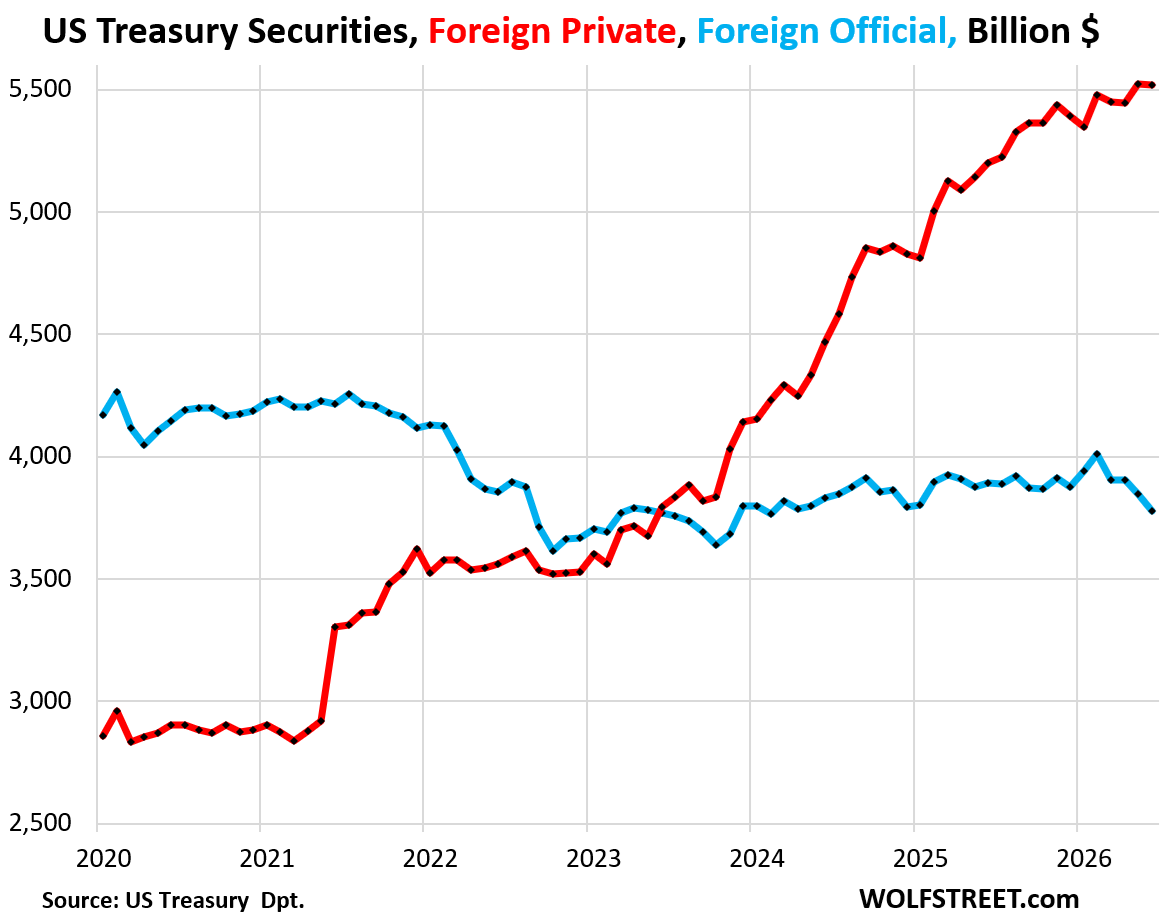
The entities that shed Treasuries were “foreign official” holders, such as central banks and government entities, see Japan: Combined, they shed $70 billion in June. Since February, they have shed $233 billion, bringing their holdings down to $3.78 trillion, the lowest since February 2024 (blue line in the chart).
But “foreign” private-sector entities kept their Treasury holdings essentially unchanged at the record $5.52 trillion (red line in the chart). They include US companies with offshore accounts, such as Apple in Ireland, and US hedge funds domiciled in the Cayman Islands that engage in the basis trade and hold the Treasuries that form the base for the basis trade in the Cayman Islands.
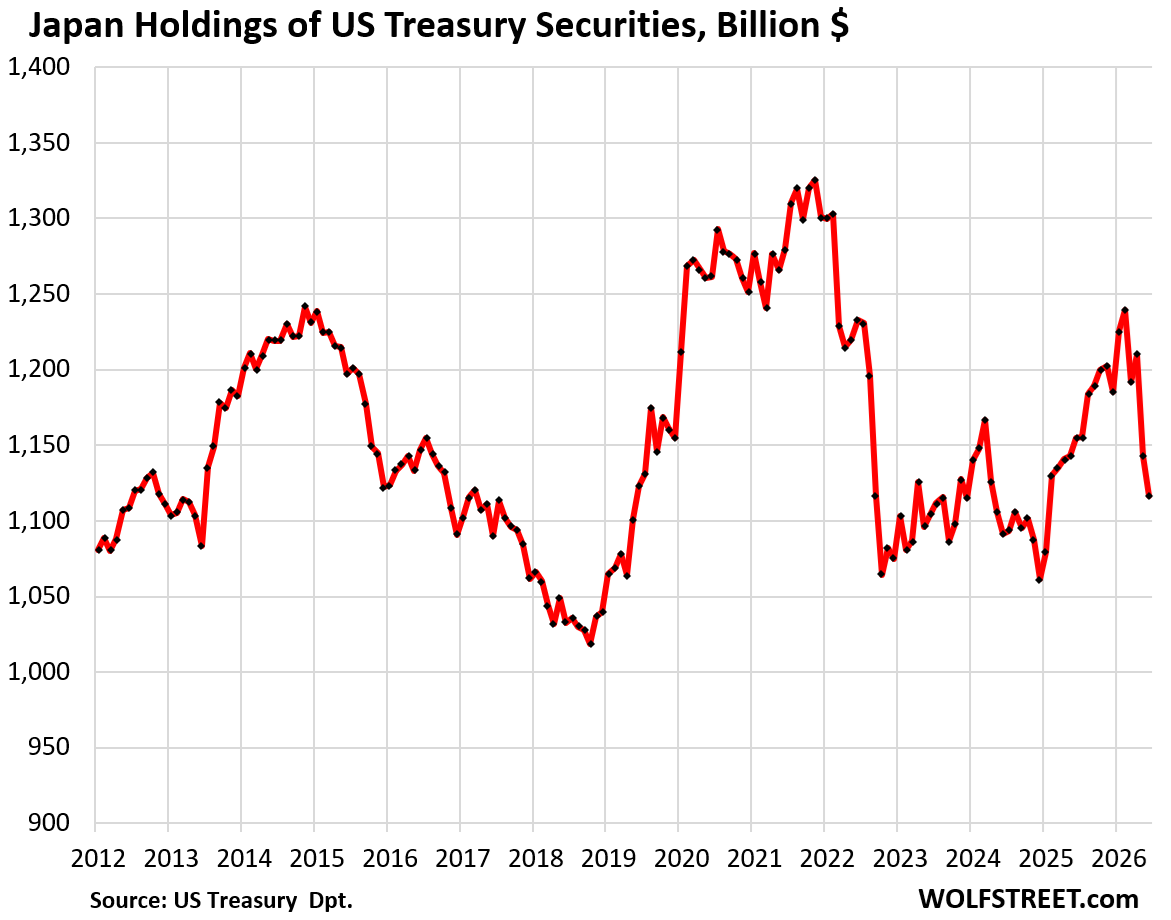
Japan reduced its Treasury holdings by $26 billion in June. Since February, it reduced its holdings by $123 billion.
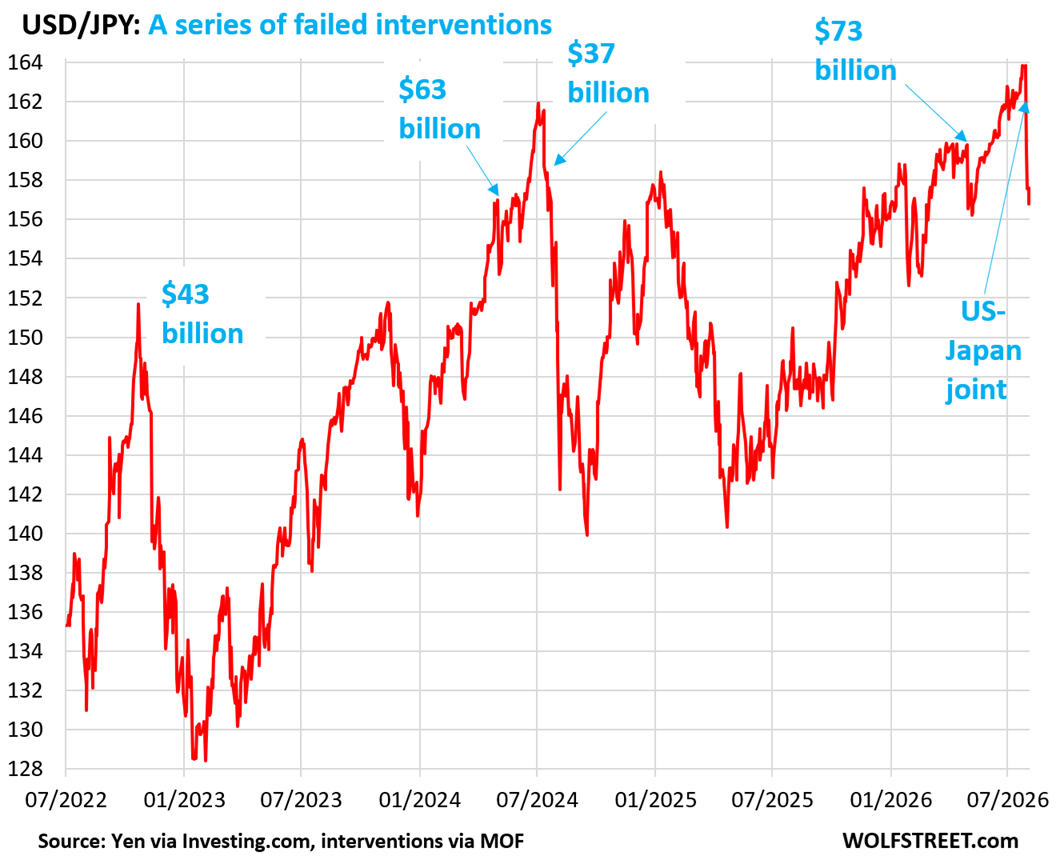
Japan has attempted to prop up the yen multiple times in recent years, including twice this year, most recently the big kahuna joint US-Japan intervention at the beginning of August. Each time, Japan sold dollars and bought yen in the foreign exchange markets.
To get these dollars, Japan’s authorities can do several things, including:
- Let Treasury securities mature without rolling them over, or selling some outright, and set aside the USD cash while preparing for the next yen intervention.
- Unwind their overnight reverse repos at the Fed as needed.
The Fed has $358 billion in “foreign official” reverse repos on its balance sheet. This is essentially USD cash that the foreign central banks have put on deposit at the Fed, and the Fed owes them this USD cash. The foreign central banks can unwind the reverse repos to cash out the USD in the morning if needed (foreign official reverse repos, like the other reverse repos, are a liability on the Fed’s balance sheet, not an asset).
The big drops in Japan’s holdings in 2022, in 2024, and in 2026 in the chart above roughly line up in advance to Japan’s big yen interventions as Japan was shedding Treasuries – likely by not rolling over maturing securities – to prepare for the interventions ahead of time. Then later, it added back some Treasuries.
The interventions (blue) require sudden selling of dollars and buying of yen in large enough a quantity to at least temporarily move the market. To get this large quantity of USD cash, Japan needs to prepare for it, such as by not rolling over maturing Treasury securities in the weeks and months ahead of the intervention:
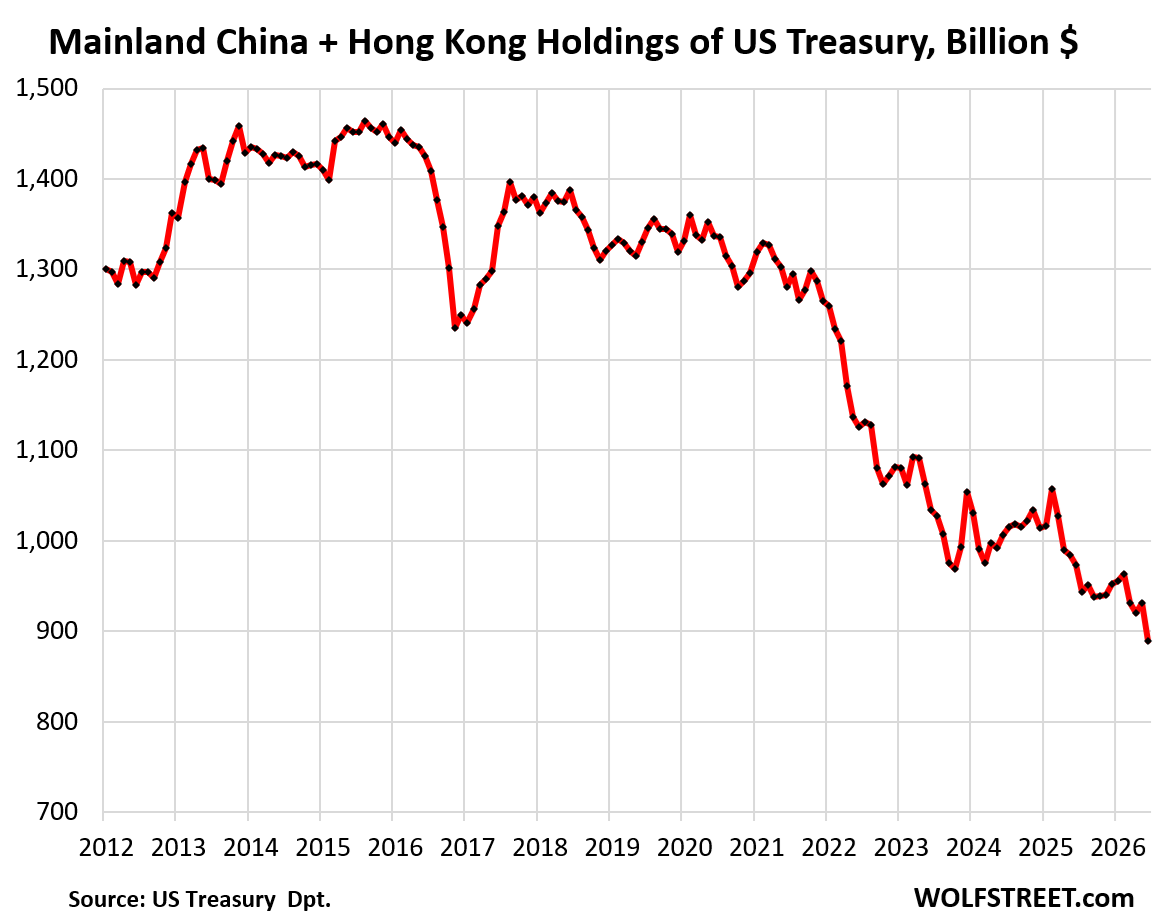
Mainland China and Hong Kong combined shed $42 billion in June and $84 billion over the 12-month period, continuing a long methodical process:

Seven of the largest holders are financial centers. Combined, their Treasury holdings dipped by $11 billion in June, from the record in May, to $3.23 trillion. They account for about 35% of all foreign holdings!
They include in order of magnitude of their holdings: The United Kingdom, or more precisely the City of London, the largest financial center in the world; the Cayman Islands where US hedge funds are domiciled; Belgium, home of Euroclear; Luxembourg; Ireland; Switzerland; and Singapore.
Some of them added to their holdings, other shed holdings. But they don’t necessarily signify foreign attitudes and concerns about US Treasuries. And there is certainly no lack of interest in Treasuries at these financial centers:
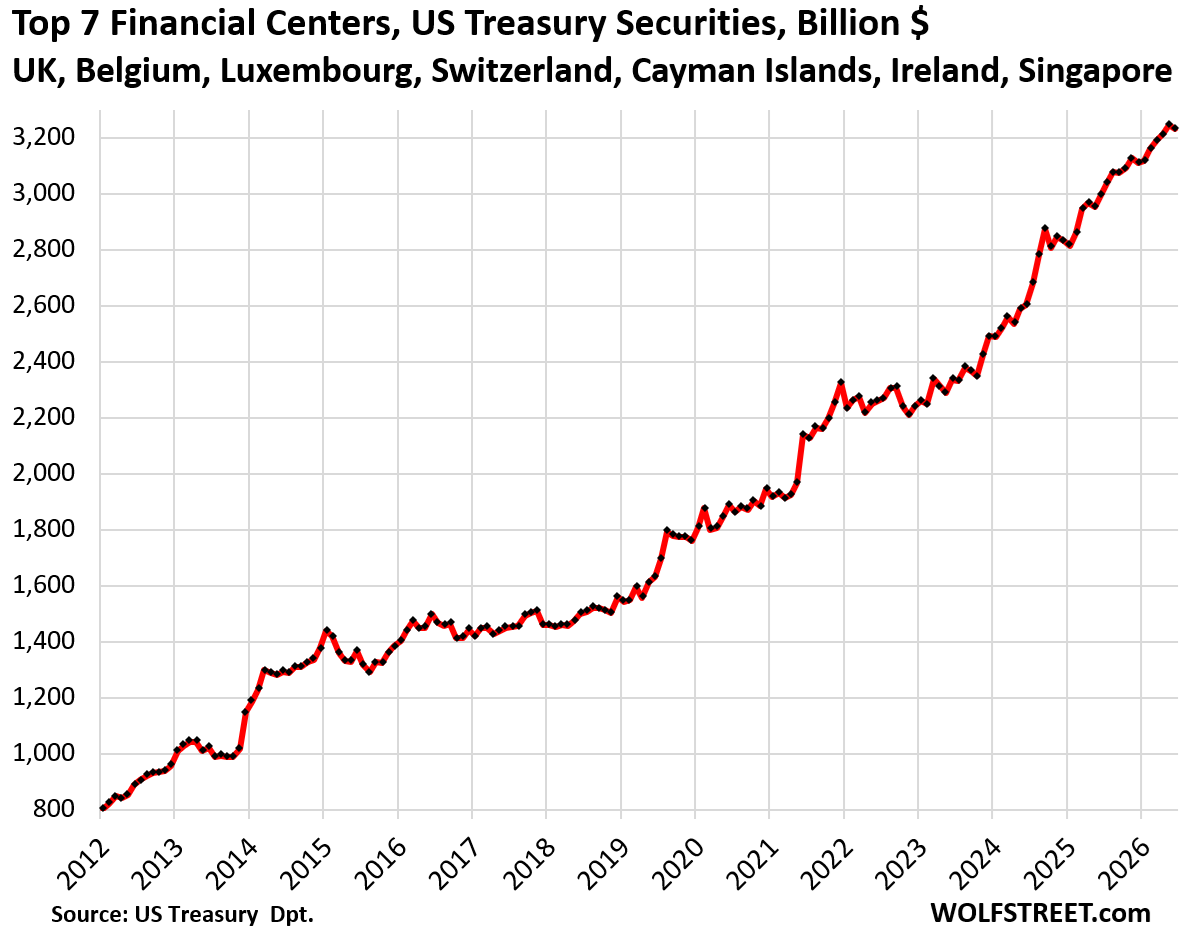
Japan, Mainland China & Hong Kong, and the seven financial centers combined account for 57% of total foreign holdings of US Treasuries.
Other major holders, and changes in June:
- Canada: $460 billion, +$24 billion.
- France: $390 billion, -$3 billion.
- Norway: $203 billion, -$4 billion.
- India: 186 billion, + $5 billion.
- Brazil: $168 billion, unchanged.
- Saudi Arabia: $142 billion, +$2 billion.
- South Korea: $135 billion, +$3 billion.
- UAE: $115 billion, -$4 billion
- Israel: $111 billion, -$7 billion.
What was not a factor in June:
Market value of Treasury securities. These Treasury holdings are valued at market value. So in months when long-term Treasury yields rise, the market value of Treasuries falls, and this will cause those holdings to fall, even without foreign holders changing anything.
In other months, when long-term yields fall, market value of Treasuries rise, and those foreign holdings rise even if holders don’t change anything.
But in June, long-term Treasury yields ended the month about where they’d started it, with the 10-year Treasury yield at 4.45% at the end of May and at the end of June. So the market value of long-term Treasuries changed very little from the end of May to the end of June. And market value was not a factor.
Enjoy reading WOLF STREET and want to support it? You can donate. I appreciate it immensely. Click on the mug to find out how:


Do you mean Yen intervention (see title)?
Yes. They did invent the yen, but that was before my time 🤣
Question. In a scenario where BOY needs to unwind their US treasury holdings further and more rapidly by actually selling rather than stopping rollovers. Wouldn’t that play right into the current FEDs hands? Higher rates with plausible deniability that it’s outside their control?
If the Fed wants to hike rates, getting the market to do the hard work for them by hiking long-term rates is one way of doing it, and accomplishes part of it. Long-term rates have more impact on the economy and financial conditions than overnight rates, though they matter too through repo market borrowing.
Unless you’ve moved the majority of your issuance to the short end and are conducting QE to hide the lack of deman?
they cannot do QE in an inflationary environment. Even Japan had to flip to QT and abandon QE and YCC.
Have they not bought a quarter trillion in Tbills since last December? QE by my book
1. Your book is wrong. QE is well-defined: buying longer-term securities to bring down long-term rates. But the Fed bought T-bills, and long-term rates have continued to rise 🤣
2. It also bought T-bills to replace long-term MBS, and that’s the opposite of QE.
3. Those RMP purchases got tapered after April 15 tax day down to just $10 billion a month, and as of Aug 14 have ended altogether. No more.
4. The Fed always increased its balance sheet with the size of the economy (GDP). And those purchases didn’t even keep up with GDP growth, and the Fed’s balance sheet as % of GDP continued to fall through Q2.
Click on this link and read all about it:
https://wolfstreet.com/2026/08/13/fed-cuts-reserve-management-purchases-rmps-to-zero-starting-august-14/
Wolf, the Treasury announced long-term bond buying today will at least double to $4 billion from $2 billion. I don’t know the frequency, but says from Sept to Nov this year. I couldn’t find if they are just shifting buying bills into buying bonds so it’s net zero and just moving liquidity from short to long-term markets. Or maybe this is new purchases above what they were going to do originally? The latter would be QE then right? Since it’s long-term bonds. Although $2-4bb seems small compared to the rest of the bond market guess it depends how frequent.
Article coming. The Treasury is issuing new debt to buy back old debt. The Treasury cannot create (“print”) money, it borrows money, and every dollar in buybacks is funded with debt, replacing old debt with new debt. Yellen started it. This has zero to do with QE. It doesn’t change anything.
Here it is:
https://wolfstreet.com/2026/08/19/bessent-doubles-yellens-hocus-pocus-treasury-buybacks-swapping-old-cheap-debt-at-a-discount-for-new-expensive-debt/
See the news this morning? ;)
Yes, article coming. The Treasury is issuing new debt to buy back old debt. The Treasury cannot create (“print”) money, it borrows money, and every dollar in buybacks is funded with debt, replacing old debt with new debt. Only willful internet morons confuse that with QE (Fed creates money to buy long-dated Treasuries).
Here it is:
https://wolfstreet.com/2026/08/19/bessent-doubles-yellens-hocus-pocus-treasury-buybacks-swapping-old-cheap-debt-at-a-discount-for-new-expensive-debt/
Bloomberg:
* Sovereign borrowing rates are surging around the world, with yields on 30-year US Treasuries rising to the highest since 2007.
* The structural forces driving up yields are global in nature, including fears of an increasingly divided world order and changes in market structure and demographics.
* Governments are paying the price, with finance ministers shifting their debt-issuance toward shorter tenors where yields are lower, as they adjust to a world where they can no longer lock in financing costs for decades at rock-bottom rates.
Interesting to see how differently official and private foreign holders are behaving. Japan reducing Treasury holdings ahead of yen intervention also shows how closely currency policy and reserve management are connected.
Well, I’m sure they’re hedging their positions daily in the US Treasury futures market.
Good information, but I am still convinced that there is nothing stopping the second wave of inflation, which has just begun. CONgress certainly isn’t doing their job and Trumpty-DUMty is making things worse (almost as if by design).
The Fed’s hand will be forced, I digress. The Fed is quickly becoming irrelevant.
The Fed really has no ability to control the deficit but it seems like they could change regulations to have banks buy more short term debt and issue more like that. They can control the long end indirectly by just reducing supply of long term. Congress will likely never solve the deficit issue and the fed will need to find a solution, which seems like they have few options.
“They can control the long end indirectly by just reducing supply of long term.”
“they” = Treasury Dept, not the Fed. And they can do that and they will do that, and they are already doing that, but then the US interest payments become very dependent on changes in monetary policy, and when inflation takes off and the Fed hikes to 6% or more, that huge T-bill part of the US debt will then suddenly cost 6% or more, while long-term debt won’t be affected until it matures years down the road. That’s why short-term borrowing is very risky for the US budget.
The Fed has already talked about replacing long-term Treasuries with T-bills, and they will eventually do some of that because a balance sheet full of long-term debt is not good for the Fed (maturity mismatch which produces operating losses for the Fed). The Fed is already replacing long-term MBS with T-bills.
Thanks Wolf.
I think I need to taser myself every time I misuse Fed or Treasury!
Any comment on the treasury increasing their buy-backs? Seems like a twist/QE “light” thing…
Nothing to do with QE. The Treasury cannot do QE, only the Fed can. The Treasury has to sell new debt to buy back old debt. Here it is:
https://wolfstreet.com/2026/08/19/bessent-doubles-yellens-hocus-pocus-treasury-buybacks-swapping-old-cheap-debt-at-a-discount-for-new-expensive-debt/
MW: 6% Treasury yields are the biggest risk facing stocks right now.
By far the biggest risk to stocks — and the economy — is a potential fizzling of the AI investment mania. It has been driving nearly everything.
It might have a ways to go. We should see more craziness like this:
Stripe will reportedly acquire AI gateway startup OpenRouter for $7B+
OpenRouter is a 2 year old company with its recent funding valuation pegged it at 1.3 billion.
OpenRouter is neither Open, nor a Router.
MW: U.S. 30-year Treasury yield hits highest level since 2007 amid global bond selloff
It already backed off of that today.
The whole issue of currency crises is value.
Ten Commandments (1000 BC): To make these “monetary surprises” simpler is the Commandment: “Thou shall not steal.” You can see it for yourself in “The Ten Commandments” movie where Moses (Charlton Heston) is watching God carve the stone with mind blowing energy blasts. Federal Reserve sin of stealing is freely and unashamedly admitted in their target goal of stealing 2% annually (2% inflation goal); Bank of Japan must be doing something similar.
Mesopotamia (Code of Ur-Nammu, 2100 BC) (Reference Wikipedia): This code referenced a prohibition of using two sets of measures, a heavy weight (on a scale) to buy and a light weight to sell. Analogous to a Federal Reserve Note (dollar) that says it is worth a dollar on it (weight measure), but considering all the dollars printed, in some type of Repo account, window or other “shell game,” that dollar in your wallet is light weight if the ratio of your money to the real amount (absolute weight standard) of money is considered. Bank of Japan is almost certainly doing the same.
Surprised to read that London is still the largest financial center in the world. The amount of social media bitching about London’s demographics makes me think it filled with werewolves 😭
British EMPIRE was a powerhouse for a few hundred years and probably still has a few pence lying around from that.
Major territories at its height included:
• India (the “Jewel in the Crown”)
• Canada, Australia, New Zealand (settler dominions)
• Large parts of Africa – Egypt, Sudan, Nigeria, Kenya, South Africa, Rhodesia
• Caribbean islands – Jamaica, Barbados, Trinidad
• Parts of Southeast Asia – Malaya, Singapore, Burma
• Hong Kong
• Ireland (until 1922)
• Scattered outposts in the Middle East (post-WWI mandates like Palestine, Iraq)
wrap your fish guts in this old news
China holdings really dumped when the US seized $300B in Russian assets.
Probably just a coincidence.
China’s holding dropped in 2016 when it had to defend the renminbi (RMB) when there was a big problem with capital flight. It had to crack down on that capital outflow, putting in place stricter capital controls, and at the same time, it was blowing USD and other foreign exchange reserves to defend the RMB. I covered this at the time with several articles because it was a pretty big deal.
Here is one article I could fine easily. There are others also:
https://wolfstreet.com/2016/10/11/whats-going-on-with-new-global-reserve-currency-chinese-yuan/
It included this chart, overlaying China’s foreign exchange reserves (include US Treasuries) and capital outflow:
Wolf – you answered what would otherwise have been my first question, which is when you say “Japan reduced its Treasury holdings […] since February […] by $123 billion” this means that $123B par value of bonds were sold/matured.
Do we know the breakdown of which securities Japan sold and which matured? It’s possible that they took a loss if they sold bonds now deep underwater, although I would imagine they have enough that billions are just constantly maturing and they receive full par value for those?
Third and final question also re Japan. If BoJ is not increasing its holdings of JGBs, and rather letting them roll off their balance sheet (can’t recall whether you previously wrote that they’re selling them outright or just rolloff) who IS buying new JGBs?
So there are a lot of aspects that go into this, from Japan’s point of view. Here are just a couple of them.
Japan has a $1.1 trillion portfolio of Treasuries. This means that every month, lots of securities are maturing, and Japan gets USD cash for the maturing bonds at face value. Normally it replaced maturing bonds by buying new Treasuries at Treasury auctions. If it doesn’t buy new bonds for a few months, that cash from maturing bonds piles up and builds a USD war chest for interventions. So they may not need to ever sell anything.
Also bonds that are just a few months away from maturity are like T-bills, and are priced like T-bills, and trade like T-bills. So if Japan sells a 10-year note with 6 months left to run, there would not be any major losses because the buyer will get face value plus six months of interest when the note matures. So Japan can let securities mature and top off its war chest by selling T-bills, and by selling notes and bonds that have only a few months left to run, and it would not lose any money in USD terms… In yen terms, it’s making huge amounts of money on these bonds.
Japan booked a ¥5.06 trillion “surplus” on its foreign currency exchange account on March 31. This account that does the foreign currency interventions and where it takes the USD cash from shedding Treasury securities to buy yen with. And it made massive amounts of money in yen terms on these sales of Treasuries and USD because the yen has collapsed against the USD, and it gets a lot more yen in these transactions than what it paid for in yen when it purchased the bonds. There is the political debate in Japan about what to do with all this “surplus.”
When it sells Treasuries, to get USD, and then sells the USD and buys collapsed yen, the government gets a shitload of yen that it has to do something with. There are rules about that to prevent the government from just blowing this money. Some of it has to be reinvested, etc. But some of it goes into the budget and is spent. For Japan, in yen, there are big profits in these Treasury and currency deals. Don’t cry for Japan.
Global bond markets ‘on fire’ as borrowing costs soar…
Mania sets up big market correction, central bank economists warn…
Wolf, re your focus on Cayman-domiciled hedge funds, there are many offshore hedge funds holding Treasuries that are domiciled in other jurisdictions. It’s not clear to me why you single out the Cayman-domiciled funds.
I single out the Cayman Islands because there is a LOT more to the story. That’s where US hedge funds are domiciled that deal in the basis trade. The Fed released a study that pointed that the Treasury’s TIC system (the data in the above article) misallocates Treasuries that Cayman-domiciled US hedge funds hold in the Cayman Islands. Instead of allocating them to the Cayman Islands, much of those basis trade Treasuries are allocated to the US. The report said that at the end of 2024, there were $1.8 trillion of Treasuries in the Cayman Islands that were used by these US hedge funds for the basis trade.
I discussed this multiple times before, including in the below article. Here is an excerpt:
https://wolfstreet.com/2026/07/14/largest-foreign-holders-of-us-treasuries-incl-us-hedge-funds-in-the-basis-trade-us-companies-with-overseas-entities/
The “basis trade” and the Cayman Islands.
We’ve discussed this before: Many US hedge funds are domiciled in the Cayman Islands, and their Treasury holdings would normally count as holdings in the Cayman Islands. But the Treasury Department’s Treasury International Capital (TIC) System, on which these numbers here are based, fails in properly attributing all the Treasury securities held by Cayman-domiciled US hedge funds to the Cayman Islands. Instead, they show up as Treasuries held domestically in the US.
This was revealed by a Federal Reserve Bord of Governors analysis last October, which showed that Treasury holdings by Cayman-domiciled US hedge funds were undercounted by $1.4 trillion at the end of 2024.
At the end of 2024, the TIC system attributed $379 billion to the Cayman Islands. The Federal Reserve analysis showed that the total was actually close to $1.8 trillion. The report relied on other government data that was better able to track the Cayman-held Treasuries, according to the report.
These Cayman-domiciled US hedge funds engage in the highly leveraged massive “Treasury basis trade.” They’re long (they buy) Treasury securities and are short (they sell) Treasury cash-futures and make money off the spread.
In normal times, the basis trade provides liquidity to the Treasury market. During times of turmoil, such as in March 2020, the basis trade caused the Treasury market to seize – and the Fed ended up stepping into it to get it going again.
Kim Jong Un has found a new target, K-Man Eye Lands
Well, hot dang – if I was holding a bunch of scorching hot baked potatoes in my bare hands, I’d want to unload them too!