
The magic 5%-line for the 10-year Treasury yield seems to be the new floor, after being the ceiling it couldn’t break through for three years.
By Wolf Richter for WOLF STREET.
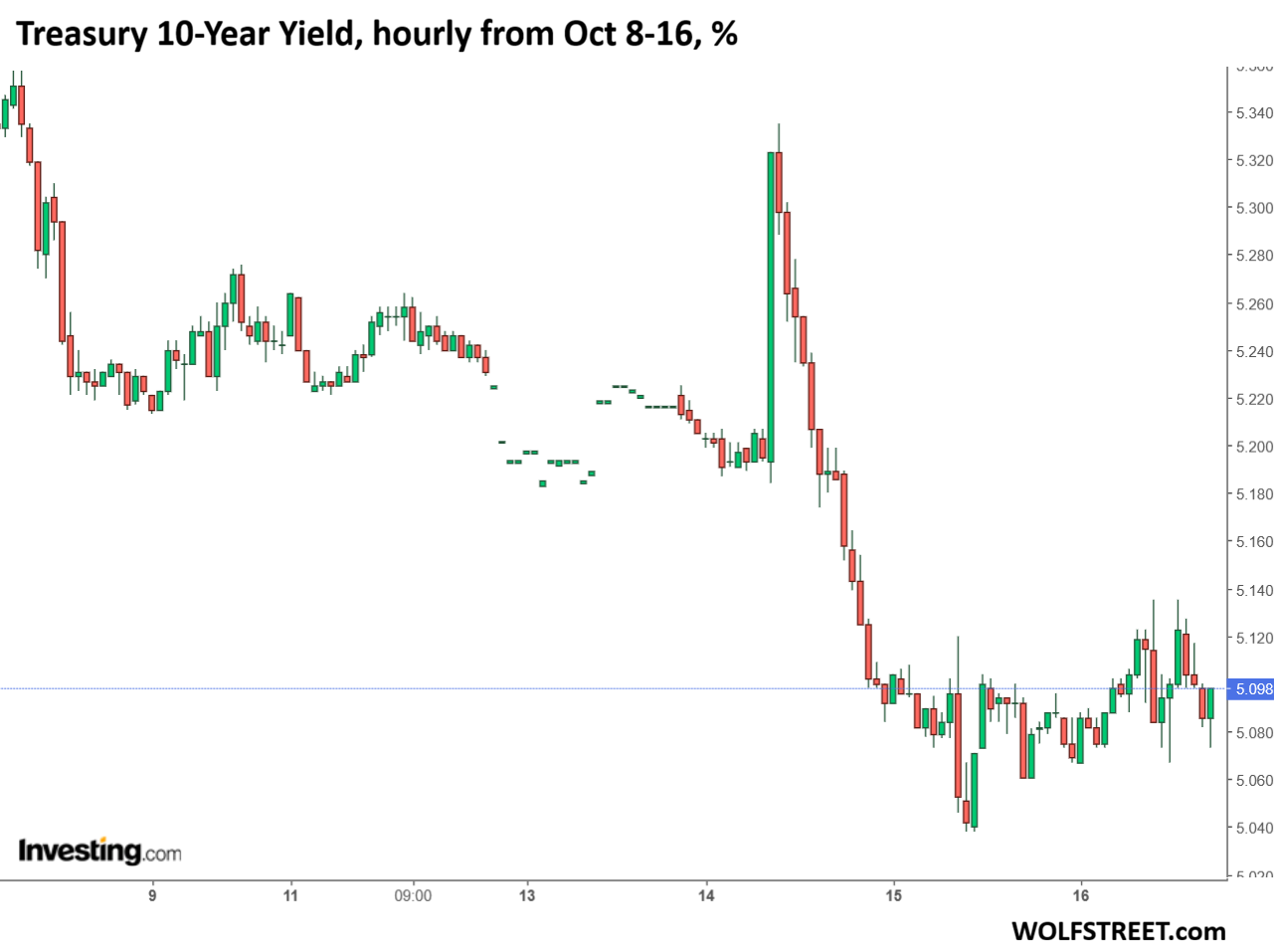
That was a lot of volatility for the 10-year Treasury yield in the four-day week, driven by hot inflation data on one hand, and a scare about the mania in AI stocks and bonds that triggered a safe-haven trade on the other hand. After everything was said and done, it was the biggest weekly rally of the 10-year Treasury maturities since mid-February (prices rose, yields fell).
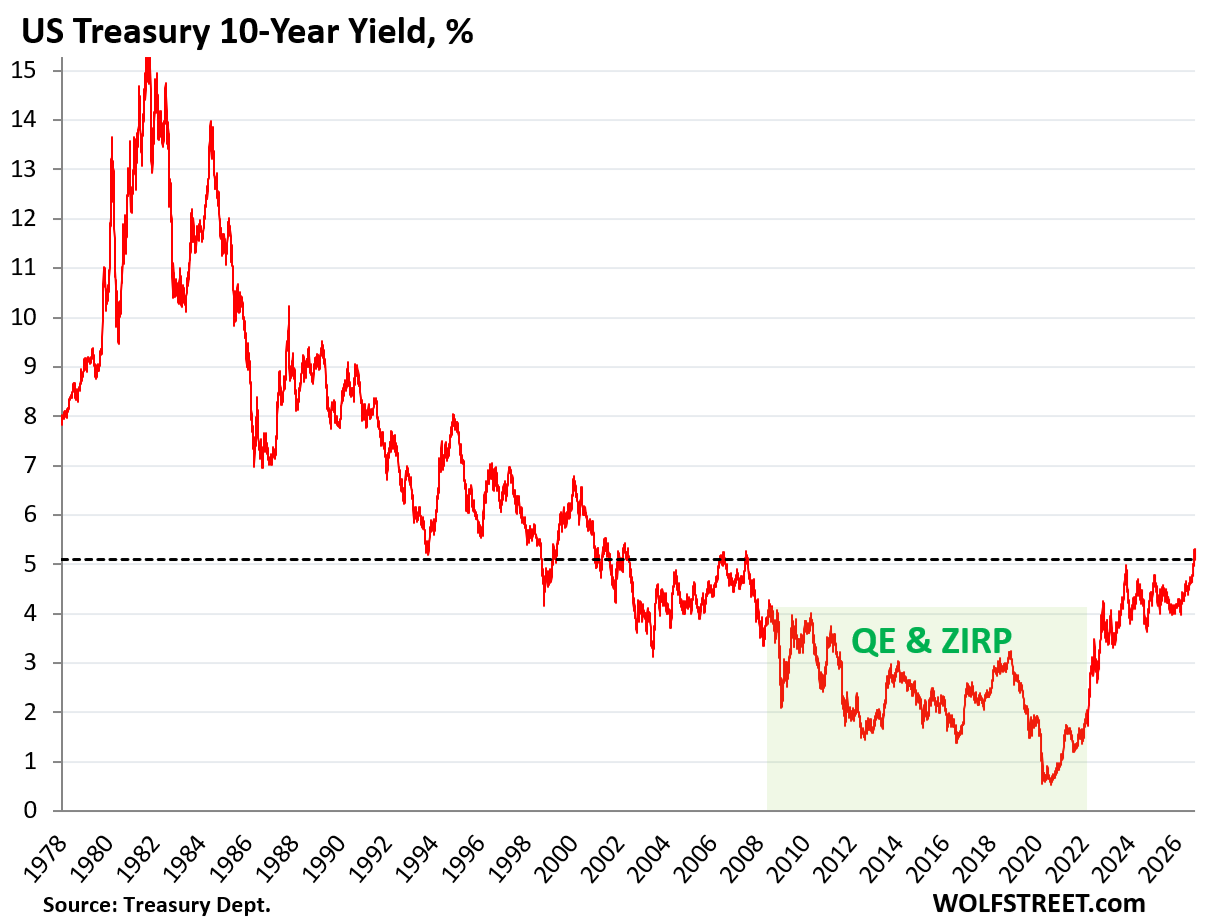
The 5%-line for the 10-year Treasury yield was a ceiling that the market had bounced into repeatedly from September 10 through September 22. It had first bounced off of it intraday in October 2023, after which it had taken nearly three years to get back to the 5%-line. Then it broke through the 5% line, and WHOOSH to 5.30% intraday by September 30.
Then 5.30%-ish became the ceiling that it kept bouncing into. At the 10-year Treasury auction on October 7, it took a yield of 5.30% to sell all $39 billion of 10-year notes.
The last time it bounced into it was this week on Wednesday. Within moments after the hot CPI report was released, it spiked from 5.19% to 5.33% briefly.
But then there was the scare about AI stocks and bonds. Shares of AI data-center company CoreWeave plunged on Wednesday and ended the week down 23.5%, and AI bonds took a beating in general, chip stocks fell – the PHLX Semiconductor Index plunged by 11.4% during the week – all kinds of stuff was going on, and investors fled into Treasuries on Wednesday and Thursday and drove up prices and drove down yields of longer-term maturities. The 10-year yield kept falling until it hit a low point of 5.04% Thursday morning.
That was a 24-hour 29-basis-point drop in the 10-year yield. In price terms, it was a huge rally. But the yield didn’t make it to the 5.0%-line. Buyers vanished before it got there, and so the yield worked its way back up a little and ended on Friday at 5.10%. It looked like 5%-ish became the new floor for the 10-year Treasury yield.
The chart shows the drama of the 10-year Treasury yield in hourly increments from October 8 through October 16.
Bond investors haven’t seen those yields in over 20 years, and those yields seem tempting. But these are also iffy times for holders of long-term bonds.
Inflation is out of the bottle and has been accelerating for over a year, while the Fed has cut its policy rate last fall into this accelerating inflation. This is concerning because a purposefully lax Fed, that allows or encourages inflation to fester, is a nightmare for bondholders. Inflation eats up the purchasing power of bonds, and investors want to be compensated for that, plus some, with yield. A lax Fed is a reason to not hold bonds unless yields are high enough to compensate for those risks.
Then there are the fiscal issues of the US government that cannot get its deficit to come down from the 6%-of-GDP nightmare level, even during a growing economy. Congress isn’t even talking about it. Bessent is talking about it, but he doesn’t control the purse strings, Congress does. And Trump is out there trying to buy votes come hell or high water, thereby making the fiscal mess worse. That’s a scary combination for potential bond buyers.
Rising yields are a huge risk for existing bondholders. When yields rise further, market prices of bonds fall, and existing bondholders can see big price declines. The 30-year Treasury bonds that were sold at the auctions in the summer of 2020 with yields of just over 1% are trading at around 50 cents on the dollar now. So the threat of higher inflation, bigger deficits, and more supply of new bonds to finance those deficits point to higher yields in the future – and that’s a scary thought for bond buyers. Do they really want to expose themselves to that risk? The answer is yes, if the yield is high enough.

Those 5%-plus yields for 10-year maturities used to be considered normal to low – back when the government’s deficit-to-GDP ratio was much smaller, inflation was lower, and QE hadn’t yet polluted everyone’s mind.
That 5.30% auction yield on October 7 was the highest auction yield since November 2000. But in the first half of 2000, auction yields were in the 6.5% range.
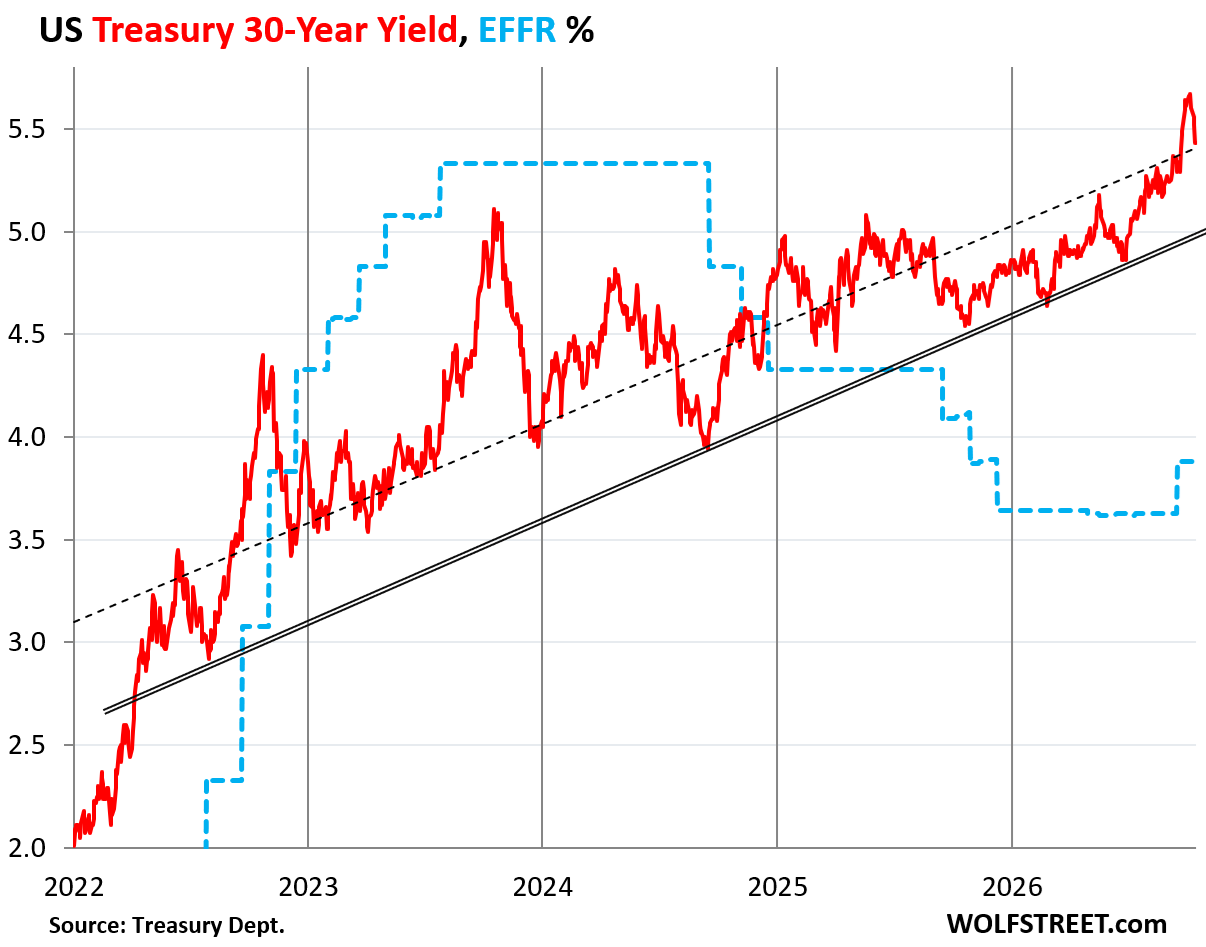
The 30-year Treasury yield zigzagged lower from 5.73% just ahead of the 30-year auction on October 8, to a low of 5.39% on Thursday October 15 – a plunge of 34 basis points – and has since then wriggled up a little and on Friday closed at 5.43%.
The chart below tracks this years-long journey to higher yields. The black double-line connects the major lows over the past four years. The dotted black line reflects the trend line calculated from the data within the timeframe of the chart. The dotted blue line indicates the Effective Federal Funds Rate (EFFR, blue) which the Fed targets with its policy rates.
With this drop since October 8, the 30-year yield has reverted to trend, after breaking out of the trend to the upside. And for now, the trend line, amid this zigzagging higher in fits and starts, still holds.
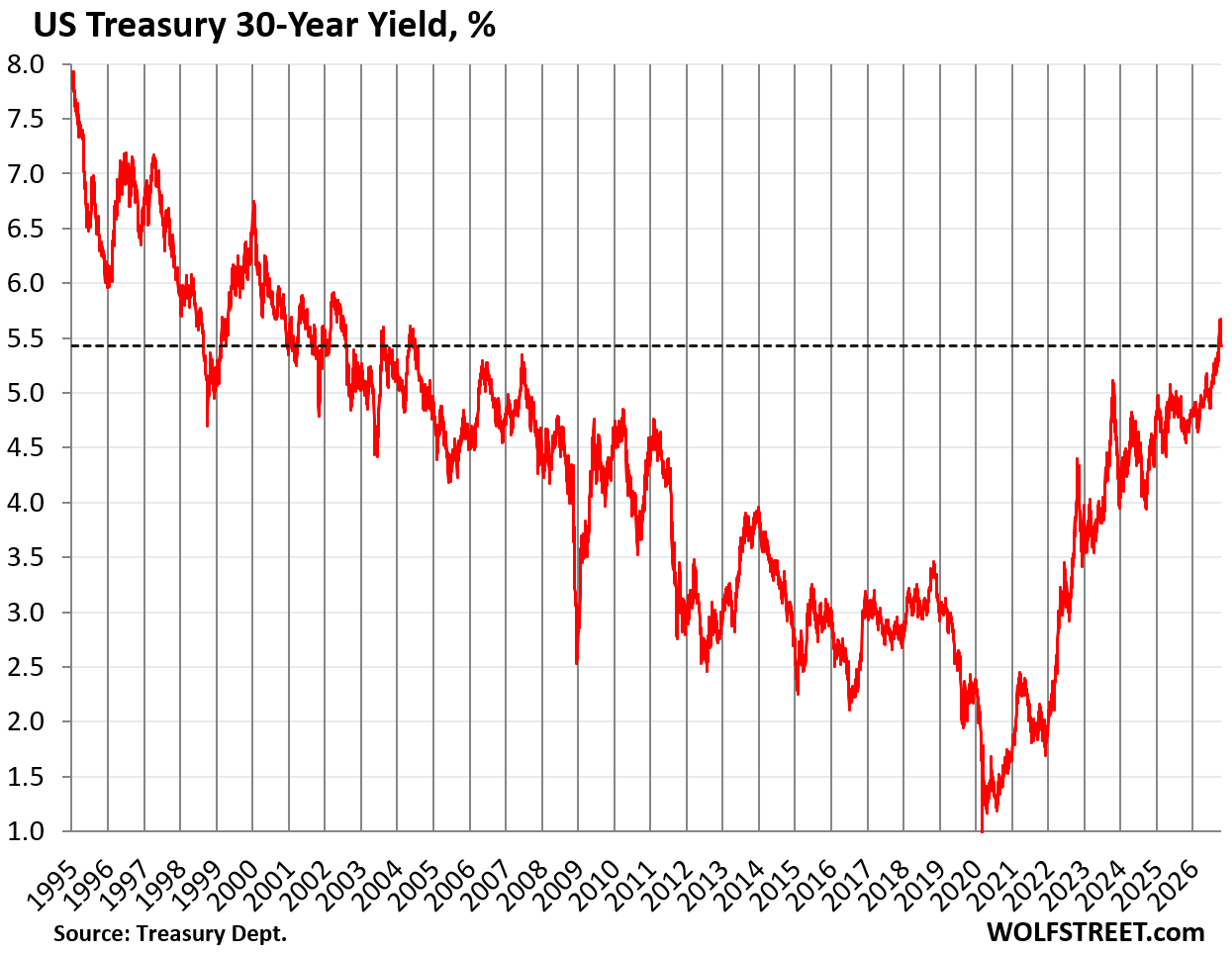
Zooming out a little, the sharp drop of the yield since October 8 was actually just another little squiggle in the long-term dynamics of the past three decades.
Short-term yields moved little this week, with the 3-month yield edging up 1 basis point to 4.26% by Friday, still pricing in one rate hike in its window.
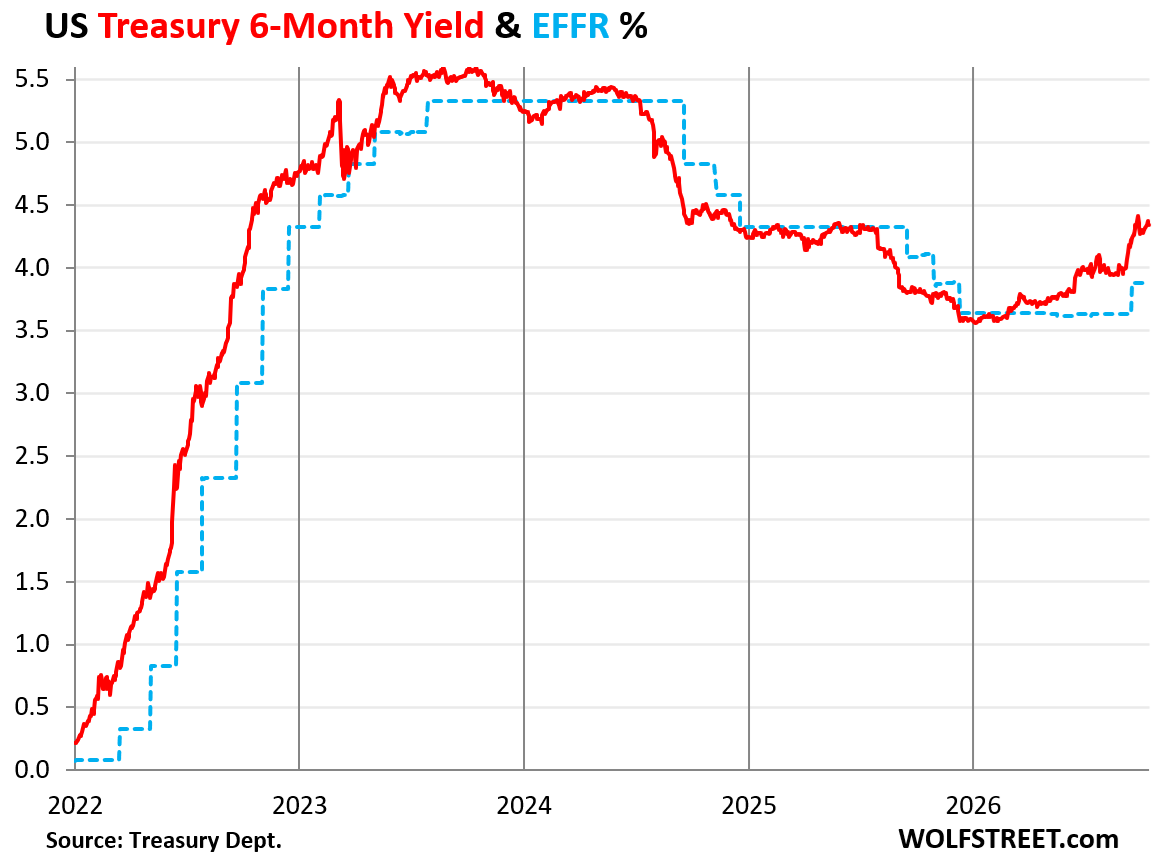
The 6-month Treasury yield edged up 2 basis points during the week to 4.34% by Friday and is 46 basis points above the EFFR (3.88%), pricing in nearly two rate hikes within their window.
The path back to higher, historically more normal yields is fraught with risks after 14 years of financial repression. So it’s good for the bond market to take its time to get there in fits and starts, and to take a breather every now and then, rather than getting there all at once and spooking the bejesus out of everyone.
Suddenly higher long-term yields can be treacherous for companies that have to refinance their maturing fixed-rate debts, and those yields can scuttle new investments, and credit markets can get dicey if it happens too fast.
But when yields zigzag higher at a measured pace, with lots of breathers in between – yields have risen a lot already from mid-2020 – companies and credit markets can adjust to them and deal with them more easily, so that the higher yields can work themselves into the economy without blowing up something big.
Enjoy reading WOLF STREET and want to support it? You can donate. I appreciate it immensely. Click on the mug to find out how: