
Today: Accelerating growth of nonfarm payrolls & hourly earnings, historically low unemployment rate, very high prime-age labor force participation rate.
By Wolf Richter for WOLF STREET.
The growth of nonfarm payrolls accelerated, the prior two months were revised higher; month-to-month growth in hourly earnings accelerated sharply, the prior month was revised higher; the unemployment rate edged down and is historically low, despite an increase in the labor force as more people got drawn into the labor market; and the prime-age labor force participation rate (which eliminates the issue of the retiring boomers), has been in a range that is the highest since the burst of the Dotcom Bubble over 24 years ago, according to data from the Bureau of Labor Statistics today.
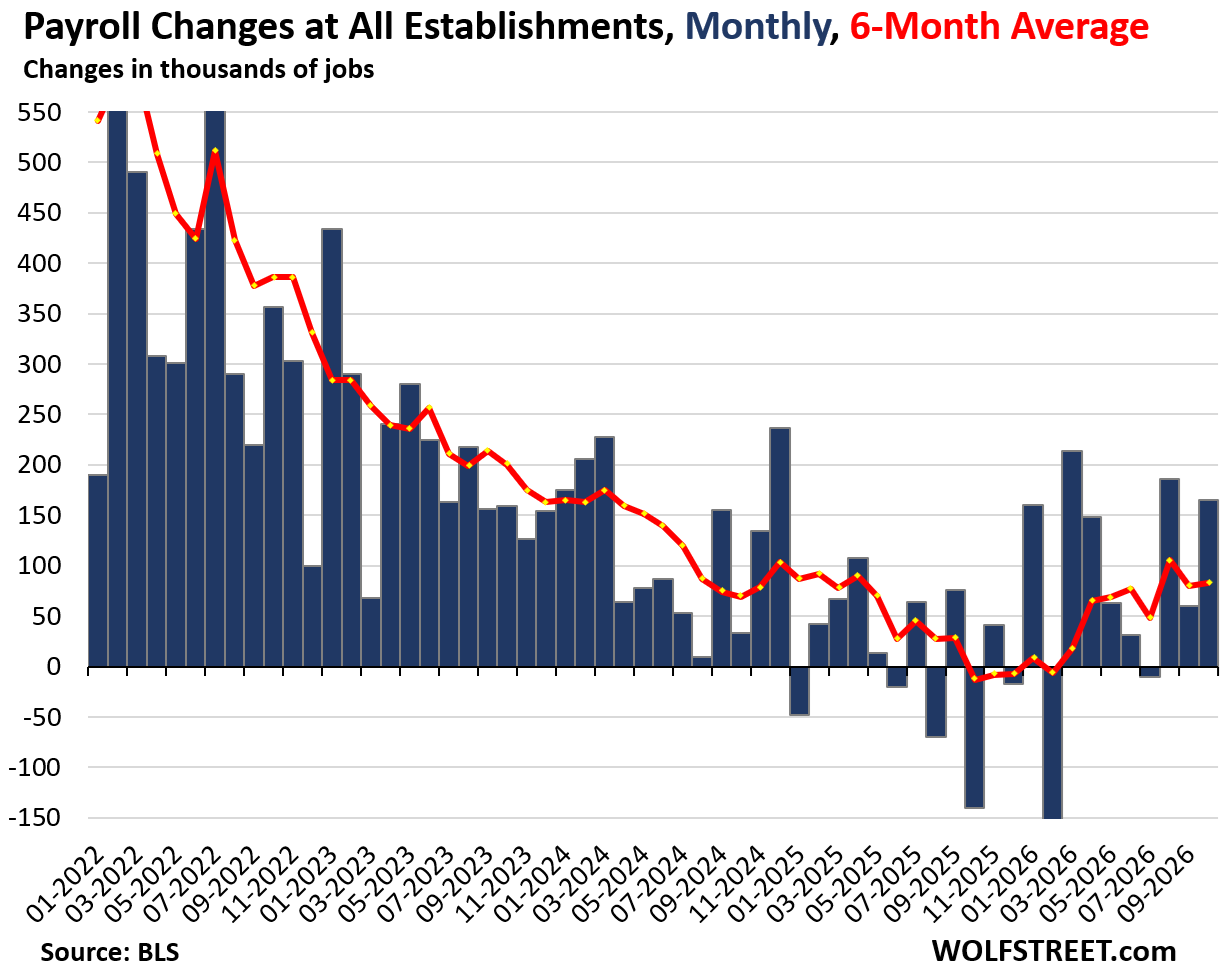
Payrolls of nonfarm employers jumped by 165,000 in October from September, and September’s gain was revised up by 31,000 (to +60,000 from +29,000) and August’s gain was revised up by 53,000 (to +186,000 from +133,000), depicted by the blue columns in the chart.
The six-month average gain of nonfarm payrolls, which irons out some of the month-to-month squiggles and shows the trend, accelerated to +83,000 jobs (red line). And this trend of accelerating job gains has been going on all year, after the low point in late 2025
These are signs of a solid and tightening labor market, confirming other recent data, such as the phenomenon of the applications for unemployment insurance benefits yesterday, which dropped to the lowest level since the 1960s, and the JOLTS data earlier this week, which showed a big increase in quits and job openings as more workers regained confidence and left for better jobs elsewhere.
By category of private-sector employers.
The major private-sector industries that gained jobs:
- Professional and business services (+70,000)
- Healthcare (+55,000)
- Transportation & warehousing (+25,000);
- Manufacturing (+19,000);
- Financial activities, includes real estate (+7,000)
- Other services (+6,000)
- Retail trade (+6,000).
Four major private-sector industries shed jobs:
- Leisure and hospitality (-13,000)
- Wholesale trade (-9,000)
- Construction (-3,000), after a big gain in the prior month
- Information (-1,000).
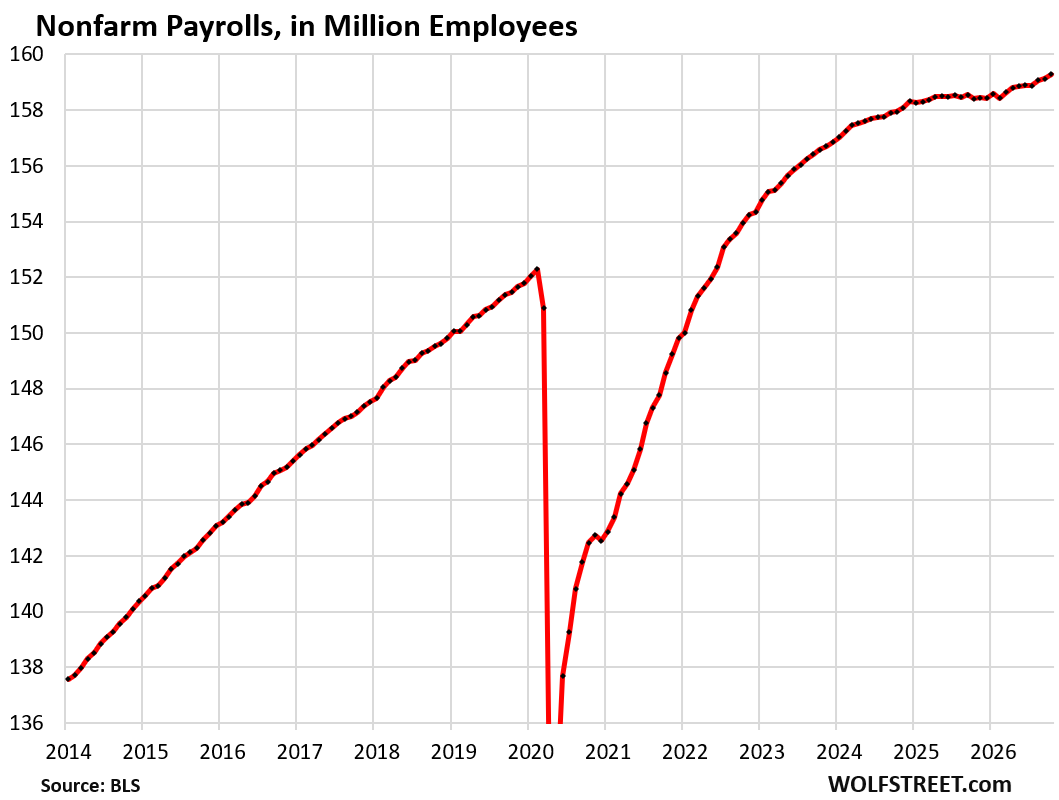
The level of total nonfarm employment rose to a record 159.29 million in October.
Note the flat spot from April 2025 through February 2026, when nonfarm payrolls essentially didn’t change, as federal and state governments shed jobs, while private-sector employers created jobs but at a lethargic pace that barely filled the holes left behind government job cuts.
The federal government has shed 11% of its workforce, or 328,000 jobs, since January 2025, and state governments have shed 46,000 jobs as their public university systems experienced declining enrollment.
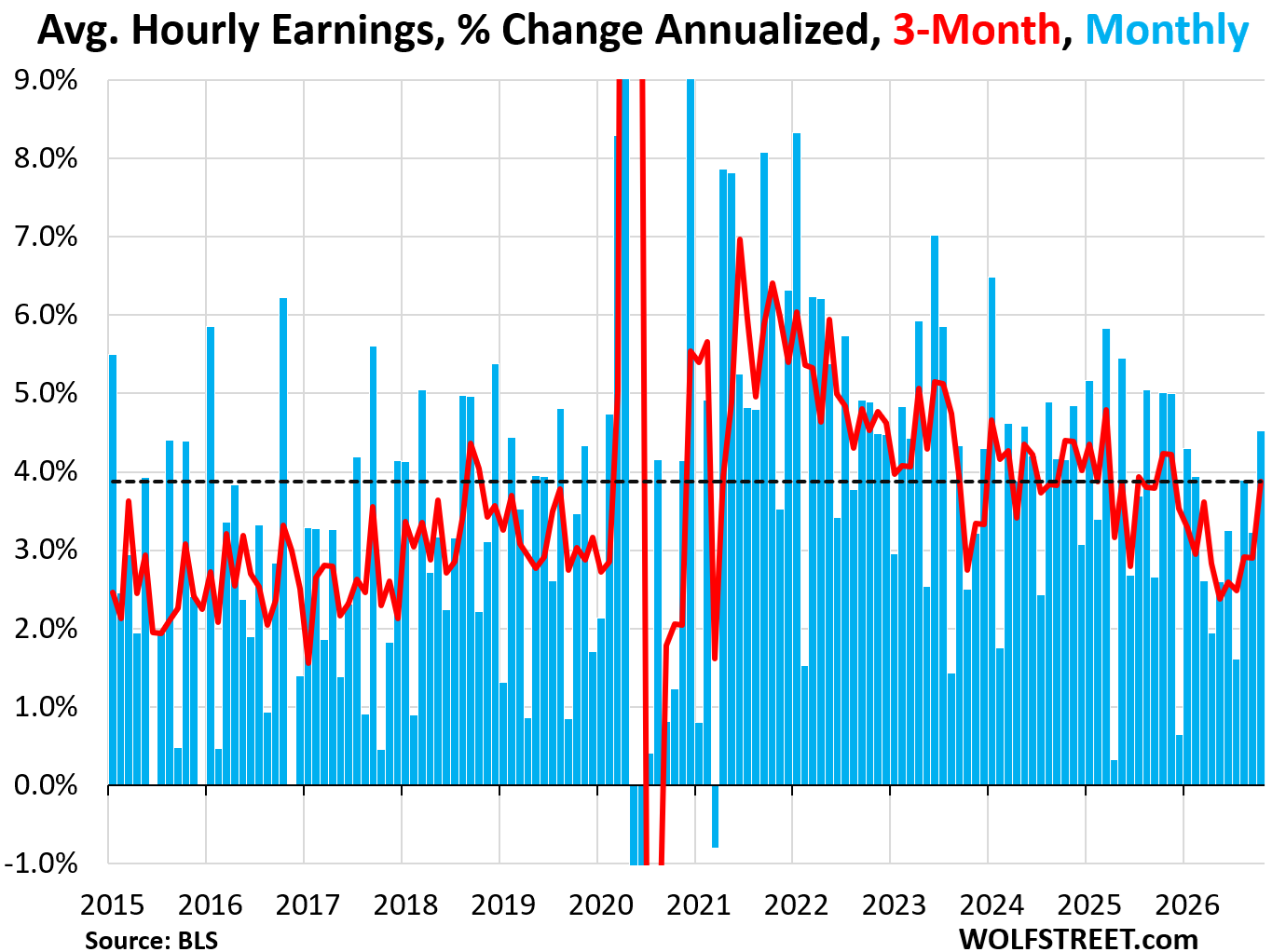
Average hourly earnings jumped by 0.37% in October from September, the biggest month-to-month gain in 11 months, and the September increase was revised higher.
The three-month annualized gain jumped to 3.9%, also the highest in 11 months.
Year-over-year, average hourly earnings increased by 3.1%.
Inflation has been accelerating since mid-2025 and has been running hot this year. CPI inflation rose by 3.7% year-over-year in September, and has been outrunning earnings increases for several months this year. Americans hate that and expressed their feelings about it at the voting booth.

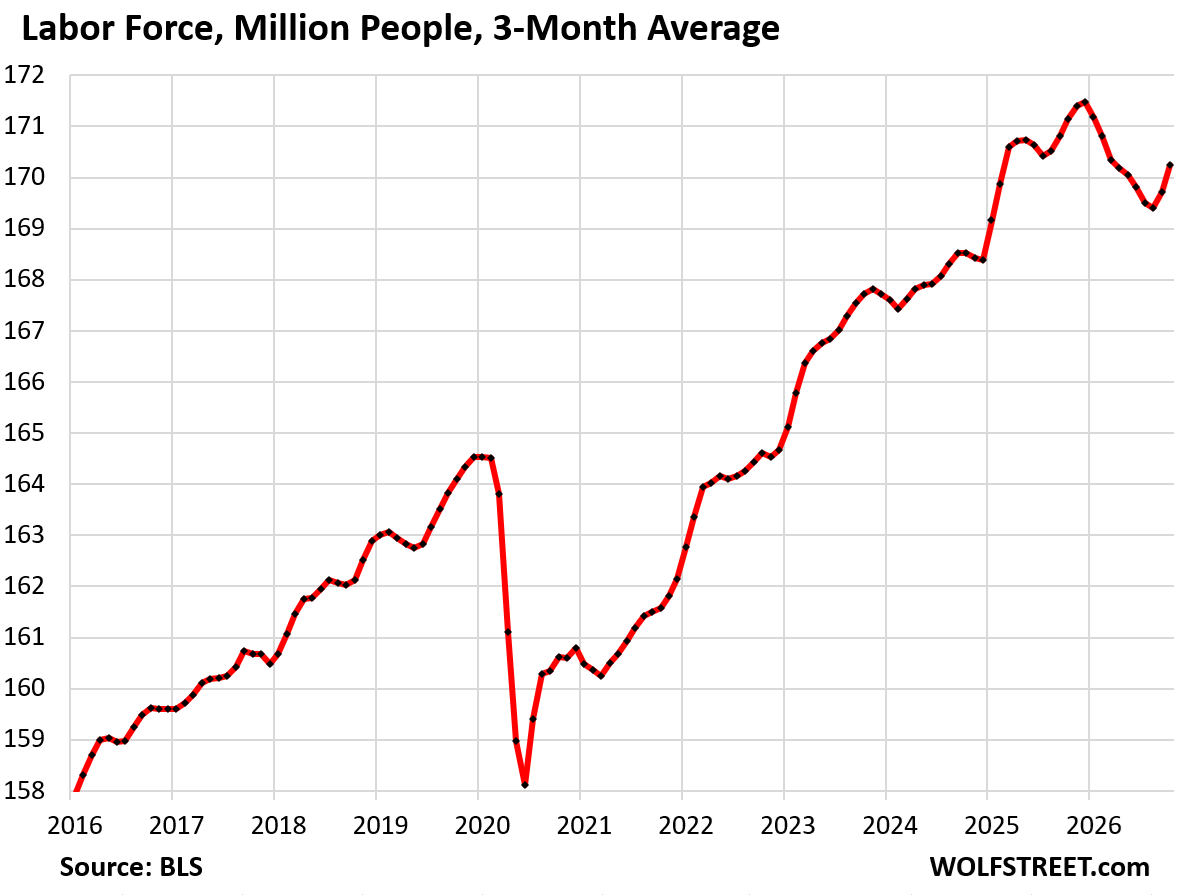
The labor force rose by 421,000 people who either had jobs or were looking for jobs in October, to 170.68 million, the third month in a row of big increases (totaling 1.59 million) as more people got drawn into the labor market, following a series of big declines earlier this year.
The three-month average, which irons out some of the big month-to-month swings and the huge adjustments, rose by 530,000 in October, the second month in a row of increases, after having dropped by 2.07 million earlier this year as a result of the crackdown on illegal immigration and the ongoing boomer retirements.
The labor force consists of people who are working and people who are not working but are actively looking for work. When a person decides to retire, they exit the labor force. The data is collected via surveys of households.
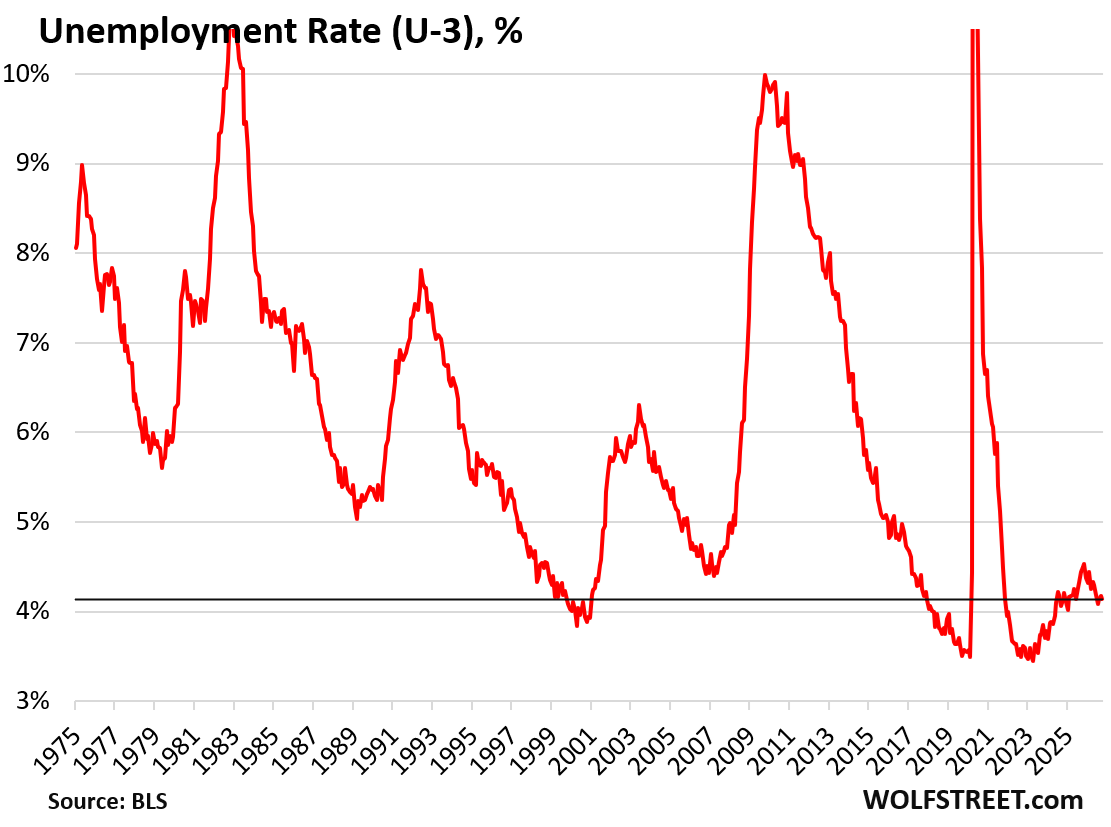
The unemployment rate edged down to 4.14%, a historically low rate within a 50-year timeframe.
The unemployment rate reflects the number of unemployed people who are actively looking for a job (7.07 million) divided by the labor force (170.68 million).
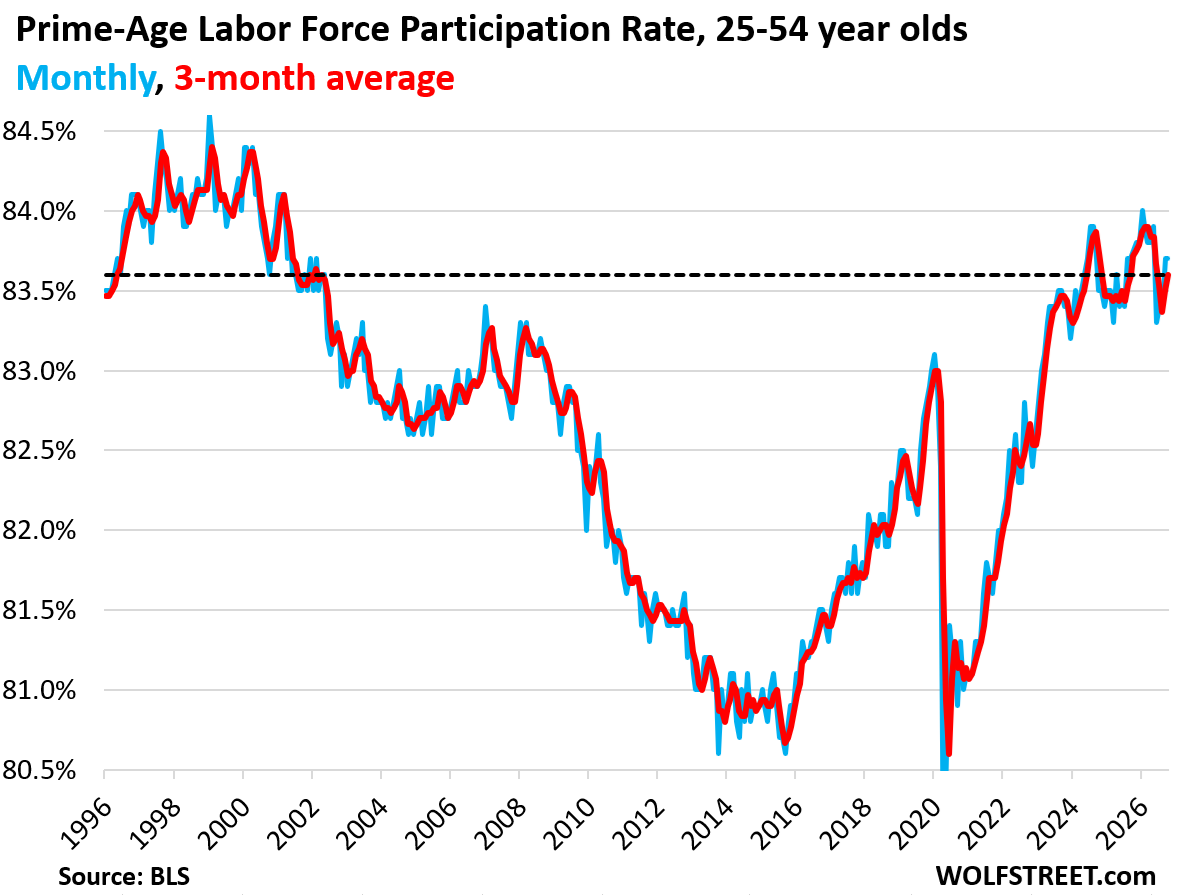
The prime-age labor force participation rate remained at 83.7% in October, same as in September, and both were the highest since May (blue in the chart below).
The three-month average rose to 83.6% (red). The range that has prevailed over the past three years is the highest since the burst of the Dotcom Bubble over 24 years ago.
The prime-age labor force consists of people between 25 and 54 years old. It eliminates the issue of the retiring boomers. When people retire and stop looking for a job, they’re no longer “participating” in the labor force. It’s the surge of boomer retirements over the past 15 years that has pushed down the overall labor force participation rate (not shown here), but not the prime-age labor force participation rate, which has been very high over the past three years.
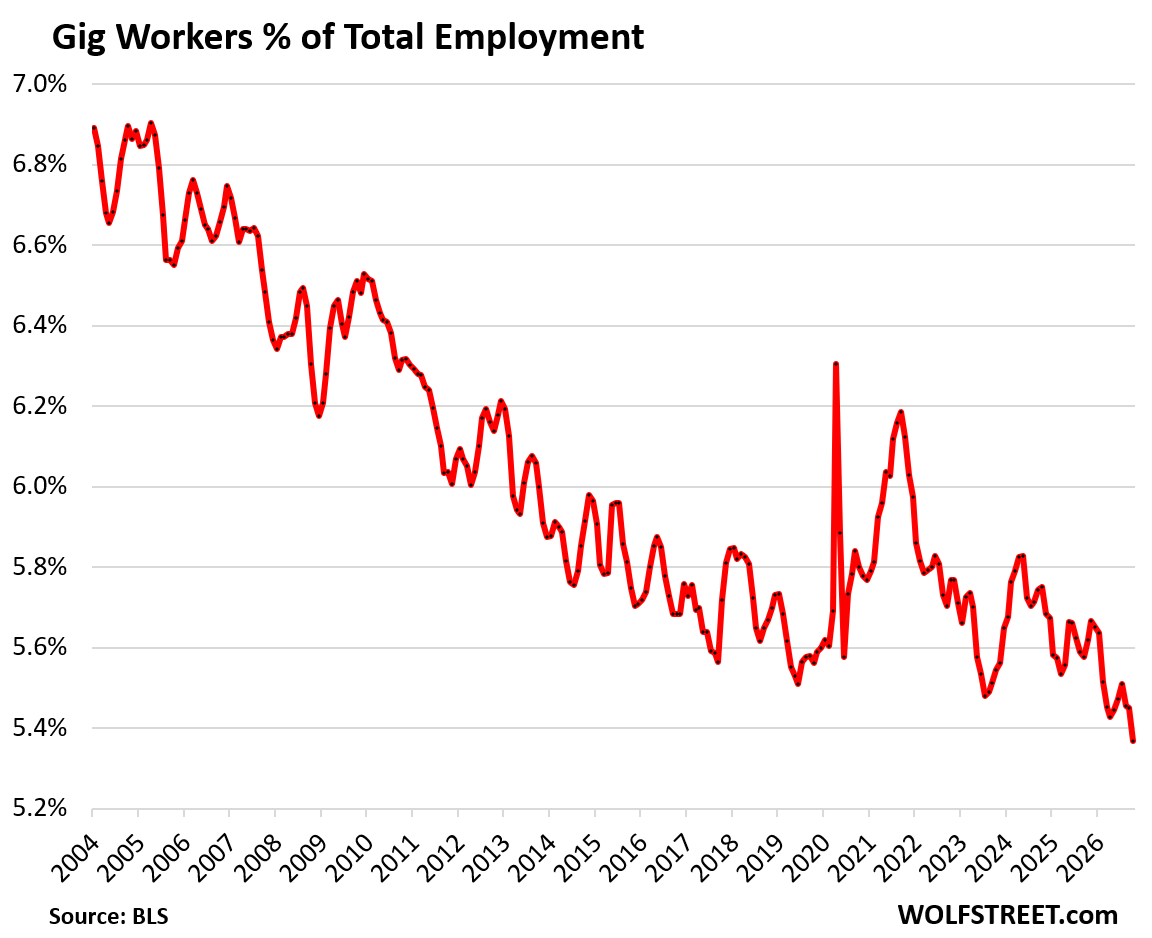
Oh, and the gig workers — officially called “self-employed” — as percent of the total employment. Gig workers have existed for at least as long as salaried workers.
In case you missed it: A Phenomenon: Initial Applications for Unemployment Benefits (4-Week Average) Drop to the Lowest since 1969
Enjoy reading WOLF STREET and want to support it? You can donate. I appreciate it immensely. Click on the mug to find out how: