
Job Openings to fill those left-behind slots rose, hires jumped, layoffs & discharges fell and were low.
By Wolf Richter for WOLF STREET.
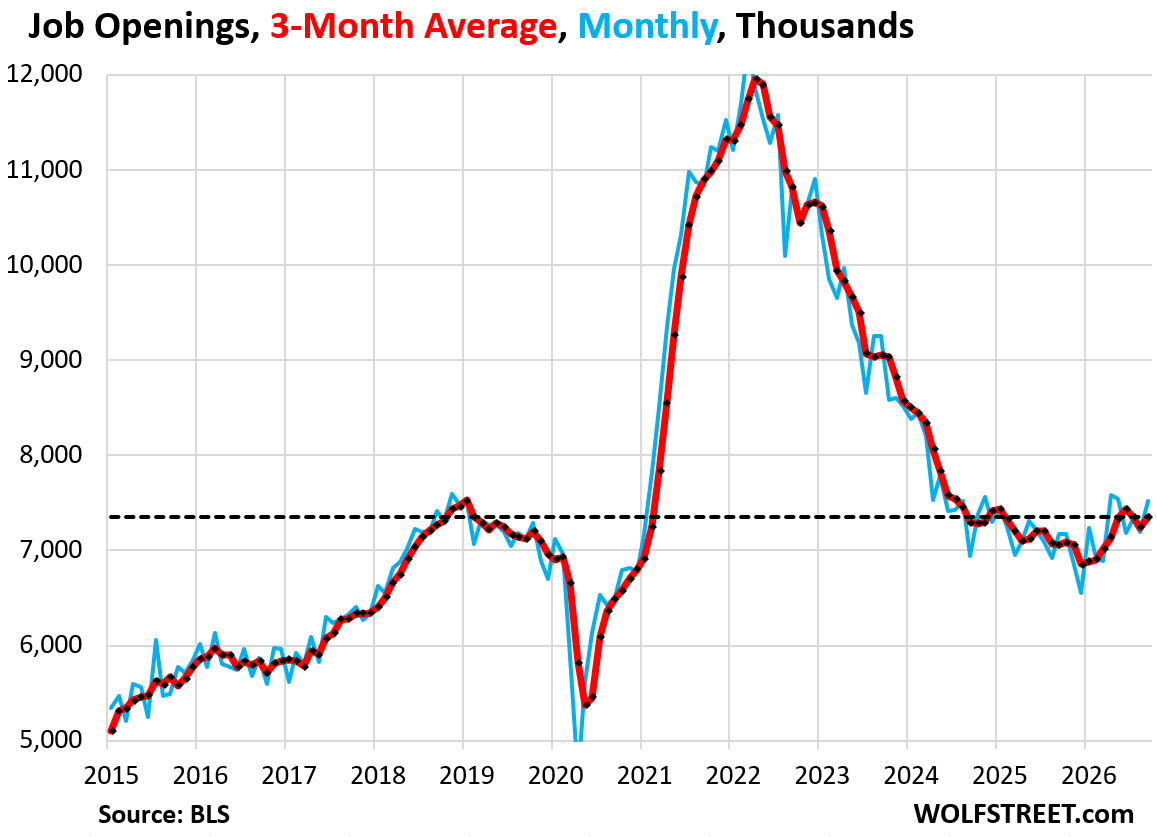
Job openings rose by 333,000 in September from August, to 7.52 million (blue in the chart), driven by the biggest jump in voluntary quits in over three years that left behind job openings that needed to be filled, amid very low discharges and layoffs, and a jump in hires. Compared to a year ago, job openings rose by 4.9%.
The three-month average, which irons out the month-to-month squiggles and includes the revisions, rose by 114,000 in September from August, to 7.35 million and was up by 4.1% year-over-year.
These job openings are a result of people who quit their jobs, got fired or laid off, or retired, or separated for other reasons, thereby leaving behind job openings that employers then attempt to fill with new hires. In 2021-2023, during the labor shortages, quits had exploded as workers were switching to better jobs elsewhere on a massive scale, which triggered a huge churn in the labor market and a historic spike in job openings that eventually had the effect of rematching workers and employers. In the chart, note the acceleration since late 2025.
These stages of churn in the labor market — separations of all kinds, job openings left behind, and hires to fill those slots — are tracked by the “Job Openings and Labor Turnover Survey” (JOLTS) by the Bureau of Labor Statistics. The JOLTS data for September, released today, provides additional color to the labor market conditions in September, already outlined in early October by the nonfarm employment report for September.
The data for job openings is based on a survey of HR departments at 21,000 business locations, not online job postings. A job is “open” only if it meets all three conditions:
- A specific position exists, and there is work available for that position.
- The job could start within 30 days.
- The employer is actively recruiting workers from outside the establishment to fill the position.
Excluded from these job openings are positions open only to internal transfers, promotions, demotions, or recall from layoffs; positions for which employees have been hired but have not yet started; and positions to be filled by employees of temporary help agencies, employee leasing companies, outside contractors, or consultants.
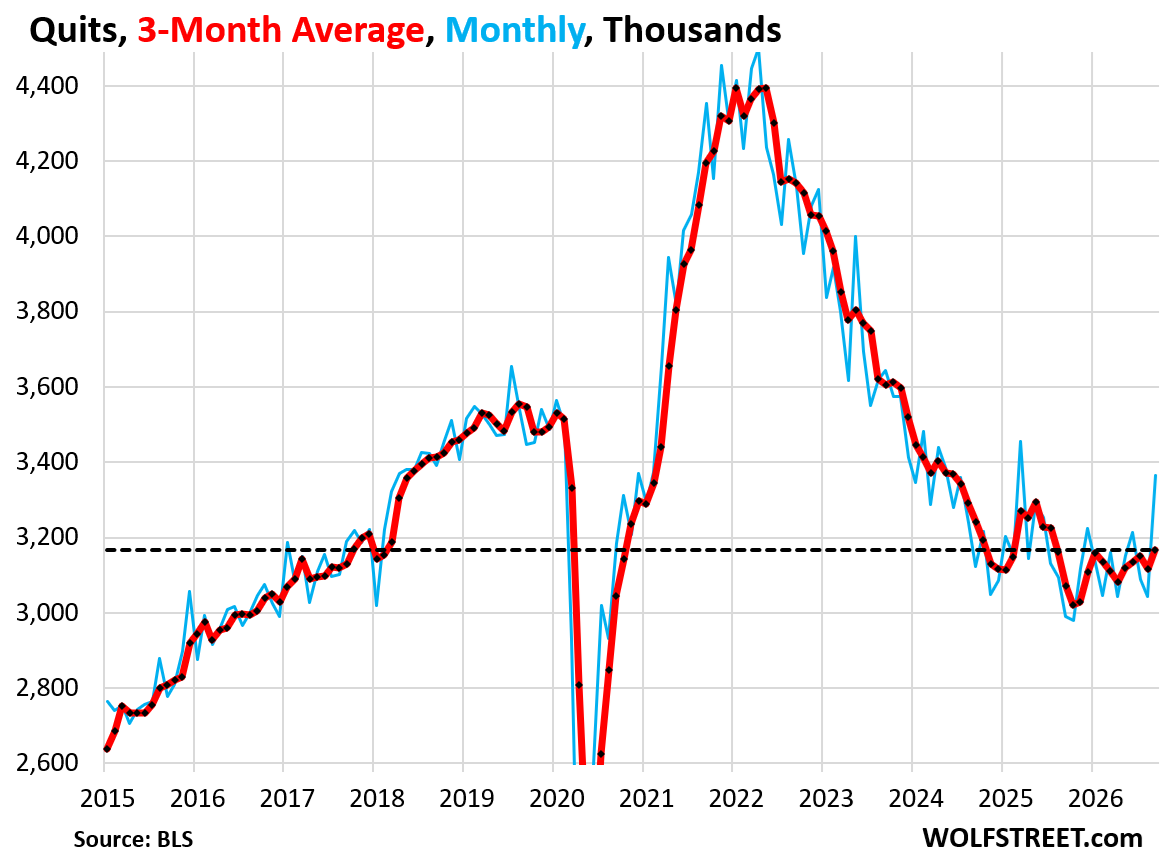
Voluntary quits spiked by 321,000 in September from August, the biggest month-to-month increase in over three years, to 3.36 million workers who quit their jobs, up by 12.5% year-over-year (blue in the chart).
The three-month average rose by 51,000 to 3.12 million, up by 3.0% year-over-year (red).
Quits are the primary source of labor market churn, accounting for 63% of total separations. More quits mean more job openings left behind that need to be filled and more hires to fill them.
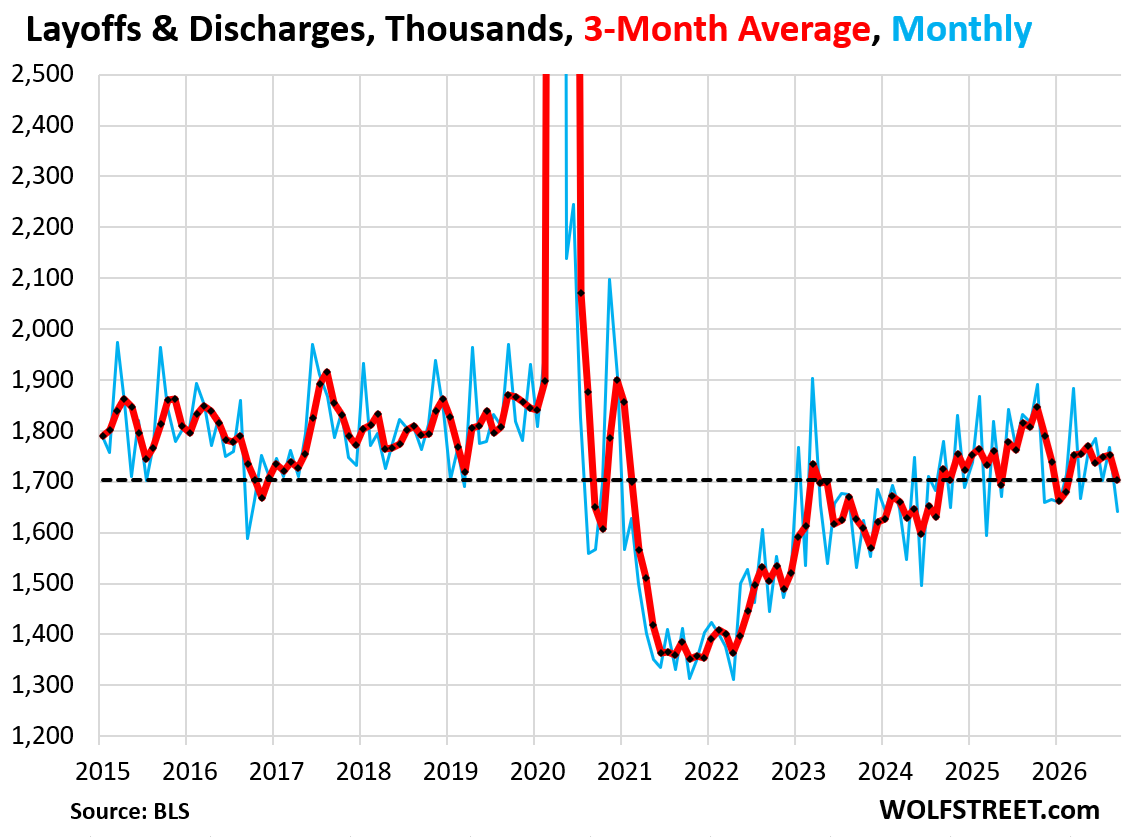
Layoffs & discharges declined by 127,000 in September from August, and by 9.6% year-over-year to 1.64 million, the lowest since March 2025.
The three-month average declined by 48,000 in September from August, and by 5.7% year-over-year, to 1.70 million.
Getting fired for a variety of reasons, or for no reason, is a standard feature of the US labor market.
These levels of layoffs and discharges are at the very low end of the range of the pre-pandemic years. The only time they were significantly lower over the past decade was during the labor shortages in 2021-2023.
Layoffs and discharges accounted for 31% of all separations in September.

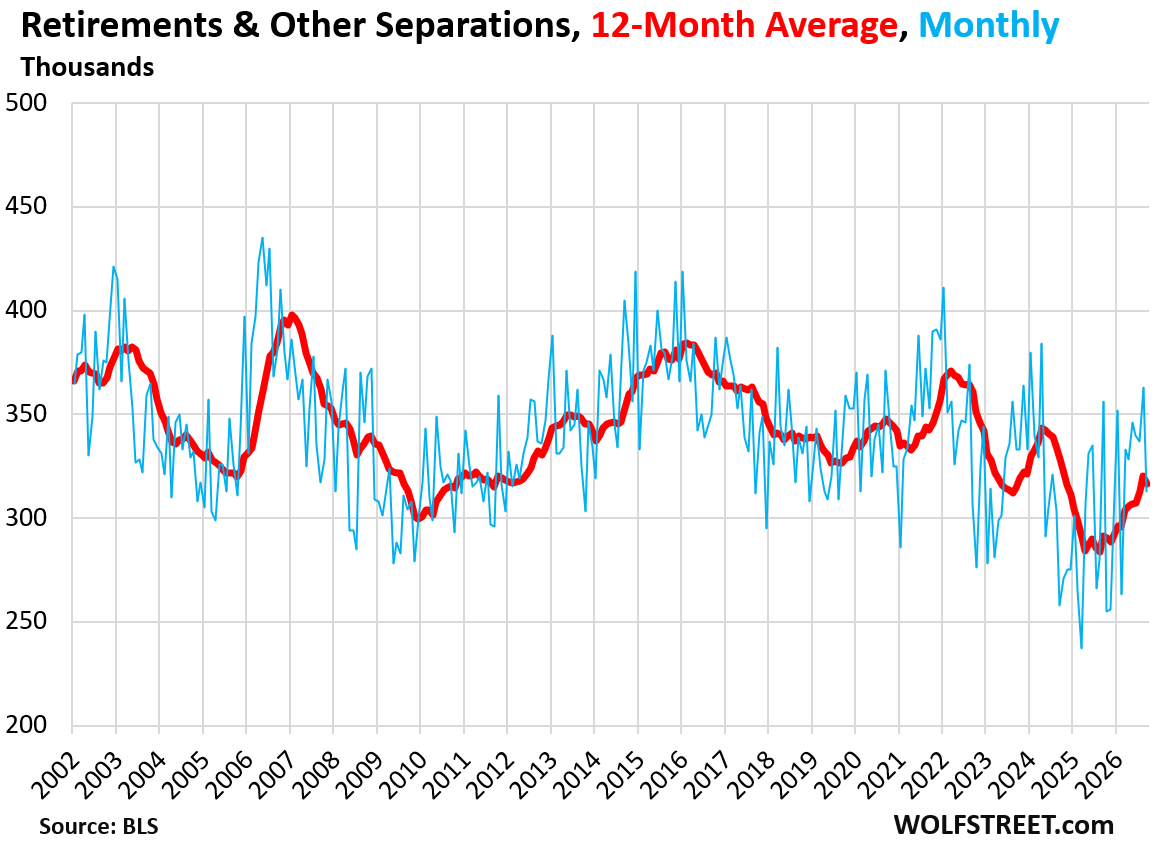
Retirements and other separations (including deaths while employed), accounting for 6% of total separations, are only a small factor in the turnover equation.
They fell to 313,000 in September. The 12-month average, which irons out the month-to-month spikes and plunges, rose to 317,000. The JOLTS data only go back to 2001; within that time span, retirements and other separations had booked a series of record lows over the past two years.
To fill those jobs left behind: Hires rose by 131,000 in September from August, and by 3.0% year-over-year, to 5.40 million.
The three-month average rose by 23,000 in September and by 1.3% year-over-year, to 5.27 million hires.
Nearly all of these 5.40 million hires in September filled slots left behind by prior separations (quits, layoffs & discharges, and retirements & other separations). The number of “Hires” does not speak to job creation in September; the nonfarm payrolls report on October 2 already addressed job creation in September.
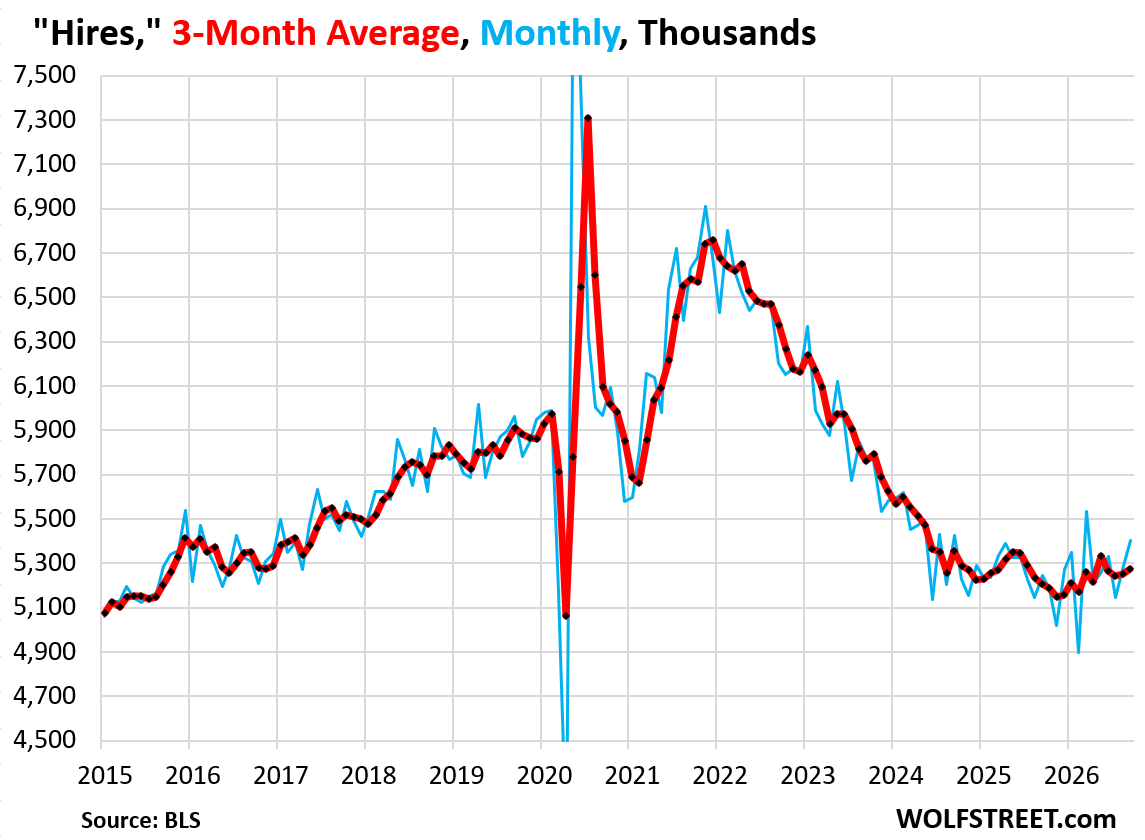
What this turnover data shows is that the massive chaotic churn in 2021-2023, driven by a tsunami of quits, has calmed down and has normalized. But in 2026, the churn has been re-accelerating somewhat.
The massive wave of quits in 2021-2023 had the effect of reshuffling the labor force and led to a large-scale rematching of workers and employers that was costly for employers at the time, triggered big wage increases for workers at the time, and reduced productivity at the time, but has likely resulted in a better overall fit between workers and employers.
In case you missed it: Economy Is Running Hot on Strong Consumer Spending Growth & Massive AI Investment Boom
Enjoy reading WOLF STREET and want to support it? You can donate. I appreciate it immensely. Click on the mug to find out how: