
The US government holds half of all multifamily mortgages. The rest is spread around.
By Wolf Richter for WOLF STREET.
There are about $2.3 trillion in multifamily commercial real estate (CRE) loans out there, backed by buildings with rental apartments. The US government, via Fannie Mae and Freddie Mac, holds about $1.2 trillion of that. Fannie and Freddie have become very aggressive multifamily CRE lenders. So, dear taxpayer, you’re on the hook for about half of the multifamily CRE debt.
The rest is held around the globe by banks, insurance companies, real estate funds, alternative asset managers – a melted-down mortgage just hit Bridge Investment Group, a unit of PE giant Apollo (more on that in a moment) – holders of Commercial Mortgage-Backed Securities (CMBS) and Collateralized Loan Obligations (CLOs).
All of them have gotten hit by melted-down mortgages as the higher interest rates make it just about impossible to refinance the balloon payments when they come due on fixed-rate loans, or even make interest payments on variable-rate loans pegged to SOFR, which jumped when the Fed started hiking its policy rates. The result has been wave after wave of multifamily defaults, and it keeps getting worse.
CMBS holders got hit by another default: The $210 million interest-only 5-year mortgage on a Class A 283-unit 20-acre waterfront apartment property, “The Cove at Tiburon,” across the Bay from San Francisco. The mortgage had been issued in 2020 to refinance the property at ultra-low interest rates. The mortgage was then securitized and sold to investors who thought that ultra-low interest rates would be a permanent feature.
The interest-only mortgage became delinquent when it wasn’t paid off in October, after having already been modified and extended in November 2025. It could not be refinanced at current interest rates because the declining rental income wasn’t enough to cover operating expenses and the interest payments at today’s interest rates. Now there are talks underway to extend it for another six months, according to Trepp, which analyzes and tracks CMBS. Extend and pretend forevermore.
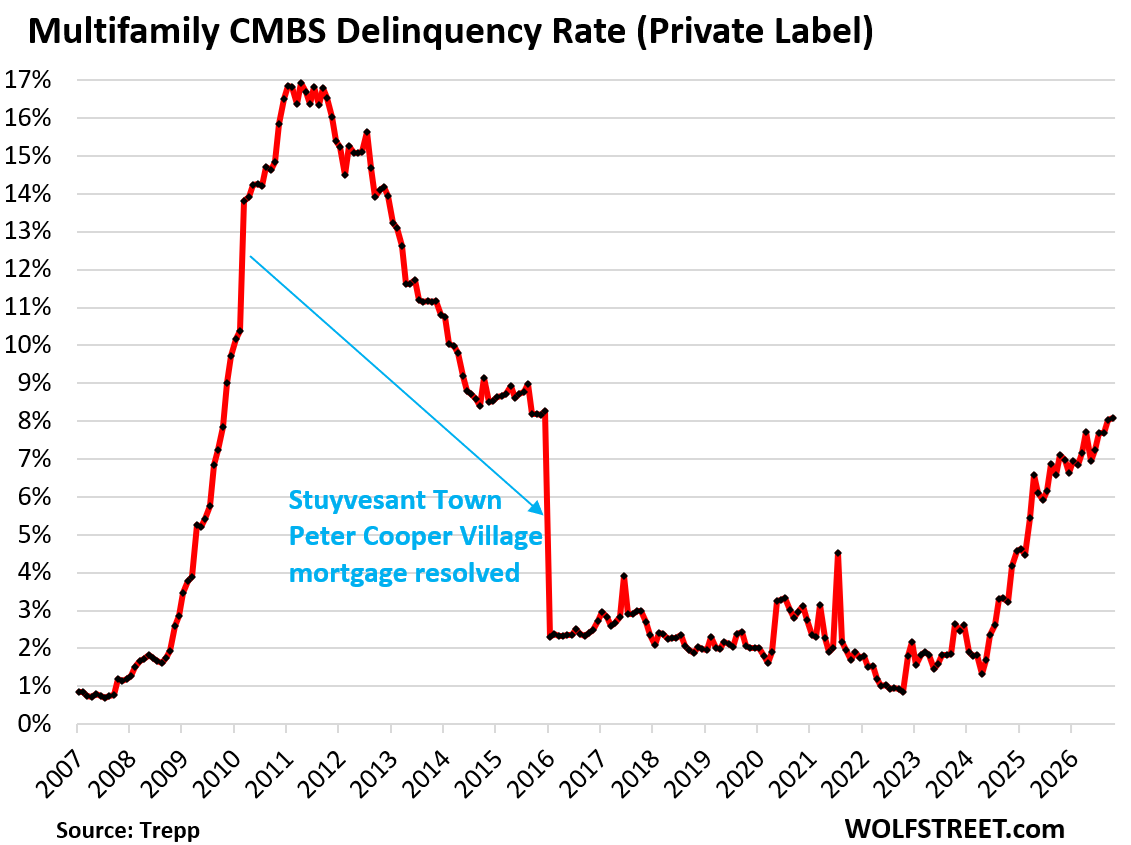
The multifamily CMBS delinquency rate rose to 8.1% in October, driven by this delinquency, the highest since 2016, when the $3 billion delinquent loan on the huge 11,250-apartment campus, Stuyvesant Town–Peter Cooper Village, in Manhattan, was paid off by the acquirers of the property.
Back in 2024, Morningstar DBRS, which rated the CMBS, wrote about the problems lining up for the mortgage on The Cove at Tiburon:
“At issuance [of the loan in 2020], Morningstar DBRS shadow-rated the loan investment grade given that the property benefits from a prime waterfront location, superior amenities, and limited competition within the submarket. However, despite these aspects, which Morningstar DBRS expected to contribute to cash flow stability over the loan term, the property’s reported occupancy rate and cash flow trended downward shortly after issuance, primarily as a result of a slowdown in leasing activity….
“As per the March 2024 rent roll, the property was 80.2% occupied at an average rental rate of $5,789 per unit, compared with June 2022 figures of 91.9% and $5,852 per unit, respectively.
“It appears that new leases are being signed at lower rental rates to curb increases in vacancy rates, resulting in lowered cash flows.…”
And now that property would have to be refinanced at much higher interest rates, and that just doesn’t pencil out.

Other lenders got hit too.
Bridge Investment Group, an alternative investment manager owned by PE giant Apollo, is now stuck with the defaulted $360 million loan on The Beaudry, a new high-end 64-floor apartment tower in downtown Los Angeles, with 785 units and amenities such as floor-to-ceiling windows, saltwater pool, spa, rooftop lounge, 24/7 athletic club, a full-swing golf simulator, etc.
The tower, which opened in 2023, was developed by giant real-estate developer and landlord Brookfield for about $600 million. Because the $360 million loan cannot be refinanced at today’s interest rates without a massive capital infusion, Brookfield decided to hand over the keys, walk away from the property and the loan, and let the lender worry about the whole schmear, according to the WSJ today.
Brookfield, which already defaulted on mortgages of numerous office towers in Los Angeles and around the country, has played a substantial role in the Office CRE meltdown.
Bridge Investment Group is now trying to sell the Beaudry loan – and thereby the rights to the property.
The Beaudry has lots of competition: Over 10,000 new apartments were built from 2017 to 2021 in downtown L.A., the most of any other downtown in the country, according to RentCafe, cited by the WSJ.
Then came working from home, and proximity to now substantially vacant and defaulting office towers wasn’t such a magnet anymore.
At the Beaudry, rents start at $2,424 a month for a 539-square-foot studio on the sixth floor, according to its website. Up the scale, a two-bedroom 1,200 sf apartment on the eighth floor is listed at $4,905. The same floorplan on the 20th floor is listed at $5,730. A 3-bedroom 1,700 sf unit on the 49th floor is listed at $8,893. All of them with big views.
Asking rents average around $4,200 a month at the Beaudry, according to CoStar, cited by the WSJ, far below what Brookfield had aimed for. “A lot of students live here,” Max Xing, a student at the University of Southern California, told the WSJ. He moved into a studio in August. But the Beaudry was designed as high-end living for professionals working downtown, Andrew Parks, a lead designer on the Beaudry, told the WSJ. “We wanted to go for something that felt very sophisticated.”
In addition to the higher interest rates…
There are other pieces to the multifamily meltdown, including:
Growing supply: The Growth of the Vacant Housing Stock in the US
And pressure on multifamily rents: Single-Family & Multifamily Rents in the US and 22 Large US Metros
Enjoy reading WOLF STREET and want to support it? You can donate. I appreciate it immensely. Click on the mug to find out how:


Everybody wants to build for the upscale, luxury market, and it works out great until they run out of upscale, luxury tenants. Then the lower the price and rent to 3-4 college kids. Hey, at least the kids get a great view…..
Yes. That is very good for everyone. The old and wealthy should work hard and provide for a better standard of living for the young and poor.
The old had the same thing done for them, they just don’t remember. In their head it was all their own efforts
Jorge,
Factional infighting based upon identity politics (age-based factional politics in your telling) will accomplish nothing – since it had little to do with creating this emerging disaster.
Basically, delusional fiscal policy for 50 years (habitual fiscal and trade deficits, which no country can survive indefinitely – and the US is no magical unicorn in this regard either) and even more delusional monetary policy from 2002-2022 (money-printing based ZIRP, despite the perpetual deficits mentioned above) has turned the US housing market into an interest-rate speculation casino – with highly volatile home prices and artificial reality based asset valuation.
Cas127,
Thank your for the reply. Although I am not knowledgeable enough to understand fully those financial causes and effects, I know your statements are correct. I don’t disagree that factional thinking helps, nor that housing is functioning like a casino.
What I can tell you that I know, based on my profession and lived experience, is that the housing supply has been restricted of growth largely based by old and wealthier demographics, based on “increased traffic and noise”, unapproval of those who rent and a tad of racism.
The financial conditions have allowed for the uncontrolled price growth, but the deep and truthful cause is not enough housing being built.
Thankfully zoning regulations in almost all states are being dismantled, and hopefully single family ONLY zoning is eliminated nation wide.
Frank wrote: “Everybody wants to build for the upscale, luxury market, and it works out great until they run out of upscale, luxury tenants…”
I am seeing that happening now where I rent in a 65 year old 55+ apartment building. In June the former owner sold out to a group of “investors”. They promptly raised rents, added utilities, and invented all sorts of “fees”. It only took 4 months for 7 of the 34 tennants to move out. So far only 1 unit has been rented. Another 10 residents have been looking for a new place.
I don’t know how the building was financed. But I suspect (hope) the investors are in shock.
These leased percentage numbers are like NFL team attendance stats – made up. I know of ~5k a month new apartments being built in a place where the median income is 25k a year by a major, major firm in the industry.
CRE is a shady bunch of people and are holding bags of crap trying to not be holding when it falls.
“I know of ~5k a month new apartments being built in a place where the median income is 25k a year by a major, major firm in the industry.”
Name and location please.
I’m not really, entirely doubting – because Zumper has periodically shown some seriously whack-a-doodle rental price *inflation* in some very, very hard to believe places (Buffalo, Cleveland, etc.) – so if crazy things can happen on the upside, I’m willing to accept that crazy things might occur on the downside.
(I kinda assumed the aforementioned isolated rust belt rental explosions possibly had *something* to do with politics-influenced spending – some hugely subsidized chip plant being built nearby or some hugely subsidized solar panel plant…and while I do think Zumper’s monthly rent price surveys might be a bit flawed, I don’t think Zumper is so off as to mis-report 10-15% annual rent hikes in the odd rust belt city).
There is nothing wrong with that.
Build luxury units. Yesterday luxury then become mid-tier. Mid-tier becomes lower end.
Build beyond market support? That is the chance the developer took. And it may mean taking a loss. That is life.
been in rental market for 30+ years
looking for more now that prices are starting to crater
since I make my money on buy I have no problem cash flowing
then again I’m not big units were 5 year financing is JOKE
if I can’t pay CASH or have 30 year financing (seller if need be)
I don’t buy
“Build luxury units. Yesterday luxury then become mid-tier. Mid-tier becomes lower end.”
Very true…but the process has been so damn slowwww…
And compare it to the wildfire 18 month run of rental inflation in 2021-2022 when rents went up 25%-30% (which might have taken 8-10 *years* in more normal times). And that wildfire was very largely *nationwide* (suggestive of semi permanent macroeconomic harm due to the Pandemic money print).
And while some markets have given back a small fraction of those wildfire gains, the aggregate national rental inflation has remained tenacious and toxic (suggesting that artificially induced demand – the opened floodgates to an extra 2-4 million illegals during last yrs of Biden admin – have extended the lifespan of those wildfire inflationary rent increases).
And at 30%+ of household expenditures, housing costs are the biggest drain on family finances by far – nothing else is even remotely close. The next biggest cost line item is like 6% of household expenditures…a measily one fifth of housing costs.
And 20 years of terrible interest rate policies have literally deranged the housing mkt.
When you look at the delta of building a class A vs class B property, it is NOT substantially different. Land costs are elevated but your soft and hard costs are almost the same. Beside an increase in amenities, the cost for a Class A might be 10-15% higher. But the rental difference is substantial. So why would anyone build a class B deal if the cost and the “pain and suffering” of entitlement and development are the same?
The thing that has caused undue stress in the market is almost the same as to what caused the problems in the residential market….Government involvement. Starting QE and running it for 4 rounds artificially increased the values of assets due to repressed lending rates. When the rates increased (due to a number of factors) and the start of QT, values are getting killed. Add in Covid and the government dropping money on everyone and you get the added bonus of incredible inflation.
I think the saying….”Show me the incentive and I can predict the outcome,” rings true here.
Last thought….All I want for Christmas is just to learn all the things that Wolf has forgotten. :)
“So, dear taxpayer, you’re on the hook for about half of the multifamily CRE debt.”
Since when did the taxpayer become the lender for over half of the commercial RE debt? This corporate socialism is just disgusting.
After today’s election, get ready for a lot more of it and in more areas than housing.
Fannie and Freddie, the two entities that are aggressively buying multifamily mortgages, are run by a Republican named Bill Pulte. Under his leadership, they have also been buying back their own MBS, which is a risky thing and blew them up last time.
When they buy the mortgage-backed security does that mean they also take over the property?
1Rainman
No. How MBS work: Fannie buys the actual mortgage from a lender that issued it and owns the mortgage. It then puts the mortgage along with many other mortgages it bought into mortgage pools, and then creates MBS backed by those mortgage pools, and then sells those MBS to investors, such as bond funds, banks, insurance companies, etc. Those MBS have guarantees by Fannie that if the homeowner defaults and the mortgage goes bad, the investor in the MBS will not be hit by the loss on the actual mortgage. If the homeowner defaults, and the default cannot be cured, Fannie can foreclose on the property, sell the property. The mortgage amount and accrued interest and fees that exceed the proceeds from the sale of the home become a loss for Fannie, and it eats that loss. MBS holders will be made hole and don’t take a loss.
When Fannie buys back its own MBS with its cash, instead of investing its cash in Treasury securities, it puts its own capital cushion at risk to mortgage defaults because no one guarantees the MBS it bought back since Fannie itself is the guarantor. So switching to investing its capital into its own MBS, instead of into Treasuries, puts the guarantor at risk of getting wiped out when mortgage defaults rise. That’s what happened during the housing bust when Fannie and Freddie were loaded up with their own MBS that went bad.
The reason why they’re buying back their own MBS is to push down the spread between mortgage rates and Treasuries, an attempt at lowering mortgage rates.
@1Rainman,
No. It starts by them outright buying mortgage loans from mortgage lenders (banks, credit unions, non-banks etc). They then bundle thousands of mortgages in tradeable securities called (U)MBS, which they then sell in the OTC market to institutional investors. Normally that puts the risk of these loans with those institutional investors because Freddie Mac & Fannie May themselves have tight caps on how many mortgages they hold that are NOT sold as part of an MBS product, as well as unsold MBS. However, in an effort to surpress mortgage rates, this admin had Fannie May repurchase 200 billion worth of MBS products. This ‘additional’ MBS demand drives down MBS rates which results in lower mortgages rates, if only momentarily. Fannie May uses existing liquidity levels for this that would otherwise be used to buy and sell mortgages. This has two effects, it lowers the freedom of movement these institutions have to react to changing market conditions, and it puts the risk of mortgages in the hands of the taxpayer because the dept. of treasury holds a +/- 80% stake in both institutions since the 2008 bailout.
Delinquencies and foreclosures do not directly bring home-ownership in the hands of MBS holders in any scenario. An MBS is a financial vehicle, you don’t own the underlying assets or even the individual loans an MBS is comprised of. Foreclosures do impacts MBS risk levels and therefor their value. Freddie Mac & Fannie May can however become outright RE owners, in the event of default where the foreclosure auction fails. This happens when the auction fails to at minimum equal the remaining loan plus some fees. When it happens that property becomes ROE (Real Estate Owned), it is inspected, if required restored, and then sold in a public listing (homepath.com and homesteps.com for Mae & Mac respectively).
Is the guarantee That Fannie and Freddie will make the MBS holders whole explicit? Or is it assumed because they did it during the financial crisis?
The guarantee is explicit and is written into the MBS contracts.
When Fannie and Freddie were kind-of semi-private GSEs before the Financial Crisis, US GOVERNMENT guarantees were implicit. But they became explicit when the US government took over Fannie and Freddie and put them into conservatorship.
If Republicans are not happy about the elections results, they need to look in the mirror for the cause. And keep in mind, for these results, some Republicans didn’t vote the way they “should” have. That says a lot about current state of things for many. But don’t worry, the Democrats will now have their turn to pander to their extreme part of their party and the cycle will continue
There’s one aspect I’m thrilled about. Hopefully, the election results put to rest the lie from the mainstream media that the voters care about the stock market. Clearly, they don’t. While 60% of Americans have some exposure to the stock market, nothing changes the fact that the top 10% of Americans own 93% of the stocks, meaning that all-time highs mostly benefit a relatively small few. That 10% alone doesn’t win you elections.
Now, that’s not to say that the negative consequences to a stock market crash won’t upset voters in other ways, but if a stock market crash can be contained to mostly just stocks, as happened in 2000, I don’t see much influence on the political situation.
“Hopefully, the election results put to rest the lie from the mainstream media that the voters care about the stock market.”
Ironically, we have an absolute moonshot to beat all moonshots going on.
Depth Charge, the theory is that the Democrats will do what they do best, which is hand out free shit to low and middle income people (as opposed to the Republicans who what they do best is give out tax cuts and indulge the military-industrial complex).
I don’t know though, how they think the Democrats will do that while Trump has the veto pen. Not unless they give him something that he wants.
I’d be more than happy to help them out
1st I’ll take over management and then find proper buyers within 12 months at MARKET PRICES of course
I use simple NOI (based on OCCUPANCY, deferred maintenance and market rents) and current Rate of RETURN to determine price
Trump campaigned on privatizing “socialist” institutions Fannie and Freddy, and people jumped into the stocks and voted for Trump thinking Trump would make them rich.
He did not.
And that’s because removing the government’s liability would lead to 9-10% 30 year mortgage rates. People would be pissed and the RE market would melt down and banks would be collapsing again. We’d be back to bailouts because all roads lead to socialism when voters expect the government to manage the economy.
But now there might be some traction to the idea of privatization. A lame-duck Trump has no disincentive to try to push this through, letting the consequences fall upon the Democrats and the voters who elected them. Voters in 2028 will be blaming their Democratic Congresscritters for the recession and pivot back to Republicans (That’s how short the memory span is).
Asking this in good faith, whats the basis for mortages becoming 500 basis points above the 10 yr?
“…all roads lead to socialism when voters expect the government to manage the economy.” is a great line btw.
Ray Charles, because if the GSEs were privatized, and didn’t carry an implicit federal guarantee, during a major recession with a lot of foreclosures, the GSEs wouldn’t be able to make good on their guarantee. So a lot more risk would be priced than against the 10 year.
Somebody understands how things actually work. I wish more people did.
Forbes: “U.S. Private Credit Defaults Hit Record 6.3% As Quiet Distress Grows”
“Approximately 88% of default events stem from soft restructuring mechanisms like interest deferrals, payment-in-kind introductions, and stressed maturity extensions.”
In other words, defaults are being papered over, 88% of them, to be exact. It’s a house of collapsed cards that they pretend hasn’t collapsed.
Typical Forbes clickbait bullshit. And you fell for it.
Forbes cites Fitch’s brand new “U.S. Private Credit Default Rate” index. Fitch started that index in September 2024, with a default rate of 5.0%. That’s how far the report data goes back to: September 2024.
Within that 2-year time frame of the new index back to September 2024, the default rate hit a record 🤣🤣🤣
Fitch’s index didn’t exist in April 2020, when loan defaults spiked out the wazoo. And it didn’t exist in 2015/2016 when oil and gas loans imploded and defaults spiked out the wazoo, and it didn’t exist during the Financial Crisis when defaults across everything spiked out the wazoo and on to high heaven.
And restructuring troubled loans before defaults push the company into bankruptcy is as old as loans themselves. That’s how it should be done. And sure investors are taking some losses, but they’re making a huge amount off high interest rates, and they’re still coming out ahead.
These AI-morons at Forbes fucked with you, and you fell for it because it fit your narrative, and now you wasted a lot of my time by dragging this Forbes bullshit into here, and make me deal with it. Dragging bullshit from the internet into here is one of the Seven Deadly Sins of Commenting.
This is a perfect example of why Wolfstreet is invaluable for sifting through the wanton bs.
wolf seems all knowing. i would assume he’s a quadrillionaire by now.
yippee
I loathe internet bullshit. But people love it and click on it and spread it because it suits their narrative, which is precisely WHY it exists. Don’t do it here. There is not enough time left in my life to waste it on internet bullshit.
Any data on GSE multifamily delinquency?
“…sold to investors who thought that ultra-low interest rates would be a permanent feature….” I am not the smartest guy around, nor the savviest of investors, but the evidence is mounting that I am a bit sharper than a lot of bankers and hedge fund guys who thought it wise to invest long term in order to get an extra 1/4 point rather than staying short term as I did.
I thought you had passed ! 2 Tickets To Paradise etc. How is it up there ?
@Wolf I have a request for a post:
Which big banks are most exposed to CRE debt?
I find myself with lots of big bank equity and bond exposure lately, and I wonder if my banks will be left holding the bill by groups like Brookstone and the PE firms.
@Chris B
Shameless plug…check out bankingstats.com. It’s not going to give you a handy list of banks that have biggest exposure (hint, FLG is one of the worst public ones), but you can search any bank/credit union and see some info on them directly.
I remember asking someone pretty high up in the solar pv farm business about matching income to interest rates, and how they adjust for changes.
He told me that they get a PURPA (repurchase agreement from utility) for 20 years and can match loan values and terms to that. So they were anticipating for changes.
Granted there has been pain in the industry, so maybe not everything was accounted for by everyone.
I guess the CRE-people didn’t do anything like this? Or did they, and it wasn’t enough?
I wondered why I have seen so many Apartment Complexes getting slapped up in my city; where is all the money coming from?
Now it makes complete sense, the builders and banks have nothing to lose.
Creating housing supply is good. Any kind of housing. Bring on the supply. Lots of it. Everywhere. That’s the only thing that will put a lid on rents and home prices. If investors take the losses, so be it.
Let’s also couple that with good public transportation. We can build housing a lot denser, even single family if that’s what people want, if we had good, clean, reliable trains. Most places in America don’t, so people care about living closer to their jobs, which creates more housing shortages in those close places.
I would settle for good clean reliable busses.
Nah, buses get stuck in traffic just like cars. We need dedicated rails.
San Francisco built a double express bus lane down the middle of Van Ness Boulevard, both for our electric trolley buses and for the ICE buses. Van Ness worked great because it’s such a wide street with very wide sidewalks. You can’t do that with every street. Lights are triggered by the buses so they can blow through and don’t have to stop. It works great. Takes up about as much space as a light rail system. During rush hour, buses are faster than cars. But then the buses can get off the express bus lane and do their routes through the neighborhoods. We have light rail in other parts of the city, which is super-fast when its underground, just as fast as our BART and without the screech, but pretty slow on the surface.
We have dedicated lanes for buses these days in the saintly part of the tpa bay area, and IIRC, the same was happening in The SF bay area Bay Bridge many decades ago.
Gotta think most places do the same now, eh?
Also seeing a lot of the buses on full electric motors too!
Well, there is that project in CA ( I’m not sure we can afford more of that type of “public transportation ” LOL
Another data point – or maybe it’s just data is that oversight that oversees Fanny and Freddie filled a very ugly report about the non compliance from Bill Pulte and his staff – running all kinds of interference and non response to information requests.
Who knew thugs and criminals couldn’t be trusted?
‘Dragging stupid-ass bullshit from the internet into here is one of the Seven Deadly Sins of Commenting.’
I saw no such under ‘commenting’. What are the other six? :-)
Time for an update to include AI?
Thanks for all you do. and the way you do it. tis refreshing.
Please forgive my ignorance here.
Re: “The mortgage was then securitized and sold to investors who thought that ultra-low interest rates would be a permanent feature.”
Does the government own whole CRE mortgages tied to specific properties, or does the government buy securities made up of slices of many CRE mortgages?
If the latter, is the securitization serving its purpose of limiting the downside of individual defaults, or are so many defaults happening that the securitization that was supposed to diversify the risk not working?
Fannie and Freddie buy mortgages and securitize them and then sell the securities to investors.
On how much comes due next: reading servicers’ own SEC loan tapes (Form ABS-EE), $30.3 billion of building-secured CMBS balance across 1,684 notes reaches stated maturity in the next 12 months, as of late October. 17.0% of it was already not current or with a special servicer on the latest remittance. It isn’t spread evenly: Washington is at 36.6% and New York at 22.9%. I run DFX Intelligence, which publishes this table free under CC BY 4.0, so the metro numbers can be checked or reused.
Freddie Mac securitizes the CRE loans they purchase in products similar to conduit CMBS issuances. This leaves the bondholders on the hook for any losses.
Fannie Mae is a bit more complicated but their DUS lenders retain loss share portions on most of the loans they purchase. So they’re not on the hook for 100% of losses either.
I don’t think it’s accurate to categorize the US taxpayer as being on the hook for all losses on GSE loans, although I don’t think it’s easy to determine a percentage either.
I don’t understand how extend and pretend happens. Aren’t folks taking losses? And if so, why isn’t anyone except you, Wolf, howling about it?
Why are lenders willing to play the game of extend and pretend, or at least how are they allowed to play it?
Excellent as always, wolf
Thanks
So Brookfield is a “person” when it comes to “free speech” but reverts back to a corporation with no liability when its time to take responsibility for a 600m failed risk….
That free speech is good business.
…..sigh……
They lost the property and all their equity in the property. It was a fairly significant loss for Brookfield. The mortgage was secured by the property, so the lender gets the property, and Brookfield lost the property.
“Brookfield is a leading global investment firm, investing on behalf of institutions and individuals around the world. Start your investment journey today.”
Brookfield apparently didn’t lose a dime.
Now some of their “savvy investor clients” may have a different outlook. I suppose they can revisit some selfies they took with BF management when signing on to the scheme.
Its funds own the properties, not Brookfield itself. I named the Brookfield subsidiary in the article: Bridge Investment Group, which has all kinds of funds, one of which owned the building. Investors in that fund lost money. Another Brookfield fund took huge losses on office towers in Los Angeles.
Brookfield is a huge octopus-like company with all kinds of subsidiaries, divisions, and funds, including some publicly traded parts, etc. Brookfield itself is publicly traded [BN]. Brookfield Asset Management, a huge subsidiary, is majority controlled by Brookfield but the rest is publicly traded [BAM].
They’re all asset managers.
What is the effect of sub optimal parking or even no parking on these new developments? Does anyone have knowledge about this?
All apartment towers, such as the example in Downtown LA, come with parking garages, either underground, or the first few floors above ground. Parking may be included in the rent, or it may be an extra. At the Beaudry, the tower in Downtown LA, it seems parking in the parking garage is an extra. People who want to live in a central location may not want or need a car, and may not want to pay for a parking space, and a car is just an unneeded expense and hassle. That’s the idea of living in a central location that is walkable and has good mass transit. Those who have a car can park in the parking garage, but may have to pay extra for it.
In California, depending on the municipality, a minimum number of parking spaces are generally required by building codes for multifamily, such as 1 or 2 parking spaces per unit, depending on size of unit, though the requirements have been loosened a little recently in some municipalities, near transportation hubs, etc.
Interesting that taxpayers are on the hook for 50 percent of these class A mortgages