
The dictum morphs from “Survive till ’25” (when low interest rates were supposed to return) to “Sell at today’s price, or the lender will.”
By Wolf Richter for WOLF STREET.
The delinquency rate of office mortgages that have been securitized into commercial mortgage-backed securities (CMBS) re-spiked in recent months and in September hit 12.2%, the second highest ever, behind only January 2026 (12.3%), and 1.5 percentage point above the worst moments of the Financial Crisis, according to data by Trepp, which tracks and analyzes CMBS.
The biggest driver of the increase in September was a $1.1 billion maturity default on a loan that had matured in August, and was not paid off. That loan was securitized in 2021 and the different slices of CMBS were sold to institutional investors around the world at the time. The banks that originated the loan are off the hook.
The loan is backed by eight office and film-studio properties of 2.2 million square feet in Hollywood, whose largest tenants are Netflix and 20th Century Fox. But two of the Netflix leases and the 20th Century Fox lease, representing 30% of the net rentable area, are expiring soon, and renewals are still up in the air.
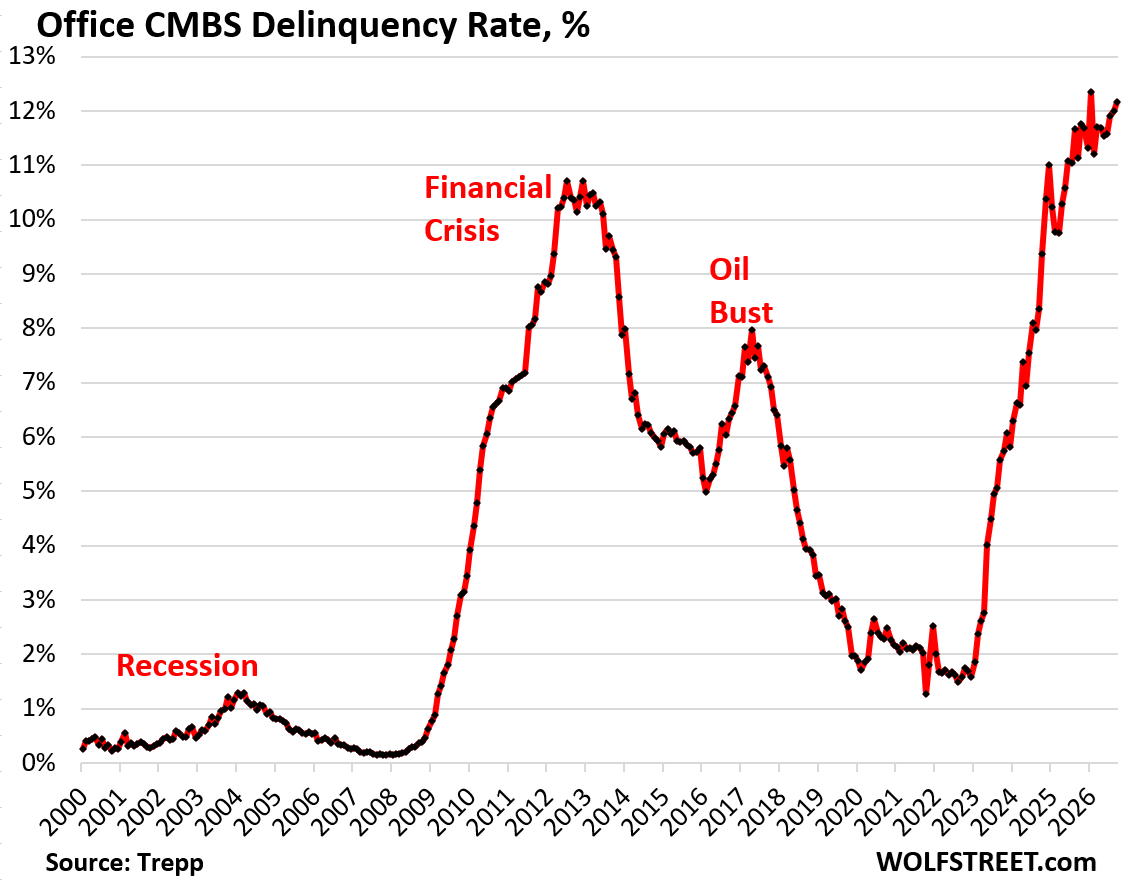
Extend and pretend forevermore?
The $1.1 billion Hollywood loan that went into maturity default in September had been transferred to special servicing in July 2026. The loan is backed by five Class A office towers built between 2008 and 2021 and three film-studio properties, totaling 2.2 million square feet, all located within a mile of each other in Hollywood. The borrowers are the mega-landlords Blackstone Property Partners and Hudson Pacific Properties.
The special servicer that is now managing the loan, representing the CMBS holders, is SitusAMC, the largest special servicer by unpaid principal balance ($111 billion as of January), according to SitusAMC.
Netflix is the largest tenant, leasing 57.8% of the net rentable area (NRA). One of its leases expires in January 2027 (7.0% of the NRA) and another lease expires in June 2028 (17.2% of the NRA), totaling 24.2%. Discussions with Netflix about lease renewals are ongoing, according to SitusAMC, cited by Fitch Ratings, which rates the CMBS.
20th Century Fox is the second largest tenant. Its lease, accounting for 6.4% of the NRA, expires in December 2026. The decision to renew the lease is awaiting confirmation on whether studio productions will be renewed for additional seasons, and the “outcome will determine if the leases will be extended,” according to Fitch, citing the special servicer.
Here is the extend and pretend: The loan was recently modified, and the borrowers, Blackstone Property Partners and Hudson Pacific Properties, were granted a 14-month maturity extension through November 9, 2027, at the current (far below market) fixed interest rate of 4.435%, according to Fitch, citing the special servicer. To get the extension, Blackstone and Hudson Pacific agreed to fund a leasing reserve with $20 million from sources other than property cash flow. Fitch noted that the loan would remain subject to a “full cash trap” until full repayment, with all excess cash flow being directed to the leasing reserve.
Citing the risk that the Netflix and 20th Century Fox leases will not be renewed, Fitch changed its rating outlook to “negative,” putting the CMBS in line for a downgrade “if market conditions, valuations, and/or actual portfolio performance deteriorate beyond Fitch’s current expectations of sustainable performance, particularly if the borrower is unable to address upcoming lease rollover risk.”
The properties were 84.9% occupied in July, down from 91% in September 2025. But the upcoming lease expirations of 30% of the NRA, if not rolled over, would leave nearly half of the space in the properties vacant.
A $470 million loan on office properties in downtown Houston was the second largest driver behind the increase in the default rate as it missed the maturity payoff earlier, according to Trepp.
The loan, originated and securitized into a single-borrower CMBS in 2021, is backed by the 34-story 1.0 million sq. ft. One Allen Center, completed in 1972; the 50-story 1.2 million sq. ft. Three Allen Center, completed in 1980; and an adjacent 6-story parking garage with a health club on top. Brookfield Properties is the landlord.
The interest-only loan comes with a floating rate of SOFR plus 3.08%. After the Fed’s most recent rate hike, SOFR has been about 3.88%, which would move the current rate on the loan to 6.96%. Another rate hike by the Fed will move the loan’s interest rate to about 7.2%. The loan was originated when SOFR was near 0%.
The property is 71% occupied. The largest tenants include Freeport LNG, Motiva, and Plains Marketing, according to Trepp.
S&P Global, which rates the CMBS, noted in March that it was concerned Brookfield Properties would not pay off the loan at the “final extended maturity date” in April. And that maturity date came and went without payoff.
Trepp said that the loan’s move to non-performing status in September could reflect the ongoing loan negotiations.
The idea is to extend and pretend some more until interest rates come back down to 2% or whatever, which might allow for the loan to get refinanced.

Extend-and-Pretend Not Forevermore.
This extend and pretend, or the end thereof, was the theme in today’s First Draft, a note that CRE publication Bisnow sent to subscribers. The note would be hilarious if it weren’t so serious, or both:
“One of this industry’s favored pastimes is the slogan, and for years it reprised one Rialto’s Joe Bachkosky recalled onstage: ‘Survive until ’25.’ But when 2025 failed to deliver, it turned into ‘bliss in ’26.’ Lately, a few idealists have floated ‘heaven in ’27,’ which sounds less like a prophecy every week and more like a prayer.”
Mark Bonner, Bisnow’s editor-in-chief and author of the note, continued:
“AEW’s Lauren O’Neil called the moment ‘a shift back to fundamentals,’ which is industry speak for when the spreadsheet voodoo stops working.
“KBS’ Sondra Wenger said today’s distress ‘is in the structure,’ a murky way of saying the building is fine, but the price paid for it isn’t.
“Poverni Sheikh Group’s Eugene Poverni said the risk curve has ‘slid one to the right,’ meaning buyers want value-add returns for core-plus risk. Translate that once, and buyers want more for less, but translate it twice, and prices start to tumble.
“Meanwhile, refinancing is all but dead.
“That could mean an apartment building that runs smoothly day to day is in trouble anyway because someone paid a 3-cap for it in 2021. At the time, the price made sense. On Sept. 30 of that year, the 10-year closed at 1.52%, with the Fed’s benchmark rate near zero. Five years later to the day, as many of those loans come due, the 10-year closed at 5.29%.”
And Bonner concluded:
“But last week, the people holding the capital stopped pretending, and it seems like ‘survive until 25’ finally has a successor. It does not rhyme, and nobody will put it on a panel slide: Sell at today’s price, or the lender will.”
Enjoy reading WOLF STREET and want to support it? You can donate. I appreciate it immensely. Click on the mug to find out how:


CMBS were sold to institutional investors around the world at the time. The banks that originated the loan are off the hook.
says it all
sure hope the insurance funds and other ‘institutional’ investors don’t back normal PENSION and other RETIREMENT type plans
tic toc goes the global commercial debt clock
lots more to come as it’s heaven in ’27 – after they die of course
No sympathetic characters in this stage play; bankers, Hollywood, landlords.
A small retirement benefit from a former employer is funded by an insurance company annuity. I am not worried about it defaulting. It has been paying on time for about 12 years. I am more concerned about the overall stability of the financial system, starting with the US government.
Government defaults tend to manifest as inflation, not “failure to pay”.
While this is cold comfort to the victims, it prevents promised payments from going all the way to zero. (usually)
And how much commercial mortgage debt comes due in the next year? Another trillion? Potentially another 100billion to default. Year after year with these high rates are going to leave a mark.
Investors and landlords have been losing their shirts for several years on this stuff. It gets spread out over time, rather than all at once.
Until it doesn’t which is what would likely happen in a moderate to nasty recession. At some point, there’s likely to be a really sudden & acute come to Jesus moment. But when that happens, the Fed will probably have 3-5 different asset protections funds setup to keep all of the spreadsheet voodoo from wiping out banks & pension funds.
There’s more here than just the financial side – some of these industries are just flat out dying. And America has no plan or capability or will to do much about them.
When they said ‘return to fundamentals’, that’s a term for assuming something is working underneath it all to get back to. But very little of anything can return to anything fundamental in Hollywood. It has basically collapsed. The CRE and their bad timing or whatever is only one part of that.
Big defaults will happen but it’s not all on CRE. You can’t operate as usual in a country trying to kill itself and kill it’s industries.
The Uniparty will solve this by bringing in another million of H1B talent. Bollywood is doing great.
Nah, they’re bringing in Nvidia H100’s
I hear that OPT and L-1 visas are fashionable now.
The H1-B program had got a bad name, for some reason.
This is a very old trick: When the rubes wise up to a scam, you just change the name.
Eventually all this bad debt must be cleared. The more financial games that are played, the worse it will all be. By now the perps that actually created and profited from all this toxic shit are long gone.
No surprise yields are rising. RISK is being repriced globally.
Joseph Schumpeter’s creative destruction
The note from First Draft was great. Nice find, Wolf!
Thanks wolf
I was on the ground with these guys as a CRE lender for years. I wonder how much of this stuff is hiding in bank portfolios even today…. and will the Feds come down on lenders as they did with banks or will they get a Get Out of Jail Free card??
Only a small portion of office CRE was ever on US bank balance sheets to begin with. Most of these loans were sold to investors either as loans (life insurers, pension funds, foreign banks, etc.) or as structured securities such as CMBS or CLOs. There are a few US banks that took on more office CRE loans, and they have been selling those loans recently at huge discounts to get them off their balance sheets.
Sure, and AIG was bailed out to the tune of $180B.
And one can easily make the argument that pension funds are more important than life insurance companies, so when it get’s bad enough, just about everyone will get a handout, save the investors of any company that’s allowed to go under.
Do we know who owns the equity tranche of these CMBS? They would be tough to place, so who would be surprised if the originating banks retained them?
I’m not a bond guy, so apologies if this is a dumb question.
Another slogan that has disappeared: soft landing
Maybe it disappeared because we’re still in the process of landing, and it’s taking a bit longer than expected.
One definition given in 2023: “I would say that a soft landing is when we increase interest rates and we manage to decrease inflation, but without causing unemployment to go up drastically and GDP growth to go negative.”
“GDP growth” just means loans. If The Fed refuses to regulate the banking system and its derivatives, “GDP growth” has a never ending supply, at any “growth rate” people borrow their way into. Obviously current underwriting standards on “GDP growth” sucks. Private Credit and Private Equity are leveraged turds layered on top of other turds. One could say it’s turds all the way down. Look no further than the crypto “market” that Charlie Munger used the turd analogy for.
The simple fact is that interest rates affect the value of EVERYTHING .
Higher interest rates reduce the value of all real estate assets and the present value of future
streams of cash flow
Complete hogwash. The only thing interest rates “price” is RISK.
I value my home no less or more when interest rates move. Is this what they are teaching people in college now? No wondered we are in the mess we are in. prices and value are NOT the same thing!
Interest also prices the cost of renting capital. T-bills have no credit risk and almost no duration risk, but they’re a way for the government to rent capital from investors, and that rent costs something.
If things are perceived as “too risky” in the stock market, yes, the short end should see more buyers. At least that’s how it used to work. Still driven by risk, or perceived risk.
Why does everyone keep looking for interest rates to come down?. They obviously are not going to do that until we have a recession/depression and the government starts the same old same old – lower rates, money printing, etc. Washington only knows one way to correct things, spend money on the problem.
I don’t know if the theories of “interest rate cycles” are exactly correct, but historically high rates of inflation have meant rising interest rates as well. Time has value after all. Trying to pretend otherwise was called QE and ZIRP and it has made a huge mess. Fwiw, I do NOT expect rates to go down soon since inflation has not improved and likely will not.
Check out the zig zag action on the 10 year note yield.
Every rally has gotten a pullback for years. That’s why people expect another pullback at some point, but it is not proof that this time isn’t different.
One of my favourite words jumped out in the article….”fundamentals”.
Of course this is all dependent on the subject it is applied to. For me it means controlling debt. For others it might mean something else.
If you or company controls debt you won’t need a life jacket, bailout, or suite of lawyers. Interesting times.
Every day I read through news reports. Then I read Wolf and all comments. I cannot imagine not being able to read these ideas. Thank you Mr Richter.
I like how they talk about fundamentals and then add layers and layers of bullshit onto financial products that massively dilute fundamentals. You build a property on debt and then serve as a middleman to the lessees and the creditor, that’s all this is. The middleman provides a service to make things simpler for the other two parties and earns something for that service.
Any chicanery by the middleman to sell bullshit to the creditor or the lessee is simply fraud, no matter which kind of acronym you want to layer on it. It should be treated as fraud and the middleman should be tarred and feathered appropriately. Real estate investment yields are lower because they are secured debt with a big asset to repossess when the loan doesn’t get paid. The MBS product in use may be shit, but the original creditors should still have that asset to fall back on after all is said and done.
I think the “fundamentals” are that a double-digit percentage of office workers now work from home due to technological and cultural changes that are not going to be reversed in our lifetimes. Even much, much lower rents are still more expensive than paying no rent/utilities/cleaning/security/upkeep at all, and paying employees lower wages to WFH.
Thus, there is a lot more office space than tenants, and lowering rents does not create as much new demand as it does in other markets (inelastic demand). Thus, the average office building will be a lot more vacant than previously thought. Some may have operating costs that make them uneconomical to operate at the levels of vacancy that are now a permanent fixture of the market, and so they will soon become blighted and be torn down (except, it’s often the case that nobody else can think of any economically viable use for the ground offices sit on).
For now, and perhaps the next couple of years, the “extend and pretend” relates to the idea that landlords just need to score a few key lease renewals, or lease at below-cost rates for a little while until inflation raises the rents or some new office-based industry comes along to scoop up all the empty space. It’s a competition to secure whatever cash flows cause money to be lost at a slower rate, but in the end we’ll end up with ghost-town downtowns, boarded-up skyscrapers and office parks, and plenty of demolition work to go around.
Thanks Wolf.
I’m wondering if there is an opportunity here, converting excess commercial space into residential, to help resolve the housing affordability issue…
There are quite a few conversions from office to residential already going on. But it’s neither simple nor cheap. And not all buildings can be converted.
That office tower in Manhattan, the former Pfizer headquarters building, that made the news in July when two steel support columns on the 21st floor buckled, that’s a construction site of an office-to-residential conversion.
Let all the bad debt clear already! Too bad the perps that created and profited from selling all this garbage have long since moved on…
That’s kind of the purpose of many modern financial instruments by design. Make coin and then jump into passive areas where it is mostly invisible until something goes wrong
The answer to all of this is just juicing the stock market bubble to new all-time highs, time after time after time. BTFD on steroids. Stock market bubbles cure all ills, eCONomical as well as societal. Keep on juicin’.
Investors clearly think tech can exist in a vacuum despite issues in the rest of the economy.
I guess we’ll see if they’re right.
They have been right for last 18 years post GFC with FED’s help.
They may be right for next 15 years.
People made tons of money and a lot of them exited as well.
But long-term rates are now over 5%. The cost of capital is getting greater. Many of the profits of big tech are just circle jerks.
They still need the rest of the economy to be robust. If there is any meaningful decline in advertising spend, the profits of big tech plummet, and P/E ratios get even more out of hand.
They don’t just need monetary policy, but bailout type fiscal policy.
Survive till ‘25.
How naive… inflation is transitory.
But trust us when we say we’ll get rates cut back to 2% in a few years, honest.
It reminds me of the saying in the oil industry when I was in school: “stay alive in ’85.”
Then came January 1986 when the Saudis flooded the oil market, and the entire industry along with the banks and real estate it supported, came crashing down.
Ah yes – that was the origin of the meltdown of RE in TX and OK which Wolf has discussed before. It is also why there was not a big RE bubble there in the 2000s unlike other places – it was still recovering from that collapse.
Thanks for the guided tour through Never-Never Land, the fictional ideal place where children never grow up and accept responsibility.
@ WB when you say “Let all the bad debt clear already! Too bad the perps that created and profited from selling all this garbage have long since moved on” What percentage of office loans do you think were originated in ‘bad faith” by borrowers and/or originators that thought the loans would not perform as agreed? 10%, 50% 5%?? As a real estate investor who works for himself, I have noticed that I am LESS risk averse than 90% of all real estate investors (After being involved with loan origination and servicing for years I saw that LESS than 90% of borrowers hit proforma rents and expenses. P.S. It is important to remember that when a commercial loan borrower “defaults” on a billion dollars that does not mean that the lender/CMBS bond holders take a billion-dollar loss. If a loan had a 75% LTV at origination and the property value drops in value by half at default the lender can wither take a big hit or hire a manager to lease the place back up so they can sell at a profit.
A lot of the people who tsk tsk at the commercial real estate investors for overpaying are sitting on massive home equity gains, brought to them by the same asset-price and inflation-pumping government policies that they deplore.
Either that or they bought in the last 5 years and vastly overpaid. This subset in non-recourse states will be walking away from their loans if property values continue dropping, and not see a hint of irony in their earlier shaming of other investors who lost money.
As a casual observer, it seems to me that extend and pretend goes on a lot these days with the legal system and high finance. But as long as the money is flowing, as it is now, investors will find ways of wiggling their way out of it. Years ago with all of the Latin American debt, the banks seemed to take the brunt of it, but eventually I guess they figured it out for themselves. These days it seems the banks pawn a lot off to other investors. The same thing may be happening with many AI loans, some I guess in the form of bonds. I like an old quote from the movie Zorba the Greek: ”Clever people and grocers, they weigh everything”. Hopefully for them, the money will keep flowing.
Lease the place? We should put data centers into the empty towers and have the steam shooting out of the sides like the original blade runner.
‘Modify and lie’
Nobody wants to hear it but that has been and is the fact
Economy’s getting bigger.
It’s growing faster than anyone could imagine. But the growth isn’t happening on this planet.
The real action is happening way up in the sky…
Space.
It seems to me that a lot of CMRE is a business that tries to extract part of the cashflow but just floads the loans and offloads the risk.
Somehow they are able to find investors every decade even though they blow up again and again.
I wonder if changes to the tax code could try to combat that. The investors shouldn’t be able to walk away from the risk completley. If they were compelled one way or another to pay down part of their loans they would be fine now. The deals you highlighted are for objects that are (partially) occupied. And if higher refinancing costs are met with lower principal then they should be able to keep the buildings afloat.
I guess they wouldn’t like that if their perpetual (debt) mobile wouldn’t work anymore.
With all these issues most public reits yield less then the 10yr note. Are we taking crazy pills?
Yes.
@Wolf do you think the shadow banking system (i.e. Blackstone, Hudson Pacific, the BDCs) is perhaps better at digesting these greater-than-GFC losses because unlike regulated banks they do not have flightly demand deposits or hard regulatory ratios that cannot be exceeded?
Is THAT what’s keeping commercial property from becoming an economic crisis?
Investors are used to losing money and get paid to take those risks. Plus, they cannot take deposits. If they lose all their money that they invested, fine, it doesn’t cause a system-wide meltdown of the banks.
You’ll know when that light fantastic gets tripped. You’ll see a whole lot of empty ‘home loan bank’ buildings posted signs that were once called something else, a week earlier sprouting up like green shoots across the land, and you’ll see a big big drop in interest rates all of a sudden all over again. Just Like deja vu. The tells will be moonshots in the biggest of to big to fail banks stock prices for no apparent reason, and a fed on TV or news daily talking unintelligible rubbish to Creamer telling us all just how wonderful everything is. History may not repeat. but it surely will rhyme. And the token small sacrificial banks will be left hanging out to dry filing bk on a Sunday in order to convince anyone watching that yes we do have real markets.
WB was very negative on office investments years ago , and he was right
WB has invested in Lennar because they are getting into using their new houses as rentals because first time buyers are now frozen out of the market and job prospects look bad due to robots and AI and companies going bust on an increasing basis
So after selling a load of stock and going into cash by the $ Billions , why is WB putting paper $ into hard house assets ?
Is it because he thinks that the $ is about to take a hit ?
Problem as I see it with small to medium businesses which were majority employers of under 24’s in the US back in 2021 now increasingly going bust , in 2026 this has stopped and the job openings have dried up.
So who is going to pay the rent to WB ?
Who is going to house unemployed 24 year olds ?
Who is going to feed and clothe them ?
Will it be the US taxpayer ?
And all these empty office blocks are they going to be converted to apartments or knocked down for redevelopment
If so what kind ? In 2027 what new types of structures will sell at current interest rates — cheap social housing to get people off the streets — could office blocks be the answer with government money to do it
If not will they just sit empty and slowly decay away
1. WB is retired, he no longer makes decisions at BRK. A new guy is in charge.
2. Lennar’s stock got hugely beaten down, and it’s using price cuts and big incentives to gain market share, and its profits have plunged. So this is a market-share play. Lennar is going to be the #1 homebuilder in the US at this pace. Maybe that’s why BRK found it attractive.
3. ALL major homebuilders build new developments for rentals, and then try to rent them out, and when they’re stabilized sell the entire development to a pension fund. DR Horton, Lennar, all the big ones are doing that.
Thanks for staying on top of this, Wolf, and kudos from identifying right off the hop during the pandemic.
This only ever ends one way — it’s “Mallpocalypse” redux …
WB’s son is now the chairman of Berkshire
Sons tend to be guided by their fathers
Lennar gets much better reviews than Horton for quality of build
The chart of Lennar tooks in bad shape stuck in a down trend , WB and Berkshire IMO will have to keep buying to stop it dropping further.
As a value play IMO WB could have waited till next year when 30yr rates could go past 8% towards 9% , no doubt he will still be buying then I wonder how high he might go past his 12%