
Who owns the single-family and multifamily rental housing stock?
By Wolf Richter for WOLF STREET.
Asking rents for single-family rentals in the mid-tier range across the US exploded by 47% from January 2020 through September 2026 — despite only small increases in 2024 and 2025. But this year, asking rents have been re-accelerating again (red in the chart). Some mid-sized markets have far bigger increases over those nearly six years. Among the largest metropolitan statistical areas (MSAs), the biggest increases from January 2020 through September 2026 occurred in:
- Miami-Fort Lauderdale-West Palm Beach (+65%);
- Cleveland (+60%);
- Tampa Bay (+59%);
- Riverside-San-Bernardino-Ontario, CA (+53%),
- Atlanta: (+52%);
- Chicago: (+51%).
Asking rents for apartments in mid-tier multifamily buildings across the US have soared by 30% from January 2020 through September 2026 — despite declines in 2024 and 2025 in many markets (blue in the chart), according to data from the Zillow Observed Rent Index (ZORI). Many mid-sized markets had bigger increases, some over 50% and a few over 60%. Among the largest MSAs, the biggest increases occurred in:
- Miami-Fort Lauderdale-West Palm Beach (+47%);
- Riverside-San Bernardino-Ontario, CA (+46%);
- Tampa Bay Area (+41%);
- Cincinnati (+38%);
- St. Louis (+38%).
Note how rent increases re-accelerated in recent months.
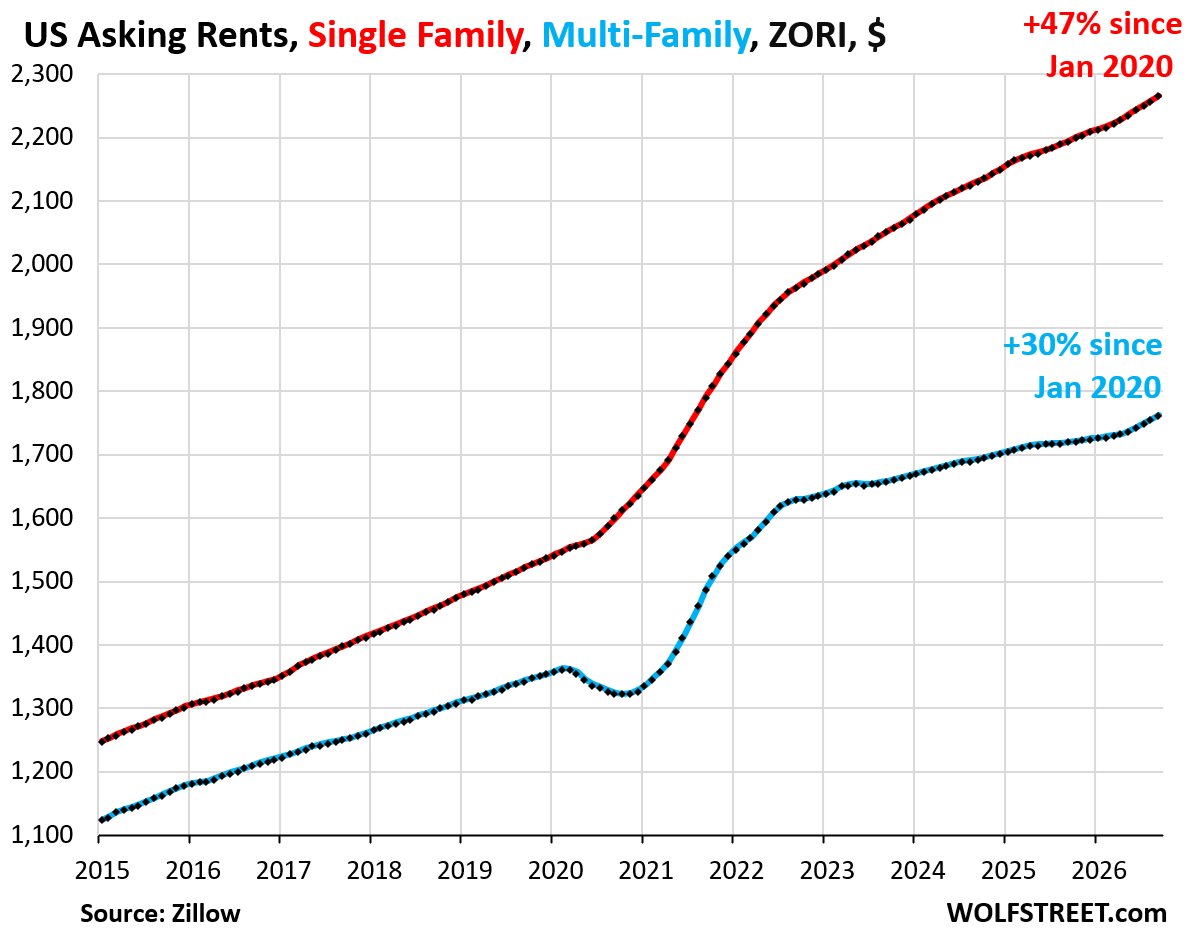
Rents are re-accelerating. The biggest portion of the spikes in asking rents occurred in 2021 and 2022. In 2023 through 2025, rent growth slowed in most markets, and in quite a few markets, asking rents, especially for multifamily, declined.
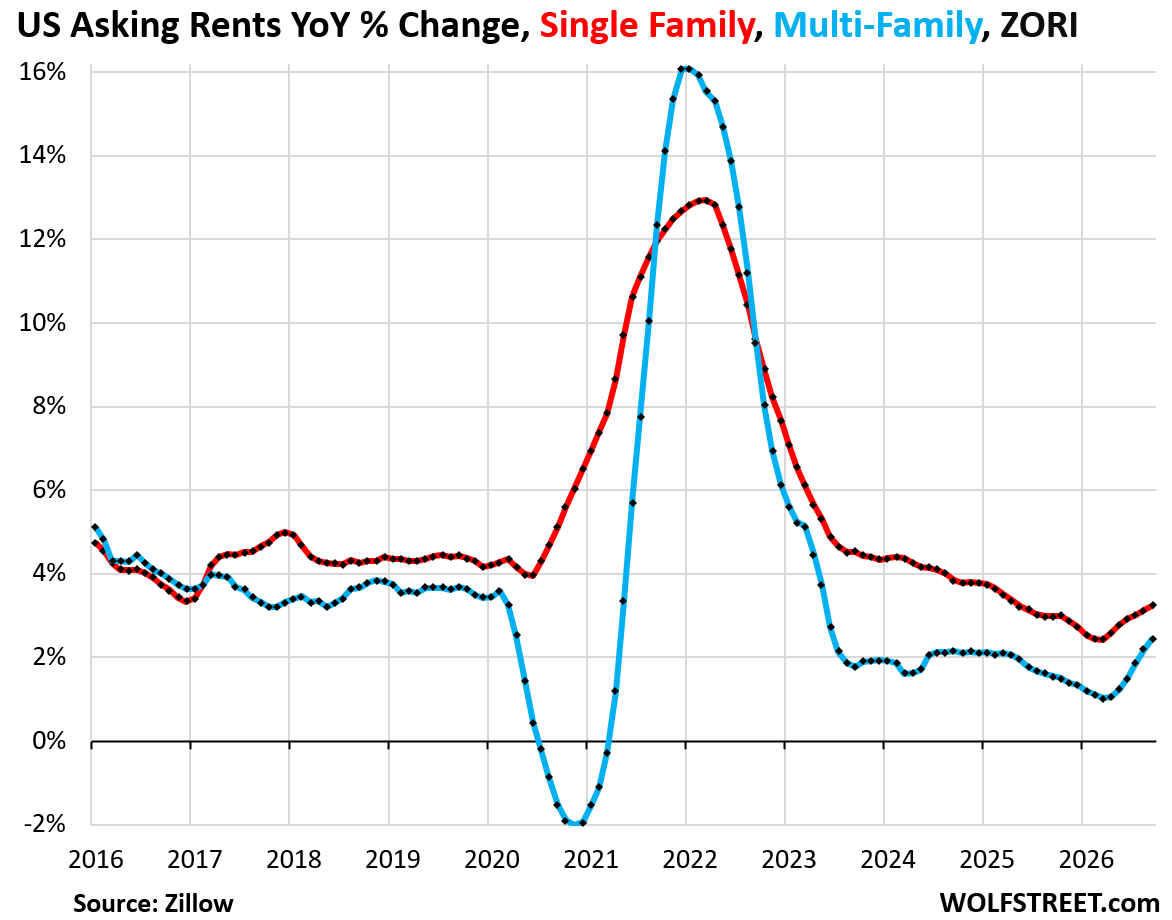
But since early 2026, the pace of increases of asking rents has accelerated again, both multifamily and single-family rentals.
Single-family asking rents rose by 3.2% year-over-year, the biggest year-over-year increase since January 2025, according to data from the ZORI (red in the chart below).
Multifamily asking rents also accelerated and were up by 2.4% year-over-year, the biggest increase since June 2023 (blue).
The current year-over-year rent increases are still lower than those in the years before the pandemic, when mid-tier asking rents increased by roughly 4% year-over-year.
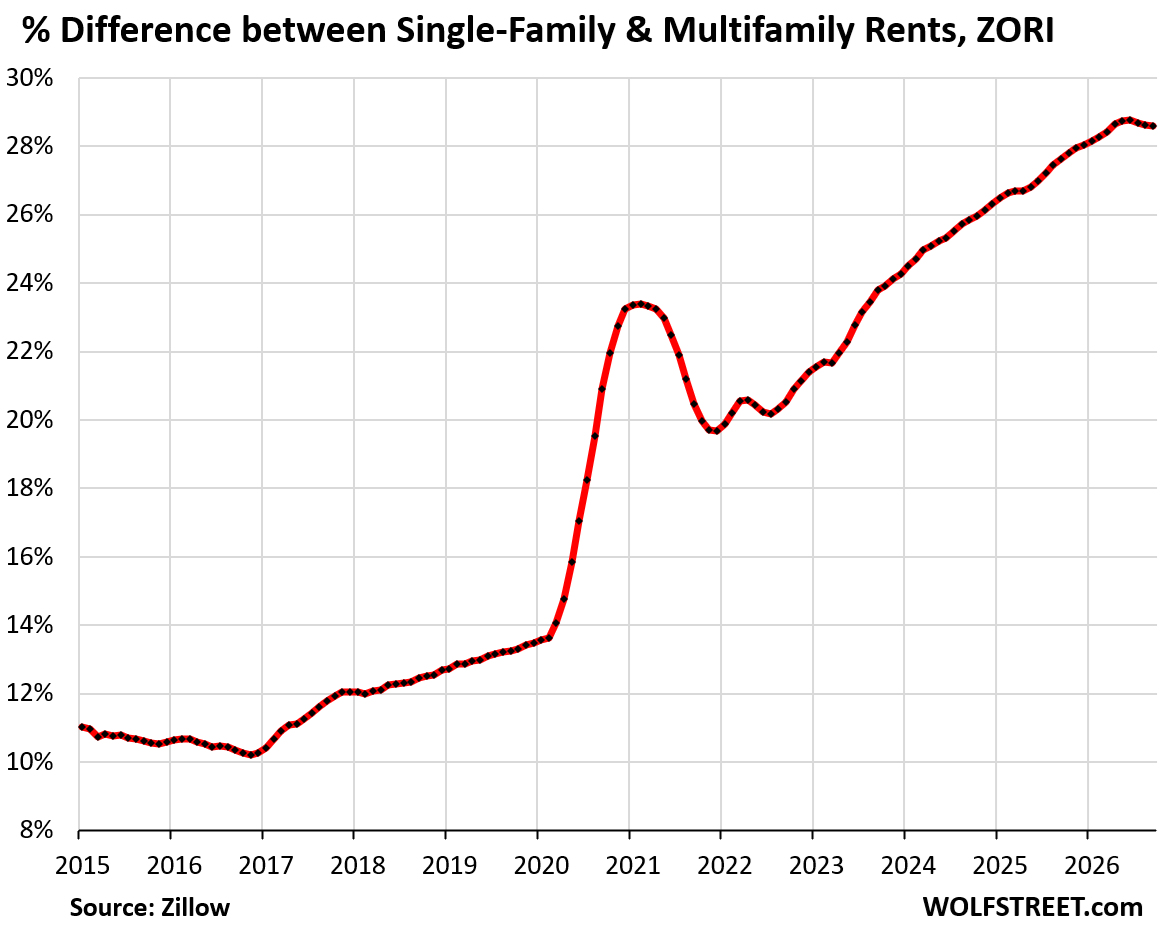
The gap between single-family rents and multifamily rents had widened in a stunning manner, reaching nearly 29% in June at the national level, more than double the gap before the pandemic (between 10% and 14%).
By September, the gap narrowed a hair as multifamily rents rose more quickly than single-family rents over the past few months.
Asking rents are what landlords want to get for their vacant units, and no one actually pays them as they’re for vacant units listed for rent. They don’t include incentives, such as two months free rent. Asking rents do not track actual rents that tenants actually pay over time.
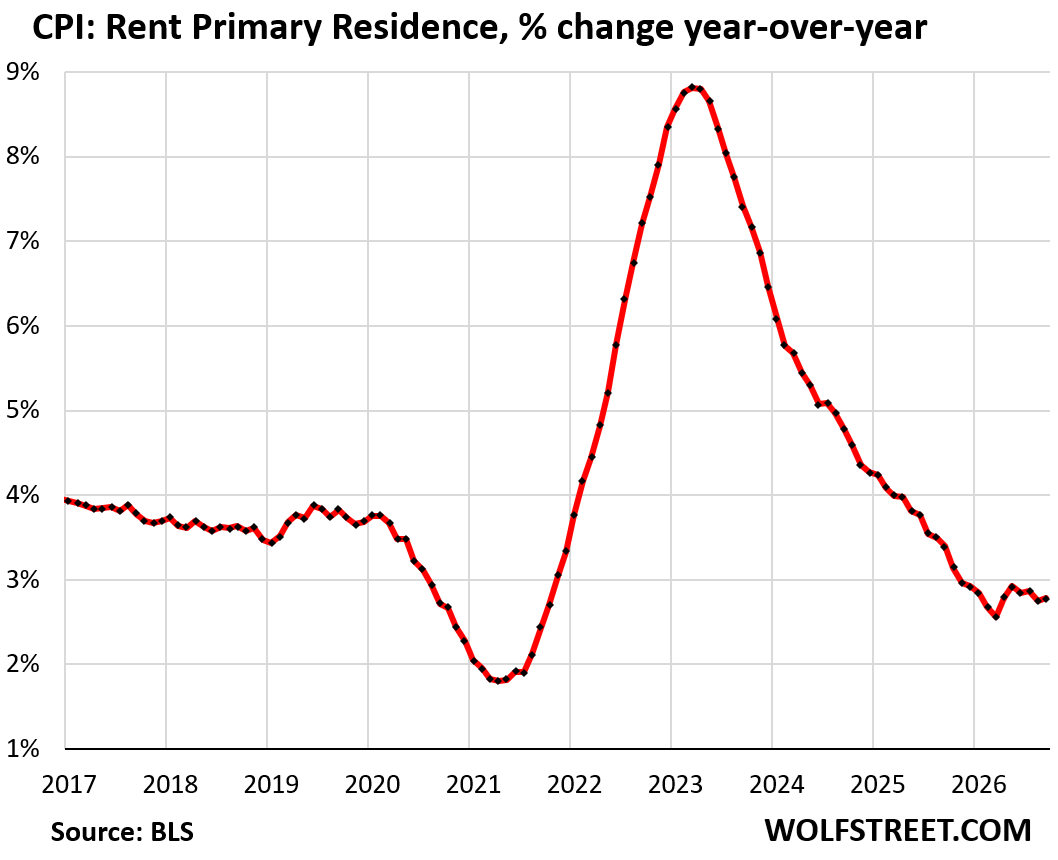
Actual rents paid by renewing tenants and new tenants are tracked by the Consumer Price Index for rent (CPI Rent of Primary Residence), based on a large sample of rental units by address, where tenants come and go over time.
But it consolidates multifamily and single-family rents into one data set. It also spans the spectrum, from high-end rentals to low-end rentals, whereas the measure of asking rents here is for the mid-tier.
Actual rents move more slowly than asking rents, which can change with the collective whim of landlords overnight, without tenants actually paying more. But over time, as the vacant units find takers, asking rents filter into actual rents.
The CPI for rent soared less dramatically in 2021 and 2022, topping out with a year-over-year increase of just under 9%. The year-over-year increase bottomed out in March 2026 at 2.6%. In September, the CPI rent rose by 2.8%. These increases are below the rate of increases before the pandemic (in the 3.5% to 4.0% range).
But the accelerating asking rents (see above) indicate that CPI for rent will also begin to accelerate with some lag:
22 large markets scattered around the US.
Below are 22 of the largest metropolitan statistical areas (MSAs), showing asking rents for single-family rentals (red) and asking rents for multifamily properties (blue), per the seasonally adjusted ZORI.
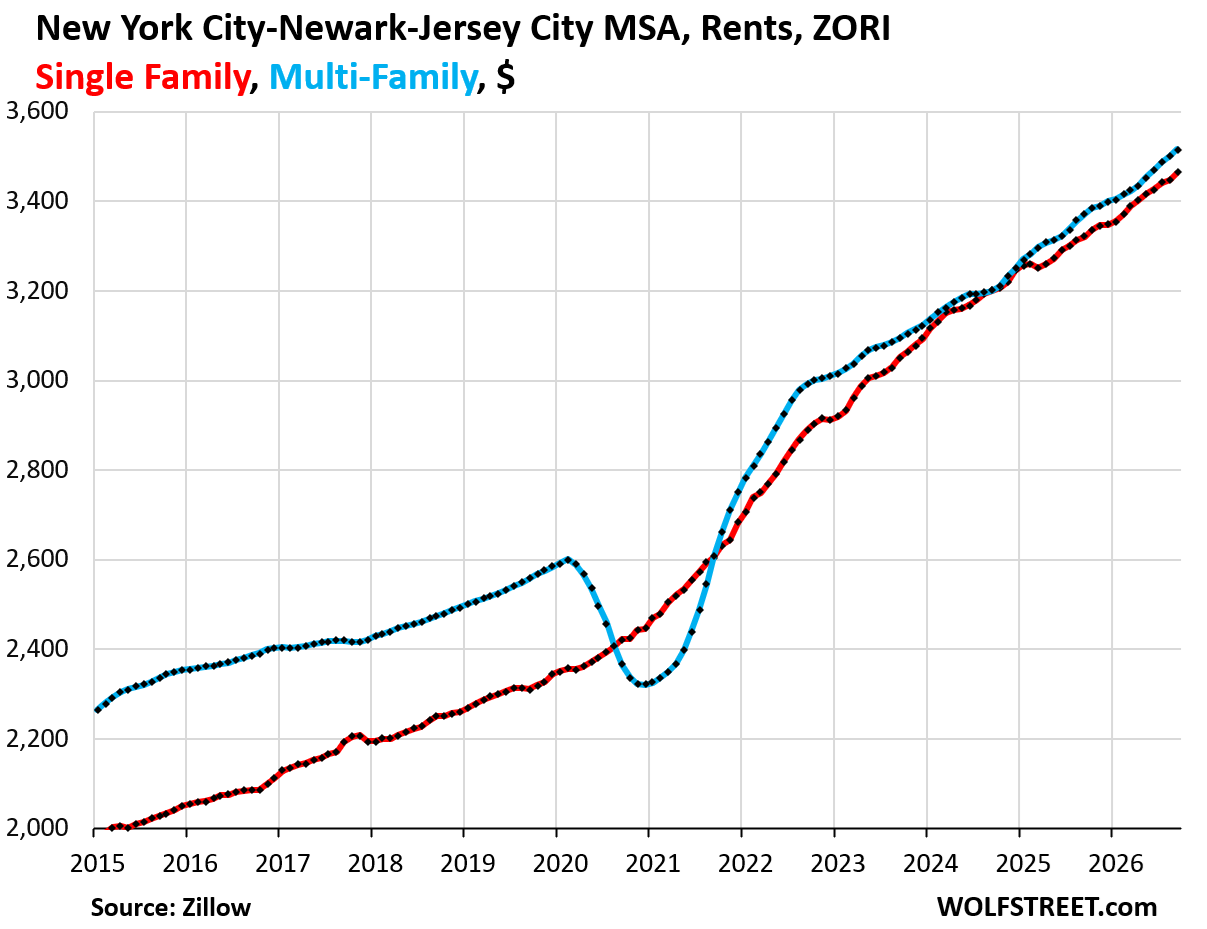
New York City metro:
- Multifamily ZORI:
- Month-to-month: +0.4%
- Year-over-year: +4.3%
- Since Jan 2020: +36%
- Single-family ZORI:
- Month-to-month: +0.4%
- Year-over-year: +4.3%
- Since Jan 2020: +47%
The New York metro is the only market here where single-family and multifamily rents have been increasing in near-lockstep – likely driven by the soaring rents in New York City’s huge multifamily market.
In the remaining 21 markets here, single-family rents and multifamily rents have diverged, and often dramatically.
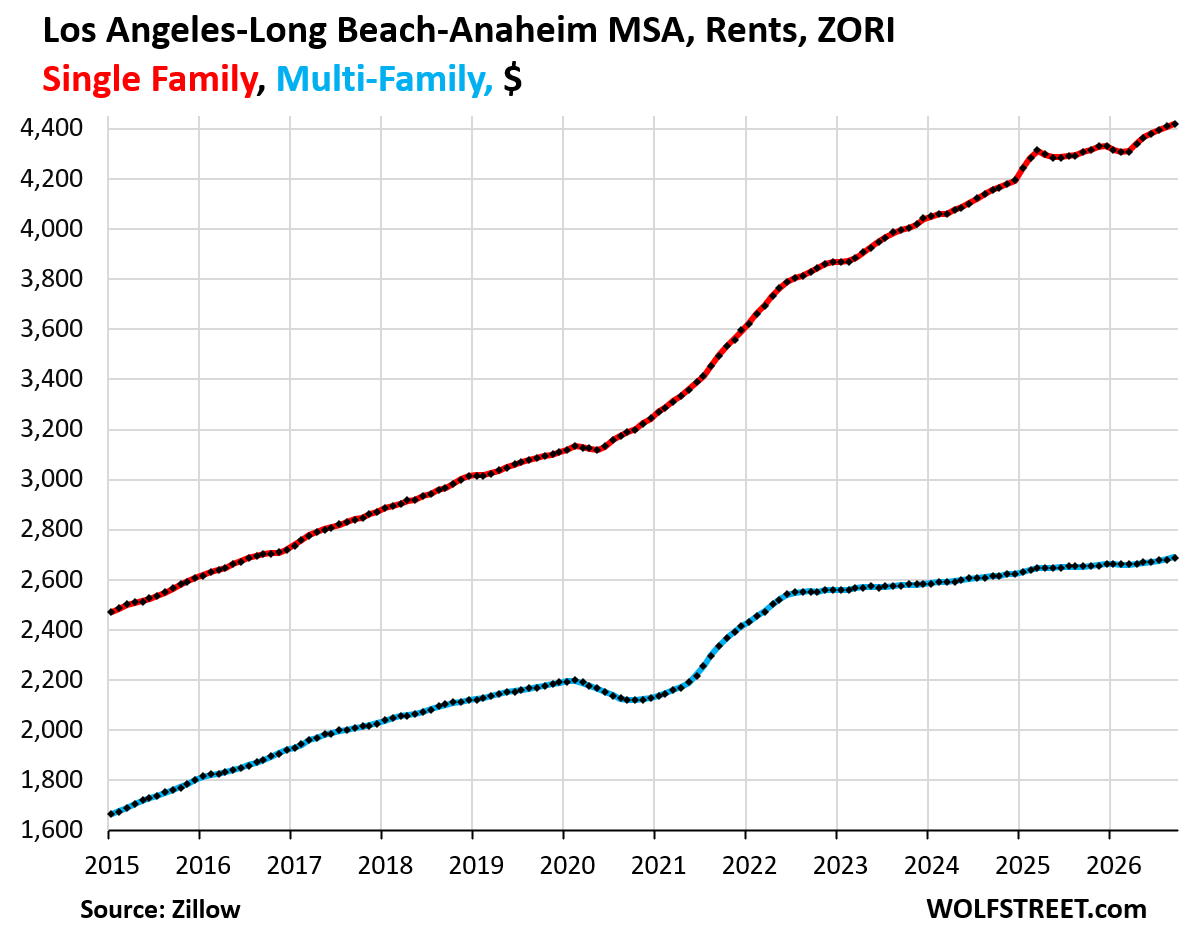
Los Angeles metro:
- Multifamily ZORI:
- Month-to-month: +0.2%
- Year-over-year: +1.4%
- Since Jan 2020: +23%
- Single-family ZORI:
- Month-to-month: +0.3%
- Year-over-year: +2.6%
- Since Jan 2020: +42%
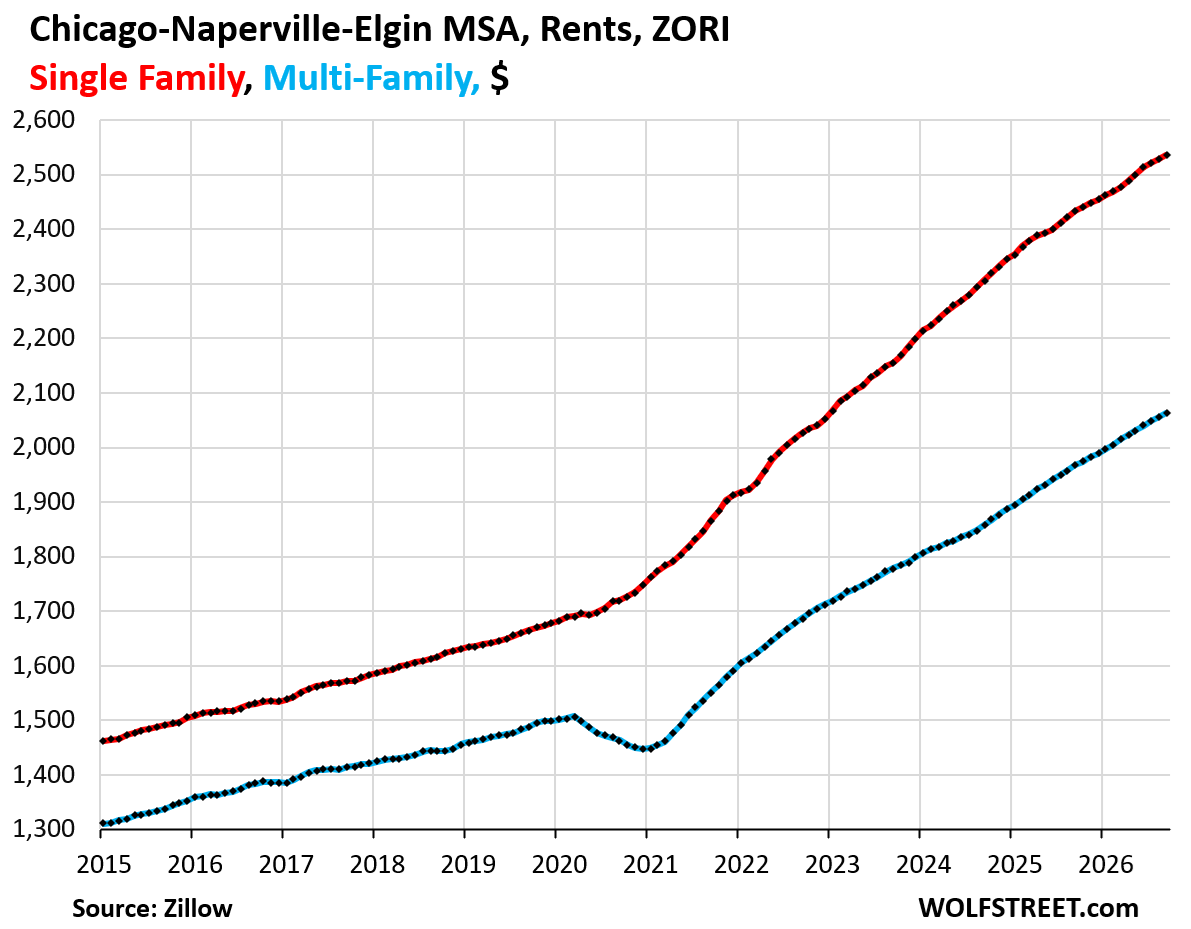
Chicago metro:
- Multifamily ZORI:
- Month-to-month: +0.3%
- Year-over-year: +4.9%
- Since Jan 2020: +37%
- Single-family ZORI:
- Month-to-month: +0.3%
- Year-over-year: +4.2%
- Since Jan 2020: +51%
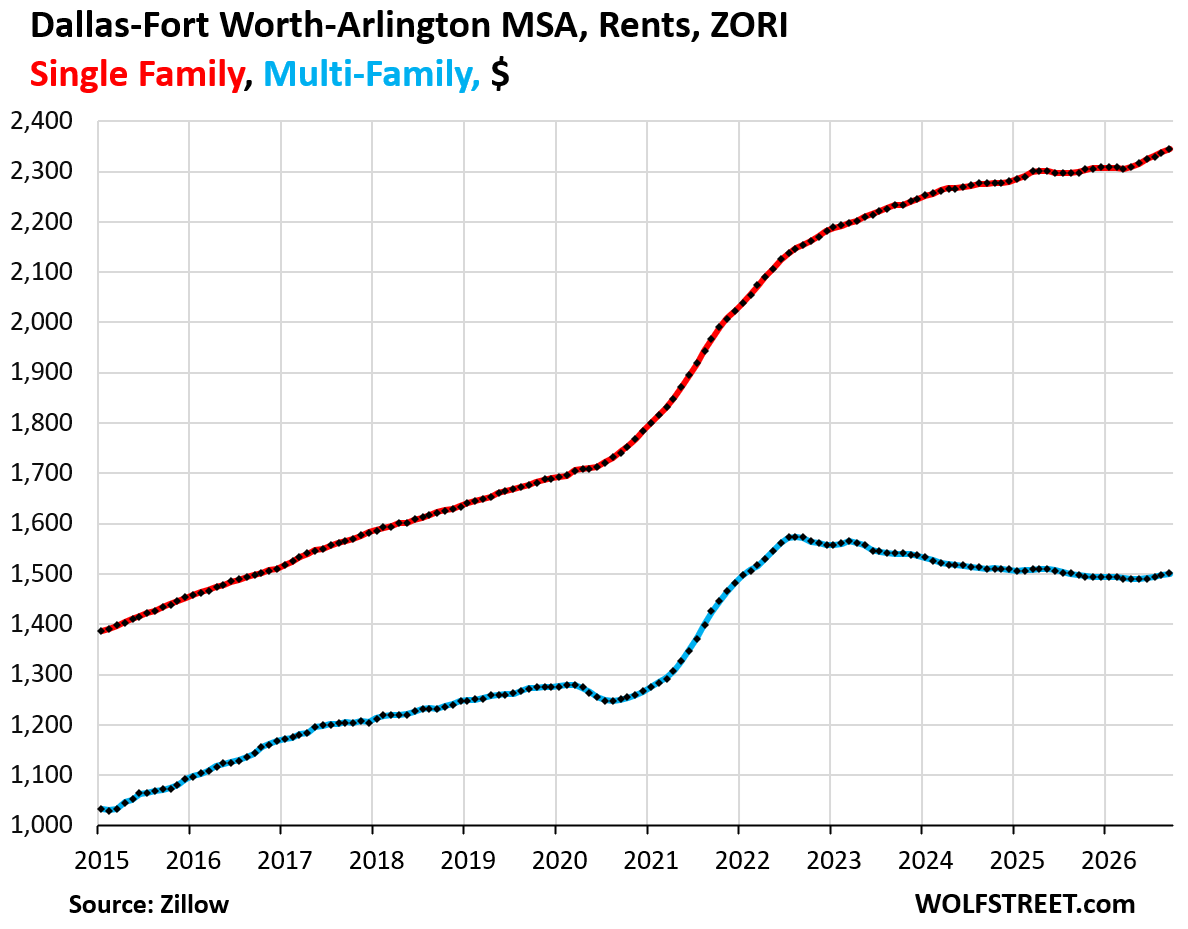
Dallas-Fort Worth metro:
- Multifamily ZORI:
- Month-to-month: +0.2%
- Year-over-year: +0.2%
- Since Jan 2020: +18%
- Single-family ZORI:
- Month-to-month: +0.3%
- Year-over-year: +2.0%
- Since Jan 2020: +39%
Multifamily rents dropped by 5% from the peak in mid-2022 through June, but since then began to edge up again.

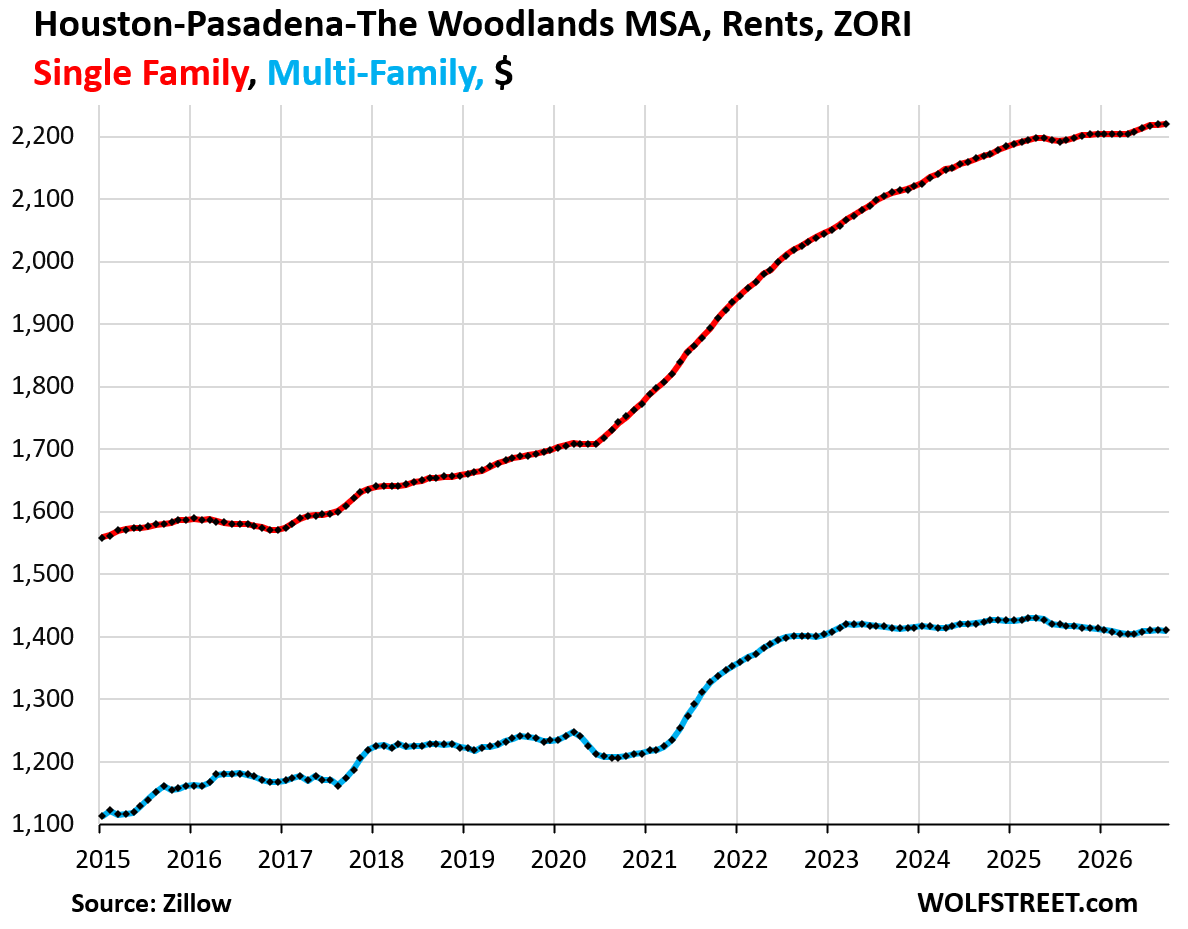
Houston metro:
- Multifamily ZORI:
- Month-to-month: -0.1%
- Year-over-year: -0.5%
- Since Jan 2020: +14%
- Single-family ZORI:
- Month-to-month: 0%
- Year-over-year: +1.0%
- Since Jan 2020: +38%
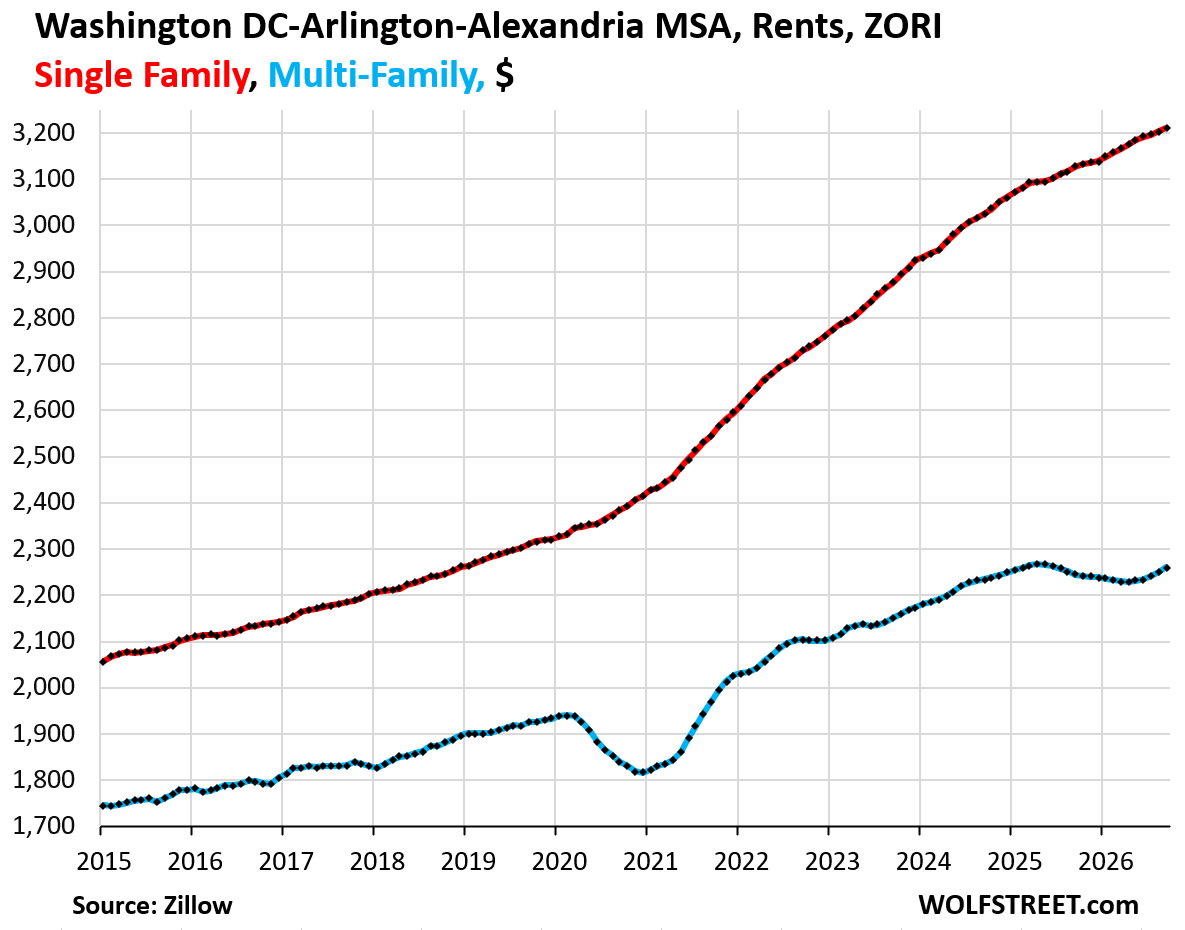
Washington D.C. metro:
- Multifamily ZORI:
- Month-to-month: +0.5%
- Year-over-year: +0.7%
- Since Jan 2020: +17%
- Single-family ZORI:
- Month-to-month: +0.2%
- Year-over-year: +2.7%
- Since Jan 2020: +38%
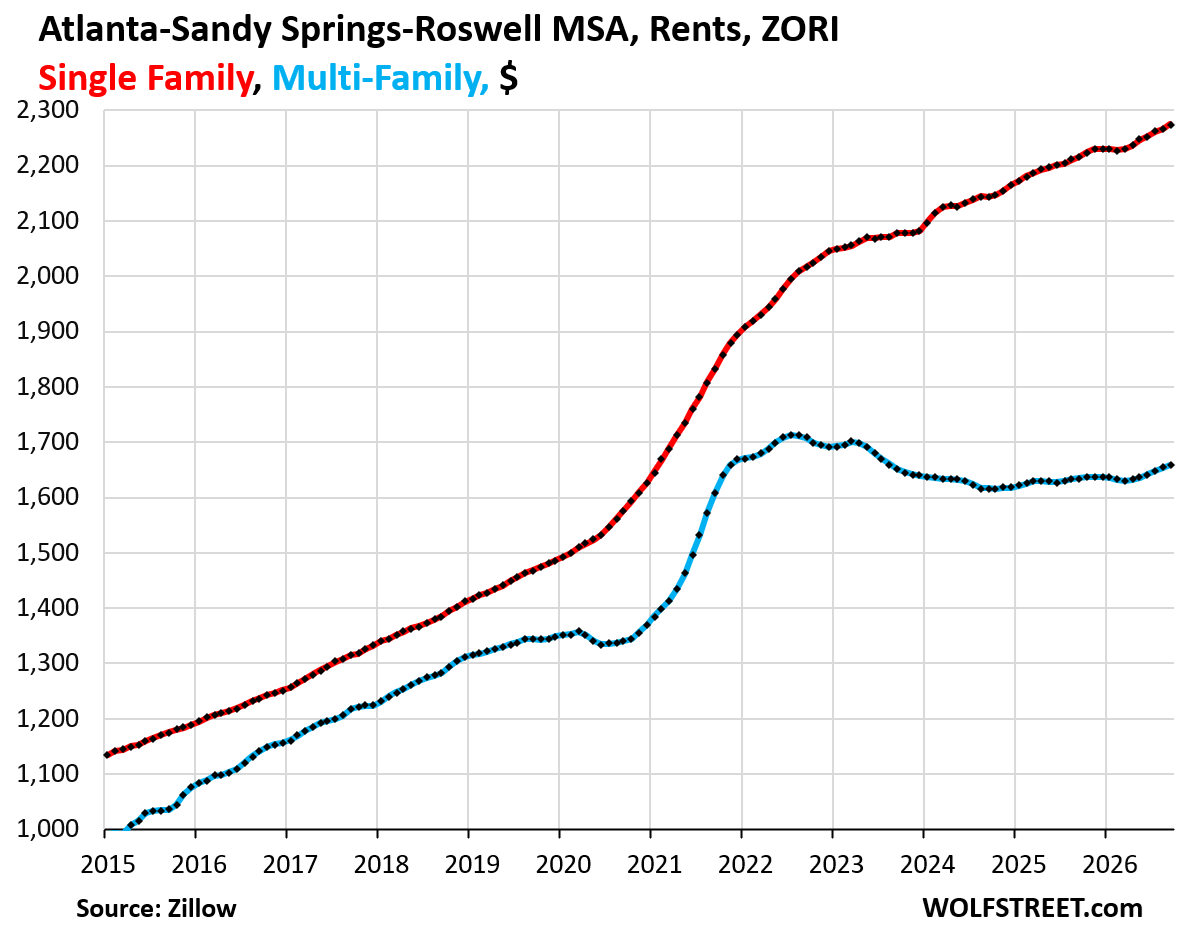
Atlanta metro:
- Multifamily ZORI:
- Month-to-month: +0.3%
- Year-over-year: +1.4%
- Since Jan 2020: +23%
- Single-family ZORI:
- Month-to-month: +0.4%
- Year-over-year: +2.6%
- Since Jan 2020: +52%
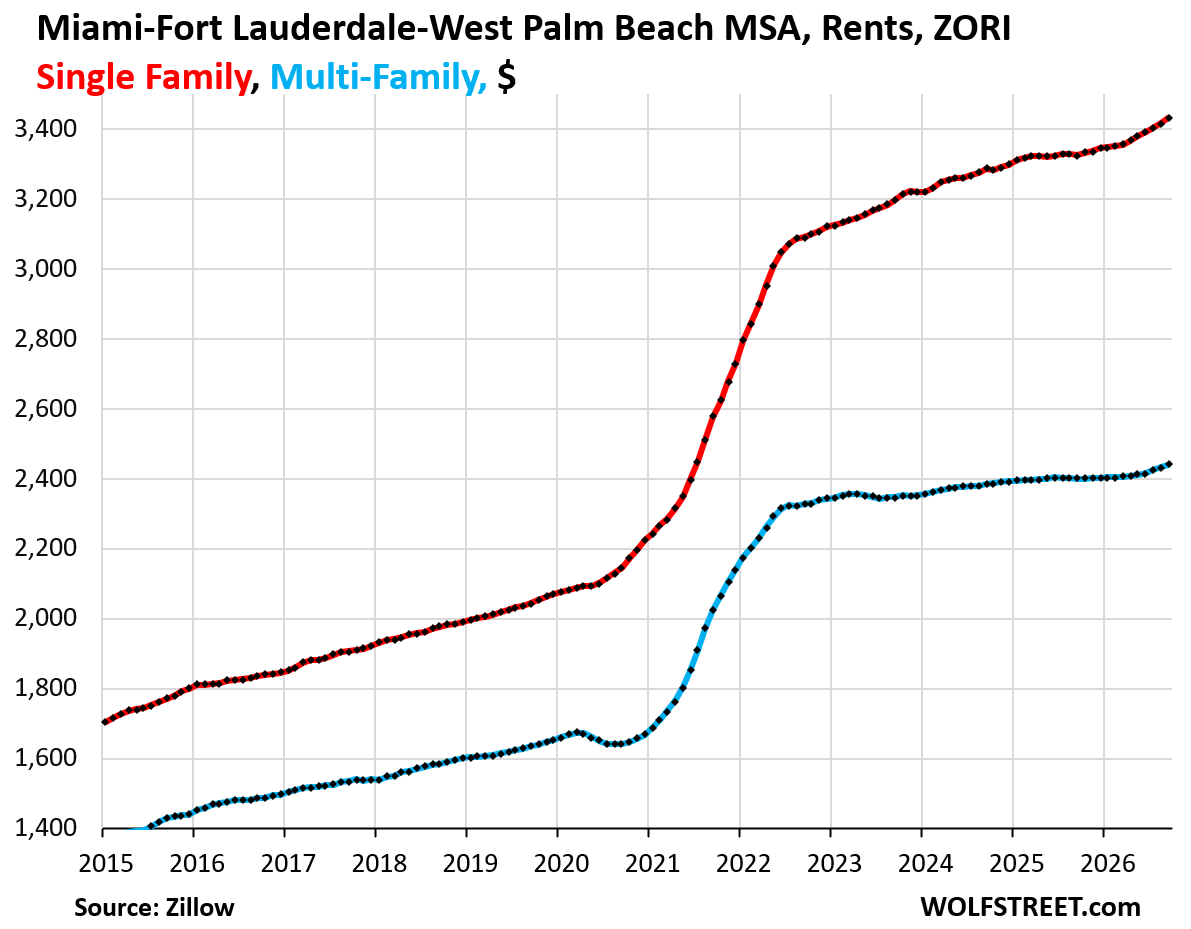
Miami metro:
- Multifamily ZORI:
- Month-to-month: +0.3%
- Year-over-year: +1.7%
- Since Jan 2020: +47%
- Single-family ZORI:
- Month-to-month: +0.5%
- Year-over-year: +3.2%
- Since Jan 2020: +65%
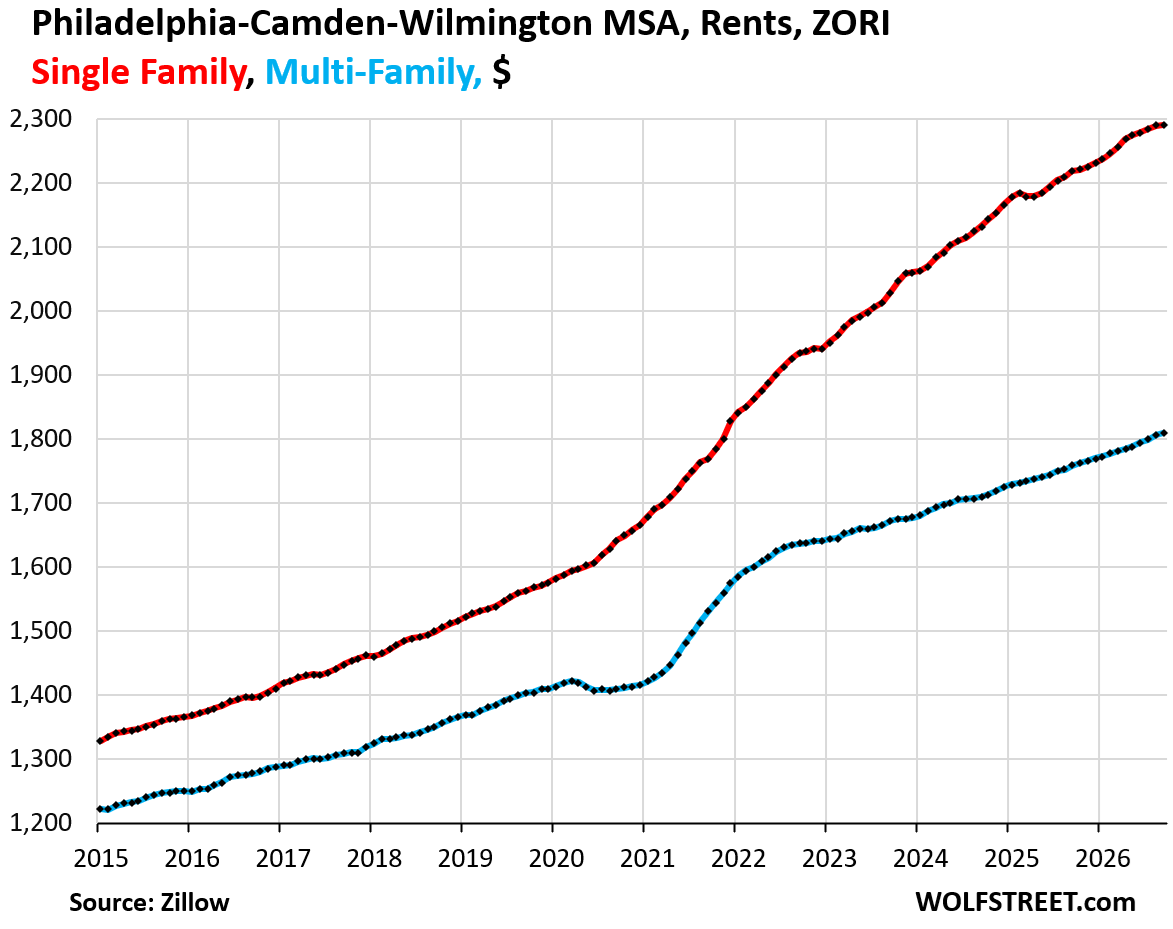
Philadelphia metro:
- Multifamily ZORI:
- Month-to-month: +0.2%
- Year-over-year: +2.9%
- Since Jan 2020: +28%
- Single-family ZORI:
- Month-to-month: +0.1%
- Year-over-year: +3.2%
- Since Jan 2020: +50%
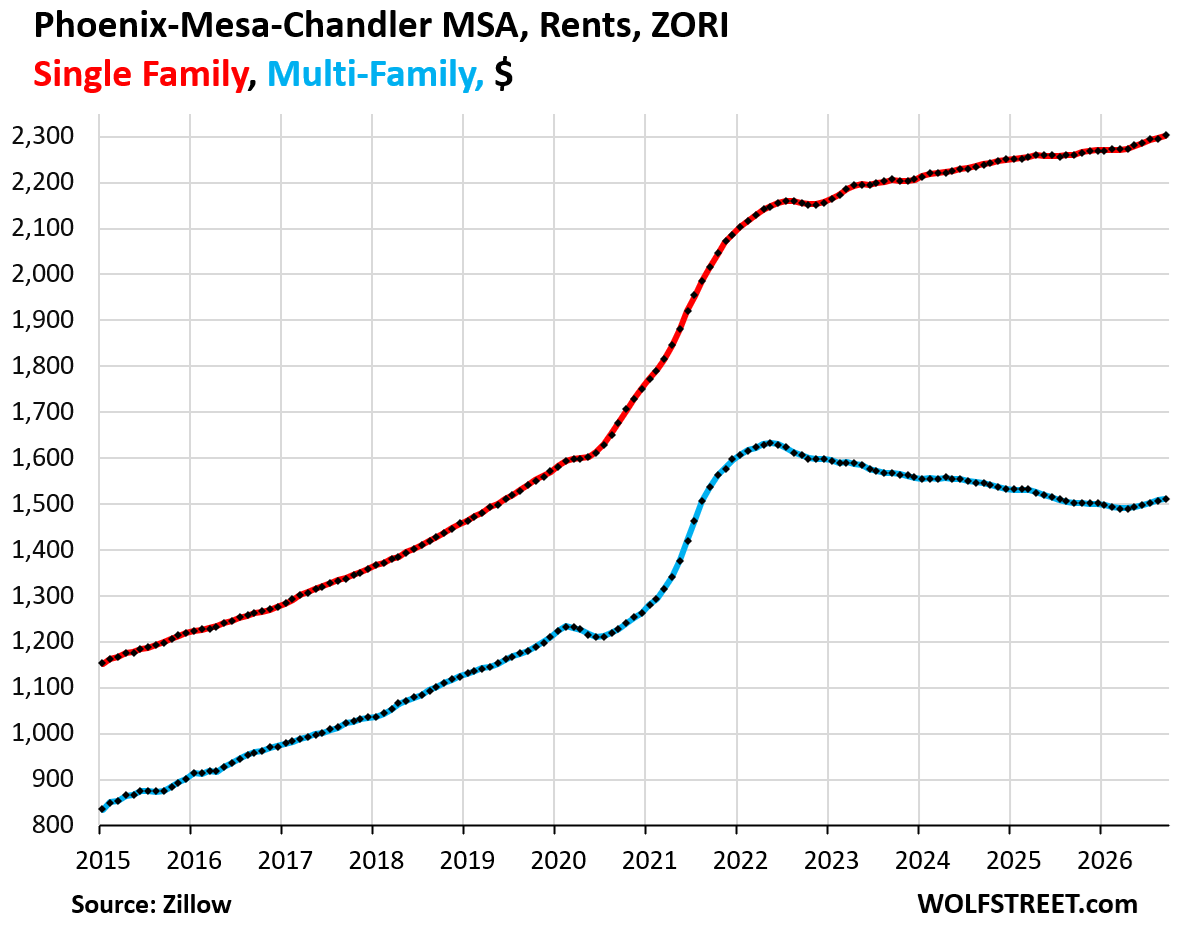
Phoenix metro:
- Multifamily ZORI:
- Month-to-month: +0.2%
- Year-over-year: +0.6%
- Since Jan 2020: +24%
- Single-family ZORI:
- Month-to-month: +0.2%
- Year-over-year: +1.8%
- Since Jan 2020: +45%
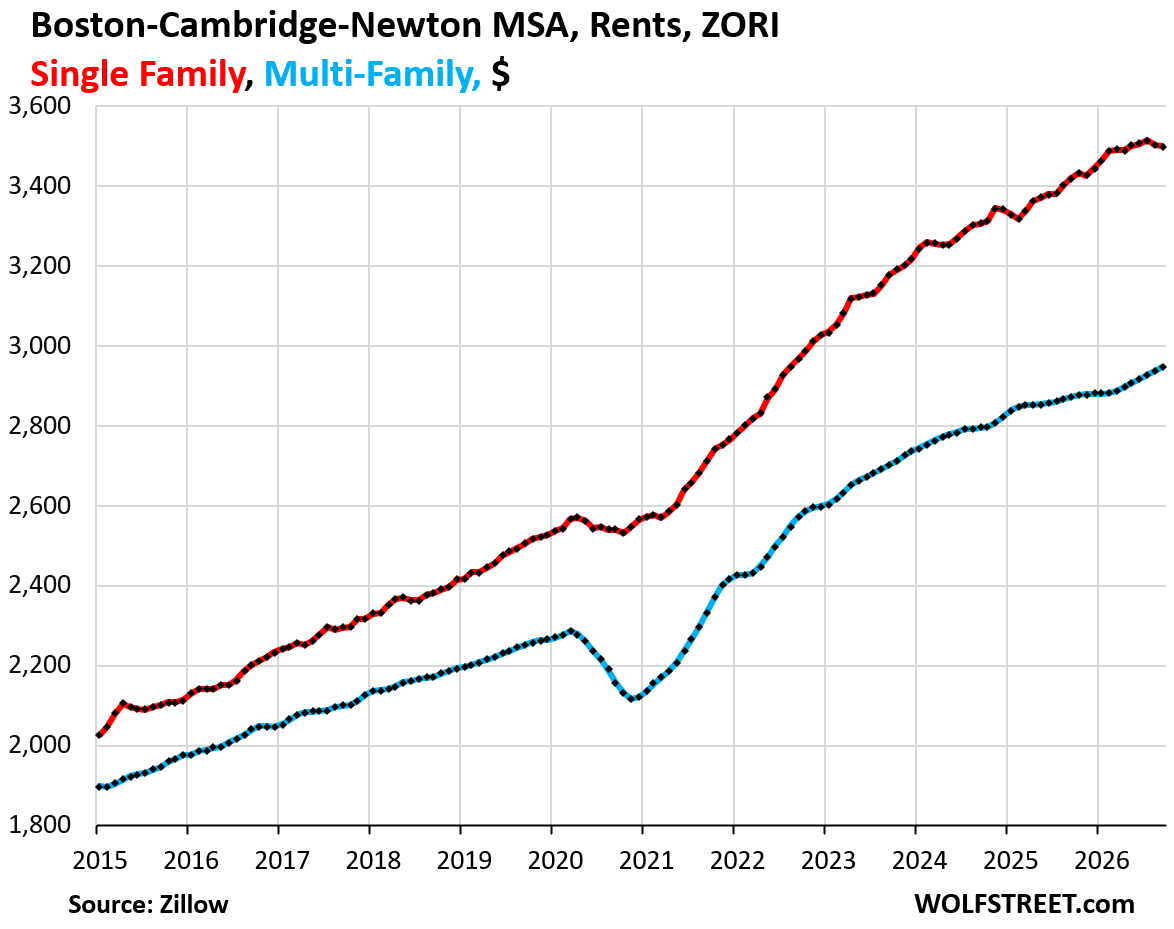
Boston metro:
- Multifamily ZORI:
- Month-to-month: +0.3%
- Year-over-year: +2.6%
- Since Jan 2020: +30%
- Single-family ZORI:
- Month-to-month: +0.1%
- Year-over-year: +2.4%
- Since Jan 2020: +38%
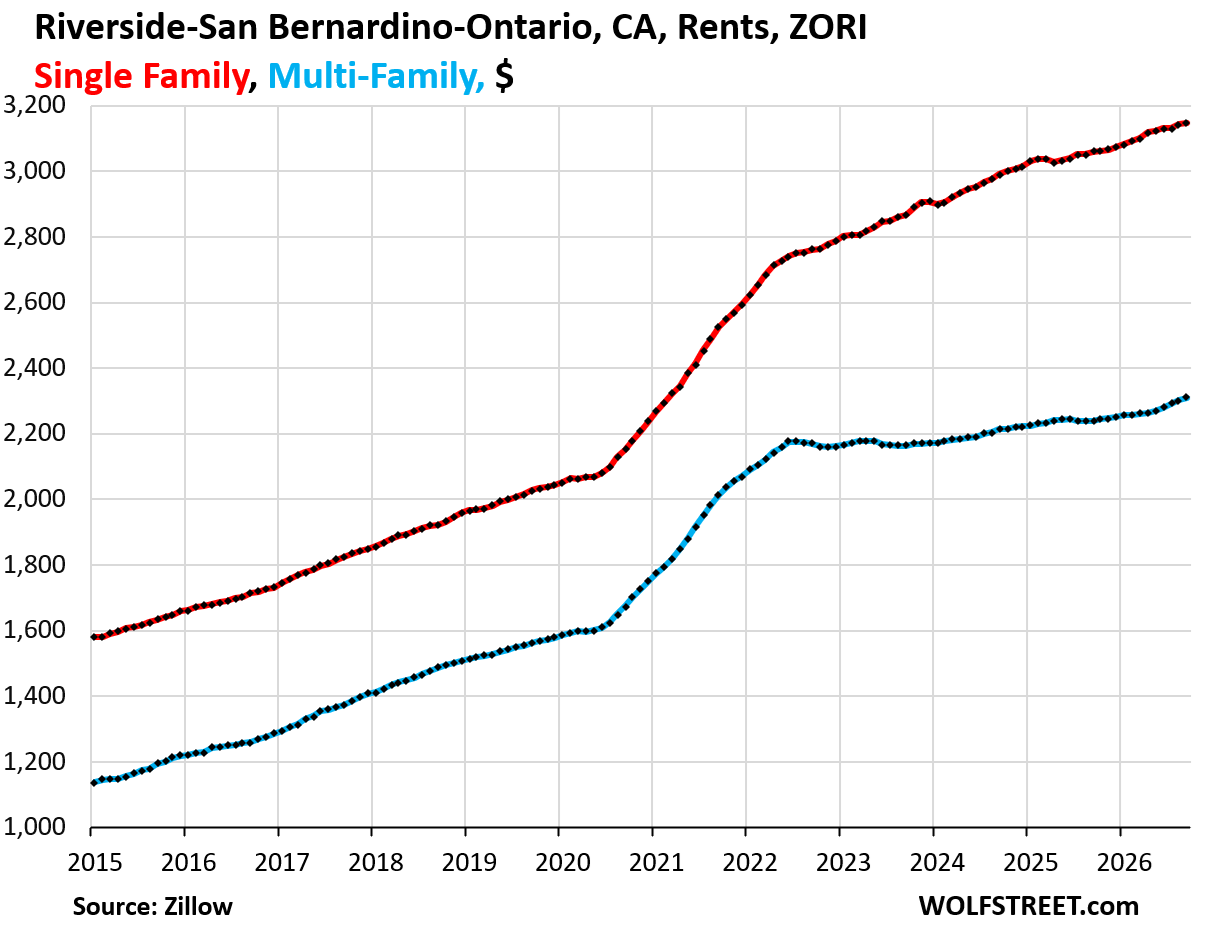
Riverside-San Bernardino metro:
- Multifamily ZORI:
- Month-to-month: +0.4%
- Year-over-year: +3.1%
- Since Jan 2020: +46%
- Single-family ZORI:
- Month-to-month: +0.1%
- Year-over-year: +2.8%
- Since Jan 2020: +5.%
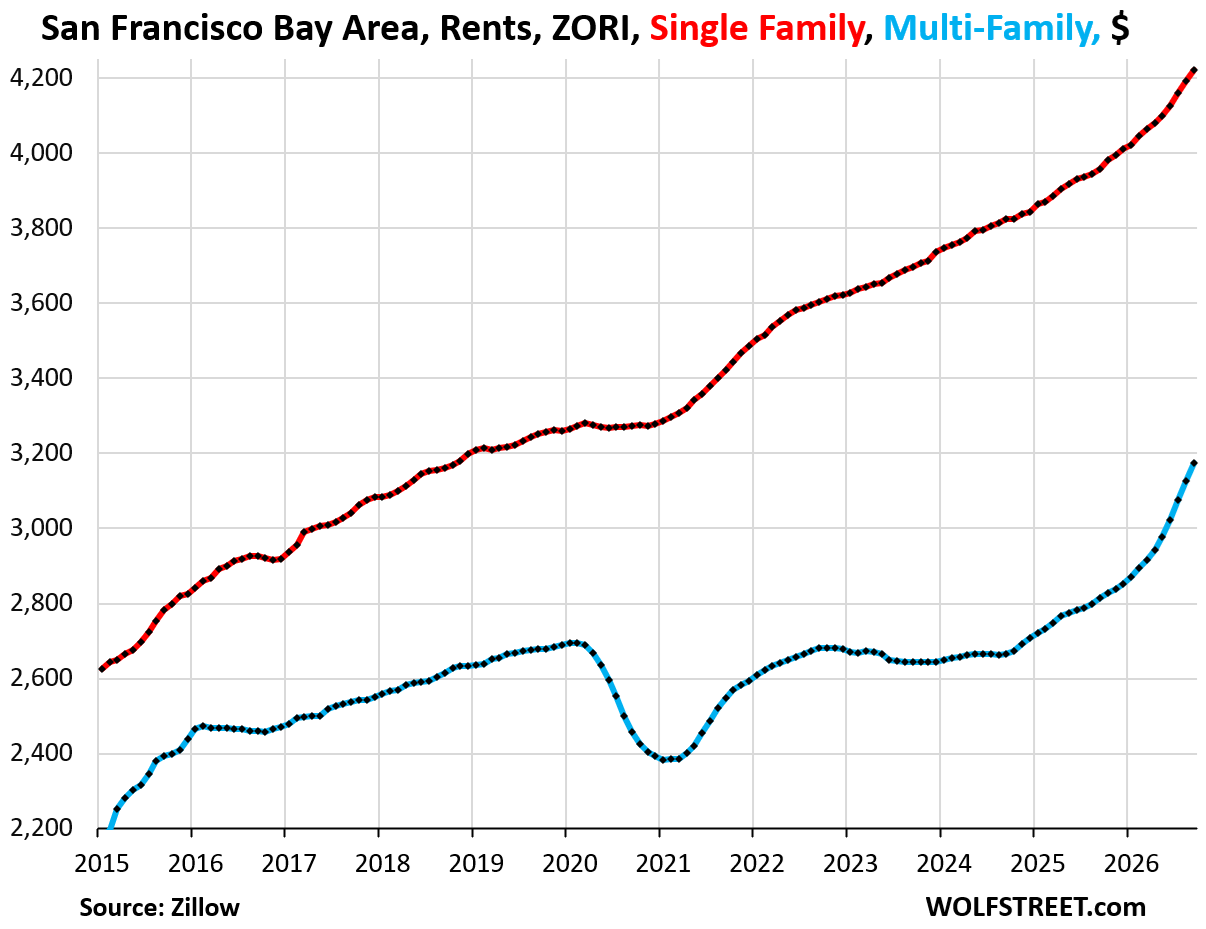
San Francisco Bay Area:
- Multifamily ZORI:
- Month-to-month: +1.5%
- Year-over-year: +12.7%
- Since Jan 2020: +18%
- Single-family ZORI:
- Month-to-month: +0.7%
- Year-over-year: +6.7%
- Since Jan 2020: +29%
AI mania has infected everything in the City of San Francisco, including the rental market, and rents are spiking massively. But this is the MSA of the Bay Area, which includes Oakland and many other cities where rents are not spiking, thereby watering down the rent spikes for the entire Bay Area:
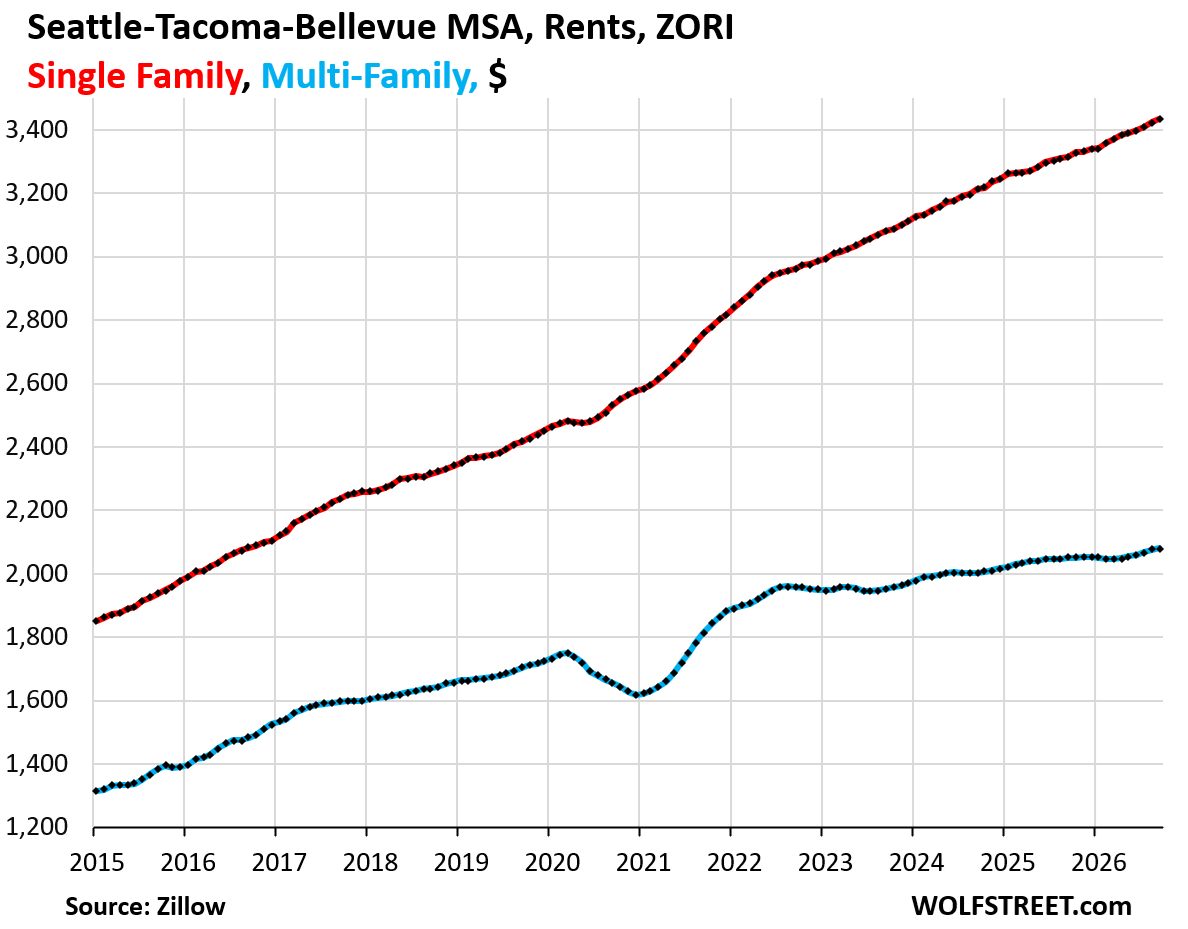
Seattle metro:
- Multifamily ZORI:
- Month-to-month: +0.3%
- Year-over-year: +1.5%
- Since Jan 2020: +20%
- Single-family ZORI:
- Month-to-month: +0.3%
- Year-over-year: +3.6%
- Since Jan 2020: +39%
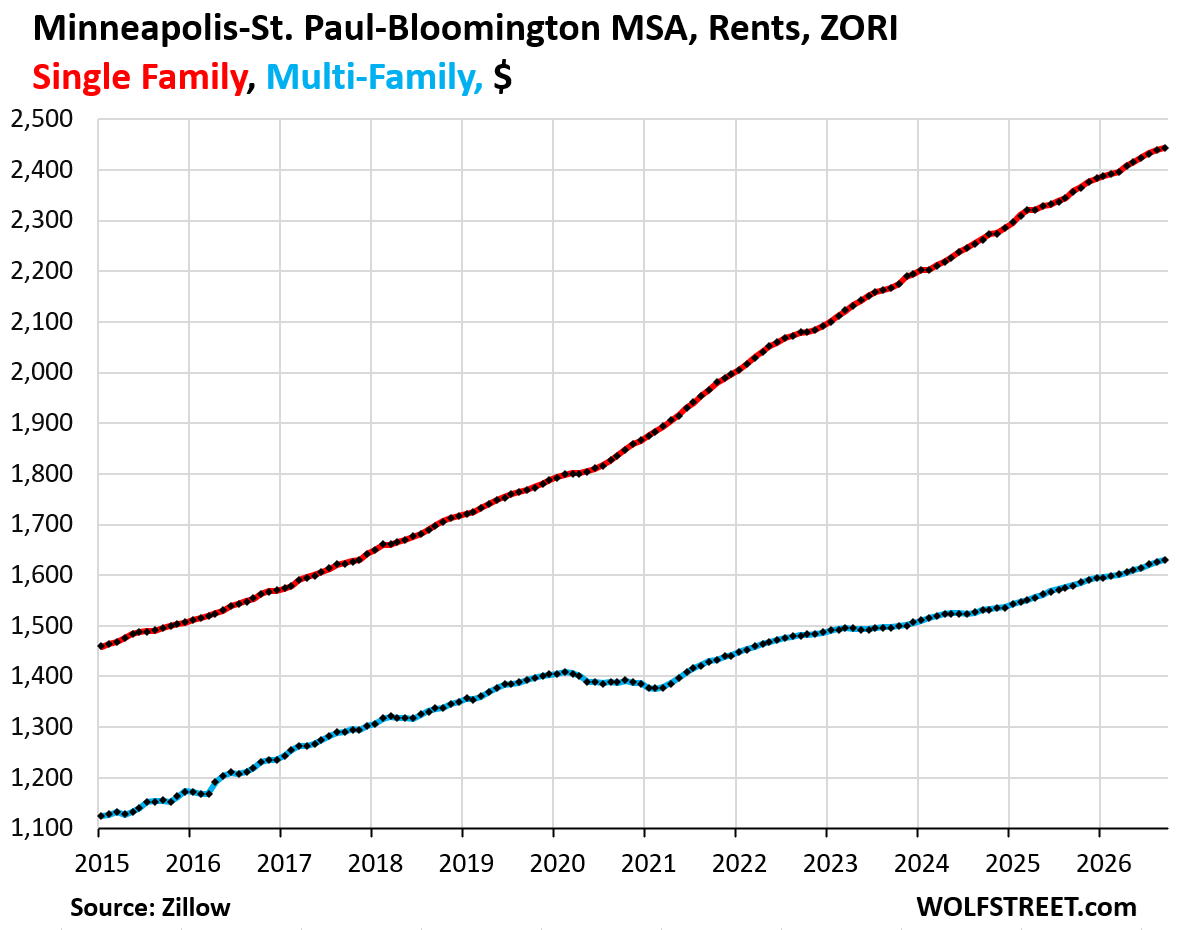
Minneapolis-St. Paul metro:
- Multifamily ZORI:
- Month-to-month: +0.3%
- Year-over-year: +3.2%
- Since Jan 2020: +16%
- Single-family ZORI:
- Month-to-month: +0.1%
- Year-over-year: +3.6%
- Since Jan 2020: +36%
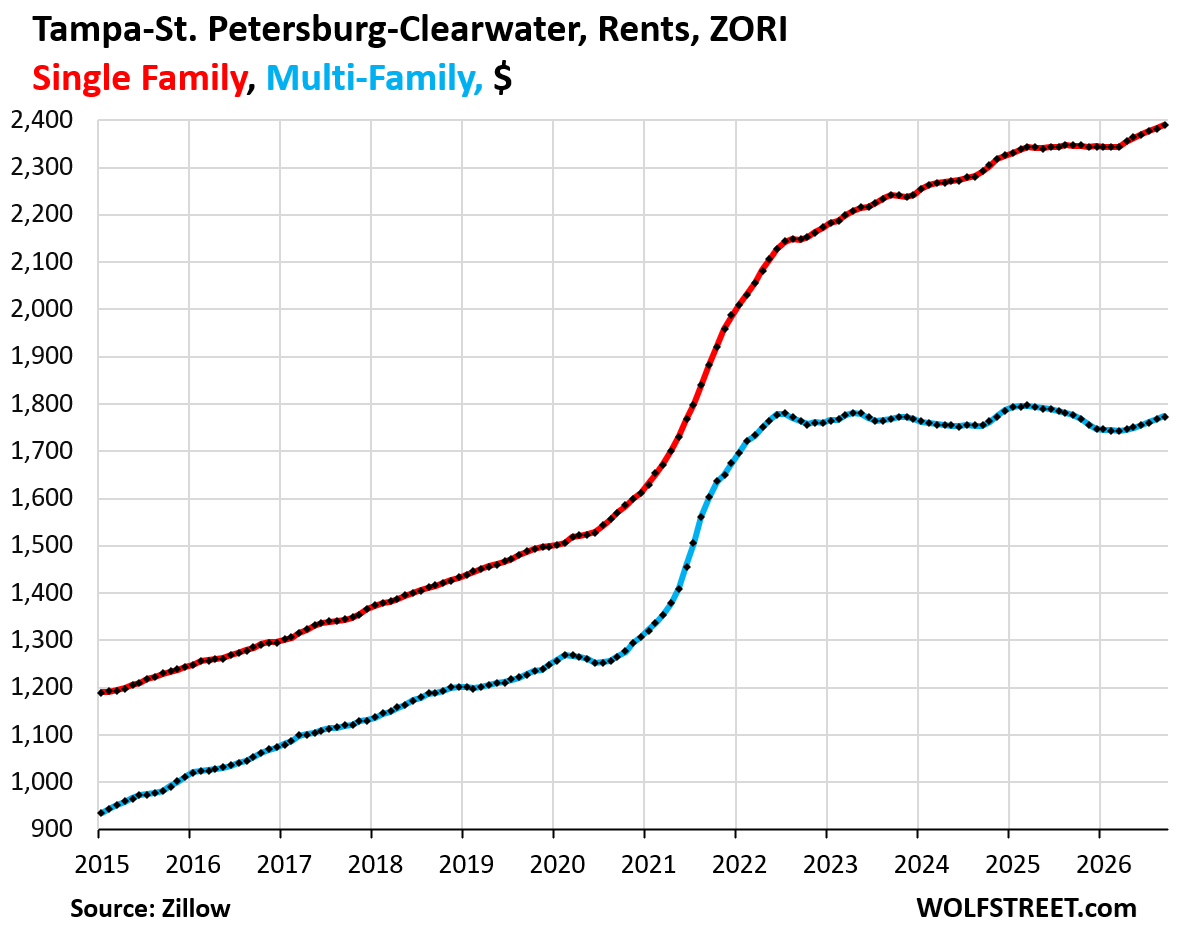
Tampa Bay Area:
- Multifamily ZORI:
- Month-to-month: +0.4%
- Year-over-year: -0.2%
- Since Jan 2020: +41%
- Single-family ZORI:
- Month-to-month: +0.3%
- Year-over-year: +1.9%
- Since Jan 2020: +59%
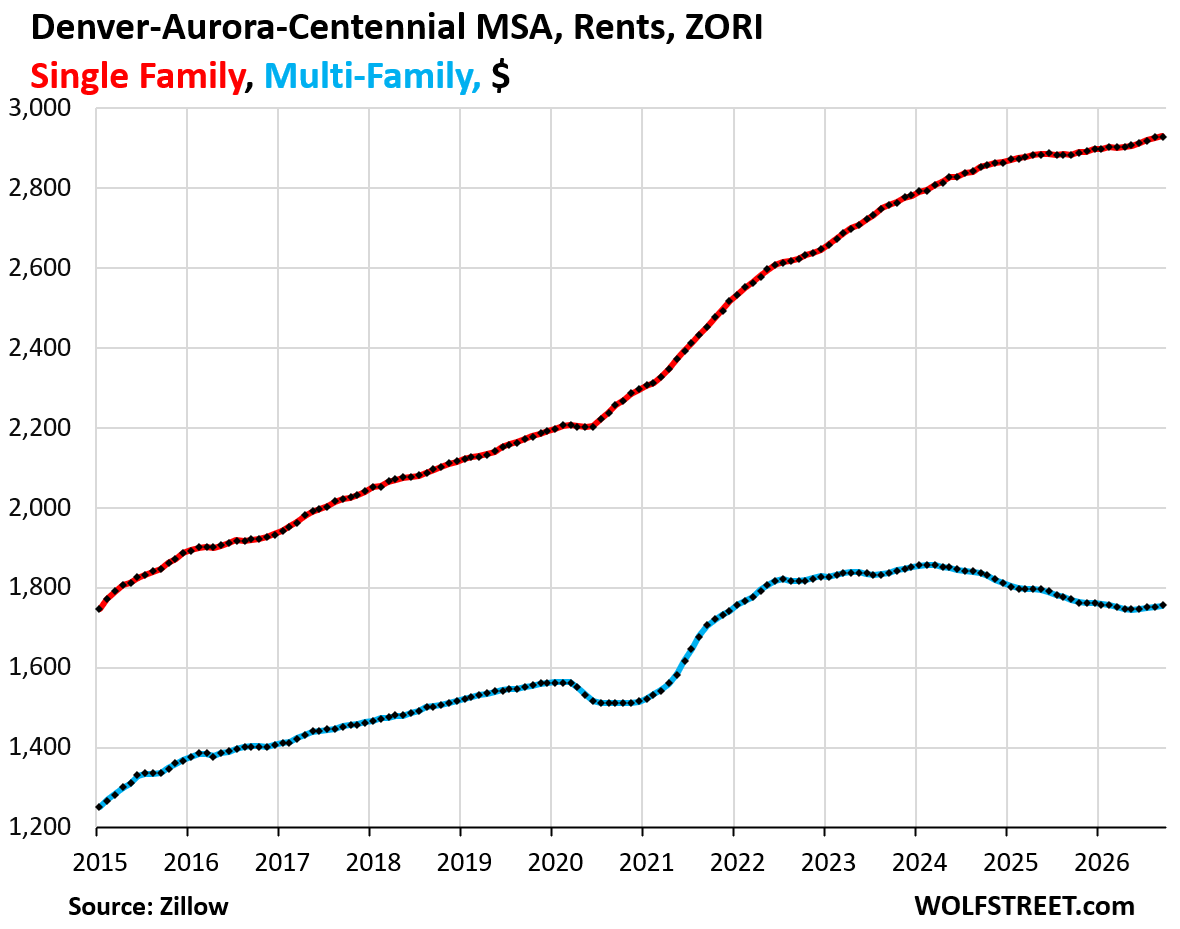
Denver metro:
- Multifamily ZORI:
- Month-to-month: +0.2%
- Year-over-year: -0.8%
- Since Jan 2020: +12%
- Single-family ZORI:
- Month-to-month: +0.1%
- Year-over-year: +1.6%
- Since Jan 2020: +33%
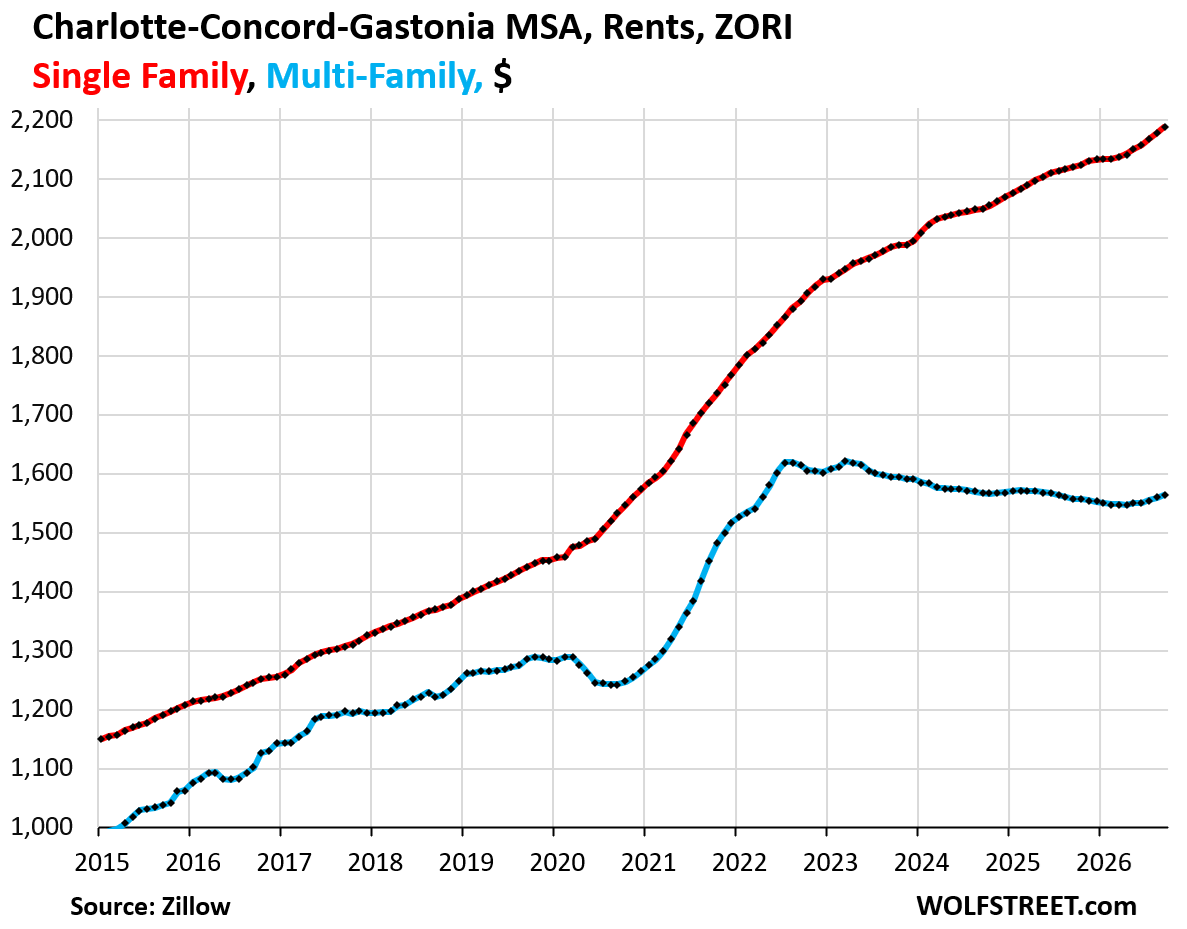
Charlotte metro:
- Multifamily ZORI:
- Month-to-month: +0.3%
- Year-over-year: +0.4%
- Since Jan 2020: +22%
- Single-family ZORI:
- Month-to-month: +0.5%
- Year-over-year: +3.3%
- Since Jan 2020: +50%
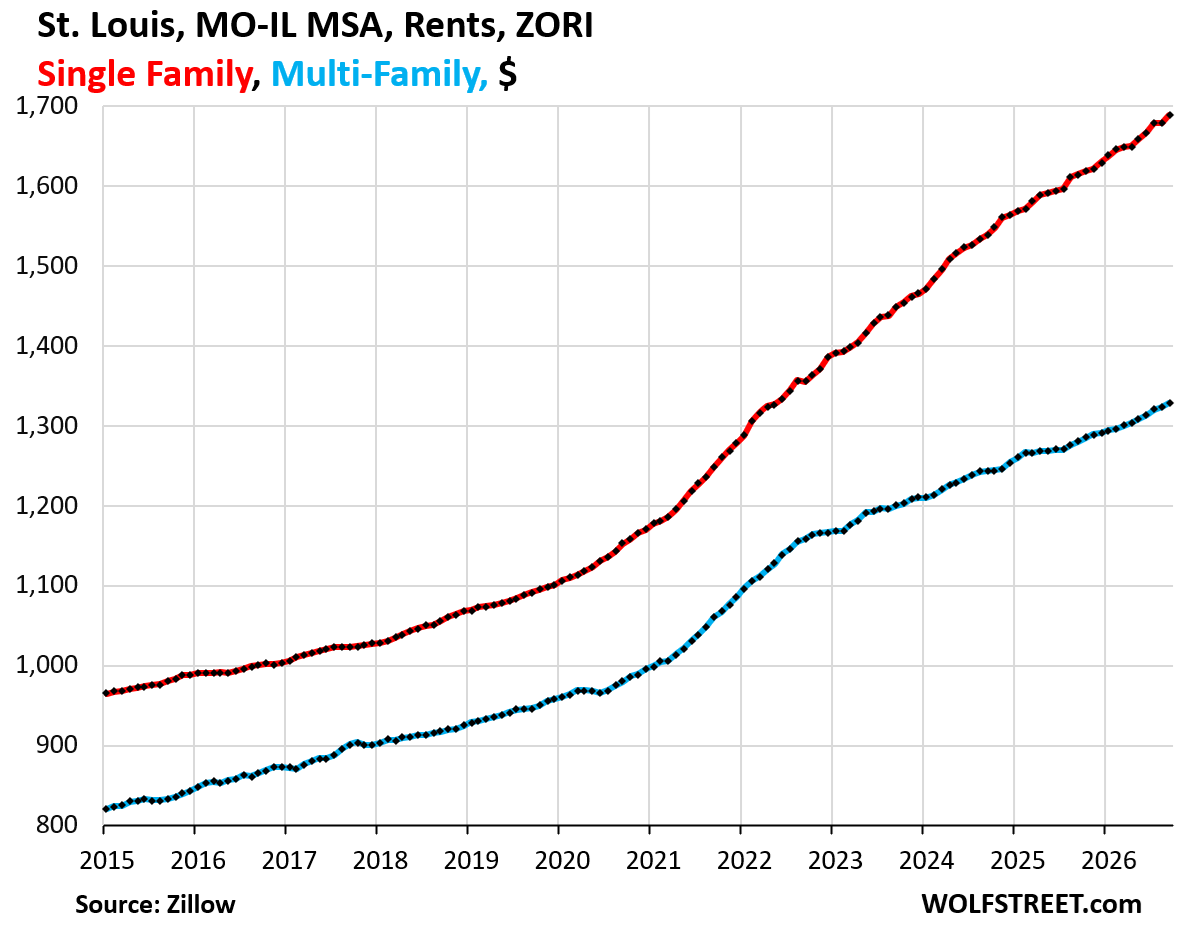
St. Louis metro:
- Multifamily ZORI:
- Month-to-month: +0.4%
- Year-over-year: +3.8%
- Since Jan 2020: +38%
- Single-family ZORI:
- Month-to-month: +0.6%
- Year-over-year: +4.6%
- Since Jan 2020: +53%
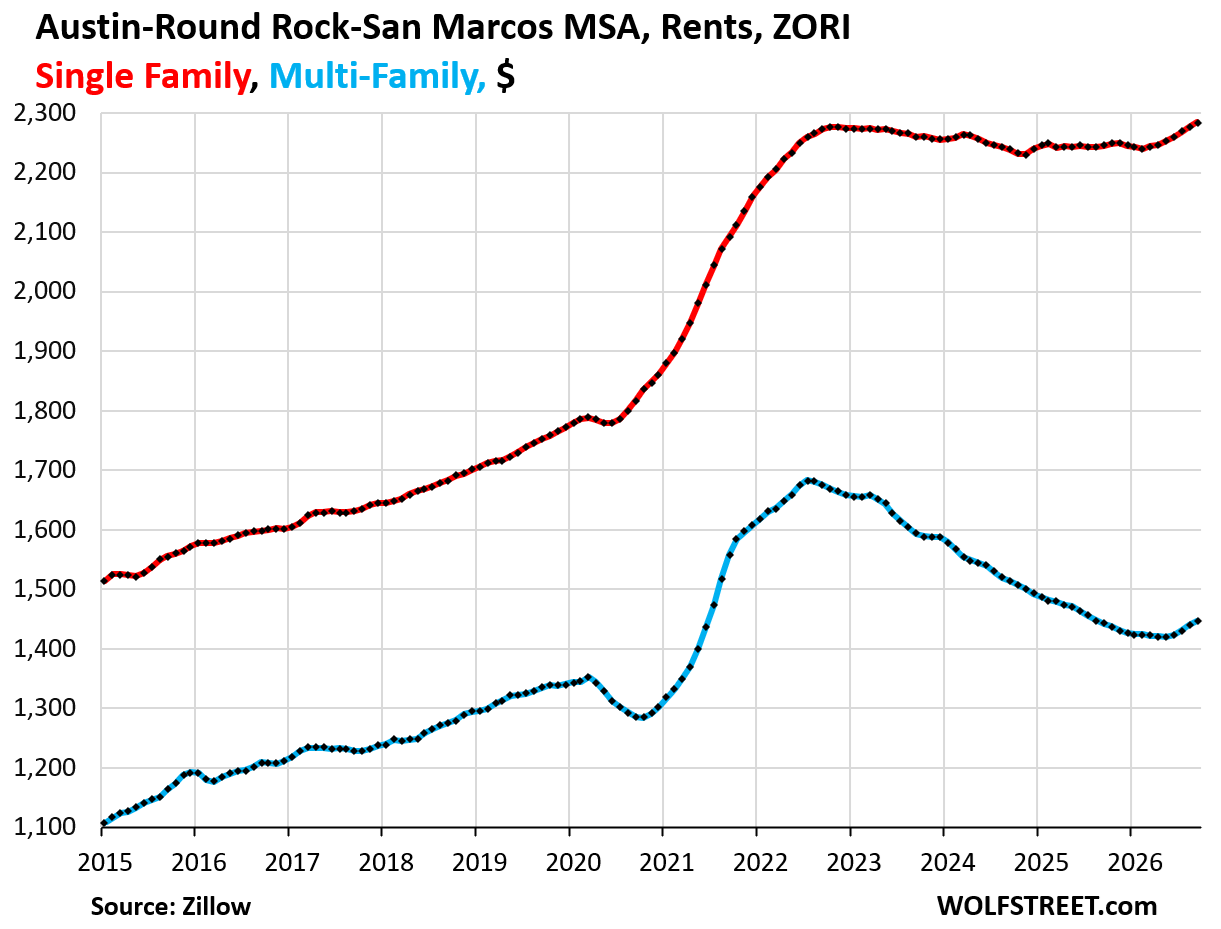
Austin metro:
- Multifamily ZORI:
- Month-to-month: +0.4%
- Year-over-year: +0.3%
- Since Jan 2020: +8%
- Single-family ZORI:
- Month-to-month: +0.4%
- Year-over-year: +1.8%
- Since Jan 2020: +28%
Multifamily rents have dropped by 16% from the peak in mid-2022, amid an onslaught of supply. But they have now stabilized. Single-family rents eased only gradually, and over the past few months ticked up again.
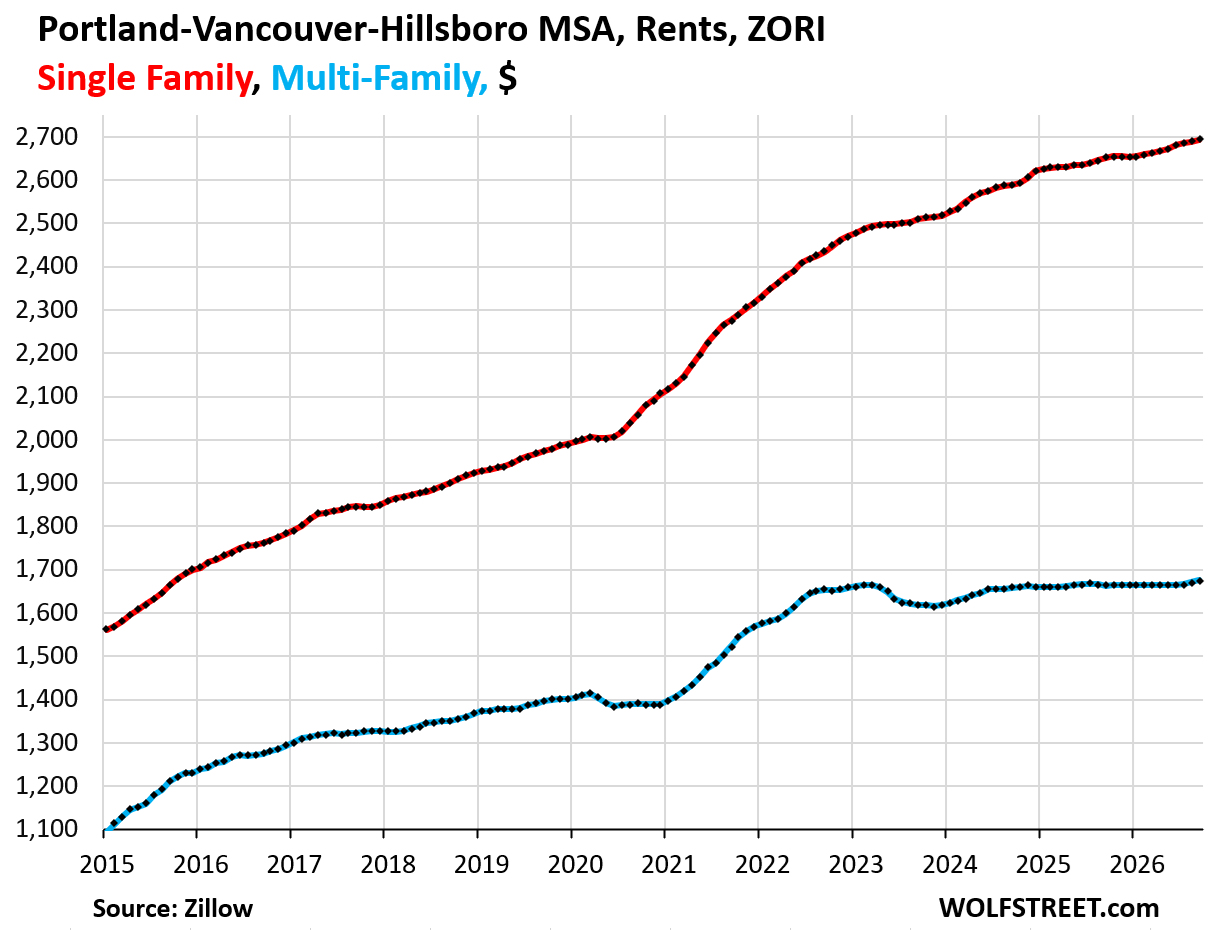
Portland metro:
- Multifamily ZORI:
- Month-to-month: +0.3%
- Year-over-year: +0.8%
- Since Jan 2020: +19%
- Single-family ZORI:
- Month-to-month: +0.2%
- Year-over-year: +1.6%
- Since Jan 2020: +35%
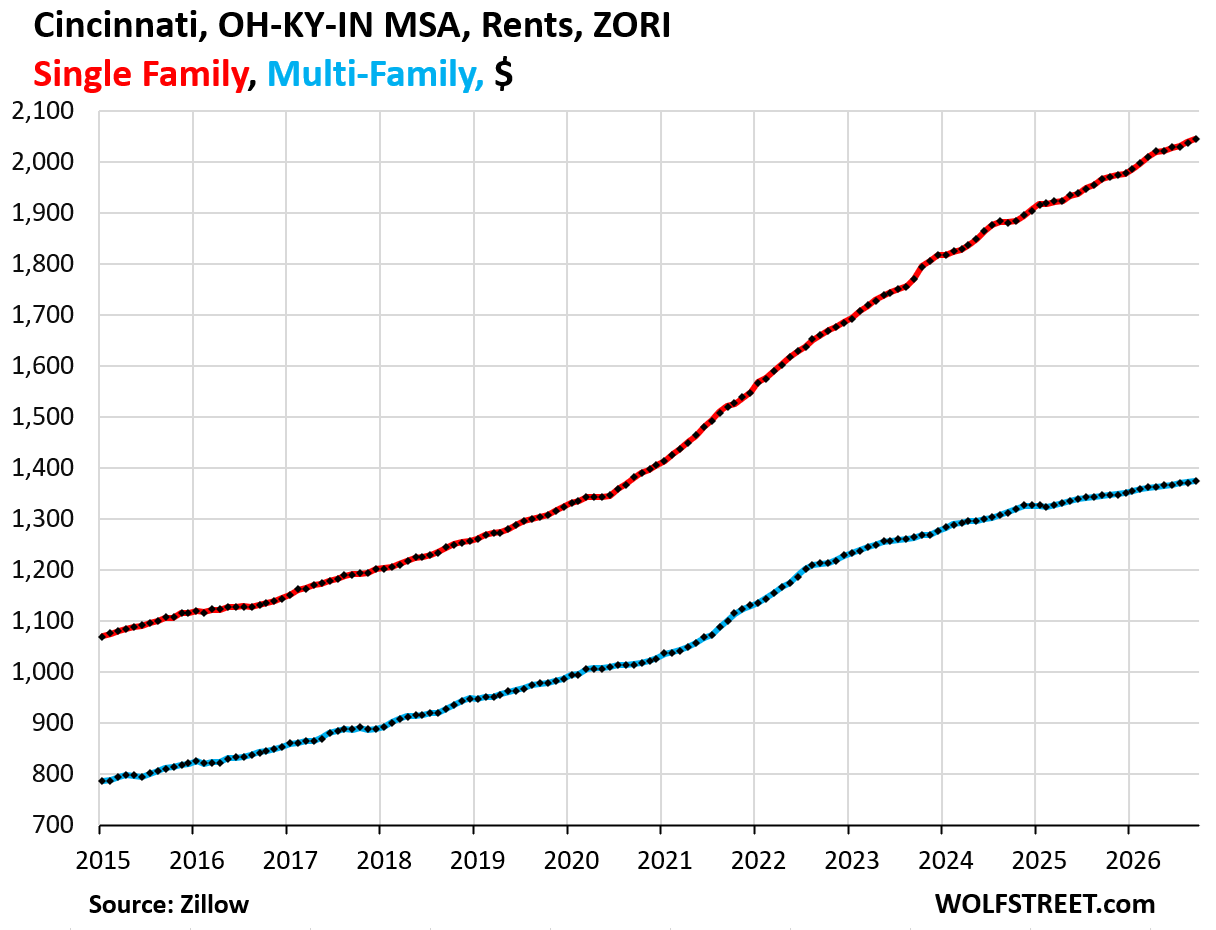
Cincinnati metro:
- Multifamily ZORI:
- Month-to-month: +0.2%
- Year-over-year: +2.2%
- Since Jan 2020: +38%
- Single-family ZORI:
- Month-to-month: +0.4%
- Year-over-year: +4.1%
- Since Jan 2020: +54%
Who owns the rental housing stock?
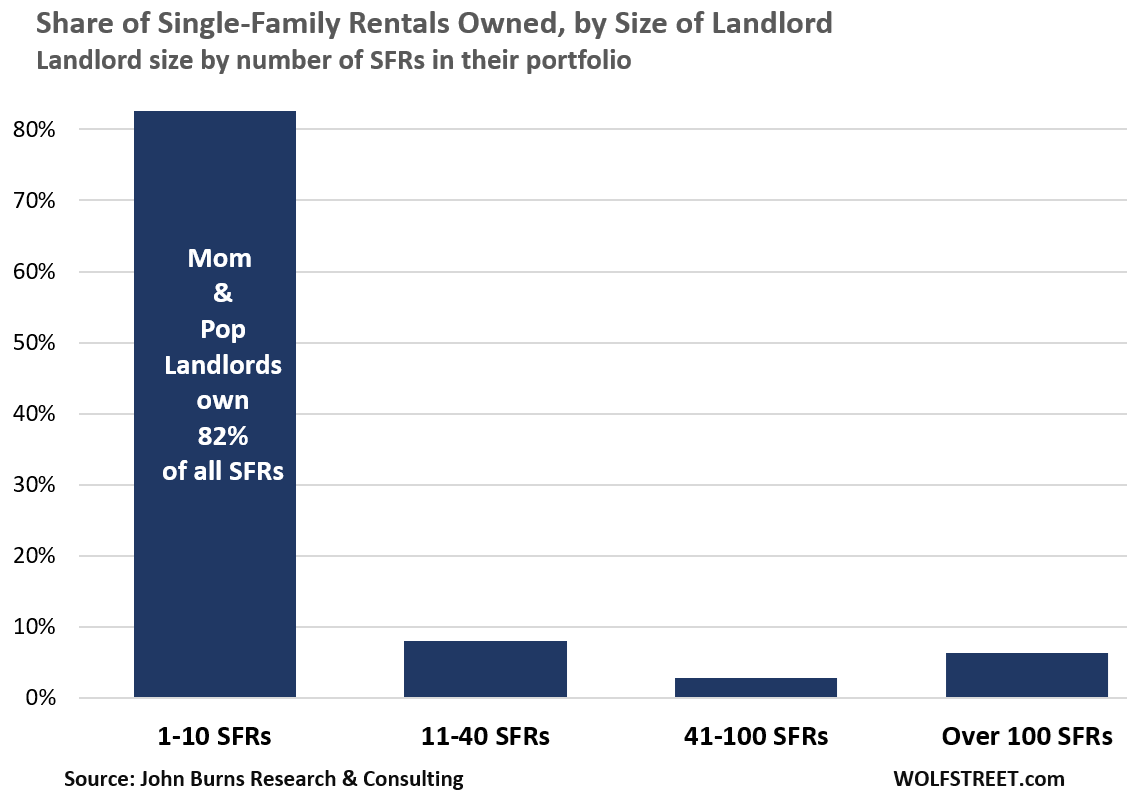
There are about 50 million rental units of all types in the US. About 15 million of them, or about 30%, are single-family rentals (SFRs). And about 35 million are multifamily rentals.
About 82% of those 15 million SFRs are owned by mom-and-pop landlords with 1-10 rentals. The remaining 18% are owned by larger landlords. Landlords with 100 or more SFRs, including a handful of giant landlords, own about 6.3% of the SFRs (data via John Burns Research and Consulting; see my analysis of who owns the US rental housing stock).
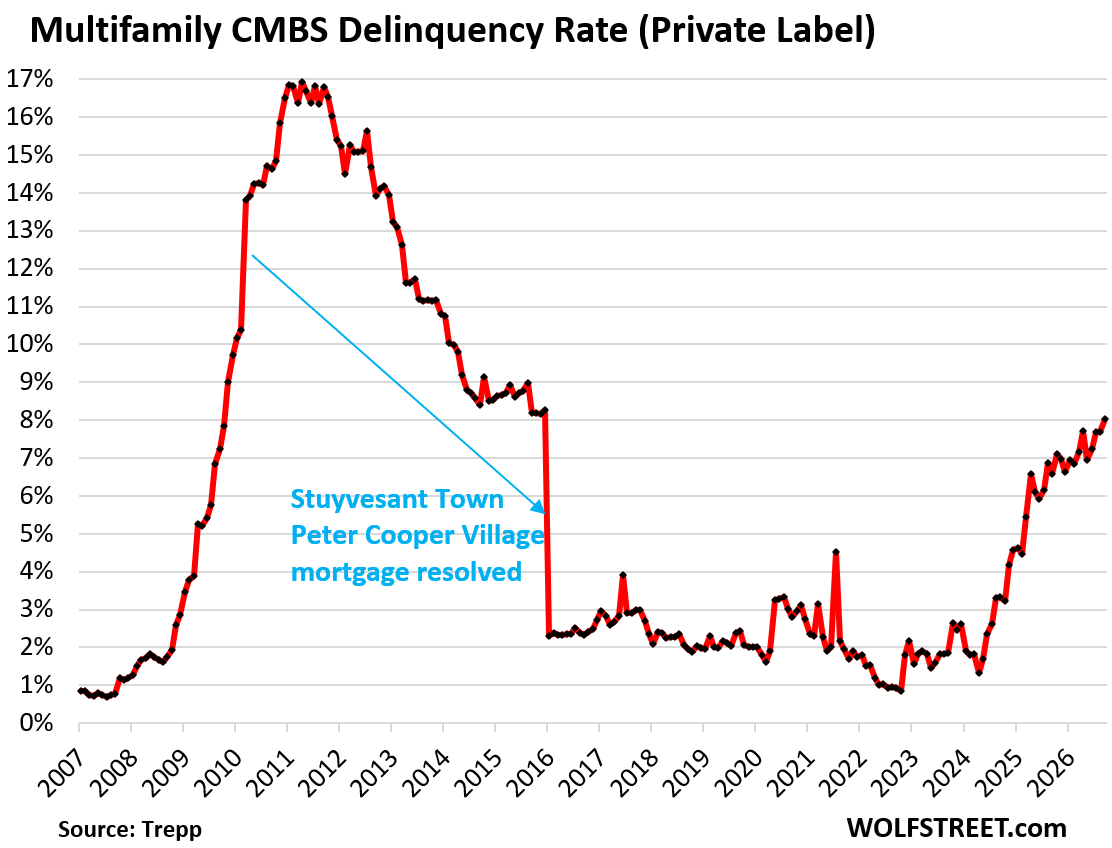
The multifamily market is dominated by big institutional landlords. Since 2022, numerous big multifamily landlords have defaulted on their debts as they’d cash-out refinanced the properties at massively inflated valuations before or during the pandemic, at very low interest rates, and those valuations don’t pencil out with higher interest rates of today.
Landlords defaulted on interest payments if they had floating-rate loans, and they defaulted because the post-pandemic valuations had plunged far below the loan value, and they defaulted on the balloon payments when they came due because they could not refinance the property with a big enough a loan to pay off the inflated existing loan. And rental income was insufficient to fund the higher interest expenses and operating costs. Lenders seized the properties or sold the loans to investors that then seized the properties. This stuff is still going on. We’ve discussed some of those deals here from time to time.
The delinquency rate for multifamily Commercial Mortgage-Backed Securities (CMBS) surged to 8% in September (data from Trepp):
Enjoy reading WOLF STREET and want to support it? You can donate. I appreciate it immensely. Click on the mug to find out how:


Do you have any insight into why they are accelerating?
I’m trying to understand “why” for cities where rent is starting to increase in 2026 after years of decreases. Could it be due to increased costs associated with properties (i.e. property taxes, catching up on deferred building maintenance, insurance,. etc..)? Or is it supply/demand where there are is a housing shortage?
Looking around here in Denver, CO. Where rent has been dropping over the last couple of years (illustrated in your figures). I see a good amount of vacancies and move in concessions. There have been a massive amount of new construction over the last few years and more new construction underway. Additionally, Denver leads the nation in accidental landlords, which adds more supply of rental properties to the market. I have had no issues negotiating renewing my lease by threatening to move.
People, including younger professionals, that previously could afford to buy a condo or single family house are being pushed into the rental marketplace up here in the Boston-Cambridge area.
Cities are raising property taxes to meet higher costs. Where I lived, residents were pissed because very little effort was made to cut any of the nice-to-have services. But there are those in government who believe everything they do is have-to-have. They’ll be learning soon that is not the case.
The inflation continues. As long as the Federal government can spend $2T a year to help around the fraying social edges of our society, it may continue. But God help us when the deficit spending ends.
Interest rates are up, so buying is more expensive, so the rent vs. buy calculus supports renting at higher rates just as it pulls housing prices down. Investors/landlords need to make more money on a given property to pay off loans. Wage growth is 3% on average which means people can more or less pay.
Google Adam Smith quote on “Property and Governments being instituted”….I’m too lazy to paraphrase or look up and paste…..but he is THE capitalist’s hero….I think…..last I heard….
He invented it
Oh…..
Really?
I rent an apartment in southern Orange county, California and my rent has been increasing each year by the maximum allowable amount under California state law, which is currently about 8%. Every other apartment complex is increasing rents at the same rate. There was a two or three month lull where it looked like rents paid were flattening, but that has since “corrected” to the maximum allowable increase. About 1/8 of all units in my complex were vacant at one point, but the increases continued, undaunted. Frankly, I don’t know how multi-family CRE survives with 1/8th of units unoccupied.
You need to be agile, and switch apartment. Best deals are available only for new tenants.
It sucks but this is how the game is played.
Or go negotiate in person. It might help face to face. Bring them some donuts randomly, introduce yourself. Then at negotiation time they know who you are.
Donuts won’t mean anything – ditto kissing up.
Any decent sized landlord gives fairly little pricing flexibility to their front line leasing agents these days (except in one case – see below) – now-a-days, central corporate runs the pricing show with heavy, aggressive use of price optimizers (see RealPage lawsuits).
The only effective negotiation tactic is to make a very real, palpable threat to leave once the lease expires – perhaps up to and including signing notification of planned departure (which means you gotta have back up plans in place in advance).
Bring a list of competing complexes with their promotional offers and let your current leasing agent know that if your desired number is not matched, you are gone.
At that point (maybe requiring signed departure notification), the yield optimizer is going to re-price – since even 1 month with zero rent has real meaning for yield optimization. The optimizer might even wait until x number of days before your arranged departure to counter – this ain’t beanbag, this is among the hardest negotiations you will ever have to deal with.
It takes a very, very serious threat with competitive intel and a complete willingness to hit the road to save some money.
And even this might not work in perpetually leased up markets (96-97% occupancy since forever) like NYC and CA. Those markets there are simply too insanely tight for renters to have much/any leverage. 3-4% vacancy is required for reasonable and predictable turns/turnover – the yield optimizers are going to have that slack built in to their baseline assumptions.
But everywhere else? There are plenty of places in the US with 90%-94% occupancy,
You got a shot – but you need to be fully prepared and willing to exit the lease.
The optimizers have a ton more data than any renter and they are merciless – (“They Have No Mouth” so they “Eat No Donuts” – they eat the maximum of the median renter’s pocketbook.)
You are in a knife fight with HAL and you gotta have a back up plan (HAL is fully capable of shoving you out the airlock) – or just surrender right off.
It’s easy to move when you’re young, but having a family or being close to work, makes it difficult. Plus there are moving expenses and potentially higher commute costs.
People need to understand that when a city imposes “controls” like this it doesn’t lower prices. Rather it provides a ceiling all landlords can just blindly target and reduce price competition.
How does this factor in the loads of apartments advertising 2-6 months free but not dropping actual asking rents?
Like I said in the article, it doesn’t include incentives. These are “asking rents” — read the part about “actual rents” and asking rents, and look at the chart of “actual rents.”
@Wolf – I always hated these rent concessions like 3 months off. I hoped to get lower rent instead of that. I wonder if it should be illegal to not report such concessions in rental data. We do it for home sale concessions, don’t we? (although people try to cheat there too).
I don’t think we have free markets, at least not in housing (rental & purchase). Institutional players are the cause of this. They have tons of units to influence the market & also money to get the laws in their favor which often goes against plebs (Yay ! Dollar democracy!).
Ok, imagine this. You have 100 units to rent as institutional investor. You need $1000 per month to make a 25% profit which you are ok with. You rent each home for $10/month, giving you the $1000. What if you could remove 10 units per year INTERMITTENTLY and rent the remaining 90 at $12/month & get $1080 instead of $1000? Basically, artificially reduce supply to jack up prices? I mean as long as your cost of carry is covered by excess profits. It does not sound implausible to me.
Of course, you can keep those 10 units off for 3 months x 4 times instead of 1 full year so that they dont become stinky or odd from lack of use.
Do condos and townhouses fall into the single or multifamily category? Is the classification dependent on ownership structure?
Thanks for clarifying.
The rentals that are included in this multifamily index here are those that are designed as rental apartments in buildings with 5 or more units. Condos are not included, nor are townhouses.
But many townhouses are classified as single-family (Census definition, which Zillow uses), and if advertised for rent, those are included in single-family rentals.
Interesting research, five or more units are classified as multifamily rentals.
The other group of multifamily rentals is 2-4 units. But they make up only a tiny part of the rental market. I include them separately in my annual construction data. But since the numbers are so small, which causes survey data to be highly variable and noisy, they’re often excluded from monthly multifamily data.
In other words, it is expensive to live in th US…
our rents have fallen by over 10% and vacancy rates are around 13% in Tucson
all big apts have signs – no deposit available(to 700+ fico)
an owner(San Diego) said that maybe we need open borders again
as then we had full occupancy
Thats crazy that the landlord said that. Next you’ll hear employers saying out loud “We need to open the borders to suppress wages.”
every landlord i knew in phoenix, small time or big time had the same attitude. as did the construction and spa and hotel……owners…….why the surprise?
Gotta have that slave labor.
Even better if they can get the tax payer to house and give health care.
Exhibit Z of why people don’t like landlords right here.
The default rate on multi family apartment debt is high inventors are walking away from projects, investment capital and their debt. It’s counterintuitive with the rate of rent increase, but the big chuck of multifamily debt has to be rolled over every 5 years and the delta in rates are crushing investors. Not that I have much empathy for multi families apartment investors they thought they knew the risk and that the risk was manageable , it’s definitely counterintuitive with the story of housing shortages and rent inflation that their is so much default in that area. Yeah I guess I have empathy for their choices and losses, it seemed like a prudent investment.
still waiting, need a couple more houses
finding that tenants are multi-generational
with 2 generations able to pay rents(ie not relying on just 1 income)
Not to worry. It’s all transitory. You blinked and missed the dip in rents.
Millionaire renter households grew 229% from 2020 to 2024, to 18,400, versus 193% growth for millionaire homeowners, a sign that renting is now a deliberate choice for some wealthy households.
Millennials make up nearly half of millionaire renters and Gen Z is growing fastest, pointing to higher-end, flexible rental demand in lower-tax Sun Belt metros.
18,000 millionaire units out of a 50,000,000 national rental base is so vanishingly tiny (1 out of every 2500 rental units) as to make it unlikely to be a significant factor in rent inflation – other than in tiny, rarefied geographic areas where people pay to have their purebred french poodles walked.
It’s interesting to see rents rising at the same time as defaults are rising. As Wolf suggests, the need to refinance at higher rates means that some apartment deals done in the past no longer pencil out. Perhaps the only way out is for apartment complexes to raise the rents.
So higher interest rates are directly feeding into rental inflation. And as rents go higher, home prices go higher too. This realization is itself heating up demand for rentals from mom & pops who can make the numbers work.
Still, I find it strange that 20-25% of the population started working from home at least part of the time, and yet they haven’t decamped from the high cost metro areas described above. There is plenty of affordable housing in secondary and smaller metros.
“Perhaps the only way out is for apartment complexes to raise the rents.”
See/Google also the Houston “Applesway” excess leverage/landlord overpayment/rent hike death spiral.
20 years of demented ZIRP cultivated a host of market pathologies related to half-assed use of excess leverage.
The Applesway fiasco in April 2023 right here on Wolf Street:
https://wolfstreet.com/2023/04/11/trouble-in-multifamily-cre-two-big-messes-and-investors-are-on-the-hook-not-banks/
From my article:
Four Class B and Class C apartment complexes, built before 1981, with 3,200 apartments in the Houston area – the Reserve at Westwood, Heights at Post Oak, Redford Apartments, and Timber Ridge Apartments – were sold at a foreclosure auction on April 4 in Harris County by the lender, Arbor Realty Trust, a publicly traded real estate investment trust that specializes in commercial real estate lending. Arbor Realty’s shares [ABR] have fallen by about half since November 2021.
Investors took the loss, not banks, and are still on the hook. As often in CRE, it wasn’t a bank that took the losses on the debt, but investors. We just discussed banks’ exposure to CRE debt, that 55% of CRE debt was held by investors of all kinds, such as Arbor Realty Trust, and/or guaranteed by the government; and we discussed just prior the huge losses some office towers dished out, mostly to investors and not banks.
The debt on the properties amounted to $229 million. According to Bisnow Houston, which confirmed the deal with Arbor Realty, the four properties were sold for $196.5 million in total, that’s $32.5 million below loan value, to Fundamental Partners, a New York-based private-equity firm.
Arbor Realty took the $32.5 million loss on the loan so far, plus foreclosure expenses. According to Bisnow, it continues to be the lender for Fundamental Partners. So it’s still on the hook for what’s left of the loan.
Variable rate mortgages taken out just ahead of Fed’s rate hikes. The former owner that lost control of the properties, Applesway Investment Group calls itself “a privately held investment firm focused on acquiring stable, income producing multi-family properties in emerging U.S. markets,” and pitches “passive income from high-yielding multifamily investment opportunities” to retail investors.
It had gone on a multifamily buying spree focused on lower-income properties during the free-money era, and funded projects with variable-rate mortgages. According to the Wall Street Journal, Applesway took out most of the loans in the second half of 2021.
This was perfect timing for variable rate mortgages: on the eve of the steepest rate hikes by the Fed in decades. According to data by Trepp, cited by the WSJ, the interest on one of the mortgages had jumped from 3.4% at origination to 8%. The purchase of at least two of the properties was financed with about 80% debt. Applesway’s losses amount to the equity portion of these properties.
In addition, Applesway was facing a $1.6-million lawsuit for unpaid work at those properties, according to Bisnow.
Here’s my article from April 2013, it’s got a lot more stuff in it, including about a huge multifamily default in San Francisco:
https://wolfstreet.com/2023/04/11/trouble-in-multifamily-cre-two-big-messes-and-investors-are-on-the-hook-not-banks/
Much more recent news of various apartment landlords (who used syndication to raise funds from too naive RRE investors) blowing themselves up and causing financial and other problems for their renters…
Multiple landlords owning multiple properties involved. This is happening *despite* EPIC rent inflation in 2021 and 2022 (and small, if any, retracing since).
Just shows how the madness of ZIRP near-free money strongly encouraged vast, speculative overpayment for assets (in this case, *apartments* – which are fairly close to having inelastic demand even under heavy thumb screw pressure on rents).
Prime example of the overvaluation madness/delusions fuelled by decades of ZIRP.
But on the flipside, there are the landlords who locked in fixed-rate mortgages in 2019-2021 and they are absolutely rolling in cash. They are getting the benefits of higher rents and paying nothing for the higher interest rates. THIS is how you inflation-hedge, not with some BS ARM.
The difference between prosperity and ruin for landlords was their choice of financing instrument.
I know it is base effects, but, Dude…
LA Multifam rent inflation post Jan 2020 – 23%
(and just 50 traffic-laden miles to the (desert) west…)
Riverside-San Bern rent inflation – 46%
Just shows how people *try* to adapt to existing and emerging rent price insanity…but, even when (too marginally) moving away, you still end up under CA tax/cost regime and without the benefit of fabled coastal CA weather but with a new nightmare commute).
I understand that people are anchored to their employers’ location…but numbers like these help explain the CA exodus. Run…but run *far*.
(Of course, none of this explains things like St. Louis-(Detroit in the Making) going up 38%…).
The percentage is high because they started with low rents.
Very interesting topic – I’ll share anecdotal about my own rental:
I charge 3800,00 for a 3br/1600 townhouse just outside Cambridge, MA.
Too high?
Bought 10/2006 for 430k, yes, just before the crash… Paid 20%/86k down and locked in a 30yr @ 6.25
Zillow+Redfin/2 = 735.320, that’s a 305k gain over 20 years -> 2.718% per year.
Was underwater technically till about 2013.. but the town increased r.e. taxes by about 1-2% regardless each year during that time.
Given that rates were falling I was able to refi, multiple times, finally into a 3.75% by 10/2016, when I started renting it out.
My mortgage payment was/is 1389/pm. I could not refi in 2020 since it was considered investment property and rates were not competitive.
In 2016, I rented it out for 2950, currently 3800, that’s 850pm higher in10 years which works out to 2.56% annually.
Condo fee is 250pm (insurance, landscaping), r.e. taxes (600) for a total COO: 1389+250+600=2239pm.
I am paying off the mortgage off at an expedited pace, putting 3k on top of the 1389 pm.
When doing taxes, TT says I need to charge 3300 for it, that is minimally, otherwise it’s considered below market…
You want to by the place?
735k -> 20% down is 147k (who has that!!!)
7.5% mortgage on the remainder -> $4111 OUCH
COO: 4111+850 = 4961
That is 4961/2239 = 2.215x as expensive.
I adjust rent on how the tenants behave, mostly, and sometimes keep it flat.
Tenant quality is worth a lot, it could squeeze them for more, but I don’t.
Their rent pays for both my mortgages, and I’ll put my kids the townhouse when/if they go to college in the area.
If some major crash happens, I have lot to lower the rent to attract tenants…
I am aiming to pay it off in 18 months, at that point it’s pure income.
I wonder if this increase in rents is due to deliberate govt/fed policy (no the fed is not exactly independent). It could just be accidental too or a unplanned side effect.
I wonder if this was the gameplan –
1. Landlords suffer from low or no rents due to covid, no eviction rules etc.
2. Lower rates to save economy, knowing that you can hike them later.
3.Lower rates will make home prices skyrocket.
4. Raise rates so that most crediworthy renters can’t buy homes and are forced to rent longer, thereby covering the landlord shortfall (partly or wholly) of step 1.
As an aside, higher rates combined with deliberate oil wars (Russia & Middle east), will make the dollar scarce (only USA can print) and harm geopolitical rivals & wavering allies/partners. Sure, the US gets hurt too, but the others get hurt more. Most of the others cant produce oil or even buy it easily like the US. Sorry, I just digressed about the oil war part.
I’m confused; aren’t rentals directly tied to income vs homeownership which is tied to speculation of appreciation\dash of emotion + highest loan values the payroll of an area can bear?
Wouldn’t this mean these areas just have rising incomes relative to supply of housing?
Rents are based on what tenants are “willing” and “able” to pay, both. If tenants are not “willing” to pay those rents, they leave or don’t sign the lease, and the landlord has to cut the rent to fill the unit.
The question is: what makes tenants “willing” or “unwilling” to pay higher rents. It comes down to competition among landlords. There has been a flood of higher-end brand-new multifamily construction that has come on the market, and with attractive rents to get filled, they attract tenants away from other rentals and put downward pressure on multifamily rents, and you can see that in the charts.
A similar thing has happened in some markets, but to a much smaller extent, with single-family rents as a surge of brand-new higher end build to rent developments are coming on the market.
On the other hand, lots of people have switched from buying to renting, which makes a lot of financial sense in many markets, and that additional demand is putting upward pressure on rents and downward pressure on home prices
Those are some of the dynamics here. They don’t all pull in the same direction.
You used to tought a chart of rental vs homeownership and it was no even close to converging. Is that still the case?