
And these mortgage rates too shall pass? It’s been four years of mortgage rates in a historically normal range. What’s high is inflation and home prices.
By Wolf Richter for WOLF STREET.
Pending sales of existing homes in September plunged by 7.3% from the already rock-bottom levels in August, seasonally adjusted, and by 11.3% year-over-year, and by nearly 40% from September 2019, to record low volume in the data going back to 2010, according to the National Association of Realtors today.
Compared to September 2010, during the Housing Bust, and the first September in the data, they’ve collapsed by 17%.
Compared to September 2021, pending sales have collapsed by 43%; compared to 2020 by 48%.
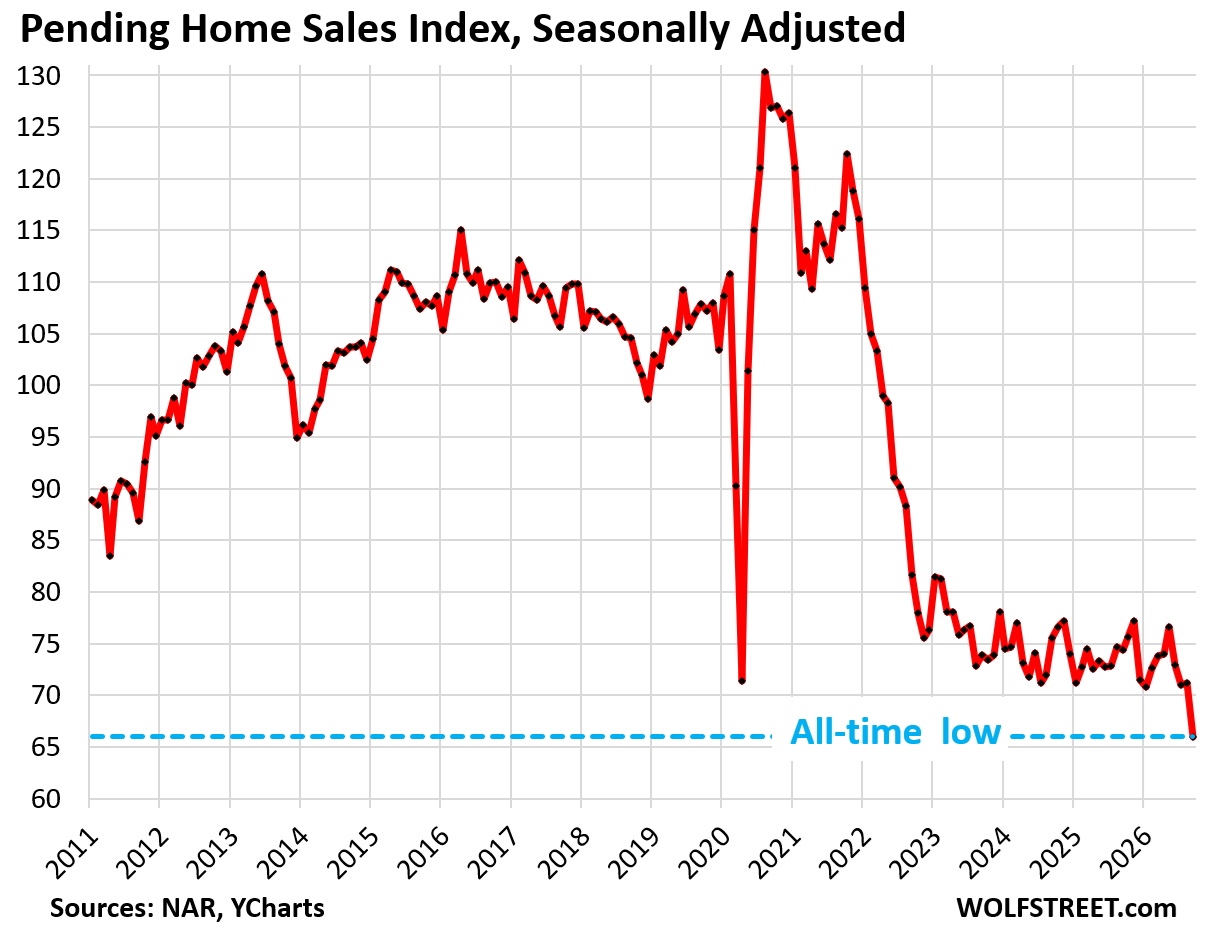
The NAR’s metric of pending home sales tracks contracts that were signed in September but that haven’t closed yet and could still get canceled. The rate of cancellations has been running high. Pending home sales are a preview of what is coming in terms of closed home sales.
“Buyers and sellers may simply be holding back until mortgage rates move favorably,” the NAR report said.
And that’s of course precisely what buyers and sellers have been doing for four years, which is the problem, hence the collapse of home sales.
Mortgage rates have been back in the normal range for those four years – it’s just that there is a whole generation of buyers and sellers out there that haven’t seen normal mortgage rates and are waiting for abnormal QE-and-ZIRP-based mortgage rates to return. But the Fed’s financial repression, which started in 2008, was among the factors that triggered that worst inflation in 40 years, and that inflation now refuses to go back into the bottle.
In terms of waiting for those QE-and-ZIRP based mortgage rates to return, Beckett’s absurdist play, “Waiting for Godot” comes to mind, in which the guy they expect to provide salvation never shows up.
The weekly average 30-year fixed mortgage rate rose to 7.40% in the latest reporting week, according to Freddie Mac. Mortgage rates have been in the 6% to 8% range since September 2022, which used to be considered normal to low in the decades before the Fed’s financial repression.
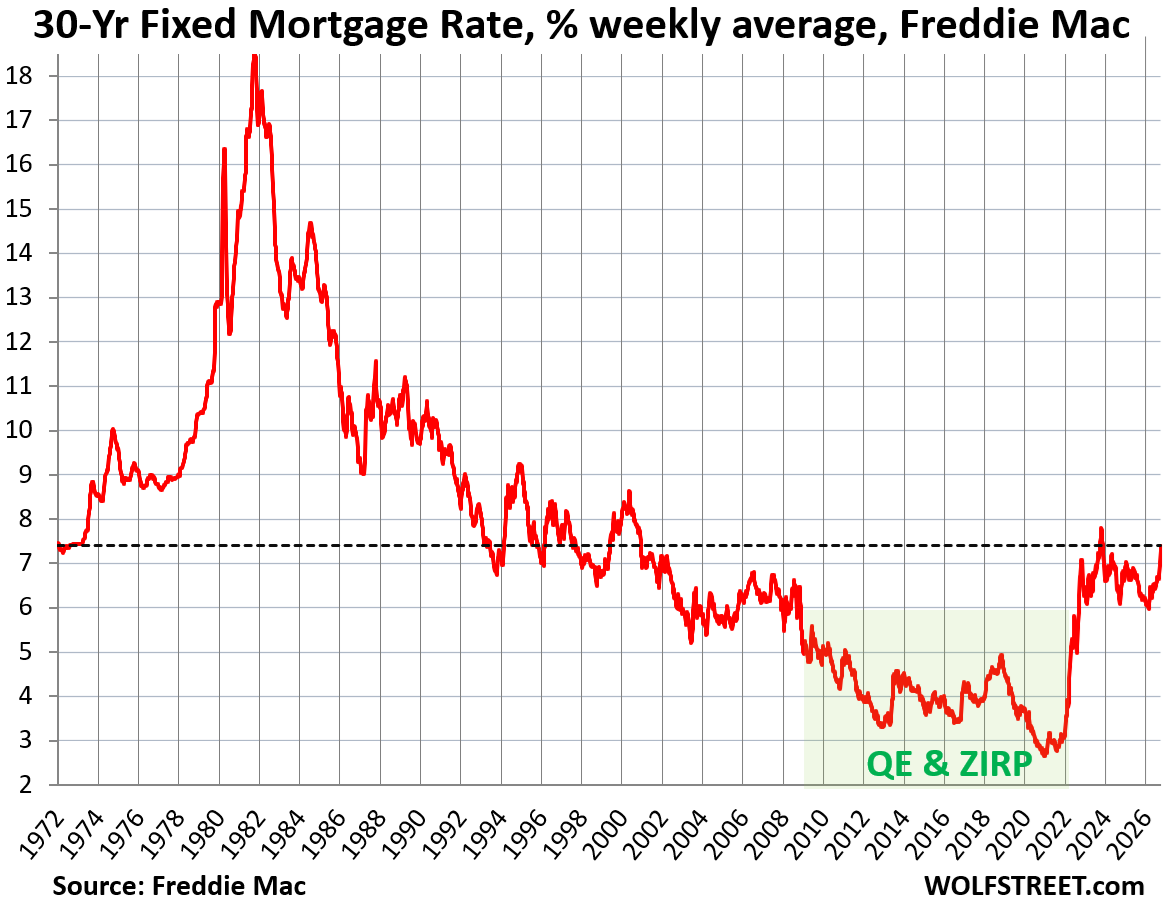
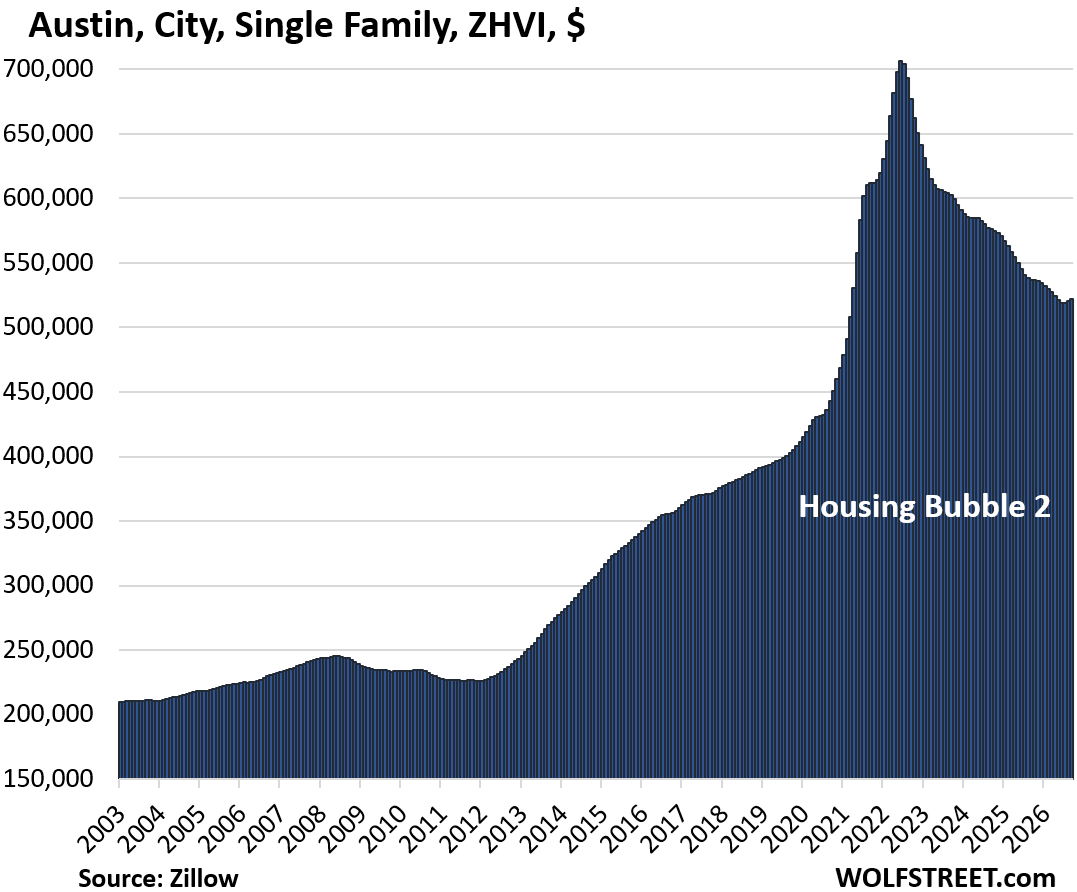
And it‘s also that the home price explosion from mid-2020 to mid-2022, fueled by these QE-and-ZIRP-based mortgage rates and FOMO, has blown home prices out of all proportion.
But as buyers and sellers are trying to find common ground, those prices have started to correct to the downside in many markets: Austin, TX -26%; Oakland, CA -23%; New Orleans, LA -20%; Cape Coral and Fort Myers, FL -18%; Birmingham, AL -17%; McKinney, TX, -14%, etc. Realistic pricing would repair this broken housing market. Here are prices of mid-tier single-family homes in Austin through September:
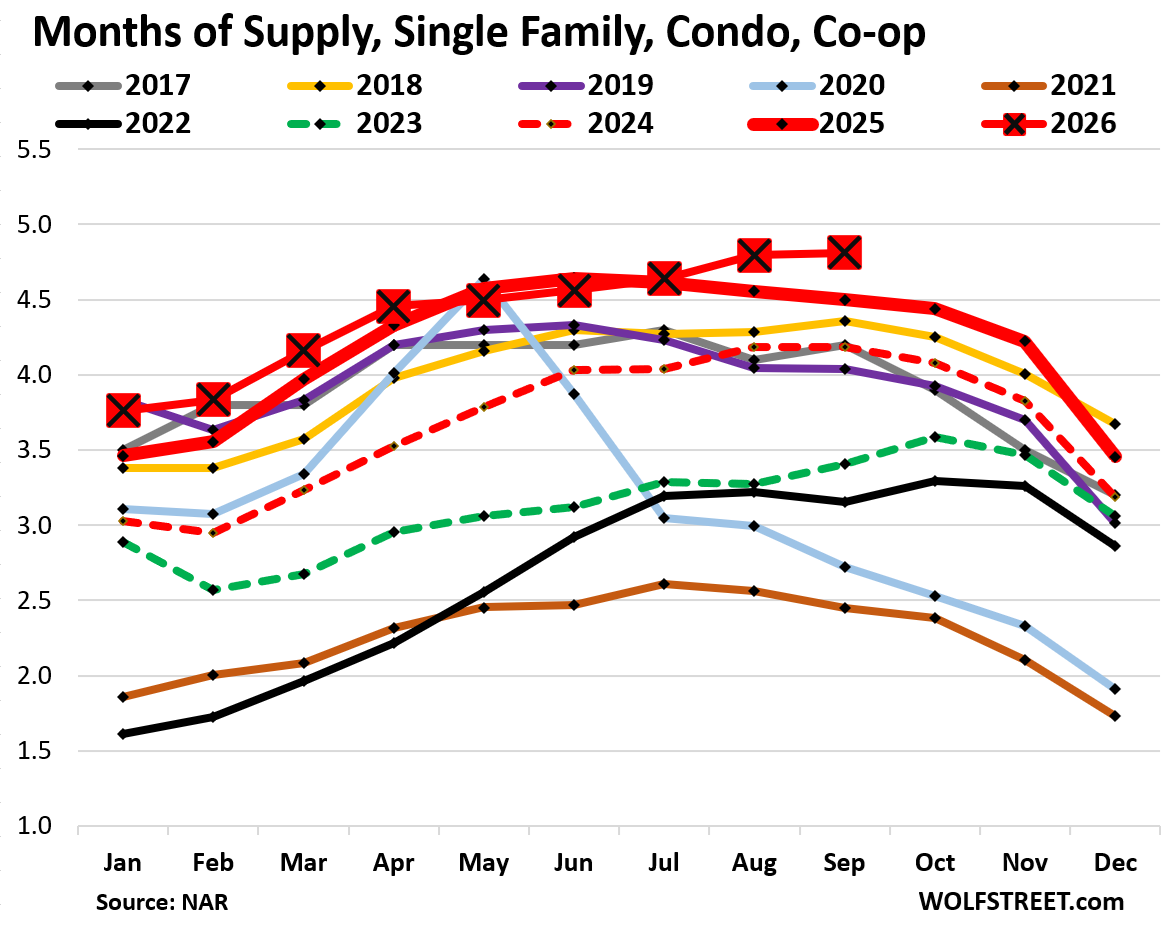
Supply of existing homes has soared to the highest level for any September in 11 years, as sales have plunged, and as inventories have risen.

Pending home sales by region.
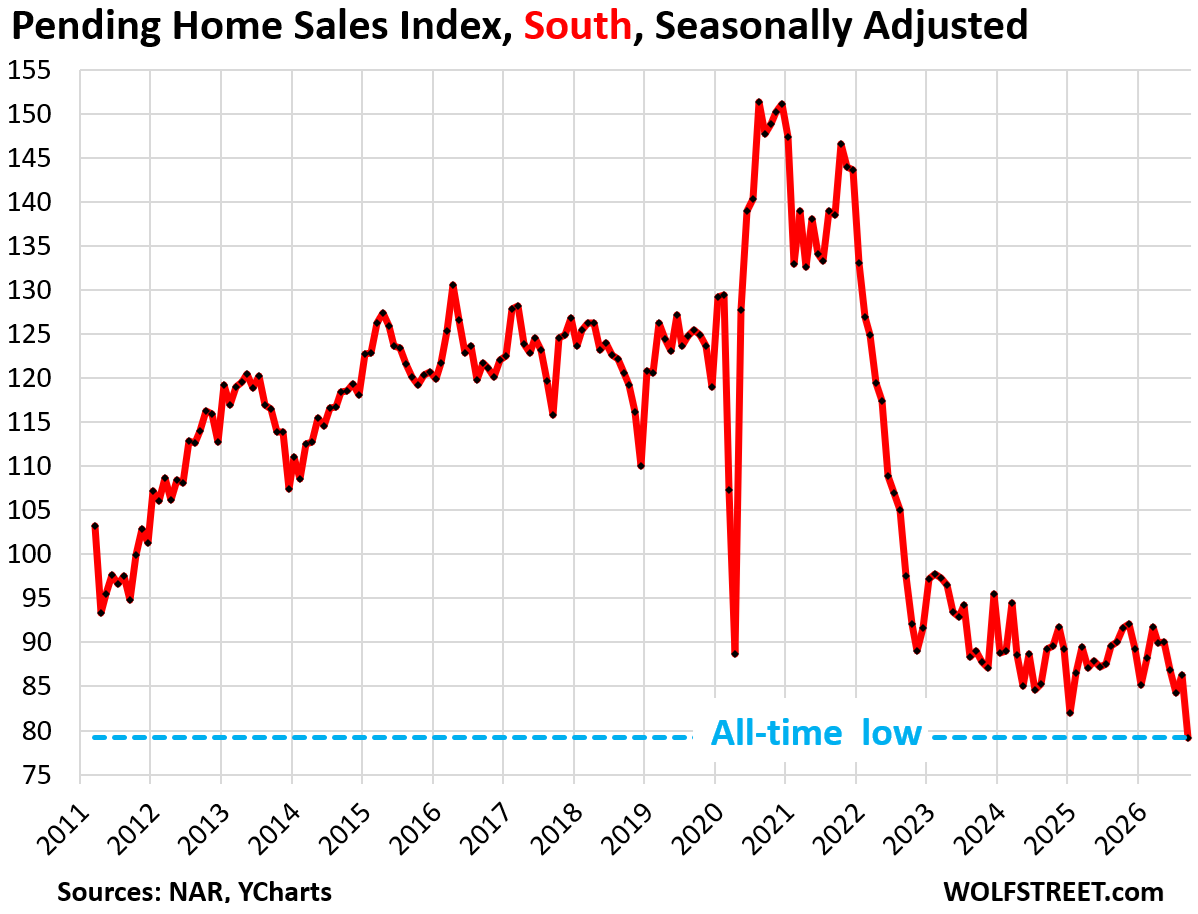
In the South, pending sales plunged by 8.2% in September from August, to the lowest volume on record, seasonally adjusted.
Compared to September in prior years:
- 2025: -12.0% (year-over-year)
- 2024: -11.2%.
- 2023: -11.0%
- 2022: -18.8%
- 2021: -42.8%
- 2019: -36.9%.
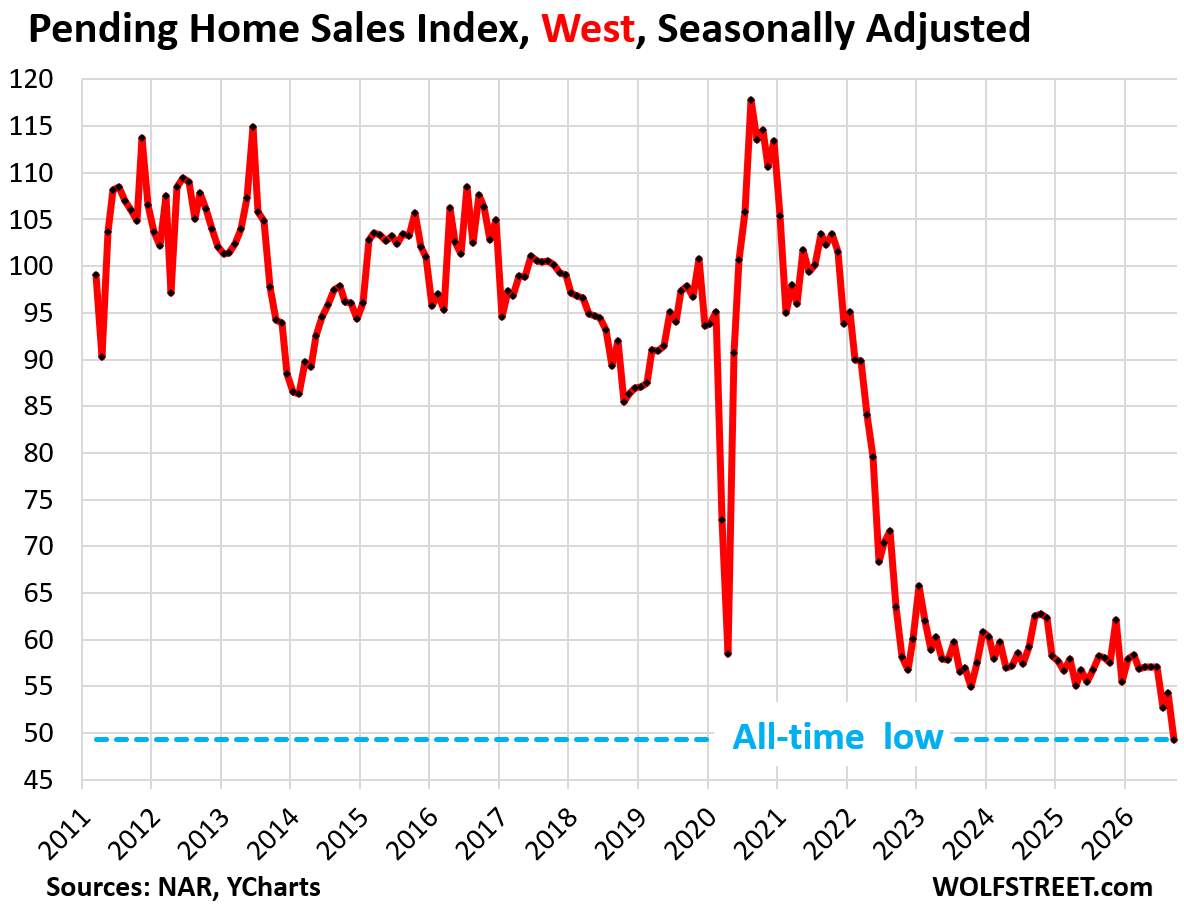
In the West, pending sales plunged by 9.2% in September, to the lowest volume in the data.
Compared to September in prior years:
- 2025: -15.0% (year-over-year)
- 2024: -21.1%
- 2023: -13.5%
- 2022: -22.4%
- 2021: -51.8%
- 2019: -49.6%.
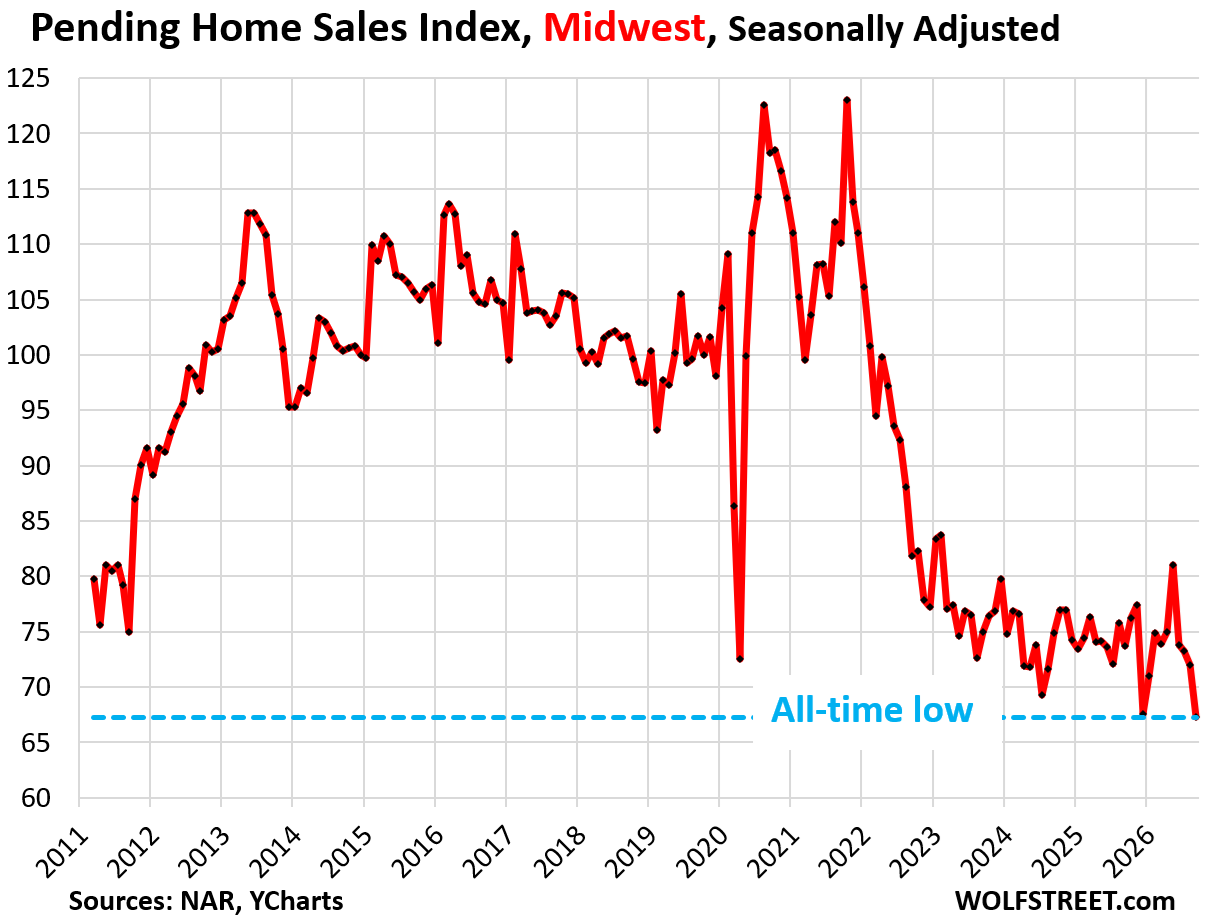
In the Midwest, pending sales plunged by 6.5% month-to-month, seasonally adjusted, to the lowest volume on record.
Compared to September in prior years:
- 2025: -8.7% (year-over-year)
- 2024: -10.1%
- 2023: -10.3%
- 2022: -17.7%
- 2021: -39.9%
- 2019: -33.8%.
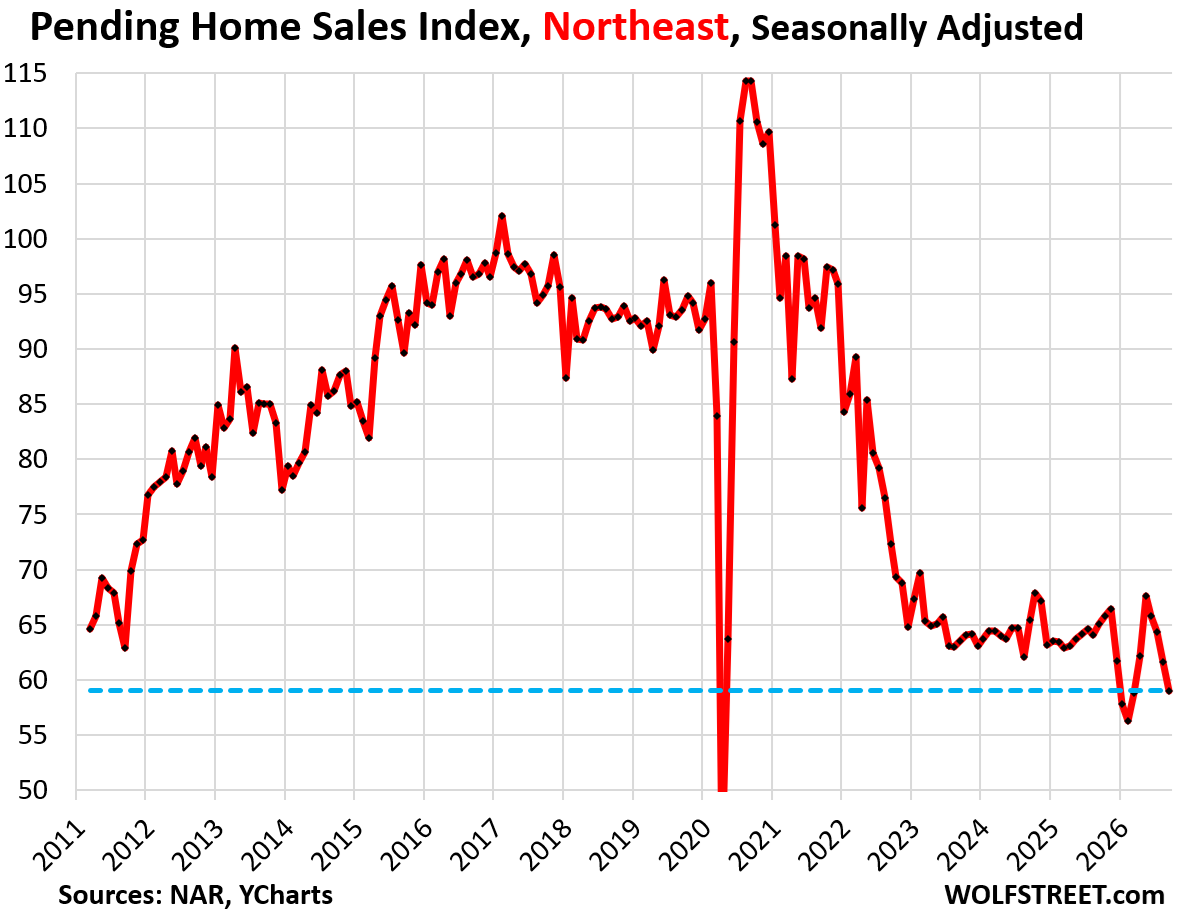
In the Northeast, pending sales fell by 4.2% month-to-month, seasonally adjusted. There had been three months last winter and April 2020 when sales had been even lower.
Compared to September in prior years:
- 2025: -9.4% (year-over-year)
- 2024: -9.8%
- 2023: -7.1%
- 2022: -18.4%
- 2021: -35.8%
- 2019: -36.9%.
In case you missed it: Single-Family & Multifamily Rents in the US and 22 Large US Metros: Amid Massive Divergence, Rents Are Re-Accelerating
Enjoy reading WOLF STREET and want to support it? You can donate. I appreciate it immensely. Click on the mug to find out how:


It’s funny looking at so many SoCal listings, you still see countless stubborn sellers asking ridiculous price for a tiny place since they cannot fathom we’re not in 2021/2022 anymore. Any price cut is pathetic, like taking $5k off on a $1.5M is going to inspire buyers to come out in mass. Smart sellers price them right from the get go and places are still selling at a decent pace. Guess this Mexican standoff will continue to last even after + years…especially if these stubborn sellers get lucky once in while and still get some FOMO buyer to bite.
Then there are many flipper special you see on Redfin, bought a year ago for less than $1M, did some minor remodeling and then relist for 50% more……some of those just sit and sit and honestly, I wish all of them would take a bath and eventually sell at a loss. When I see the last buyer on the property under some flipper special company name own by Tarek, I just wish them the worst…
^^^This if it’s owned for less than a year, I’m like hard pass. I’m not supporting the flippers.
Also no amount of work is worth a 50% increase in price. I’d so rather do it myself…
@MM Every year there are less and less people that can “do it themselves” so there is a market for “flippers” who buy homes and renovate them to sell them to people that have no idea how to “do it themselves”…
In a normal housing market, there are “rehabbers” who do excellent work and get paid for it. They buy at very low prices, rehab the house, then sell it for a profit. They address every problem the house has, including structural, and fix it correctly and professionally.
Then HGTV came upon the scene, and the housing bubble, and everything changed. Suddenly, Karen with a sledgehammer is shown breaking through some sheetrock with the intent of knocking down a load bearing wall to “open the place up.” F**king disaster what it all turned into….
Most of these flippers are just slapping some lipstick on a pig. Not many adding real substantial value.
“Most of these flippers are just slapping some lipstick on a pig. Not many adding real substantial value.”
Exactly. Most are totally unqualified.
I feel like maybe the willingness to do it has gone down, but the ability has actually gone up.
All you need is some youTube videos and chatgpt for things like floors, tiling, refinishing cabinets, painting.
For a small markup, I’d 100% buy something where a flipper did it for the time savings, for $200k+ increase in value in 6 months though it’s a hard pass. Also a lot of the flips look very similar, the same gray everything
But with AI, everybody is an expert in everything. We will no longer need any experts, period. AI will know all. It will do ALL. Like magic, your expert legal, financial, medical, engineering, or heck even contracting knowledge is absolutely WORTHLESS. Haven’t you seen it? It can write a script in python, you should be very very impressed as that was damn near impossible before AI. So just stop being so hard on those flippers /s
ApartmentInvestor:
Agreed. Many people do not have the imagination, and work ethic to make it what they want.
So they pay someone who does.
Which is why flipping works. Love it, hate it, people still buy it.
I’m doing remodel now
gonna be nice house when done
already got told by ‘realtor’ that I wasn’t going to get my price
I said FINE
then it will REMAIN rental
at much higher rent
the increase in rent alone will pay for it in 4 years
and my mortgage(just grifters insurance and property taxes)
2 months RENT
White collar professional services call it a practice for a reason.
I just bought a house in SD. We closed today.
Buyer was reasonable and listed the house for $300K less than it would have went for during covid. I came in with a big downpayment and requested a 2/1 rate buy down. Then came inspection and I got the buyers to agree to credit the cost of a new roof.
Deals are out there but most sellers are delusional. I waited over a year to find the right deal. There were way too many homes with deferred maintenance and sellers wanting top dollar.
Anyways, bring on the large mortgage payment. The only thing worse than a high mortgage payment is dealing with the slumlords who seem to be everywhere in SD.
totally agree
I like the 1 payment mortgage
ie C A S H
Good for you.
I wonder how much was asking price and how much you paid after 300k off.
Asking price was $1.4M. I paid $1.36M after credits by sellers due to issues on inspection.
At the peak of the craziness homes in this neighborhood were going for $1.7M plus. Demand is dead so it is a buyer’s market right now. I did the math and home prices in this neighborhood are now about inline with historical values after you account for inflation.
I truly don’t get the residential real estate market. Houses are bought and sold on the sizzle and not the steak. Flips and spec homes are MVPs (minimum viable products).
If I was buying a $1M piece of art I would be damn sure about its provenance and have it authenticated by a serious art historian/appraiser.
But, provenance and the actual construction of homes goes out the windows with real estate agents. It’s all about feel good marketing copy and the nearby schools.
Then, at some point, a realtor’s sexiness became the most important attribute to be marketed.
Does one with proven funds and who show a real interest in a property get to test drive the “sexy realtor…..,asking for a friend.
It would seem that countless stubborn sellers asking a ridiculous price for a smallish place are actually a unionized business cartel.
With government support, the landlord’s rue the roost.
did you know that from 1970 to 1980
avg house prices went from $17k to $76k
same house
just had to use more WORTHLESS fiat $dollars
that had been DEVALUED due to end GOLD Standard
called Brenton Woods(nixon ended in 1972)
taken 50+ years to ruin this once great nation
thank you FEDERAL RESERVE and grifters in CONS gress
Bretton Woods was already broken long before the end of the gold standard. No living economist believes that a gold standard is better than what we have now.
@Phoenix,
Same here in flyover land (southwest Ohio.) SOME sellers are taking a more realistic approach to their property pricing. Others continue to wallow in 2022 price fantasies. I’ve seen some ridiculous examples of that recently.
In the interim, the fantasizing existing home sellers seem oblivious to the fact that they are competing with new home builders. As Wolf has pointed out, those builders do not have the option to say “let’s just take it off the market. We’ll try again next spring.” The builders MUST sell homes day in/day out and they adapt their pricing/policies accordingly.
The pricing entitlement attitude is still very much in play. “My neighbor sold his house for this much in 2022, so I should get the same price at least.” Ah, no. Not even close. But that attitude still seems to be common.
Homeowners in California (especially long term homeowners) have very favorable property tax status on their homes. If they sell, they are probably going to buy a new property and pay dramatically higher property taxes on the new property. Combine that with people who bought or refinanced their mortgages at 2% to 3% (there are still a lot of people in this situation) and it’s easy to see what may be happening. A home seller is also likely a home buyer on a replacement property. If they cannot make sufficient profit to justify giving up favorable property tax treatment and/or favorable interst rates, they will just keep the homes until they can. I could easily rent out my home for significantly more than my mortgage. Why would I sell unless I thought the price was right for me?
I agree about alot of the rehabbers/flippers probably not adding “real” value to justify their markups.
Low unemployment and a strong stock market, and yet pending home sales are in a major bear market. Imagine the impact on the housing market if the unemployment rate meaningfully increased.
If if the AI bubble bursts…
…or both.
Maybe the housing market should (also) be worried about a travel recession that lasts for a few years that would turn vacation rentals into money sucks and push them back on the market.
@Wolf most rental vacation homes in the US are owned by the “working rich” (like me) who bought (or inherited) a “vacation” home where they like to go on vacation and are renting the homes for extra cash when they are not using them who will be fine if we have a “travel recession”. Sure there are some highly leveraged “AirBnB” Youtubers who will suffer but they are a minority (and almost nonexistent in higher end vacation areas where a multimillion dollar home will not cash flow even with a 50% downpayment and 80%+ occupancy).
Some owners in your situation will give up these second homes because insurance rates for them are skyrocketing. Second homes already cost more to insure than primary residences, and they’re often located in areas with high risks of natural disaster (wildfire, flood, etc.). AirBnB income might have been the only thing that made keeping a second home worthwhile.
Such hubris….
Real rich people would never rent their property to the unwashed.
There’s your first lesson.
/s
It probably depends on your location. In Colorado Airbnbers like you are the minority. Here it’s mainly people who bought thinking they’d get rich. Most are losing money, but small amounts currently. In a travel recession the owners do not have the means to pay their Airbnbs mortgage.
A lot people also chained these. They used equity from one to buy the next. In a travel recession the dominoes would go the other direction because they can’t cover the full mortgage.
That being said at what point it becomes a problem may be different for everyone. Some people may be able partially cover the mortgages.
MM summed up our local B and B wannabe tycoon. She inherited a ton of money, saw a beautiful BC coast valley and continually overpays for her ‘finds’. She knows zip and zilch about the buildings, the people, or building, (carpenter here), and does the lipstick treatment for a 100% markup resale. Or, she converts her ‘finds’ to a B&B that usually sit empty. I just bought my + 90 year old neighbour’s place. They are in their 90s, their house was just a tired double wide. They had always planned to sell their property to us. However, we also had no choice but to buy it as the B&B tycoon started making moves before they even started the sale process. It was all on the QT but she got wind of the sale through the gossip telegraph. She phoned them several times and simply hung up when they said no. One night she phoned them and said, “whatever you are asking, I’ll double it”. Seriously. That was the day after we closed. And after the place sold and the neighbours moved she phoned them at their new place and asked if it was still available, she wanted it.
Anyway, I’m selling the double wide for a dollar to another neighbour provided he hires a certified/insured house mover to haul it away by summer. He is looking for a lot as he now rents. Even if I wanted another rental, insurance is impossible to obtain for an older mobile to use as a rental. Plus, not worth any reno money. My buddy will take it away and rehab it for his own home. We’ll likely break even but at least we can now can remain here without having our situation ruined. It would be $5K to have it smashed up and hauled away, and the appliance sales would not even cover it. Or, the neighbour gets it for a buck all ready to go and he pays the move.
Could have been worse. It could have been a data center.
@MM do you actually know people with vacation rentals in CO? My sister has a place in Aspen that she rents to help cover expenses and I personally know half a dozen other people with vacation rentals in Vail and Aspen and with the exception of the post Covid travel boom (when both rents and occupancy was high) there was no way to have positive cash from flow from a $1mm to $5mm home or condo in Vail or Aspen (unless you personally manage the place full time and do all the cleaning and maintenance yourself). As you mentioned insurance is crazy, we pay over $11K/year to insure our cabin in Tahoe (up from just over $1K 20 years ago) with ~$5K to the CA Fair Plan Fire police and ~$6K for the other insurance coverage. We also have a manager that charges 30% of gross rents to deal with the renters (+ 10% of anything a vendor they hire and manage charges).
ApartmentInvestor,
“most rental vacation homes in the US are owned by the “working rich” (like me) who bought (or inherited) a “vacation” home where they like to go on vacation and are renting the homes for extra cash…”
The people I know in SF who own short-term rentals own multiple condos that are dedicated to short-term rentals. It’s a business. They tell me that they have to keep them filled about 40% of the time to break even/begin to profit. STRs have become an industry, a HUGE business, and includes the massive conference business in SF and elsewhere. It became an industry with the arrival of Airbnb and others, and only a small part is people renting out their own vacation homes part of the year (that’s the classic pre-Airbnb model).
Most recent data I could find: in 2023, there were 2.5 million listed STRs and 785,000 individual hosts – so about 3.1 STR units per host.
https://www.consumeraffairs.com/movers/short-term-rental-statistics.html
@ApartmentInvestor yes I know multiple people with airbnbs in Frisco, Vail, Copper and Steamboat. These were purchased as businesses, not as second homes. They’re all losing money. They bought into the realtor hype. They believe real estate will keep going up so they just need to hold on. If vacancy rates drop further they will be in trouble because they cannot cover the mortgage.
I also know someone who owns a hosting company in Breckenridge that people pay to manage their airbnbs. He was saying he had a number of clients who bought them as investment properties and are freaking out because they expected them to make money. He gives them all the actual stats, booking rates, vacancy rates, comps etc showing he’s actually doing well for the market and the owners are panicking because they’re not breaking even. So very similar experience.
I also know people with homes multi million $ homes in Keystone, Beaver Creek and Vail. These people don’t airbnb. It sits empty for when family wants to use it. The rich aren’t airbnb’ing. They don’t need to.
So what I was getting at is there two types of Airbnb owners. 1) Owners who bought it as a second home they could afford and extra money is nice. 2) Owners who bought it as an investment property, expecting it to make money because they believed a bunch of realtor/airbnb hype who cannot cover the mortgage if they needed to. I meet a lot of the second type. I actually don’t meet a lot of the first type tbh – most people I know who can afford a second home don’t bother with the pain in the ass Airbnb is and are using it the majority of ski season anyways.
@Wolf & @MM I am just talking about “Vacation Homes” in “Vacation Areas” (like Vail, Aspen, Tahoe Napa and Carmel) where most homes are $1-$5mm. Nobody buys those for cashflow (since they won’t ever have any, even without any debt if you maintain them at a high level) unlike Wolf’s friends in SF that are basically just getting into the corporate housing/furnished apartment business. I also know people in Michigan and Iowa who were able to buy and renovate homes near colleges and cashflow as STRs renting short term “furnished homes” vs. “vacation homes” but they were local and doing all the management and maintenance other than cleaning.
The 3.1 SRT units per host has to do with most (but not all) people with $1-$5mm “vacation homes” hiring someone to manage the place and list on AirBnB (and VRBO) and most (but not all) hosts with a lot of property just “managers” not “owners”, Our cabin manager/host manages about a dozen other $1mm+ Tahoe vacation homes and “Tahoe Luxury Properties” manages over 100 homes (including over a dozen lakefront places worth more than $10mm each). Renting our vacation home not only covers the cost of home but the cost of the “manager” (who deals with snow poles, snow plowing, snow shoveling, defensible space inspections and all the cleaning and repairs). It is sad that so many people MM knows are so bad at basic underwriting to think that anything other than a dept free vacation home will have positive cash flow if they are not running the place as a part time job and doing ALL the work themselves (in Tahoe it is tough to find anyone to come out and replace a 9V battery in a smoke alarm for <$100 and last time I filled our 1,000 gallon propane tank it cost more than I paid for my first car.
INSURANCE in vacay area’s
I’m biting my tongue as I write this
time for GOVT to step in
simple solution and then Insurance companies either offer entire state or not at all
National catastrophic insurance(everyone pays say $100 year)
fold ‘flood, earthquake’ backstops into one
then Insurance covers NORMAL non-catastrophic events as USUAL and CUSTOMARY
Ha my daughter is heavy into the STR / Buy vacation home and rent it out when not using .
She went from owning one outright in 2022 (close to the peak ) to owning 4 with 3 as partial ownership with partners .
She has negative equity in all of them after 4 years though the STR income does cover the overhead.
Not the depreciation. For some reason depreciation on these rentals are not viewed as an expense. Think about condo buildings vacation homes or any home after sitting for 30-60 years .
Unless located in a premium city area where lot prices have increased these homes are worth very little .
Delusional.
I am hoping El Niño brings the goods with powder, may all the skiers have over the shoulder pow shots, big smiles full of snowy faces! Southern flows may be huge this winter. Powder chasing year, hopefully powder will show up to chase. :) nothing left to do but smile smile smile plus skiing beats looking at charts
What would make housing market healthy if interest rate are going up and prices have already corrected like in Austin.
I’d say most markets need to go back to 2015 values as that is about what they would be had interested rates stayed normal.
Barring a huge recession my guess is that we muddle through until 2015 prices adjust led for inflation match current prices which may be another 10 yrs
My guess is that in HCOL high demand markets is that home prices will just trade sideways for years. Covid basically bought forward 10 years of gains.
But a lot of HCOL cities have seen home prices down by 30% or so from the peaks.
In 2021-2022: People who has vested interest aka landlords/house hoarders used to think home prices will never go down.
The same people in 2026, now are saying home prices will not go down but trade side ways for decades to come.
These people absolutely can’t fathom in their mind that home prices can nominally go down by a big chunk,
Yep. This.
I think we all know that markets tend to overshoot in both directions, though.
The real values are there and are increasing.
Now what a buyer can pay and what sellers are selling for are still very far apart.
All of a sudden one may catch up to the other especially with 5 cycles of slow selling.
How is waiting for a price correction any less delusional than waiting for the return of sub-4% mortgage rates?
The anchoring fallacy can have multiple anchor points.
can’t happen
Insurance
Property taxes
cost of rebuilding
all say
GIVE ME MORE OF THOSE WORTHLESS fiat $dollars
guess we need to devalue more
There is only one short term solution, a sudden decrease in asset prices
commonly recognized as a the prelude to depression
The concentration of free rider wealth in the world is a testament that aristocracy won and that the lower class became comfortable with less
What does the lower class have less of now than in the past. Actual wealth, not perceived/comparative wealth.
‘Perceived’ or unequitable?
Cash buyers are tstill buying over oriced homes in Nothern NV and Northern Ca.. Just saw a place at 1.2 m on the market 3 days went pending in Grass Valley ca.. and they have the crazy FAIR plan insurance that just went up 30%!
Yes some homes under a 1m of course but theya re STILL over priced.
Carson Valey area, Minden, Gardnerville, INSANE high because of migration from California people paying cash and the tax and insurance savings there is worth the trade off in price… so this report in general is true but …. not entirely..
As for the rates, it is what it is,buy or do not buy..
As for the prices of homes, a lot of it is greedy RE Agents blowing smoke up clients skirt. 5K reduction is done to just pop it back up in the MLS..means nothing!
How stupid do “they” think we are?
I do not see prices comeing down in the 100K’s in the near future and that is exactly what needs to happen to correct this… It will not happen.. we will never see pre 2020 prices o homes again.
1. “Just saw a place at 1.2 m on the market 3 days went pending in Grass Valley ca..”
That doesn’t say anything about general prices. All it says is that it was priced right for a buyer. How many times had the house been pulled off the market, and put back on the market at a lower price? What did it sell for most recently? That kind of info could provide more useful info.
2. In Las Vegas, where you seem to be, this is what prices of single-family homes actually look like (but yes, they’re still way too high and have a long way to go before they make sense again):
The stubbornly high prices in Las Vegas now is quite a contrast to the Great Recession, when prices tanked.
Hi Wolf – why did you put me on moderation ?
Because you cannot keep your opinions about states run by Democrats and about abortions and about people who have them to yourself somehow — that’s the politest possible way of saying it.
Is that a thing he does manually? LOL. I thought he approved every comment manually, I guess i been on moderation for years now.
Sparks, Reno, carson valley area.. I hailed from Penn Valley Ca.. 50 plus years.. would love to go back, cannot afford to go back now..Had a nice ranch etc.. been in NV now 10 yrs, crazy build out, all around me in Spanish Springs which was “rural”..no more!
Trying to get out of here is impossible right now and has been 2 years.
Don’t forget the house in San Francisco that listed for 7.9 million and sold for 15 million. Across the bridge you have shantytowns and condos selling at 2014 prices
Bat Bridge? Not in Marin I don’t think.
I see the home prices collapsing because the buyers have been priced out of the market not only because they aren’t being paid enough but walmart exported their jobs overseas.
Walmart is trying to portray itself, it seems to me, as a damsel in disstress
Here in CT, sales are low because no houses are available. If anything good comes on the market, there is a bidding war and it sells in a few days. Builders are mostly building rental apartments, because land in desirable areas is scarce.
14 yrs in the real estate business in Central Tx. Heavy on the seller side. Full-time broker and its a FULL CONTACT bloody market. Most sellers (95%) remain in denial that buyers are in control. Days on market are stacking up with buyers owning the leverage and sellers continue the transfer of equity. The equity transfer is silent until the offer arrives…
Thanks for the Beckett reference, very fitting.
The longer the price sticks and with the current inflation trend, I don’t see prices dripping substantially more. They may just stay stagnant until everything else catches up. But I’m a dunce, what do I know….
I was watching a video from Realtor talking about how sales have collapsed and they did a really good job of showing how much sellers need to come down in price to match increases in interest rates and competition from home builders.
It was also kinda interesting they also pushed back against everything that NAR was saying as bad advice.
I guess being a realtor is tricky you have to push getting the highest price because that is what your competition is saying they will do but your livelihood is based on volume. Selling two houses at 10% under market is better then 1 at 10% over.
Wolf
You are using a 15 year rolling window for your data graphs. I wonder if you make an exception and include data covering pre-housing bust of 2008, it might provide better, predictive information. I understand we can’t go back to 1930 depression era but the ZIRP, QE have connections to 2008. TIA
Would you please read the article?!? All of it. And not just look at the pictures. So you won’t have to post this BS.
If you took away the high speed trading in Wall Street we would see pathetic low volume there too like housing is experiencing. I liked wolf’s past mortgage bucket charts by %. Plus we got the accidental land lords that can’t sell their homes playing a part. We need a steroid(catalyst event like greater than 5.3% yield in tnx) to speed up the price discovery in housing, Kospi was down 3.73% last night but cool as cucumbers here today in semiconductor land. $sox are down 22.45% as I type from their highs but no one is talking about the bear market in semi since spy are within 2% of highs. Bullish market capitulation away from believing new highs in spy are around the corner, is up to bat! It looks like Russel 2000 has found its dead cat bounce high today and will resume selling tomorrow or maybe briefly retest today’s high again before turning south, iwm looks like it found its target for the smart money to sell into. Don’t underestimate junk bonds influence on equities or its historic correlation!
I know it’s the mantra here that QE/ZIRP was somehow the anomaly where it drove prices up insanely and rates are just “back to the usual range” with prices to blame, but really look at that figure with the green box. That area is what is odd? Come on. The norm for 40 years was falling interest rates more or less continuously at the same rate, just look at the plot, there is nothing special about 2008. It’s the trend since the mid 80s, there are no 5-year periods where rates didn’t fall. Housing prices basically track the same growth rate up to 2020 (averaging through the 08 crisis).
Obviously the anomalies are the two areas with huge interest rate upticks, around 1980 and 2022, which dramatically upset the market equilibrium and take time to unwind. Constantly repeating this line on the absolute levels being “in the normal range” so “it’s the price inflation that was the problem” makes really no sense. At most you could say that continuation of the 40 year interest rate trend was always unsustainable and so there would have to be a correction at some point … but the current frozen market would still be due to that correction, its suddeness, etc.
What happened then? Inflation shock in 2020-21 pushed real rates negative. That is when the bubble kicked in, not 2008, and you can see it in your price charts. Please no more green boxes and no more “the rates are normal!, it was ZIRP!”
“At most you could say that continuation of the 40 year interest rate trend was always unsustainable and so there would have to be a correction at some point…”
At most?!!
From 14% Treasuries (and therefore paralleling mtg rates) in 1981 to 2% Treasuries in 2021 even as Fed Debt-to-GDP relentlessly rose (since Congress has been congenitally unwilling, in a 60 year fit of fiscal pedophilia, to remotely balance the budget).
The only thing that kept the madness going was the Fed’s willingness to print (read, create citizen inflation) in order to buy the Treasury’s cr*p paper at delusional, non-economic ZIRP rates.
That’s the mad mechanism that turns 14% rates into 2% rates even as Fed debt quality (in real asset terms) evaporates over 40 years.
The end of QE is as was expected. No free lunch.
Monetary policy is the genesis of the QE calamity that now threatens our collective futures
Soooo…” rates should be lower”? Or am I misinterpreting the scare-quotes you put around “usual range” and “normal range”?
“…there is nothing special about 2008. It’s the trend since the mid 80s…”
You think the post-2008 rate trend was just a continuation of the prior multi-decade trend? That all the same conditions for that trend remained in place? The “QE” in that green box is a few trillion dollars conjured from the void by the Fed to subsidize those mortgage rates via MBS purchases. They weren’t doing that 1980-2008. Imagine what that post-2008 mortgage rate trend would look like if Fed thumb hadn’t been put on the scales at that magnitude, i.e. MBS purchases remained at zero. My guess is it would have been…flatter. Maybe even close to, say, “usual” or “normal”. And flatter probably would have tempered the pendulum swinging between frenzy and coma in the home sales market.
There was no 40 year interest rate trend. There was a 28-ish year trend of falling interest rates. And then an entirely new trend forced by entirely different conditions created by questionable decisions. Those questionable decisions have led to consequences.
“What happened then? Inflation shock in 2020-21 pushed real rates negative.”
Not sure you’ve got the timing correct for the inflation shock but do you know what did happen in 2020-21? The Fed increased the MBS on their balance sheet by about 50%. Over half-a-trillion QE dollars magically appeared at the same time a lot of people wanted to buy another house. Imagine how that passed through to asking prices.
I say “yes” to the green box. It’s easier than trying to overlay the chart of MBS on the Fed balance sheet. Or maybe it’s a good time for a chartbomb.
What do you think interest rates were like before 1980?
If you look even farther back, what do you think the average interest rates were?
Answer: They increased steadily from 1945-1980.
Answer: The very long term average (over 150 years or so) is 5-6%.
The only other time that interest rates were sub-3% was during WW2, which was also a result of intentional interest rate suppression.
There is a very tiny core of mortgage brokers in West Hawaii that date back to the early 80’s. One friend of mine told me yesterday that he has always had a pipeline of loans. It may be huge, it may be small. But always, even in the worst times he had multiple loans going. Today he has one loan in process. And nothing in sight after that. First time ever. And he is a very good broker…. and honest.
full broad brush
– vacation rentals less occupied
– immigration down
– population degrowth and eventually decreasing (particularly with highly anti-immigrant sentiment)
– insurance going nowhere but higher (and unobtainable in increasing areas in which case buyers must be 100% cash)
There are a number of confluencing factors here.
I agree w that.. who are the household formation people? Young people around here seem to be more interested in digital life as opposed to home life. Even doing without autos. Post WW2 was a massive cultural phase of family neighborhood and community formation. Different now. People don’t know their neighbors / go in and handle their electronics for the most part.
Housing is cooked. Toast. Finished. Sitting on the precipice. It’s just a matter of time.
There is an ad on Wolfstreet’s webpage for Lennar Homebuilders. It says “New Homes in Dallas from the High $100Ks.” ( !!!)
California should change its name to Unafordable-ornia, or WeScrewYou-Ornia. Or maybe NoHomesUnder$500K-Ornia. Or maybe just “No Room for the Average Joe-Ornia. What TF happened to California?
I’m seeing those ads too. I’m in San Francisco. Is Lennar trying to stimulate an exodus from SF to McKinney, TX, inquiring minds want to know. San Franciscans could buy 10 homes in McKinney, TX, for the price of 1 mid-tier home in SF.
In Downtown Dallas, Oklahoma runs giant billboards that say “Avoid Traffic & Get a Cheaper Home in Oklahoma” – smack in the middle of downtown. So it’s all relative I guess.
They’re trying. Tulsa is offering $10,000 to work-from-home people to move to Tulsa and bring their income with them. I’m rooting for Tulsa. I went to high school there, and went to grad school there, and lived there and worked there, and it went through hell when nearly all the oil companies that were headquartered there (and in Ponca City and Bartlesville) moved their headquarters to Houston. Tulsa called itself the “oil capital of the world” back in the 1970s when oil money flowed knee-deep through the streets. And it all moved to Houston, and people and their incomes left, and Tulsa lost population, and young smart people left, and all the higher-end restaurants closed except for 1 (one). Tulsa was in a depression for about 20 years. So the Chamber of Commerce and the city leaders have been desperate to revive its fortunes, especially by trying to bring people back. I think they’re doing a pretty decent job. And in some ways, Tulsa is nicer than Dallas, it’s hilly, it’s got an actual river with actual water in it that winds through it with a forever-long park alongside it, it gets just as hot and the ice storms are just as bad as in Dallas, so you’re not missing out on anything that you have in Dallas, etc…. But as we used to say, mainly related to flights: Even if you go to hell, you have to go through Dallas.
Spectacular decline in volume for sure. Who would have thought that a mortgage rate increase from 2.5% to 7.5% (30 year fixed) could cause that?
The monthly principal and interest payment for a 1M mortgage went from 3.1k to 5.6k, at those rates. A mere difference of 2.5k, each month.
And before anyone says “cash buyers”: in 2024, 74% of homebuyers financed their purchase; first-time buyers were much more likely to use a mortgage than repeat buyers (91% versus 69%). This is from a NAR survey.
Also from NAR: the median age of a first-time homebuyer in the U.S. is 40 years old. In the 1980s it was late 20s.
Well done, America.
“Also from NAR: the median age of a first-time homebuyer in the U.S. is 40 years old. In the 1980s it was late 20s.”
The NAR is spreading bullshit. It’s the ONLY entity that says that the average age of the first-time homebuyer increased (blue). Everyone else says it’s roughly the same or lower, including the New York Fed (red):
And everyone else, via the Mortgage Bankers Association (MBA). Red marks are mine. The NY Fed CCP/Equifax data are the columns on the right.
LOL! It wouldn’t be the first time they do that. Thank you for the correction, excellent data as always.
you mentioned that in your podcast. thanks for clearing that BS up. i actually was believing the rubbish. hat tip to you. i see my kids friends……in late 20s and mid 30s starting to buy stuff. even in brooklyn. in phoenix they all can afford to buy in mid to late 20s. nice comfortable starter homes. it’s the rich world. i told about a thousand immigrant pals in college in NYC in the 1980s to rent a car and drive outside the city for about 10 to 20 hours and see how big and vast and cheap amerika is. the ones that did, worked like dogs, saved everything and own multiple properties in whatever location they headed. north or west or south…….
Wolf, as someone who doesn’t have access to NAR data, do you know what is causing the discrepancy between them and these other organizations? Having multiple other sources pointing to the average first buyer age remaining the same makes sense to me, but curious to know if there’s a root cause from how they’re collecting their data.
The NAR’s data is based on its surveys of its Realtors… what they say.
All the other data is based on mortgages, who actually is on the mortgage, and on other transaction data.
In 1982, with the nesting instinct fully in control,
I bought a house paying 14.5 pct interest
Another trend I noticed recently in North Carolina, tons of foreign corporation owned airbnbs. It seemed like they were renting tons of units in nice new apartment buildings.
They expressly tell you not to talk to building management, they wanted to do their own off site identity verification their own portals – asking for sensitive information and threatening to cancel your rental and not refund you if you didn’t comply. These listings were also on Expedia and Booking.com. I called Airbnb and said it seemed like an identity theft risk – they told me many foreign owned Airbnb’s are now requiring this. That owners can do whatever they want. They said though if you provide data to an external portal or site not owned by Airbnb they cannot verify the safety of your data. I then had airbnb cancel my rental for a full refund.
Airbnb was great when it was people making some extra money off a vacation property they already used and owned.
It’s now gotten so sketchy. The properties are often run down and cheaply decorated. And no everyone’s basement should not be turned into a rental unit.
And like seriously why are we letting foreigner companies rent large chunks of US apartments to turn around and Airbnb them???? If you rent an apartment you should have to live in it.
I haven’t seen much of this in the West yet, but it seemed to be all over the East Coast.
Oh and an Airbnb I did stay at in a condo building had “no Airbnb” signs everywhere and a phone number to call to report them. I was tempted to call the one I stayed at in. There is an issue with laws protecting housing but not actually enforcing them.
As I was leaving I also saw other people with suitcases clearly checking out based on the time of day.
To solve the housing problem we need to restrict housing that is supposed to be residential to actually be used that way. If these want to be commercial properties they should be taxed as such.
Airbnb rental income is taxed, but it may not have transient tax depending on the length of stay.
Commercial property tax rates are significantly higher than residential property tax rates.
If a property is being used as a business it should pay the commercial property tax rate.
It has been successfully restricted where I live.
AI blurb
British Columbia enforces the Short-Term Rental Accommodations Act, which restricts short-term rentals (under 90 days) in most urban areas to the host’s principal residence plus one secondary suite or accessory dwelling unit. All hosts must register annually with the province.
• Annual Fees: Registration costs $100 annually for a host’s principal residence and $450 annually for a secondary or non-resident unit.
• Platform Enforcement: Major booking websites like Airbnb, VRBO, and Booking.com must verify and remove unregistered listings or cancel unverified reservations.
MM
There is obviously a market for people to rent an air bb.
Some people complain about it, but people are still renting them. It will not stop until the demand for renting them stops.
Kinda like high house prices…. People complain about high prices, but there are still enough people paying the high prices… so the prices remain high.
In my wife’s home town, Hyunai is building a huge steel mill. The Koreans are buying up property in the area causing people to complain that the Koreans are taking over.
They could not buy if people did not sell. But people keep selling. It will not stop until people stop selling.
I am always perplexed by peoples reasoning.
Basic supply and demand stuff.
This is like watching a slow motion train wreck. Like a dam that’s overwhelmed it eventually bursts. Not really sure how this plays out? If prices collapse what does that do to the rental market? If prices don’t collapse then that means inflation is blowing through the roof. If rates collapse then who’s buying a house if nobody’s working?
It’s in the government’s best interest that home prices go up. As long as that’s the case, home prices will go up, even if it has to be propped up with bad financials, unfair subsidies, and foreclosure moratoriums. Under current economic conditions, any potential crash would just be a blip in the chart, albeit with a possibly slower growth rate after the blip passes. The Covid employment graph is a good analogy of the worst one should expect. More likely, nominal prices don’t fall at all, and prices go “sideways” with slight growth for some number of years, as inflation drags down the “real” appreciation.
I’ve been in the market to buy a second home for well over a year. I still haven’t found the right home because prices are way too high. I’m open to condos or townhomes, but the HOA dues are just insane because of insurance, amenities and many HOAs don’t have enough reserves. I will just continue using short term rentals during the winter until something changes. It’s not as convenient, but I don’t have to tie up cash and have recurring expenses as well as maintenance.
Tell me about it broski. Me and everyone I know is looking for a second or third wife. We are all amazed that it is so hard to find a solid woman out there. I can thoroughly relate to the sorrows of all existing and prospective house polygamists. Dear lord, why have you smote us! Be it thy will that we are forsaken?
Dude, you just need STR.
–Geezer
It may be a character flaw in me, but I laughed at that.
Geezer succinctly conveys his deep wisdom obviously accumulated over years from a productive life. Thank you sir.
I hear houses can be a lot of work. Do I really want three? Bad pipes in just one is a nightmare. And then there are all the liabilities. Sure, I can impress my buddies with my hoard of houses, but sometimes when it rains, it pours, and the roof leaks and I am unaware. Renters may like the place I can charge them for, and shaking people down for rent money twelve times a year does give me those lovely butterflies in my stomach, but then I don’t get to have my way with my own house whenever I want at my convenience. So much to think about here. The burden of choice is a mighty curse.
NOTE: THIS IS ENTIRELY ANECDOTAL … BE WARNED …
We drive around lots here in the Western Suburbs of Chicago. Mostly for shopping … uh … Doctor appointments VBG
We are seeing more homes with “for sale” signs now. All different looking sizes. From starters to Garage Mahals.
But very few with “Sale Pending” or “Sold” signs.
Again … entirely anecdotal from our limited perspective.
Our opinion is that it is NOT a good time to sell.
Isn’t the best time to sell now, when prices are still high? Price it to sell and it will move fast. You capture the gain, which might disappear in a couple years time.
In the part of the real estate market that is moving briskly about $1 million that is exactly what is being done.
Those are nice Chicago suburbs, right?….that’s interesting.
I wonder why? Are these vacant or second homes?
Anon, Chicago is is homicide leader in the US…enjoy.
Most of the homicides involve people who are already involve in serious crime.
If you are not already involved in crime, your likelihood of being homicided is exponentially lower.
If you are not already in the crime demographic…. It will most likely be fine.
Don’t bother. Scaredy cats who haven’t been within 500 miles of Chicago already know what they need to know. I go to downtown Chicago 3 times a year and lived in the western suburbs for many years. It’s all fine if you know what you’re doing.
Also, Chicago is everyone’s poster child, but St. Louis’ murder rate is over 3 times higher than Chicago and KC, MO is double. Someone should really go check out Missouri. Looks like they have serious problems.
The “world class school district” arms races (high and higher property tax) and walk-to-train (less demand for Metra commuter to Chicago) aren’t what they used to be. Was a big fan of the Tivoli Theater in DG back in the day. Some good running trails, if you’re into that sort of thing. Left under the cover of c-vid 6 years ago. As an extension to OutWest comment above, beware around the Oak Brook Mall, which is a few miles from Chicago city limits.
I see tiny rotbox fixers languishing on the market at $250k without even a hint of an offer. In a few years, I’ll pick one up for $75k cash.
Sure you will. Just remember… “If you post enough, the housing crash will come.”
Somebody tell SoCal_Phoenix that Orange County is hollowing out as we speak. “Nobody goes there anymore, it’s too busy.”
Don’t let my commentary bother you too much, i own zero houses. I’d like to see houses crash to 30% of their current prices too. I’d also like to be 22 years old again.
Do you think state and local taxing entities can withstand a massive decline in tax revenue? I don’t. That alone is enough reason for me to doubt that house prices will crash before being propped out through some sort of combination of financial engineering schemes. It’s certainly the reasons that things are so overvalued in the first place.
If home prices crash, the tax assessor would just increase the mill rate to achieve the same tax revenue as before the crash. A crash in home prices does not necessarily equate to a drop in property tax revenue.
I understand that but from my limited knowledge it depends on what state you are in because not a states use that system. California does not, as an example, if I understand correctly. My general thinking goes beyond the taxes from property alone, to include tax revenue as a whole. You can see by the graphs posted on this site previously that tax revenue increased dramatically from the pandemic era due to all the stimulating money flow. Taxes from incomes, businesses, sales, spending, materials, remodeling, vehicles, etc………would all likely take a serious hit if house prices dropped to 30% of their current levels and if sales fell off a cliff to actually be able to get that low. If the stock market were to crash then initially the government may have a large source of tax revenue that year due to the profit-taking initial wave of sellers but those people also tend to be much more savvy in avoiding paying taxes on their gains.
“Sure you will. Just remember… “If you post enough, the housing crash will come.””
Apparently you learned absolutely NOTHING from the last housing bust. The buyers in this market have absolutely vanished. Land will, once again, be ten cents on the dollar. You can go through life in a blind stupor if you like.
I did go through the last housing bust. It was more than just a housing bust to me, it was a terrible time to be starting a career. It affected me profoundly enough that it is part of the reason I have no house to this day, because I am hesitant to buy even though I can and have been able to since prior to the pandemic.
There is very little fairness or logic to what is going on, but that does not mean that fairness and logic will come and have it’s day. Economics is not a hard science and society is not functioning off fairness, fiscal responsibility, and justice.
Pay attention to the state of affairs of the US government. The country has demonstrated that it is desperate for a way out of the financial situation it has created for itself, heavily amplified by the last financial implosion / housing bust / great recession. Hijacking oil tankers on the high seas, instigating and amplifying wars, kidnapping leaders of foreign nations to get control of their oil reserves, devaluing the currency, tariffs and trade warfare, sanctions spewing, local and state governments that were near to or actually in a state of bankruptcy prior to the pandemic, government and taxpayer funded workers with ballooning pension liabilities that can’t be balanced, infrastructure neglect and underfunding, trade imbalance, China’s technical and commercial capabilities rapidly improving and starting to surpass the US, etc. were all bubbling up to a point of boiling over and then boom…….we have a virus and the antidote is to devalue the currency and encourage massive inflation in everything.
I have been paying attention here long enough to see your comments beating the same dead horse. House prices may come down or drop quite a bit but if you think that history truly repeats itself like a simple child’s game then you are just as foolish as I was. Look through the comments here.
Look through the comments here all the time. Look at the comments all over the internet and in real life. Look at what is going on around you. People are salivating for a housing crash so they can buy houses. Even many people who are long time house owners want a housing crash and makes comments all over the internet saying so, adding that their main reason to hope so is that it will cause their property taxes and possibly their insurance to decrease (none of which is likely to occur in any significant amount).
Do you see a disconnect of logic here? When people are openly bragging that they are flush with a pile of cash and just waiting to scoop up multiple homes on the cheap, all while large percentages of the ‘fools who rushed in’ and bought overpriced houses have low interest rate loans, big jumps in wages and salaries (which was not the situation in the past), and the job market is nothing near to what it was in the great recession period, shouldn’t that give you an indication that the game is always changing enough even if there are cycles. What happened to the cycles anyway? Wasn’t it supposed to be something like every 8, 12, or whatever number of years between real estate downturns.
I have heard of somewhat ‘industry insider information’ saying that the commercial real estate sector was facing a massive crisis of financial instability back to at least 2017, which was probably based on real financial reasons to hear such commentary, but hear we are, with the commercial real estate sector only getting stacked with massive amounts of new complications and amplifications of financially unjustifiable standing, and yet there has been no case of the commercial real estate market causing a cascade effect into other areas of finance.
It should be obvious by now that we are not dealing with anything that involves real logic when rules can be changed on the fly. And to think that suddenly the game is going to start benefiting you after spending years posting here showing that you are upset that the game is rigged and not doing what you want, you can keep on keeping on just like SoCal_Phoenix can keeping waiting for everyone to leave coastal southern California so he can get a good deal on a house.
Let me state to be clear, I am not actually saying that home prices won’t drop. I am saying that it is unlikely that you are going to go for a walk on the beach and find gold treasure everywhere when people saw it happen when the last pirate ship sank just offshore and now the everyone has showed up waiting for it to happen for this next ship the is precariously close to the rocks.
@Garbage Man: Home prices are indeed falling and fallen at about 30% from their peak values and are still falling in these places. The bottom-line is: Demographic changes, home prices, rates, expenses don’t support the current prices and hence this frozen market.
I have friends hoarding many homes, many vacant i hope of getting top dollars, in the market for months. They all want 2022 price and can hold for some time but they are bleeding money on monthly basis. For sure a time will come when they will be a forced seller.
The original comment that I replied to was about house priced at $250k selling for $75k. $75k is 30% of the original $250k price (250 * 0.3 = 75). I know how to do math. Another way to say it would be that the final price would be a 70% drop from the original price. A 30% price drop on a $250k house results in a price of $175k. The problem is, there are not that many economically viable areas with single family homes that are $250k these days.
I know of some areas, and they were not long ago and probably still are considered the hood, as in bad areas that you do not want to live and buying a home has severe down sides (this would be for areas that exist in metro areas that actually have jobs in the greater region). It could happen that some deals for homes come up, but we are unlikely to see a repeat of the insane deals that some people benefited from massively during the last housing crash. Too many people saw other people come up off of that (and brag about it) and so now everyone and their mom’s boyfriend is waiting the next one so that can be one of the really clever few while everyone else is busy wallowing.
As for your comment that prices of houses have already dropped 30%: “Home prices are indeed falling and fallen at about 30% from their peak values and are still falling in these places. ”
There is no need to just exaggerate and make things up. This is the link to Wolf’s very recent article on the subject.
https://wolfstreet.com/2026/10/16/oh-dear-prices-of-single-family-homes-fell-by-11-to-26-in-16-bigger-markets-already
It has a table of the localized markets with the greatest decline in house prices from the very extreme peak, with the peak itself being usually very brief and an extreme outlier beyond the already outlandish and absurd inflated prices. Also, there is the important distinction between a seller’s asking price and how much that may have declined versus a decline in the actual final sale price of comparable homes in a specific area.
It is important to considering at least this one factor alone, among many other factors that have changed since the last housing bust, which is the rise and widespread adopted use of publicly viewable, casually browse-able real estate listings. (such as Redfin, Zillow, etc.)
The intelligent assessment and valuation of real estate is as is commonly said, local. One aspect compounding the situation is that there are plenty of people with money that aren’t necessarily the sharpest knife in the drawer or the most well informed or thorough in their due diligence, research and investigation.
Now add onto that what internet real estate listings has done to change the situation. What was once a completely local and often extremely or hyper-local marketplace, has transformed into one that is national and even international. Local markets now have a national and global audience. What this has done is increase the potential customer base, and in this case massively, likely by exponential factors in many markets. There are many more eyeballs on each potential listing now. The more people you have to even market your product to, who can even know of it’s existence and price, the result is often that you can edge up the price more to push it to the very maximum price point at which it will move. The market place for houses has moved towards the wide initial exposure and casual browsing experience of searching whenever and from where ever you want just like browsing from random things on Amazon that you don’t even know if you actually need.
How many wannabe snowbirds do you think who are in the upper midwest droning away at their day-job nearing retirement do you think have now been able to casually browse listings in Phoenix, AZ for years on end as they fantasize about their escape from the misery they have endured. How about the international or corporate investors that can scan listings for possibilities to capitalize on the fundamental need for shelter of the masses. Consider all the people stuck in urban and suburban areas that know little about rural life that can now casually see properties and search for a second house to be their vacation home out in the countryside while laying in bed in their condo or townhome closer to their job. What about all the foreigners looking somewhere to park their wealth for safe keeping and the US government in no way obstructing such activity. What about the upper echelon of investors that may have access to algorithms and massive databases that they can now use to automatically sort and flag properties to look into more thoroughly so they can throw their money around and beat out the average person by shear efficiency of their process of searching and accumulation. How many people are still using those local real estate listing magazines that used to be available for free all over the place in the area where you live, even during the last housing bust, when they want to browse house listings? What insider information do the services running the online real estate information have far in advance that you do not? They have a massive amount of data and can also track the level of interest just from webpage visit numbers. What is there to keep the banks from playing games and withholding foreclosure listings to try to contain the damage to the our financials, just as they did during the last housing bust and seem to be doing now in possibly different ways such as shifting them to the government and taxpayer under Fannie Mae and Freddie Mac.
@Jon,
You know what really gets my goat? The fact that 40% of all homes are owned outright, and yet people keep saying the housing market is “frozen” because of the lock-in effect on mortgage rates. Well, there are at least 32,000,000 Single Family Residences out there that could sell their home and buy a new one without having to worry about a mortgage. If just 1% of these people decided to list their homes it would create 320,000 new active lstings on the market. Mortgages rates are exactly 0% of a concern for these people.
PS Only 53% of people own a home, not 65% commonly cited. Here’s the recent report from the Minneapolis Fed:
https://www.minneapolisfed.org/article/2026/new-homeownership-measure-puts-people-first
JeffD
This is a BS measure these three economists fabricated. But it suits people’s narrative. It twists the meaning of “household,” including multi-generation household, into absurdity.
From the article:
“Housing unit 1. A couple owns their home. The woman’s parents live with them.
Housing unit 2. A couple owns their home. Their son, a recent college graduate, lives with them.
Housing unit 3. A man owns his home. A friend lives with him.
Housing unit 4. A couple owns their home. Their two young children live with them.
Housing unit 5. Three roommates rent their home. The owner lives elsewhere.
As illustrated in Figure 1, these five housing units are home to 14 adults. Because four of these five housing units have their respective owners as residents, the owner-occupancy rate — the measure traditionally viewed as the homeownership rate — on the cul-de-sac is 80 percent. However, because only seven of the 14 adults are actually owners of the homes they live in, the HPOP is much lower, at 50 percent.”
Housing transactions could be go back home with the H1Bs in part. The investment picture for condos and single family homes is in recession. Bulk buying of Austin tract homes appears to less popular. Foreign buying of prime real estate, for example Frank Lloyd Wright Carmel beach home, appears to be having issues. They like to own homes without residence. The end result is middle and upper middle houses are very over priced for family formation.
Foreign or corporate ownership of single family homes should be banned for long term investment.
I sometimes do not entirely understand people who own multiple homes. Lots of headaches, bills, taxes, maintenance, worries, etc, but I guess they hope for price appreciation. But if you are an occasional vacation renter of a home, which is sometimes me, it’s all easy and fun – you arrive, do your thing, empty the garbage and leave.
I am a home owner and recently had root messing up sewer pipe for which I am looking to pay thousands!
My maintenance on home is quite a lot and does not make sense if the home prices don’t keep appreciating
On top of this, in my city, the purchase to own is 100% more than to rent on monthly basis.
@JRAY The main reason I own a “vacation home” is that I can just jump in the car on Friday without packing a single thing and drive back home on Sunday without unpacking (we have a locked closet in the master bedroom). The amount of skis, water skis, wakeboards, SUPs, road bikes, mountain bikes and other outdoor “stuff” we have at the cabin is mind blowing and it is nice to not have haul it home every weekend, We also have a huge locked pantry with a fridge so we don’t even need to stop at the store.
A self-replenishing fridge and pantry? Dude, you’ve finally jumped the shark with this nonsense.
i’ve been a small landlord / investor in 1 and 2 and 4 family homes since the 1980s. i’m also a stock trader. i always just went by what the cap rates of the properties are compared to the 10 year note. a recent trend i rode was in phoenix az. bought about a dozen beat up properties that needed TLC restoration, in 2011 and 2012 at bottom of the r/e depression there. properties in my hood downtown of 100 year old craftsman bungalows……went down 70% from top of market circa 2005/2006. i bought cap rates at 20%. we had a great crew of mexican friends and fellas……so i could get properties rented in a month or two. i sold them all in 2022 and 2021 at very small cap rates. not positive but i think market values today on same places are down about 10% from when i sold. cap rates suck compared to the 10 year. i’ll wait until i find high cap rate properties in the towns i know to make sense again. luckily i have lived in 6 distinct cities/regions of this big continent. i’m not seeing any cap rate value in brooklyn, long island, hudson valley, charleston SC, phoenix, oakland, and sonoma county CA. oakland cap rates make no sense. insurance and taxes and maintenance costs seem way too high still. CAP RATES ARE EVERYTHING. if it is a business. and not a beauty pageant to fall in love. it’s just r/e. not a human or dog or cat…………
Maybe it has become normal to just list the home you intend to live in for a stink bid and leave it listed indefinitely.
I.e. if someone wants to pay you a quarter million dollars more than the place is worth, you’ll happily move. You don’t get the windfall if you aren’t open to it, and don’t have your home listed.
The lack of homes on the market means maybe you’ll find that person who is so desperate to buy a home they’re willing to subsidize your retirement.
And if that’s the case, the numbers about homes on the market, time on the market, pending sales, asking prices, etc. are becoming less meaningful.
Ugh, I’ve known quite a few people that do this but usually not with real estate. Guys will throw cars, tractors, guns, equipment, trailers, RVs, etc. up for way more than what it’s worth on local forums/marketplace/CL and have it just sit there hoping for a sucker that almost never comes along.
Just received this from my LENNAR New Home Consultant who I didn’t know I had. Armstrong Floorplan 1635 Sq Ft 3 Bedrooms 2 Full Baths $344,00 Punta Gorda, Florida. But wait, Free Golf Cart until Nov 15
You can get the same thing in Cape Coral for under $300K, so that free golf cart costs at least $50K.
Here I thought I was special. It was a nice looking golfcart anyway.
We have lost the ability to make rational decisions, and should recognize that we are both drunk and senile. Whatever you do, do not follow the herd anywhere.
Okay, firstly you need to throw out all the stats from 2020, 2021 and 2022. Those were the pandemic years with crazed buying, WFH stoked overvaluations and rock bottom interest rates designed to keep the economy from crashing.
You already started out by saying that interest rates are back at historical levels previous to the pandemic’s artificially low rates, which will never come again. Only a depression would cause rates to fall that low, but then you get other problems with a depression. AI could be a wildcard in that area, but that’s a whole other topic.
The current 7.5% interest rate compares very favorably going back 50+ years. As a matter of fact, you pointed that out in a graph last week. I think that graph indicated 7% in 1972. I remember, starting my career at the phone company in the 1980s, when interest rates were in the teens. I remember the oil shortages of the 1970s due to OPEC and the oil embargo. I remember my father unable to pull the trigger on a gorgeous, new home listed for 29K back in 1972. That same house sold for over 700K a few years ago.
My first starter home, in 1989, cost me 110K, a 30 year loan at 10.5%. It was a 2 story Cape Cod with an unfinished basement and unfinished 2nd floor. Only the first floor was finished so that it could qualify as a HUD starter home for 31 year old who just launched his computer programming career at the phone company.
My current home, which I purchased 9.5 years ago, came in on a 15 year loan at 3.99%. This is my 5th, last and final tiny, retirement bungalow. I paid it off 2.5 years ago about 6 months before I retired. I’ve seen homes selling in my neighborhood, next to me and 3 doors over and 1 street over in the past 6 months. They all sat empty and were discounted at least once before they sold. They all sold below the asking price.
Currently, there is a newly remodeled, 2/1 on the next street over which is grossly overprices even after a 40K drop in price. The investor/flipper is from out-of-state and is obviously out of tune with SW Florida real estate. We are experiencing multiple challenges.
Newer development started during the pandemic is now coming on the market. There is too much new inventory and builders are sitting on sunk costs as these new homes languish on the market. So, builders are offering incentives, freebies and loan buy-downs to move inventory. The condo market is collapsing again, just like in 2008-2010 during the great recession, but spurred by the physical collapse of the condo building in Surfside in South Florida. New, strict condo inspections, insurance requirements and fixes from the State of Florida have collapsed the condo market.
Where do we go from here? A 7.5% interest rate is not the issue. A nice, median priced home in the SW Florida area at 400K is not the issue. The issue is insurance rates, which have gone ballistic after 3 direct hurricanes in 9.5 years. I’ve been through all 3 and watched my insurance rates almost quadruple. Home valuations by the country appraiser’s office, skewed by the pandemic, are forcing higher and higher property taxes annually on home owners.
These are the two issues regarding affordability for us here in Florida: Insurance and property taxes. The latter is being addressed by amendment 3 in the mid-term elections specifically to address rising property taxes in Florida. The former, insurance, is subject to free market forces.
In 1992 Hurricane Andrew devasted South Florida. The majority of private insurers left the state of Florida. Hence, the creation of Citizens Property Insurance owned, funded and guaranteed (I use this word loosely) through the State of Florida.
Here we are 34 years later. I am lucky to have State Farm covering my tiny, 1300 sf. retirement bungalow with a huge deductible costing over 5400 a year. I know people who are paying between 7K and 10k for their homes, which are of course larger. If you live near the water, I’m 10 miles from it, or you are in a flood zone, I am exempt, then you need to carry FEMA flood insurance or insurers will not insure you and mortgage companies will not finance you.
Here in Florida we are the epicenter of climate change. Every summer gets hotter and we broker records in 2026. The Gulf of Mexico (not America) continues to get warmer. The Atlantic continues to produce more violent storms given 70 years of weather tracking data. These are things that are factored into insurance company actuarials.
So, let me reiterate again. It’s not the cost of housing. It’s not the interest rate. It’s the total cost of home ownership, which is going up and does not appear to be slowing, let alone reversing. California is also getting affected, but from a whole different set of disasters. Who builds and populates a state along an active fault line? Who builds a state on a gigantic sandbar sticking out like a sore thumb in the Gulf, Carribean and the Atlantic? Cheers.
I think we build near water because it is extremely useful, if not a necessity, for commerce at a modern global scale (and by modern I mean going back centuries)
There is no area free of natural disasters. Thankfully humans are smart and will eventually adapt their housing to withstand most of it.
This is obviously historically true, but what is the rationale for the modern worker who presses buttons on a computer for a living, or provides healthcare services, or waits tables, to pay the premium for living in an area vulnerable to natural disasters, which is most coastlines in the U.S? A very tiny sliver of the population is employed in fisheries, dock work, or shipyards.
E.g. for the marginal worker, why would they move from, for example, relatively safe 220 feet above sea level Montgomery, Alabama to, for example, Tampa, Florida a couple dozen feet above sea level?
I suppose Tampa has the beach, which the average resident probably visits a few times a year. But the costs of living in Tampa are way out of proportion to the salaries that can be earned there. In exchange for not visiting the beach as often, the Montgomery resident might retire or pay off their home ten years earlier. They could parlay insurance checks not paid into investments and never end up sifting through a flooded or wind-destroyed home looking to salvage their stuff.
Let’s just say there’s a good reason people didn’t start living in Florida until pretty recently.
The insurance rates are most likely just what it costs to insure against a place that is guaranteed to have a certain number of weather-related home disassemblies.
I suggest you google “Insurance companies making all time high profit” without the ” “. You will find that the Insurance companies are taking their turn at the rip off trough. Keep believing democracy works and your vote makes a difference and the gov’t is here to help. Oh, and it’s all “our” fault because of “climate change”.
“The property and casualty (P&C) insurance industry, which includes homeowners and personal auto as well as commercial liability products, just posted its most profitable underwriting year in over two decades. Underwriting income—what insurers collect in premiums above what they pay out in claims and operating costs—surged to $68.7 billion in 2025. That’s up from $25.3 billion the year before, and a roughly $90 billion reversal over the last two years.
Meanwhile, the industry raked in $111.6 billion in investment income, down slightly from the past two years but more than double what it saw in 2016.”
How does democracy get pulled into this?
What form of government rule has solved this issue and resulted in a better outcome?
What a strange comment
I won’t argue that insurance companies aren’t taking what profits they can. If you want to stop that, there are two major choices: 1. stop paying those prices and take your chances or 2. get the government involved in approving insurance rates and mandating that insurers cover certain things.
“Buyers and sellers may simply be holding back until mortgage rates move favorably,” the NAR report said.
I feel a lot of folks like me are waiting for flu pricing to drop (a lot!),cash buyers are not directly concerned about mortgage rates unless in this case they may help our final buy in price.
Location. location, location. The high end neighborhoods are still doing fine in our neck of the woods…
Same as it ever was.
“Homeowners familiar with basic math should realize that if home prices fail to rise by a rate that equals or exceeds their cost of money then they will experience a negative return on their housing “investment.” Furthermore, borrowing 80% of the price of a house equates to significant leverage (5 to 1), which in turn magnifies any negative return on housing. Viewed from my perspective as a monetarist, this housing “squeeze” is a sure-fire way of supercharging the demand for money (because it depresses the demand for loans), and that in turn should help bring inflation down. Why? Because borrowing money is equivalent to a negative demand for money; thus, the less people want to borrow, the higher their demand for money.”
Calafia Beach Pundit
Note:: as the demand for money rises, velocity falls.
Short term rentals didn’t exist in previous housing bubbles, and while some are second homes owned by distant folks who only used their places once in awhile, the majority of them were bought with the idea of making bank on AirBnB, VRBO, et al.
You wouldn’t want to put too much of a down payment on a venture like this, and on the back end when the real estate market crashes out again, it’ll be so easy to show a house, in that its pre-staged, and no pesky fond relationships with neighbors to fret over, or moving the kids from their school and friends, because there isn’t any.
of course they did. they were called motels and hotels and in working class places, SRO’s. i lived above a saloon in the early 80s, in nyc in a per night rental. one big bathroom and shower end of hall for the 20 or so single room occupancies. great memories as it was on the beach and i was a young man.
“ They’re trying. Tulsa is offering $10,000 to work-from-home people to move to Tulsa and bring their income with them. I’m rooting for Tulsa.”
Wolf – i just thought of something – YOU would likely qualify for that $10K incentive. And your rent would certainly be cheaper!
I got out of Tulsa for a laundry list of excellent reasons. Tulsa is great for others though.
In addition, we’re a two-earner household, and my wife works in an office in Silicon Valley (not a remote job). And if she finds a job at all in Tulsa, it would be for a fraction of what she’s making now.
But a good friend of mine, who is retired now, moved back to Tulsa and loves it. But he never lived in California and doesn’t know what he’s missing 🤣.
I feel ya.
Every time I complete my morning commute in 15 minutes, and every time I look at another $1,000 mortgage statement, and every year when I write a $1,200 check for that year’s homeowner’s insurance – and do it again for the two cars – I am reminded of all the joys I’m missing out on by not living in California.
It’s so excruciatingly boring here in Flyover City that the neighborhoods never even burn down. Guess I’ll head to the pub, where beers are $2.22 on “pint night”.
Real simple Wolf thanks for the clear and considerate explanation of political nonsense off of a financial website .
One would think common sense would prevail .
Thanks again for your moderation skills