
Mortgage Applications to purchase a home collapsed, a forward-looking indicator of the direction of home sales in October.
By Wolf Richter for WOLF STREET.
Mortgage applications to purchase a home plunged further in the week ending October 16, the seventh week in a row of declines, revisiting the rock-bottom lowest points in 2023 and 2024, which had been the lowest since the early 1990s, according to data by the Mortgage Bankers Association today.
Compared to the same week a year ago, purchase mortgage applications have plunged by 18%; compared to the same week in 2019, by 47%.
These purchase mortgage applications are a forward-looking indicator of the direction of “pending” sales and then “closed” sales in October and November to be reported in November and later. Purchase mortgage applications show demand from buyers – or the lack thereof – who want to obtain a mortgage to fund their purchase.
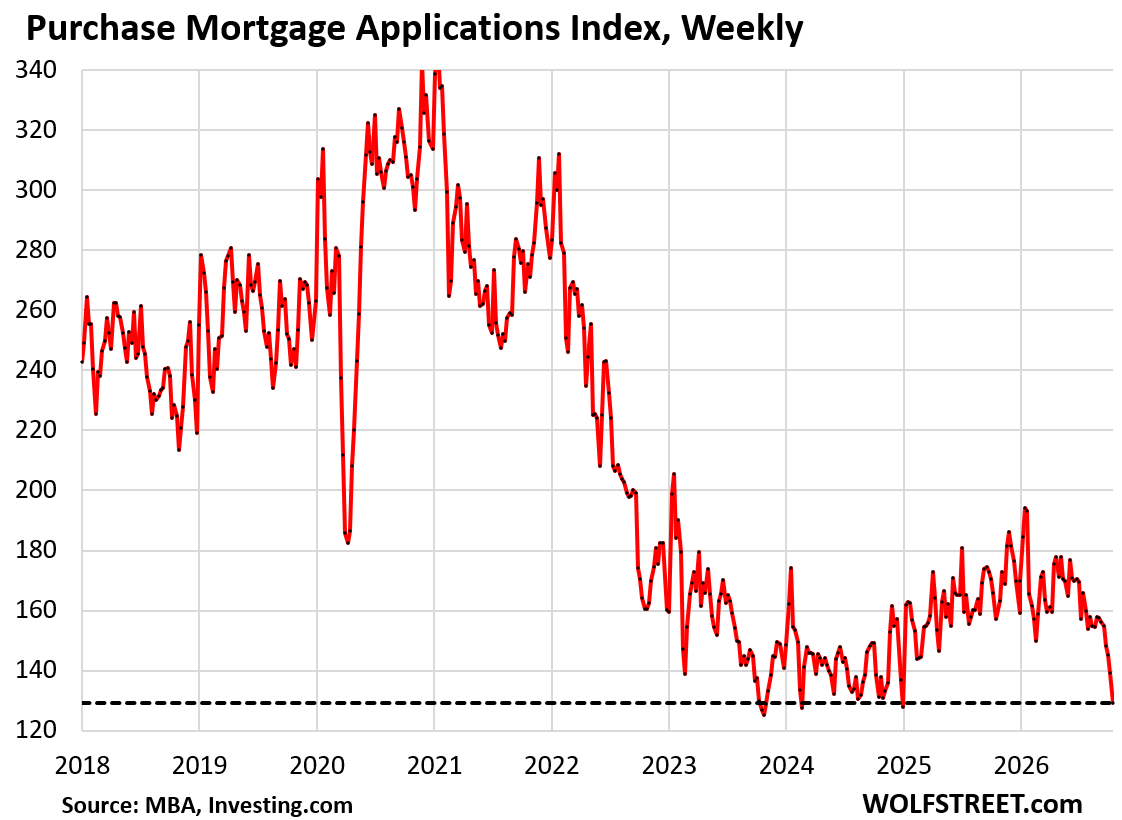
Including cash deals…. This plunge in mortgage applications indicates that pending sales for October will be even worse than in September. Pending sales for September – sales that hadn’t closed yet by the end of September – collapsed to the lowest volume in the data going back to 2011, according to data from the National Association of Realtors yesterday. These pending sales for September included cash deals.
If homeowners want to sell their homes, there is a market and there is demand, but the price has to be where the buyers are. That’s what this says.
Renting has become the far cheaper option on a monthly basis in many markets, given where home prices, mortgage rates, homeowners’ insurance premiums, property taxes, and HOA fees are. High home prices entail high carrying costs all around.
And home-price increases can no longer be taken for granted to bail out buyers with too-high carrying costs. Home prices have already been falling in many markets (we discuss some of them here).

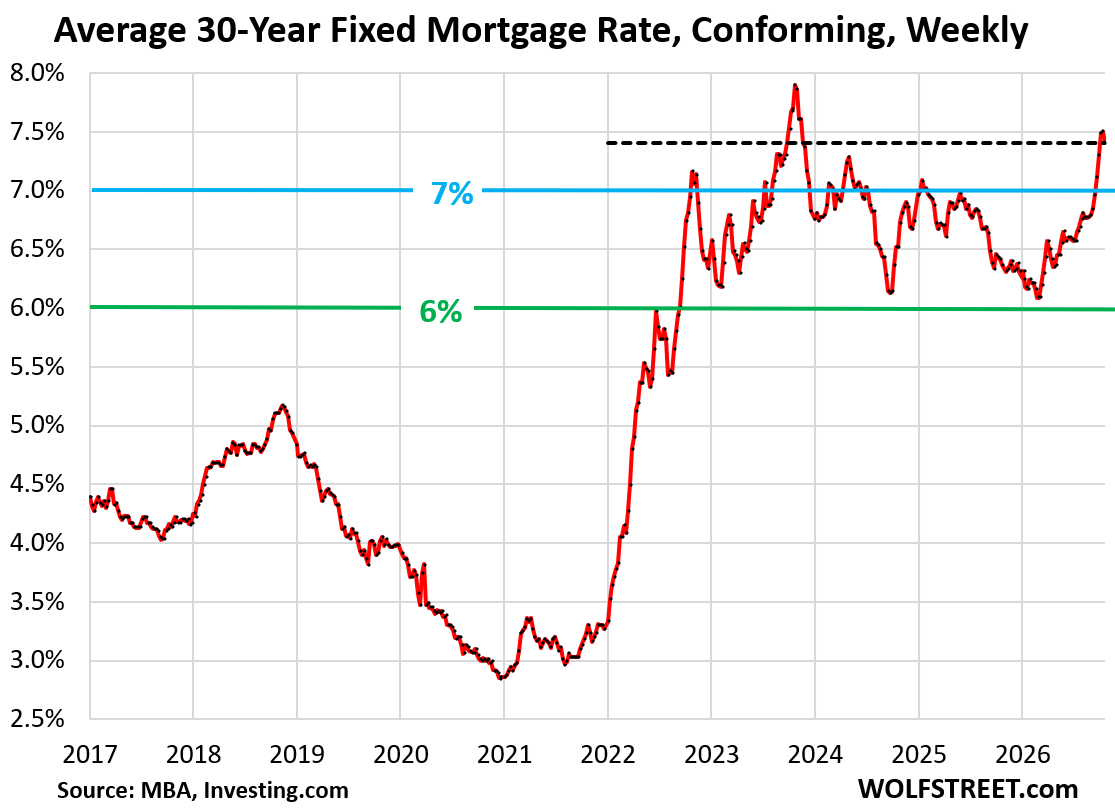
The average weekly mortgage rate for conforming 30-year fixed mortgages dipped to 7.41% in the reporting week, according to the Mortgage Bankers Association today.
These 30-year mortgage rates track the yields of mortgage-backed securities (MBS), but are higher, and MBS track long-term Treasury yields, but are higher, and that spread between them varies over time.
This average 30-year fixed mortgage rate has been in the 6-8% range for over four years, since early September 2022. During the normal times, before the Fed’s QE and interest rate repression started in 2008, those 7.5% mortgages were considered normal and for many years low.
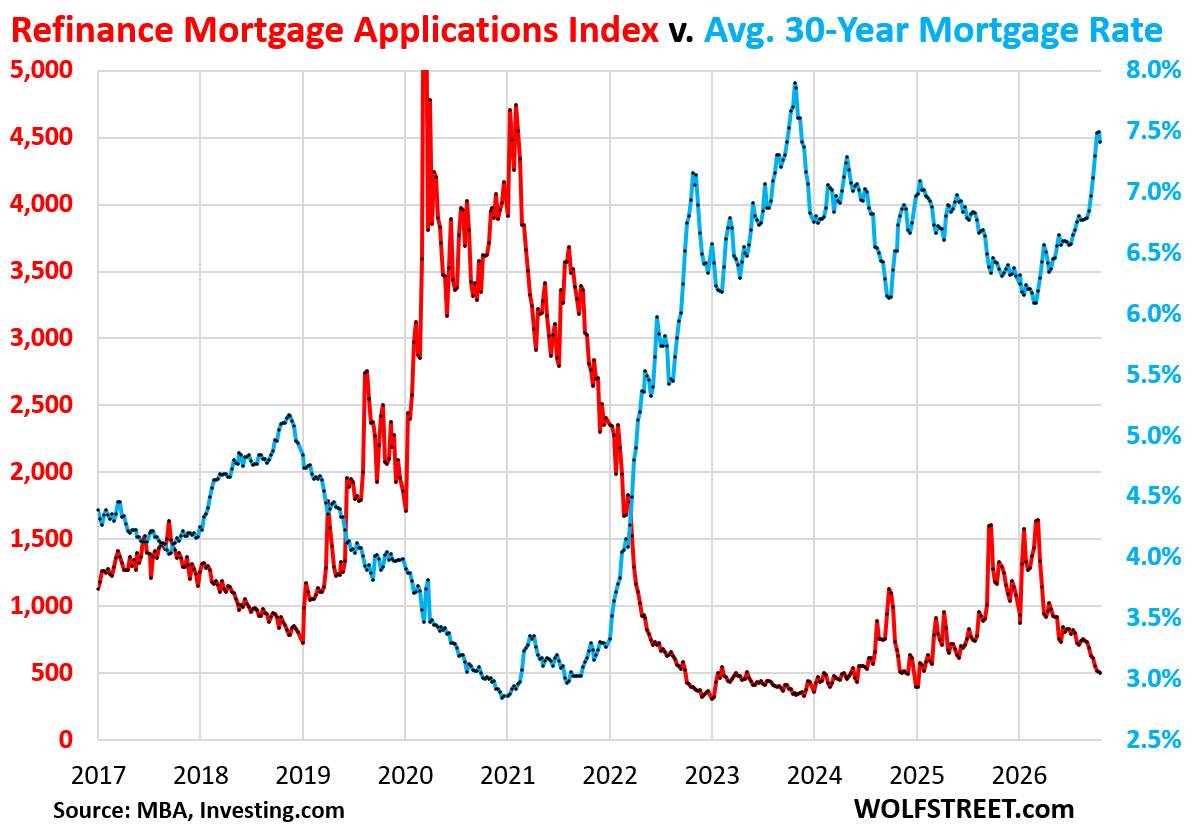
Mortgage applications to refinance a home dropped further during the week and are down by 57% year-over-year and by 76% from the same week in 2019, according to the MBA today.
Refinance applications react inversely to changes in mortgage rates: Higher mortgage rates cause refinance applications to dry up; lower mortgage rates trigger mini-booms of refinancing. At current mortgage rates, refinancing activity has collapsed.
Real estate agents and the mortgage industry exhorted potential buyers, after mortgage rates had surged in 2022: “Marry the house, date the rate.” Meaning that they should pay whatever for the house, and mortgage rates would soon plunge again, and then they can refinance into a 4% mortgage or whatever, and it would all work out. Those buyers married an expensive house and also married an expensive mortgage.
This chart shows that inverse relationship between mortgage rates (blue) and applications to refinance a mortgage (red):
One of the reasons the housing market has been frozen for four years is that home prices had exploded by 50% or more in many markets from mid-2020 to mid-2022 due to the Fed’s interest-rate repression resulting in below-3% mortgages when inflation was 9%. That home price explosion came on top of the already high home prices at the time, to where now home prices don’t make economic sense. But they push up the carrying costs of a home: Mortgage payments, homeowners’ insurance premiums (via surging replacement costs), property taxes, and HOA fees, thereby triggering a historic affordability crisis.
In case you missed it: Single-Family & Multifamily Rents in the US and 22 Large US Metros: Amid Massive Divergence, Rents Are Re-Accelerating
Enjoy reading WOLF STREET and want to support it? You can donate. I appreciate it immensely. Click on the mug to find out how:


I find the dichotomy between the housing market and the stock market fascinating. The housing market is starting to get the overvaluation. The stock market is not.
In part because earnings are skyrocketing. Earnings per share for the S&P500 were up 20% in just the first 6 months of 2026, and up 33% year over year.
Yeah, but how? The economy is growing at 5-6%, not inflation adjusted, and the S&P profits skyrocket by 20-30%. Are they playing accounting games? Who is getting screwed in this arrangement?
Partly tariff rebates? I just listened to a Planet Money podcast on this. More than a hundred billion isn’t getting past the goalkeeper(s) into the end consumer net.
Maybe we paid for them through higher prices, maybe not. There’s almost never a paper trail so I guess we’ll never know.
Maybe corporate America is using the inflation theme to increase margins. Corporate profits have doubled since 2020, far out pacing the inflation that supposedly caused the price increases.
Why? Trump corporate tax cuts and all the special immediate tax deductions in the BBBill.
Monopolization in business increases profits.
Not sure. Probably related to the continued increase in consumer spending coupled to the continued increase in corporate-debt fueled expansion.
The market isnt every company that comprises the GDP. Some companies are extemelyy lucrative and push the market l. Others flatline or fall off completely. And it’s not a zero sum game
The bottom 60-70% of consumers are getting screwed. We’ve had higher than wanted / expected inflation now for six years, so the higher inflation expectation is baked in. This means that consumers simply aren’t pushing back hard enough yet against rising prices. And why would they with the economy being relatively strong, employment remaining at decades low and pay raises for the middle-income earners has remained fairly strong?
Most importantly, we haven’t had a real recession in going on 20 years.
These are enormous distortions that are good for business’ bottom lines.
It all makes sense. Anybody who owns a house knows well that buying it is half the trouble. On top of what you mention, the cost of maintenance (repairs and upgrades) has gone up through the roof in the last ten years. Even though rents are rising, in many areas renting is still a better deal than buying.
Yes, that is some steep pricing on mortgages. I guess that is the point though: to slow the economy via housing in part in order to arrest inflation. Hopefully it will work.
Your post seems to indicate that there is “a plan and some concerted effort” to keep interest rates high, and this will bring down housing prices and inflation.
IMO, there is no such plan or concerted effort.
In fact, these things are happening in spite of efforts to arm twist the Fed to bring interest rates down. Never mind that the clueless politicians don’t understand that given the current inflationary conditions, pushing short-term rates lower will actually increase long-term rates and create a bigger mess in housing than what we are in right now.
Yes, there’s a plan and Wolf has outlined it repeatedly.
It’s called letting the economy run hot.
Which would you rather have? An economy that runs hot for 10 years and slowly pushes down housing prices or a big nasty recession that forces prices to drop 5x faster over 18 months and might lead to your losing your job?
Yes, there’s a plan: run hot and keep us out of a recession.
Big nasty recession!
Those are normal rates, historically. What’s not normal are the prices. They are delusional. It’s the same story as the last housing bubble. Ask longtime owners if they could afford their current house at today’s prices and rates. For most the answer is an emphatic “NO.”
I am one of those owners. I absolutely can’t afford my home at current price/rate.
Thank you for your honesty.
In most markets, house prices need to be HALVED in order to get back in line with rents and affordable monthly payments. There is great pain not only on the horizon, but happening RIGHT NOW. As Wolf has shown repeatedly, many markets are not only correcting but crashing. And that’s just based upon median prices.
The current median price is grotesquely obscuring what’s really going on as the mix is skewed towards the higher end where the wealthy are focused and purchasing, since they are the only ones who can afford these outrageous prices. It’s a bloodbath out there.
This is wrong. Nationally, monthly payments are about 20% higher than the 90s and early 2000s.
Certain specific markets are far worse, specifically the West Coast bubble cities (CA, OR, WA, ID), plus some of Florida and Texas. These are closer to 30-50%.
Does that 20% higher number include payments at very low interest rates? If so,
that doesn’t seem valid metric for current home affordability
It is the housing affordability measure, which compares the monthly payment on an average priced home at current interest rates with the median monthly income. It is now at 105, and has historically averaged around 125. It was at 175 during the 2012-2020 housing boom and bottomed out at ~65 in 1981.
The same measure for the West region is at 77, so it’s a lot worse.
Thanks.
Wonder if the spread between where people want to live and where they dont is significantly bigger now, so that costs don’t reflect in national averages
This comment is correct, as seen in a graph available in the following facebook link:
https://www.facebook.com/photo/?fbid=28718968377713296&set=a.101381436565372
I’ve got two new homes a mile from me. They have been on the market almost 2 years and a 1.5 respectively, if you can even call them new anymore? The oldest is starting to look like it needs paint.
They tore the old 2 and 3 bedroom traditional style down and built giant palaces complete with wine cellars, pools, artificial lawns, on and on.
Anyway, one started at 1.8m and the other at 1m. Not much in CA dollars but for a working class neighborhood in North Tampa called Lowry Park, insane.
Well, we are now at 1.4m and 785k. I figure based on the location and interest rates the 1.4 should 785 and the 785 about 495 and still may be hard sells. Huge haircuts yes, but if you new the area and the lots these monstrosities were built on it becomes clear.
50% haircut is not unheard in Florida pullbacks or more depending on location.
These are not the only McMansions out there, there are dozens. How long before these independents throw in the towel? Methinks soon.
Oh, and they both have flat roofs, a builder savings short cut and about the stupidest thing you can have in a place that gets 55 inches of rain a year. Who knows what else they skimmed on.
I’m going to assume that when you see you’ve got two new houses near you, you don’t mean they are actually your houses, but that they are just located in your area and you are having been paying some attention to them………….cause otherwise, damn, you would have to have a self deprecating sense of humor to not only recognize but post that about your own situation. Let us know if the houses aren’t actually years, because they are probably a handful of other people who would like to post some comments totally sh–ing on those houses and whoever owns them but we don’t want to be extreme in our cruelty to a fellow comment poster here. Hopefully at least the wine cellar came fully stocked so that drinking away some of the sorrows may be an intermediary solution for the time being.
Sorry, there were a lot of typos. I’ll try do better about reading first before posting a comment.
The top end of the housing market has seen a national 4% increase in prices over the past year and is functioning just fine without any bother at all with pedestrian and mundane mortgage nonsense. As long as the real sales involving real prices continues well, what difference does it make at all as to the rest of the vastly overbuilt housing markets?
I typed a comment about carry cost last night but didn’t push post comment, carry cost adds up and with increase yield returns for capital like 5% tax free muni bonds its better to rent than to own for cash buyers these days, or its better to sell and reinvest the capital than to own. Smart Rich people are trying to unload their extra homes. I really question how smart rich people are today.
@Delusional about inflation Only a tiny percentage of rich people buy homes and vacation homes to “make money”, they buy them as a “place to live” and a “place to vacation” just like they buy their daily drivers and fun cars for “car to get around town” and “car for date nights and weekend drives” not because they think they will save money vs. taking the bus and renting a fun car from Turo. I was a happy guy when my cabin was worth a million less six years ago and I will be a still be happy guy if it is worth a million less six years from now.
My point is 5% or 5.25% Muni coupon minus not spending money on carry cost is driving my neighbors to list their extra homes. historically, no one list homes in ski towns right now, this is the month people pull homes off the market and re list in April. Right now homes are being listed at a fast rate, the opposite of normal. 5% tax free yield equates to 9% taxable yield in my state, for the people who live in California its definitely a double-digit return without much risk in normal times. most of my neighbors own more than 3 homes or more in a family trust, so those new Muni bonds from selling their homes, will go into the trust instead of extra home titles. when i said rich people are less smart, i was comparing to 30 years ago, it’s true! it is too easy to become rich taking risk living in “moral hazard times”, 30 years ago rich people were smart or had smart parents that gave them money. Now….people will freak out not knowing what hit them.
Sell a extra 10m home save 150k in carry cost per year, grab 525k ish in tax free money for the next decade or two or until your kids decide what they are going to do with the trust, that’s my point! 675k per year of free cash flow ongoing or until your bonds mature or own an extra home thats going down in value right now. Muni bonds yield are paying 5% to 5.25% for 1 year out to 30 years, it’s flat curve. Wolf you should write an article about Muni bonds, if you want to:) I am sure people would like to read about them.
A very good CPA is going to hand off all that stored up wealth to the kids w/o paying much, if anything, to the taxman. The very wealthy don’t live in our financial world. There’s is totally different. They live in a world where the only word they want to hear is yessir! I had an old friend visit last night. Her kids are partners in an exclusive island resort that they discovered the islands potential and spent decades working with the local populace to create a win/win. Turns out a tech giant(who I will not name) really liked staying there and pretending his family was “just one of you”. He quietly found out the weak link in the partnership, bought the guy out and showed up as the bazillionaire he really is. Now he’s changing the island, building his new digs and the leftover partners are powerless to stop him. File under “who wants to sue one of the richest men in the world?”
@Delusional about inflation Mind if I ask where you live where “most of your neighbors own more than 3 homes”? I live in a pretty nice area on the SF Peninsula and since I’ve lived in on the Peninsula for over 40 of my 60 years (and I’m a real estate guy that people talk to about real estate) I know a LOT of people and I don’t know a single person that owns three homes. My wife would like to buy a weekend place in Carmel or Seadrift, and I don’t want to since 1. I don’t want to deal with another vacation home and 2. I think that Seadrift and Carmel both have some of the most overpriced real estate in the US. I was pushing my wife to name a single person we both personally know who owns more than one vacation homes. She could not name one off the top of her head and after a week of texting friends she came up with just two families with “two” homes (WAY less than the MORE than three that MOST of the people in Delusional about inflation’s neighborhood).
No nominal gains on a leveraged bet is not a good thing. Good luck out there on your investments!
This could end up being the Bubble Burst of bubble bursts. My mind can’t erase those mountain-like graphs that you show of Housing Bubble 1 and Housing Bubble 2. It’s like I’m locked in this tiny 10’ x 8’ prison cell 24 hours a day with nothing else in the cell but myself and that giant elephant staring me in the face. Even in my dreams, I see the elephant. He’s there and he never goes away. His name is HHM – Horrific Housing Monster.
What drives the highs and lows on the mortgage rates since 2022? It looks like it fluctuates +- 2%
Mostly the bond market.
My wife and I are currently renting. We have the cash to buy outright and are watching three zip codes across three different states.
The income from our T-bills alone far exceeds our rent—roughly $35,000 a year before federal taxes on that interest.
Over the past year, home prices in those areas have dropped 5–10%. Had we bought a year ago, we would have absorbed $40,000 to $75,000 in depreciation.
We’re still ready to pull the trigger if the right house appears, but so far patience is paying off.
I wouldn’t call that drop depreciation. I would call that market adjustment.
Depreciation is when your HVAC, water heater, and roof get older. That’s happening at the same time as market adjustments but is kind of hidden because it’s harder to estimate replacement cost than it is to look up listing prices.
Houses depreciate too. You just don’t notice because the land underneath is rising in value faster.
IMHO, the housing market will bottom out in 2-3 years from now.
The 08 bubble took many years to go from peak to trough. Peak was July 06 and the bottom was Feb 2012.
A forty-ish couple in our family bought a house in Portugal early this year. For the first four years their mortgage rate is fixed at 2%. After that it becomes variable rate, presumably linked to the Euro base rate.
What they dread is the combination of rates shooting up and prices accordingly falling off a cliff. Their dread-in-reserve is that a period of higher inflation will be succeeded by a depression, meaning they might lose their jobs and thereby their house.
As long as they keep their jobs the inflation case is probably less worrying for them than the depression case. That’s assuming, of course, that Paris-style troubles don’t visit their part of Portugal.
Man proposes, God disposes.
“And home-price increases can no longer be taken for granted to bail out buyers with too-high carrying costs.”
Let’s be clear here. This statement refers to nominal price increases. On an inflation adjusted, “real” basis, most owner iccupied homes are now money losers fir the owners.
“most owner iccupied homes are now money losers fir the owners.”
That depends on the purchase timing and price.
Most who bought before 2021 are ahead of inflation, usually by a lot.
Purchase volumes have collapsed because people understand that real home prices are falling, and in some markets nominal prices are falling, too.
You’re right. I should have called out the last year, or possibly two, where the appreciation of the crummiest of my Ibonds over that period have outpaced housing gains as reported on a national level. The stock market has outperformed on large multiples of that. I’m sure at least one of the common measures of inflation have outpaced home price appreciation over two years, and it is definitely the case over the last year. Hell, some renters have outperformed owners when mortgage rates are considered.
I just saw an interesting video from a real estate investor I really respect. He was cryptic in what he said, so i will read between the lines. He said that due to all the insurers not offering wildfire, hurricane, etc. coverage for large geographic regions of prominent states, what keeps him up at night is that the federal government will use the “ACA for health insurance” model, and apply it to real estate, so that every home owner gets guaranteed eligibility for coverage against loss. California, New York, Florida, and Texas could band together and exert pressure to get this passed.
PS If you want a fllod of active listings on the market, this would do it. Affordability problem solved.
This is the last thing that would keep me up at night. The federal government has done the opposite, decreasing FEMA flood insurance subsidies to put the insurance cost of flood zones back on property owners. Nationalizing home insurance would be a Democratic death knell even if it were doable.
There’s always something to drive up insurance, anywhere in the US. Avoiding carrying costs is the game of the financially stable renters I know right now, successfully played for the time being. I would bet a lot of younger people are sitting on nice down payments collecting nice interest rates, knowing inventory is not going down or selling fast.
@JeffD we already have the government in home insurance where private insurance will not go e.g. flood and fire in CA and hurricane in FL
The investor said something about lender placed insurance for investors that only covers the mortgage and nothing else, that wouldn’t cover full replacement value. Maybe you are better able to understand where he was going. He said if this were moved to the federal level for resolution, it would be unpredictable how it would get resolved.
@JeffD there has always been “lender placed insurance” aka “force-placed insurance” where a lender can insure the property securing their loan if you don’t do it (and add the cost to what you owe). This has always been crazy expensive (you want to keep your lenders happy with the insurence you have so they don;t go out and buy their own insurance).
There are several things that are affecting the malaise in the real-estate market. Firstly, many homes were purchased or refinanced during the rock-bottom interest rates during the pandemic. Home owners are reluctant to give up their sub 4% mortgage rates and move to another house where they would have to finance at 7.5%.
Secondly, buyers were jaded into believing the artificially low rates during QE and then the pandemic were normal – they are not. They are an aberration. The current 7.5% rate is more the historical norm, not the 2.99% rates during the height of the pandemic. Rates will never be that low again.
Thirdly, retired baby boomers like me are sitting on homes that are paid off, therefore amassing large quantities of real-estate equity and wealth. We are not planning to give our houses away and many of us, like me, plan to live out the remainder of our lives in our homes. That takes a lot of homes off the market for years to com.
Lastly, and I’ve said this over and over again, the cost of home ownership is the problem and not the prices or interest rates. The two biggest costs are insurance and property taxes. Both of these continue to increase as the years go by. This shows up in the monthly payments for homeowners carrying a loan.
Renting is like throwing money into the wind. If the stock market crashes then you lose everything and if you bought a lot of stock on margin, then you’re going to be in a world of hurt. Real-estate is real property and not a piece of paper subject to the whims of Wall Street. Real-estate is cyclical, but 70 years of government data supports the appreciating value of real-estate long term. Cheers.
“Renting is like throwing money into the wind. If the stock market crashes then you lose everything and if you bought a lot of stock on margin, then you’re going to be in a world of hurt.”
Disagree. I am a renter in California that pays half of what PITI would be in a similar home and invests the difference diligently and smartly and have for years. The fact that I could, but choose not to own a home, proves that it isn’t always black and white when buying a home especially with carrying costs being so high in this state. I will purchase outright out of state when I retire and my highest earning years are behind me.