
The bond market has come to grips with these 5%-plus yields and is settling in.
By Wolf Richter for WOLF STREET.</h4
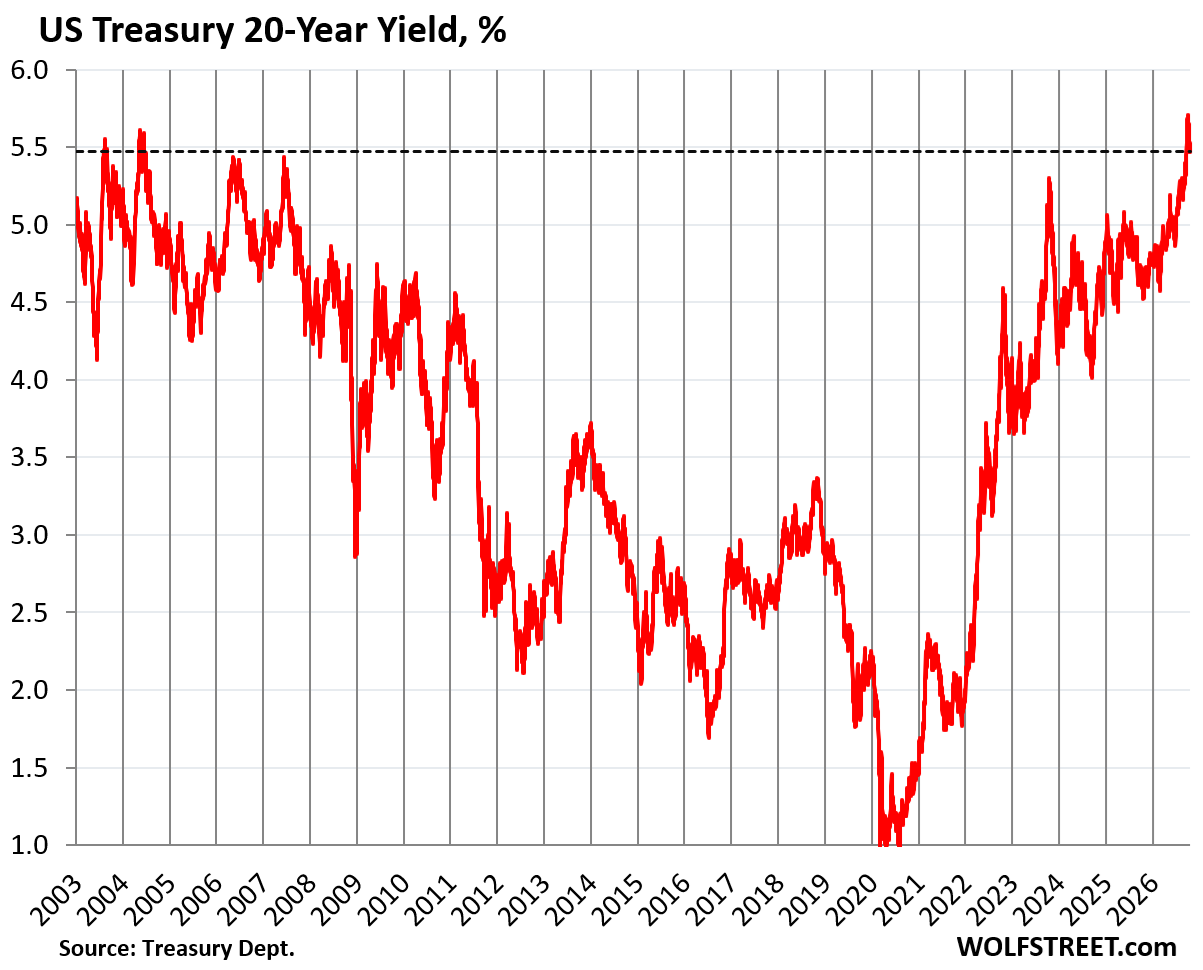
At the 20-year Treasury bond auction today, it took a yield of 5.469% to attract enough demand to sell all of the $13 billion of bonds, the highest yield since the 20-year bond was re-introduced in May 2020. That’s what investors demanded to be compensated for the additional risks they were seeing. The function of yield is to create enough demand. And it did.
And it was the highest auction yield since 1986 with an asterisk: Issuance of the 20-year bond had been discontinued in 1986. At the last auction, in January 1986, the 20-year Treasury bonds sold at a yield of 9.45%. Yeah, those were the times.
At the 20-year auction last month, the bond had sold at a yield of 5.420%, in August, at 5.204%, in July, at 5.163%. You get the drift.
Exactly three years ago, at the auction in October 2023, the 20-year bond had sold at a yield of 5.245%, up from 1.22% at its first auction in May 2020, but that had been too far, too fast, and the bond market took a massive breather, during which the 20-year yield plunged by about 130 basis points in 11 months. Now the bond market has come to grips with those yields.
Today’s auction may have been one of the last 20-year auctions. As has been typical for the 20-year yield: it’s higher than the 30-year yield. The spread is currently about 4 or 5 basis points. In 2020, after the reintroduction, the spread was about 20 basis points.
This makes the 20-year bond relatively more expensive for the government to sell than the 30-year bond.
The 20-year bond is lacking interest from institutional investors, including foreign central banks. It’s the unloved bond. So the auctions are small (just $13 billion, compared to $39 billion for the 30-year auctions), and the bond is new, so there is thin liquidity in the secondary market, which makes it harder to sell them, which triggers bigger haircuts for sellers.
But for retail investors who are building a Treasury portfolio and are planning to hold to maturity, the unloved 20-year bond is more attractive than 30-year bonds: a higher yield on less duration risk.
The same lack of interest from institutional investors and higher yields had doomed the 20-year bond in 1986.
Rumors or discussions have recently been circling that Bessent is considering discontinuing the issuance of the 20-year bond once again. With this on-again, off-again approach, and even discussions about it, it’s hard to build up long-term institutional interest in the bond.
The 0.9 basis point tail: When a bond auction is announced, the new “when-issued” bond starts trading so that price discovery begins before the auction. The when-issued bond traded at a yield of 5.460%, which turned out to be 0.9 basis points lower than the auction yield of 5.469%. This 0.9 basis point “tail” indicates that demand at the auction was weaker than the market had expected.
At the auction a month ago, the tail was 2.0 basis points, as demand at the auction was substantially weaker than the market had expected, and the auction was termed “ugly” and “sloppy” because of it. So this 0.9 basis point tail wasn’t as bad as the tail a month ago. But the yield was higher.

The Bid-to-Cover Ratio was 2.73, with $35.48 billion in bids and $13.00 billion accepted, the highest bid-to-cover ratio in months (2.57 in September, 2.53 in August, and 2.64 in July).
Indirect Bidders purchased 58.2% of the $13 billion, below the six-month average but higher than at the last auction (52.3%, which had been the worst so far in the six-year existence of the modern 20-year bond auction).
Indirect bidders are buyers that placed a competitive bid through a primary dealer or direct submitter, and include foreign central banks that bid at the auction through the NY Fed. The auction results don’t distinguish between foreign bidders and other indirect bidders.
Treasury retail bidders purchased $30.8 billion of the bonds.
It was the second “reopening” auction of the same bond that had originally been sold at the auction in August, with the same CUSIP number (912810UX4) and the same coupon interest rate (5.125%), and the same maturity date (August 15, 2046).
The difference was the price, which was established through the auction. Today’s auction price was 95.85 cents on the dollar. The lower price with the same coupon interest produced the yield to maturity of 5.47%.
Each of the three auctions sold $13 billion of this same bond, so there are now $39 billion outstanding. The 20-year auction in November will start a new bond, with reopening auctions in December and January – if Bessent doesn’t shelve the 20-year auctions before then.
The long-used practice of selling the same issue over three auctions increases the amount of the same bond outstanding, which improves liquidity and trading in the secondary market. All 10-year, 20-year, and 30-year Treasury auctions, all TIPS auctions, and the 2-year Floating Rate Note auctions have these reopening cycles.
In the secondary market, the 20-year Treasury yield barely moved and ended the day unchanged at 5.47%. Earlier this month, the 20-year yield had spiked briefly to 5.70%, and all of those yields were the highest since 2004.
Enjoy reading WOLF STREET and want to support it? You can donate. I appreciate it immensely. Click on the mug to find out how:


The 20-year bond is lacking interest from institutional investors, including foreign central banks. It’s the unloved bond.
Let’s all give it a big hug!
We gave it a little hug.
“Life of the party” comment.
I seriously wonder how people are making it with small wages in a big city. Everyone is spending including me. I wanted to cut back on my energy drink. But like a poor man buying tobacco, I brought them anyway. I will not be surprised if this thanksgiving and Christmas sales came up to be OK. May be even higher than the previous years. I am planning to buy shoes and a cheap tablet. This will come from my overtime. I think people are secretly wealthy or earning more or using cards/debt. The yield is going to be higher than 6 soon.
I amazed at the 15 car waiting line at Mercury Coffee today at 1:30PM. People are waiting 10-20 minutes and paying $5-7 the or a coffee drink?
Coffee must be one helluva profitable business. I make my own premium coffee every morning for $.30 a cup, so I’ll never understand.
We’re in the biggest financial mania in world history. Of course the coffee shops are going to be busy. That’s cheap enjoyment.
I’ve waited that long for a double espresso at a freaking zoo called Starbucks, while on the road.
Chick -Fill-A always has a line of cars for the drive through and it isn’t cheap.
There are so many lemmings in the world.
I don’t understand this one either. Grease is grease. You can get the same greasy chicken sandwich at lots of places with zero wait time and less cost. People are suckers for branding.
ChickFila actually is pretty cheap. Join the rewards program that gives you 5% back maybe and then add a credit card that gives you 2-3% back at a fast food place.
I try to stick to the sandwich only or add a fry every now and then. And drink a water with it.
Good every now and zen
“Coffee must be one helluva profitable business.”
Yes, yes it is. That is why the last 5-15 years have seen the rise of small (now midsized) competitors to Starbucks.
Caffeine, like sugar and nicotine (for good and somewhat more for ill), functions as a mild(ish) “functional” drug that helps most people get through the stressors of their lives – unless/until the “functional” drugs become problems themselves.
But that explains why these products are very, very popular.
Where were you 20 years ago? 30 years ago? And how are things going now? Then? I cannot imagine buying a paper asset these days with the belief in a stable return in these increasingly unstable times.
Wouldn’t that be the reason people buy bonds though? To get some stability in unstable times (which is all the time anyway)? They know how much they’re going to get paid every year. It is pretty stable.
Long term bonds didn’t make much sense when the yield was very low. At 5% they *start* to become interesting, if you don’t believe they are going to become much higher.
If yields reach 10% (not impossible!), the current bonds will lose half of their value (if my math is not incorrect).
I made a comment awhile back that I wish I had locked in 20/30 year bonds back in 1982 when they were at 15+%. I was in high school with a $3/hour job so I didn’t have the cash like I do today.
Also. My crystal ball didn’t exist back then so I feared they might go higher. Greed and fear stopped me back then just like today. I stuck with 8% savings accounts while the Fed battled inflation. My mistake.
Taking greed out of the picture today, I would consider investing long term at 7-8% since that is the average return in stocks. Also, given that politicians and the Fed would fear for their jobs with high inflation, there would be a major concerted effort to lower these rates. Given nominal inflation, I can also survive and thrive at 7-8% for the rest of my life. That would be ideal, I wouldn’t even care if rates went to 15% after that as long as inflation was addressed just like in the 1982.
It’s not likes it Covalent or anything…
🥁
You take your molecular insults out of here!
Wolf
Are there any tools out there that can forecast compounded gains if the investor is constantly re-investing bond coupon profits into shorter term notes and bills?
That seems like a very safe way for a young person to build a sizable nest egg over 40 years.
40 years out? Sounds silly…
Not for my super smart grandson….
:)
Suggest teaching that grandson the Rule of 72. That’s a simple way to figure out how many times your dollars will double in 40 years.
But then you have to apply Rule of 72 to inflation and see how much less your dollars will buy in 40 years.
And no, we don’t expect grandson to stick with that plan for 40 years. But it’s a great way to get started!
P.S. Then again, back when I was in high school in the 1980s, the 5% interest rate on bank savings was incomprehensibly low. There were so many better things to invest my meager savings in, like a music player, sports gear, and stuff for the new family computer. In hindsight, those were actually good choices: that old boombox served me for 30 years. The sports equipment led to a healthy long-term lifestyle. And the computer/STEM skills have made my fortune. Perhaps the best thing grandson can do is to be aware of the value of money, but invest heavily in himself!
There may be tools like that, but I’ve never used anything like that.
Excel users can construct their own tool pretty easily, I would think. You’re forecasting interest payments and returns on the interest payments for 40 years, so you will need to decide on some assumptions, including inflation. I mean I wouldn’t want to do that. After that it should be pretty easy to construct that tool.
That sounds a lot like a pension modeller. I used to work for a business making stuff like that, the t&c and caveat around assumed returns and inflation were always a good laugh… but essentially random number generators.
And the very best stochastic modellers still removed financial crashes, pandemics, wars, natural disasters, and even they had vast probability outcomes, like 1% chance you get almost nothing, 1% chance you get millions, at each end of the bell curve.
So even the expensive stochastic modelling was a random number generator.
I’m not sure how anyone dares buy long dated debt. It’s a huge gamble unless it really is a part of a well structured portfolio.
This is essentially what OASDI does combining recurring contributions and reinvested treasury income.
There are a couple distinctions,
1. No lump sum distribution is ever available.
2. Income is from long term treasuries which reduces the volatility of short term bills and perhaps a small amount of income but over a 40 year period with its ongoing portfolio churn is mostly nullified.
3. A slight discount for the expenses of disability insurance and management fees.
As a strategy to maintain equivalent buying power, it is reasonably effective. If you compare how many months of a year you could have survived on 12.4% of your pre-tax annual income 35 years ago to how mamy months you could survive today on a years SSI those are probably close.
For building differential wealth, it fails as a strategy but for a “nest egg” with no net gain in buying power its acceptable.
Have you tried to ask Gemini or ChatGPT to model that for you?
These LLMs can create a mathematical models using spreadsheets or even a python notebooks (the kind of solution used in data science).
Give it a try!
I wonder what’s going on at St. Louis’ site maintenance that’s taking so long.
Two catastrophic PHP vulnerabilities got leaked into the wild last night before PHP could be patched. PHP is a programming language that about 75% of the websites on the internet use, including WOLF STREET. Lots of government websites in Europe were already shut down this morning when I woke up, as per recommendation until patches would become available. The St. Louis Fed’s data base (FRED) gets a lot of traffic and could be a target, so they shut it down until patches could be implemented. Shutting down PHP sites was the recommendation. I didn’t shut down WOLF STREET, hoping for the best. Hope is not a strategy, but sometimes it works. PHP has now been patched on WOLF STREET, and it looks like we survived without shutting down. Lots of drama today behind the scenes. Lots of me using AI to figure things out (thank God for AI). Not a great thing to wake up to at 5 am for sure. But now I’m finished and I’m going to bed.
Thanks for the good work! The damage an agent can cause with 5sec of access insane.
Be careful!
The most insidious exploits will not break your web site. Their goal is to infect the machine without being noticed.
They could have installed a backdoor, that will allow remote access, or a program that waits for instructions.
Eventually, your host could become part of a botnet, start to distribute malware, etc.
At this juncture there have only been three credible threats with analysts noting actually executing the code was ominous even for an agent to carry out. It took our guy all night and morning to get the patches done and the information was spotty early morning.
Wolf (or commenters)-
What (if anything) do you read into last month’s announcement of Bessent’s hiring of Judy Shelton (and her past unconventional recommendations to experiment with changes to Treasury’s debt-stack)?
Apologies if you’ve addressed this in past articles
Thanks
The job he hired Shelton for is to advise him on currency policy (her specialty) and financial conditions in China, likely to put together some support for the allegations that the RMB is purposefully undervalued against the USD to benefit China’s exports to the US. Lots of people have said that, so let’s see what comes of it. Not worth an article.
Selling the world some sort of 50-year bond? The FRN must be devalued for many reasons. The question is what will it take to get institutions and people/corporations to buy such a bond? It may take more than faith, maybe gold, oil, energy output, compute power, all of the above? Collateral is starting to matter again…
Interesting times.
Judy Shelton wrote a quite prescient book in 1989 called The Coming Collapse of the USSR.
It’s only just begun. Summer of 72′ again, this time with 40+ trillion in debt…
Interesting times…
That’s an interesting theory, and could be worth an article.
What if this just the beginning?
It’ really less theory and more the MATH of the situation. I think Wolf has covered it.
10-Yr Bond
5.05
-0.09 -1.83%
What’s up with bonds this am?
MW: ‘AI is on trial’: Bond yields sink below 5% as investors look for safety
20 basis points on the 10 year so far today? I wonder how many times that has happened. Safety I think. There’s a lot of twit money out there that will need a safe home when the twit-o-sphere goes tilt. I worry about margin affects, mostly. Not worried about the twits. But I think a lots of twit-o-trades are on borrowed money.
10 year yield is down to 4.954 and still crashing. Even El-Erian (I can’t stand this guy), the supposed bond guru, is questioning why and how the 10 year yield is FALLING given the horrible inflation numbers, and that was yesterday before today’s yield bloodbath. Something stinks to high heaven.
Private credit is blowing up. Capital seeking some safety and return. If yields were not going down gold would be going up. What you might expect without manipulation of rates…
…for now.
“Large financial institutions have been heavily fined for illegal market manipulation in the Treasury market. For instance, in 2020, JPMorgan Chase paid a record $920 million settlement after admitting that its traders engaged in “spoofing”. Traders flooded the market with hundreds of thousands of fake, automated orders they intended to cancel before execution to create a false illusion of supply or demand, artificially moving prices to benefit their own positions.”
“September 29, 2020
Washington, D.C. — The Commodity Futures Trading Commission today issued an order filing and settling charges against JPMorgan Chase & Company (JPMC & Co.) and its subsidiaries, JPMorgan Chase Bank, N.A., and J.P. Morgan Securities LLC (JPMS) (collectively, JPM), for manipulative and deceptive conduct and spoofing that spanned at least eight years and involved hundreds of thousands of spoof orders in precious metals and U.S. Treasury futures contracts on the Commodity Exchange, Inc., the New York Mercantile Exchange, and the Chicago Board of Trade. This case is brought in connection with the Division of Enforcement’s Spoofing Task Force.
The order finds that JPM’s illegal trading significantly benefited JPM and harmed other market participants. JPM is required to pay a total of $920.2 million—the largest amount of monetary relief ever imposed by the CFTC—including the highest restitution ($311,737,008), disgorgement ($172,034,790), and civil monetary penalty ($436,431,811) amounts in any spoofing case.”
DC
I missed the part about how many went to jail….
“DC
I missed the part about how many went to jail….”
Zero. The government just wanted their cut of the ill-gotten loot.
I said to buy bonds after the CPI release at 5.31%. The 10yr hit 5.35 intraday. But then the post was for some reason deleted.
That’s when Wolf also said to nibble.
Flight to safety and short covering
7:33 AM 10/22/2026
Dow 52,555.46 -300.63 -0.57%
S&P 500 7,649.78 -107.39 -1.38%
Nasdaq 26,114.50 -588.35 -2.20%
VIX 18.28 +1.60 9.59%
Gold 4,063.40 -86.60 -2.09%
Oil 98.92 +1.77 1.82%
I was surfin’ the sky castles late last night,
When my screen caught hold of an eerie sight,
A balloon was risin’ filled with air,
I asked for an AInswer but there was no one there.
Do the Crash,
Do the Twit Coin Crash.
Do the Crash,
It’s all gone in a flash.
Do the Crash,
They’re all smokin’ that hash.
Do the Crash,
Do the Twit Coin Crash.
Copyright 1929 by The Crypto Kicker Five.
Happy Jaw-loween, from your fxiends at the Fed!
10-Yr Bond
4.9650
-0.1810 -3.52%
Risk-off
I think that’s a sign of risk on. Head for the TNX Hills!
French bonds getting French Fried. Head for safety. AI(aka the stock market) getting ready to crack wide open.
Waiono-
“ AI(aka the stock market) getting ready to crack wide open.”
Interestingly, RSP is up marginally. AI is not necessarily “the market.”
True that! Tnx is definitely risk on for the buyer. Bank of America has what 108b of unrealized loss on their books and that is what they admit to. Off balance sheet liabilities could be…..use your imagination.
Looking like the yen carry trade is getting unwound. Yen is strengthening the past couple days, but oddly bonds are rallying. I guess all the chatter I kept seeing on various websites was successful at motivating retail buying on the secondary market!
Do the 20-year and 30 year US Treasuries have coupons? It looks like I will have to be the trust fund manager for my younger brother once my father passes…. but having entered my 60s I am starting to realize the limits to my own longevity and need something that is both safe (e.g. US Treasuries/bonds/notes) AND that provide steady income.
But I was under the impression that coupon bonds had gone away… until I started letting the AI on my computer tell me otherwise. Not sure what to believe now.
Treasury notes (2-10 years), Treasury bonds (20 and 30 years), and TIPS pay coupon interest every six months.
T-bills (1 month to 1 year) are discount bills that you buy at a discount and get face value when they mature. If you set them up on auto-rollover (but I think it’s limited to 2 years), you will get the interest payments every time they mature. But you cannot rely on that income stream because when the Fed cuts its policy rates, T-bill interest rates sink with it.
Thank you Wolf.
Each passing auction in the long bonds create new highs in yield, thanks for explaining tail post auction so clearly and bid to cover. This period in history reminds me of a past time, The Panic of 1873 began after a crash in Europe and spread when investors sold American investments, especially railroad bonds, causing many railroads to go bankrupt. Now it’s all about AI bonds instead of railroads :) also in 1869 property values began a surge in value creating a similar wealth effect for the speculators. The previous biggest bubble as a ratio of GDP to credit borrowed and spent was over 150 years ago. History rhythms at times thanks for the article and glad you did t have more stress with this potential web infection. Back to crash of 1873, comparing Europe than to now, hasn’t had a stock crash yet but French bonds are causing fear, now South Korea yeah that’s a crash from the peak that is underway. Crash of 1873 could be a similar road map of what comes next.
In the floor system, the Fed supplies more reserves than banks need, so the quantity of reserves does not constrain bank behavior.
But the Minsky Moment in the precious metals occurred when bank reserves were drained. Total reserves fell from 3340 in jul to 2879 in Nov.
Reserves held at the Reserve Banks haven’t increased since July 3 2025.
Reserve balances shrinking at the margin, should tighten liquidity conditions.
Reserve balances in the Reserve Banks in July last year were 3,225,980. They are down by 263,373 today at 2,962,607.
Alan Blinder says that oil supply shocks deserve much more blame for the rise in inflation.
Bank Size Median NIM
Under $100M………3.85%
$100M–$300M…….3.93%
$300M–$1B…………3.88%
$1B–$3B……………..3.69%
$3B–$10B……………3.64%
$10B–$100B………..3.57%
Over $100B…………3.09%
With both SOFR and the IORB at 3.90% there’s not much incentive for the DFI’s to lend/invest. There is no need for the FED to hike.