
They all spiked: Construction of data centers and power plants; orders for equipment at US manufacturers; and inflation in construction.
By Wolf Richter for WOLF STREET.
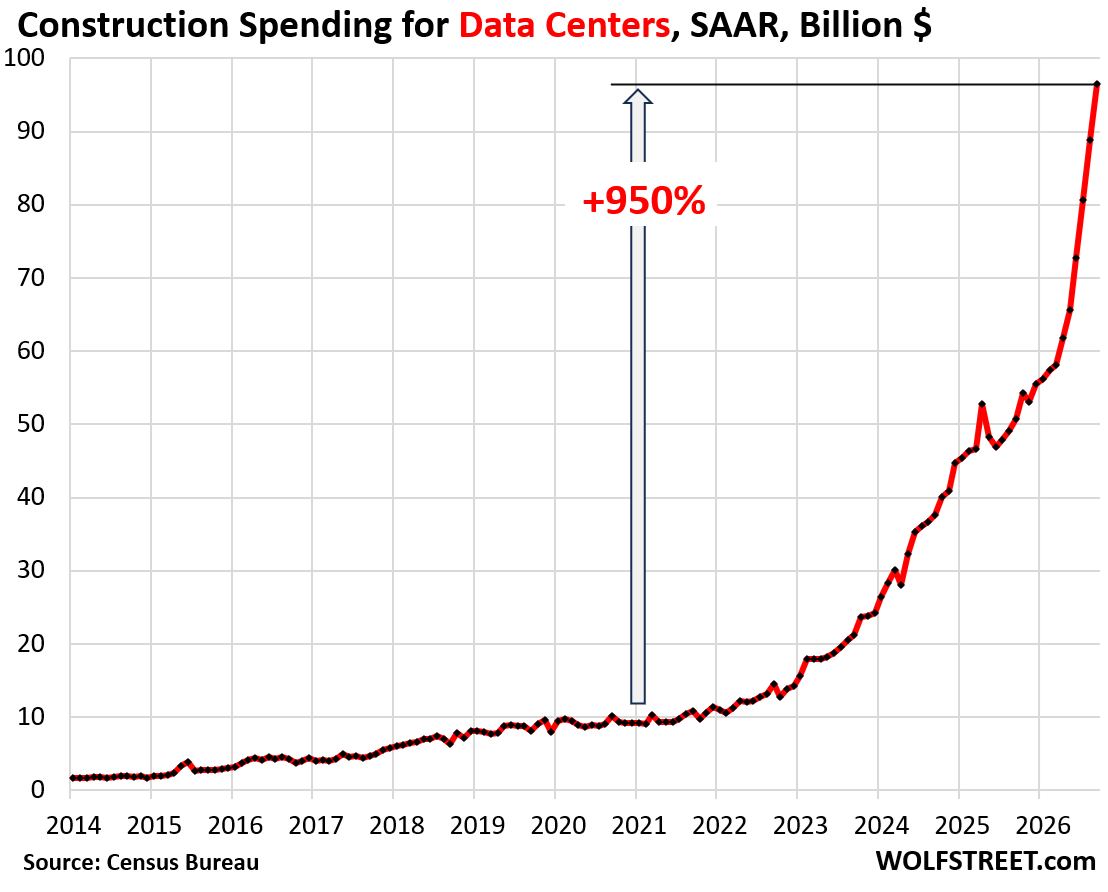
Data center construction spending spiked by another 8.6% in September from August, and by 90% year-over-year to a seasonally adjusted annual rate of $96 billion, according to construction data from the Census Bureau today.
Since the beginning of 2021, the annual rate of construction spending on data centers has spiked by 950%.
The AI data center construction boom is continuing along a near-exponential curve. Nothing that needs to be funded can grow on an exponential curve for long. But the inflection point imposed by capital constraints hasn’t come yet. The big 12 AI companies are still raising massive amounts of money, more than they’re spending, and have already accumulated an unused war chest of $1.1 trillion in cash and cash equivalents, much of which they can spend even if tanking market make further fund raises too difficult (my analysis).
Not even local resistance on the ground by people, municipalities, and state governments have managed to slow the overall growth of data centers though they have delayed or stalled one or the other project.
Data centers, their demand on power, their effect on electricity prices, and related issues have entered midterm election rhetoric, but that issue will fade in a couple of days.
Construction is the cheap part of data centers. These amounts only reflect the construction costs of the buildings, the improvements around the buildings, and the equipment integrated into the buildings, such as HVAC systems.
Not included is the expensive part of a data center: The servers and racks, electronic and optical equipment to connect the servers to the internet, the electrical equipment to supply the servers with power, including in many cases onsite power generators.
The construction spending trend – though only a slice of total investments in data centers – is a good indicator about future demand for equipment needed to turn an empty building into an operating data center.
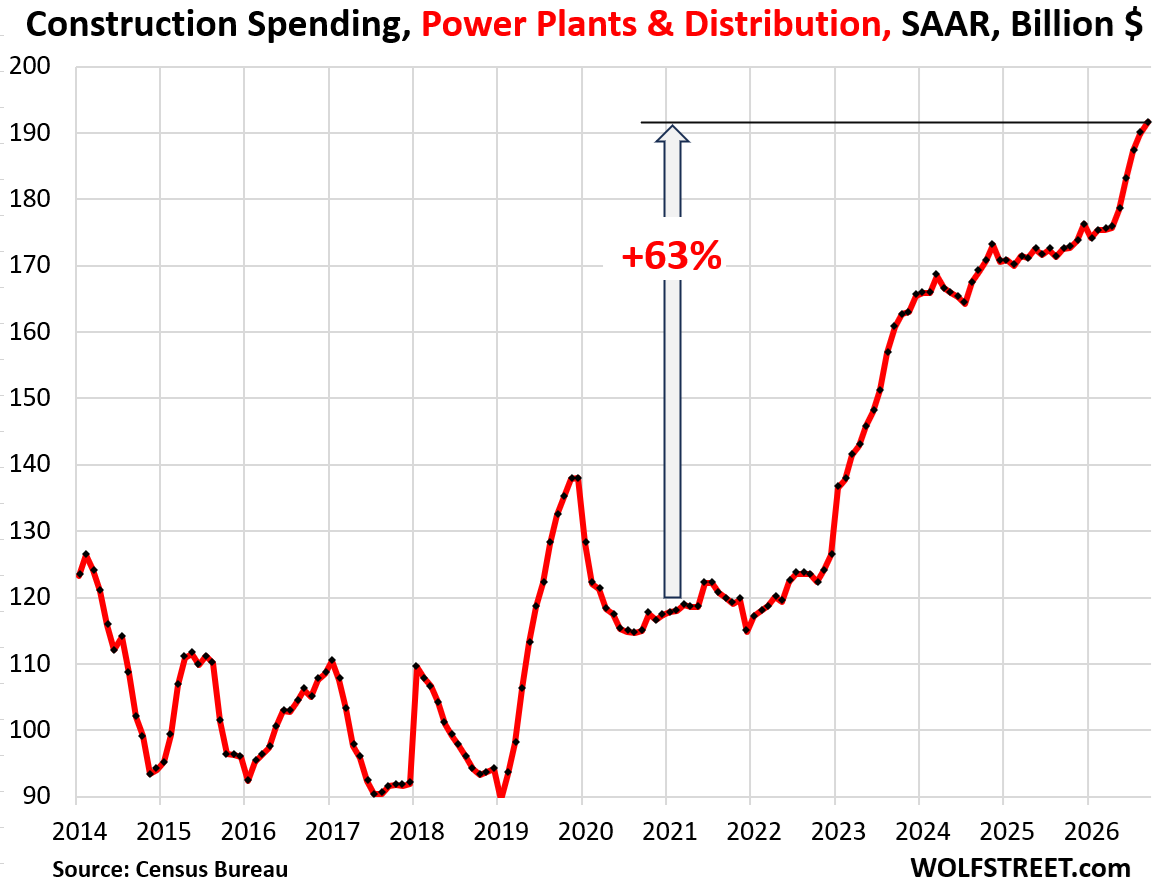
Construction spending on power plants and distribution infrastructure rose by 0.9% in September from August and by 11.1% year-over-year to an annual rate of $192 billion. Since the beginning of 2021, the spending rate has increased by 63%.
Power plant construction spending includes the costs of the power generation equipment.
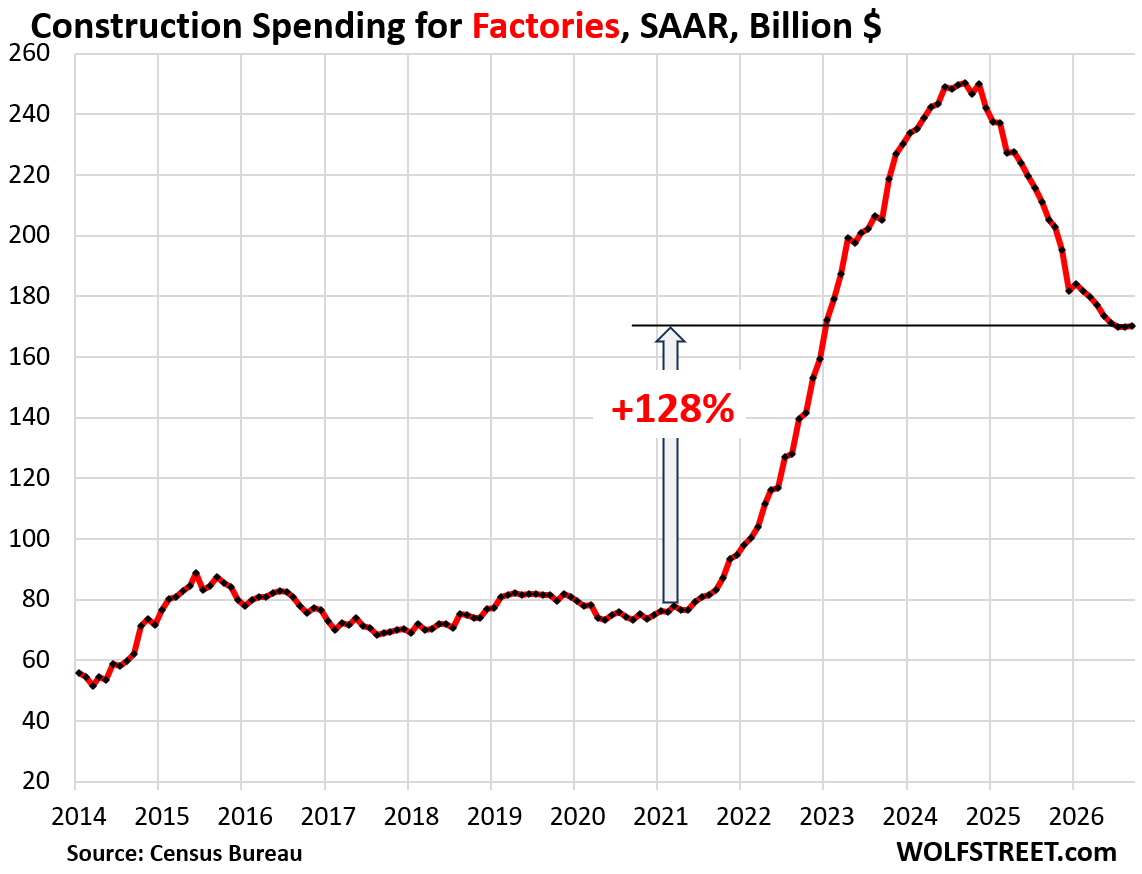
Factory construction spending has been roughly stable over the past three months at an annual rate of $170 billion, and that was up by 128% from the beginning of 2021. But it has fallen off the construction boom levels a few years ago.
This is still a massive amount of factory construction spending, 76% higher than data center spending. And it indicates that expansion of the US manufacturing capacity continues at a breakneck pace.

Equipping a modern factory, including semiconductor plants, is by far more expensive than the costs of construction of that factory.
Once the factories are built and equipped and production starts, their real contribution to the economy and employment begins and continues for decades. Building a factory is not a one-time shot but a long-term contribution to US production. It’s not the construction spending that matters to the economy, but the future production that will come from these new factories.
Shockwaves of demand for US manufacturers.
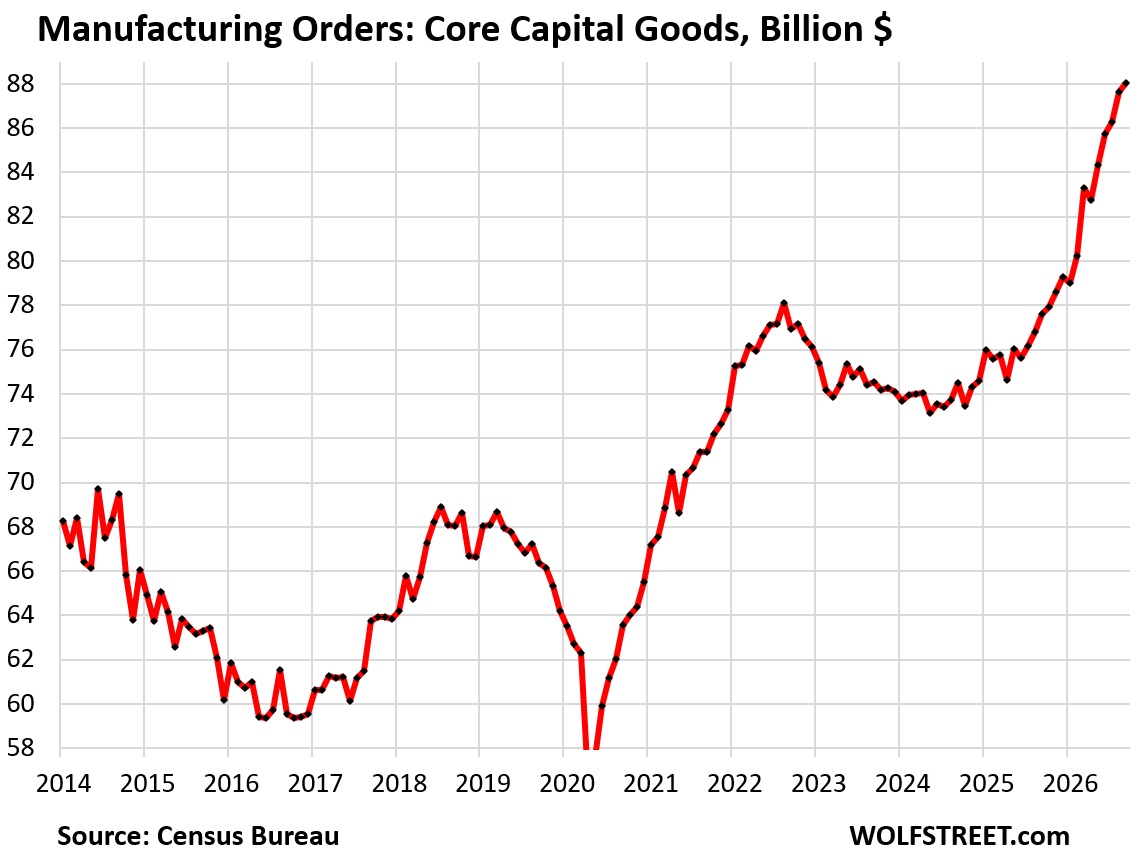
Demand for the equipment that is needed for data centers, power plants, and factories has sent a shockwave of demand through the industrial economy.
Orders received by manufacturers in the US of “core capital goods” (durable goods without defense and aircraft) spiked by 10.4% year-over-year in September, to $88 billion, according to separate data from the Census Bureau in October.
This category includes manufacturers of factory equipment, construction machinery, computers and electronics, electrical equipment, fabricated metal products, farm implements, appliances, heavy-duty trucks, railroad rolling stock, ships, etc.
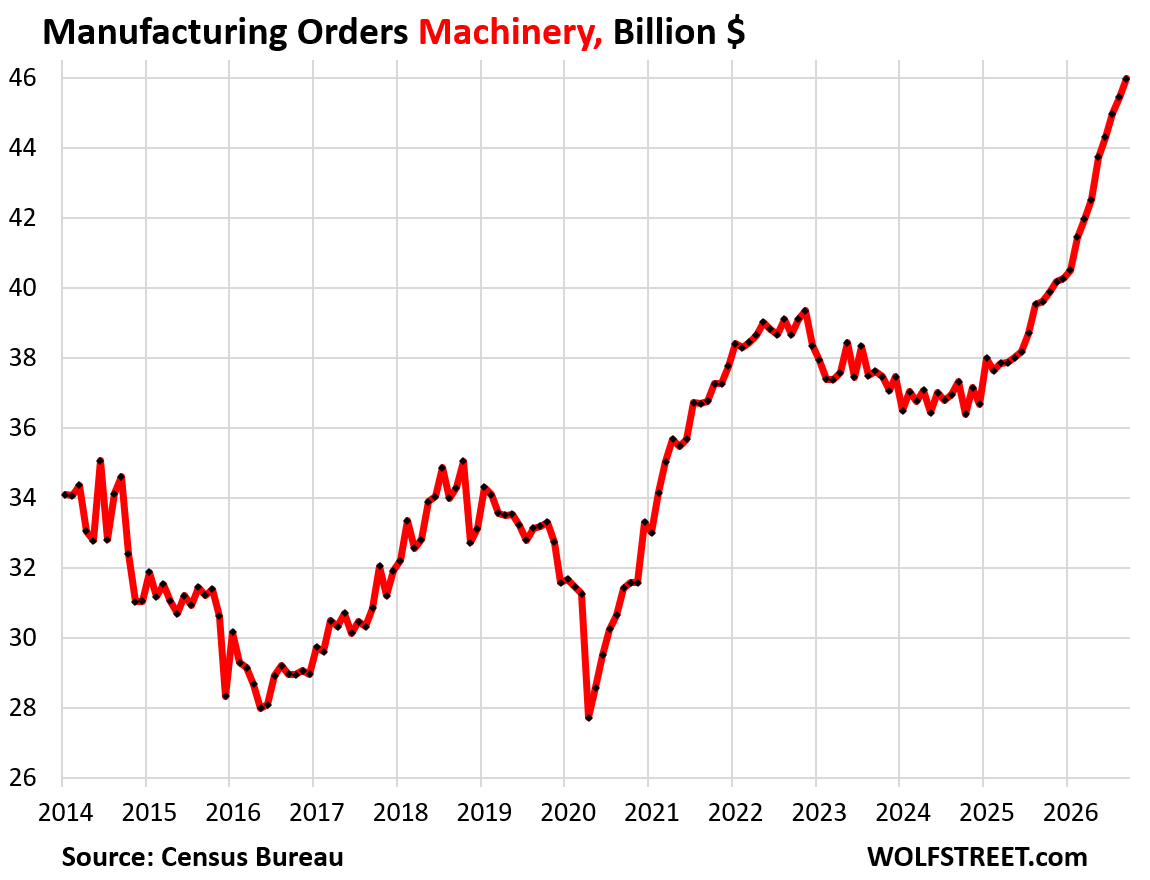
Orders for machinery spiked by 16.1% year-over-year, to $46.0 billion. This has data centers, power plants, and factories written all over it.
Industries in Machinery Manufacturing (North American Industry Classification System, NAICS, code 333) includes manufacturers of:
- Engine, Turbine, and Power Transmission Equipment
- Ventilation, Heating, Air-Conditioning, and Commercial Refrigeration Equipment
- Machinery for Construction, Agriculture, and Mining
- Industrial Machinery
- Commercial and Service Industry Machinery
- Metalworking Machinery
- Other General-Purpose Machinery.
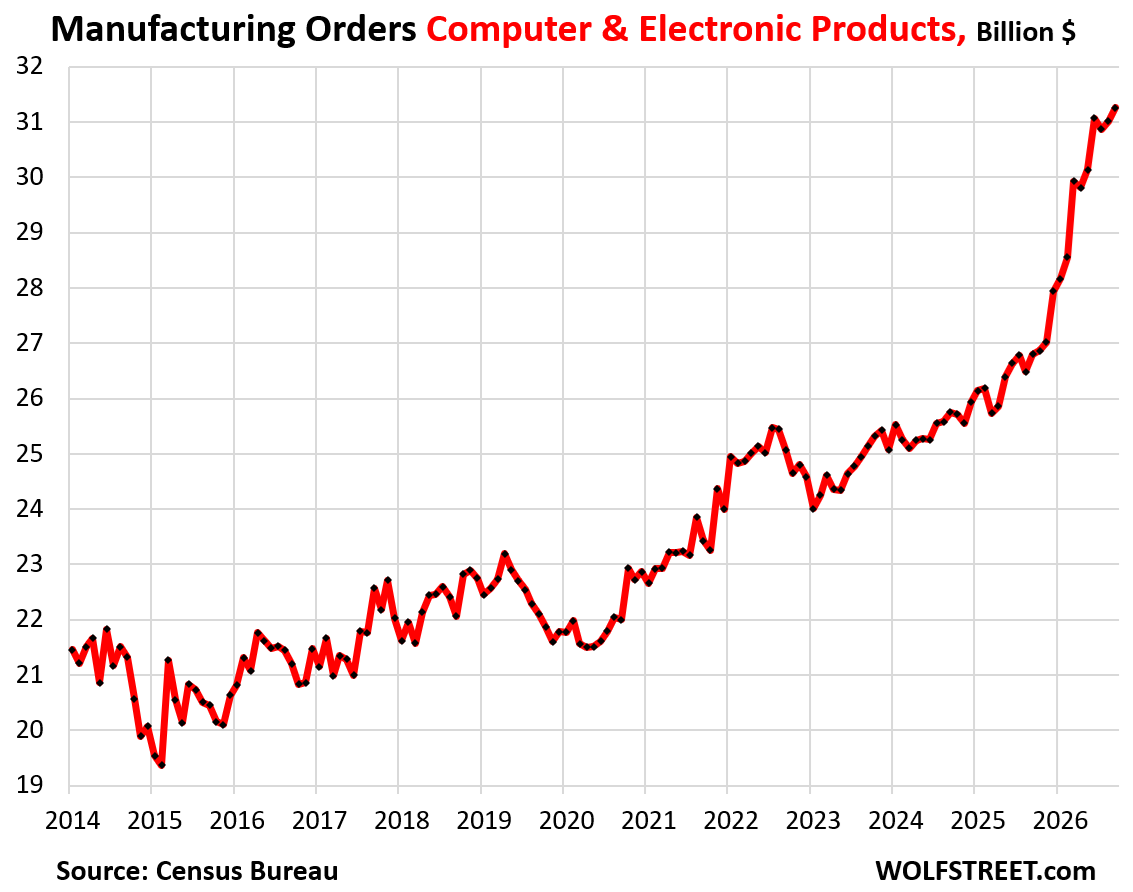
Orders for computer and electronic products spiked by 16.6% year-over-year to $31 billion. This includes orders for semiconductors at US-located semiconductor fabs.
Industries in computer and electronic products manufacturing (NAICS 334) include manufacturers of:
- Computer and Peripheral Equipment
- Semiconductor and Other Electronic Components
- Communications Equipment
- Audio and Video Equipment
- Navigational, Measuring, Electromedical, and Control Instruments
- Magnetic and Optical Media.
Construction hit by the second wave of inflation.
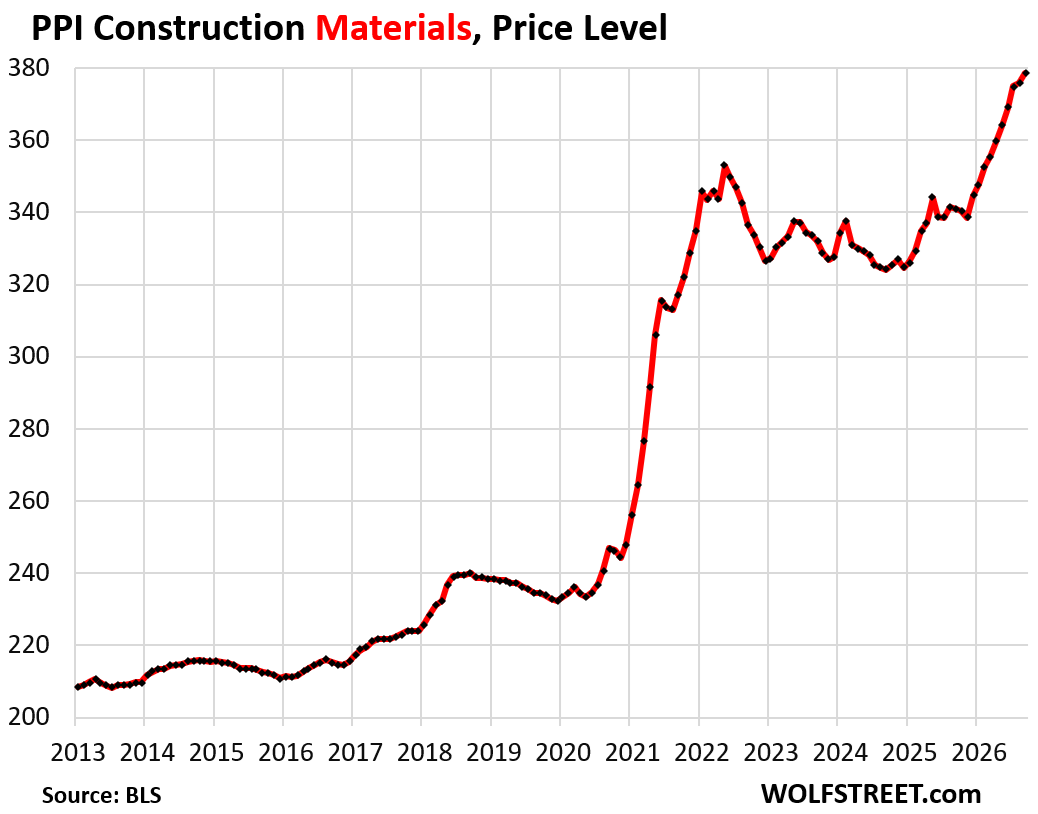
The Producer Price Index (PPI) for construction materials spiked by 11.0% year-over-year in September, according to the Bureau of Labor Statistics in October. This includes steel mill products, concrete, lumber, gypsum, etc.
For an analysis of overall PPI inflation, see: Businesses Slammed by 6.3% PPI Inflation, Worst since 2022, Much Worse than Consumer-Facing Inflation
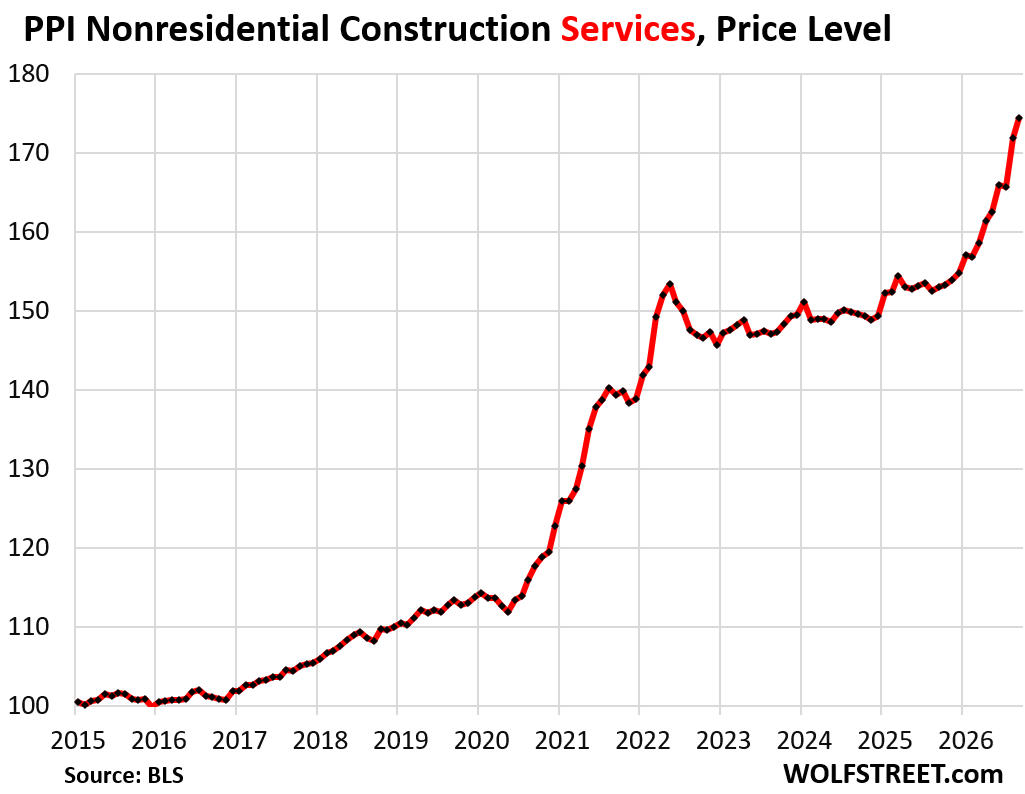
The PPI for nonresidential construction services spiked by 14.0% year-over-year. This includes trade services, transportation, warehousing, architectural engineering, and legal services.
In case you missed it: The 13 AI Giants, from Alphabet to Oracle, Sit on $1.13 Trillion in Cash. They Can Keep Spending on AI even if Markets Get Ugly
Enjoy reading WOLF STREET and want to support it? You can donate. I appreciate it immensely. Click on the mug to find out how: