
As AI & chip stocks tanked, investors shifted from the “AI trade” to the “safe-haven trade” and bid up Treasuries.
By Wolf Richter for WOLF STREET.
The US government sold $907 billion of Treasury securities this week, spread over 11 auctions. That’s a big pile of paper that went through the auctions. $1 Trillion here we come.
Of them, $670 billion were Treasury bills with maturities from 4 weeks to 52 weeks, spread over seven auctions. And $237 billion were Treasury notes across four auctions.
T-bill yields eased across the board this week. They largely reflect the Fed’s policy rates (no rate-hike meeting) and market expectations of the Fed’s future policy rates. They can also reflect big shifts in demand. There was some of that, as the market shifted from the “AI trade” to the “safe-haven trade” with AI and chip stocks tanking left and right – oh poor Intel.
| Treasury bill auctions this week: | ||||
| Type | Auction date | Billion $ | High Rate | Investment Rate |
| Bills 4-week | Oct-29 | 121 | 3.910% | 3.976% |
| Bills 6-week | Oct-27 | 103 | 3.950% | 4.023% |
| Bills 8-week | Oct-29 | 116 | 4.020% | 4.100% |
| Bills 13-week | Oct-26 | 103 | 4.050% | 4.149% |
| Bills 17-week | Oct-28 | 79 | 4.140% | 4.256% |
| Bills 26-week | Oct-26 | 89 | 4.210% | 4.361% |
| Bills 52-week | Oct-27 | 59 | 4.290% | 4.496% |
| Total T-bills | 670 | |||
Most of these huge T-bill sales replaced maturing T-bills as T-bills are short-term in nature and need to be rolled over all the time. But not all.
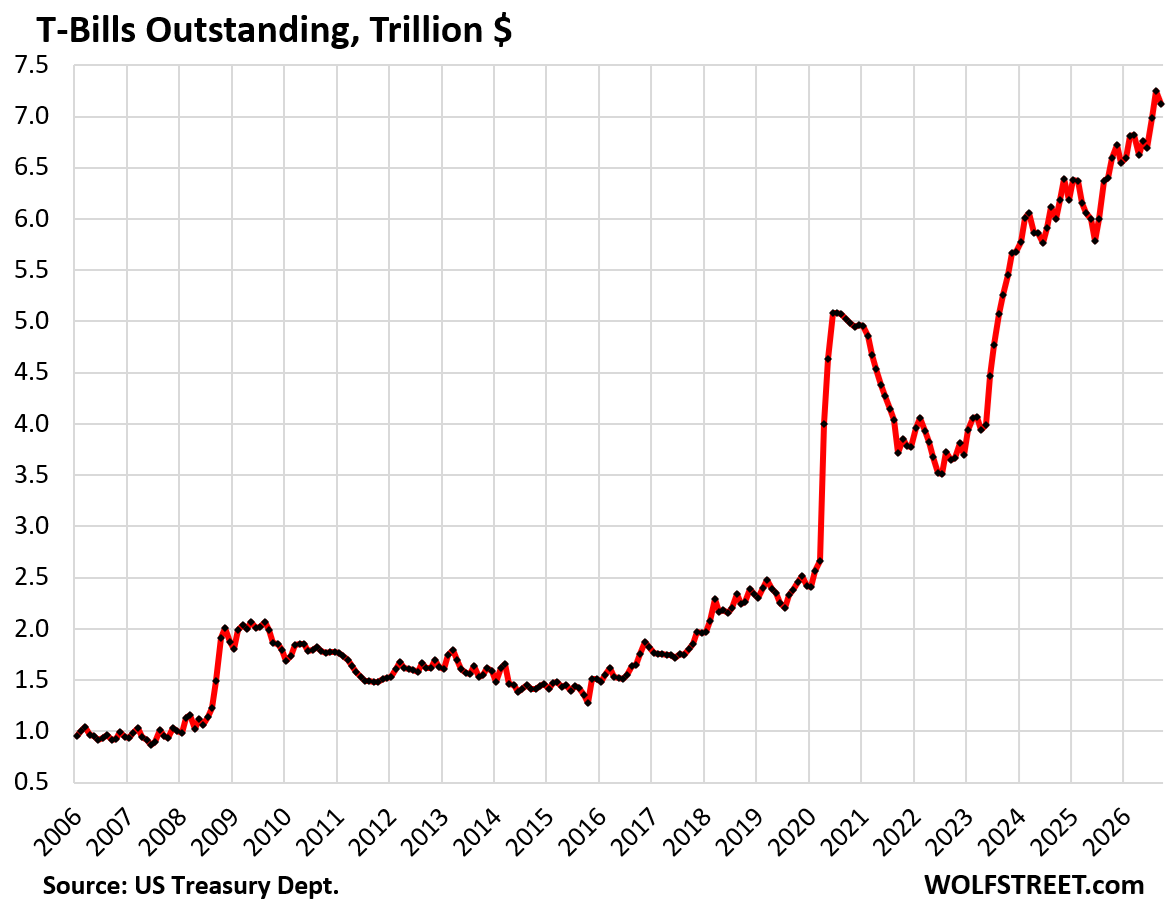
And the pile of T-bills outstanding has been ballooning, from $2.5 trillion at the beginning of 2020 to $7.12 trillion at the end of September (end of October data is not yet available).
Since January 2025, the beginning of Bessent’s reign at Treasury, the amount of T-bills outstanding has increased by $930 billion.
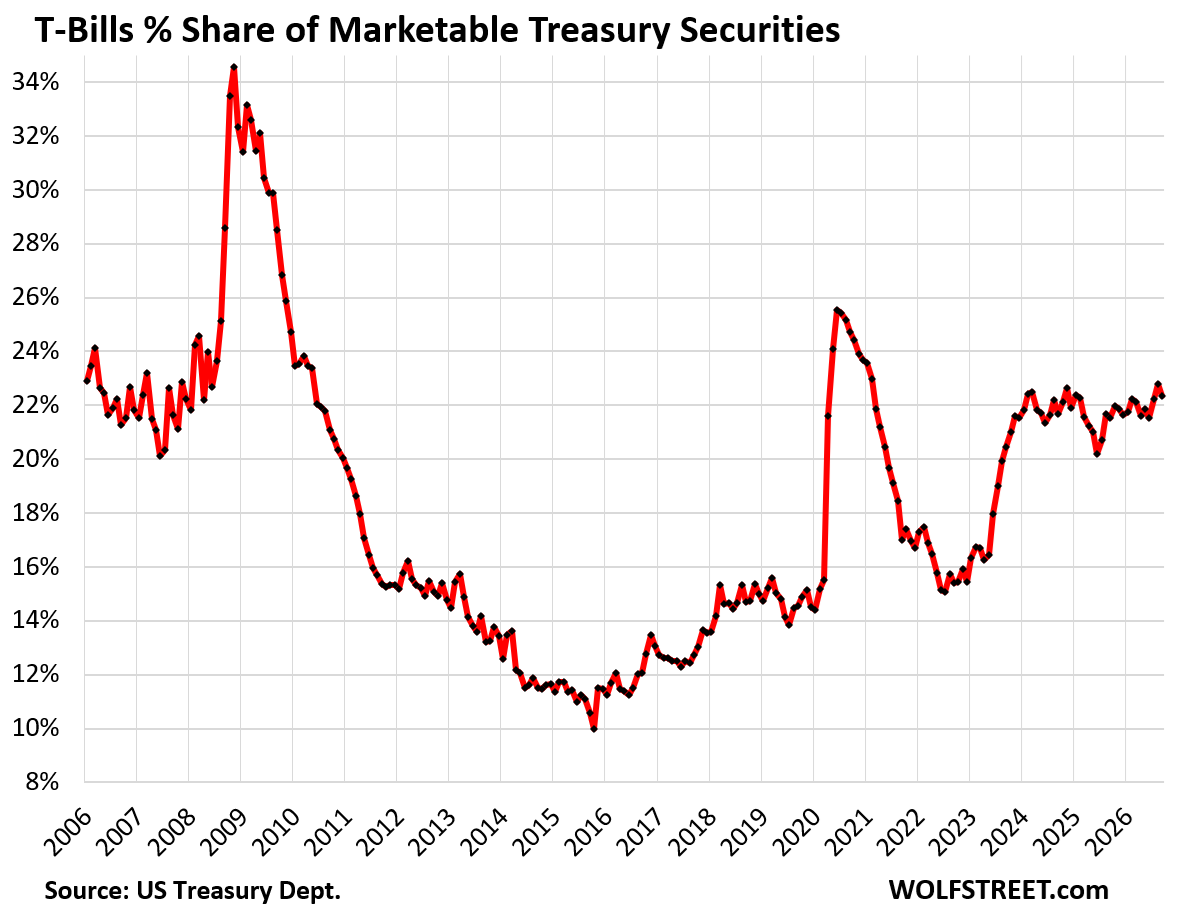
But not yet Bessent’s shift to T-bill issuance. All marketable securities outstanding also soared over the same period, and the share of T-bills has been roughly centered around 22% of total marketable securities since the beginning of 2024. So Bessent’s much heralded shift of debt issuance from notes and bonds to T-bills has not yet taken effect.
A share of 22% for T-bills is considered high. A high share of T-bills can blow out the US government’s interest payments during inflationary times when the Fed hikes its policy rates, and substantially worsen the deficit. All T-bills turn over in less than a year, and when new issues at the new higher rates are sold to replace maturing issues with lower rates, rate hikes translate quickly into higher interest payments.
In addition, as T-bills mature all the time and need to be refinanced all the time, shifting even more issuance to T-bills will cause T-bill auctions to balloon to grotesque proportions.
Over the last two years of Yellen’s reign at Treasury, issuance had already shifted to T-bills, and their share rose from 16% in early 2023 to 22% by early 2024 and stayed there. Bessent has been sticking to Yellen’s script. Maybe the primary dealers cautioned him to not overplay his hand in this shift to T-bills.
The $89 billion of 26-week T-bills were sold at the auction on Monday at a “high rate” of 4.210% or at an “investment rate” of 4.361%.
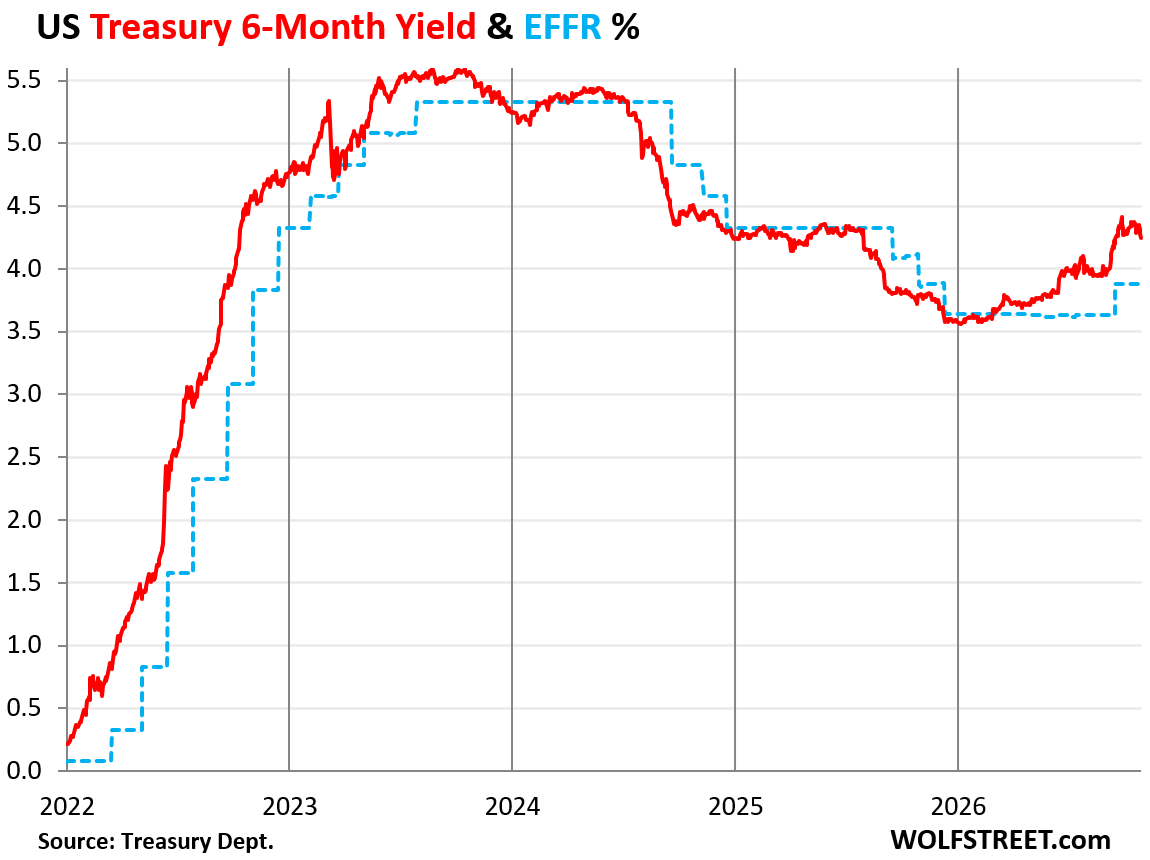
In the secondary market, the 6-month Treasury yield ended the week at 4.275%, 37 basis points above the Effective Federal Funds Rate (EFFR, dotted blue, 3.88%), which the Fed targets with its policy rates.
This 37-basis point spread indicates the Treasury market expects at least one rate hike within the window of 6-month maturities. The 6-month yield has a decent record of predicting changes of the Fed’s policy rates several months ahead of time.
It does fumble around a bit, now that Warsh has declared war on “forward guidance,” and markets are left to their own devices, which promises to generate more volatility. In this rate-hike cycle, the 6-month yield traded as high as 4.41% on September 28.
The government sold $237 billion of Treasury notes this week, spread over four auctions, including two 2-year auctions: one for the regular 2-year note with a fixed coupon payment, and one for the 2-year Floating Rate Note (FRN).
The 2-year FRNs were sold at a “spread” of 0.038%. Holders get an interest rate that resets every week, based on the yield at which the most recent 13-week T-bills were sold at auction, plus the spread of 0.038% (discount margin). For the current week, the yield is 4.088% (13-week T-bill “high rate of 4.05%, see above, plus the spread of 0.038%). The yield of this 2-year note changes every week with the yield of the 13-week T-bill auctions.

Yields have dropped in recent weeks, and the auction yields of those notes this week were lower across the board than at their auctions a month ago.
| Treasury note auctions this week: | |||
| Notes | Auction date | Billion $ | Auction yield |
| FRN 2-year | Oct-28 | 33 | spr 0.038% |
| Notes 2-year | Oct-26 | 77 | 4.708% |
| Notes 5-year | Oct-27 | 78 | 4.845% |
| Notes 7-year | Oct-29 | 49 | 4.894% |
| Total notes | 237 | ||
The $77 billion of 2-year Treasury notes were sold at a “high yield” of 4.708%, down by 8 basis points from the auction a month ago (4.787%).
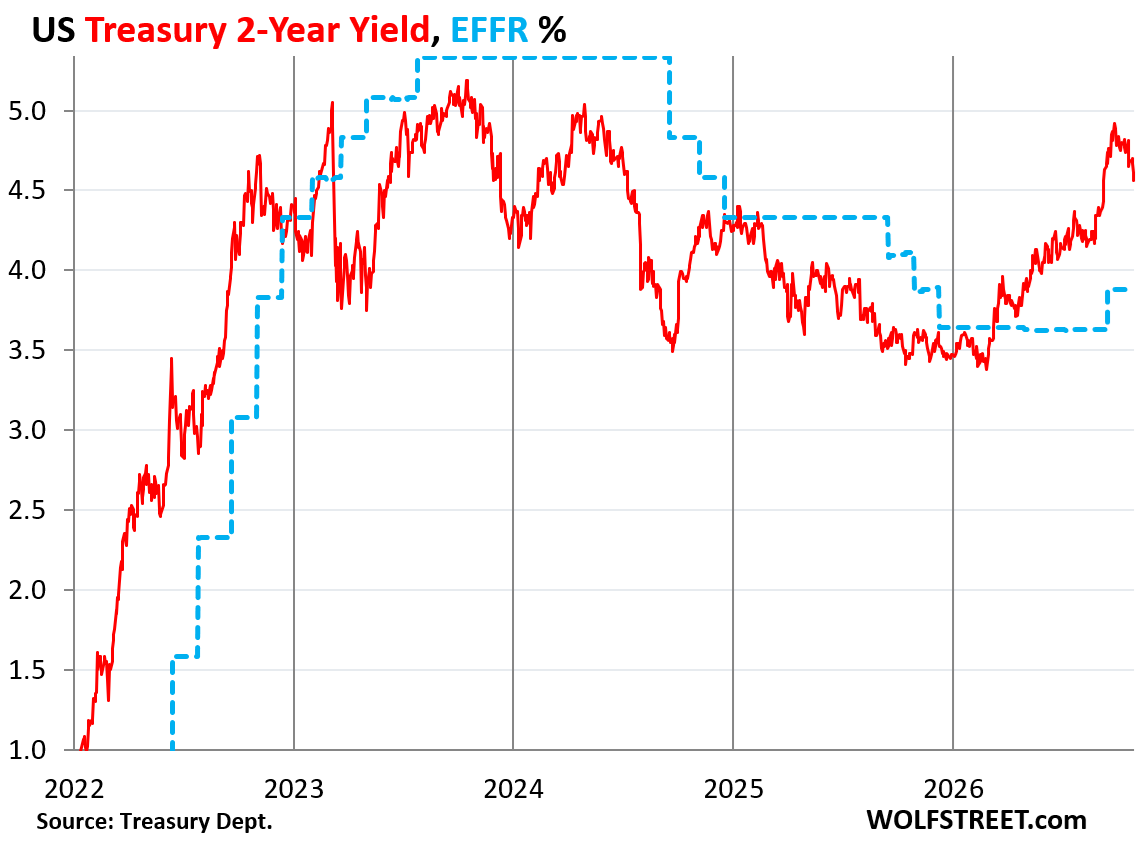
In the secondary market, the 2-year Treasury yield ended the week at 4.56%, having dropped by 14 basis point since the auction on Monday.
Two factors could have been in play: The market dialed back rate-hike expectations and, as AI and chip stocks tanked, shifted from the “AI trade” to the “safe-haven trade,” which caused investors to bid up prices of longer-term Treasury maturities, which caused their yields to drop.
Despite the substantial reversal of the 2-year yield, it’s still 68 basis points above the EFFR, indicating that the market still expects some rate hikes in its window.
The 10-year Treasury yield eased by 6 basis points during the week and ended the week at 4.94%, down by 37 basis points from the closing high on October 5 of 5.31%.
The long-term chart shows just how volatile the 10-year yield is. It had surged from 4.0% to 5.31%, or by 131 basis points, in less than eight months. That’s a lot. But that kind of yield surge is not uncommon, and typically a big yield surge (bond sell-off) is followed by a yield pull-back (bond rally).
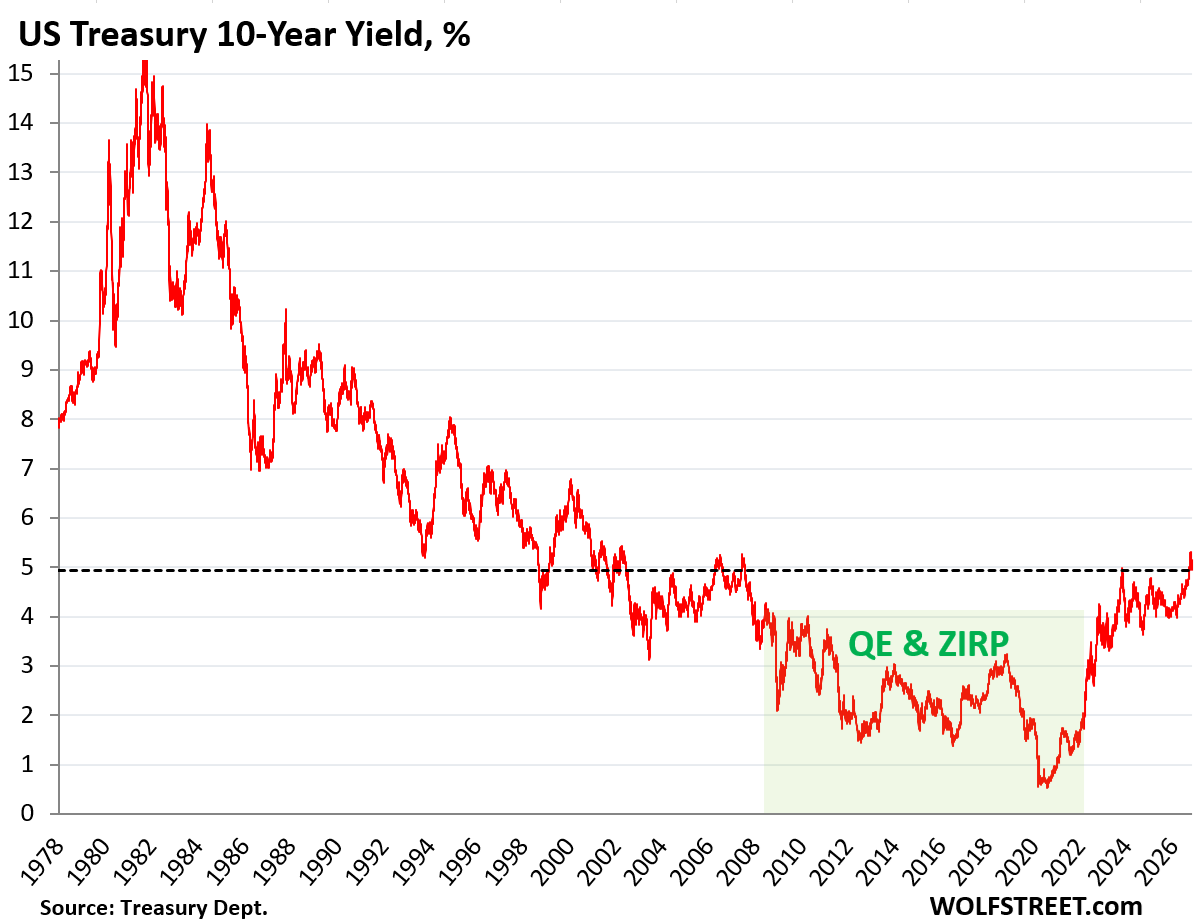
For this observer (and buyer at the 10-year auction on October 7), the 10-year yield is now back in the range where it is no longer attractive to this observer. So no, someone else can buy them.
It is of course possible that this is as good as the yield is going to get over the next few years, and that it’ll zigzag down further from here.
But that’s not what I see. Rather, I consider this a technical pullback after a spike, and I expect the yield to eventually work its way higher, once again driven by fundamentals: Inflation that refuses to go back into the bottle, $2.2 trillion a year of new supply of Treasury debt that investors have to be induced to buy, and competition from corporate debt issuance that comes with much higher yields (and risks), especially in the AI sector.
It seems to me that over time those fundamentals would create enough upward pressure to push the 10-year yield substantially over the 5%-line.
Enjoy reading WOLF STREET and want to support it? You can donate. I appreciate it immensely. Click on the mug to find out how:


Interesting times we live in.
It will be more interesting after midterm elections.
Stay safe everyone!
The California wealth tax is interesting as well. That might be the tip of an iceberg,
Hogs could get slaughtered.
Highly liquid, low-risk assets, ergo, U.S. Treasuries.
Those low-risk assets had recent history of losing half its value. I know, I know – can’t happen going forward.
I mean, if you want to buy 30 year treasuries at 1.3% and then sell them immediately at 5.3%, then you deserve to lose half your investment. But more sane approaches to bond investment didn’t come anywhere close to losing that much (IEF, which tracks 10 year treasuries, lost 20% and then made half of that back; GOVT, which tracks all Treasuries looks quite similar).
I think only Cathy Wood’s ARKK fund and some altcoints did worse than 10y+ treasuries over the last 5 years. One would have to be actively shorting Nvidia to do worse.
It is true that if you invested only in 30 year Treasuries you lost about a third of your investment in the last 5 years.
But even just moving to 10 year Treasuries and it’s now only a 7.5% loss (or about -1.5% annually).
And if you diversify amongst all Treasuries, or hold for longer periods, and it’s fine.
The only real lesson here is “don’t invest only in long-term bonds, even if they are Treasuries”.
You lost another 20% to inflation over those 5 years. Don’t forget that!
“Dollar” don’t mean what it used to mean.
andy
Low risk in this discussion = credit risk = zero with Treasuries, you goofball. Hold them to maturity and you have ZERO loss, plus you collect all the coupon interest payments along the way.
High credit risk = junk bonds. If they default, you do not get much or any of your money back, you may have a 100% loss, cash loss, and you cannot hold to maturity because they defaulted and will be restructured either in bankruptcy court or in an out-of-court restructuring run by PE firms, and your money is toast.
What you’re talking about is interest-rate risk where market value fluctuates based on changing interest rates, and with Treasuries, which won’t ever default, the closer you get to maturity, the closer interest rate risk gets to zero, and the closer market value gets to face value, and at maturity, market value = face value, and you get all your money back, plus you collected the coupon interest payments along the way. For people who hold to maturity, interest rate risk is irrelevant. It only applies to bond traders who bet on the direction of interest rates.
You need to get a grip on this.
Yes, Wolf, understood. The good news is you always correct commenters on the important points.
yes, your money is returned with interest. what I worry about is how much of the purchasing power is returned. The value (i.e. purchasing power) of these investments does change with inflation and rates, whether they are held to maturity or not. There is no escape from the math. Unless I am misunderstanding something?
If your stocks drop 50% over three years, and there is 15% inflation over those three years, your loss may be 65% in terms of purchasing power or something like that. Inflation eats the purchasing power of everything, including stocks and labor. Your only hope with assets is that the interest will out-earn the loss of purchasing power; or that asset price increases will be higher than the loss of purchasing power. Neither one is guaranteed anywhere (except with inflation-protected securities, such as TIPS and I bonds).
Wolf-
Though it’s a very unscientific guess based on a unique timeframe, your 10-year Treasury chart suggests that a 5-8% range (with tails on the high and low sides) seems a reasonable expectation going forward.
Any commentary you’d care to add (especially concerning those frightening sine-wave “tails”)
I think 7%-plus is high for the 10-year in the current scenario unless there is persistent 5-8% CPI inflation (not just an energy-driven brief spike), but I don’t see that. But it could happen….
Back in the late 1980s and early 1990s, inflation was largely in the 3% to 6% range, after it had zigzagged down from 15%, and investors, who’d gotten crushed by 20 years or hot inflation, didn’t want to invest in Treasuries anymore and demanded higher yields (that’s what caused the term “bond vigilantes” to be born). That is not a scenario we now have.
I think the 5% to 6% range for the 10-year is realistic, given the current inflation scenario, and it could briefly go to 7%, but I don’t count on that. There is lots of demand at the 5%-plus for the 10-year now.
For potential buyers targeting a classic low-risk hold-to-maturity fixed-income portfolio, the question is: do you wait till the yield goes over some hoped-for line, such as 6% or 7%, and maybe not be able to buy at all, or do you start buying on the way up when yields are “good enough?” Those are tough questions.
Treasuries are not junk bonds. There is zero credit risk with Treasuries. They’re not going to have junk-bond like yields, which should compensate you for the risk of default. It’s perfectly alright to boost the yield in a fixed-income portfolio by adding risk such as corporate bonds, including junk bonds, as long as you’re aware of the risks, and as long as spreads are wide enough (they’re not yet for my taste).
I agree with youe forecast for yields going forward on the 10 year (5%-6%, with maaaaaayyybe hitting 7% occasionally), but there are two huge unknowns. The first is how serious the FED is about fighting inflation. I don’t think they are really serious about getting inflation down to 2%, but I don’t think they will let it get out of control and hit above 5% either. However, if the FED does lose control of inflation then obviously the 10 year can easily go above 7%. Unlikely, but still possible since everyone is still nervous about how serious the FED is going to be about inflation.
The second unknown factor is the federal deficit. There is zero appetite by either party in Washington about getting the deficit under control and in fact it is the opposite. Both parties are looking to spend. The current administration wants to greatly increase the military budget and the Democrats want to increase healthcare and the safety net spending. Right now there seems to be enough buyers to keep the 10 year under 6% in the near future, but if the deficit continues to expand there will have to be a reckoning at some point where buyers under 6% run out and other buyers need to be attracted at higher yields. Heck, I think the deficit might get significantly worse in the near term. If the Democrats take congress, I could see there being a “compromise” on the next two years budgets where military spending is increased and the safety net spending is increased and deficits jump even higher. All of this ignores any potential economic recession where tax revenues crater and spending increases. Then the deficit will really jump.
At some point (I have no idea when), yields will have to rise to attract new buyers.
Being an optimist, I think the FED is going to keep inflation between 2.5% and 3.5% so while it will still be higher than it’s supposed target, it won’t be out of control. I also think at some point Washington will get at least moderately serious about the debt. Like inflation and the FED I don’t think Washington will get really serious about deficits, but I think they will do something to at least dress the wound.
I take your points, Wolf.
When you said: “ Back in the late 1980s and early 1990s, inflation was largely in the 3% to 6% range…,” I would counter that the inflation rate in the 1970’s decade presented bouts when the inflation rate was significantly higher than 3 to 6%. Maybe it was an unrepeatable fluke.
In addition, federal debt to GDP was roughly half of what it is now, and total debt to GDP was even more dramatic.
The prospect of a vicious ascending debt-service spiral is concerning (over multi-year period, or even multi-decades).
That said, I hope your version unfolds, not mine!
I need to get it together and start investing a piece of my savings in Treasury bills. Even the 4 week’s rate crushes that of my “High Yield” Savings Account. Maybe today’s the day I make an account on Treasury Direct….
You can also participate in auctions and the secondary market with a brokerage account. Many folks prefer to do this instead of dealing with Treasurydirect.
Yes. Banks will screw you on interest for as long as they can.
I made one earlier this year, learning a lot about how the world works
Nothing is easier than Treasury Direct. Even I could figure it out. You hook up one bank account – they will take say $997 and deposit back $1000 in 4 weeks. Pick your number of re-investments – they will deposit say $3 every 4 weeks, then send you back the original $1K. And that $3 is closer to 4% APY by some magic – like .gov year is faster or something. Milage may vary. Things you learn on Wolfstreet.
3.8% divided by 12 months is 0.32%, or $3.20 on $1000
I think they count it daily, and from $997, and then their year is 360 days. It is akin to .gov measuring CPI :)
$3 on $1K ratio plus the time spent logging on to track it all? Smells like desperation to me. $30 for $10K? Other ways to make money like cashie work on the side imho.
That “$3.20” on $1,000 (that Numbers cited) is PER MONTH, every month, month after month, and after 12 months = 12 x 3.20 = $38.40 for the year. No logging-in required after the initial purchase, it’s on automatic pilot.
But it’s actually more because MMF dividends get reinvested automatically, and so the principal grows every month, so the dividend rate is applied every month to a higher principal. If the dividend rate stays the same, such as in periods when the Fed doesn’t change its policy rates, then the monthly dividend amounts grow every month, thereby increasing the speed at which the MMF principal grows. It’s called compounding.
Most money market funds automatically track the 4 week rate. I’m getting 3.9 right now.
Seems like a good time too remind all about the Treasury Direct where US citizens can but the US Treasury issuance directly,
I can’t help that that failure of the Fed too allow interest rates too rise created the monetary waste fueling inflation
Not too mention the 40 trillion dollar debt that the least deserving recipients of America’s hard won life style have apparently accumulated.
Don’t forget to account for the .gov tax that will consume a chunk of the fee you are paid for loaning money to the same entity.
Nice business, that!
At least most states leave you alone, I guess.
Why is federal tax on income only brought up in relationship to Treasury interest? It applies to all income, if you haven’t noticed.
I’m TIPped out.
I would like to know how high a debt to GDP ratio the US economy can stand? Japan had a 250 percent ratio. What is France’s ratio today.?
Japan’s went over 250% but has come down recently. Half of that debt is held by the Bank of Japan, which kept the issue under control. But that doesn’t fly anymore because Japan’s currency has collapsed (all monetary sins ultimately lead to the currency) and inflation is messing things up. And Japanese yields have exploded.
France’s is about where the US is today. But it doesn’t control its own currency (unlike the US and Japan), and for the past two years, it has had a political crisis that is now turning into an economic crisis and a mess in the streets. You can thank Macron for that, for his idiotic decision to dissolve the government two years ago.
The hole France dug itself is deeper. Their deficit mainly stems from the pension gap. In 2023 they managed to bypass parliament to incrementally increase the pension age from 62 to 64 by 2030, but it’s too late and too little. They still have a huge gap which is the main culprit of their deficits. Their fractured political landscape doesn’t allow for a strong majority that’s able to take difficult decisions. On top of that, the people will take literally any excuse to organize crippling strikes that virtually always spiral into violence.
US has plenty of wiggle room to get to a healthier balance sheet, from spending cuts to tax increases. We also have a much higher chance of ‘sweeping’ elections that create enough political stability to pass laws. We don’t, but we could.
It’s really difficult to purchase the ten year with two conflicting issues at play, AI bubble and inflation. Inflation is definitely higher, but if the bubble bursts, yields will drop. So, I’m just building ladders for the next twelve months. Might considera two to three year time line, but for now holding tight. Definitely afraid of equities at these valuations. Patience is a virtue.
I feel your angst. The what if that everyone is confronted with by their mind. How too beat the house.
I think that the extent of the obviously incoming economic contraction will be severe.
The monetary stimulus option IMO will immediately increase inflation.
But what do I know. Nothing.
“Berkshire Owns More T-Bills Than the Federal Reserve”
Is that still the case? The Fed has been replacing its MBS with T-bills, and as its MBS holdings shrink, its T-bill holdings rise. The Fed is now at $571 billion in T-bills.
The AI trade will bounce back when the Supreme Court gives it personhood in the “AI is People” decision and AI starts voting for our side of Uniparty.
Maybe. I think the AI trade has been exposed as extremely overpriced.
The worst investment for the year may be buying AI IPO shares
France bonds seem to be a sweet spot. Looks like they are getting their fiscal house in order and rebuilding their industrial base with cheap energy.
The risk is that Europe and the IMF will pull a Greece, bail out France, install technocrats, force reforms on the people, and give private-sector bondholders a big haircut. Probably not a big risk, but it has happened with Greece.
But if they get a functional majority government after the election in six months, they might get things straightened out on their own. Right now, their government is in total chaos, Parliament cannot come to any agreement on anything, Prime Ministers come and go, and the economy is essentially on hold till that gets resolved with the next election. You can thank Macron for that mess when he dissolved the government two years ago.
So that’s the bet you make when you go for France’s 4.97% government 10-year bond yield on euro debt.
Berkshire Hathaway held about $325 billion in short-term U.S. Treasury bills as of June 30, 2026.
The Federal Reserve’s SOMA portfolio held roughly:
$568 billion in Treasury bills
$3.6 trillion in Treasury notes and bonds
$278 billion in TIPS
plus other Treasury securities, for total Treasury holdings well above $4 trillion.
The confusion comes from a comparison that was true for a while: Berkshire’s T-bill holdings became larger than the Fed’s T-bill holdings alone after the Fed dramatically reduced its bill holdings during quantitative tightening
Wolf, It seems like the average weekly auctions have been 725 billion. What is the cause of the Jump to 900 billion ? Are your speculations in the article and I missed it ?
Is it just Treasury seeing the opportunity from money flooding out of risk in Europe and Equities etc, to sell a lot of Treasuries without pressuring yields ?
“average weekly” covers up a lot of fluctuations from week to week.
In addition, there are times when auction sizes are fixed and smaller, such as during the debt ceiling. And there are times when auction sizes are huge, such as after the debt ceiling, when the government has to refill its empty checking account through extra issuance.
But since the last burst of issuance to refill the checking account, once that subsided, auction sizes have been zigzagging higher. This week’s was the highest since that replenishment period. And that makes sense because more debt requires bigger auctions – and that is immediately noticeable with T-bills because any increase in T-bill issuance requires bigger T-bill auctions in the near future as they mature.
The 10yr real yield is 2.474%. That’s not enough to compensate for inflation.
If you want higher real yields, you drain reserves while reducing FDIC insurance limits. That would activate monetary savings.
For example:
(1) the Dec. 2012 reduction in unlimited transaction’s deposit insurance that dramatically raised real yields
(2) the 1966 Interest Rate Adjustment Act (reduced Reg. Q ceilings for the banks)
I.e., savings flowing through the nonbanks increases the supply of loanable funds, but not the supply of money.
“The 10yr real yield is 2.474%. That’s not enough to compensate for inflation.”
That’s not what “real yield” means. You have it backwards. Real yield means the yield after inflation.
Real yield can mean two things:
1: Real yield = TIPS yield. Total TIPS compensation = yield + CPI inflation protection. So if CPI = 3.71% (September) and the TIPS yield = 2.47%, than that TIPS earn 6.18% for that period. (Note: the 10-Year TIPS yield was 2.60% on Friday). Real yield is what TIPS earn on TOP OF CPI inflation.
2: Real yield = 10-year Treasury yield (4.93%) minus CPI inflation (3.71%) = 1.22%.
Now go back to the drawing board with your theory.
It’s no theory. It’s accounting. I just described it wrong.
If you want to squash asset prices, drive up the real yield.
My father’s house in Evergreen Co, doubled in price in the last 5 years.
It may seem counterintuitive, but the price level falls faster than the supply of loan funds increases.
“Fact Check: Was 2013’s ‘Taper Tantrum’ Actually So Tumultuous?” LOL, QE3 was contractionary.
There was no recession in 1966 even thought there was an interest rate inversion.
The Ph.Ds. are running the economy in reverse
Lending/investing by the DFIs (deposit taking, money creating institutions), expands both the volume and the velocity of new money. I.e., lending/investing by the DFIs is inflationary.
Lending/investing by the NBFIs (nonbanks) increases the turnover of existing deposits (a transfer of ownership), within the commercial banking system. I.e., lending/investing by the NBFIs is non-inflationary (other things equal).
It is a theory. They are using the Cleveland Fed’s estimate of the real interest rate that takes the 10-year Treasury rate and decomposes it into an inflation expectation, an inflation risk premium, a real risk premium and a real interest rate. They still publish these estimates monthly, but it takes a strong background in econ to understand what they mean (it’s a bit beyond me).
Their model estimates that the inflation risk premium has been unchanged at 0.5% for decades (back to 1982). Similarly, the real risk premium has also been relatively unchanged at about 1.2%. These are the portions of the real interest rate to compensate investors for risks to changes in the inflation rate and changes in the real interest rate respectively. They also estimate that inflation expectations are currently 2.7%, which leaves a real yield of 2.4%.
Cleveland’s #’s are up for November, month to month and year to year.
People are front-running the rumor that Trump will acquiesce to Iran’s demands.
Crude Oil Dec 26
95.49
-8.63 -8.29%
GDPnow reported 3.7 for the 4th qtr. today. They’ll report again on Wed.
With bonds up again today it feels like time to sell them.
See: “Profit or Loss from Time Deposit Banking”, Banking and Monetary Studies, Comptroller of the Currency, United States Treasury Department, Irwin, 1963, pp. 369-386
Look, I love your other comments. But I cannot believe you don’t get the message that you cannot year-in, year-out bombard the comments here with your (crazy, I would say) economic theories based on publications from the 1960s-1980s. It seems that many decades ago you either wrote a book or a dissertation or both on the topic, and you want your theory to get some traction online 50 years later. I delete most of those comments of yours.
If you did publish a book on this, and write a dissertation, send me the info via email. But I beg you quit posting this stuff about these 60-years-ago economic theories over and over and over again.
As Huey Long said: “Share the Wealth”
Some of those people who woke up with a margin calls, are going to be liquidating position right about now into strength. The rest will wait to their deadline on Wednesday, big day!!! It looks like it’s reversal time or sell the rally.
Will see what happens next, I am looking for a 5% drop in spy by Friday if not Wednesday close.
Cheers
Apple reports today, and Nvidia in few days. Apple’s new $2K flip phones are cracking the screen. They have new CEO who lacks gravitas – and Tim Cook wasn’t Obama himself. Anyway, bought few Apple puts last friday. Actually rolled some Google puts into Apple. Testing the waters.
I am finding it very easy to buy T-bills via Fidelity and Vanguard at auction and to create a simple ladder. Rates are better than most MM funds available and the money turns over pretty fast. I would say the downside of holding longer T-bills is that you don’t get residuals until maturity so that means you can’t compound. But still, not a bad return as I wait out the short term market and watch some of the equity positions take a dive.
Another option is the t-bill etf SGOV. The ‘vig’ is .09% as opposed to fidelity spaax which runs a bit higher vig at ~.45% annually. Both mm track short term tbills. Pretty safe stuff imo.