
Driven by spiking costs of energy and services.
By Wolf Richter for WOLF STREET.
Inflation in prices that businesses pay each other and charge each other – tracked by the Producer Price Index (PPI) – accelerated to 6.3% year-over-year in September, the worst inflation in the realm of businesses since December 2022 (red in the chart).
Inflation has been far more aggressive for businesses than for consumers, though it has also been getting worse for consumers: The Consumer Price Index yesterday accelerated to +3.7% year-over-year. GDP tracks inflation that all economic participants face – consumers, businesses, non-profits, and governments. And these readings in the PPI today and the CPI yesterday tell us that inflation in the overall economy in Q3 was ugly, and we’ll discuss that ugliness here when it is released with the Q3 GDP data at the end of the month.
On a month-to-month basis, the overall PPI spiked by 1.3% (+17.4% annualized) in September from August (blue in the chart), according to the Bureau of Labor Statistics today. Part of it was driven by a huge spike in energy costs, and part of it was driven by a huge spike in the costs of services that businesses buy and pay for.
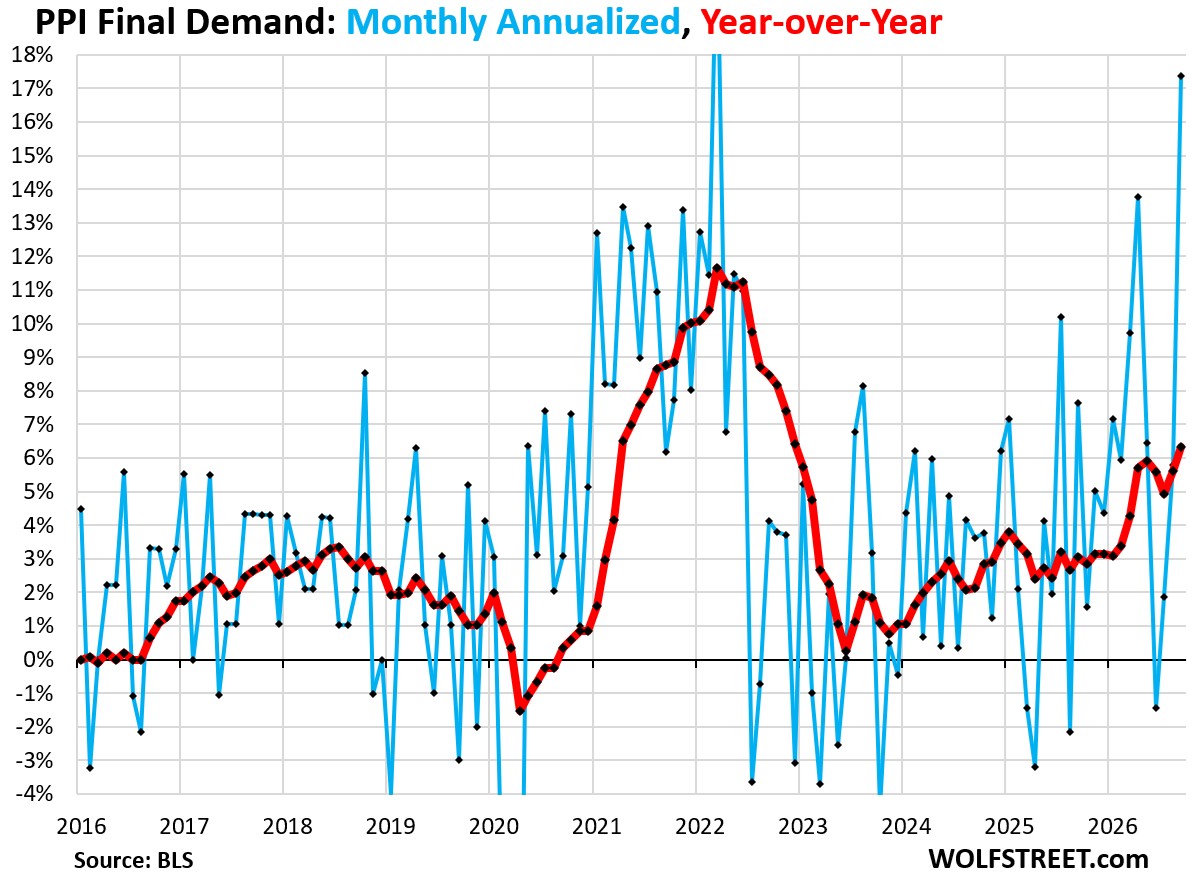
That’s a lot of inflation in prices that companies pay each other. As the chart above shows, business-facing inflation has accelerated in its zigzag manner since the low point in mid-2023, while the Fed, which is focused on consumer price inflation, has cut its policy rates.
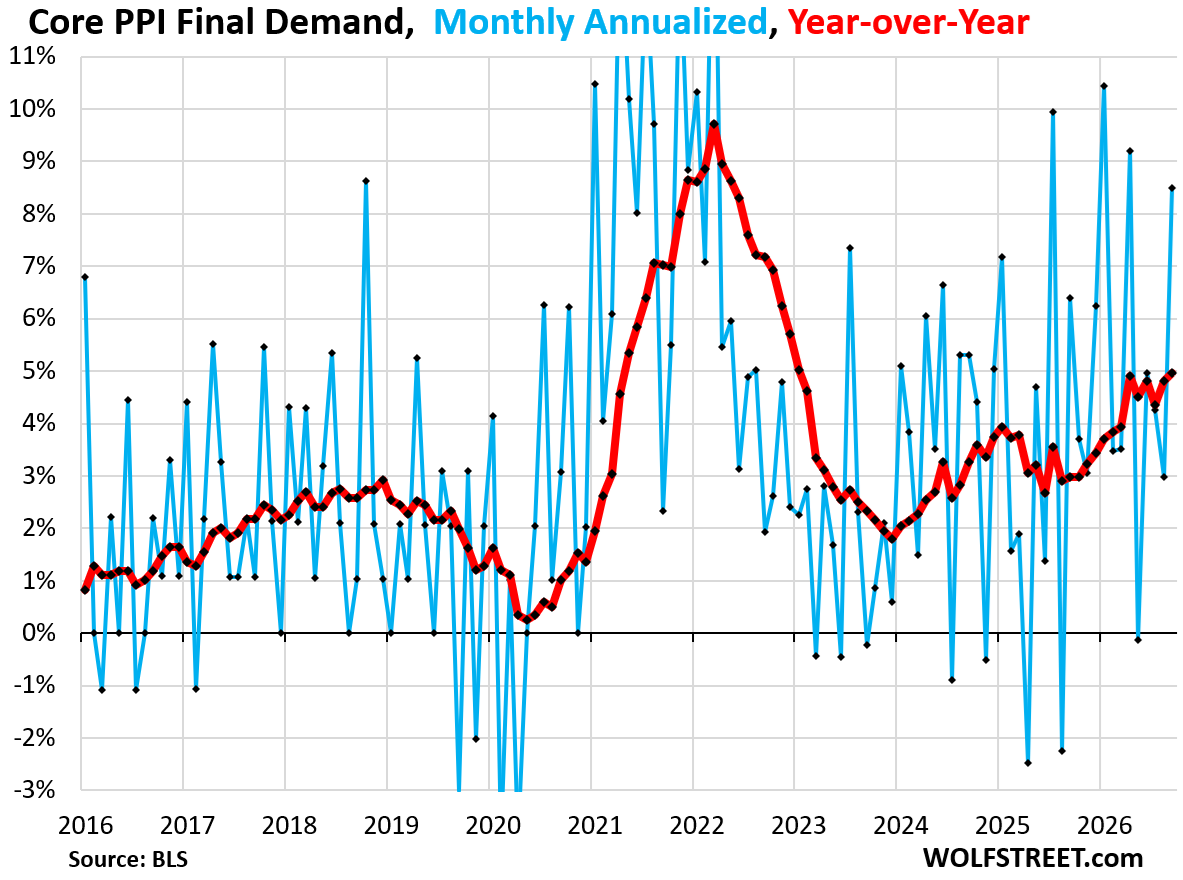
Core PPI Final Demand, which reflects the overall PPI minus the energy and food components, accelerated to 5.0% year-over-year, the worst since January 2023 (red in the chart below).
The index, dominated by the services PPI (see below), has been zigzagging higher since the low point in January 2024.
Month-to-month, the index rose by 0.68% (+8.5% annualized, blue).
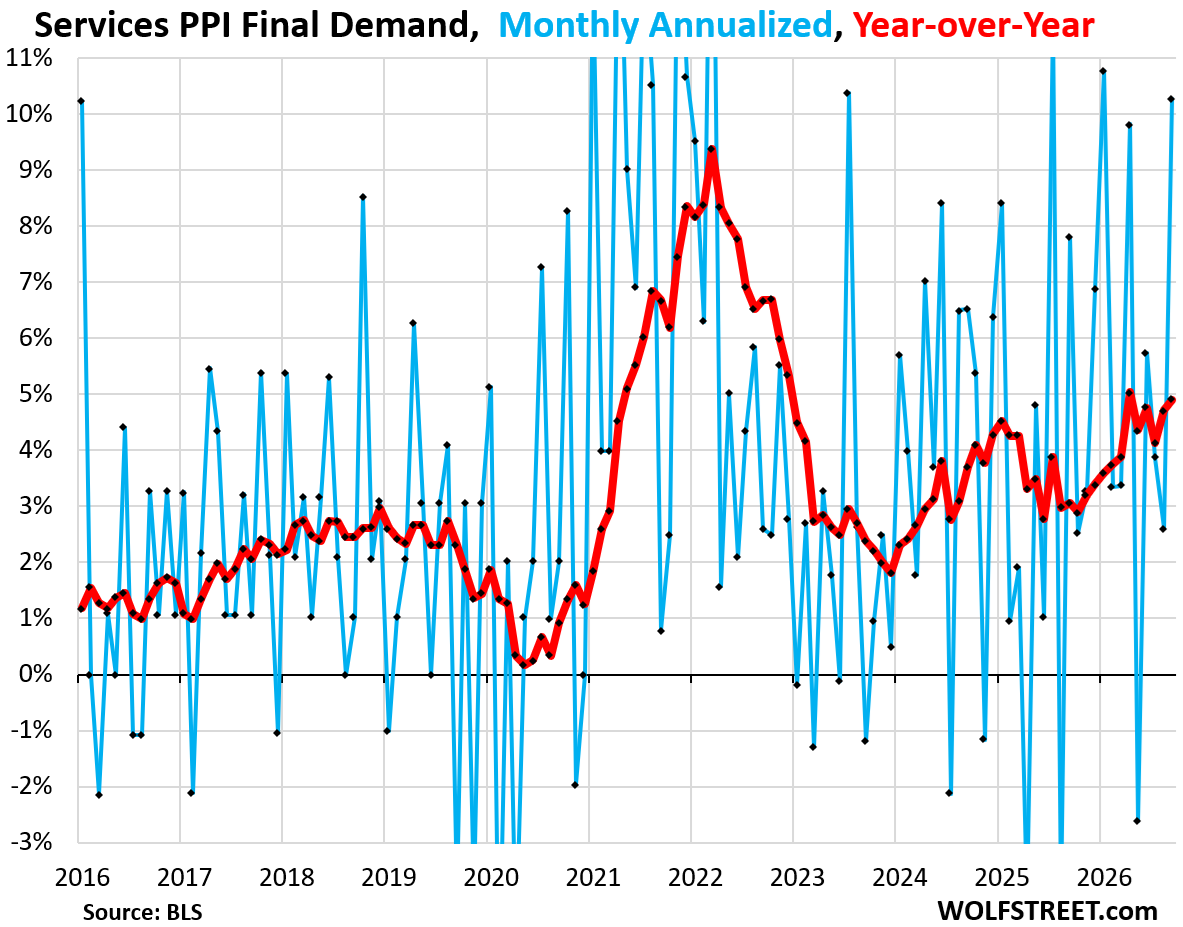
The services PPI spiked by 0.82% (+10.3% annualized) in September from August. This was mostly driven by two subindexes, the PPI for transportation and warehousing services and the PPI for trade services, both of which exploded. More on those two in a moment.
Year-over-year the services PPI accelerated to 4.9%, just a hair below April, and both were the worst since December 2022 (red in the chart below).
Services account for 68% of the overall PPI final demand. They move the needle.
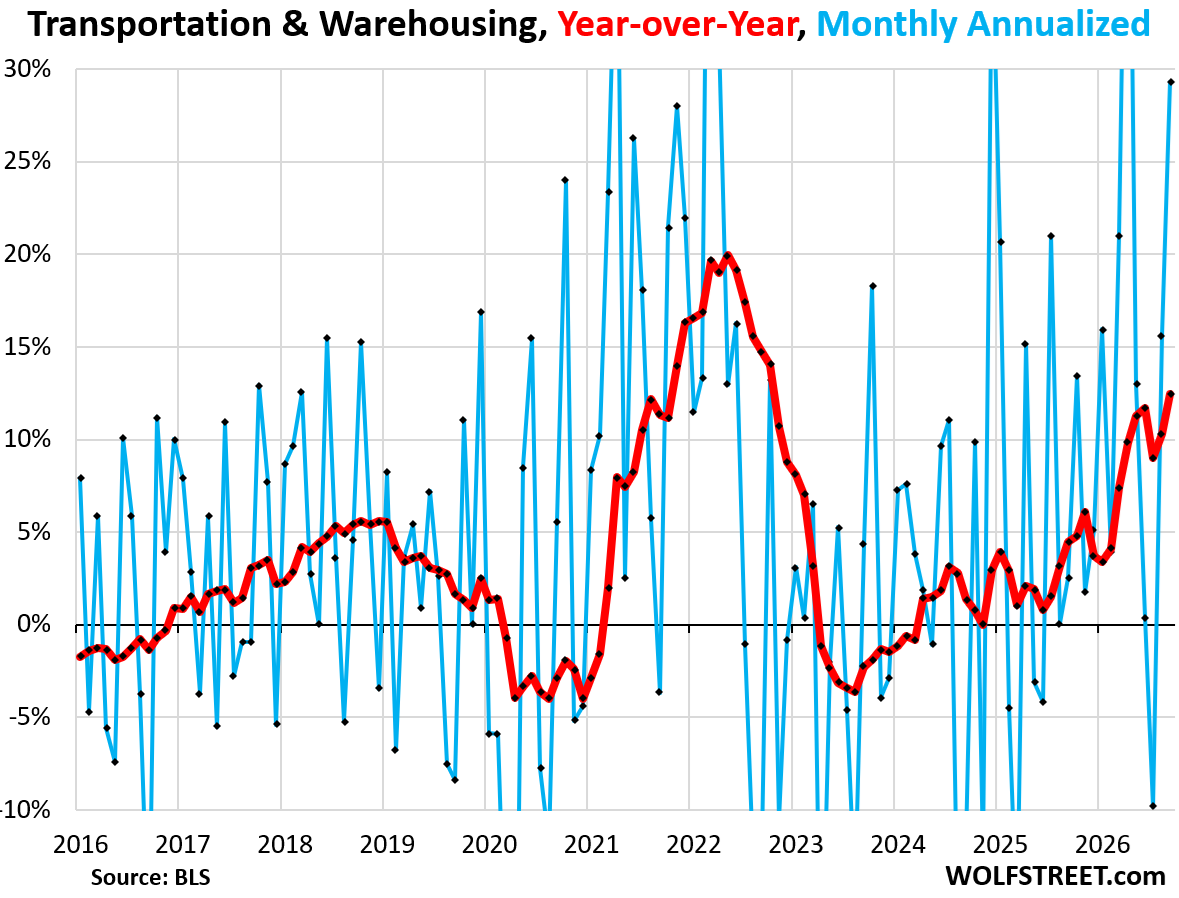
The transportation & warehousing PPI, which is within the services PPI, spiked month-to-month by 2.2% (+29.3% annualized, blue), driven by higher input costs, including spiking diesel costs.
Year-over-year, prices soared by 12.4%, the worst since October 2022 (red). It has been zigzagging ever higher since the low point with negative readings in July 2023.

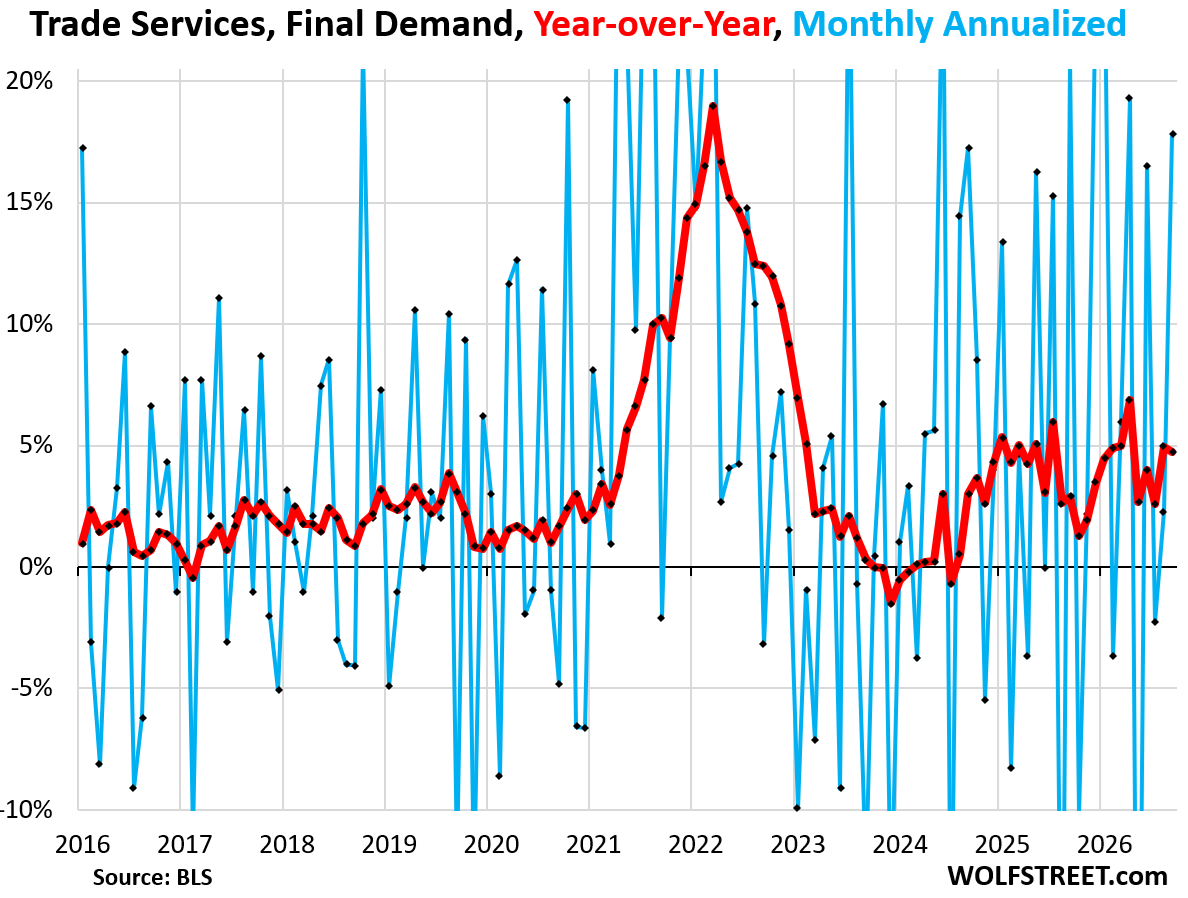
The trade services PPI, which is also within the services PPI, spiked month-to-month by 1.38% (+17.8% annualized, blue), after a low reading in August, and a negative reading in July.
Year-over-year, prices rose by 4.7%, a deceleration from August. That range is about double the normal range before the pandemic (red).
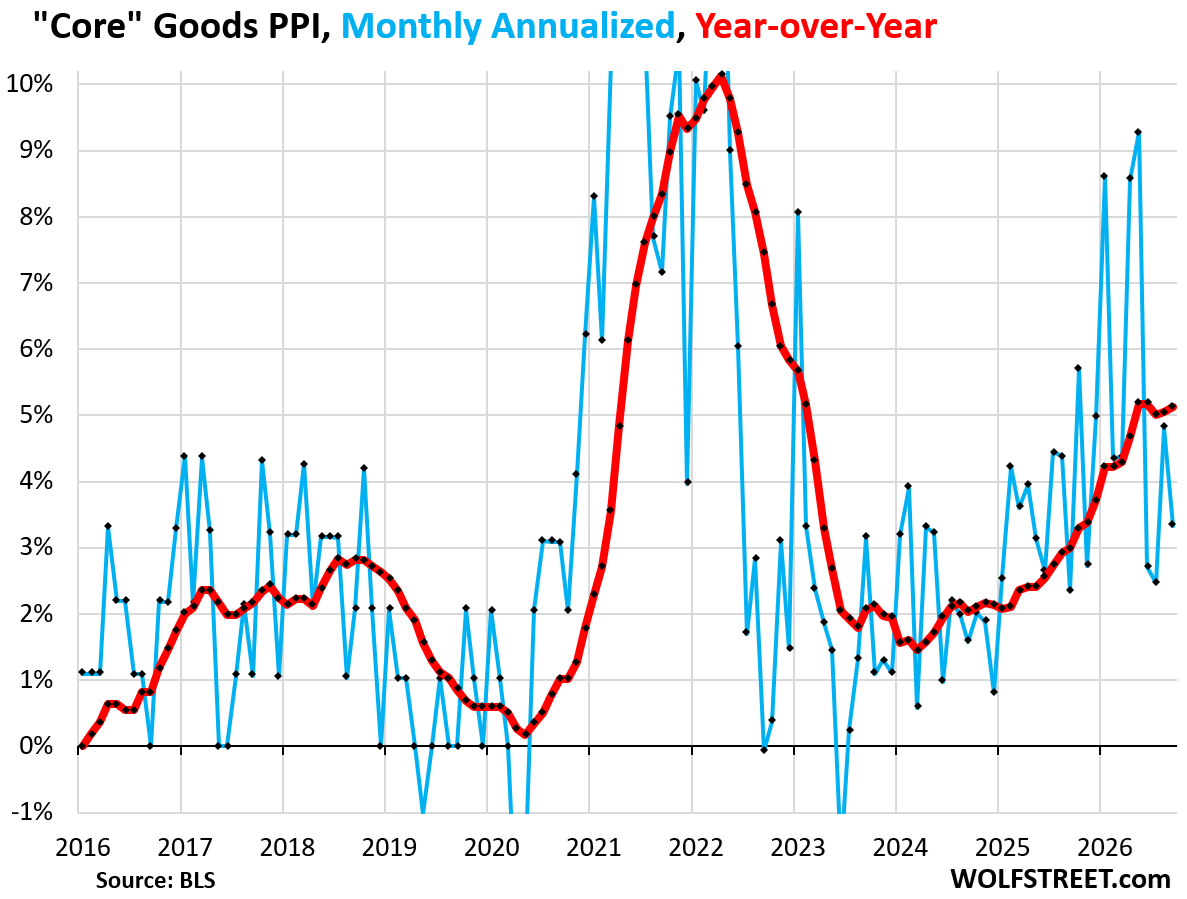
The PPI for core goods, which excludes energy and food components, rose by 5.1% year-over-year, and has been in this range for the past five months. Those five months have been the highest since February 2023.
It has been zigzagging higher since March 2024.
Month-to-month, the index rose by 0.27% (+3.3% annualized, blue).
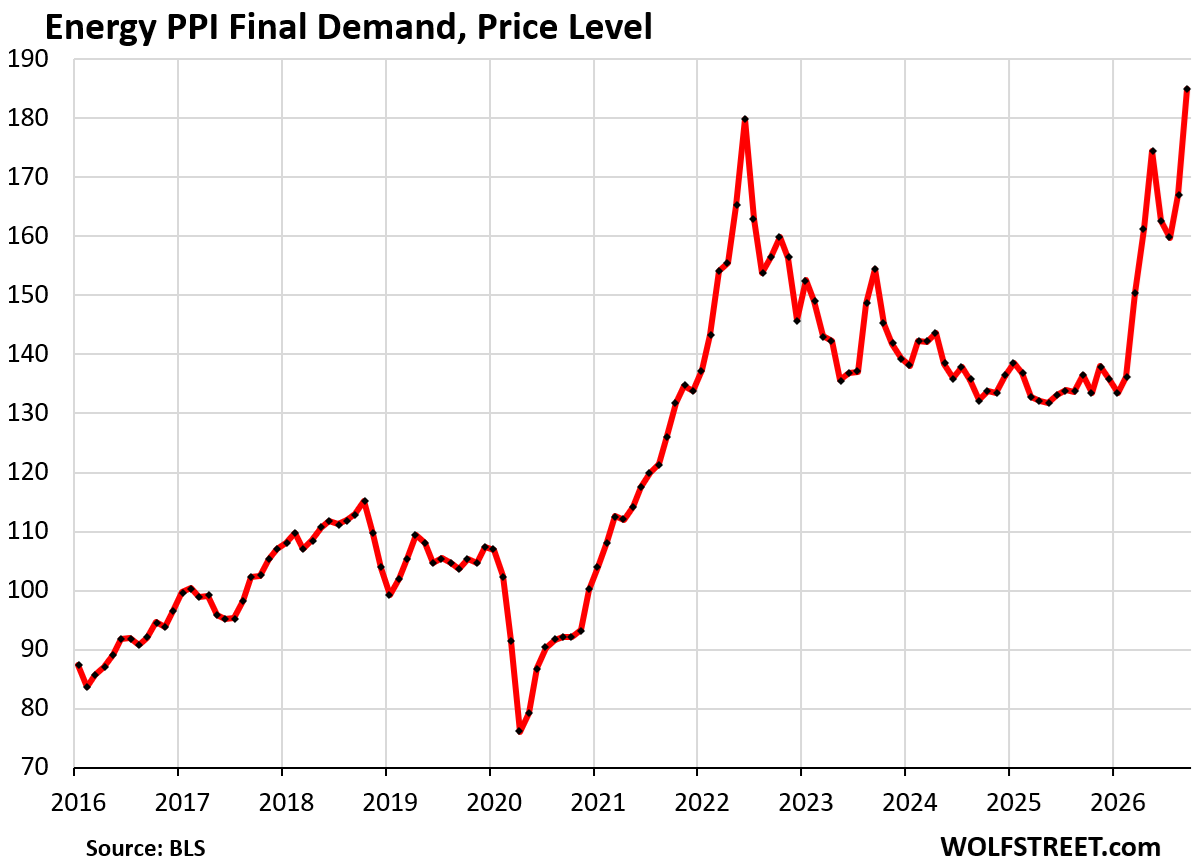
The PPI for energy spiked by 10.8% month-to-month and by 35.6% year-over-year.
The chart shows the price level of the energy PPI, and not the hugely volatile percentage changes. Note how the price level in September surpassed the June 2022 peak.
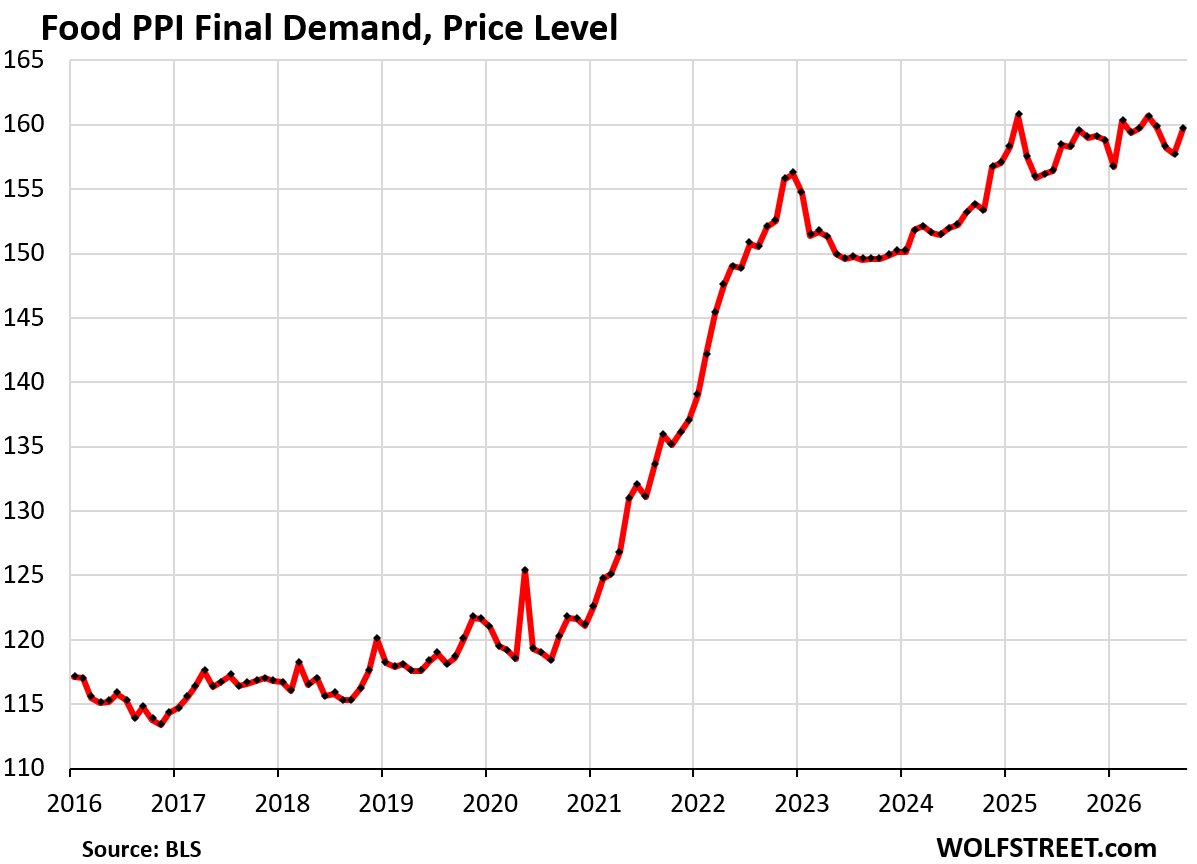
The PPI final demand for food spiked month-to-month by 1.2% (+15.7% annualized), after two negative readings in a row in August and July.
Year-over-year, it was unchanged.
The chart shows the price level of the food PPI, and not the hugely volatile percentage changes.
The big food inflation occurred from mid-2020 through 2022, when food costs that businesses faced, such as manufacturers of packaged foods, soared by about 31%, but hit a ceiling and fell in 2023. Since early 2024, prices have zigzagged higher at a moderate pace, from those very high price levels to even higher price levels.
In case you missed it: Inflation Spreads across the Economy, Not Going Back into the Bottle: CPI, Core CPI, Core Services CPI Spike
Enjoy reading WOLF STREET and want to support it? You can donate. I appreciate it immensely. Click on the mug to find out how:


Very bad. Some businesses in my area a shutting down – just cannot afford the energy to drive all over town delivering packages for Amazon or mow lawns.
Elect clowns, expect a circus.
Nothing is shutting down in Texas.
I hear real estate prices are very strong in the Permian Basin.
And Texas state coffers are overflowing with oil tax money.
Just praying for more inflation to make my fixed rate mortgages on my homes seem smaller and smaller over time.
Glad I don’t live in liberal dying state, like I used to.
Life is so great in the magical land of Texas that it’s poised to elevate its noble AG to Senator by thunderous margins!
…
Oh.
Well, we’ll see.
If you were to go by the dying MSM, 2+ Democratic Senators would have been elected the last couple of elections – Ms. Sneakers and Beano O’Rourke.
Things might be different this time but TX is a pretty Republican state and the rotting MSM has a lonnnng history of trying to shove *its* desires down the gullet of, well, everybody.
Via any baloney it can pitch.
That’s why it became the *dying* MSM the second it faced any real competition from the internet.
As I said, it is possible that the Dem might be elected (the base-line economic concerns of Americans have been ignored for years) but everybody has dealt with the 2 political mafias their whole lives…they basically have zero faith in either one at this point.
Sour grapes, eh?
Texas is in the United States.
The bottom 10 states with the worst cost-of-living-to-income ratio (where low wages or high expenses mean paychecks do not stretch far despite nominal affordability) are typically led by states with depressed median incomes, high poverty, or low wage-to-cost purchasing power:
Mississippi
Louisiana
New Mexico
Arkansas
Alabama
Tennessee
Kentucky
West Virginia
Oklahoma
North Carolina
I believe you have your list backward.
Dunno why NC on that list. We’re boomin baby!
You should see the traffic in Raleigh.
There’s like 3-4 costcos. 3 Sam’s clubs, 12-14 targets. Got the cool toll road loop to get around quicker. Think they are building the 4th or 5th Whole Foods.
Things are moving pretty fast here.
Charlotte and Asheville too are busy busy.
I am very happy that war is good for business in the Permian.
I’m starting to see many smaller businesses folding up
and I just close my eyes at homeless cheapo when I check out
they just quoted me $23k for kitchen cabinets
my son is getting order for $10k(same plywood cabinets)
That sounds very west Texan, smug over natural resource money the state lucked into, no brains required (and worshiping football brain damage too); completely unconcerned with the natural world but maybe with a second home or time share in Colorado for status; and willing to degrade the environment and profit off AI investment until we’re all dead. Fortunately that end will take you too, probably before the next oil bust. Even with that, it looks like Elon might not be able to buy your Senator. Billionaires own Texas and the liberal states, and you’re not one of them.
I know west Texas. The cities have nothing redeeming.
You sure know west Texas.
Mountain Time:
The natural resources were always there, so it is not lucked into.
And the “luck money” that you speak of was just a resource before people moved there and worked to make it into money.
Probably the majority of the things you use and make your life easier and more comfortable are made from petroleum byproducts.
Which is why house fires used to make dark brown smoke, and now make black smoke.
The black smoke is the byproducts of combustion of all the petroleum byproducts that the house and its contents are made from.
Black smoke is UNBURNT hydrocarbons……creosote…and/or what used to be called “town gas”…..remember people sticking their heads in ovens to commit suicide?
Very nasty shit, anyway……bad chemicals, bad particle size.
the blue v red hatred is idiocracy. you have been played. by your owners and betters. divide and conquer. sun tzu and the romans knew how easy it is.
Yep. As Galbraith and now his kid realized…it’s just predators and prey…..only it’s just done in “money”, and ignoring REAL value to human life.
Lol. I’m hoping this is sarcasm. Oil has always been boom and bust give it a few years and it will be like the 2015/2016 collapse. The beauty of capitalism is we’ll always hit over production.
Prices are only high because it takes time to determine where to drill, drill and bring new supply online.
“Just praying for more inflation”….
Yes, the end-stage of capitalism is a debt fueled circle “work.” Everyone who’s leveraged to the gills looks like the smartest guy in the room.
Meanwhile the prudent person who learned a conceptual “living within means,” is getting working on a steepening and accelerating treadmill.
I can’t really complain about whatever, but it’s a divided house that falls, in an increasingly polarized East v West (where the west is praying for their neighbors demise, and the east is just pulling the trigger).
What businesses are delivering for Amazon?
Lol
They have their own trucks
Do these “businesses” tell you they won’t be coming around anymore with a tear in their eye. Won’t see little Johnny grow up? Awww
/s
they make new drivers deliver out of their personal vehicles
well we haven’t had SERIOUS business cycle in decades
last one in 2009 was FINANCIAL cycle brought on by grifter banksters
this one will take out a lot of weak players and 1% standing ready to hoover up cheap assets
That’s not a business.
That is Amazon shirking having an employee.
They might have to pay Employer paid taxes!
Jeff wouldn’t have that yacht 🛥️
It’s apparent the Fed should increase interest rates, and it looks like this is what the bond market is anticipating.
But in the past there has been only 2 cases (from what I could find) where interest rates were increased within 2 months of an election.
In this case, it’s around a week before the mid-terms. Oct 27?
Fed is in a tough spot as increasing rates will affect the election results.
Leaving them alone may cause bond rates to soar and inflation to spike.
This will be interesting.
Do not panic. The Fed knows how to deal with interest rates. They get all their good advisement from the law firm of Skinum & Daley.
Or dewey cheatham and howe.
“It’s apparent the Fed should increase interest rates, and it looks like this is what the bond market is anticipating.”
The 10 year Treasury yield is crashing. It should be soaring.
Wow, with that definition of “crash” you must lose a lot of sleep. It’s only a crash if you’ve mentally anchored to the recent high yield from like a week ago.
The 10 year yield is down a bit from that high, but it’s still up from last month and all prior time for the past 10-15 years.
It did pretty much the same thing in 2025, 2024, 2023, 2022, 2021 and 2020… falling back after rising too fast and spiking to a a short-term-unsustainable high.
Put a different way: bond funds were oversold and due for a snapback rally. I don’t think the 10 year yield (now at 5.09%) “crashes” below 4.8%.
I wouldn’t say it’s “crashing” per se, but it does show, in my opinion, there’s still too much liquidity in the system.
I just keep, keeping on
working daily, don’t care much about stalks or bummds
haven’t owned anything wally street for 25 years now
my assets do as I set them up to do
CASH FLOW
November 2nd 2022 and the time before that was in 1978 before a mid-term.
Lot of market pundits are pretty certain that the FED will not hike.
I really hope yields spike if they pause.
Good thing wages are increasing at a slower pace than consumer prices or else all this producer inflation might translate more directly into higher prices.
I would actually enjoy seeing wages for our young folks increase dramatically, hoping that then we would see the age of our first time homebuyers drop by 10 years.
I cringe to think how bureaucrats might foul up fiscal policy to achieve this; but might it be feasible?
The National Association of Realtors is the ONLY entity that says that the average age of the first time homebuyer increased (blue). Everyone else says it’s roughly the same or lower, including the New York Fed (red):
And everyone else too:
The Mortgage Bankers Association (MBA) came out with a chart showing just how far out there in no-man’s land the NAR is with its 40-year first-time buyer age nonsense. Red marks are mine. The NY Fed CCP/Equifax date are the columns on the right.
Why do you think they want us to believe that?
Good question.
(In the back of my mind, I know that the NAR, as a lobbying organization, will try by hook or crook to get mortgage rates down).
One chart is “average” and the other data set is “median”?
Caveat: I distrust NAR info mightily!
It doesn’t really matter because the age range is so narrow. The age range is not from 0 to 10,000, where it would matter.
If 70% of the home buyers were 20yo (the effective floor age), and 30% of the home buyers were 60 years old, then the median would be 20yo, and the average would be 34yo. This extreme case in favor of it “not mattering” seems to point out that it matters.
🤣 You just proved my point. Zero (0) buyers were 20 years old, unless they were strawman buyers. So start over again. And quit being absurd. Just because you can multiply it on a calculator doesn’t mean it exists.
Ok… 32yo average. Still, a 12 year bump to the discrepancy.
Whoops. I just saw we were consudering first time buyers, not all buyers. The “all buyers” median age is supposedly 59. My example was incorrectly applied for the first time buyer case. Wilf is right.
Sorry for the typos. I was rushing to point out Wolf knows his stuff.
For completeness, I refreshed my knowledge of when precisely the mean and median statistics diverge significantly, and it happens as the underlying probability distribution function becomes less symmetric over the range of values that the independent variable can take on. For example, if you create a histogram of purchases according to age, and divide each bin by the total number of purchases, the result will be the probability distribution function for the sample. The less “overall symmetry” that histogram has, the more that mean and median will diverge. It’s the asymmetry that matters, also known as the skewness.
Love those Histograms!
Ok… 32yo average. Still, a 12 year bump to the discrepancy.
Yeah it’s always a good thing when everyone gets poorer.
Not for homeowners, and corporate equity holders for that matter.
For example, when housing prices, wages, earnings and CPI all double, the interest cost on fixed rate mortgages seems relatively smaller.
If your income (social security, wages) go up, it makes the mortgage payments a lot easier.
For renters (mostly poor people), and fixed rate bond holders (mostly rich people and gov’t pensioners) this is a bad deal.
Inflation punishes asset-holders and short-term debtors (who must refinance), while rewarding long-term debtors.
The net result is negative since by definition there are more assets and short term debt than long-term debt.
to Bagehot’s Ghost,
I agree, the net effect is negative.
Just saying that it could be a positive experience depending on your position.
Given this it was surprising to see 10-yr Treasury rates drop sharply today (bond prices up).
Right! What’s up with that?
As the late Dr. Daneile L. Thornton said: “the interest rate is the price of credit, not the price of money”
“Today “monetary policy” should be more aptly named “interest rate policy” because policymakers pay virtually no attention to money.”
link Daniel L. Thornton, Vice President and Economic Adviser: Research Division, Federal Reserve Bank of St. Louis, Working Paper Series
“Monetary Policy: Why Money Matters and Interest Rates Don’t”
We’ll see on the H.4.1 release today at 4:30.
👍
Likely the debt issues in AI and related which is driving up demand for 10 year and thus reflected in lower yields. Just a guess though.
I believe it is higher demand that is driving the yields down; perhaps people are hunting for more secure returns than what they perceive the stock market will give them what with all the inflation.
I would agree and add to that if the bond market thinks we’re inching closer to a recession in the next 6-9 months, then locking in 5% 10Y yields makes a lot of sense, given the likelihood that the Fed will intervene with QE to push down rates.
I have no idea why “QE” comes up when you’re talking about a recession. It’s just Wall Street manipulation you’re pulling off here. I have a term for you people: “QE mongers”
That BS has been going on here since the fall of 2021 when the Fed said that it would end QE. It’s been six years of the same BS over and over again.
They already pushed down rates with Powell’s uncalled-for easing into a bubble back in 2024. Warsh is currently acting to reverse that, but very slowly. Which ensures that it will be inadequate with such strong inflationary pressures.
Some part of it would be that FEDs will be forced to up the rate more aggressively, possibly making a recession, hurrah!?. This would put breaks on inflation in the longer term.
Thanks Wolf; that red line snaking through the crazy blue zigzags is informative.
If we charted CPI versus PPI, I would expect to see a close correlation with CPI lagging PPI. And I would then conclude, inflation is bad; and we do not yet see improvement on the horizon.
I expect a reversal in the near future and the return of higher yields in the long end. In the mean time, the Bills remain essentially unaffected and safe. A return to 5% Bills with duration under 1 year by end of 1Q next year certainly looks doable.
Oil is marching ever higher, the ME is completely destabilized.
Does PPI > CPI mean average margins are declining?
We’ve had some real bumper years lately for record profits, so maybe some of this is a regression to the mean on margins.
Wolf
Electricity cost has risen less than the Cost of Inflation but now appears to be reversing that situation. Another ominous inflationary factor. I know you’ve posted on that before but I forgot where.
Yes, electricity prices showed relatively modest inflation in 2009-2020, as demand for electricity stagnated. Then in 2021, AI data centers, other data centers, crypto mining… whatever kicked demand into high hear, and prices soared
“Then in 2021, AI data centers, other data centers, crypto mining… whatever kicked demand into high hear, and prices soared…”
All of which are total bullsh!t scams. The billionaires of the world are destroying the environment and wasting natural resources to line their pockets while driving up the cost of everything for everybody.
Can you plan your affairs to protect yourself from those possible problems ?
That darn Biden! He did it again. 🙃
And Biden have done the current the record? budget deficit. This guy is so powerful. Few years ago many here were tough on Biden, the current genius is getting a major pass here, like all the problems are just pure unluck or something.
Only the normal cre for this price inflatio, a deep fecession or worse. The Fed remains toothless. All the meetings in Bankok won’t correct this mess. These increases are baked in.
The issue with wages and pensions is o. The co dominion co text they are not keeping up
Further retention of ownership of a condominium especially for an ow er dweller vs investor or landlord is far less secure because of the embedded automatic liens behind all maintenance and special assessments which use a different metric now not the cpi. Plus a top up of thirteen percent for hst/pst. Of the construction material and labour costs eg the bcpi which doesn’t take into account work arounds and insurance for an on occupied building and unlike a pbr there is no write off of maintenance costs or ability to recover hat tax added to construction project bills
I suspect likely it was the several decade time lag before the reality of structural maintenance costs which is now hitting home for older buildings ha surfaced plus earlier acts were even foggier on requirements for funding a reserve fund eg this was a legislative flaw
Plus most
Boards using ont as an example march to the same for same when it co rs time to replace aging infrastructure per section 97 of the condo act of Ontario which means ow era who find this aren’t getting the best value for their money despite the costs far outmatching cpi let alone raises or fixed incomes and government uses either well this is a commercial arrangement re ownership or well this is a private issue to sidestep award questions re affordability to remain I. A condo dwelling as an owner this is very different from the freehold co text where timing for critical structural repairs is up to the ow ers discretion. Hence the carrot of eco retrofit grants. There are some carrots for co do communities in major urban areas eg the atmospheric fund is one but unfortunately boards are leery because of the section 97 protocol. This aside from their condo crisis
I note there was a comment re consumer prices would be higher if wages really were keeping g up. And that actually supports this issue re gap between income and cost to retain ownership
Of a condo dwelling )even mortgage lenders don’t use the complete data for costs to maintain a condo and are more focused on cpi related plus osfi stress test and fifty percent of maintenace fees. Not the full amount or special assessment risk Many condo managers also worry about the complexity of programs like Taf adding to their workload even though the atmospheric find and others bring their own expertise I. To help
Bev, I had a lot of trouble reading your comment due to spelling errors, lack of punctuation, and sentence constructions that would make even Wittgenstein bow in awe. But I can tell you have a perspective, experience and knowledge of interest and I’d love to see more of it.
I’d be grateful if you could:
– proofread your writing (or have an AI help)
– break up run-on sentences and complex sentences into simpler thoughts.
– capitalize acronyms (and expand for those not familiar)
– create a logical flow with digestible paragraphs.
It sounds like it was voice-to-text, maybe in a car. My wife does that occasionally with text messages to me, often with hilariously baffling results.
When I pay a business I always use sand.
For like dollars it slips through your fingers!
The stock and bond markets in the US now appear very confused today.
The reaction of the bond and stock market was probably due to the unwinding of hedges and options after the 2 days of cpi and ppi.
Options that are not in the money expiring soon and sold and the underlying stocks rate derivatives are then closed out. This has been a frequent pattern since more and more retail players in the options game
The ceiling seems to be 7800 in the S&P
Always a bad sign when they just keep tapping it over and over.
The Elliott Wave theory said there was some more upside. But we are at a top so the defensive moves in bonds make sense too.
The increase in costs for businesses will always and eventually be passed on to the consumer, or they will cease to exist. They are not a charity or designed to just break even.
And business and citizens carrying debt face the added joy of higher financing costs.
No exemptions for AI, either.
yes, this is part of the inflationary pressures. But it’s not that simple.
In a competitive environment, lots of businesses cannot easily pass on higher costs or else their sales would decline as their customers buy somewhere else. They have to at least maintain their sales, and so they either eat their higher costs, or they find ways of reducing their costs.
All kinds of businesses lose money because they cannot pass on their higher costs, and many businesses can lose money for years, and then the business files for bankruptcy.
But the low-cost producer wins this game. If a business can cut its costs below that of its competitors, it can lower its prices and increase its sales, and its competitors bleed.
That’s how competitive pricing works. A business cannot charge whatever. It doesn’t matter what the costs are. What matters is at what the maximum price is at which it can sell its products or services in the desired volume.
That is precisely the problem with a monopoly, in that it can set the prices, and there is no competition to get in the way. And its customers will have to pay those prices, or do without the service, such as an electric utility. Which is why monopolies are either regulated or broken up.
Is this what China is trying to do?
The invisible hand at work. Thanks Adam Smith.
Paul –
Average corporate profit margins can erode a LONG way before anyone goes out of business.
The St. Louis Fed tracks corporate profit margins as a share of GDP. Record highs. (Workers’ income as share of GDP? Way down…)
P.S. I realize there are a lot of smaller businesses that are struggling. There’s a lot that needs to be fixed. Antitrust law needs to be reinforced and re-enforced.
Update: Lance Roberts has an article which touches on this. Quoting the most recent data:
“In the second quarter, labor’s share of nonfarm business output fell to 52.8%. The Bureau of Labor Statistics flagged that as the lowest level in a series that begins in the first quarter of 1947.”
Ouch. More Lance:
“Read that again. There have been 79 years of data, 2 dozen business cycles, 4 major wars, the Volcker shock, the China trade shock, and the pandemic. Despite all that, in what is supposed to be an economic boom, we just set a record low.”
Yet another example of “K-shaped” economy. Record corporate profit margins enriching the few. But workers’ wages are not growing commensurately with GDP. This is a long-running trend that is failing to revert to mean. Instead, we’ve had a “One for you, two for me” economy for the past 25 years.
Voters in all parties are angry because they believe, correctly, that they’re not getting their fair share for the work they do.
“Those who make reforms impossible make radical changes inevitable.”
Your comment is dumb beyond belief, designed to rile people up with BS.
Automation, which started many decades ago, is generating more and more output. Go into a semiconductor plant: huge output in dollars, almost no humans. And most of those few humans are highly paid specialists. Auto manufacturing plants are similar, with all of the dangerous and difficult jobs (stamping, painting, etc.) now done entirely by machines without humans, though humans still install wiring harnesses and other stuff like that that are part of the assembly. Automation (computers, LOL) has long ago taken over many white-collar jobs, such as inventory management, ordering, invoicing and billing, accounts receivables, payroll, and other bookkeeping jobs, accounting jobs, jobs dealing with payments, etc. While this process has massively reduced jobs in those functions, it increased output, fueled overall employment growth, and overall economic growth.
As a result, real output (value added, inflation adjusted) in the entire economy per worker, all workers, has soared from record to record. Compare the two charts:
Real (inflation adjusted) value-added output per worker keeps soaring from record to record:
https://fred.stlouisfed.org/series/OUTNFB
Labor share of output, keeps declining:
https://fred.stlouisfed.org/series/PRS85006173
If you want to get pissed off about something real, get pissed off about the wealth disparity.
BUBBLE TROUBLE: Data Center deals slow…
Investors dumping AI stocks as ‘tech wreck’ worsens…
Suddenly, Wall Street worried economy very vulnerable…
Thanks Wolf,
This is the best site on the Internet to cut through the BS. For real, thanks for all you do.
Do you have a recommended asset allocation for this period in time? For an average income household smack in the median age-wise?
Early on during the Dotcom Crash, on one of CNBC’s money shows, the four participants were asked what position each recommended, and one of the guys, he was bald and funny, I don’t remember his name anymore, he said, “fetal position.”
That was hilarious. And with hindsight, he totally nailed it. I’ll never forget that.
But we don’t have any kind of crash yet. Things are still rocking in rolling, just not super-smoothly at this point.
Cramer?
😂
/s
Probably Jeff Macke.
That sounds familiar. Online pictures match my memory. But he didn’t work at CNBC during the Dotcom era. He was there during the Financial Crisis, so he probably made that “fetal position” comment during the Financial Crisis. Thanks for jogging my memory of the details.
the best way to trade bubbles is hitch on for the ride. use trailing stop losses, whether automatically or calculate yourself. works like a charm. i’ve rode a few fantastic bubbles this way. the .com was easy. this latest little AI thing. the r/e bubble and bust too. the temperament is to know you don’t know. no one does. not me. not wolf. not jesus, moses or allah. nobody.
The beginning of the end with bubbles of often when rates go up, leverage dries up, and there is less dumb money that asks why do I care about CAPEs when some superheroes don’t care about them lol lol??
The fed has a mandate to promote stable prices and full labor. It does not have a mandate to prop up speculation, nor the build out of would-be digital slaves.
Whether the doomers or the tech bro fanboys are correct is subject to argument. But these are interesting times. May your bets continue to prosper :-)
I am guessing some of PPI inflation is sitting in business receivables, days sale out has to be increasing to float the added cost of the inflation.
Spy all time closing high was 779.09 on a closing basis, I am guessing Wall Street is stacked with stop loss at 2% or limit loss spy 763.50. The Nikkie was down over 6 % at a point last night, their circuit breaker kicks in at 8% for a 10 minute pause. $tnx yield ripped lower from yesterday pivot at 3.32ish , it found support at 5.041 and resistance at 5.1% today I am guessing we close above 5.1% tomorrow to end the week. Maybe closer to 5.198% or 5.2%. The deleveraging ball is in motion. Today only 51% of the companies in the sp 500 closed above their 200 day moving average down from yesterday, yesterday we had 52.6% of the sp 500 closed above their 200 day moving average. Pay attention and see a slow motion crash occurring and it’s ready for the big fall. The pundits said money was moving from AI to the rest of the market, not true!
Excited to listen to wolf interview later tonight.
It’s close
Good point on receivables. I remember our finance meetings during 2009-2011, and how much receivables had gone up was several orders of magnitude above the 2008 levels. Customers were finding every excuse to not pay on time or use their bills as a way to float operating expenses. Receivables are an excellent indicator of economic stressors, but truly good data on it is largely opaque without insider info.
In a way, though, receivables stress is a healthy part of the finance cycle. It forces businesses to become smarter with their cash flow and borrowing, while tamping down fast and loose corporate finance departments. The businesses with good financial discipline do better through these stressors and ultimately outcompete their peers to the betterment of their industries and lower overhead. During downturns, this leads to lower costs for consumers and a release valve on inflation.
Greatly appreciate all the information you provide.
No doubt PPI is filtering through to CPI, which underestimates actual household expenses.
Rents may be flat but property taxes, insurance, services and utilities are all up while my grocery prices continue to climb at a rapid rate.
So, inflation gauges are in red zone. Those red alerts may soon turn into “there she blows”. That won’t be fun for anybody!
Dont worry!!
We people at FED are committed to see through those non-sense called Inflation.
I know it is very clear case we are behind now on rate cycle.
But our supreme leader wants lower rates. So how can raise it? That too few days before election!
We will keep talking tough on inflation though. So you all can feel good about I was Hawkish in Presser.
— Kevin Warsh
Friend of Wall St and President and UST
Even the dullest of humans knows by now that inflation is the goal. These clowns get up in front of the cameras with all manner of bluster during their dog and pony shows. They are not serious about inflation – unless we’re talking about causing inflation.
Amen
I just now read that Warsh kind of said “No hike” this time in Hokng Kong.
CME probability now dropped to 15% from 30% after comments.
Entire this month, Williams and others have come out to say we have TIME.
What BS those guys are. TIME already passed long back.
WARSH is just like POWELL. Just that he talks more tough than Powell.
In a previous life I did some consulting for some small businesses. Generally $3 – $10 million in revenue.
There was one guy who ran an abrasives business. They literally took sand (or crushed ceramics) of various grit sizes and glued them together and baked them. Obviously a bit more complicated than that, but not much. The business did $4 million ish in revenue when I started with him and now are doing over $20 million.
The owner’s gift was that he knew his costs down to the penny. He wasn’t a very good business man, but he know what it cost him to make various pieces. From the cost of labor, to the cost of sand, to the cost of the natural gas it took to power the huge ovens to bake the peices. He knew it cold. So as long as he could sell his wares for more than it cost to make he knew he would make money.
It used to be that the natural gas cost was negligible. He had these huge ovens that he would run half full because it did not matter. The costs was meaningless. It was more important to finish a product in a half empty kiln and charge the customer more than to wait for a full kiln. This was when natural gas prices were next to nothing.
Recently I had an interesting conversation with him. He made it clear that they didn’t run kilns until they were full. They couldn’t charge customers enough to make up for the extra natural gas costs.
He also mentioned that his shaft costs were going through the roof due to tariffs (the metal shaft is mounted and glued in the piece so it can be mounted). There were no domestic suppliers for the type of shaft he needed.
His costs are rising a lot so he has been trying to cut costs wherever he can, but he admitted that long term customers were in for a price increase surprise when their contracts were up.
Inflation is out of control.
This story doesn’t make sense. Natural gas prices are not especially high right now and in fact haven’t changed much since 2008.
Indeed, the natural gas price charts indicate today’s prices are only up slightly since the 90s, and have had a steady decline when discounted by inflation. https://www.macrotrends.net/2478/natural-gas-prices-historical-chart.
Sounds much more likely this business owner is simply watching all costs more closely because of shrinking margins.
Where does the unreal increases in health insurance for small business fit in this picture? I may have missed that. Where I used to work is now having about a $9.00 per hour cost to ensure.(18k per year) for a 40 yo. They are shopping.
We need to stop providing health insurance through one’s employer for a variety of reasons.
With an ample reserve’s regime, reserves aren’t binding. The binding constraint becomes the administered rates (IORB, ON RRP), not the quantity of reserves.
Reserves are still down by 203.840b since July 3, 2025.
Commercial bank credit creation continues unabated.
You need to look at reserves and the TGA together.
Cash flows from reserves to the TGA (government checking account, also a liability on the Fed’s balance sheet) when the TGA balance increases, and it flows from the TGA to reserves when the TGA balance decreases.
The TGA is a real issue because it removes the government’s cash from the banking system. And when the balance drops, it injects this cash back into the banking system, which is why reserves move in the opposite direction of the TGA balance.
Before 2009, the government banked at the biggest banks in the US (JP Morgan on top), and its cash was always in the banking system. During the Financial Crisis, the government moved its checking account from the banks to the NY Fed, where the government’s cash is not part of the banking system, and the cash just vanished from the banking system and was destroyed by the Fed. And as the government pays for stuff out of the TGA, the Fed re-creates this money and sends it into the banking system (reserves).
And it’s not petty cash either, it’s close to $1 trillion in the TGA. It moves the needle.
Those are the unintended consequences of pulling the checking account out of the banking system and stashing it more safely at the Fed. It messed up the banking system and the Fed’s balance sheet.
There has been some discussion between Treasury and the Fed to move some of the TGA cash back into the financial system, such as by engaging in the repo market and having a portion of the government cash be in repos (and earn interest), though that could mess up the repo market during the debt ceiling when the government’s cash balance drops to near zero, and it would have to stop lending to the repo market entirely.
I don’t think they’re discussing moving the checking account back to the banks though.
I wish you would write a book with a title like “The Monetary System for Dummies” that would illuminate all these details about the raw mechanics of the Banking, Federal Reserve and Treasury system. Please include a couple of chapters on the EuroDollar world and the mechanics of how Dollars exist outside of the US without being pallets of cash sitting in offshore bank vaults.
On second thought, you would probably want to delete the “For Dummies” part of the title which would let you charge 2x the price for the book.
Yeah, big #’s in the latest report – 883.373b
saw your interview online recently. your point about age of people buying first time homes was interesting. thanks for that information. i do enjoy the way you create easy to follow charts on r/e and bonds……..and your analysis is quite different from most. thanks. i did contribute to your blog
…
In comments at the IMF’s annual meetings, Fed Chairman Kevin Warsh did not specifically address the FOMC’s upcoming October meeting but said that “in the intermeeting period, the world has broadly conformed to our expectations [at the September meeting].”
…
So how is that statement NOT forward guidance. That plus all the fed speak in-between from Bowman and Daly definitely telegraphing no urgency = no hike.
No matter what he says and doesn’t say, pundits will interpret EVERYTHING he says into “forward guidance.” That’s their own problem.
No one expects the Fed to hike just before the midterms. The Fed almost never does that, and hasn’t over the past 40 years.
From my delusional take a hike may postpone the crash to after the election,( probably not) punting will surely create panic in the 10 year, maybe black Monday Nov 2. Covid onset was the fastest 20% drop in history with only 22 trading days. If the spy fall 20% from their highs to bear market on Nov 2 that’s like 19 trading days, if my count is correct. Record breaking speed, I think it’s more than possible.
George H bush definitely blamed the Fed for losing his election.
20% drop from here is nothing. That would go to only 6,100 or so. I remember right before Covid S&P was 3,300 and people were screaming how much of a bubble that was lol.
Hard to discuss issues i.e. inflation without trying to understand the root causes. Here the current administration has caused big increases in prices of fossils, fertilizers etc. Diesel prices also affected data center constructions.
The current administration also wants to maximise the data centres boom, without any guardrails.
Not even mentioning the tariffs. Research shows that virtually all tariffs over time end up in the consumer prices.
FEDs cannot do much, rates up does not make diesel more available or reduce tariffs. The first step should be do to something about the regime in USA. Yet “trump” token has 0 occurrence in this thread. So odd and said. Commentators here are self policing seems like. Where is the famous American freedom of speech?
Commenting on partisan politics is one of the seven deadly sins of commenting. If you want to get blocked, that’s one way of doing it.
“3. When commenting, we check our political views at the door. WOLF STREET is a business, finance, and economics site, not a political site. Readers from across the political spectrum are invited and should feel comfortable. It’s OK to mention politicians and policy issues. It’s not OK to descend into partisan bickering.”
https://wolfstreet.com/2022/08/27/updated-guidelines-for-commenting-on-wolf-street/
“sins” of commenting although in this case I don’t think the typo will confuse anyone!
autocorrect fail
thanks
Dear Mr. Observer,
Your conclusions are only a snippet of current affairs. Please go back 10,000 years and read history coming forward. You might formulate a very very different conclusion.
Note the average peak – red line- of 2022 is offset to the right of that in the monthly readings. The year-by-year in the charts is an average of the last 12 months i.e. backward looking. This is shown in BLS mathematics notes.
This is not an issue when inflation is changing slowly. However, when inflation is increasing rapidly, then the backward looking average underestimates what is happening, hence, population grievances in that official statistics does not seem to fit reality. Of course the opposite occurs when inflation is decreasing rapidly.
Don’t worry Z, this cycle that started will test the covid lows, give it 18 months to 2 years. It’s set up for the perfect storm!
I hope you’re right I Just don’t think we’ll see that unfortunately. I’m a car guy and watching the collector car market bubble has been crazy…everything has basically doubled in price the last 6-12 months. Ferrari F50 with delivery miles is coming up soon expect in excess of $20 million. Seems absurd. Enzos now regularly over $10m were $5m a year ago.
Liquidity mop ups for the rich. Also homes with garages that hold dozen cars are popular too. That’s the symptom of too much liquidity, insane car appreciation for the rich. Higher Interest rates will push asset prices much lower, give it time. Bad debt is being carried as an asset, once the chain reaction of mark to actual liquid market occurs it’s going be like an atomic bomb going off in the credit world. Debt covenants are being blown now! Liquidity is becoming more scarce. Debt to equity ratio will affect future liquidity. Capital calls won’t be made. The velocity of change will be mind blowing. Inflation and healthy employment will let it all occur. Oct 32, 6 years of this to work out. We are not growing our way out of this mess. The illusion of real growth by piling up debt is the core problem. You can’t fool equilibrium, it always returns. Unless destruction happens, then it’s game over.
Oct 2032? I don’t know if the dollar will be worth anything by then lol. Compounding interest/inflation will destroy a lot including currencies imo…I think Yen will go first and then that will lock up the bond markets. Not sure what to look at most for signs of liquidity. I’ve looked mostly at Chicago Fed’s weekly NFCI to get some idea, which is getting tighter, but still looser than back in March.
There are a lot of very nice Ferrari’s on BringATrailer, but the most expensive appear to be 812s which are going for around $800,000.
When currency is debased by money printing, people flee to hard assets.
Real estate, gold, art, etc.
S&P 500 and Nasdaq sliding sharply in final hour as AI selloff deepens
Inflation hits everyone differently. I know my household is at the point of cutting some of what we consider luxuries. Got a Brita and only rotate bottled water for emergency storage. Sirius radio gone, Disney+ gone, gold passes for Cedar Point not happening, Vacation maybe next year, replace the paid off vehicle – nope regular oil changes and positive thoughts. Turn the furnace on in October in NW Ohio also no – put a hoodie on and some fuzzy socks. Holiday light display – a battery candle in the window will have to do for Krampus. Holiday gifts – we’ll replace the tablet that broke 9 months ago. Want to grab a drink – no, I think a nap or early bed time will serve me well. Grocery store this week, nah grab something from the cupboard & finish the vitamins we never take. Out to the movies – no, if I can’t stream it then I don’t care to see it. Trick or treaters – I hope you like ramen! I just made the husband replace his Clark’s bc the soles were worn through and his feet were getting wet. Donate to my favorite local organization – sorry, I will try to recycle more though. We’re not struggling but I’m not one to play it close with our reserve funds – the safety net comes first.
IMO you’re lucky to have a partner like that.
War is inflationary — hucudanode?
The ultimate in “designed in obsolescence”.
Not too good for the bottom level war players or the citizens of the war zone. though.
Money printing goes on and on
A few
Trillion here, a few Trillion there
Double digit interest rates are inevitable
Bob Gershin
No, money printing stopped in 2022 and since then, the Fed, the ECB, the BOE, and the BOJ have un-printed (via QT) about $7 trillion. Hence the higher long-term interest rates.
“No, money printing stopped in 2022 and since then, the Fed, the ECB, the BOE, and the BOJ have un-printed (via QT) about $7 trillion. Hence the higher long-term interest rates.”
Is that cash that’s physically destroyed or…? I’m sure you’ve written about this.
Also, someone left a comment suggesting you write a book for newbs about all things money and, I agree. A book that could coherently explain all the intricacies requires a skillset like yours. It’s taken years of learning for me to realize I don’t know s about s. It would be one years gift to all my people.
“Money” means lots of things but mostly not physical cash.
“Money printing” and my corollary “un-printing” are metaphors for QE and QT, which are electronic entries (everything is debits and credits).