
The massive piles of dollars getting thrown at AI infrastructure have an effect.
By Wolf Richter for WOLF STREET.
Construction of AI data centers, and the infrastructure needed to supply them with power, has turned into a mad scramble, and spending is exploding at an exponential rate. Huge amounts of money are being thrown around to get these projects done, equipped, and hooked up amid shortages of all kinds, including labor shortages, such as electricians.
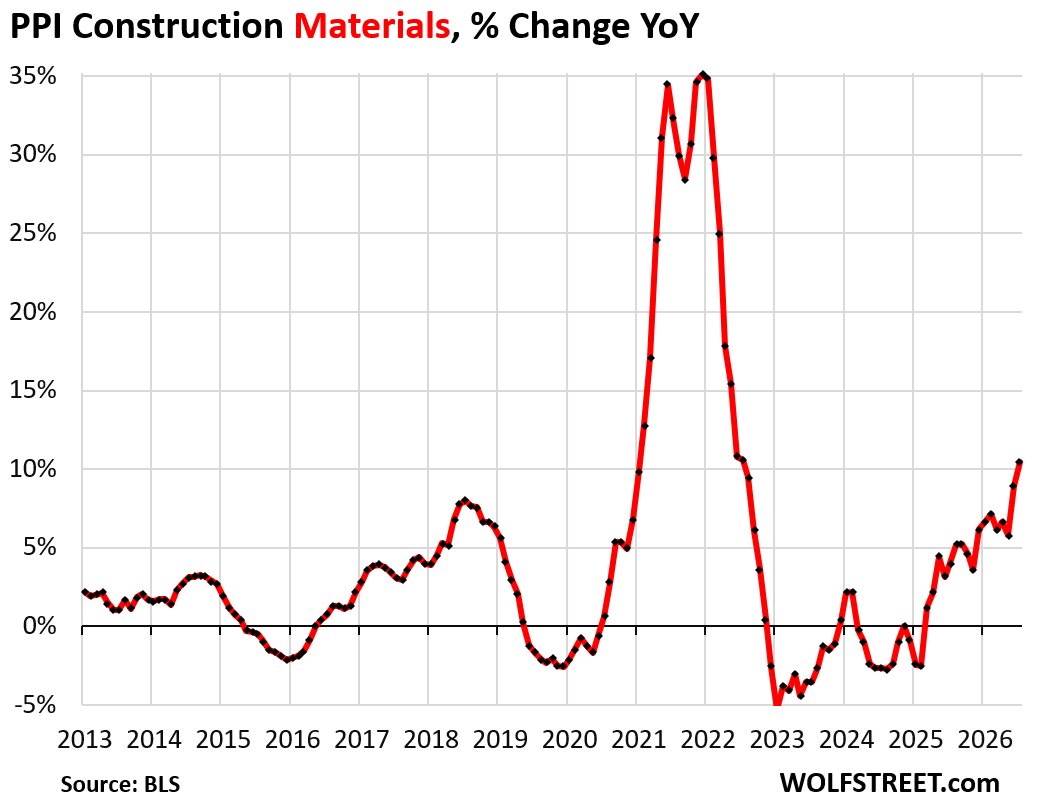
And construction costs for nonresidential buildings in general are surging. The Producer Price Index (PPI) for nonresidential construction services spiked by 7.4% year-over-year in July. And the PPI for construction materials – steel mill products, concrete, lumber, gypsum, etc. – spiked by 10.5% year-over-year, according to PPI data released by the Bureau of Labor Statistics.
The PPI for nonresidential construction services began spiking in March this year, and over the past five months has spiked by a cumulative 5.1%. Compared to a year ago, it jumped by 7.4%. The year-over-year increases in June and July were the highest since July 2022.
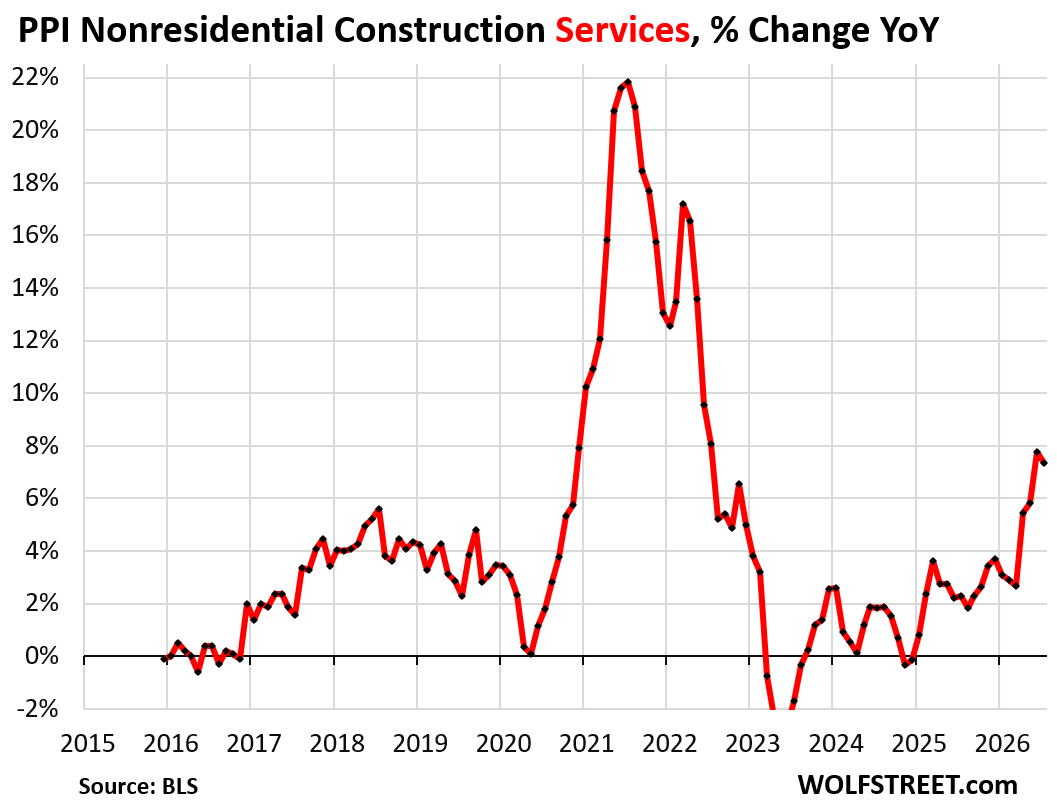
The index tracks domestic prices that one company pays to another company for trade services, transportation, warehousing, architectural engineering, legal services, equipment leasing, etc.
It excludes direct labor costs on construction sites, capital investment (such as purchases of heavy equipment), and imports.
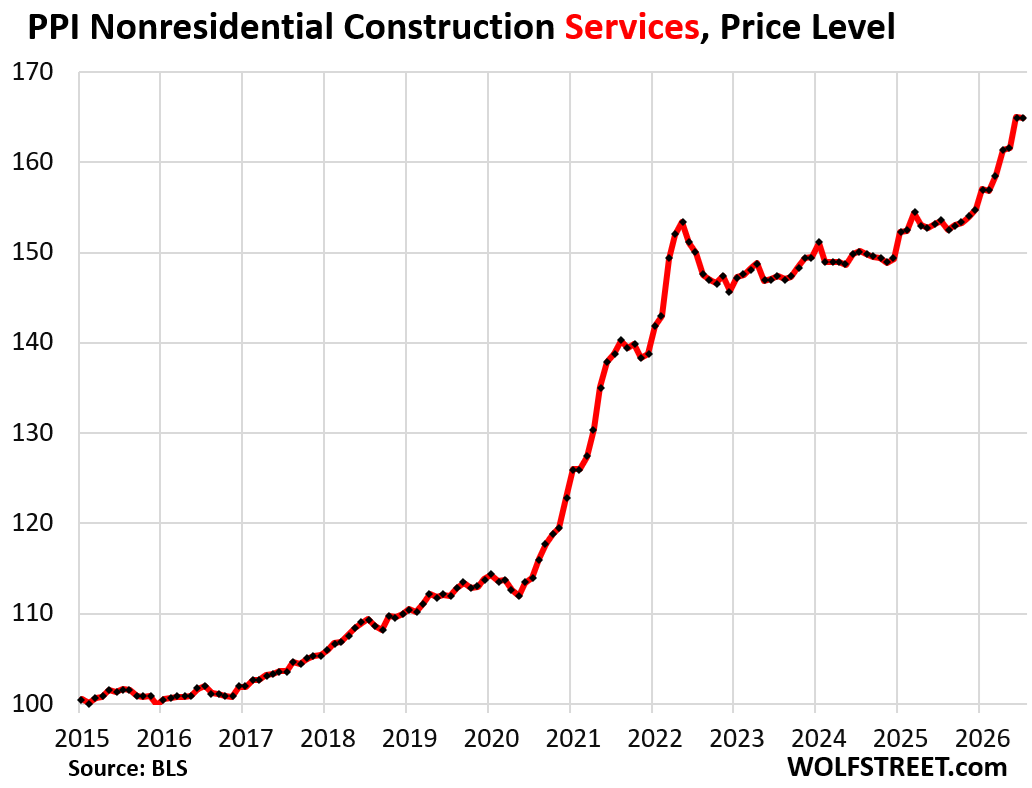
Since January 2021, the PPI for nonresidential construction services has soared by 31%. Since January 2020, it has soared by 44%.
This chart shows the price level of the index, not the percentage change. It shows how the price surge over the past 12 months came on top of already very high prices for those services.
The PPI for construction materials – steel mill products, concrete, lumber, gypsum, etc. – spiked by 10.5% year-over-year, the biggest increase since June 2022. The index tracks the change in selling prices that companies charge each other.
Commercial contracts frequently include contract escalation clauses that cite this index to adjust project budgets based on real-world raw material inflation.
Steel joists and rebar, for example: At the product category level, the PPI for “Fabricated Structural Metal Bar Joists and Concrete Reinforcing Bars” spiked by 17.7% year-over-year. It’s part of the PPI for construction materials.

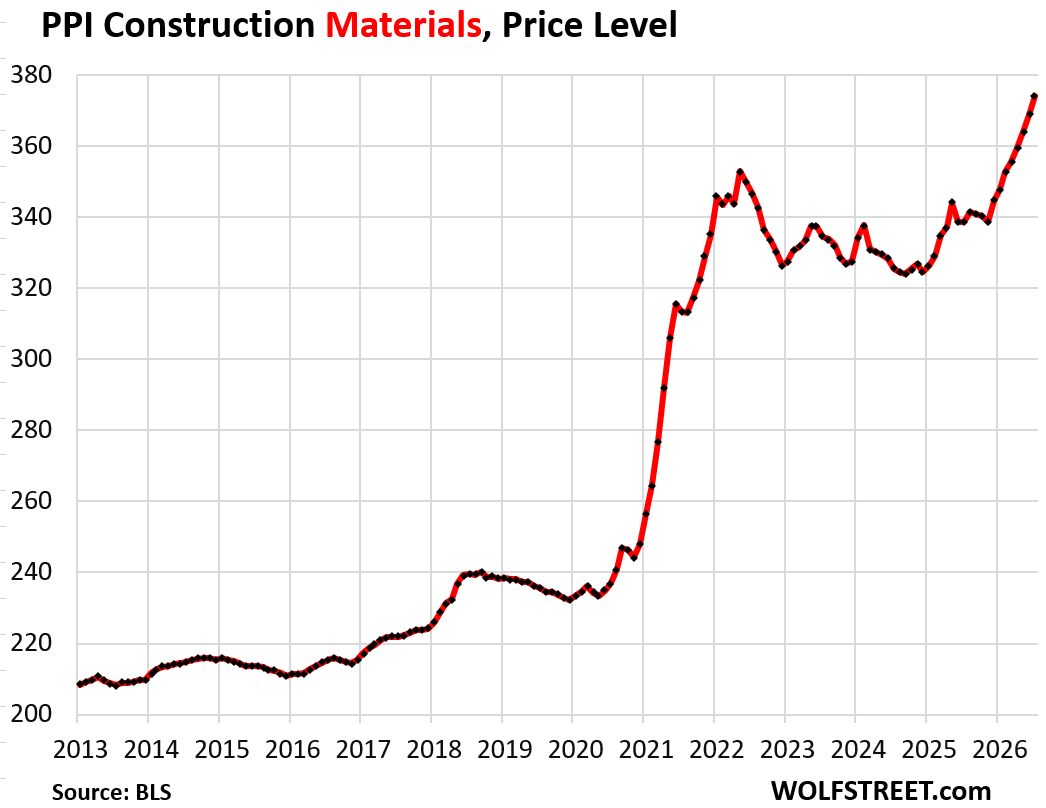
Since the beginning of 2025, over those 19 months, the PPI for construction materials spiked by 15%. Since January 2021, it spiked by 46%. Since January 2020, it spiked by 58%.
This chart shows the price level of the index. The 15% price surge over the past 19 months came on top of already very high prices for those materials.
The PPI for nonresidential building construction – tracks total put-in-place building costs including direct labor, materials, site equipment, services, and contractor overhead – jumped by 5.2% year-over-year.
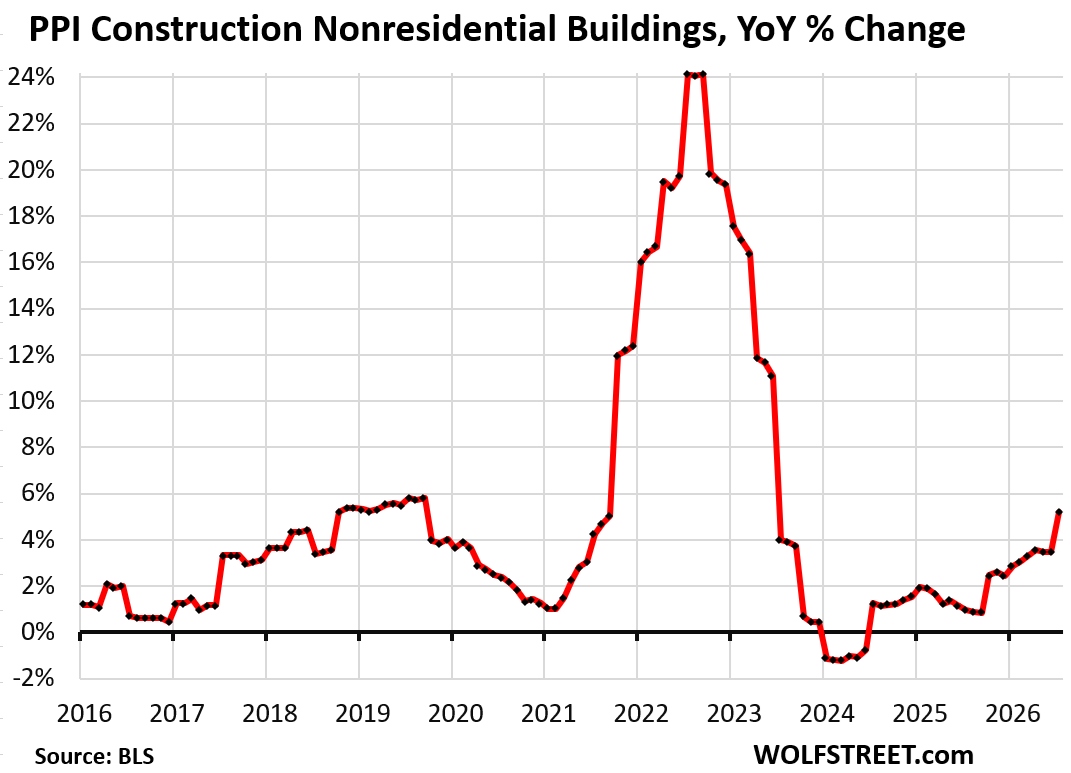
The 5.2% increase over the past 12 months comes on top of already very high prices. Since the beginning of 2021, the index has soared by 45%, despite the breather in 2023 and 2024, after the massive spike in 2021 and 2022.
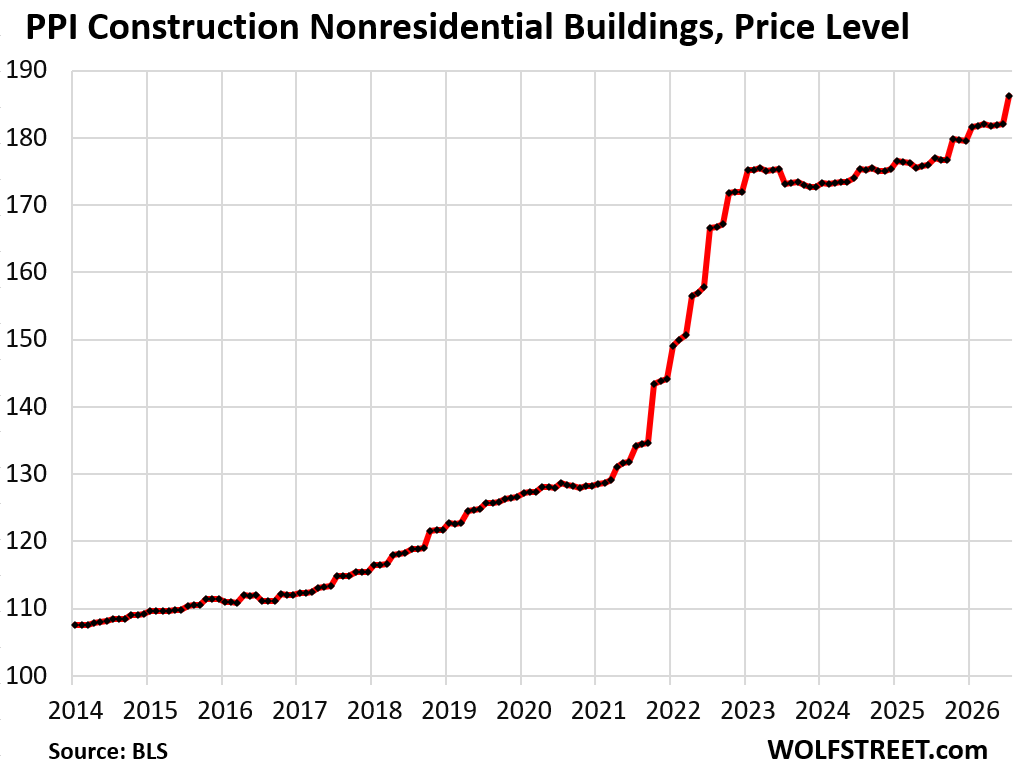
These soaring construction costs are only part of how the massive piles of dollars that are being tossed around as investment in AI infrastructure create inflation across various sectors of the economy.
The PPI doesn’t isolate data centers. These are construction costs for nonresidential buildings in general. The construction boom surrounding semiconductor plants that started in 2022 has had a similar effect. And the construction booms for data centers and semiconductor plants are linked, amid efforts to shift some of the AI-related chip production to the US, and those chip plants are being built.
Enjoy reading WOLF STREET and want to support it? You can donate. I appreciate it immensely. Click on the mug to find out how:


Thank you. I had been wondering why concrete, not so dependent on tariffs and trade, keeps rising so fast. It doesn’t bode well for residential materials or general energy costs with the massive energy requirements of concrete and metals production. What cities and regions have already experienced residential electric bill shock due to these data centers?
Concrete has very high energy inputs. (Steel, too.)
I still don’t get the rush, the revenue vs costs is still negative isn’t it?
And depreciation of the current investments will outweigh any possible revenue in the coming years?
The more they rush the more they flood the nascent market and keep revenues down?
So irrespective of if it’s a thing or not (personally using both image/video and llm stuff locally and cloud for work and hobbies and I think it is a thing, but at this price?) surely the mad rush makes things just bad all round for everyone and the AI industry itself?
Or are they still operating on the basis of AGI any month now fomo?
The rush is to cash in before the anti-DC movement gains political traction.
It will be interesting to see if these big increases in prices and demand will have any impact at all on creating new supply in the construction and construction materials industry. My guess is that the Corporate CEO’s will see this as an opportunity to reach their incentive goals and decide that this demand is not real and therefore defer investment in new, price killing production.
With Tariffs in place, as long as all the US suppliers play along (without picking up the phone to talk to each other), it may be good for a year or 2 of “shareholder value” bonuses
Of course some young entreprenuer may wreak the whole game, assuming he can find anyone to lend him the capital or invest with him, to create new production at lower prices. Assuming, of course he’s willing to jump the regulatory, building code and lawfare hurdles.
Hopefully American enterprise is still alive. We will just have to wait and see.
Current US government is not exactly on the pro-competition side of business policy.
Incumbents are doing well, though, with continued pricing power. (Perhaps an underappreciated source of inflationary pressure.)
American Economic Liberties Project is an interesting group. DC think tank founded around 2020 to promote pro-competition policy.
No one needs or wants data centers.
Using more power and water to make cartoon images is dumb.
The demand for tokens from companies is absolutely staggering, though. 80% of what I discuss with the exec team at work is (1) how to drive business transformation with AI, and (2) how to control the costs of AI inference, training, and providers (OpenAI or Anthropic).
More tokens will require more compute, so more data centers. I’m not sure it will continue, and I wouldn’t risk doing any forecast. But right now, it is crazy.
I found this article to be of concern for corporate bondholders. Not just the buildings, plus the computers inside are sucking up a lot of money as we all know.
What is new is a change in bond underwriting rules that no longer require the originators to hold a stake in the financing. No limit to how much can be raised by bond sales to the public. When the bond bubble pops?…. I predict a bailout but it could hit a LOT of mainstream savers with supposedly safe bond funds.
Overhyped.
They waved the 5% risk retention requirement. These are Asset Backed Securities that are sliced into risk-rated tranches, with the lowest rated tranches taking the first losses and the highest rate tranches taking the last losses. The lowest 5% must normally be retained by the issuer so that the issuer takes the first loss until the 5% is eaten up, then the next lowest tranches eat the remaining losses. What they waved was this 5% requirement.
The reason is that these ABS are from other ABS different. Normally, ABS are backed by financial assets, such as loans where borrowers make interest and principal payments, such as auto loans and credit card balances, and those interest and principal payments get passed through to ABS holders, and these ABS are self-liquidating, and ABS holders get paid by the underlying financial assets (auto loans, etc.).
But these data center ABS are different. They are not backed by financial assets (such as auto loans), but by the cash flow from rents received from a real property, namely the data center’s servers (compute). So this is more like a real estate securitization such as CMBS or MBS that don’t require risk retention either. Same difference.
Will some of them blow up? You bet. I’ve long been reporting on CMBS that blew up, and we’re still here. Investors take risk, and they get paid a yield to take those risks. And when the ABS blow up, the investors lose their shirts, much like they lost their shirts on CMBS.
You remark that 5% is not much and that’s true but my view is it’s the difference between having some skin in the game and none at all. Thus the underwriters can print unlimited bonds. The collateral is the buildings and the hardware inside them but what if/when that value crashes?
The best metaphor is I see myself as the peasant girl sitting on the wall eying storm clouds on the horizon.
Mr. Wolf writes: “The massive piles of dollars getting thrown at AI infrastructure have an effect.” I don’t see anything AI is doing for the infrastructure of its most important consumable; i.e., electric power. The article mentions a shortage of electricians; one could imagine they are all at work on the load side of the electricity.
The AI boom is wreaking equal havoc on the consumer electronics markets so don’t expect your TVs to be cheap for long.
High speed memory is going for 4x of its YoY value and the big chipmakers have already stated that 2027-2028 inventory is spoken for. I’m not sure how much of that is just peacock strutting for investors, but it doesn’t bode well for inflation in the tech sector.
Looks like soaring costs for materials and labor also needed for residential construction.
So Lennar et al are going to have to either raise prices or take a hit to profits.
If anyone has a minute, check out the market caps of some of the specialty construction companies, like Quanta and Emcor, helping to build the data centers. They are going through the roof. Their revenue and profits are increasing, but the stock prices are another level. Of course, they still bought back stock over the past year…
One cost that does not show up in any of these indexes: on data center and plant work the labor is not local, it is traveling crews, and a big slice of their pay is per diem rather than wages. We run a job board for traveling trades workers, and industrial electrician postings right now run $38-45 an hour plus $100-125 a day per diem, paid seven days in a lot of cases. That is a real project cost, but per diem is not wages, so it lands in no wage index at all – and as you point out, the nonresidential services PPI excludes direct site labor to begin with. So the fastest-moving input on these jobs is also the least visible one in the data. We keep state trade wages next to the federal per diem ceilings public if it is useful to anyone.
The real culprit I believe, is the “roll-up” aka PE entering the small biz mkt and buying up mom and pop construction services like roofing, design/build, and yes, concrete. Less choices=higher prices.