
Warsh makes another baby step — as suggested at his first FOMC meeting.
By Wolf Richter for WOLF STREET.
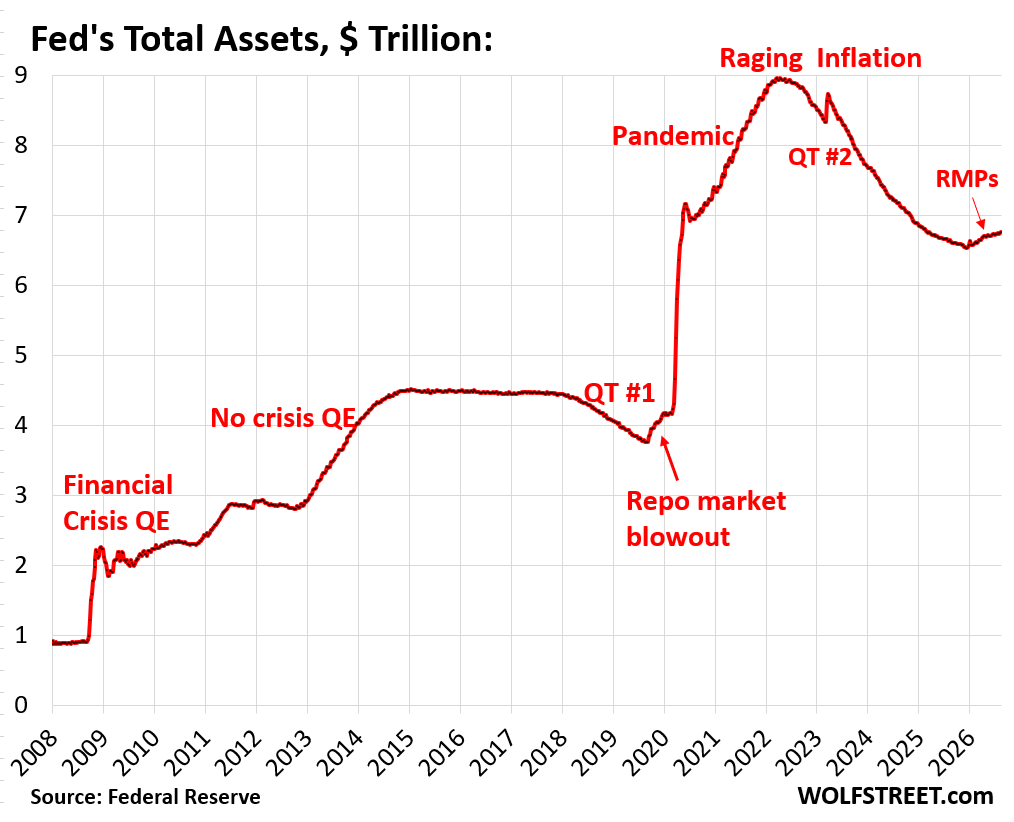
The Federal Reserve Bank of New York announced this afternoon that it would halt Reserve Management Purchases (RMPs) for the period of August 14 through September 14, after having already tapered the RMPs to $10 billion a month, including for the current period through August 13.
RMPs were started in mid-December. Under this program, the Fed purchased $40 billion of Treasury bills (Treasury securities with terms of 1 year or less) in the mid-month to mid-month periods, to increase the reserve balances so that there would be enough liquidity to deal with the liquidity distortions associated with April 15 Tax Day that might otherwise cause repo market rates to wobble.
After April 15, the Fed tapered the RMPs to $10 billion a month. And now to zero.
The possibility of reducing RMPs to zero was among the changes of Warsh’s first meeting as FOMC Chair on June 17.
The sentence in the FOMC’s Implementation Notes (released alongside the FOMC statement) regarding the RMPs was changed to “When appropriate, increase…” from Powell’s version of “Increase…”:
The Implementation Notes under Warsh, June 17:
“When appropriate, increase the System Open Market Account holding of securities through purchases of Treasury bills and, if needed, other Treasury securities with remaining maturities of 3 years or less to maintain an ample level of reserves.”
The Implementation Notes under Powell, April 29:
“Increase the System Open Market Account holdings of securities through purchases of Treasury bills and, if needed, other Treasury securities with remaining maturities of 3 years or less to maintain an ample level of reserves.”
This could be Warsh’s first baby step, the least controversial one, to rein in the Fed’s balance sheet. Monetary policy decisions have to be made by vote of the 12 voting participants on the FOMC, and he appears to be struggling to build a majority for anything other than maintaining the status quo.
These RMPs have increased the Fed’s balance sheet, which has risen to $6.76 trillion as per the balance sheet released today.
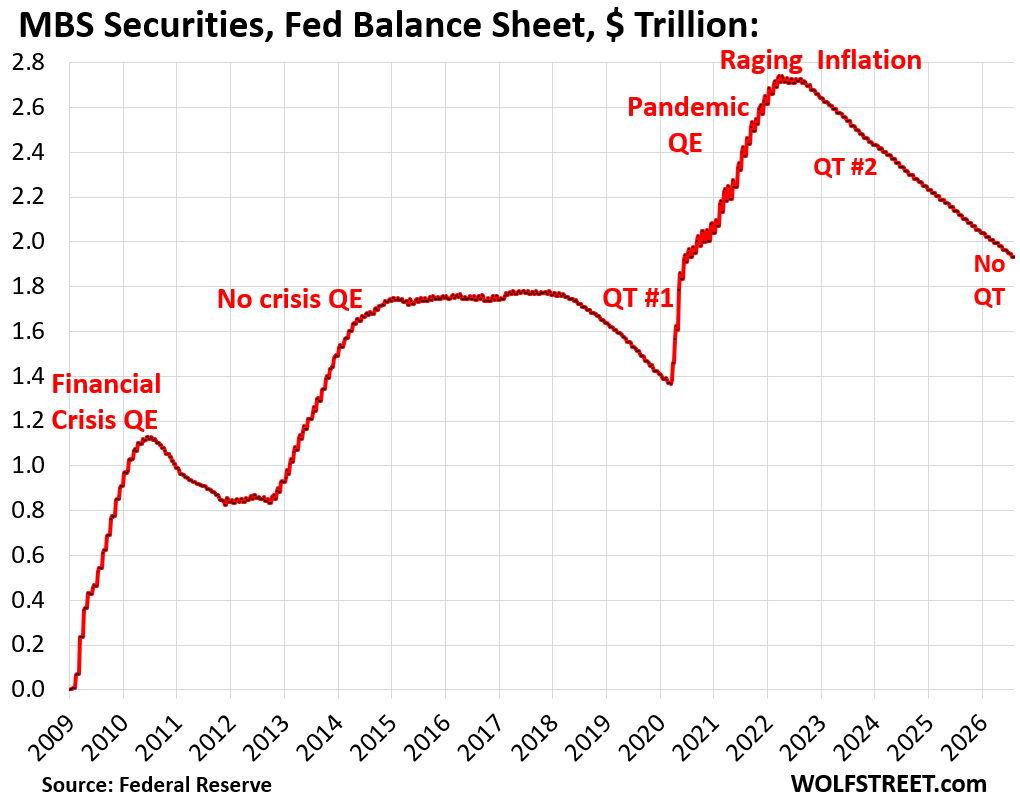
MBS will continue to run off the balance sheet on automatic pilot and be replaced with T-bills, the New York Fed reiterated this afternoon.
MBS come off the balance sheet mostly via passthrough principal payments when the underlying mortgages get paid off or get paid down, and the pace depends on the mortgage market and is difficult to predict. Since mortgage rates have risen, causing mortgage refinancing volume to collapse, the flow of mortgage payoffs has slowed, and the MBS runoff has become a trickle, mostly between $15 billion and $18 billion a month. The Fed no longer caps the runoff of these MBS. But the runoff amount is replaced with T-bills.

The Fed estimated that the MBS runoff during the August 14 through September 14 period will be about $17 billion, and that it would therefor purchase $17 billion in T-bills during that period to replace those MBS.
With this process, the Fed is removing long-term securities from its balance sheet and is replacing them with short-term securities.
Since the fall of 2022, the Fed has reduced its holdings of MBS by $809 billion, or by 29%, as of the balance sheet released today. The Fed only holds government guaranteed “agency” MBS where the taxpayer takes the credit risk.
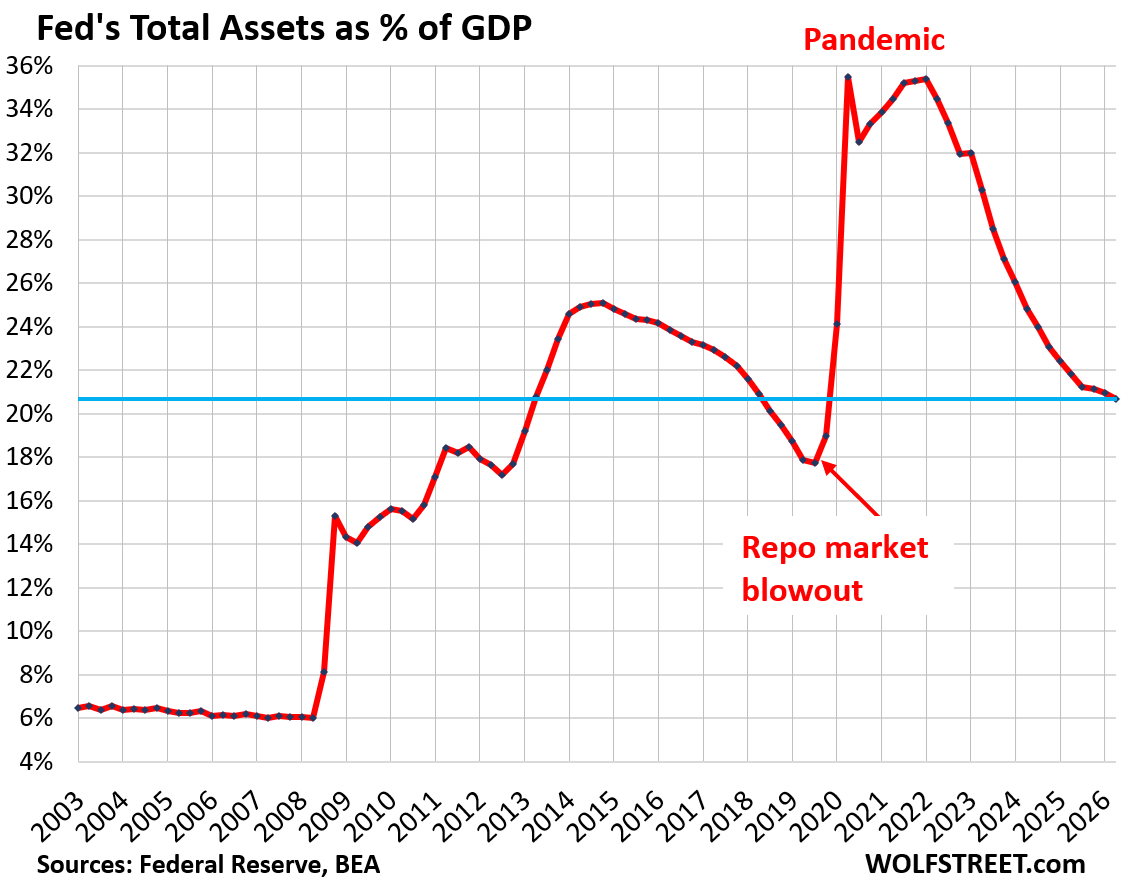
Compared to GDP: The ratio of the Fed’s total assets to GDP has continued to decline, despite the RMPs, but the RMPs slowed the decline of that ratio. At the end of Q2, the ratio of total assets to GDP dropped to 20.7% of Q2 GDP.
Enjoy reading WOLF STREET and want to support it? You can donate. I appreciate it immensely. Click on the mug to find out how:


I thought the average maturity of a lot of MBSs was around 10 years, so shouldn’t a lot of the early stuff be coming off soon?
Agency MBS have terms of 15 years or 30 years. They’re self-liquidating via passthrough principal payments. When they get to the end of their 30-year term, there would be nothing left to mature since all the underlying mortgages would have been paid off and the remaining balance of the MBS would be zero. So MBS get called after they self-liquidate below a certain level, and the remaining mortgages in the pool get repacked into new MBS. This call feature is also a way by which the Fed’s holdings of MBS shrinks, but it has been a small factor.
Most MBS that the Fed now holds were issued during the refi boom in 2020-2022, when the Fed bought something like $110+ billion in MBS a month in part for QE and in part to replace the existing holdings of MBS that got wash out due to the tsunami of refis.
Thanks for a very clear and through explanation! That’s why I keep reading.
Imagine the paper losses on all those mortgages in the 2-4% range (I know it doesn’t matter to the institution that prints money).
But if the Fed is rolling (selling) these old low-rate MBS into higher rate MBS, they are taking a capital loss, right?
Thus, unless these are marked to market and the Fed only buys MBS with what they received from the sale, the Fed would have to spend more money to buy the new MBS than they received from the sale of the old ones, right? And would this constitute QE?
Chris B.
The Federal Reserve is fine with holding toxic MBS assets & losing trillions…
But God forbid if their Wall Street banker buddies lose a penny.
Instant tears & teeth nashing.
The Feds main job is to support Wall Street. If main street dies of a ponzi AI scam, it’s fine with that. In fact the Fed might find that mildly entertaining.
CPI & U1-U6 duties are relegated to Federal Reserve propaganda unit deep inside the Eccles bldg.
I refuse to take any of this serious anymore. It’s been comedy hour ever since they started QE.
I must laugh or I might cry.
I’m trying to buy a house in 6 months from now.
So, do we expect MBS prices to rise or fall based on the increases runoff.
The MBS runoff has been and continues to be between $15 billion and $18 billion a month. That’s not changing.
What changed is the RMPs — there won’t be any in the period from mid-August to mid-September.
The MBS runoff has the effect of widening the spread between Treasury yields and MBS yields, and therefore between Treasury yields and mortgage rates. But Fannie Mae and Freddie Mac have started buying back their own MBS, and they’re funding those purchases by selling their holdings of Treasuries and using their operating cash flow. This has narrowed that spread, but it looks like it might have pushed Treasury yields higher – so a narrower spread off a higher Treasury yield. The net effect? No sure. We do know that that mortgage rates are now higher than they’d been when they started this.
I’m pretty sure you did this before, but the only major Central Banks with fewer assets as a percent of GDP than the Fed are Canada and Australia. England is similar, India and Europe are quite a bit more, and China, Switzerland and Japan are 3-5x more.
I’m not seeing a strong correlation between this number and economic health or inflation.
The supply of money is structurally connected with the price level. The growth rate of the money supply is connected with the growth rate of the price level. The assets of the central bank as a percent of GDP are connected with the price level. The growth rate in the ratio of central bank assets to GDP is connected to the growth rate of the price level. Inflation is not connected to the stock of money or to the ratio of the stock of money to GDP. Inflation is connected to the rate of growth of the money stock and to the rate of increase in the ratio of money stock to GDP.
Rudy, you say
“The growth rate of the money supply is connected with the growth rate of the price level. ”
” Inflation is not connected to the stock of money”
I assume you use “stock” to mean supply.
Could you square those two declarations?
Also, regarding the first quote, Powell said we must “unlearn what we know about M2” in March or 2021….just before a spiking inflation hit.
Conceding that M2 is not a perfect metric, it still is a measure of money supply, hence the “M”.
$40 TRILLION IN DEBT…
Interest Tops Defense…
Treasury market facing reckoning?
US sells 30-year at highest borrowing costs since 2001…
Those yields are still way too low to be attractive imho. 5.2% sounds good, but 30 years of inflation is a long time.
AI might cause deflation – may be in 10-20 yrs from now
Buy TIPS?
IMHO buying anything TREASURY offers is losing proposition
with REAL inflation(devaluation fiat $dollar) exceeding 10% annually
interest rates on Treasuries never keep up
real surprise is coming fast as I hear fat lady practicing
let’s see what sept/oct does with oil prices
will china magically buy buy buy oil at $150 barrel in oct to help with grifters in CONS gress election surprise
Maybe, but only the short durations. Reaching out further creates too much interest rate risk. Look at the chart of the ETF TIP between 2021 and 2023. And that happened with only intermediate duration. And that scenario was exactly what people were buying TIPS for! Consider STIP instead.
joididee
How long do you want to be in the stock market with
Ukraine/Russia
China/Taiwan
Iran/US/Israel
and Trump declaring the straight of Hormuz a US Territory? Imagine if China had done similar.
Japanese yen propped to dissuade then selling treasuries.
Sept historically a bad month for stocks.
Mid term mayhem likely, and impeachment to follow.
And if the Dems take Congress, watch for higher capital gains taxation etc.
Homebuyer Demand Drops to Record Low…
Today’s young adult generation will come to see a massive mortgage as a burden, just like student loan debt or credit card debt.
They’ll see the big 3 and 4BR detached houses behind gates and call them GenX housing, completely impractical in a world where mobility and keeping expenses low are the most important things. Meanwhile, those big, cheaply built houses will become increasingly run-down as GenX moves into their 60s and 70s, just a the neighborhoods built by the Boomers are now becoming ghettos.
This is probably a simple question with an obvious answer, but if the Fed replaces MBS with short-term treasuries, does that not decrease the yield of their investment? Put another way, I see the liquidity appeal of replacing long-term securities with short-term securities, but aren’t MBS more valuable yield-wise?
The Federal Reserve never tries to ‘maximize yield’ and is essential a not-for-profit banking corporation which rebates around 94% of any profits back to the US Treasury each year. Its 12 member FOMC (Federal Open Market Committee) makes interest policy rate decisions government 5 interest rates for the purpose of attempting to manage inflation or employment in the US economy.
The Fed gobbled up most of its MBS debt when mortgage rates were around 3%. Short-term notes today are above 4%. They are actually increasing their yield mix.
Regardless, The Fed doesn’t care about generating income, that’s never been its purpose and it can create unlimited money anyways.
For the same reason, The Fed has no sense of “liquidity appeal”. It is the ultimate liquidity -PROVIDER- with its power to conjure unlimited money instantly.
The obese balance sheet of the Federal Reserve Bank, chartered to be the very beacon of financial probity, is suspected of being something other than that
the invisible hand of concentrated wealth
It seems like Warsh wants to know liquidity/sensitivity and what the market really wants. The RMPs reduction may help provide it.
I’ll tell ya what the market wants. More land, labor, and capital—all on the cheap. Markets flourish with abundance. More more more.
The delicious backdrop to this drama is the most expensive markets in history
Those charts all get “wonky” around 2009+/-, I trust my disdain for Bernanke is well placed…
Maybe it’s time to try and sell my “Thomas Hoenig was right” t-shirts with the Eccles building as a back drop.
Thanks as always for the information and insight
Hoenig and Warsh both quit the Fed in protest over QE-2.
Hoenig reached mandatory retirement age.
Hoenig was a clear thinking realist from outside the Washington DC bubble.
His post was a lonely station. He did not swim with the other ducks.
@Wolf – Warsh quit over QE2 ? I strongly suspect he is a fake hawk. A trickster. I am trying to dig deeper into this guys past. I dont know how much I can dig. I aint a 3 letter org.
One thing worth noting is that he is the son in law of Ronald Lauder who was a bud of Jeff the PDFfiles guy (not pdf space files). Would the international wars for pdf boya clients need money printing at some time? If yes, then Warsh might have to oblige, especially if he has been in the Jeff files himself. Currently, the Jeff file has only one mention of Warsh which does not prove anything. Gotta keep digging.
“Warsh quit over QE2 ? I strongly suspect he is a fake hawk. A trickster. I am trying to dig deeper into this guys past. I dont know how much I can dig. I aint a 3 letter org.”
All you have to do is read his speeches from back in the day about it, and Bernanke in his book even alluded to the conflict with Warsh. Why Warsh quit the Fed is well-known. Here is a speech by Warsh from 2018 about why he quit the Fed, what he thinks about the balance sheet, etc. I’ve linked it before and discussed it. Just because you didn’t read it, doesn’t mean it doesn’t exist.
https://hoover-s3-website.s3.us-west-2.amazonaws.com/s3fs-public/research/docs/aei_remarks_june_7_2018_warsh_final_for_distribution2.pdf
I get really tired of people posting homemade BS into the comments. The comments are not a convenient disposal bin for homemade BS.
Finally!! Welcome Warsh led FED’s baby step in bringing down balance sheet. On grand scale of QE, those RMPs were small amounts but still they were steps in wrong directions.Those RMP reversed most of QT done in 2025. Good to see FED stopping it now.. even though it said only for month.
Good work Wolf, I follow Fed reporting and didn’t, still waiting, see this move by Warsh.
Glad to see Warsh is following his view on the Fed’s balance sheet
This is the best sign yet that Warsh actually means business.
You’ll have to explain that one to me. Wolf explains it as a routine wind-down of a liquidity enhancing tactic around tax day.
Will Warsh remain a heroic inflation hawk if this tactic is repeated early next year?
Talk is cheap. Let’s see what actually happens.
It’s the -only- sign that Warsh “means business” (if the business is restrictive monetary policy)
otoh, Warsh voted to leave rates unchanged, and is sustaining the buy-treasuries-to-replace-expiring-MBS policy.
Like I said many times here, a Fed chair cannot dissent.
A Fed chair who dissents on a monetary policy vote is finished. They’re finished with Wall Street, they’re finished with their own colleagues, they’re finished globally, they’re finished with the credibility in being able to accomplish a majority.
There was only ONE Fed chair that ever dissented: Marriner Eccles, at the meeting in December 1938. And even he did NOT dissent on a current monetary policy decision but on a vote on structural changes to the Fed’s balance sheet.
That’s just how it is. I have replied to this nonsense about Warsh not dissenting many times. People need to wrap their brains around it and stop trolling my site with this line.
What does finished with Wall Street and globally mean? Why should someone on the Fed care about Wall Street and whoever else globally that is aligned with wall street, especially since what wall street wants seems in opposition to what’s good for average Americans. This is why the Fed should be abolished. Their interests are clearly not what’s best for average Americans if they serve wall street.
But then you have the majority of Republican voters in Kentucky voting out Massie who started a bill to abolish the Fed:
https://massie.house.gov/uploadedfiles/fedresboardabolitionact119.pdf
So, inflation and serving wall street’s interests should be no surprise to them.
“What does finished with Wall Street and globally mean? Why should someone on the Fed care about Wall Street and whoever else globally that is aligned with wall street,”
You need to think this through a little. A dissent accomplishes absolutely zero. The majority changes monetary policy. The dissenters have zero power and don’t matter. They’re amusing to listen to, but they don’t matter. The majority has ALL the power. If Warsh dissents, it accomplishes nothing. But he will ruin his power to effect change. To effect change, he needs to build a majority on the FOMC for his views, and that takes time, and he needs to be seen as someone who can build a majority, and signaling with a dissent that he is incapable of building a majority would be the end of his ability to build a majority, and he might as well quit. That’s just how it is. It doesn’t matter how you and I feel about it.
In terms of abolishing the Fed, Massie isn’t the first one to propose such a bill. That has been going on for many years. Ron Paul introduced such a bill in 1999. But they’re all just jacking off. They know exactly that this is just grandstanding and that nothing will ever come of it. So it’s safe to propose such a bill. They need a majority in Congress to abolish the Fed, and there isn’t even a minuscule minority in Congress willing to vote for that 🤣💔
You’ve made it clear your belief that Warsh wants to raise rates but is simply too incompetent to get it done.
Meanwhile, Warsh’s boss keeps telling the press that Warsh secretly wants to lower rates, but is too incompetent to get it done.
Does it really matter which mind-reader is correct, when both explanations end up at the same result?
This is Great News!
The Fed counts on the fact that the average American does not know the difference between real and nominal yields. The Fed has (quite intentionally) been behind the inflation curve since Greenspan took over.
RISK is finally being repriced globally. Slowly at first, then all at once…
Hedge accordingly.
The fact of the matter is this – the twelve members, including Mister Chairmen are but twelve little dwarfs trying to stop an avalanche. Kinda like toothless tigers.
>>the twelve members, including Mister Chairmen are but twelve little dwarfs trying to stop an avalanche.
13 people *created* the avalanche of inflation in the first place, poushed by Wall St.
Honestly feels like everything will be status quo or meh, at least in the US. Not suggesting that is good or bad but feels like most things are locked in with little meaningful predicted change ahead.
Not saying some of the predictions around misc ongoing conflicts or AI won’t weigh in but if anything things have been resilient in the US. I honestly don’t even think an AI bubble would be that significant, just a reallocation of capital gains into different areas. Nobody likes $4+ gallon gas but with a K shaped economy it probably doesn’t move the needle except on the people it impacts most.
Feeling like I could go into a slumber for 6 months and just wake up and wonder what happened it midterms, which probably would just match what I expected.
@Wolf – I guess the FED could sell MBS to get them off the balance sheet. I dont know if they have the desire to do that. What would the impact be if they started selling those MBS in mass?
PS – I wonder who will buy the fed mbs, especially if their yields are lower than recent mbs (last 2-3 years). At a discount maybe i.e. higher yields than current mbs. Then new mbs issues would have to match that higher yield. Would that force banks to raise the mortgage rates? BTW, I am not a professional at this stuff. Just picked up bita here and there.
MBS are currently coming off the Fed’s balance sheet via passthrough principal payments at a rate of $17 billion a month.
If the Fed wants to speed up the process, it can sell its MBS at market prices. The MBS market is huge and liquid, and the Fed has been selling MBS regularly as part of its “small value exercises” (something like $70 million each time) to keep its trading system operating, and it’s working fine. The price is the market price. MBS that the Fed bought in 2020-2022 would sell at a substantial discount (loss to the Fed), thereby converting an “unrealized loss” already disclosed on its financial statement, into a realized loss. But the Fed doesn’t care about losses.
By the Fed stepping away from MBS market in 2022 (when it stopped buying them), the spread between mortgage rates and Treasury yields has widened. If the Fed wants to sell lots of MBS, it would widen the spread further. A wider spread translates into relatively higher mortgage rates.
But the Fed doesn’t have to do that. MBS are self-liquidating and are callable, and when the remaining mortgage balance in the pool gets too small, the GSEs will call the MBS and they then come off the balance sheet entirely. This will take years on autopilot before that the last MBS are gone from the balances sheet. And there would be no losses at all for the Fed.
Clearly, J Pow is the hero in all this! The biggest reduction of the balance sheet in history! (Just don’t ask how it exploded in the first place!).
See what I did there? Aaaand, that’s how the books are written.
There was a cartoon in the New Yorker a while back showing a couple of bank robbers standing outside of an abandoned building. One said to the other, “all we have to do is wait around, and it will eventually open up as a bank”. Mortgage backed securities are one of the main reasons there are so many banks. So easy to make loans and avoid risk by pawning them off to investors. This of course is one of the main reasons for the 2008 financial crisis.
Banks? 🤣💔 No, the largest four mortgage lenders by the number of mortgage originations are nonbanks. Combined, those four nonbank mortgage lenders wrote 1.08 million mortgages in 2025, of about 5.4 million total mortgages. Thousands of smaller nonbank lenders, banks, credit unions, and thrifts carve up amongst each other the remaining mortgage originations.
But they all sell mortgages to the GSEs, which securitize them into MBS.