
Auto loan balances, average amount financed, loan length, credit score, debt-to-income ratio, and delinquencies from subprime to prime.
By Wolf Richter for WOLF STREET.
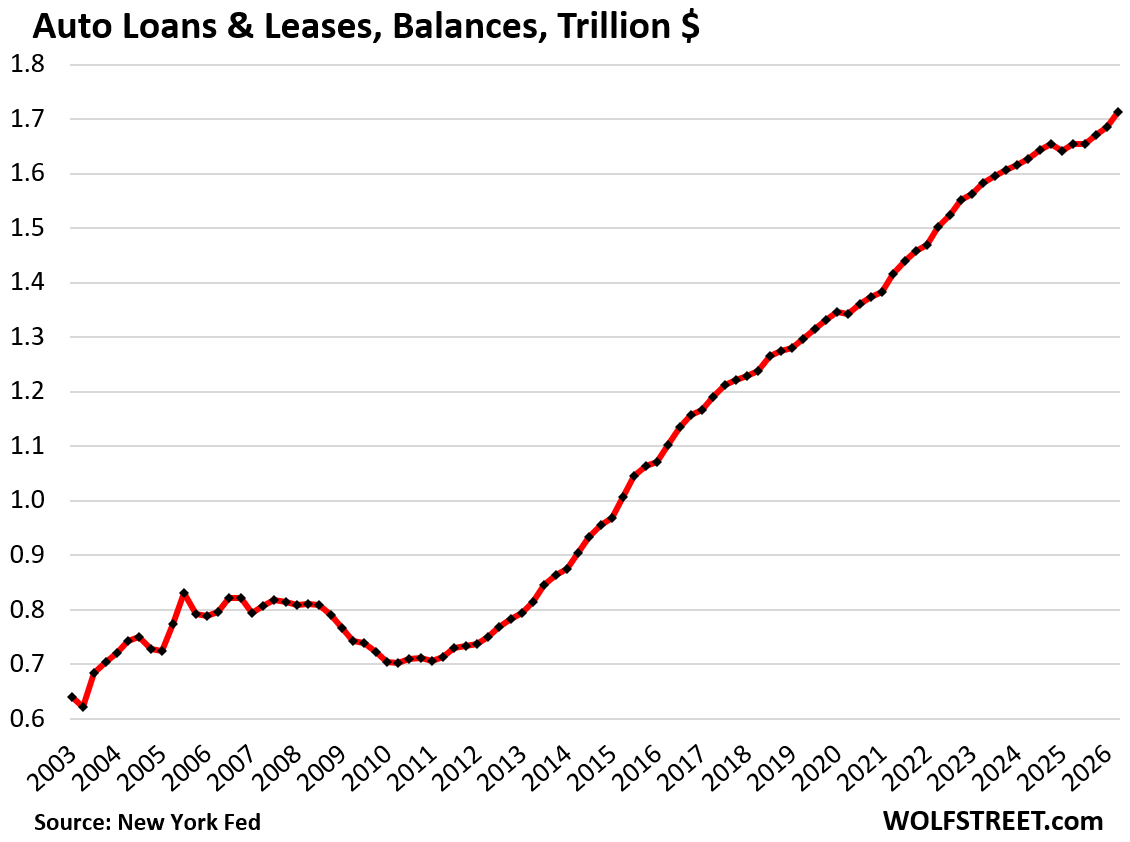
Loan and lease balances outstanding for new and used vehicles rose by $28 billion in Q2 from Q1, and by $58 billion (+3.5%) year-over-year, to $1.71 trillion, according to the New York Fed’s report on consumer credit, based on Equifax data.
Auto loan balances rose over the years with vehicle prices as automakers kept going upscale with bigger, fancier, and more advanced vehicles. Balances also rose as vehicle prices spiked during the high-inflation years and chip shortages of 2020-2023.
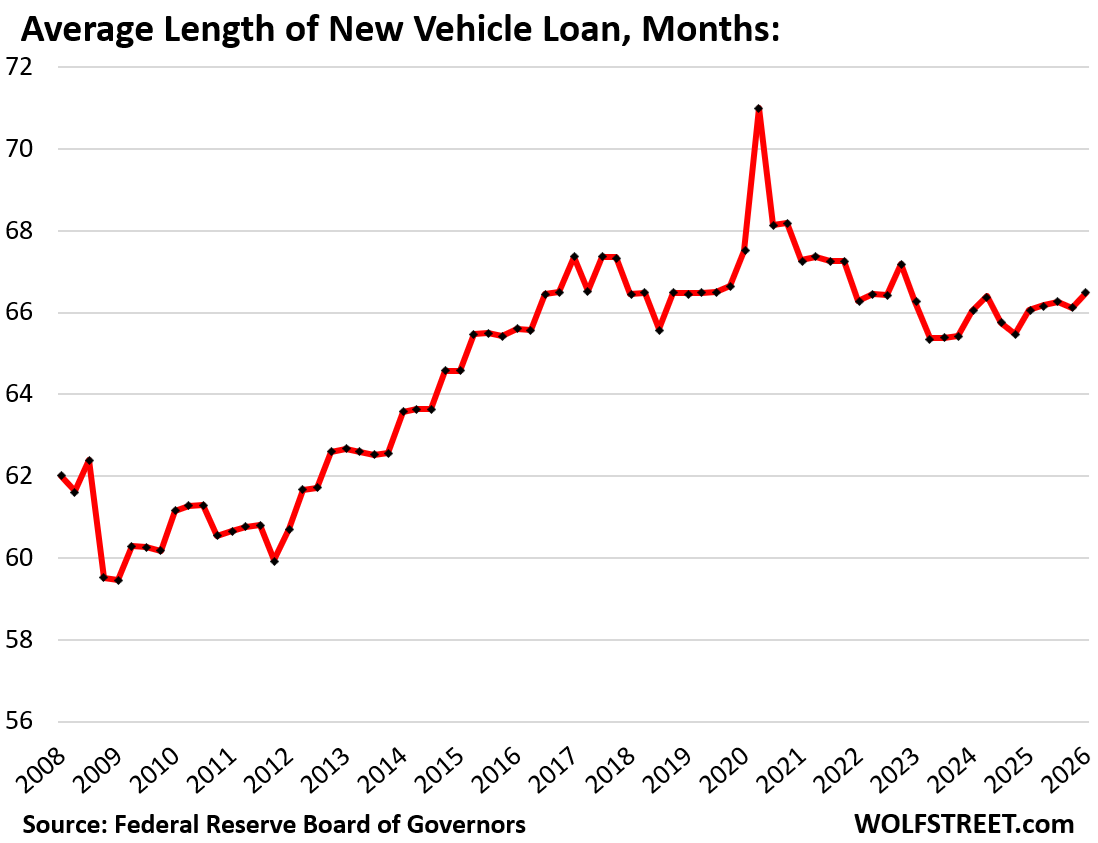
But two factors did not contribute to rising loan balances: Vehicle unit sales have remained below the levels before the pandemic, and the average length of new vehicle loans was where it had been a decade ago and shorter than in 2020.
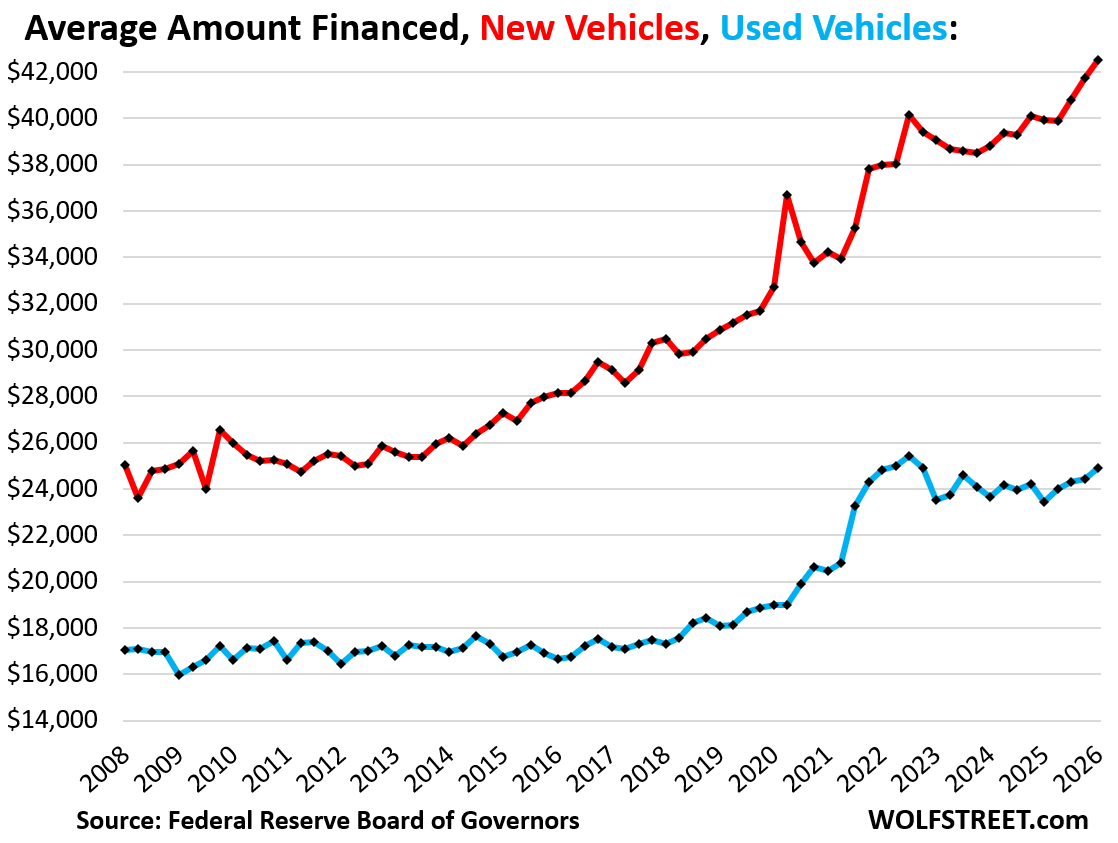
The average amount financed for new-vehicle loans soared to a record $42,500 (red line in the chart below), as automakers continued to go upscale.
US legacy automakers, in their infinite Wall-Street-inspired wisdom, killed off most of their sedan models even before the pandemic and handed that lower-priced market segment to foreign brands. Luxury 4X4 Crew Cab pickup trucks with a $100,000 sticker, that’s what Ford now wants to sell. And Americans are loving them and are buying them. And it pushes up the loan balance and the average amount financed.
For used vehicles, the average amount financed had peaked at the end of the 50% price spike during the pandemic. Used-vehicle prices have declined from that peak, and the average amount financed, at $24,900 remains below that peak, according to data from the Federal Reserve Board of Governors for Q1 (blue line).
The average loan length for new vehicles ticked up to 66.5 months, a level it first reached a decade ago, in 2016, but that was down from the free-money pandemic peaks.
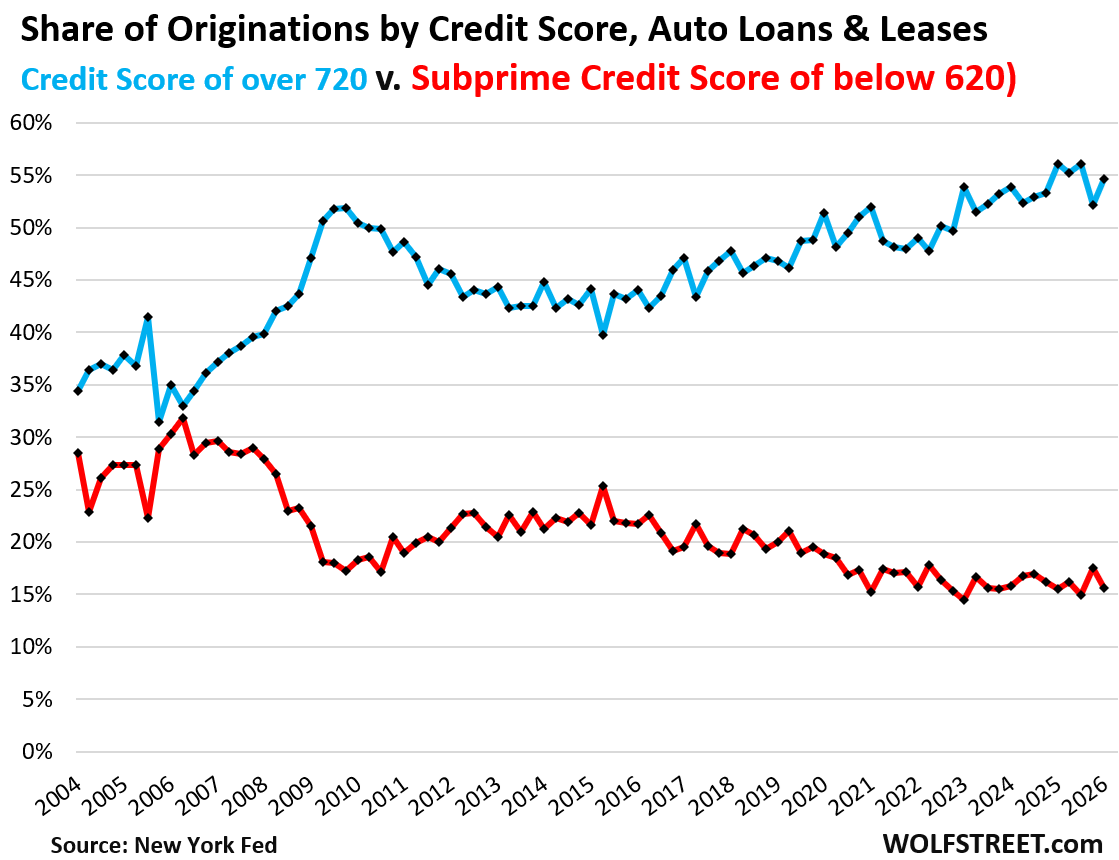
Auto loans by credit score: Of all auto loans and leases originated in Q2, a near record-share of 54.6% were made to borrowers with a prime credit score of 720 and higher. The record in the data was set last year at 56.1% (blue in the chart below).
The share of subprime originations dropped to 15.6% in Q2, after hitting record lows last year (red). In the years before the pandemic, the share of subprime originations ranged from 20-22%. And it was higher still before the Financial Crisis.
Subprime means “bad credit,” not “low income,” a history of not paying bills and obligations. The young dentist that got into it over his head is a classic example of a high-income borrower with a subprime credit rating. They’ll get it worked out eventually. Subprime is not permanent.
Subprime lending is a high-risk-high-profit business, often conducted by specialized dealer-lenders that securitize the loans and sell them as asset-backed securities to bond funds, pension funds, etc. Subprime borrowers pay very high interest rates and often pay a lot more for their vehicles, than prime-rated customers, and default rates are huge, but so are the profits on the loans and the vehicles, and the credit losses are part of the cost of doing subprime business. Periodically, some of these subprime-specialized dealers implode, and some have recently, which is why the business is high-risk.

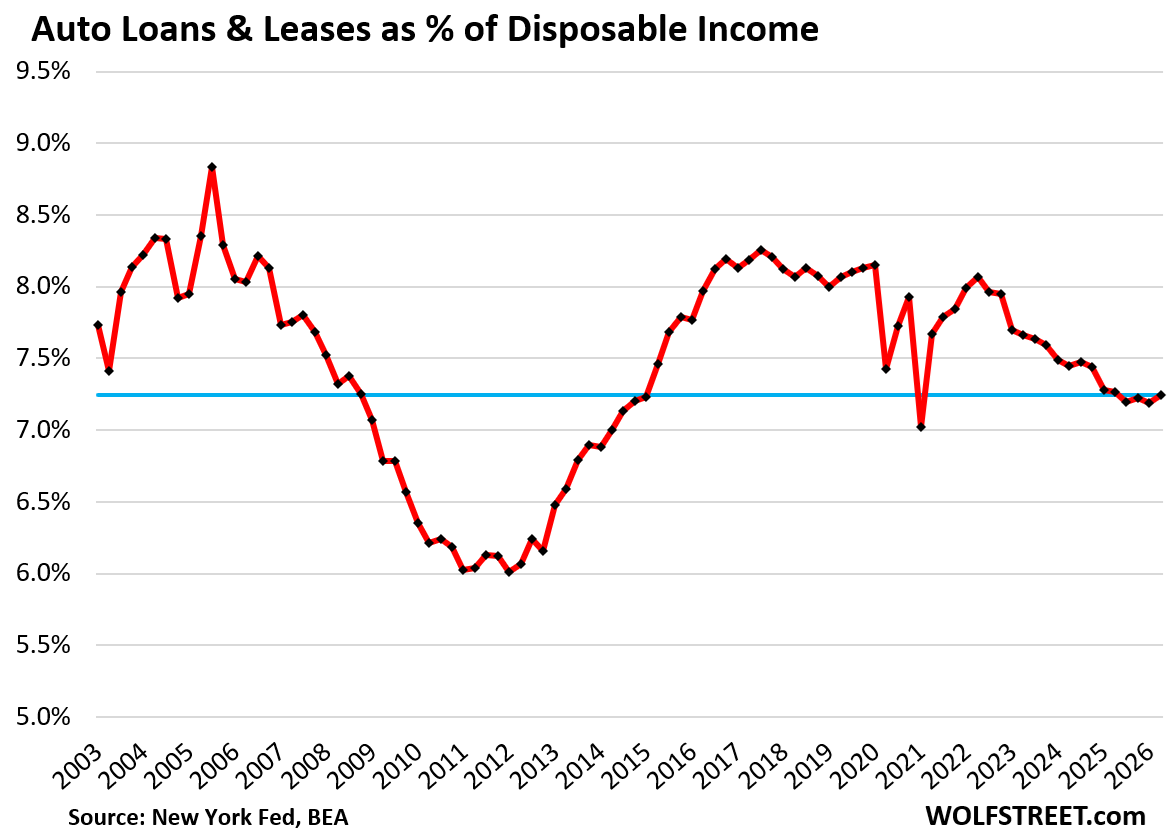
The aggregate burden and credit risk of those auto loans can be evaluated via a debt-to-income ratio. For household income, we use “disposable income,” released by the Bureau of Economic Analysis.
Disposable income consists of after-tax wages, plus income from interest, dividends, rentals, farm income, small business income, transfer payments from the government, etc.
But it excludes capital gains, which is where the wealthy make most of their money. Excluded are thereby income from stock-based compensation plans and capital gains where billionaires make their billions.
Disposable income has grown over the years because the number of households has grown over, and the income per household has grown, and so total household income has grown – and it turns out it has grown about as fast as auto loans, with some ups and downs in between.
The auto-loan-to-disposable income ratio in Q2 ticked up a hair to 7.25%, right in the middle of the sine-wave of the past two decades.
Delinquency rates: overall, subprime, and prime.
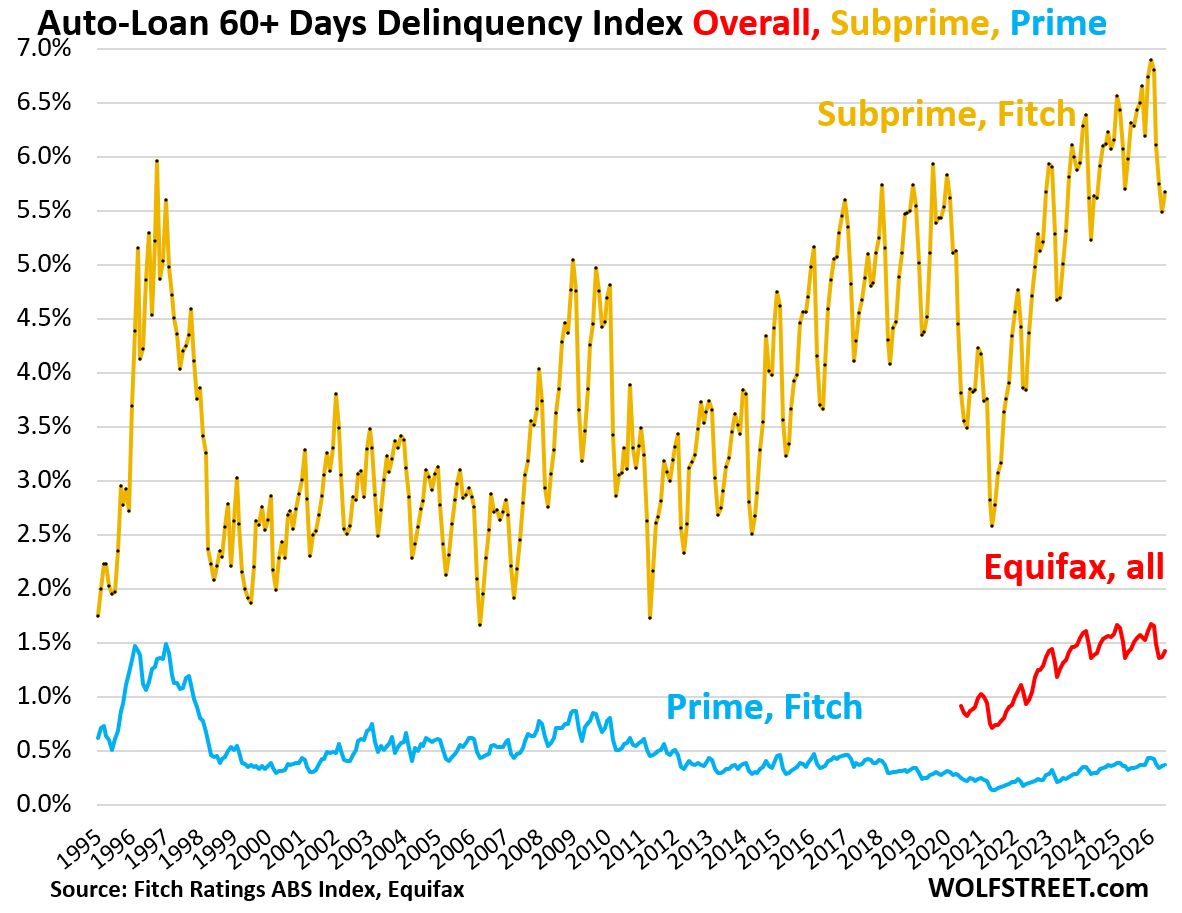
The 60-plus-day delinquency rate for all auto loans and leases, at 1.42% in June, was down by 2 basis points year-over-year, according to Equifax (red in the chart below).
The available monthly Equifax data only goes back to 2020, the free-money era when delinquency rates dropped to ultra-low levels. The increase since then is from those ultra-low levels. We lack the comparison to the pre-pandemic normal years.
The 60-day-plus delinquency rate of subprime auto loans ran at record highs starting in 2023, as a number of subprime dealer-lenders imploded – including Tricolor under a mushroom cloud of fraud allegations and some PE-firm-owned dealer-lender chains. Many of their customers stopped making payments at that point. Delinquency rates are seasonal, and January is the high of the year. In January 2026, the delinquency rate was a record 6.90%, up by 34 basis points from January a year ago. But the delinquency rate has improved this year and started running below year-over-year levels.
The subprime delinquency rate in June, at 5.67%, was down by 64 basis points year-over-year, according to Fitch Ratings, which rates these ABS (gold in the chart).
The 60-day “Prime” delinquency rate was a pristine 0.37%, according to Fitch, which tracks prime auto loans that were securitized into prime ABS (blue in the chart). Prime-rated auto loans are nearly always in good shape.
And in case you missed them:
Enjoy reading WOLF STREET and want to support it? You can donate. I appreciate it immensely. Click on the mug to find out how:


Any thoughts on why the delinquency rates are seasonal, why Jan. Is the high ?
Consumer bankruptcies are seasonal too. Lots of stuff is seasonal for strange reasons. With a 60-day delinquency rate, a January peak doesn’t even line up neatly with the post-holiday blues, though it may have something to do with it.
I was just curious.
Long story short… who knows, and probably why should I care… haha
Thanks
It is possible they planned ahead to skip payments and save for the holiday expenses. YOLO and especially when you feel you are sinking, few inches or feet above your head doesn’t matter.
Blame the weird cultural tradition of buying xmas presents.
Probably because someone wants to book the write-down “next year.” It’s possible also that there’s some bad press about hurting families during the holidays, etc. But I would guess the former rather than the latter.
All the financiers window-dress before year-end, but they’re not putting off write-downs? – unlikely.
Perhaps historically people manage to scrounge up money and get current on their auto loan obligations over the holidays – gifts from rich uncles, bonuses from work, etc. So perhaps waiting until Jan is actually better for all parties involved anyway…
Interesting question to think about.
Christmas gift credit cards bills, filling the heating oil tank, resumption of health care deductibles, new winter tires, etc. January has always had an unpleasant surge of new expenses for hourly wage earners.
In most cases if one needs to finance $42K for a car they should be buying something else. It’s been a couple years now, but we bought a “stripped down” new Honda CR-V for $32K that has more stuff in it than I could have dreamed of 45 years ago when I took out my first (and last) car loan.
Everyone has their own personal and financial situation and going by the delinquency index they seem to be more than capable of making payments.
We were going to pay cash. But they offered 1.9%.
I’ll let my money keep working.
I agree.
A few friends and family purchased GM cars last year when they were offering 5 year 0% financing.
The choice was after negotiating the best deal and applying other rebates/incentives. Free money for 5 years as long as you don’t miss a payment and get slammed with late fees.
GM also also offered 6% 4 year loans with an additional $1200 rebate. I took this and paid it off ASAP and came out almost 1K ahead. In retrospect, I would have come out further ahead with the 0% financing by year 2 if I took the money and put it in 3.5%-4% TBillls.
It would have been a poor financial choice to pay cash since there wasn’t a $1200 rebate.
Dealer incentives puzzle me. I guess they hoped people wouldn’t pay it off early or would miss a few payments and be able to collect large late penalties.
I’ve become cynically paranoid.
With these types of loans, I completely understand why loan balances are rising. 0% is free money.
“Dealer incentives puzzle me”
The days of competing on price are long, long dead.
As with other large dollar purchases, the mechanisms/pathologies of “consumer financing” have eaten the actual process of productive efficiency primacy.
Translation – The selling off of auto dealer/manufacturer originated debt (to a saver class starved of yield by insanely over-indebted governments) creates every incentive for those auto dealers/manufacturers to,
1) Over-price their cars so as to create more sellable buyer debt,
2) Be-sh*t the auto loan “underwriting” process since defaulted auto loans (having been long sold off) are the loan buyers/savers problem.
A *blocked* crappy auto loan makes dealers/manufacturers *zero* money.
An *approved* crappy auto loan *generates* high profit margin money for auto dealers/manufacturers.
Guess which gets chosen every single day.
This terminal perversion of incentives was institutionalized decades ago with the dawn of ZIRP (although the debt pathologies had emerged well before that).
UnZIRP diminished the maximal benefits of debt-origination quasi-fraud but the system is too institutionalized to be fully unwound.
That is a major reason why dealers/manufacturers are basically okay with selling fewer cars than they did in…1977.
Everything becomes clearer when it is realized that dealers (appropriate name) are really much more in the crappy-debt-production-business than the efficient-production-of-autos-business.
casOneTwoSeven,
Yes. From evidence, the financial loan/credit card divisions of companies have become too powerful.
The more loans made, justifies their existence.
Corporations would rather leverage their customers with cheap loans and rebates on credit cards than lower prices a comparable amount. I suppose that does keep the base price of their products high (ie they charge 10% more for the product and offer you a loan at 0% interest and make more on the product rather giving you a 5% discount.) A 5% discount for cash would be deflationary. The old paranoid rubes like me who dislike debt are too set in our ways and miss out by paying cash rather than taking on debt.
Corporations cannot make money just on these loans. 0% interest is free money. Even if they bundled these these and offered them on the free market, they would have to take a loss since nobody would pay face value for a 0% loan when safer Treasuries pay more.
On a side note, after reading Sorkin’s books on the 1929 and 2008 crashes, a major cause of the crashes was corporate, Wall Street, and bank overleveraging. 1929 overleveraged consumers/investors with being everyone being able to borrow money to buy stocks. This worked well as long as stocks rose. If they flattened then fell as people sold, then the problems arose with every mom and pop “investor”
Everyone leverages today on a house. I don’t see a problem with leveraging unless it becomes extreme.
ie, Having the following in IMHO, is overleveraged.
400K mortgage at 3%
2X 5 year car loans at 80K at 0%.
Roof or windows HELOC at 60K at 5% (or window companies offer 2 year no interest loans at 0%)
All of these involve “free” money at today’s investment rates or Treasury rates but I consider this overleveraged if you lose lose your job and can’t make principal payments
If you have the $540K sitting in a safe Treasury, you will enjoy the benefits of “free money” but if you don’t have the ability to pay off this debt in a crisis, you will become the typical consumer from 1929.
Corporations may be overleveraged today. Is this data available? With more consumer loans, consumers are being dragged into the overleverage traps of 2007 and 1929.
“Subprime means “bad credit” – a history of not paying bills and obligations. It does not mean “low income.” The young dentist that got into it over his head is a classic example of a high-income borrower with a subprime credit rating. ”
Your dentist is the exception to the rule. Subprime is very strongly correlated with low income.
Not when it comes to borrowing to buy $15,000 vehicles or $300,000 homes. Low-income people cannot borrow. Low income people get subprime credit scores because they keep falling behind on their $200 utility bills or medical bills. But low-income people don’t have income to get a $15,000 loan at a dealer to buy a vehicle. They don’t even qualify for credit cards except with very low credit limits. It’s just BS to keep blaming low-income people for these bad loan balances — they cannot get loans. It’s the higher-income people that fall behind that are responsible for the vast majority of delinquent loan balances.
Which goes back to my observation, that I know a good handful of people that should be well off due to their income…. But constantly struggle due to poor financial decisions.
Just an observation.
Yeah, there are far MANY idiot borrowers who don’t understand what an APR is, or how badly their higher rate and longer term loans are screwing them.
I watch a YT channel that shows tons of stupid people trying to trade in vehicles with 5-7yr loans that they’re massively upside down on because their 15-25% APR loan payments are servicing mostly interest.
I have a coworker here in California that just has to have overpriced german cars instead of reliable japanese hybrids because he’s gotta be cool while stuck in LA traffic. Meanwhile he’s paying $5.80/gallon for 91 octane and watching his vehicles depreciate far faster, leaving him upside down on the loan when it’s time to upgrade to the next flashy POS.
Correct Huck. I’ve known many affluent people who have ruined their finances through poor investment decisions. And it isn’t always foolishness – the reason is sometimes hubris.
Some people make or inherit money and then begin to believe they have the Midas touch. They then proceed to invest in something about which they have insufficient knowledge to make wise decisions.
I knew a guy who was once worth $30 million and blew it on bad real estate investments. He wound up filing for bankruptcy and living the rest of his life like a schlub. True story.
Cold Midwest:
I was thinking more along the lines of middle class peoples living way beyond their means. Boom and bust, boom and bust, their entire lives.
But your example is pretty crazy also.
My credit score just dropped like 90 points because I sold my house. The amount of money I spend monthly has gone way up but only because I’m not yet in permanent housing again. If anything my ability to repay a debt is much higher because I have way more money in the bank. But FICO doesn’t see it that way. It’s a ridiculous system that shouldn’t affect my job prospects or insurance rates.
Yes,
If you have no debt, you are a “deadbeat” customer to someone trying to sell you a loan.
How can they make money on someone who pays off their loans extremely early? /sarc
It really shouldn’t affect insurance rates since insurance companies want timely payments and conservative customers. I don’t understand this.
The jobs in Wall Street probably want a personality who accepts higher risk.
So are we saying that the very high subprime 60 day deliquency rate from 2022 on is all attributed to: “Their customers stopped making payments, to see what would happen next.”?
I’d be interested in any hard data that shows how much these subprime company failures contributed to the skyrocketing 60 day deliquency rate starting in 2022 and continuing (with a recent dip as indicated). Thanks.
“So are we saying that the very high subprime 60 day deliquency rate from 2022 on is all attributed to: “Their customers stopped making payments, to see what would happen next.”?
No, we’re not saying that. We’re saying that those loans added to the normal delinquent loans (always huge with subprime), and so it become a record, rather than just normally high.
Tricolor was huge. And it involved alleged fraud. After it collapsed and the counting started, over 30,000 loans were found to be delinquent. And 60,000 to 100,000 loans were in limbo. That moves the needle in the small subprime segment. That come on top of the PE-firm-owned dealer-lender chains that collapsed.
Thanks for the clarity.
On Monday I went to see my buddy’s new car. Luxury model Hyundai, with 178,000 km…that’s 110,000 miles on the clock. His current one has 350,000km so time to trade up. :-) He paid $300 for the new one and is tickled pink. The battery kept going dead so the owners just bought new. Problem? he put his meter on the usual suspect (dome light) and a bug had crawled in there to die and shorted out a diode….leaking 1.5A per hour. Removed the bug, charged the batt back up, and bingo.
$110K pickups? Can’t fix stupid. Time for a reset into reality. And Helocs to buy them? Crazy risk. You lose a job you lose the house and the wheels. Nuts.
1. “$110K pickups? Can’t fix stupid.”
Some people buy corporate jets. YOLO. You might as well buy what you enjoy. That’s America.
2. “And Helocs to buy them?”
No, because you can get a good deal on a loan or lease with the vehicle as collateral, and not your home as collateral. HELOCs are used for other stuff, such as remodeling, down payment for another rental property, a daughter’s wedding, and other stuff you cannot post as collateral; so you use your home as collateral.
Refi and buy. My neighbor, back before the housing crash, over a few years when appreciation just kept on going up refinanced a few times to the tune of $200,000 and bought a couple of cars.
Foreclosure, but lenders never got the house. Must of had a good lawyer or some other scam going with her partner on the deed.
Wolf mentioned YOLO,
This is a common reason from friends and co-workers who are older with large debt. Also, they love their jobs and toys and will never retire.
YOLO is an attractive concept. Who wants to die extremely wealthy? The timing of dying is a hard thing to predict.
I can’t judge. It makes me nervous if I calculate that I will only make it to 120 years with my current frugal spending. It makes it worse when a more conservative co-worker tells me that with modern medicine, people will live to 130 by the time I get there. Maybe I’m not even halfway done yet.
Your co-worker is not worth listening to. 130 year life spans? Not a chance. Look at how long the males in your family normally live, then plan accordingly.
If a person wants to spend their hard earned money or credit that way… more power to them.
Not necessarily stupid, just not your or my preference….
The beauty of the freedom of America.
In 2008 I purchased a loaded 2008 1 ton Silverado. Price was $31,000 after a $10,000 manufacturer rebate and a $10,000 dealer rebate… it was a lot of money at the time, but almost 20 years later she is still show room, runs good, and has served me well…
Short story long…. A bunch of family and friends called me stupid when I bought it….
Does’nt stop them from calling me when they are moving or need a trailer hauled… haha
Not necessarily stupid… just personal preference on how one spends their hard earned money.
PS…. $100,000 for a pickup is a lot !!!…haha
And some folks buy VW Bugattis for over $6 million each. Everyone in the market for a new car has different tastes in what they want and some can afford to pay the highest prices possible. BMW Rolls-Royce now has some bespoke configurations marked up to $25 million each.
MW: The average car loan is now $785 a month — and lasts for almost 6 years
1. Not the “loan,” but the “payment” is 785 a month.
2. That “almost 6 years” is the same as 10 years ago and is down from 2020. Look at the #3 chart.
Correct.
I traded my old truck to a kid for a new driveway. He loves the truck. I love the long driveway. That is America today without financing.
So, overall American vehicle debt is higher, but like other types of debt now-a-days, the debt to income ratio is not that far out of historical norm.
$1.71T isn’t what it used to be.
One of the reports on a TV news channel this week said that new vehicles are being purchased by only the top 20% of income earners in the US, but that sure isn’t the way it used to be back in the 1970s when nearly all Americans were buying new cars just about every 3 years. At this rate, the automotive industry is headed back to where it started in the late 1800s where only the very wealthy could afford new cars. Is that a good thing?
“can’t afford” and “don’t want to” is not the same.
There are quite a few nice new vehicles out there for less than $30K. Those payments are easily affordable on the median married-couple household income ($120,000 in the US).
But 2-year old used vehicles (off-lease, rentals, etc.) look really nice, like new, and are much better deals because buyers don’t instantly lose $8k when they drive off the lot.
Holy guacamole! These numbers are stoopid.
I can’t imagine going several tens of thousands of dollars into debt just to drive a shinier Shopping Utility Vehicle or Luxury Pretty Truck.
The $1.7 TRILLION in auto debt and leases represents only a portion of the value of all the cars out there, which is probably several trillion. And every last one of them is depreciating rapidly, losing 5-10% of their value per year, and requiring costly insurance, maintenance/repairs, taxes, and interest/opportunity cost.
That money comes out of the pockets of regular people, many of whom work multiple months out of the year just to cover their transportation to work.
People get all worked into a tizzy about their taxes and the national debt, but meanwhile they’re getting their personal finances utterly destroyed by a lifestyle of driving too much in too much vehicle and getting utterly wrecked by the scams of auto dealers every few years. Don’t make another complaint about the macro environment unless you are doing something to stop this bleeding out of your own wallet. Drop the Pretty Truck and buy a used Civic for cash from a private party.
Our 15 and 16 year old Japanese econoboxes helped make us millionaires over the past decade, and they’re still going strong because we made a choice to live closer to work and take good care of them. I have zero regrets about not buying a bigger, fancier, less economical vehicle. That would have been less money available to invest in stocks.
These numbers are tragic. Many of these folks carrying all this debt will have Social Security / impoverished retirements, and what are they going to do when SS and Medicare get cut? Their kids will repeat the cycle, working a lifetime to pay the car and financial industries in exchange for some expected satisfaction promised by the car ads. Think for yourself or be poor.
While I agree that cars are very expensive, dealers aren’t scamming people into buying new cars. People want to buy new cars. Without those people you wouldn’t have old cars to buy.
Wolf, could you please clarify the seasonal peaks and valleys on the delinquency chart? I can’t tell which month is the high and which is the low, assuming it is the same each year, which it may not be. Thanks.
The peak is almost always in January. The low point is mostly in April.
I replied above to a question above about the why. The summary of my answer was, Who knows. Seasonality is kind of weird. A seasonal peak in January of a 60-day+ delinquency chart means that those payments were supposed be made in November, but were missed. So that’s BEFORE the massive surge of holiday spending. It doesn’t even line up with holiday spending!
Tax refunds ? Used car dealers here always load up on vehicles at the beginning of the year to capture the tax refunds which start coming in late January and early February.
Then in April, those that have to pay curtail their spending for a month or so before ramping back up.
It lines up if people are spending on gifts in Nov-Dec instead of paying their bills.
Sounds dumb, but millions of people behave this way.
One of your commenters put a down payment on a
“Ford Raptor Earthquake Tremors XXL Patriot Platinum King Ranch Edition LTD SVT EXEC”
a while back. I hope they’re doing okay out there…
Bad idea. Their finances are extremely shaky!!
Sounds like a focused strategy shift by the dealers and manufacturers: Sell to the top income brackets for increased profits per vehicle, and take the hit to unit sales? Fair statement?
Yes. This is kind of what they’ve done for decades. People that buy a $100,000 truck don’t mind that Ford makes $30,000 and the dealer makes another $6,000. But when people buy a $20,000 entry-level vehicle, hardly anyone makes serious profits, and automakers abandoned them.
Wasn’t the idea behind the entry level vehicles to build brand loyalty? Buy the cheap car then move up as one’s income increased. This definitely worked for the Japanese cars. After being impressed buy Civics and Corollas, many never left the brand.
Bought a 2017 loaded 6 cylinder Camry September 2016, $300.00 over invoice. The salesman called me a savage. Zero out of pocket, $1500.00 rebate was the down payment. Financing was 1.9% for 60 months. Paid it off in 48. Perfectly maintained, garaged. IMO the cheapest way to go. Looks and runs new w 108k on the clock.
Ooh, that’s good! Congratulations. Many years ago a work colleague would volunteer as a negotiator for friends when buying a car. He did something similar, got the price down based on financing and then paid cash, as was the plan all along.
Some years later, my wife and I bought a mini-van and she did the negotiating on a rainy day at the end of the month. After everything was said and done, one of the salesman came back and complimented my wife on the best deal for the customer he had seen.
For my most recent (and maybe last) purchase, I got a $10K rebate towards a BEV (my choice was the 2027 Bolt) to allow the local air quality district to dismantle my perfectly fine 2004 Acura TL. It was a good deal and gets better as the price of gas goes up and I can use a time-of-day electric rate plan.
I can only wish that were available today. Want to punch myself in the face for not buying a Camry TRD before it was mercilessly killed off.
Hybrids are SUPER complicated and the thought of trying to keep one alive for 18 years (as our current RWD GM V6 sedan is) without going broke on repairs is horrifying. Not going to happen. Wife may veto that though, trying to convince her to go full electric with Toyota before going hybrid.
Now that major companies are reverse engineering Chinese EVs from the ground up, perhaps Americans will get some solid EVs at a good price point. I’m sure that is at the top of the list for Ford. Good old American protectionism can make that free market dream real.
My best friend from childhood is a surgeon here in So Cal. He’s paying his ex $200K/yr alimony indefinitely plus child support. He showed me his new Hyundai SUV, nothing super luxurious.
My coworker told me he sold his Ferrari and bought a Lambo. Apparently it’s more reliable since Audi owns them. He also has a 50′ boat in the harbor. Never been married / no kids.
I bought a used F150 a couple years ago for cash. It came pre-dented. I ride dirt bikes in the desert and have added some cool desert pin striping. I’d like a $100K Raptor. For the cost of raising two kids in CA, I could probably buy it tomorrow. Maybe the Lambo too if the wife would disappear.
I admire your wisdom. All my bad decisions in this life have had wheels or mammary glands attached to them.
Call me crazy – i bought a 2000 camry LE in 2000 for cash – have done most of the maintenance on it after the 3 year warranty was done.
Today that car has 365,000 miles on it and i haven’t had a payment in 23 years.
I will continue to drive it until it will no longer run
A 2000 Camry was the 4th Gen designed in the early 90s. Technology especially safety has changed immensely in three decades. I wouldn’t put my wife and young kids in that car today.
sure safety has changed but the drivers of old were just as bad as today – we used to drive without seat belts – that was really crazy – and i rode motorcycles for 60 years – guess i am just not safety conscious
Good job Wiz,hell,the frame(OK unibody) and interior in good shape might even consider dropping a long block in when(if!)needed.
I loved the late 70/early 80’s toys with the 20R or 22R motors,with care they went on forever.