
But not all automakers are losers in this tough market.
By Wolf Richter for WOLF STREET.
Sales of new light vehicles – pickups, SUVs, crossovers, sedans, vans, etc. – inched up 0.5% year-over-year in Q2 to 4.22 million vehicles, after having dropped by 6.3% year-over-year in Q1. For the first half, new vehicle sales are down by 2.8% from a year ago, according to data from the Bureau of Economic Analysis.
But March and April 2025 had been marked by tariff front-running, and sales had spiked during those two months as people had believed the clickbait in the media that tariffs would cause new vehicle prices to explode. When that didn’t happen, sales fell in the months that followed. So the year-over-year comparisons have those distortions to contend with.
Ford deliveries plunged by 10% year-over-year in Q2, and GM’s deliveries dropped by 4%, but Hyundai-Kia’s deliveries have been rising from record to record, and did so again in Q2. Sales by other automakers also rose, including those of Stellantis and Nissan, by 6% and 10% respectively, from the collapsed levels a year ago.
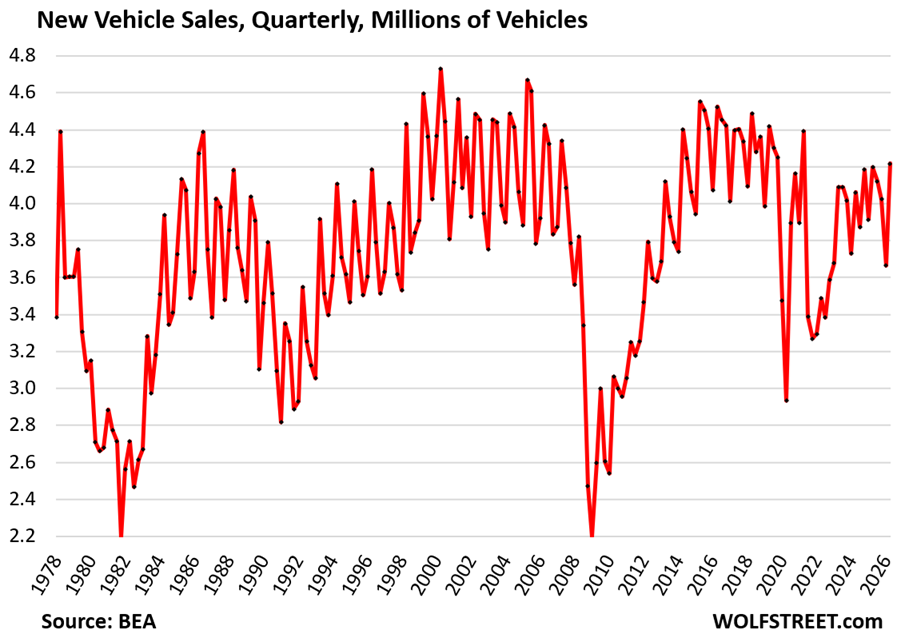
Sales in Q2 2026 (4.22 million vehicles) were below Q2 1978 (4.39 million), below Q2 1986 (4.27 million), barely above Q2 1988 and 1996 (each 4.18 million), below Q2 1998 (4.43 million), below Q2 1999 (4.60 million), below Q2 2000 (4.73 million, the Q2 record), below Q2 2001 (4.57 million), etc. etc.
You get the idea of the long-term problem for automakers in the US: Overall sales have been stagnant or declining for 50 years, interrupted by steep plunges, despite population growth and economic growth.
A big reason that new-vehicle sales have been in long-term stagnation or decline, interrupted by deep plunges, is that automakers, in their short-termism and allegiance to Wall Street, kept going upscale year after year and jacking up prices to fatten their profit margins and please Wall Street – with the big three US automakers going as far as scuttling their sedan models because their profit margins were thinner than on trucks and SUVs – thereby losing customers in the process, which caused unit sales to decline further.
As the big automakers – specifically GM, Ford, and what is now Stellantis – have fallen into this trap, other automakers have not, particularly Hyundai-Kia, and their sales continued to soar from record to record. Not all automakers are losers in this zero-sum game (my charts of annual sales by automaker through 2025).
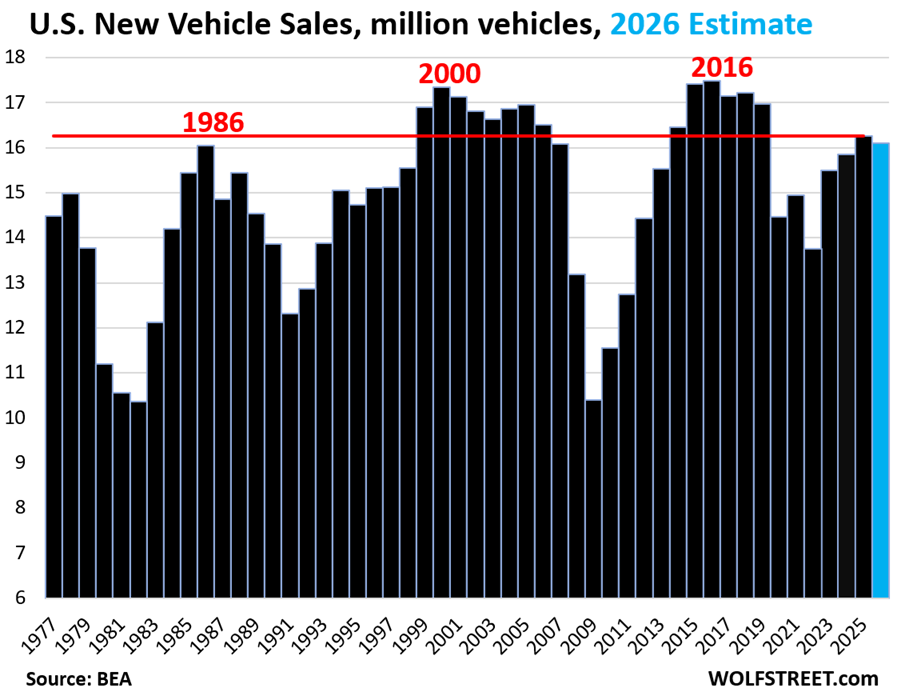
With the first six months under the belt, we can now estimate annual sales for 2026 to come out slightly below the annual sales of 2025.
Annual new vehicle sales had peaked in 2000 and 2016, each followed by a long deep plunge and a slow recovery.
In this kind of zero-sum market, growth by one automaker means declines at others.

Top 7 automakers’ deliveries in Q2 and the first half of 2026.
The combined deliveries of the top 7 automakers accounted for 80% of total auto sales in Q2. The other automakers — there are over a dozen, including Subaru, Tesla, the German automakers, Mazda, and Rivian — all combined accounted for the remaining 20%.
#1 General Motors, Q2 deliveries: -4.2% year-over-year, to 714,896 vehicles, all brands combined.
YTD deliveries: -6.8% year-over-year, to 1,341,325 vehicles.
#2 Toyota, Q2 deliveries: +1.1% year-over-year, to 673,971 vehicles, Toyota and Lexus brands combined.
YTD deliveries: +0.5% year-over-year, to 1,243,391 vehicles, with Lexus sales -5.2% and Toyota sales +1.5%.
#3 Ford, Q2 deliveries: -10.3% year-over-year, to 549,200 vehicles, Ford and Lincoln brands combined.
YTD deliveries: -9.6% year-over-year, 1,006,515 vehicles.
#4 Hyundai-Kia, Q2 deliveries: +2.8% year-over-year, to 468,892 vehicles, a record Q2.
YTD deliveries: 3.0% year-over-year, to 881,295 vehicles.
Hyundai is the parent company of Kia, with Hyundai holding a 33.9% stake in Kia, and Kia holding stakes in Hyundai subsidiaries, and they share vehicle platforms. For our purposes here, the duo counts as one automaker with different brands.
The automaker has been the big winner in the zero-sum US auto market, along with Tesla, taking share away from the others and growing relentlessly at their expense.
#5 Honda, Q2 deliveries: +8.4% year-over-year, to 420,089 vehicles, Honda and Acura brands combined.
YTD deliveries: +2.4% year-over-year, to 756,920 vehicles.
But these year-over-year increases leave sales well below the peak in 2017. Full-year 2025 sales were down by 13% from the 2017 peak.
#6 Stellantis, Q2 deliveries: +5.9% year-over-year, all brands combined, to 328,284 vehicles, ticking up from the abysmal levels last year. Annual 2025 deliveries were down by 44% from the peak in 2015.
YTD deliveries: +5.2% year-over-year, to 634,345 vehicles.
#7 Nissan Q2 deliveries: +10.2% year-over-year, to 230,443 vehicles, Nissan and Infiniti combined, from the collapsed levels a year ago: Annual 2025 deliveries were down by 42% from the peak in 2017.
YTD deliveries: +0.4% year-over-year, to 464,761 vehicles.
Tesla only discloses global sales, not US sales. In Q2, Tesla’s global deliveries rose 25% year-over-year from the abysmal sales in Q2 last year, to 480,126 vehicles, squeaking past the prior Q2 record set in Q2 2023, as high gasoline prices globally caused demand for EVs to re-surge. But Tesla doesn’t report US sales, so it doesn’t fit into this lineup. Here’s my report on Tesla’s Q2 global deliveries.
Enjoy reading WOLF STREET and want to support it? You can donate. I appreciate it immensely. Click on the mug to find out how:


Would love to see the US bring in some Chinese competitors.
So many of these brands have just nothing new in their cars are meh to begin with.
I’m still surprised consumers buy a new cars in this market.
But don’t we all strive to work a whole year or more to afford a bubble shaped Shopping Utility Vehicle with a bigger dash screen and low profile tires that will pop on the first pothole?
Sure, the CVT transmission will eat itself in three years, but for a short moment in time we’ll be able to buy 15 cases of toilet paper from Costco and take a selfie doing it.
I’m seeing lots of big F250/350’s out there
guess $2,000 month – 10 year loans are flying off Ford’s shelves
I sold my 2016 F350 – whole 12mpg
not getting 27mpg with my 5 year old gas sipper
DOWN SIZING in light of coming 30% SSI cuts coming soon
thanks to CONSgress grifters stealing SSI $$$
I drive a 2021 F350 Super Cab with a long box and the wife traded her 10 year old F250 for a F350 crew cab/long box this spring. Both are gas rigs, and 10 speed, hers with the 6.8L. You couldn’t pry our super duty pickups from our fingers as they have to work in terms of payload, terrain and durability. No, we don’t use our rigs for recreating. And we don’t have $2000 payments or 10 year loans. And we’re both retired with SS.
.
I don’t get your point other than you really didn’t need a 1T pickup?
Another evidence-based conclusion? We prefer facts over prejudice.
I’m not sure you do want to see that. Manufacturing is one area the US still has left, albeit much smaller than it was, if it manages to keep its automotive industry. Might be good for your pocket book, like globalization, but maybe not so great long term for your country.
Keeping the people in currently in charge of the decision making at GM, Ford & Stellantis is what’s not good for America. With the auto industry, Wall Street is doing far more damage than tariffs.
Yes it’s fashionable to blame tariffs in the press but US automakers have been dysfunctional for a long time.
So your solution is to put them under and further set our country back because you don’t like the way they are operating. How about let another American carmaker prevail? Tesla??
There’s a push for a political push for EVs so people often quote China as a bastion of green, clean energy citing there enormous EV production forgetting China’s reliance on coal. Also it’s easy to hype something that can’t be bought and tested for reliability and safety.
Your comment is BS at every level and between every level. I’ll address just one level: China is by far the biggest wind-power producer in the world with over half of the world’s installed wind-power capacity being in China, which has been and continues to be a HUGE investment for China. China is also by far the biggest solar power producer in the world. Solar power production is over 4 times that of #2, the US. China is the third-largest nuclear power producer in the world (behind the US and France) and has far more nuclear power plants under construction (40) than anyone else.
China may have the largest amount of solar and wind production in the world, but it doesn’t negate the fact that the China is the largest consumer of electricity in the world with the majority supplied by coal. China consumes twice the amount of electricity as the US and is the largest producer and consumer of coal according to Wikipedia. Over 50% of it’s electricity comes from coal.
The share of electricity generation from coal has DROPPED to 54%, from 81% in 2007.
China uses almost no natural gas for power generation because it doesn’t have much natural gas and needs to import it via pipeline from its neighbors and via LNG from the US and others. That’s expensive and would make China dependent on imports for power generation. It does have coal though.
Generation from renewables has soared and continues to soar, while growth in generation from coal has stalled over the past two year after slowing in prior years.
No country on earth has done as much as China to harness renewable power generation. But it takes time, even in China, to build these power plants.
Chinese vehicles are heavily government subsidized and would require massive tariffs to be on equal footing. They get sold in China for less then it costs to make them. Most of them are also EVs that Americans have been trained by the fossil fuel industry to hate.
I’m in the middle of some travel and I’ve been pleasantly surprised by several uber drivers with BYD cars. It’s a comfortable ride and they’re very happy with their purchase. According to them the pricing is very competitive.
The auto market in the US is one disappointment after another. The moves upmarket, subscriptions, lack of physical buttons. I sure would love some competition. I won’t be surprised if Mexico authorizes BYD imports or direct sales now that the USMCA is set to be allowed to expire. Though I’ve heard it said that even paying the tariff for a BYD it ends up being cheaper than a US equivalent but you have to pay cash; I’m not sure if that’s actually true.
I’m looking for a “new” 1995 “D” this or a 2006 “F” that. The kiddies can keep their screens. Today, I would never buy a 2026 new car from the companies that made those I partially referenced.
If the big three want to sell more units they should focus on drivetrain reliability, stop blocking access to key components to enable repairability, and reduce the electronics/screens, etc., which are doomed to a short life.
Nissan’s CEO is blaming their lackluster sales on its association with rental fleets. He stated that a strategy of chasing volume sales to rental car companies “cheapened the brand” by associating the brand, in people’s minds, with rental cars.
The rental business cuts both ways: It gives rental customers a chance to take extended real-world test drives in different vehicles, and if they’re impressed, they might buy that model later. That happened to us.
We ended up with a Ford Fusion Hybrid as a rental in early 2020 to go skiing in the Sierra Nevada, just when we were looking to replace our 14-year-old real-wheel-drive gas-guzzler Infiniti. We liked it a lot, including the relaxed way the hybrid powertrain operates (no shifting), and were impressed with the mpg we were getting (double that our Infiniti), and ended up buying a Fusion Hybrid a few weeks later directly from a rental fleet.
Obviously, Ford didn’t benefit from that sale at all since it was a used car. And Ford scuttled the Fusion after the 2020 model year, along with its other sedan models. Ford cannot be helped. If there is a stupid decision within reach, the executives at Ford will invariably reach for it.
Why GM and Ford have abandoned the passenger sedan car market is intriguing when Hyundai, Kia, Honda, and Toyota are able to sell them and grow their market share. While Hyundai and Kia do not even sell a full size pick up truck and Honda only selling the Ridgeline and still being able to be profitable is interesting to say the least. Two of my nephews both own Kia’s and they both have the option to buy a Ford at employee pricing. I’ve asked them why they bought Kia and their answer was affordability and value for the money. Their generation are and will be the future buyers when the boomers and millennials are gone.
I really don’t think they abandoned it. They just shifted all their models to these “tall wagon” styles that people like. A Chevrolet Trax is as much a “truck” as a Chevy cavalier was in 1995. So instead of four car models they have four unibody FWD “crossover” models that serve the exact same purpose. Moving people and light loads to work, the mall and soccer practice.
With car sales shrinking we’ll see another round of brands to go soon. Tesla is an American company that sells two models quite well. Came out of nowhere fifteen years ago. Nobody misses Oldsmobile, Mercury, Eagle, Renault, Saab, Geo, Scion, Saturn, Pontiac or Plymouth.
@Ol’B:
“Nobody misses Oldsmobile, Mercury, Eagle, Renault, Saab, Geo, Scion, Saturn, Pontiac or Plymouth.”
Oh oh oh wait! Now do Scout!
If you can’t find them on the web here’s a hint: “Scout” is spelled with a V and a W these days.
Same question here. According to Wolf, it should be clear to those companies seeing sales drop that getting rid of or constantly upscaling their more reasonable models means some people who just want something practical, affordable and reliable will go elsewhere.
I have driven most types of non-sports cars and I found SUVs a real exercise in futility, unless you live in the boonies and really need 4×4 drive.
Bought a second-hand MPV with 50k miles and insanely low fuel consumption for EUR 10k (original price was 27k) some years back. It’s been great, roomy enough to sleep 2 people and take you on long road trips, while doing great in the city too. Invested the difference in stocks for amazing returns. Shaking my head at current market trends.
The Ford hybrids really are very good, but Ford has killed them off one after another. My daughter had planned on buying a Fusion but now drives a Hyundai – she didn’t want an SUV and views them like a minivan. Ford just walking away from sizable chunks of the market is so short sighted. Now that the sedans are gone the Escape is next with no equivalent to replace it. This will result in further declines in unit sales and customers moving to other brands.
I don’t get the minivan stigma.
The Toyota Sienna is an amazing vehicle. Hauls people, stuff, decent mileage, super reliable, etc .
Consumer Reports rates the kia carnival as the best minivan. And kia designed it to look nicer than the typical minvan.
Killing off the Fusion is what officially pushed me away from Ford, stupidest thing I’ve ever seen. It was a good car, I still have my 2008.
Based on its lifespan, I can only assume they moved away from them because they can’t afford the voluminous recalls with the car’s margins.
Instead of improving the reasons for the recalls, get rid of the product entirely…good business am I right? 80s MBAs lack a fundamental appreciation of baseline lower margin business to buffer against high margin business volatility.
We never had a single mechanical problem with our two Fusion Hybrids, knock on wood. And maintenance = new tires every few years, new wiper blades every now and then, and every 15,000 miles an oil change with synthetic oil. That’s it. When I drive, I get about 45-50 mpg in the city, trying to maximize the hybrid-drive system. My wife gets just under 40 mpg. Our Infiniti that we got rid of in 2020 got 25 mpg on the highway on a good day, and a lot less in the city, and there was always some mechanical problem or other. I’m done with Nissan.
From Ford’s point of view, profit margins were thin on the Fusion. It was profitable, and Ford sold a good number of them, but Wall Street analysts wanted higher profit margins, and Ford kowtowed to them by scuttling all its sedan models, and its profit margin has gone up as a result. But it gave all that volume to the Japanese and Korean automakers, and hybrid sedans are now a hot category, and Ford is trying to figure out how to get back into it.
Every single day is a day that every Ford executive needs to be auto-slapped in the face.
Nissan was killed, and continues to be killed, by their CVT transmissions.
These often die before 100k miles, and cost more than the car is worth to replace. Resale value is in the toilet, mechanics hate them, and people are increasingly embarrassed to own the brand.
I don’t like (and will never buy) a CVT transmission, but you do know that Honda, Subaru, Kia/Hyandai and Toyota all have them too, right?
funny you mention the CVT tranny
I was in retail store who had price is right on
2 grand prizes offered up NEW SUV/TRUCK with CVT power train
I put 185,000 miles on my Honda Civic with a CVT. Never had a single problem.
Most people who own a car with a CVT don’t spend the money to have the fluid & filter changed.
I bought a used 2025 Nissan Versa a year ago for $16K with 4.3K miles on it. I have put about 17K miles on it in 11 months. The SVT model even came with push to start & wireless phone charging, two extras a Corrolla LT don’t have.
I fully plan to drain & replace the CVT fluid by 40K miles and then by no later than 80K miles I’ll replace the fluid again and change the filter.
Time will tell how it all turns out. The car with the CVT gets fantastic mileage, about 40 MPG combined driving.
From what I can tell, Nissan has been climbing in the consumer satisfaction surveys over the last few years.
Knock on wood, very pleased so far.
You are absolutely right about the newer Nissans. I wouldn’t touch them with a 10 foot pole but in the mid 2000’s they were using CVT’s that were very reliable, Murano’s for example.
Ford 10 speed 10R80, a nightmare as well, GM has the same transmission, even 2026 models are having issues, 2017-2023 were the worst years, along with Fords V6 eco boost engines blowing up.
Blocking access to key repair components killed their reputation, try getting a Nissan CVT repaired, Nissan refuses to sell the parts for most of them, leaving people with the option of replacing the transmission at high cost or dumping the vehicle.
Had a riding lawn mower with a CVT transmission. Set the throttle to relatively high RPMs and control the mower propulsion with a heavy xmisson lever. I loved it. If you IQ is above room temp (me on occasion) the technique is easily mastered.
Not so good for larger vehicles it appears.
I’m waiting to see if Slate Auto can bring their truck to market as projected. CAFE footprint standards in the 2010s killed the compact truck market and I suspect the big three were happy to go upscale.
People used to buy trucks because they were cheap. The Slate will be cheap like an old truck ($25k today was about $2900 in 1970) but now we get AC plus a vehicle that won’t kill you in a crash.
I love the online chatter about how having crank windows means nobody will buy it, and how 205 miles of range isn’t enough. Anyone who drove a V8 anything back in the 70s knows that you probably wanted to look for gas before you made it 200 miles, and if you do the math (about 0.3 kW/mile) these will be cheap to run compared to a gas car.
The problem with Slate in my opinion is they start about 3k too much. Once you option things people normally expect in a modern vehicle like cup holders, armrests, radio, paint (aka vinyl wrap), etc. you are getting close to 30k. Then you can just buy a 4 door ford maverick.
You could, but the Slate as advertised is a better truck…a truck should have a bed bigger than the cab. Plus, look at your electric bill and figure out what 300 W/mi will cost you for home charging compared to the Maverick, and keep in mind the maintenance on a well designed EV is incredibly low on top of that.
New car sales will continue to plunge in 2027 if the “you have to blow into a tube” to start your car technology is required. Not to mention , the cameras trained on your eyeballs to make sure you’re still on the road. I’m sure they won’t malfunction at all.
If this tech comes to pass I’ll expect a general revulsion against new cars.
Time to buy a motorcycle.
Koala
All that fancy tech from the car world is coming to the motorcycle world also.
If you don’t like new technology…You will have to buy older models.
Curious how that will play out in the market as well. Expect the average person won’t pay attention to it and it’ll be a blip in the statistics.
Wolf, Do you have similar statistics for the sales in the USA for the premium segment (i.e. BMW, VW, Daimler, etc.)? Historically the premium segment has held up better than rest of the market and I am curious if that is still holding in today’s market. I believe the theory is that the premium buyers are less sensitive to price and fuel economics, etc. They buy cars when they want to buy cars because they can. At least that has been the historical theory.
Their volume is too small for me to spend my time on them. The top 7 that I show account for 80.3% of US new vehicle sales. Dozens of other automakers account for the other 19.7%.
BMW sold 102,713 vehicles in Q2. That’s less than half of Nissan, the smallest of the top 7. BMW’s Mini brand sold just 7,456 in Q2. MB hasn’t even reported Q2 sales yet, and won’t for a couple more days. But they will be even lower than BMW’s sales. Volkswagen of America hasn’t reported Q2 either and won’t for another week or so, but they’ll be even lower than MB’s sales. In Q1, its sales plunged 16% to 73,803. These three combined are about as big as Nissan, the smallest of the big 7.
There are lots of automakers with small numbers. I just stick to the big seven. And I have annual charts of each of the big 7 going back to 2013. You see those in early January when I do my annual update. The German automakers are niche producers in the US. BMW’s lunch got eaten by Tesla over the years (rear-wheel drive performance sports sedans and SUVs in the luxury and near-luxury categories). Volkswagen Group got eaten by diesel gate, and by the Japanese and Korean automakers.
Every automaker now as a “premium” segment. Ford, GM, and Stellantis are selling $100,000+ pickups. Pickups are huge in the US. GM sold 242,000 full-size pickups in Q2, Ford 198,000. Most of them are fairly expensive.
Quality cars have always had miniscule sales relative to all of the shoddy mass market junk out there in the marketplace, and BMW reigns superior today as the ultimate driving machines and is making the best quality cars in the business and will continue to do so.
You mean BMW Bring More Worries? I suppose if you worry about the expense for the buy and maintenance you can’t afford to own one.
What I would like to see is an auto/truck taste test. Remove all the little insignias like the Lexus L or the Audi circles and rate the appeal. Or better yet, take some passengers out blindfolded and see what ride is preferred.
I like BMWs but when I was deciding on a car for the next 5-10yrs (this was 6yrs ago) I went Japanese, me and you have a VERY different idea of quality. As a European immigrant I get tempted by ze germans whenever I’m in the market, but then I remember that I value my personal time very highly and do not want to spend it at the mechanic
Paul, BMW vehicles are extremely reliable and have superb diagnostic systems for anything that could possibly go wrong including management software called ISTA (previously INPA) to specifically pinpoint everything that can possibly be monitored.
No thanks to new cars.
Unreliable comparatively speaking to older versions of same.
CVT transmissions are unreliable.
Same for dashboard gadgets and gizmos.
Older model rigs if well maintained, are extremely reliable and you can still perform the majority of the maintenance yourself in your garage. No need to go to a dealer or a independent shop.
(my Mercedes ML350 4-Matic has 302,211 miles on it and still going strong without any major component failure. Maintenance on it has been religiously performed since it was new.)
As to a pickup, I’ll keep the old 7.3 diesel F250 4×4. 350,000+ miles and just did the throwout bearing on the clutch in my garage. Runs like a top and the reliable manual transmission has never let me down even once.
You couldn’t give me a new pickup for free. I wouldn’t want it. Will keep older rigs running tip top and they don’t spy on me 24/7 and cannot be controlled by anyone but the person behind the wheel.
Thanks but no thanks on the enshitification of vehicles these days.
This stuff is really funny. Every auto article here draws those kinds of comments.
That’s for sure about the new car comments older the better ??? Never considered such a thing!
Having been stuck in snow ice rain and other elements with vehicles that were worn out nothing like a new reliable vehicle !
One of the market’s most reliable long-term indicators is flashing red
The overvaluation of US stocks has now surpassed the level that brought the stock market crashing down in 1929. At a rating more than double that of their British and European counterparts, and the highest since the peak of the dotcom bubble, US equities are in for a hairy decade.
This new analysis notes that the US S&P 500 stock index trades on 41 times earnings, based on Robert Shiller’s cyclically adjusted price-earnings (Cape) calculation. This is the highest valuation for US equities, using this tool, since the peak of the technology, media and telecoms (TMT) bubble of 2000 and exceeds the valuations reached at the highs of 1929 and 1901, both of which preceded seismic crashes.
The 41-times rating is also more than double the UK and European equivalent multiple, the widest gap ever seen.
Y’all talking bout a CVT, what be that? A Continuously Variable Transmission (CVT) is an automatic transmission that uses a system of belts and variable-diameter pulleys instead of fixed gears. This design provides an infinite range of gear ratios, keeping your engine in its most optimal power and fuel-efficiency range.How a CVT WorksInstead of shifting between 1st, 2nd, and 3rd gears, a CVT uses two cone-shaped pulleys connected by a durable metal belt or chain.Acceleration: As you speed up, the pulley connected to the engine shrinks in diameter while the pulley connected to the wheels grows.Seamless Shifting: This continuous adjustment allows the car to accelerate seamlessly without the distinct clunk or jerk of traditional gear shifts.Pros and ConsPros: CVTs typically offer superior fuel economy and provide incredibly smooth, linear acceleration. They are excellent for daily commuting and stop-and-go city traffic.Cons: The driving experience can feel “rubber-bandy,” where engine RPMs soar and sound “droney” before the car catches up. Because the belt relies heavily on high hydraulic pressure to maintain friction on the pulleys, CVTs can be prone to overheating if the fluid is not maintained, potentially leading to expensive repairs
AI generated 😡
why did you leave that comment up?
Free public education. To demonstrate that it’s easy to identity AI generated comment slop and warn people not to do it because their login is going to get blacklisted if they get caught even if I let the comment stand.
Howdy Youngins. Don t think a new vehicle is dependable? Could be the way you drive?
There is so, so VERY much to this comment. Or the wrong vehicle providing the service required.
How far Ford has fallen. Go back to 2012 and 2013 and the Ford Focus outsold the Toyota Corolla for top vehicle sales volume worldwide. They also had a very solid compact smaller SUV with the Escape. They proceeded to ruin the Focus and the Fiesta with a terrible dual-clutch transmission and the redesign on the Escape was ugly and drove Ford customers to the RAV4 and CRV.
Now I read last week the Escape and the Edge are also discontinued. And a bunch of blown money on EVs nobody wanted.
I guess they can continue to brag the F-Series is the #1 seller in the US since 1979 while Toyota and Honda and Hyundai earn their former customers who don’t want a truck.
Oh the sweet ford focus!!! I have a 2007 with 210,000 and hoping she goes till 300,000. I have changed tires, oil, brakes, and bare essentials on that car and it is still running well!!! And next year, I am going to put it on the main drag of our town when they shut everything down for classic cars show!!!!! So pumped!!!!!
I agree with everything you said in this article. You are 100% correct, I just wanted to add a few other relevant factors.
One, the auto industry (as a whole) has become a victim of their past success towards quality. Cars are lasting longer and longer now. It is not uncommon to see 12 – 15 year old cars on the road running fine and still being reliable. Having so many reliable old vehicles on the road lessens demand for newer vehicles.
Two, culture change. For a long time America was a car culture. People were defined by the cars they drove just as much as they were defined by the jobs they held or the churches they attended. That has been changing, younger generations now looks at cars as a tool to get you from point A to Point B. As such owning a car now competes with car services, mass transportation, or renting.
Three, (and I fully admit I am not sure about this) I wonder how much the crackdown on immigration has hurt new car sales. Obviously many immigrants are not buying new cars, but there is a down stream effect. With less people competing for older cars, it means more older cars are available for other people to drive lessening their need to buy new.
To some extent, I’ll also add in the failure to keep up with the road infrastructure. When I was 23, I could jump on a two lane I-95 and blow down the road at 80 with just a few cars every few miles. Now at 64, I jump on a 3 lane I-95 and do 72 in the fast lane in packed traffic. Driving isn’t fun anymore. I could write a check for a brand new Porsche 911 GT. But why?
Howdy JimL. Car Culture?? I love remembering my Pop taking our family to Steak and Shake on weekends, watching the hot rods drive in circles while I ate. My Pop had glass steak and shake glasses to go along with his toy car collection….Things do change. Oh Well…
Tools to get you from Point A to Point B? That’s what my mother used to say.
We lived in a neighborhood where a lot of people drove cars that were supposed to impress people. Whoopee, my mother would say.
Then she’d really go for the jugular by saying that those cars were just four wheels and a motor.
Everyone wants freedom unless it’s something they don’t like, like buying cheap cars from China. Then, not allowed.
Either we believe in capitalism or we don’t. If not, then we should have a thorough discussion on how we divide the pie and the kids have some thoughts the olds won’t like.
Prices went up, so demand went down. Pretty easy to figure out what happened.
Seems you don’t understand China.
Sounding like the 80s and the fear of Japanese cars at this point Wolf. They could easily shift Chinese manufacturers into American facilities that have been closed in Detroit/Mexico/Ontario, they do it to every other international brand.
“Oh but SECURITY!!!!” easy fix, ban all this personal tracking and spying software from cars and trucks. If you don’t want them to access information, just remove the source of information. Can’t do that though, our own agencies want to spy on us and call us “theorists” and “cooks”.
All while suggesting it is safer to use robot drivers as the curtain they want to hide behind( it’s your favourite go to defense). It would also be safer if people with a CDL could speak/read the language of the road signs, yet they still keep getting on the road.
As for stagnant sales – more on topic – Chasing the boomers/Gen X money for the last kick of the can. Their isn’t really a plan for cultivating the next generation of drivers, you can’t blame people for not wanting to learn to drive in a vehicle worth $40,000 or more. Even the used market doesn’t have an under $5000 market, all vehicles under 5k are 20 years old – that’s a vintage car.
China is not a free market. It’s as simple as that. Japan was, or at least aligned with how we view capitalism and regulated capitalistic markets and their relative transparency.
People touting faith in capitalism as the reason to engage with a communist economy have never heard of irony.
Outsourcing slavery ain’t capitalism.
Capitalism is based on the voluntary market exchange of goods and services.
It’s not clear how voluntary the labor is in China.
audi a6 buyer here 1 year ago 12k off list ok i will take it. sedans drive much better as wellas far as i am concerned and seats fold down.
I wanted to comment that a statisitc of the average age would be a good graph to inlcude in the articel.
Then I found that: https://www.bts DOT gov/content/average-age-automobiles-and-trucks-operation-united-states
Under sources the US government has an aticle from wolfstreet. They somehow weren’t able to find their own data for 2017. Not bad wolf, talk about circulatory sourcing.
As always will stick with me 80’s 4×4’s and my newest car,a 1998 olds Inrigue,got for 5 thou with 40,000 miles,still running great at a hair over 60 a few years later,will give her a oil change and tire rotation in me shop this week.Only work besides oil changes so far were front and rear rotors and pads(slotted/drilled rotors of course!).
I have personally no interest in the newer vehicles.
Grimp, it’s very clear with China.
Heck, they will throw in a free organ of your choice
with your purchase.
Tom, while I’m sure you China comment is badly done humor…
It’s obvious you’ve never been there…
As China ,as a whole, makes the US, as a whole, look more like a 3rd world country every day…
A sad truth i can state, as I’ve been there, and look for ro visiting again.
No badly done humor.
Why just Visit again?
The days of mom having a station wagon for the family and a weekend “fun car” are disappearing due to cost of purchase, insurance, and maintenance.
It’s part of the reason why cars like the (modern) BMW M3/M5 or Cadillac Blackwing models now exist: these are vehicles that have to perform dual/triple duties because the household can really only afford one.
Great article. The fact that Stellantis is still in business amazes me. I think they’re about as bad as Ford.