
But forget the Model S and X, and the Cybertruck.
By Wolf Richter for WOLF STREET.
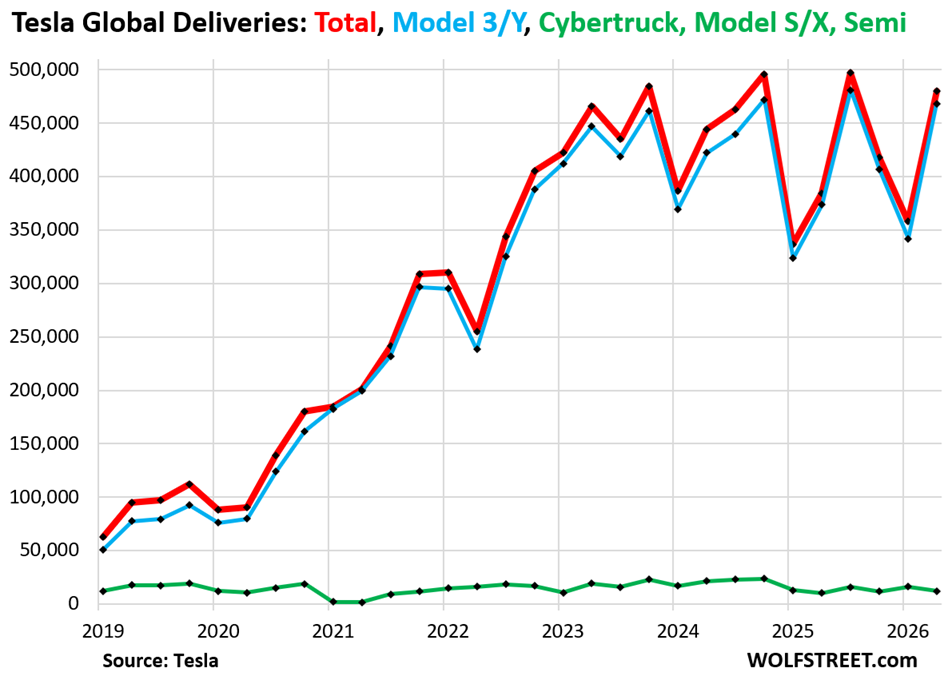
The total number of vehicles that Tesla delivered to customers around the globe in Q2 2026 spiked by 25.0% year-over-year, to 480,126 vehicles, a record for Q2. Compared to Q2 2024, deliveries rose by 8.1%; and compared to Q2 2023, by 3.0% (red line in the chart).
That growth came from the Model Y and Model 3, whose deliveries jumped by 25.2% year-over-year to 467,762 (blue line in the chart). This growth was driven by the spike in gasoline prices globally and occurred despite the end of the US federal EV incentives last September. Customers front-ran the end of the federal incentives, which caused EV sales in the US to spike through September 30 and plunge after September 30.
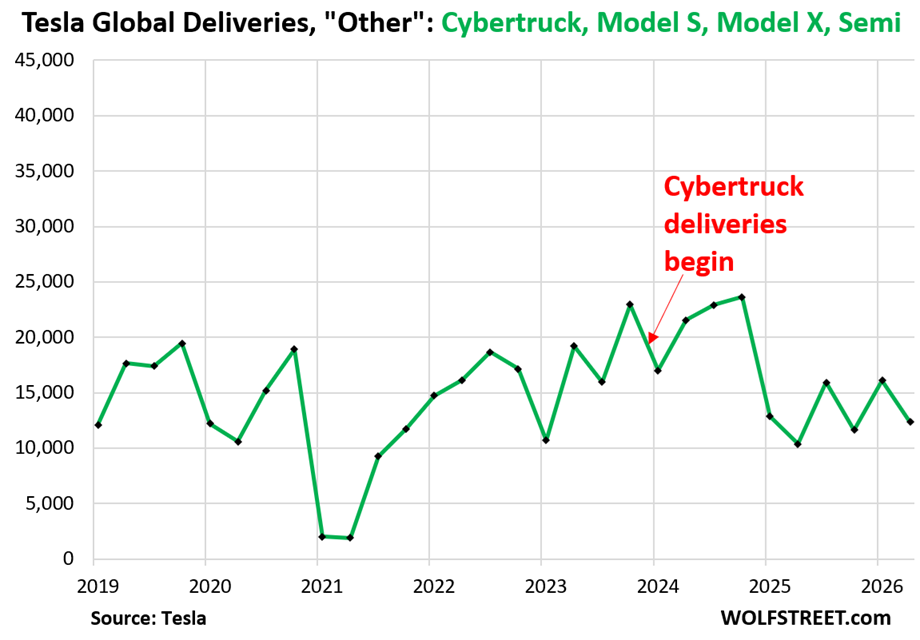
“Other Models” – Model S, Model X, Cybertruck, and now the Semi heavy truck – rose year-over-year by 19.0% from what had been the lowest Q2 since Q2 2021, to a still abysmally low 12,364 (green line at the bottom of the chart).
Tesla had officially ended production of the Model S and Model X by early May, and that final production run appears to be sold out, with Tesla no longer showing any availability on its website.
The much-hyped Cybertruck has remained a dud, except with SpaceX, which purchased $131 million of them in 2025, accounting for about 8% of total Cybertruck sales in the US, according to the S-1 pre-IPO filing of SpaceX.
In 2023, Tesla said it expected to be able to ramp production of the Cybertruck to 250,000 units in 2025. Maybe it could produce that many, but it couldn’t sell anywhere near that many, not even including those sold to SpaceX. For the whole year 2025, deliveries of “other” models (Cybertruck, Model S, and Model X) collapsed by 40% to just 50,850 units, as the Cybertruck became one of the auto industry’s most famous failed models.
The Semi has now entered mass-production at the new plant in Sparks, Nevada. The prior units were sold under a limited small-scale pilot program that companies like PepsiCo tested. Mass production will gradually ramp up.
Looking at the “other” models – Cybertruck, Model S, Model X, and Semi – under the magnifying glass:
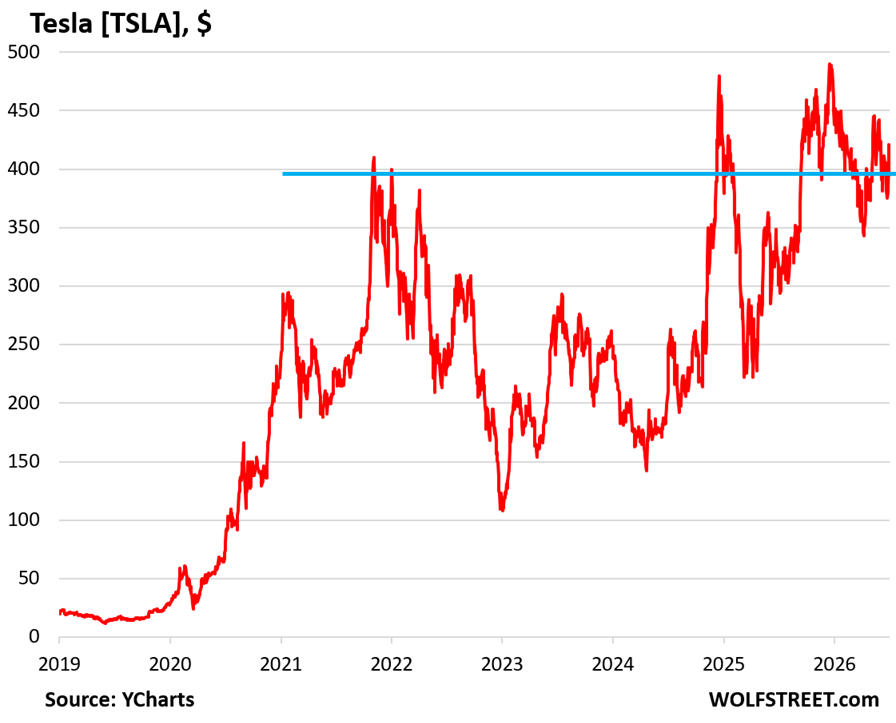
Tesla’s shares [TSLA] re-plunged this morning by over 7%, to $395 a share at the moment, down by 21% from the high in December, on the news of the deliveries, which blew by Wall Street estimates, or despite the news, or on the perception that Tesla is now a humanoid robot company, and even less an automaker than it was before, and perhaps on the perception that the Optimus, which is now entering production at Tesla’s former Model S/X factory in Fremont, California, is lining up to be another immensely hyped product that turns into a dud with consumers.
And Tesla’s robotaxis are where Alphabet’s Waymo was about two years ago. Only Waymo doesn’t bother to build cars, it is focused on the self-driving technology and leaves the building of cars to others.
Tesla is a phenomenal hype machine, and so its shares trade at a P/E ratio of 361, despite the recent decline, when automakers listed in the US usually trade in the 10-20 range, including Toyota with a P/E ratio of 10, GM with a P/E ratio of 30, and Ford with a P/E ratio of N/A as it had a blistering loss of $8.2 billion in 2025.
Enjoy reading WOLF STREET and want to support it? You can donate. I appreciate it immensely. Click on the mug to find out how:


Well spotted that since 2022 the trend of delivered vehicles is slightly declining. The stock price has been going up as if sales have doubled. The stock price seems not to be correlated to the deliveries at all. Crazy stuff. Still i wouldn’t dare to short TSLA.
I think stock prices are propped up because of the huge amounts flowing into ETFs. Dunno.
That’s been the stated justification for a while, but I think it’s more that investors are convinced the Fed has their back, so that there is no risk.
It will be a short at some point unless their 18 wheeler is popular. We have to wait and see. If the 18 wheeler is a dud, the stock tanks. Cybertruck was a crazy dud! Billions will be written off. I do not trust Tesla numbers. Car registrations is a more reliable number.
Hats off to Elon Musk (King Tut) who manages to get investors to pay so bigly for a vision that is always 10 years in the future. And gets governments in the US Canada and EU to subsidize his products plus effectively banish Chinese competition.
Musk couldn’t figure out how to scale and get cheap before his Chinese competitors.
The only thing that is probably keeping him in the car game is tariffs, which the votes hate.
I guess as the pendulum shifts and the environmentalists swing into power, they’ll protect the battery and solar manufacturers a bit, but at least ease up on sedan / crossover tariffs, and then TSLA is toast.
Fortunately for him personally, he at least has a rocket/sat business that the military loves.
Voters hate tariffs because the media lies about what they are
He’s an odd combination of Barnum and Bailey and Geordie Stephenson.
His shares are not for me.
He’s an lethal combination of all the Bond villains rolled into one.
Pathological liar, fraudster, eugenicist… and bullshit artist. A decade or more of lies about Mars, solar panels, “Full Self Driving”, Hyperloops… now data centres in space.
And Musk is the world’s richest man. Jesus take the wheel.
Spot on post….it’s so hard for me to imagine how a slimy character like Musk can end up with a fortune and not be put in jail somewhere along the way.
thoughts on the battery power pack business ?
By revenue, it’s a small part of Tesla’s business and it is included in the revenues and profits and in the ludicrous P/E ratio of 361.
True but it is growing. The Chinese mostly have those batteries figured out using sodium. Much cheaper. In time Electricity will become our main power source. Pave deserts with solar. Lots of room for solar arrays in America. Trump helped by botching the Iran war. Gulf States paid him to fight it, then, when Iranian missiles and drones got through the defense, they asked Trump to stop. Probably paid him to stop. Kushner is collecting billions over there as the “peace negotiator” with Witcoff.
Photovoltaics are maintenance nightmares. The panels themselves are not so much the problem, but the surrounding electronics can be a constant problem. It may be that you want things exposed to the sun and so there is a tendency for a lot of the components to be exposed to heat which then impacts the electronics.
Waiting now on a crew to come out an replace a PVLink that takes 20% of my production offline. The part is warrantieed for 26 years so you can guess that the engineers dont expect it to fail, but this has been a pretty regular occurrence. Have also replaced a board in the Inverter and Transfer switches in the past 5 years – again under warranty.
My house runs on solar, tied into the net with a battery buffer. It’s a hobby more than investment. There will never be an economic payoff. By the time the “investment” is repaid it will be time to replace the whole thing.
On the other hand I’m mostly insulated from the current trend of electricity price increases and I’m never without power.
I thought the market was always right?
Markets are crazy, not “right,” which is why prices swing so much, spiking and plunging as they go. That includes TSLA. Look at the chart at the bottom of the article. That chart is a personification of nuttiness.
A P/E ratio of “N/A”. 😂
How much does a Cyber truck cost, so we can estimate the qty purchased?
WTF is SpaceX going to do with them? Bolt a satellite dish on the roof and launch them into outer space?
If any aliens are reading this, the human race is not worth conquering, we will be terrible pets.
Cybertrucks start at about $70k and go over $100k
Hmmm… so quarterly deliveries are averaging about 450,000 since 2023 it seems. Hard to see how that P/E of 360 holds up then. Even giving them the benefit of the doubt and a P/E 20% higher than GM’s elevated P/E… Tesla’s stock could end up on Wolf’s “imploded” stock list with a 90% haircut.
Tesla is the best car I have ever owned, it will hard for me to buy anything but one of them. It also helps that it is generally the most American made car too. I wouldn’t buy the stock, but the cars are great.