
Big Tech, after years of incinerating vast amounts of cash with share buybacks, is now raking the cash back in with share sales at sky-high prices.
By Wolf Richter for WOLF STREET.
Intel’s shares had spiked by 576% from August last year to the peak of $142 at the end of June, amid the general AI investment mania, though it lost $19 billion in 2024 and 2025 combined, and $14 billion so far this year, for a total of $33 billion in net losses. So now it’s time to sell lots of shares at a very high price, though the price has meanwhile dropped back by 31% to $97.
Intel announced this morning that it priced its big stock offering, and it’s now even bigger, at a lower price, providing even more dilution to stockholders than in my analysis and estimate yesterday, and more cash to Intel, which sorely needs that cash.
This is quite a U-Turn for the former share buyback queen that had incinerated now sorely needed $94 billion in cash on share buybacks between 2008 and 2021.
But it did “buy low” during the buybacks, and it will now “sell high” to investors, though it missed the peak of the share price back in June by 31%. Maybe it was hoping for an even higher peak. But good enough. Kudos to Intel for selling its shares at a still sky-high price. Not sure how that will work out for stockholders, given the dilution taking place here.
Today’s announcement raised its stock offering to $20 billion, up from $15 billion yesterday, plus it raised the 30-day option for underwriters to purchase an additional $3 billion in shares, all at a share price of $95.
In terms of the number of shares it will sell: 210.5 million shares in the public offering, plus up to 31.6 million additional shares to the underwriters for a maximum of 242.1 million shares. If underwriters execute their 30-day option in full to purchase the additional shares, the share sale would raise the share count by 21% from Q2 2025, to 5.29 million (blue segment in the chart). That’s a lot of dilution taking place here.
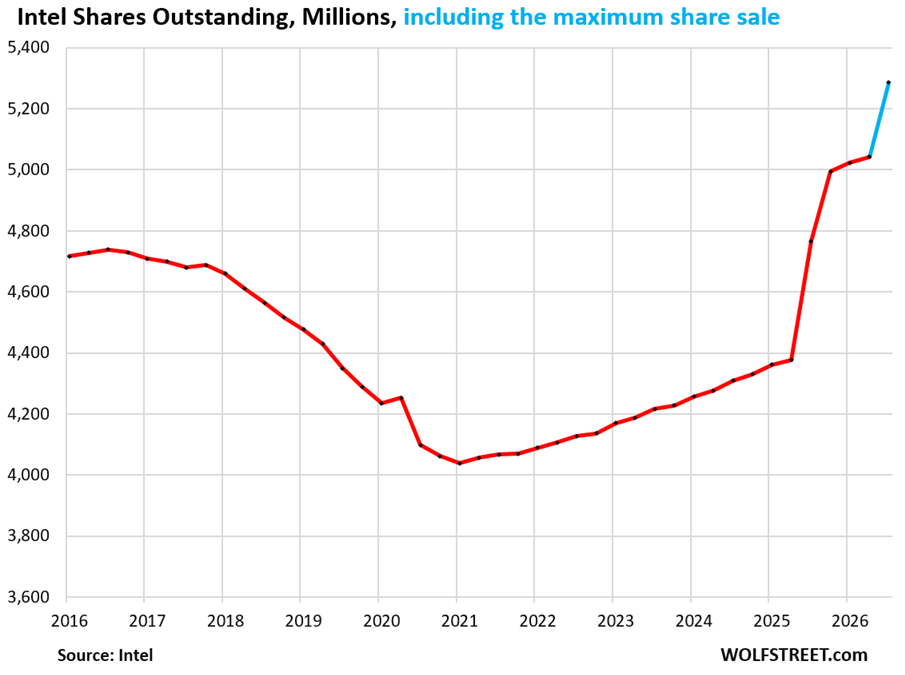
The chart of shares outstanding shows the effect of the final years of the share buybacks, the declining share count through Q1 2021. Then the share count increased due to the dilutive effects of stock compensation packages and stock-funded acquisitions no longer covered up by share buybacks. In 2025, the share count spiked after Intel sold a 10% stake at much lower prices to the government. And now the estimated effects of today’s stock offering, including the additional allocation to underwriters (blue).
With today’s deal, Intel is joining the other Big Tech companies that, after years of incinerating cash on share buybacks, have now flipped to selling shares at extremely high prices. Makes one wonder what they know that the buyers of those shares don’t.
Enjoy reading WOLF STREET and want to support it? You can donate. I appreciate it immensely. Click on the mug to find out how:


Intel is 0.5% of my globally-diversified stock portfolio. So I guess I’m mad about this. But once I divide my anger by 200, it’s not bad.
You have given me an entirely new way to look at life George!
What do they need the money for?
Intel lost $33 billion over the past 2.5 years, which ate a gaping hole into its already tight finances. It’s credit rating was downgraded a year ago to just two notches above junk, to BBB with “negative” outlook, meaning further downgrade on the horizon (Fitch).
Intel even mentioned that maintaining its “investment grade” credit rating — not getting downgraded to junk — was one of the reasons for raising the cash. As I reported in my article yesterday, Intel included this:
“The offering is intended to further enable Intel to pursue the growth opportunities ahead while maintaining a strong balance sheet and its commitment to an investment-grade rating.”
What is the story behind the government buying a stake in Intel ?
Click on the blue phrase in my comment. The link takes you to my article about it.
It’s a bit odd that some view share buybacks as “good” for investors.
Rather than invest its money into R&D, process improvements, and other activities that would benefit investors through higher future profits, buybacks seem to be classic short-termism at the expense of performance.
Raising capital through issuing shares should be seen as good for investors, conditional on the company having a clear path for spending the capital on activities that grow the company or at least increase its market position relative to rivals.
Maybe share buybacks should be viewed as “uh oh, company leadership has no better ideas for how to strengthen the company.”
Share buybacks are just dividends without taxes. Are they overused? Sure. But I’d rather have share buybacks than dividends any day. And the whole point of owning stocks is to receive a cashflow eventually, so I wouldn’t call that a ‘waste’ unless the company is actively losing money, like intel.
Buybacks are great until they are 95% of FCF, funding executive stock options as happened before Covid. The four major US airlines. United, Delta, Southwest and I think AA, had their boards juice payouts to the executives instead of R&D, more efficient planes, better benefits for employees, etc. What did they get? $50 billion? Did us taxpayers get equity in them? They all could have been run through prepackaged bankruptcy, toss management and emerge strong with competent management. No gates lost, planes unaffected, instead, bailouts.
Well we have to overturn Dodge v Ford if we want companies to be run for the employees again.
It’s worse than that. Share buybacks are often there to mask the effects of stock options and executive pay packages.
Agree.
Whether or not they have lost billions lately, if they don’t have a spending plan, it seems like they’re just throwing good money after bad. I hope investors are betting on something other than AI hype. Maybe mgt. thinks the stock will go down and they can book profit by buying these shares back at a lower price ;)
Maybe you should start thinking about the old, and bad for investors, reverse split. They generally reduce the shares outstanding, putting a very high price on the remaining shares for a very short time. The average investor rarely, if ever, get a chance to sell his remaining reduced number of shares at these prices. Only the cognoscenti get the high prices, not you and I. After the price crashes, the company can then get a bigger price increasing buying back it’s shares because there are a lot less shares outstanding and the price per share is low. The prices then go back up and companies play this game all over again. Be warned
I know absolutely nothing about Intel. Well, i do know one little fact – it’s inside.
🤣
Wolf: Any takes on the Nvidia circular financing deal just announced?
nah. That’s just an agreement to create a “platform” to raise money. They haven’t raised any money yet.
Thanks, Wolf. Very thought provoking, especially for me.
Here’s a bit of recent buyback history from our locally HQ corporation, WHR.
Between 2021-2022 according to AI, SW Michigan based WHR bought back about 9.5 million shares for $2.15B at an average price of $210/share.
After its recent 52-week-low of $35.45 WHR closed today at $43.59.
At today’s closing price WHR’s total market cap is about $2.8B
On a cash basis WHR lost $1.7B. or 60% of its current market value as a result of its buyback program.
My father, a lifelong resident of SJ/BH, MI died in 2010. One of his last instructions to his four children was “don’t sell the Whirlpool”.
His four siblings are an obstreperous bunch. We could agree after his demise on only one thing. Guess what?
I do not own any interest in WHR. I do on occasion frequent KBEH, SW Michigan Regional Airport. In the salad days of 2021 WHR operated a fleet of Gulf-streams. Now there’s just one left. There have been some other corporate jet traffic in the past month but therearen’t any tail numbers with the D prefix in the FAA registry.
If WHR were to be taken over and its corporate HQ and Technology Center moved elsewhere it would have a material impact on our local economy. Bosch has a parts plant in south SJ. Its corporate headquarters are in Stuttgart.