
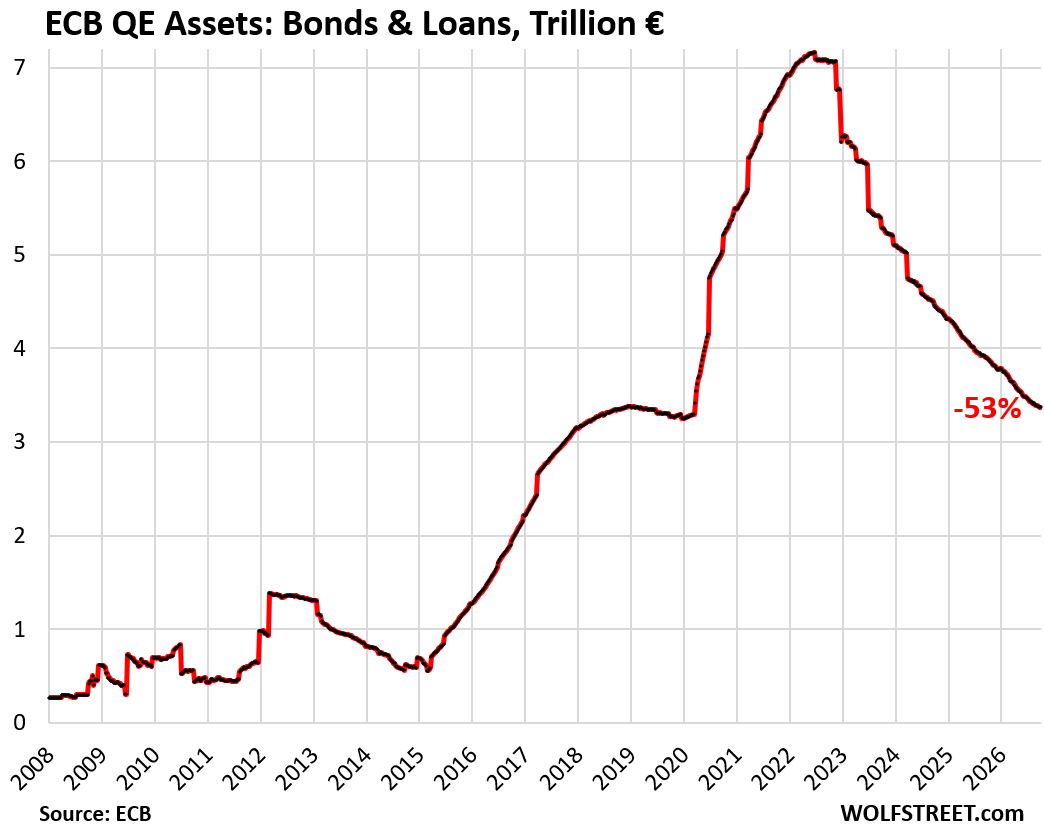
The ECB shed €95 billion of QE Bonds & Loans in Q3. Since mid-2022, QE assets dropped by 53%! Gold got marked up to market.
By Wolf Richter for WOLF STREET.
Despite surging yields of government bonds in the Euro Area, the ECB shed €95 billion ($106 billion) of its QE bonds and loans in Q3, bringing them down to €3.37 trillion. Since the peak of those QE assets in mid-2022, the ECB has now shed 53%, or €3.79 trillion ($4.25 trillion), of its QE assets.
Let that sink in for a moment. This is an extreme turn for a central bank that had been uber-dovish for over a decade, with negative interest rates and “whatever it takes” QE – the immortal phrase of then ECB president Mario Draghi in 2012 – that lasted from the Euro Debt Crisis through 2022.
Shedding 53% of its QE assets is far more than anyone thought the erstwhile uber-dovish ECB, or any other central bank, could ever shed. The ECB has cleared out nearly all of its mega-sized pandemic-QE!
The bond market has been on its own, slowly re-learning what a bond market is supposed to do, which, it turns out, is not to provide unlimited free private-sector money to governments to fund their ballooning deficits, but to price the risks of inflation, default, and other issues, while funding governments and providing adequate returns for bondholders who take those risks.
Government bond yields have surged since central banks began to reverse QE and hike their policy rates – even the Bank of Japan flipped from QE and Yield Curve Control to QT and has shed 17% of its assets. The threat is a surge of inflation, and for Japan, it’s also the collapse of the yen.
The ECB also re-hiked its policy rates twice by 25 basis points each time, first on June 11 and then again on September 10, lifting its main deposit rate to 2.50%.
By continuing with the balance sheet reduction, and by hiking its policy rates, the ECB is pursuing a clear tightening strategy.
The ECB’s two QE assets: Loans and bonds.
The ECB’s QE consisted of two methods, loans and bonds. Combined, they ballooned from €440 billion in 2012 when Draghi still reigned over the ECB, to €7.16 trillion by mid-2022 at the peak.
The bonds that the ECB acquired during QE were mostly government bonds from the member states, but also included corporate bonds, mortgage bonds, and asset-backed securities that the ECB bought under various programs.
Since mid-2022, when QT began, the ECB:
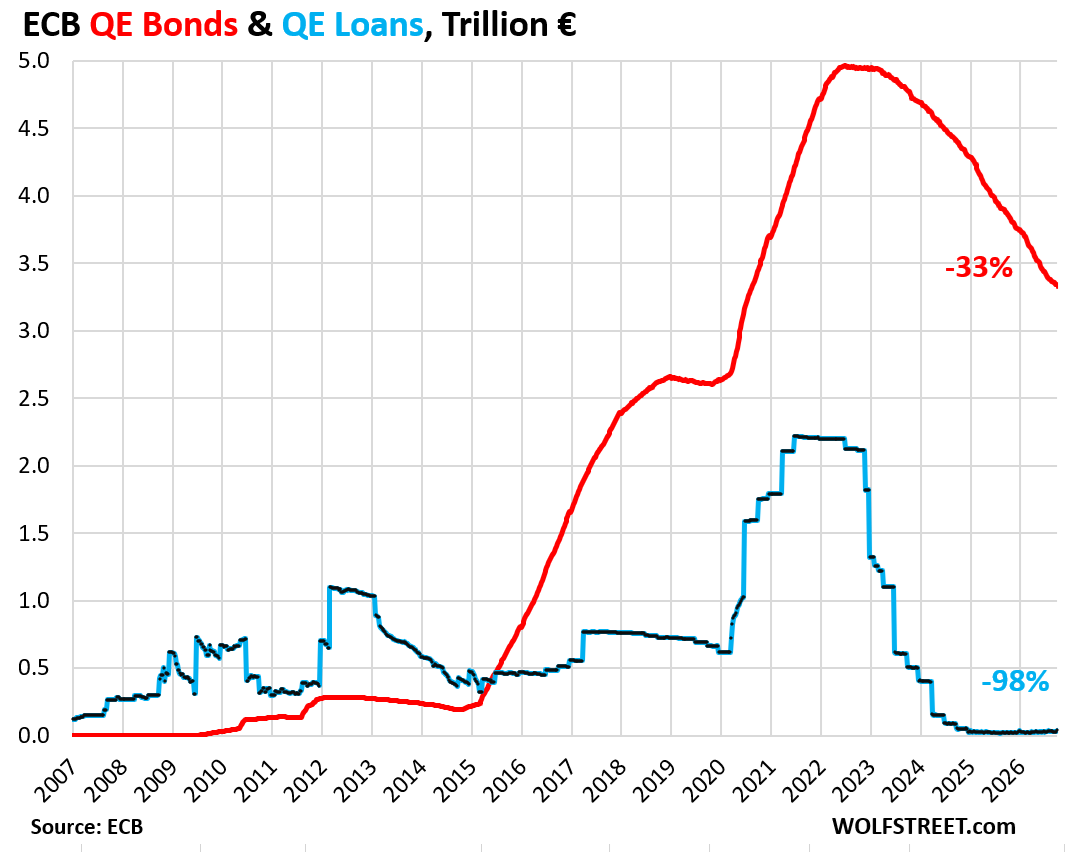
- Shed 98% of all its loans, bringing them down from €2.2 trillion at the peak to $38 billion (blue in the chart below).
- Shed 33% of its bonds, from €4.96 trillion at the peak to €3.33 trillion now. Bonds come off the balance sheet when they mature and the ECB gets its money back (red).
The ECB has exited the bond market. And nothing bad has happened. Yields have risen back into the pre-QE normal range, and that’s where they should be in a normal bond market. Despite all the brouhaha in France and the hand-wringing about the French 10-year yield, it’s still below 5%. It’s just that everyone misses the free money.

The ECB marked up its gold holdings.
The consolidated balance sheet represents the combined assets, liabilities, and capital of the individual central banks of the Euro Area’s member countries. The German Bundesbank is by far the largest, and also has the largest gold holdings, which account for about 31% of the ECB’s gold and gold receivables.
The ECB marks gold holdings to market prices at the end of every quarter, a somewhat unusual practice among central banks.
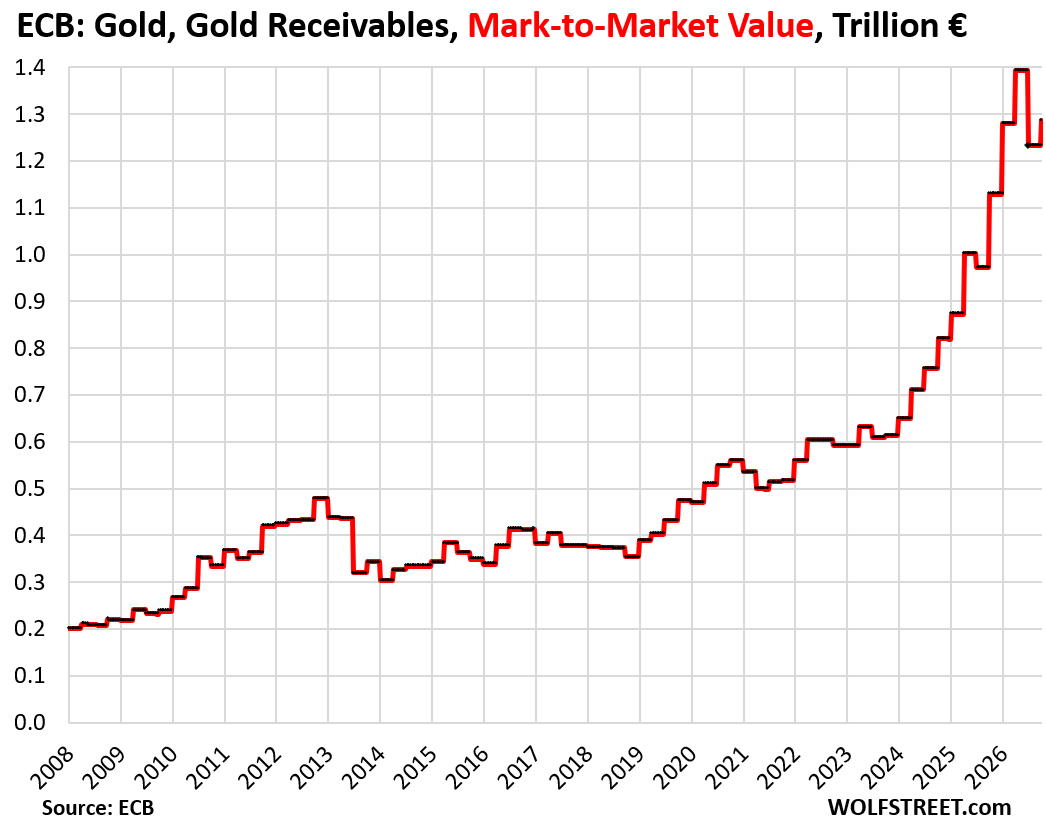
On today’s balance sheet, which reflects the value of gold as of September 30, the ECB wrote up its gold holdings by €53 billion, to €1.29 trillion, as the price of gold rose in the July through September period.
In Q2, the ECB had written down its gold holdings by $160 billion, as the price of gold had dropped in the April through June period.
These mark-to-market adjustments are paper adjustments after the end of the quarter and do not involve purchases or sales of gold, money printing, QE or QT. They simply reflect variations in the market price of gold. Neither the Fed nor the BOJ mark their gold and gold receivables to market.
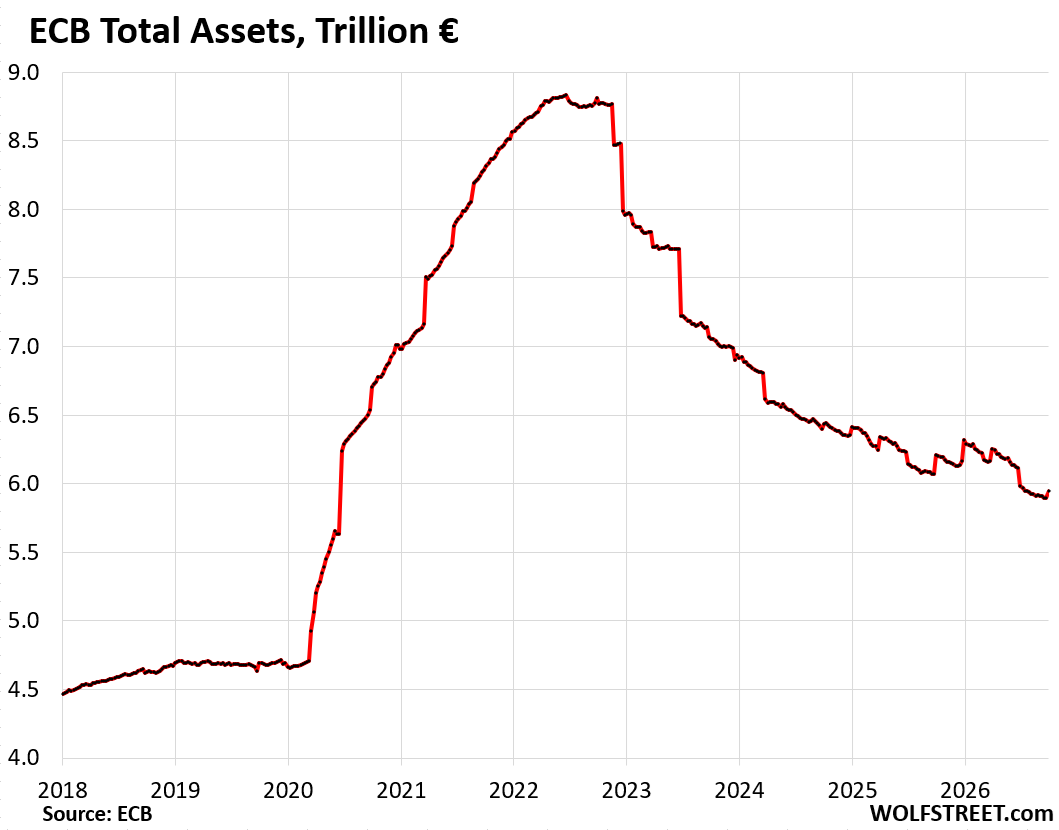
All combined, total assets dropped by €35 billion in Q3, after the €53 billion mark-to-market write-up of its gold holdings, to €5.95 trillion. Without the mark-to-market accounting adjustment of gold, total assets dropped by €88 billion.
In terms of total assets, the huge mark-to-market write-up of its gold in prior years, especially when gold prices exploded in 2025 and Q1 2026, masked a substantial portion of the magnitude of QT. The up-jags in 2025 and 2026 were the effects to the mark-to-market accounting write-ups of gold, amid massive gold price increases, overpowering the amount of the QT runoff.
And in case you missed it: Thoughts on the 10-Year Treasury Auction’s 5.30% Yield, Highest since 2000: It Created Demand, Bond Bloodbath Continued
Enjoy reading WOLF STREET and want to support it? You can donate. I appreciate it immensely. Click on the mug to find out how: