
The government is the most aggressive CRE lender. But even CMBS balances are surging again, water under bridge?
By Wolf Richter for WOLF STREET.
Commercial real estate has gotten double-broadsided, first by the effects of the pandemic, including working-from-home; then by the higher interest rates. It was a sudden turn of events for most property types – except for indoor-mall and big-box real estate which had been getting crushed for years by the Brick-and-Mortar Meltdown.
It came after years of super-low interest rates that caused valuations to balloon and that allowed landlords to cashout-refinance their properties with massive new loans at low rates and supported by Loan-to-Value ratios based on these ballooned fantasy valuations in appraisals commissioned to back those loans.
A big portion of those pre-pandemic or pandemic-era loans were floating-rate loans that quickly became economically impossible when short-term rates began to soar in mid-2022, and so landlords struggled with their interest payments.
And fixed-rate loans could no longer be refinanced when they matured because a property that made economic sense with a 3% loan didn’t make economic sense with a 7% loan.
So these troubled loans have been ricocheting through the financial system and investor portfolios since the pandemic, with lots of defaults, foreclosures, deeds-in-lieu of foreclosure, loan modifications such as extend and pretend, write-downs, write-offs, loan-loss reserves, and ultimately sales of loans or properties at massive haircuts to new investors that then could do something with those properties because their cost basis was a lot lower and realistic.
All combined, there were $6.3 trillion in commercial real estate loans outstanding in Q2 2026, spread across two types of CRE loans:
1. CRE loans on properties with rental income, total balance outstanding: $5.1 trillion (properties that are completed and have tenants).
2. CRE debt on properties that did not produce rental income, total balance outstanding: $1.41 trillion, of which $696 billion in construction loans (paid off when the completed income-producing property is refinanced); and $712 billion in loans on owner-occupied commercial properties (a business owns and occupies the property and services the debt). Data from the Mortgage Bankers Association.
Largest Holders of the CRE debt:
- Banks: $1.92 trillion, or 37.5%, of income-producing CRE loans (plus $1.17 trillion in loans that are not income producing).
- US government via Fannie Mae and Freddie Mac: $1.17 trillion, or 22.8% of income-producing debt.
- Insurance companies: $815 billion, or 15.9% of income-producing debt.
- CMBS, CLOs, and other securitized: $771 billion, or 15.1% of income-producing debt.
- Other government: $220 billion or 4.4%.
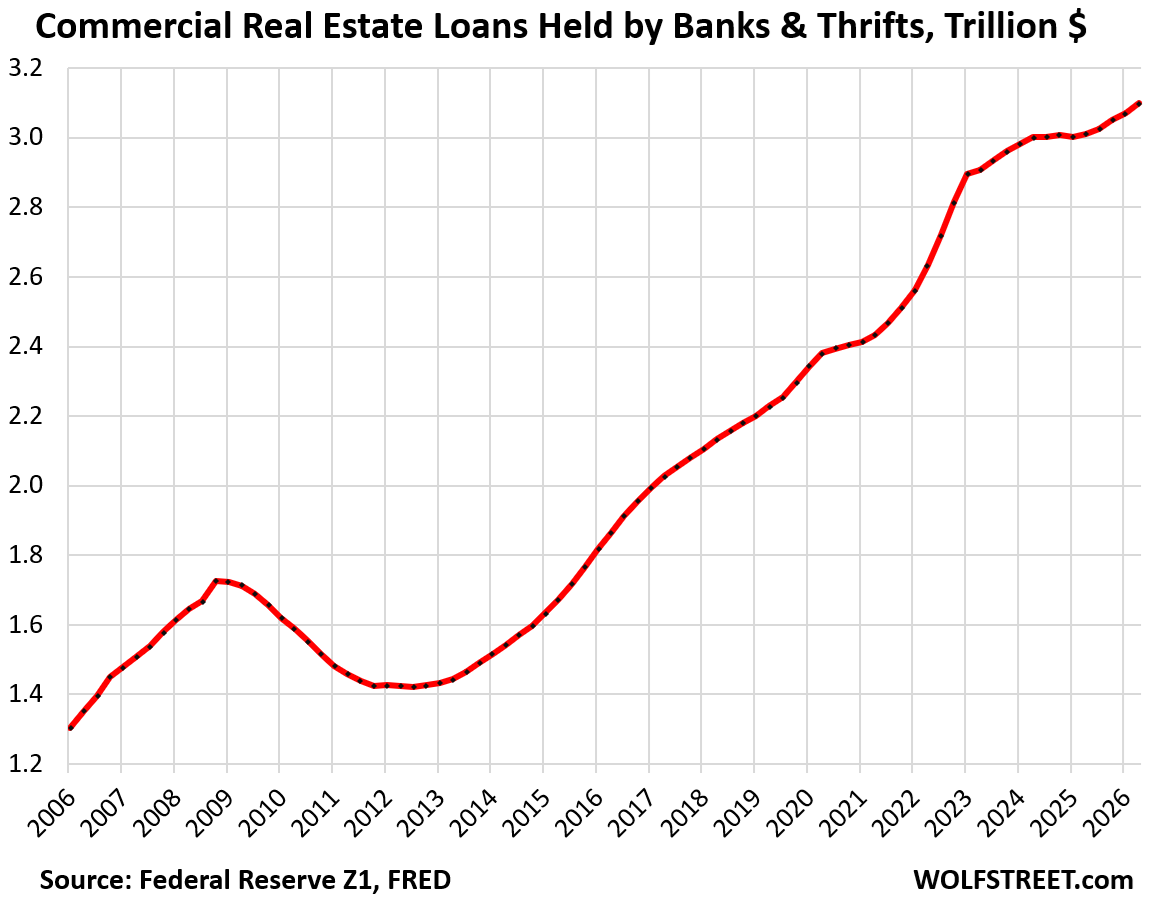
Banks and thrifts held $1.92 trillion of income-producing CRE loans (37.5% of the $5.1 trillion) plus $1.17 trillion in loans that are not income producing: $454 billion of construction loans and $712 billion owner-occupied loans.
In total, banks held a record $3.1 trillion, or 47% of that $6.3 trillion total CRE debt.
Foreign banks’ US-chartered branches are included, such as famously Aozora North America, a subsidiary of the Japanese bank Aozora that in February 2024 disclosed big losses on its $1.9 billion US office-loan portfolio; or also famously Deutsche Bank, which serially reported big increases in loan loss provisions on its US CRE loans and has been offloading loans to clean up its balance sheet.
In 2024 and the first half of 2025, banks’ CRE portfolios remained flat as they offloaded troubled loans and issued new loans at about the same pace.
But banks, which are in the business of making loans, once again increased their CRE loan book toward the end of 2025 and in 2026. By Q2, their CRE loan balances were up by $88 billion year-over-year, or by 2.9%, according to data from the Federal Reserve’s Z1 accounts.
The federal government held $1.17 trillion of the $5.1 trillion in income-producing CRE debt, via Fannie Mae and Freddie Mac (the GSEs). The GSEs are aggressive multifamily lenders, and their loan book keeps increasing.
In Q2, the GSE’s multifamily CRE loans grew by 8.2% year-over-year, according to an analysis by Trepp.
Multifamily loans account for $2.34 trillion, or 46% of the income-producing CRE debt, and the government, via the GSEs, holds half of it ($1.17 trillion).

Insurance companies need predictable cash flows and have long-term investment horizons, and they have been and continue to be substantial investors in CRE.
Their income-producing CRE debt outstanding increased by 3.3% year-over-year to $815 billion in Q2, according to Trepp.
CMBS, CLOs, and other ABS… so here we’re talking about securitized CRE debt: Commercial Mortgage-Backed Securities, Collateralized Loan Obligations, and other Asset-Backed Securities.
Most of this category is CMBS. They have for years featured in the meltdown of the office sector of CRE, where bloodletting has been enormous. WOLF STREET has documented this with countless articles starting in 2020, when vacancy rates exploded, and then when office debt keeled over.
The delinquency rate of office CMBS has been gigantic, and worse than at the peak of the Financial Crisis. When the market thawed in 2022, office towers, foreclosed or not, began selling with haircuts of 50% to 80% compared to pre-pandemic prices. It has been a royal mess (our October 5 report on office CMBS is here).
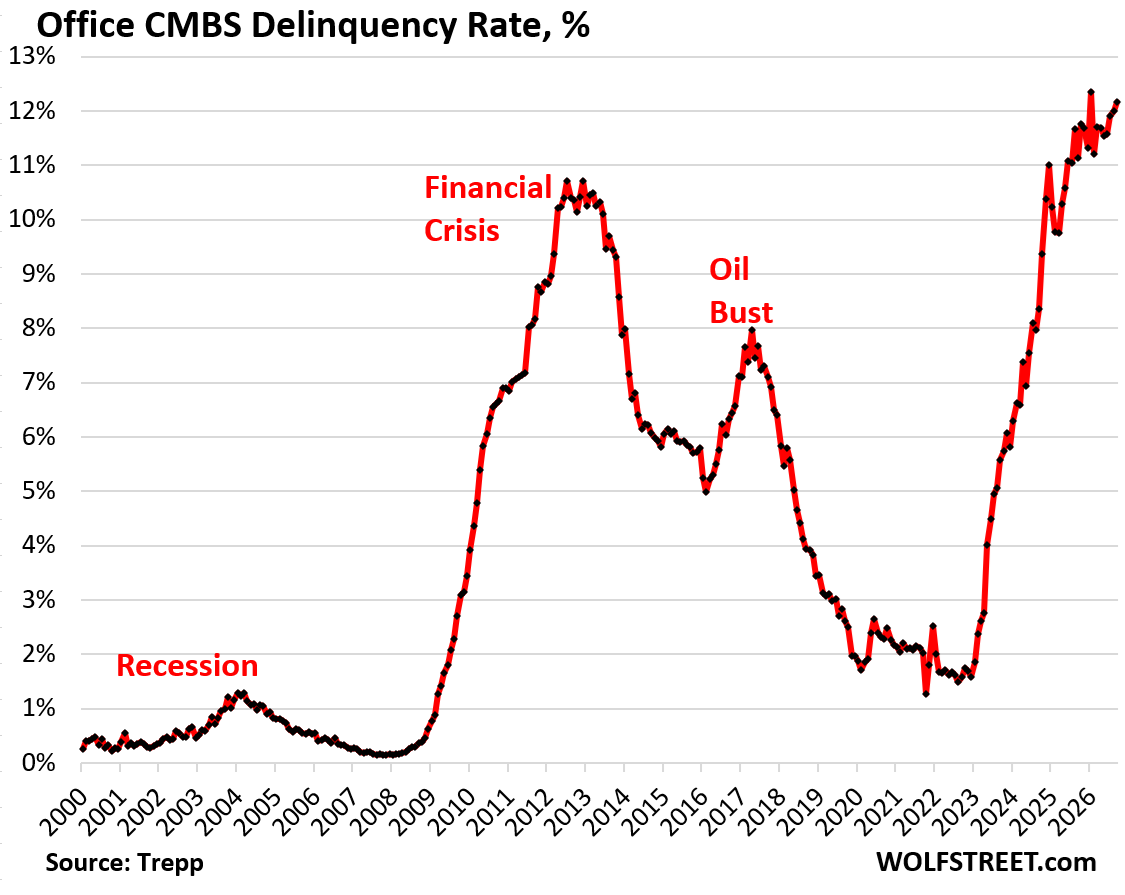
We have long suspected that banks sloughed off their riskiest office loans in the years before the pandemic by securitizing them and selling the CMBS to investors and letting investors take the brunt of the losses over the past few years.
But the Wall Street show must go on, and investors are chasing yield – a match made in heaven. Those were old loans, and old investors, let bygones be bygones, water under the bridge, etc., and now there are new loans and new investors, and so new CMBS are being sold to these new investors at a breakneck pace, and year-over-year, the CMBS balances have surged by 7.4%, to $771 billion, according to Trepp.
Enjoy reading WOLF STREET and want to support it? You can donate. I appreciate it immensely. Click on the mug to find out how:


I wonder what the yields are on various tranches of CMBS. What kind of rate does it take to tempt professional money managers to hold the note on a half-empty skyscraper, or an apartment complex filled with people who will lose their jobs soon, either to AI or recession?
We obviously can’t use rates at the time of issue as a guide, because these CMBS will have been discounted by a lot since then.