
Vast amounts of cash get moved from Investors to Big Tech via equity and debt sales to be spent in the real economy.
By Wolf Richter for WOLF STREET.
Intel announced today that it plans an offering of $15 billion in common stock, with underwriters receiving an option for an additional $2.25 billion in common stock, for a potential total of $17.25 billion in share sales.
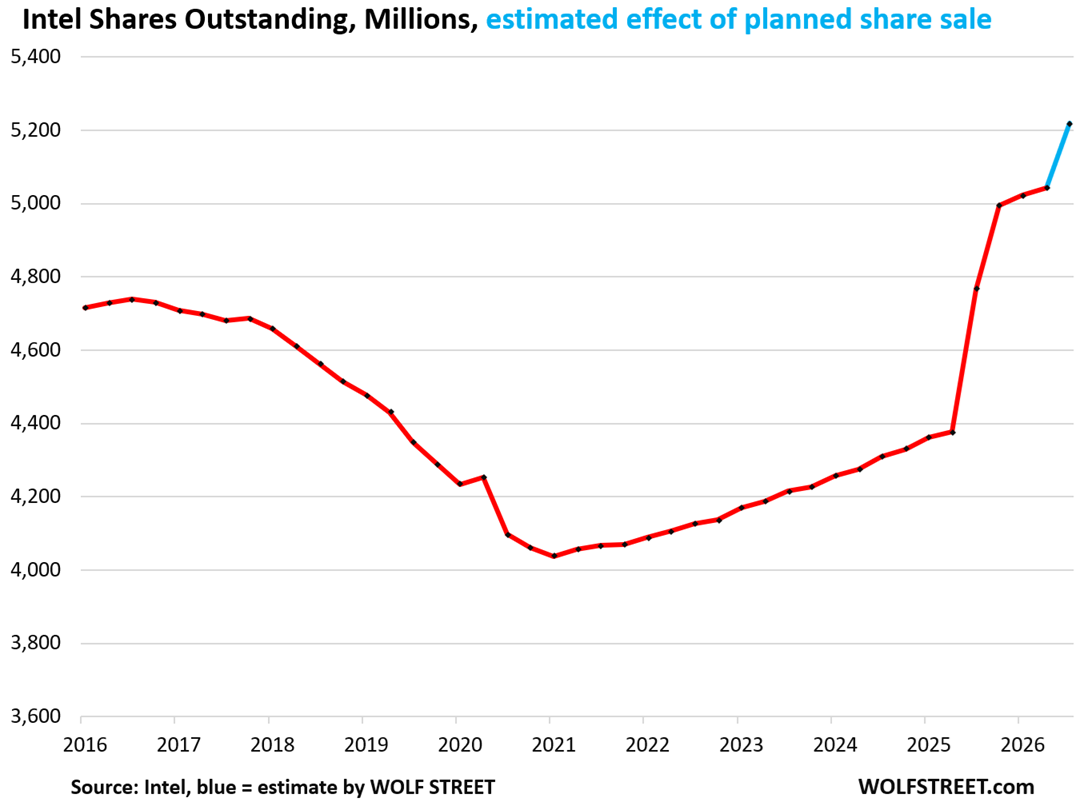
The SEC filing left the number of shares to be sold blank – the shares have not been priced yet – but at this morning’s share price of $98 a share immediately after the announcement, the total offering would amount to an additional 176 million shares, which would bring the total share count to 5.22 billion, up by 19% from a year ago.
With today’s announcement, Intel is becoming the latest tech company to sell shares at extremely high prices. The price of Intel’s shares have shot up by 380% over the past 12 months, fueled by AI investment mania – which is the perfect time for anyone to sell shares. Big Tech has figured it out. And the economy is benefitting, though maybe not investors.
That’s the opposite of share buybacks. Intel was one of the share buyback queens, having incinerated $94 billion on share buybacks between 2008 and Q1 2021, when it stopped the practice.
The chart below of shares outstanding shows the decline of the share count from 2017 through Q1 2021 due to share buybacks; then the increase in share count due to the dilutive effects of stock compensation packages and stock-funded acquisitions no longer covered up by share buybacks; then in 2025, the mega-sale of shares to the government; and then the estimated effects of today’s offering, including the additional allocation to underwriters, at this morning’s stock price (WOLF STREET estimate, blue segment).
In the press release, Intel said:
“Intel intends to use the net proceeds from the offering for general corporate purposes, which may include, but are not limited to, capital expenditures and working capital.
“The offering is intended to further enable Intel to pursue the growth opportunities ahead while maintaining a strong balance sheet and its commitment to an investment-grade rating.”
The strategy of ending share buybacks (burning cash) – Alphabet, Oracle, Amazon, and Meta also stopped share buybacks – and flipping to selling shares (raising cash) has become one of the methods with which companies are funding the enormous cash burn of building the AI ecosystem, including semiconductor plants and the exponential surge in costs of data centers.

The other methods of funding the cash burn of building the AI ecosystem include prodigious amounts of bond sales. In addition, Big Tech is using cash already on the balance sheet, and using cash flow.
It’s stimulative for the economy that companies sell shares at extremely high prices – including startups from the first round of funding all the way to the IPO – and sell prodigious amounts of debt, thereby moving vast quantities of cash from investors of all stripes to corporate balance sheets. That cash then gets disbursed in the real economy, from pay packages to the construction of data centers and factories, from where it begins to circulate to the rest of the economy.
To some extent, this process has always been going on, but the amounts are now huge, and the announcements of huge deals to raise cash from investors to be spent in the economy are coming one after the other, by the biggest companies in the world. As long as this heavy flow of cash from Investors via Corporate America to the real economy persists, the economy will be stimulated, and demand will be stimulated, and inflation pressures will be stimulated.
The thing to watch for is the moment when this heavy flow of cash from investors into the real economy begins to dry up. But that’s not happening yet.
Enjoy reading WOLF STREET and want to support it? You can donate. I appreciate it immensely. Click on the mug to find out how:


Intel is partially government owned company. It’s a lot like Petrobas down in Brazil.
If you wouldn’t own Petrobas, then why would you own Intel?
The socialists are running against socialism, and it’s somehow working!
Makes me wonder when US taxpayers are allowed to sell and what that price point will be. Sell it all, today!
“Fascism should more appropriately be called Corporatism because it is a merger of state and corporate power”
― Benito Mussolini
….there are many names for what is transpiring…
Aren’t you happy the us government now owns intel and 30 other companies. Make that total to 300 or 3000 before Donald Epstein croaks
The US government doesn’t “own Intel.” It owns less than 10% of Intel’s shares. It’s a small minority stockholder in the other companies.
A nice quote, I like it, but according to AI, not correct:
No, this quote is not correctly attributed to Benito Mussolini.
The statement is widely circulated but does not appear in Mussolini’s official writings, including the 1932 Enciclopedia Italiana article “The Doctrine of Fascism” (often cited as its source) or his 1935 book Fascism: Doctrine and Institutions. Researchers have searched extensively and found no original source for this exact phrasing in Mussolini’s works.
Additionally, the quote misrepresents Mussolini’s actual views: when he discussed corporatism (Italian: corporativismo), he referred to guilds (corporazioni), not modern business corporations. His economic model involved state control over syndicalist organizations representing different sectors, not a merger of state and corporate power as the quote suggests.
Conclusion: This is a fabricated or misattributed quote, not an authentic Mussolini statement.
Benito Mussolini’s fascist government took extensive ownership and control of companies, particularly during the 1930s. While Mussolini initially pursued privatization in the early 1920s to win favor with industrialists, a massive banking crisis later forced the state to step in and acquire major corporate stakes. By 1939, Italy had the highest rate of state-owned enterprises in the world outside of the Soviet Union
I don’t know about all that but I am a witness to the Intel money pit, analogous to the physical construct of a black hole. Voraciously devouring taxpayer dollars too come in 8th place.
And that 10% ownership Wolf is talking about is worth $32B today.
Unless the Treasury sells at a loss down the road, I don’t see how this is a bad thing.
This is not socialism. This is the government investing in strategic companies to help bring production back to the US.
Granted, Trump could lose the House and then all of a sudden the DSA / Dems are going to go scorched earth to find out if Trump profited from the Intel deal and others.
Time will tell, but for now, the Treasury has a very valuable minority stake in Intel.
It’s so incredibly sick to me how people are willing to overlook just about anything as long as money is being made.
The US Government made an investment in Intel that made them a stronger company. 10% is a minority stake. America gets a commitment from Intel to continue to do leading edge R&D on chips & to expand manufacturing. In addition, the DoW will be getting future chips from Intel.
None of that is a bad thing at, given how far behind in manufacturing here in the US we have become.
All of these investments are in strategic resources & goods. One can easily make the argument that what Trump is doing on whole to reduce our dependence on China should have started 10-15 years ago, after we collectively should have realized that China ascending into the WTO in 2001 was turning out to be very bad for us.
There’s a reason why a big part of America are aligning against globalism.
Moe Rawlls,
The amount Intel got from the Trump administration in exchange for a 10% stake is just a restructuring of a big grant (gift) that Intel was promised from the Biden administration. Biden was going to give Intel the cash and get nothing in return. Trump restructured it to get shares in returns. Same money. So for tax payers, this is a far better solution than just giving the money to Intel. For investors maybe not so much because their shares got diluted by 10%.
I discussed this last year when the deal was made:
https://wolfstreet.com/2025/08/25/big-fuss-in-the-media-about-the-governments-10-stake-in-intel-but-just-giving-this-cash-to-intel-under-the-chips-act-was-fine/
On a related topic, the biggest risk to the AI bubble is the backlash from voters over data center build out as it relates to electricity prices & environmental impacts. If this has a material impact on delivery of data centers as it should, the clock may well run out on big tech borrowing gargantuan amounts of money.
I’ll stay away from this Intel offering. My piddly little 10 IPO shares of SPCX is enough for me. I like the dividends of QYLD with fairly low volatility, and it seems to be somewhat late to be jumping on the AI bandwagon for now. There needs to be a downturn to flesh out who’s really going to make it.
“as it relates to electricity prices & environmental impacts”
let alone the surveilance data these ghouls are pushing to capture in a data center,
AI is the best forger ever contemplated designed to steal just like a counterfitter
Mr. Wolf’s headline supporting paragraph: “Vast amounts of cash get moved from Investors to Big Tech via equity and debt sales to be spent in the real economy.”
Analysis: Perhaps that “real economy” is, in large part, the oligarchs’ pockets.
Gary has a point. And Bastiat called this out centuries ago (See “That which is Seen and that Which is Not Seen”).
Whether the share and bond sales (or anything else) are stimulative or wasteful depends not just on how the funds are spent, but equally on what other activities those funds are being diverted from.
Or, if the necessary credit is being created by banks, whether the loans will pay off or default.
Is it an investment or a waste? Only time will tell!
You ain’t seen nothing yet…” China Unleashes $28 Trillion Capital Markets to Challenge US in AI.”
1. The headline you cited doesn’t mean what you think it means. This article you cited is about China’s existing “$28 trillion stock and bond markets.”
The article you cited, said this about that “$28 trillion”:
“The frenzy [from the CXMT IPO] was the culmination of one of the country’s most aggressive efforts yet to marshal the power of its $28 trillion stock and bond markets.
“Regulators have fast-tracked IPOs for strategic companies and opened more avenues for them to raise money through bond sales.”
2. The same article with your headline also said this:
“Chinese tech firms raised about $217 billion through initial public offerings and bond sales over the past two years, according to data compiled by Bloomberg. For every $1 they secured, US peers raised more than $6, led by companies including Amazon.com Inc. and Alphabet Inc.”
3. And the article spelled out the theme:
“It represents a change in how Beijing finances its strategic industries. China has rarely used capital markets as a major industrial policy tool, relying instead on subsidies, tax incentives and state investment. The shift opens access to the $26 trillion held by citizens — the world’s largest pool of household savings — while Chinese companies also enjoy some of the cheapest funding globally.”
Do read the articles before you drag the headline into here. And if the article is behind a paywall, don’t drag the headline into here.
I’m very sorry Mr. Richter, I will not do that again as I didn’t know all the things you said, I was thinking China was making a huge committment and wanted to mention it. Again, my appologies.
Yes, no problem, Mr. ryan, that’s what I thought too when I read the title. The article was good, but the title was misleading clickbait.
You can google the title, and you’ll find the article not behind a paywall. The article is worth reading.
BUBBLE TROUBLE: Worst period for hedge funds since 2008 after AI stock rout…
Well one wonders with AI available to make recommendations how did America self destruct after sucker punching Iran twice while the nations were in diplomatic negotiations ?
I suggest that perhaps the Palantir’s AI model reflected Alex Karp’s demented view of Kurt’s in the masterpiece, apocalypse now, the horror is the only solution.
Send a missal into a children’s school. Then double tap it when the rescue squad and the parents
Not the America I grew up in
As part of Nixon’s ‘Vietnamization’ effort I served with Montagnard Ruff-Puffs in the II Corps Central Highlands on the 4-man MACV MAT II-25 in 1970-71.
Regular army personnel took over the MATs after the SF SOG Teams were booted out of VN in part at least because of John Wayne’s portrayal in the 1966 movie. Another factor was the famous AP Tet-1968 photo of a GVN QC blowing the brains out of a captured VC prisoner. Not pictured in the photo was a SF advisor standing behind the QC.
Some might consider Apocalypse Now a masterpiece. But any similarities between any tinsel town movie and the actual reality of the ‘Peace Corps with Guns’ experience in an aboriginal Boun are non existent.
I was just a butter bar 1542 fresh out of OCS and a brief stint as an Infantry School instructor in the leadership department cut short prematurely by the deputy post commander when I was assigned to MACV. See the April, 1968 National Geo for context. And admittedly, am often in error but seldom in doubt. But until my dying day I’ll believe if I’d been in command of the 11th Cav with close air support we could have marched into Hanoi just like Schwarzkopf and the 3rd ID took Baghdad.
There’s a 180-degree difference between playing to win and trying not to lose.
You’re right about one thing, dang. It’s not the America this octogenarian grew up in. Whose fault is that?
Bet this one gets moderated too. But that’s okay because I write for myself.. I find thinking it’s cathartic, …..and for Wolf ‘cause everyone needs free entertainment.
I’m a very conservative investor. Since before Liberation Day last year, I’ve mostly sold off twice (right before the tariffs & last week) the portion of my IRA portfolio that’s not in brokered CDs, banking some nice decent profits. Granted, I’ve lost some upside, but I’m well positioned for the next big drop or worse. I’ll sit on the sidelines at least until the election.
Ben, I think the big banks just lent all our savings to the AI bubble companies.
If the AI companies do well, the banks will share in the joy.
But if the AI companies blow up, most banks will get bailed out again.
I suppose in either case we’ll eventually get our money kinda-sorta back after an inflationary haircut.
Hi Wolf,
Is this unprecedented, or did we see the large equity and bond offerings during the housing boom leading up to 2008, the internet buildout bubble, the Roaring 20s, and the railroad building booms? My knowledge of US economic history is limited in this regard, but am thinking we must have had spend on (what turned out to be excess) capacity during those episodes. I did see a table not long ago from another blogger showing that “this time is different” in terms of the speed at which we have gotten to the current increase over baseline spend.
Many thanks for any and all insights!
The Dotcom Bubble had this kind of stuff, and it blew up, and the Nasdaq collapsed by 78%, and thousands of companies vanished, but the internet thrived and is what it is today because of the Dotcom Bubble. The railroad bubble may have had a similar dynamic. The Housing Bubble was different; that was less of an investment boom (sure there was some from homebuilders, but it wasn’t huge), and much more just a price spike amid wild speculation.
Or the surge to build gilded casinos that all went bust. Took about 20 years or so with mucho rebranding, stiffed contractors, and bankruptcies along the way. And isn’t that the Market these days? Sure, bandwagon trades but to an outsider it mostly seems like gambling. And now there is actual legal and public/private prediction sites. Gamble on the gamble. And crypto?
I come to this site because Wolf tries to write about the truth….. with stats. I don’t always agree with his conclusions and sometimes get censored, but I write for myself as well and draw my own conclusions. The take for me is the foundation of human nature in finance, politics, and even war. And I can say with all conviction based on a life of work that cream does not always rise to the top. There are a lot of self serving dishonest people in charge these days and the trajectory is really when, and not what will happen as a result.
You reap what you sow.
So hats off to the entrepreneurs and self employed that provide an honest service and/or product. That’s capitalism, not this nonsense. This is something else, entirely.
I suppose it is all good.
People making money and making it happen…
Until…
At some point in time…. Not so much
The question is when ???
People have lots of ideas….
But reality says that nobody knows !!!
Luv muh inflation.
Inflation has always been part of the plan. Bernanke’s monetarist experiment in real time has failed.
Long term Interest rates IMO are 200 bpts below fair value.
There is a lot of money sloshing around
out there. I expect to see more stories
like this concerning the data center build outs.
I just read, and I think it was Fink of Blackrock, said there is hundreds of trillions of dollars in the world out there. He was talking about private equities new securitization scam with Navida.
“ Larry Fink, the man who helped turn the home mortgage into a global financial product, has a new obsession.”
“ Jensen Huang’s framing of this shift is characteristically precise: Nvidia is no longer just a hardware vendor; it is an infrastructure architect. By standardizing compute as a collateralized financial instrument, Nvidia is effectively creating a new class of productive, investable infrastructure: the AI factory. This is the institutional-grade third phase of the compute landlord thesis”
It seems all of this will probably be backstopped by the government in the name of geopolitics, strategic investments to counter China etc. Guess disruption will happen and folks will lose money but the government will step in. Just some thoughts!
U.S. data centers: heavily international
Businesses all over the world use U.S.-based cloud and data-center infrastructure. A company in Mexico, Europe, Japan, Australia, etc. can run its applications and store data in U.S. facilities operated by companies such as AWS, Microsoft, Google, Oracle and others.
Source of demand
Importance to U.S. data centers
U.S. Big Tech / hyperscalers
Very high
U.S. businesses
High
Foreign companies using U.S. cloud
Significant
Global AI customers
Growing rapidly
Foreign governments
Smaller but growing
U.S. government
Significant
China is different
Foreign businesses do use data centers in China, but primarily when they need to serve Chinese customers or operate businesses inside China.