
With the stunning amount of capital getting sucked up while the AI revenue model is in fantasy land, you’d think it would be Panic City. But no.
By Wolf Richter for WOLF STREET.
The AI infrastructure investment boom is sucking up capital globally, both debt and equity capital, with huge debt sales, share sales, fund raises, and IPOs. The biggest IPO so far was SpaceX. OpenAI and Anthropic are on the horizon. But the IPO of Nvidia-backed Firmus in Australia, seeking to raise about US$5.5 billion, collapsed and was pulled.
IPOs at sky-high valuations raise lots of money for the companies – $86 billion for SpaceX – and allow them to raise even more money later with follow-on offerings. This is capital that companies will never have to pay interest on or pay back.
But that’s not enough, and so SpaceX has been in talks with Apollo Capital Management and some banks to borrow $40 billion to purchase GPUs from Nvidia, according to sources cited by CNBC two days ago.
SpaceX already borrowed $25 billion in June via a bond sale, spread across several maturities, and investors stood in line to lend: that bond sale received $90 billion in orders. Yields were higher than Treasuries, but not much, and have since then surged, and spreads have widened.
For example, the $6 billion slice of 10-year senior unsecured notes was sold with a coupon interest of 5.875%, so this was tempting, being nearly 120 basis points above the 10-year Treasury yield of about 4.7% at the time. The notes were rated at the low end of investment grade (BBB+ by Fitch and BBB by S&P Global; junk starts at BB+, see our cheat sheet for corporate credit ratings by ratings agency).
Today, the 10-year Treasury yield is at 5.25%, and that SpaceX note trades at 90 cents on the dollar with a yield of 7.20%, according to TradingView. The spread to Treasuries has widened to nearly 200 basis points.
So that caused a lot of handwringing because 190 basis points is the spread now between BB-rated junk bonds and Treasuries. And SpaceX is trading in that BB-rated spectrum now, like a junk bond.
So now comes the next $40 billion in debt, but this time, SpaceX appears to target loans via private credit and banks, rather than the bond market.
The bond market is getting saturated. In the US, there are about $12 billion in corporate bonds outstanding, both investment-grade and high-yield bonds, according to SIFMA. The big AI companies alone are throwing another $500 billion at it this year.
So some of the borrowing has shifted off balance sheet, to SPVs, to commercial leases, to purchase commitments, etc. And private credit is elbowing in on it.
Then there are other big borrowers, such as the Paramount Skydance acquisition of Warner Bros. Discovery, that is funded by $52 billion in debt sales, including $44 billion of bonds, of which $12 billion are junk bonds, leaving the combined company with about $80 billion in debt. It’s not like the rest of the world is waiting for AI to get through borrowing.
The debt markets globally, private debt firms, banks, and other lenders are struggling to absorb the huge amounts of debt capital that the AI firms are in the process of raising, or plan to raise, in addition to the debt sold by other companies, and good lordy, by governments. The US government alone has to fund about $2 trillion in deficits a year.
AI debt is risky. The amounts are gigantic. The revenue models of AI companies remain in fantasy land, as neither consumers nor businesses may ever be able to spend enough on AI to justify the planned AI capital expenditures.
You’d think it would be panic city. But no.
Yields have risen, but are now essentially just back in the pre-QE normal range that prevailed before QE was instituted across the world in 2008 and after.
And spreads of corporate bonds to Treasuries have widened, and for some specific bond issues, such as the SpaceX debt, have widened a little further, but they remain narrow by historical standards, as investors are still chasing yields.
The spread between BB-rated bonds – upper level of junk bonds – and Treasuries of equivalent maturity widened in early October to 2.04 percentage points, then narrowed again to 1.94 percentage points currently, as per the ICE BofA BB US High Yield Index Option-Adjusted Spread. That spread is still hobbling along historic lows.
In March 2020, the spread went over 8 percentage points. During the Financial Crisis, the spread topped out at nearly 15 percentage points. Even following Trump’s “Liberation Day” speech on April 2, 2025, the spread went over three percentage points.
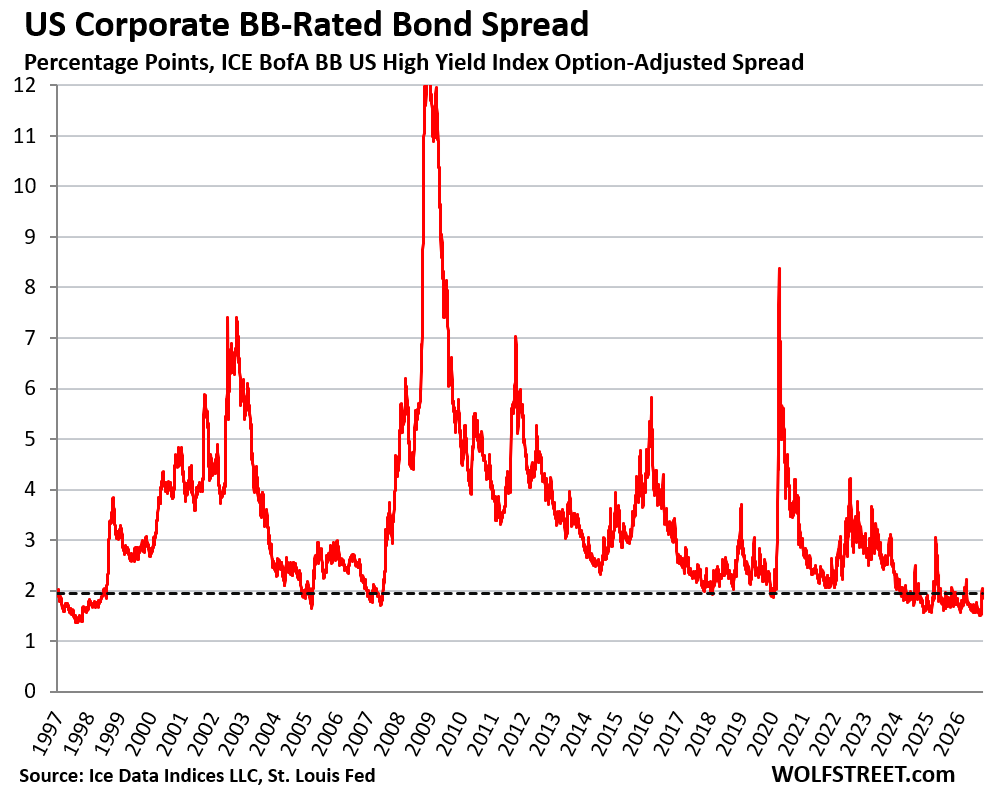
These narrow spreads at the upper level of junk bond land – despite all the handwringing out there about widening spreads – show that the corporate bond market is still in la-la-land.
Part of that is driven by the AI-related stocks with trillion-dollar-plus valuations and by future trillion-dollar-plus IPOs such as by OpenAI and Anthropic that allow companies to raise lots of money with follow-on share offerings from the huge and deep global stock market. that’s confidence inspiring for the bond market.
But when those shares plunge, making share sales difficult or impossible, that’s when the bond market would get frazzled.
The investment-grade senior unsecured 5.875% 10-year notes that SpaceX sold in June at a spread of about 110 basis points, are now trading like junk bonds in the BB-range (upper level of junk bonds), depicted in the chart above, with a spread of nearly 200 basis points and a yield of 7.2%.
So yes, investors are taking some losses on these AI bonds in terms of lower prices due to higher yields and wider spreads, but yields are not high by pre-QE standards and spreads are still historically low.
None of these AI bonds or loans have defaulted yet. All the plates are still spinning nicely. Sure, the Firmus IPO got pulled as investors balked at the valuation and maybe because they finally glanced at a prospectus, but that was an Australian IPO that really tried to push it.
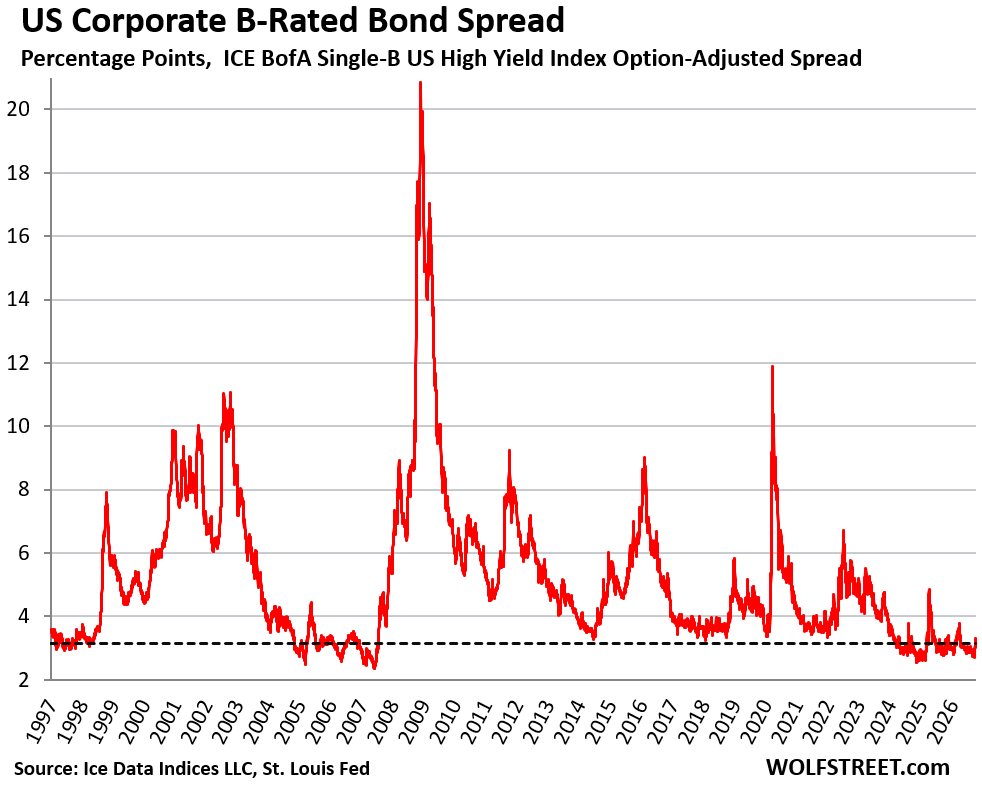
The B-rated spread – that’s the middle of junk bond land – has widened just a tiny bit to 3.15 percentage points, but also remains historically narrow.
This still has la-la-land written all over it.
Enjoy reading WOLF STREET and want to support it? You can donate. I appreciate it immensely. Click on the mug to find out how:


a BRILLIANT presentation.