
Treasury bills outstanding ballooned by $1 trillion year-over-year, to $7 trillion. But total marketable Treasury securities ballooned by $2.5 trillion. So…
By Wolf Richter for WOLF STREET.
The US government sold $638 billion of Treasury bills during the week, with maturities of 1 month to 1 year, spread over seven auctions, most of them to replace maturing T-bills. At three of those auctions, the government sold more than $100 billion each. At a fourth auction, it sold $99 billion. Those are big-fat auctions.
This was also the week when no auctions for Treasury notes (2-year to 10-year) and Treasury bonds (20-year and 30-year) were scheduled.
| Treasury bill auctions this week: | ||||
| Type | Auction date | Billion $ | High Rate | Investment Rate |
| Bills 4-week | Aug-06 | 115 | 3.640% | 3.701% |
| Bills 6-week | Aug-04 | 103 | 3.640% | 3.706% |
| Bills 8-week | Aug-06 | 105 | 3.710% | 3.783% |
| Bills 13-week | Aug-03 | 99 | 3.750% | 3.838% |
| Bills 17-week | Aug-05 | 75 | 3.785% | 3.886% |
| Bills 26-week | Aug-03 | 85 | 3.855% | 3.986% |
| Bills 52-week | Aug-04 | 56 | 3.880% | 4.050% |
| Total T-bills | 638 | |||
Short-term Treasury yields edged down this week after the FOMC’s no-rate-hike meeting at the end of July, when the bond market had already priced in a rate hike either at that meeting or at the September meeting.
Long-term Treasury yields declined after the US-Japanese intervention in the currency markets, when the US sold euros and bought yen to push up the yen’s exchange rate, along with Japan’s yen-buying. This was the big kahuna of currency interventions, and the yen soared. The Treasury Department did this to put a lid on longer-term Treasury yields, out of fear that Japan’s selling of US Treasuries to obtain the USD to buy yen with could further drive up long-term Treasury yields.
The Treasury Secretary is the top bond salesman or saleswoman in the world, and it’s their job to keep yields as low as possible to keep the government’s interest expense down. Bessent has got his hands full.
T-bill yields unwound the rate-hike expectation for the July FMOC meeting, and the expectations for a rate hike shifted to the FOMC meeting in September.
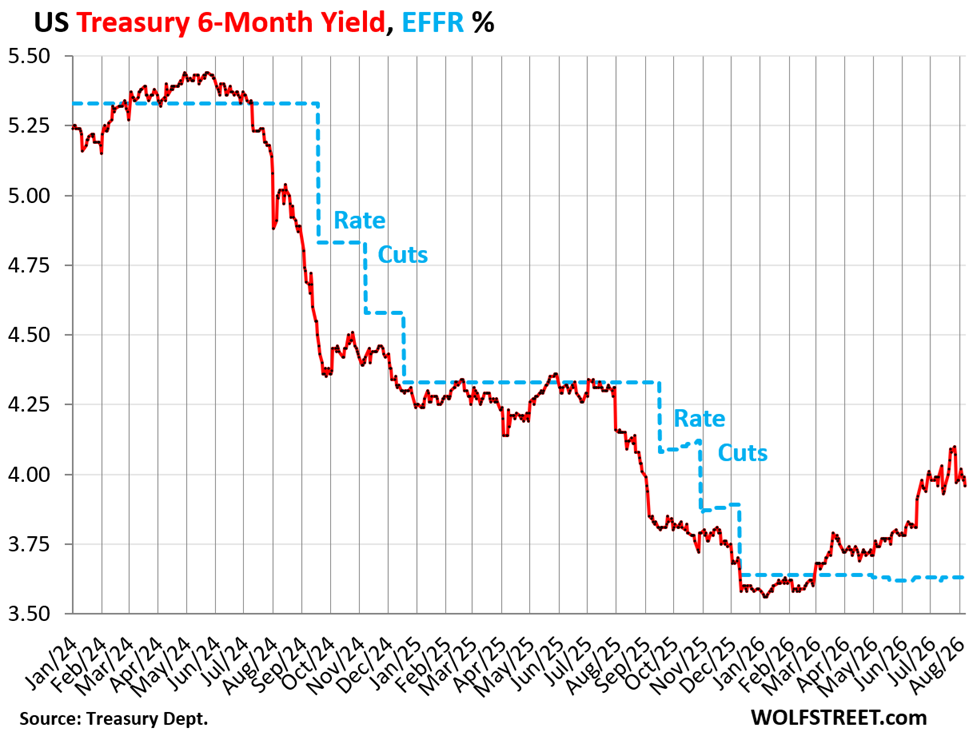
The 6-month T-bills sold at auction on Monday at a “high yield” of 3.855% or at an “investment rate” of 3.986%. That was down by about 10 basis points from the auction just before the FOMC meeting when 6-month T-bills had sold at an investment rate of 4.08%.
In the secondary market last week, the 6-month Treasury yield edged down about 2 basis points to 3.96% by late afternoon Friday, according to Treasury Department calculations (which are close to the “investment rate” at the auctions).
Note the mini-spike just ahead of the July FOMC meeting to reflect the expectation of a rate hike, and the drop-back since then.
The 6-month yield is now 33 basis points above the Effective Federal Funds Rate (EFFR, blue, 3.63%), which the Fed targets with its policy rates. So the expectations of a rate hike have remained intact, but shifted back to September.
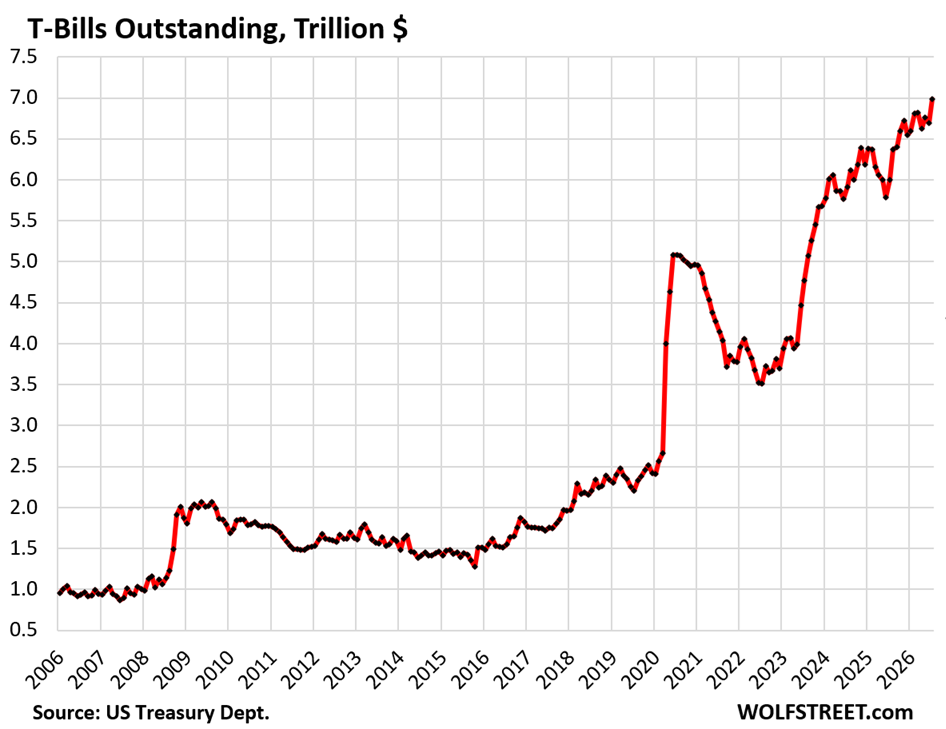
The surge in T-bill issuance has pushed the amount of T-bills outstanding to $7.0 trillion by the end of July, up by $1 trillion from a year ago, according to the Treasury Department, which releases this data monthly. The big-fat T-bill auctions this week are not yet included in the data.

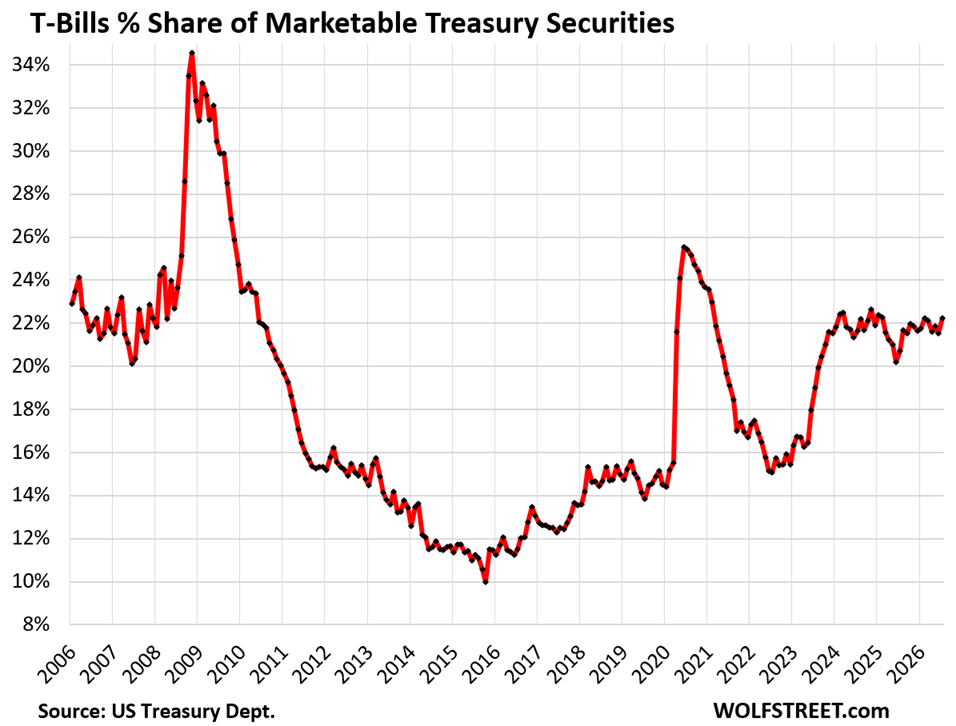
But but but… issuance of Treasury notes and bonds, oh-la-la, has also surged, so that the total amount of marketable securities outstanding has ballooned by $2.5 trillion year-over-year to $31.4 trillion at the end of July, and the share of T-bills has remained at around 22% of total marketable Treasury securities outstanding for nearly three years. In July, T-bills’ share rose to 22.2%.
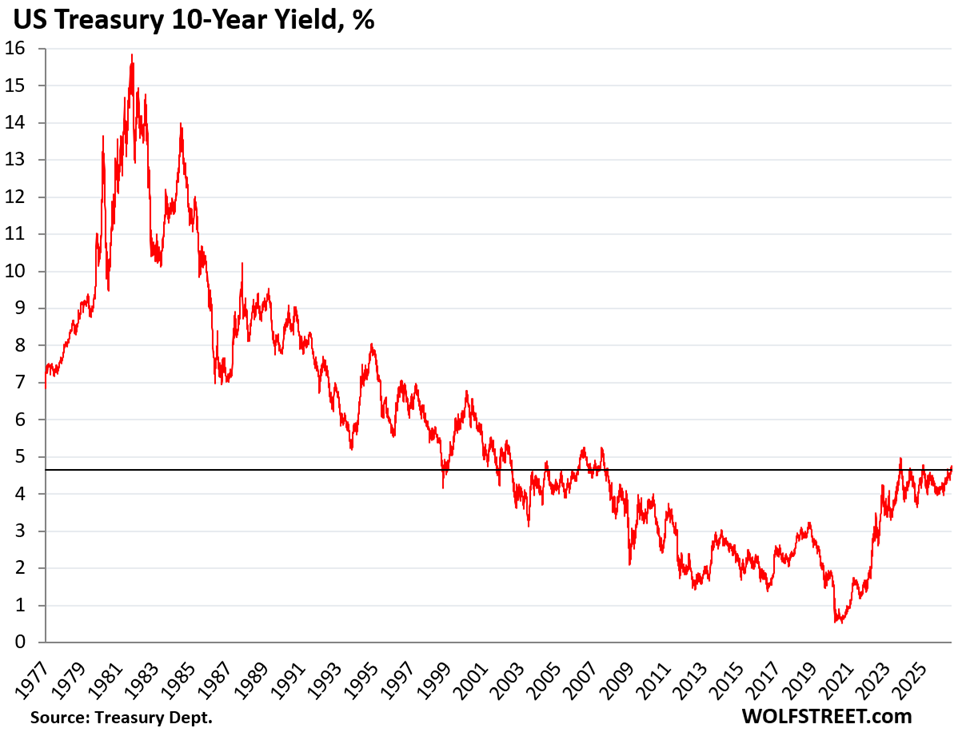
The 10-year Treasury yield declined by 10 basis points during the week to 4.65%, following the big-kahuna intervention in the currency markets that at least temporarily removed the threat from the bond market that Japan’s authorities would sell some of their Treasury securities to raise the dollars needed to buy yen to keep the yen from collapsing further.
But the inflation threat remains intact. Higher yields allow the bond market to live with higher inflation as the higher yields would more than compensate bondholders for the expected loss of purchasing power of the securities over the term of the securities. How much inflation buyers and sellers in the bond market expect over the next 10 years goes into this calculus. And these expectations differ, which is what makes a market.
This guy here is not a buyer of 10-year maturities at this yield, not anywhere near, because inflation has been hot for over five years, and the Fed has cut rates in 2024 and again in 2025, with the last three rate cuts occurring while inflation was re-accelerating.
That’s not a good sign, but a sign of a lax Fed that has chosen to let the economy run hot, with more nominal economic growth and more inflation, as a way to manage the growth of the gargantuan Treasury debt.
Supporting this theory was the fact that Warsh had made a huge effort multiple times over and over again during the FOMC press conference to dispel that theory with words – rather than with a rate hike and the announcement of more balance sheet reduction. Whatever his thinking may be – he’s a lifelong inflation hawk – but words won’t suffice, and a robust majority on the FOMC’s voting members are in the camp of letting the economy run hot.
Letting the economy run “hot” is a logical way of managing the debt, as Congress and various administrations have made zero effort to get the deficit down to where it would be sustainable without running the economy “hot.” We get that. But it makes long-term Treasury maturities unattractive at these yields.
The long view of the 10-year Treasury yield shows that in the big picture, the dip this week was practically nada; and that the 10-year yield can go a lot higher when inflation takes off, which is what the world’s top bond salesman is worried about.
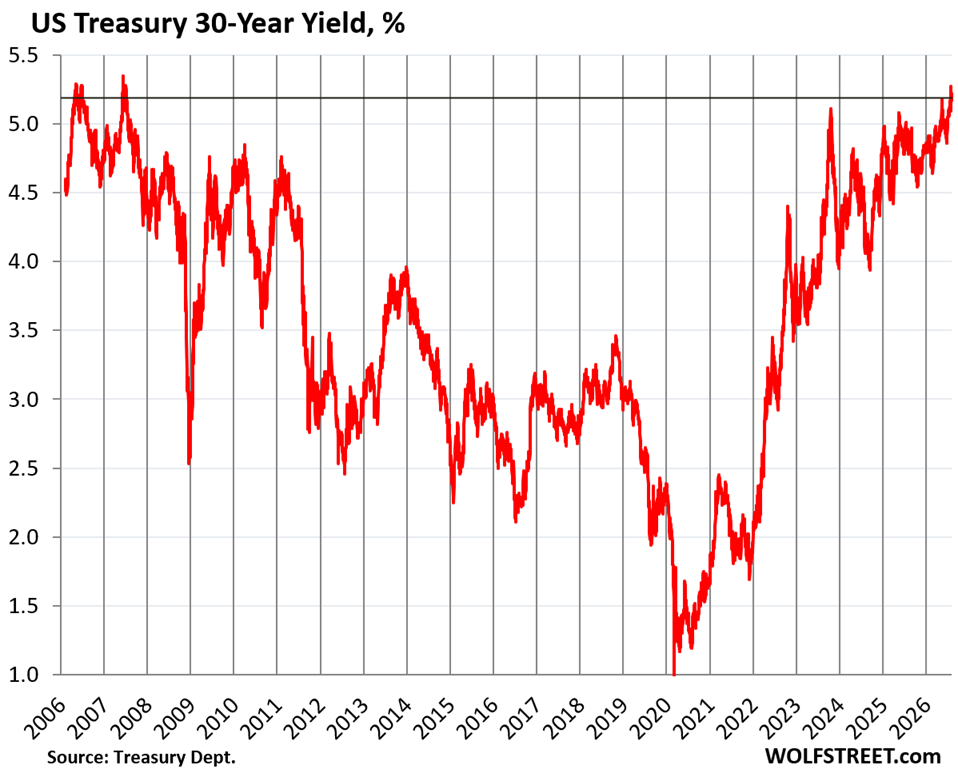
The 30-year Treasury yield declined by 8 basis points this week, from the two-decade high a week ago, to 5.19% on Friday.
The 30-year yield is less of a concern to our top bond salesman since issuance is relatively small, roughly half that of 10-year notes, and it doesn’t have the benchmark characteristic of the 10-year yield.
Markets use the 10-year Treasury yield for pricing of other yields, such as mortgage rates and corporate bonds. A surge of the 10-year yield drives up long-term borrowing costs across the private-sector economy. The 30-year yield doesn’t serve that function, and there were many years when the US didn’t even issue 30-year bonds. So the 10-year yield really matters, and when it goes over the red line of 5% at an auction, Bessent is going to have conniptions. But he’s probably not going to lose a lot of sleep over the 30-year yield.
In case you missed it: One Thing Is Clear about the AI Boom: It’s Burning Huge Amounts of Cash, and Alphabet Needs More
Enjoy reading WOLF STREET and want to support it? You can donate. I appreciate it immensely. Click on the mug to find out how:


The Fed has some competition. I just bought 1 mo. CD with 3.9% yield.
If you are living in California, a 1-month T-Bill might be a better deal than your 1-month CD. You don’t pay state or local taxes on T-Bills.
1. Wolf, take rest. World, US, treasuries can take care of themselves.
2. It seems, SGOV is the best foot forward at least for the next three months.
3. US, US Stock market is older than US itself. More than 250 years indeed. JP Morgan, Corenelius Vanderbuilt, Edison, Ford and Peter Lynch.
4. Bond market is larger than stock market. Smarter people (not necessarily rich) are in bonds not stocks.
5. Governments all over the world sacrificed bonds in favor of stocks for al most 20+ years (I stopped counting with my toes)
6. Please unblock Mr. Engles. We need to know if we are the only ones tripping.
“Corenelius Vanderbuilt” 🤣🤣🤣
The concern is not what you cite, but rather the amount of interest the US is paying on its ever-growing debt.
“Toto, we aren’t in Kansas anymore.”
What you really need to look at is interest expense in relationship to tax receipts that are available to pay for it. I track this quarterly, last one on June 30:
https://wolfstreet.com/2026/06/30/inflation-nominal-economic-growth-to-the-rescue-the-us-governments-ugly-fiscal-mess/
Yes
You make this point all the time, and I can’t say that I disagree with it. However, we haven’t had a real recession in almost 17 years, so when the next one arrives, the tax receipts will drop by at least $500B. And when this happens, that ratio will shoot higher. $32T is a lot of money & with the shrinking trust funds, it will get harder for the revenue from Intragovernmental debt (non-marketable treasuries) to pay for maturing bonds, making it likely public debt will be issued for these maturing bonds.
I want to say that I’m stunned that Congress is sitting on its hands so long, but I’m not.
Maybe Trump will survive the midterms and pivot to pushing through SS reforms, trying to save his legacy. I won’t hold my breath.
BenW, your post made me think of a headline I saw on ZH. As much as that site has turned into a moral swamp, the headline says what a lot of investors believe.
“ Hartnett: Tactically Bearish, But Strategically Bullish As Policymakers Won’t Allow Market To Crash”
Interesting that the ratio you graph depends on both tax receipts and interest payments, but the periods of large decline in the ratio come almost entirely from the increase in tax receipts (most likely due to economic growth).
Take off your pants CP, so you can at least count to 21 !! LOL
All seriousness aside, I have known lots of folx who appeared to have to do that and who also turned out to be savvy investors.
While there should be NO doubts for any investor following all, or at very least most, of the information and analysis Wolf’s Wonder provides, that will mean nothing if you ignore it.
Please don’t ”invest” with emotional blinkers on,,,
thank you,
” long term recovering SM investor”
Cobalt a derivative of ATT language, one step beyond the binary machine language back in the age of iron core magnets
@Wolf and @Cobalt Programmer – What happens to SGOV if the prices of 1-3 months TBILLS falls (i.e. yields go up) ? What could cause those conditons to happen? Will SGOV then be able to maintain a stable value of $100.zz or will it drop below that for a long time ?
Prices of short-term maturities change very little when yields rise or fall, unlike long maturities. SGOV primarily invests in Treasury securities with less than 3 months to run. That’s very short, similar to a Treasury money market fund. Yield changes can cause the price to fluctuates at little. If you hold T-bills in your brokerage account, you can also see the price fluctuate a little.
Who are the fools buying debt with a yield at 3.7 %?
Central banks suppressing rates again?
WB,
If you are hedging against a potential pullback in stock market and inflation increasing what would you recommend? I am one of those fools you speak of and combined with being in California this gets me over 4% compared to state taxable options. I am also closing in on retirement.
To.ke hedging against a downside makes sense especially given the SPVs and I knowns in private credit markets. Perhaps I am missing something obvious.
Ditto!
TIPS would offer at least some inflation protection, while maintaining state tax exemption. The 5 year breakeven rate between TIPS and nominals implies the Fed will start hitting its 2% target any minute now.
But really, you should never let the tax tail wag the investment dog. Shove the money into a Roth or traditional IRA and suddenly you’ll find a whole world of possibilities you’d never considered before.
Some of the highest yields are non-qualified, which doesn’t matter to me because I’ve built up my IRAs.
Sorry to hear that. Protective puts are VERY cheap. Learn how to buy them. Some equities are still paying 10-15% dividends. With a protect put on my position, I sleep well knowing that I am collecting the dividend (not re-investing) and will make triple the position if the stock goes below my strike price.
The same morons that were buying 20Y @ 2% in Feb 2021.
SVB anyone?
Once the Fed started buying treasury bonds, NOBODY should have bought any of that stuff. As I’ve said for years, a 5th grader with a decent understanding of inflation & bonds could have called what happened. Bond buying during heavy periods of Fed intervention should be considered toxic. Anything past 5 years makes absolutely no sense.
My hypothesis is that the villain is the Fed and their maintenance of an obese balance sheet om order to provide instant liquidity so that asset prices don’t fall
Warren Buffett
Do you mean Tbills at 3.7% ? What are the alternatives?
Protective puts are VERY cheap. See my post above.
……………………..”Treasury bills outstanding ballooned by $1 trillion year-over-year, to $7 trillion. But total marketable Treasury securities ballooned by $2.5 trillion. So…”
The elephant in the room is spending. Out of control, and The FED has no choice but to accommodate the spenders.
We JUST saw the passage of the “Big Beautiful Bill” that will increase the deficit by roughly $500 BILLION per year and still all the internet commenters are doing their duty and repeating the mantra that the deficit is due to a spending problem.
What, exactly, did we buy for $500B last year?
FWIW, look up “government spending as a percentage of gdp by country” and observe that the US is has a relatively low spend compared to many developed countries around the world. Especially considering how many wars we fight in the Middle East.
The elephant in the room is not spending but spending without being willing to pay for it. We as a nation have the means to pay down or even pay off our public debt but we lack the collective political will to do so.
The last comprehensive federal tax reform bill was passed in 1986. We now have 40 years of accumulated changes in the tax code without an overarching review for strategy or sustainability. Not sexy work but desperately needed.
Wolf, Excellent analysis, as always, and I particularly appreciate your thoughts directly on how you are thinking about the 10 Year.
It helps to formulate my own. Thanks and uhh, well past time for me to reward your insights.
Better later than not doing it
All well and good but I would appreciate your view of 10 year
My personal suspicion is that correct 10 year should be 7 pct
Of course recognizing the fact that I have been wrong for so long that people that I love routinely automatically bet the opposite way
I’m amazed at how resilient the financial system really is.
…I also worry about the unknown ‘last straw’ that will cause it to buckle. Increasingly I fear that it will be like a buckling tectonic plate that suddenly pops, and nobody knows where, how, or what the impact will be.
Interesting times!
It’s “resilient” because as of now, people are still willing to lend money at reasonably low rates to the U.S. when it’s clear that we’re not willing or able to tighten our belts.
I’ve seen this with small to medium sized businesses too, where they survive as zombie companies borrowing money, until finally, they can’t borrow another dollar and go bankrupt. Large sovereign governments are basically playing the same game, on a much larger scale. And of course, they can print the money if push comes to shove, but that just further destabilizes things.
Well that’s mainly because it’s a global issue to do with demographics as much as anything. Most developed countries have grown debt at similar rates, despite paying higher rates than we do. French and Italian, and Japanese and British forums have similar fretting without the economic growth, dynamism, or room to raise tax rates.
The financial system I argue is brittle and that the Trump administration is laying visible the weakness that the neoliberal capitalist society built.
They educated the well off in the Ivy league cauldron of horseshit
Since 9/11, almost 25 years ago, Gold has performed 2.4 times better than the dow jones.
two huge fallacies in your short sentence (and I don’t even know if your math is right): you ignore 25 years of dividends, and you picked when gold bottomed out in 2001 after a 20-year bear market 🤣
So here is a mental enema:
1. In 1980, gold was $850/oz. Over those 46 years since then, gold increased by 417%, barely outrunning CPI inflation which amounted to 390% over the time.
2. S&P 500 index, NOT including dividends, rose by 5,942% over the same period since 1980. The S&P 500 total return index, which includes dividends, doesn’t go back that far. It only goes back to 1988, so eight years less, and yet despite that 8-years-less, it returned 6,846% since 1988.
3. Gold is a speculative investment with huge manias and peaks followed by long declines that can last 1-2 decades. But over time it has proven to be a good hedge against inflation – but it doesn’t pay interest or dividends, unlike other investments. If you buy high and have to sell low, you can lose 50% to the price of gold plus another 40% in purchasing power of the remainder due to inflation over that period. Gold traders know this, and they make lots of money knowing this. People who invest in gold for the very long term know this, and they’re fine. Gold bugs don’t know this.
I really like the way you worded this.
There are a few of reasons to buy gold:
1. The most obvious is vanity. Jewelry, fillings etc. That isn’t being discussed here.
2. Local insecurity. Whether it means civil unrest (civil war or Jews escaping the Nazis), gold is a physical asset so it can be hidden or smuggled and at possibly hold its value versus inflation. It could also cover illicit behavior. Since it is physical and can be hidden or smuggled, and is untraceable, it can be used by individuals engaged in illicit behavior. Electronic currencies have taken part of this niche, but the untraceability of gold still reigns supreme.
3. A general hedge against inflation. Long term, gold generally matches, or ever so slightly beats inflation. Entry point and exit point matter a lot, but given random entry and exit points, a gold investor should generally match inflation. So someone who is looking to keep some portion of their assets liquid but still matching inflation, gold is the way to go. However, smart long term gold investors also know they are not beating inflation with their gold assets. Given their circumstances/outlook it might be perfectly reasonable to accept this tradeoff.
People who think they are making money long term by investing in gold are Gold Bugs. Gold Bugs need to cherry pick their start and end points to make it look smart because long term, gold doesn’t make a holder money.
And I would humorously point out what a pain in the ass owning gold is. Beginning with the trust issue. Does your gold physically exist
I mean I used to poor 1000 oz loafs
Not easy too handle
You can generate income with gold by selling covered calls or selling puts on gold ETFs.
Or by selling your wedding ring when your wife dumps you for spending too much time on this site.
🤣❤️
One word.
Diversification !!
Nothing is for sure…. And if somebody tells you it is for sure…. That is a sure sign that it is probably not even close to for sure.
Spread it out a bit.
also with gold, taxes are optional. carry it anywhere on planet to spend too.
Capital gains taxes on gold are optional in the US only if you don’t mind spending some quality time in a federal hoosegow for tax fraud.
why would a non usa citizen selling gold in usa, which does not trigger any 1099s, to purchase real estate or whatever, have to pay taxes in usa or back home. most countries don’t tax overseas activities. the usa does of course. i think you are confused. but too arrogant to admit.
If you’re US citizen or green-card holder, you HAVE to pay US income taxes on ALL your global taxable income, including capital gains on gold, you goofball. Sure, you can try to commit tax fraud and money laundering, just don’t get caught. In terms of foreigners who are not green-card holders, living in another country, well, I don’t give a f**k where and how they pay their taxes to their countries.
You have to declare gold just like currency, and where exactly are you “spending” gold?
Gold is not treated like a currency in any of the 196 countries of the world with the possible exception of South Africa, so it simply cannot be spent or invested like a currency.
And when the S hits the fan, it won’t have any value.
Food, water, shelter, batteries, solar panels & 2A equipment is what will matter.
Until then, it’s just a hedge like Wolf points out.
When the S hits the fan, I would much rather have a passport, foreign language skills, and an offshore bank account than some merchandise.
Think about it. If I dropped you in Haiti, Afghanistan, Venezuela, or Somalia right now, would you rather have this shopping list or the means of getting out?
Benw:
The problem is that the stuff is probably not gonna hit the fan…. I have been hearing that story for half a century, and no such luck.
A group in my home town in rural California decided the world was gonna end… this was the 70’s.
They built a warehouse and filled it with dry goods, 50 lbs sacks of beans of all types, rice, salt, etc. to the gills.
In the late 80’s the people were gone. Nobody to lay claim…. Nobody could find anyone that claimed any of it. My old man would periodically go get a bag or two of stuff for the family.
My observation as a young person
(one that has stuck with me my whole life)
The moral of the story is:
They did all that because of perceived global economic collapse.
Turns out the world did not end, but they did…..
and the end result for all their efforts is my family got free beans and rice.
That was shit is gonna hit the fan a half century ago…. Turns out not so much
I like your “spending gold” comment. When Obama was first elected, I had a co-worker who could best be described as a nut. He was 100% convinced that Obama’s election meant the end of the U.S.A. Muslims were going to take over and society was going to collapse.
I kid you not.
So he did what he thought was rational. He bought an old abandoned property in the middle of nowhere in central Illinois thay was drivable for him. He mortgaged it to the hilt figuring he never would have to pay it back. He then spent every dime he had and bought 5 American Eagle gold coins. He thought that after society collapsed, the dollar was going to be useful “only as toilet paper” (his words). So he wanted gold “to spend”.
I asked him how he was going to spend his gold. He said he would use it to buy food or whatever supplies he needed. I said I meant what were going to be the actual mechanics of his spending? He had 5 units of gold. That means he had 5 transactions he could make.
So if the collapse of society hit when he was at work and only had 1/3 of a tank of gas and therefore did not have enough to make it to his hidey-hole property? Was he going to use a whole American Eagle coin just to get a tank of gas?
Point being, putting assets into gold to prepare “for the end of the world” may, or may not be smart depending on the odds of the end of the world. But equally, do not forget to realize that gold isn’t as liquid as you might think in such situations. There are going to be huge transaction costs. So much that it means you REALLY,REALLY need to be confident that the end of the world is coming for thise type of investments.
If gold was a currency, it would be sold in BB size little balls for spending purposes, instead of collector coins to the Fox News crowd.
Just imagine how much better off your coworker would have been had he not developed the habit of consuming certain media.
Good points JimL. And Mark Twain (supposedly) stated one other survival option. “If the world came to an end, I’d go to Cincinnati and live for another eight years.”
Why does nobody seem to mention the endless series of “tax cuts” enacted over the years, as well as “tax spending” loopholes to pay off campaign contributions or other “PIK/fee-for-service legislation”, plus often stymied efforts at enforcing what’s already on the books (“no cops on the beat”)? Maybe we have a “revenue problem” as much as a “spending problem”. I am not an economist, so it’s just a thought.
Well you have Art Laffer and his Lysenko-level economic theories to thank.
I’ve never heard this analogy, but by damn it fits.
no, it’s always first and foremost a spending problem;
it’s a spending AND a revenue problem. You and yours thinks it’s mostly a spending problem. Me and mine think it’s a revenue problem. Neither one of us is objectively right or wrong – the only objective truth is that spending exceeds revenue. You/yours and me/mine need to come together and address the spending / revenue gap. We elect a Congress to do that work and it is fairly even divided between your perspective and my perspective.
My guess is that Congress and the Executive Branch will do nothing until an external force compels them. The bond market is one of the few forces that could do that.
I guess it’s safe to say that Japan wasn’t the first one in line at this T-bill auction. 🇯🇵 🤔😲
No, they’re on the other side. They’re scrounging up USD cash (by selling Treasuries) to build a pile to buy yen with in the future.
Looks like stagflation to me. Tax receipts are about to take a hit.
They’ll take a hit if stocks dive and capital gains taxes plunge. But that hasn’t happened this year. It happened in 2022, and you can see the results in the blue line. In Q1 and Q2 2023, tax receipts plunged because capital gains taxes for 2022, due by April 15, had plunged.
I was early. But the FED didn’t raise rates. Don’t know for sure but the rate-of-change in means-of-payment money, the proxy for real gdp, is decelerating rapidly – but not the proxy for inflation. The shift in deposits is unusual and there’s no history for it.
In my experience, a lot of people get the turns right.
Daneric’s Elliott wave has been looking for a top at the end of the summer since early spring.
“We’ll all has come to pass. One more small higher high and a completed impulse up would have formed. We’ll label this Minute [i] of Minor 5 of (5) of [5] up.”
I agree assets are grossly overpriced
About gold, that barbaric relic. I met my wife, a UK native in 1982 across the counter at Deak-Perara International’s Forex office in Anchorage. Deak did precious metals as a sideline.
After the Hunt’s failed attempt to corner the silver market and the price for junk silver dollars cratered from $50 to $10 I discovered an opportunity in cherry-picking the coins Deak got on occasion from their vault in NYC for their numismatic rather than intrinsic value.
From 1982-1985 I put together three complete sets of fairly high grade (VF-BU) Walking Liberty half dollars, a nearly complete set of Barber halves missing just the 1897-O, and a fistful of circulated commems. One more than one occasion I would buy a coin from Deak for ten bucks and immediately drive across town to the Dimond Mall coin shop where I’d sell it for over a hundred.
At the time I worked with a devout Mormon who insisted I should have a years supply of food. He was aghast I’d turn around and sell the stuff I bought rather than hoard it.
It got so annoying that in the end I told him I’d made arrangements to ensure our family was a prepared as his. I didn’t buy any food or gold. I didn’t need to. Instead I’d acquired a .357 revolver and a Remington 870 shotgun and if times got tough I’d just come over to his place and help myself.
Point being, about once in every ten to fifteen years or so an opportunity may arrive to make a bit of profit in metals but it is not a sure thing and as my father always warned me, ‘a fool and his money are soon parted’.
In my experience the only ones who consistently win in the precious metals money game are the dealers. And PT Barnum’s estimate of there’s one born every minute was an undercount.
Cool and thank you
does the gold that one has paid for actually exist
I looked up the EUR:YEN exchange rate, and it appears the Euro dropped significantly against the Yen when Bessent and Co. did their little maneuver to protect the dollar.
Since then, the Euro has started appreciating in Yen terms.
If currency interventions can only temporarily suppress prices, perhaps borrowing Yen and buying Euros would be a good trade right now?
Tables have turned.
In 2024, Miran and Bessent criticized Yellen for being Activist Treasury Secretary by tweaking issuance. Lot more short duration and small long duration.
After Bessent is sworn in, he is doing same thing what Yellen did. At least during Yellen time, FED was doing QT. So she had “some” Excuse.
Bessent has tweaked issuance more than Yellen. He is pushing it out to 2027-2028.
So lets see if Warsh will stay true to his word on Reduction in Balance sheet. Talk is cheap.
You haven’t figured out yet that its all the same table? Red or blue you’re gonna get screwed.
Mega intervention, for a moment.
How much firepower will we devote?
Steep drop, and immediate turnaround/bounce.
Dollar milkshakes? IDK.
I’ve never been a Forex guy. But this Yen intervention has me paying attention. It appears that about 25% of the prop effect from last week has already been given back – Yen at nearly 159 to the dollar again. How many times will the US Treasury hit the button to bail this whole Yen carry trade/UST system out? Is the BOJ quietly selling UST in the background to raise dollars – they just didn’t want it all to happen too fast and cause a panic? UST 10-year back to 4.69% this morning..
so poster OBC threatens a co-worker with armed robbery at gunpoint yet those that got godl are the cooks?
It was a joke.
Wolf you wrote “The 30-year yield doesn’t serve that function…”
What function does it serve?…how does it behave vs the 10 year yield?
the 30-year Treasury yield is generally higher than the 10-year yield except.
The function for the government would be to spread the costs over a longer period of time, which is better suited for long term projects such as infrastructure. If they are not using long term bonds to finance a railroad, they are effectively making the current generation pay for benefits that will last a century. It also removes financing risks on long-term projects. For example, you don’t want a 10year bond yield going up to blow up your new nuclear plant business case when you’re halfway through building. Same for large asset heavy companies, think industrial investments that need more than 10 years to break even.
The function of the 30y in the financial market is similar from the bond holder perspective. Pension funds or life insurers for example accept the kind of long term liabilities that require the certain and stable sort of income that only 30y bonds provide.