
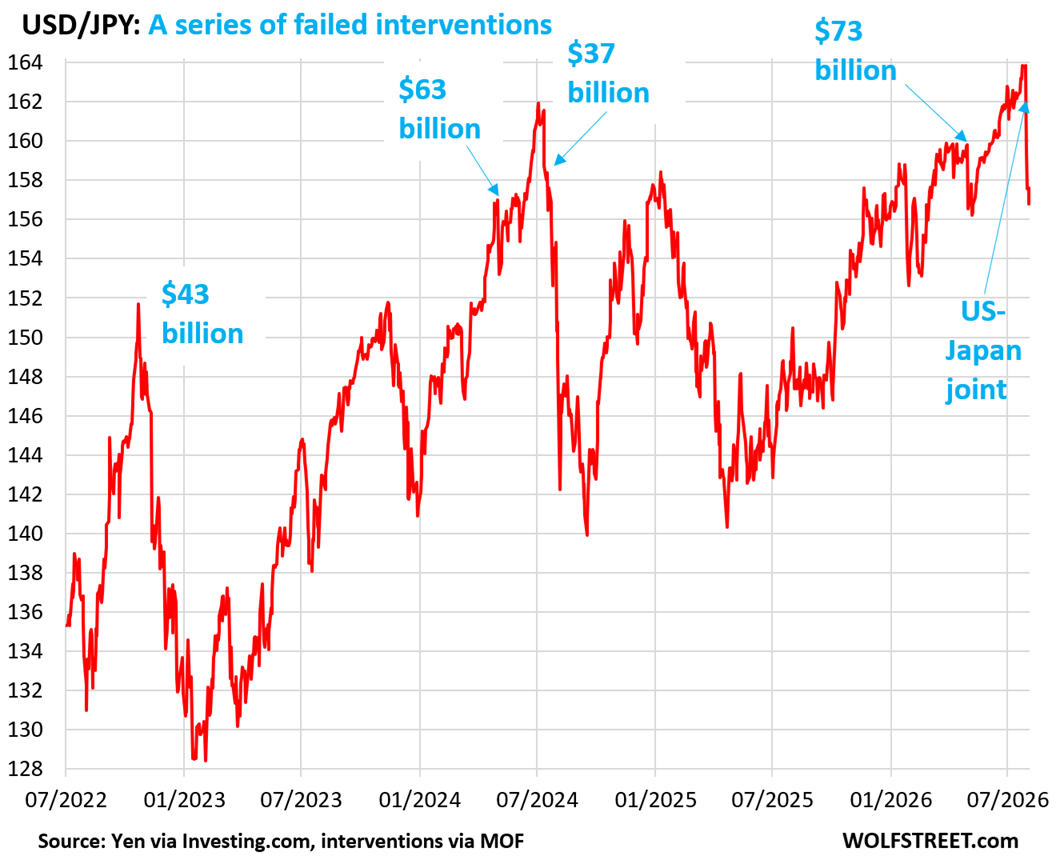
But the prior interventions failed to permanently turn around the downward spiral of the yen. What’s needed: much tighter monetary policies by the BOJ.
By Wolf Richter for WOLF STREET.
There were fears Japan would have to sell US Treasury securities to raise the USD cash to buy yen, as it battles to prop up the collapsing currency. This forced selling of Treasuries would have led to a further spike in Treasury yields. And it’s Bessent’s job – as the top bond salesman in the US – to keep those long-term yields from blowing out despite whatever else is going on. To forestall this forced selling of Treasuries, all kinds of stuff happened.
The numbers remain a secret, but the move has been confirmed by both Bessent and the Japanese Ministry of Finance: The US Treasury Department via its fiscal agent, the New York Fed, and Japan’s authorities jointly intervened in the currency market on Friday to prop up the yen, which had plunged to ¥164 to the USD by July 28.
Rumors about an impending joint move had already pushed up the yen on Thursday. Then in a piece of visual theatrics, Bessent put a one-item “To Do” list in view of the cameras at the cabinet meeting at Camp David on Friday. The only item on the list was “Buy Japanese Yen (JPY) $5 – 10 bill.”
According to a leaked comment published by the Financial Times, the New York Fed sold euros in its reserves – not dollars – and bought yen with the proceeds on Friday. The use of euros instead of USD has not been confirmed yet.
The amount was not leaked. But Bessent gave an indication with his “To Do” list. At the same time, the MOF and the Bank of Japan also intervened and bought yen.
(The MOF announces the amounts of interventions monthly, with the cut-off date being around the 28th, so the amount will be disclosed at the end of August).
The rumor effect before the intervention, the theatrics, the intervention itself, and the announcement and confirmation effect resulted in a jump of the yen against the USD, from about ¥164 to the USD on Wednesday to ¥156.9 currently. This joint intervention was the big kahuna.
And both sides said that they would be ready to do it again, if needed.
Sure, but the prior interventions by Japan failed to turn around the downward spiral of the yen; they just provided temporary reprieve before the yen started spiraling down again.
Much tighter monetary policies by the BOJ – including lots of QT and much higher rates much faster – need to happen to permanently end the plunge of the yen. The yen is getting crushed by the BOJ’s crazed monetary policies from 2012 to 2022. That’s the root cause. What’s amazing is that they got away with it for so long. All monetary sins ultimately lead to the currency.
Interventions are just temporary window dressing. And the big kahuna of interventions will be tested again.
And to forestall forced selling of Treasuries by Japan, the Bank of Japan will use the Fed’s Standing Repo Facility (SRF) for Foreign and International Monetary Authorities (FIMA) instead of selling Treasuries.
At the FIMA SRF, approved foreign central banks can put their Treasury securities as collateral for USD cash. This shift to the FIMA SRF, rather than selling Treasuries, was also part of the announcement, though the BOJ has had access to the FIMA SRF for years.
The Fed announced the establishment of the FIMA SRF on July 28, 2021, when it announced its regular SRF that US banks can use. This standing FIMA repo facility replaced the temporary FIMA repo facility the Fed had created in March 2020.

And this shift to the FIMA SRF by Japan to get USD liquidity for future interventions removed pressure from the Treasury market. And Treasury yields of 2 years and longer declined this morning, with the 10-year Treasury yield falling by about 5 basis points to 4.69%, and the 30-year Treasury yield falling by about 4 basis points to 5.23%.
The yen got crushed by a decade of crazed monetary policies. But the collapsing yen, and the resulting inflationary pressures feeding into the economy via now much more costly imports (in yen terms), has forced the BOJ to back off those policies.
But the BOJ’s policy rate is still only at 1.0% after five baby-hikes spread ridiculously far apart over more than two years, and remains negative in real terms (below the rate of inflation). So this hasn’t accomplished anything. It needs to hike a lot and fast to put a floor under the yen.
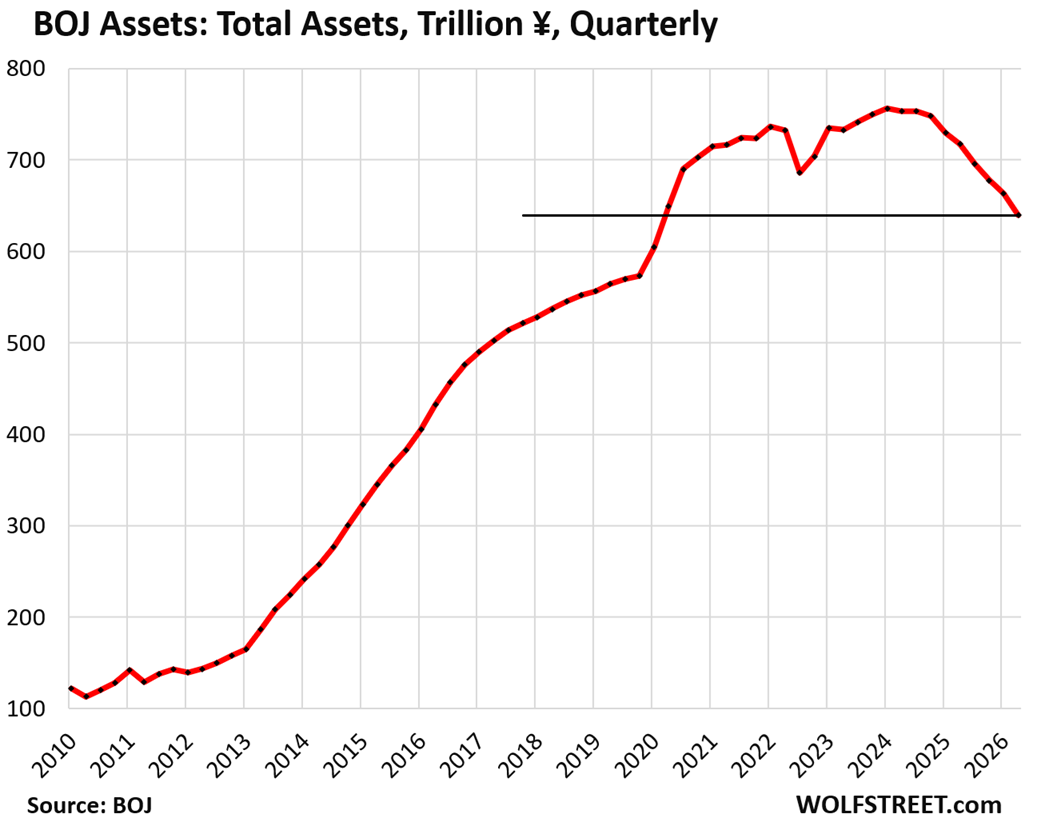
In late 2024, and to its credit, the BOJ started QT that it then accelerated, reducing its balance sheet so far by about 16%, which may have slowed the yen’s downward spiral, but it wasn’t enough; it needs to go much deeper. And it needs to hike its policy rates a lot more to put a permanent floor under the yen, instead of goofing around with these currency interventions.
Enjoy reading WOLF STREET and want to support it? You can donate. I appreciate it immensely. Click on the mug to find out how:


“the Bank of Japan will use the Fed’s Standing Repo Facility (SRF) for Foreign and International Monetary Authorities (FIMA) instead of selling Treasuries”
Isnt this part of the trend of increasing the moneyness of US Treasuries. Similar to Stable Coins.
Does the original issuance of Treasury Debt, borrow money into existence ? And now we can also use the DEBT itself as money ?
What does this mean for definitions of money-supply ? Anything ?
1. “Isn’t this part of the trend of increasing the moneyness of US Treasuries. Similar to Stable Coins.”
No, nothing to do with it. The BOJ used the temporary FIMA facility in 2020, like other central banks. It provides them temporary dollar cash in exchange for Treasury securities. At the time, banks in other countries had trouble getting dollar cash for their clients (such as borrowers that had to service their USD debts) due to the turmoil in financial markets.
2. “Does the original issuance of Treasury Debt, borrow money into existence ?”
Issuance of Treasuries does not “borrow money into existence.” It borrows existing money from investors and spends it in the economy.
3. I don’t see how the BOJ using the FIMA SRF to sell those dollars and buy yen with for a brief intervention that then gets unwound (these are “repos”) has any lasting impact on US money supply.
What this does show is heightened worries about Treasury yields blowing out.
While I agree that the original issuance of Treasury debt doesn’t increase the global money supply, if a significant amount the dollars used to buy Treasuries comes from outside the US, the amount of dollars inside the US will increase, which could lead to increased inflation within the US. If when these Treasuries mature, if they aren’t rolled over, then those dollars could leave the US, having the opposite effect.
Wrong mechanism. Money supply is largely irrelevant for inflation; significant foreign buying of treasuries reduces the interest rate which increases investment and leads to inflation.
Liked – fed selling EURO’S to buy JAPPY BONDS
Personally I don’t pine for the good old days rather I mourn their loss
I don’t know about directly causing inflation.
Instead, more government debt leads to treasury notes/bills/bonds competing with private and local debt.
Ford, Google, or such might need to price their debt just a bit juicer because they are competing with the Federal government for people to lend them money and the Federal Government has huge advantages.
It also sucks for some local metropolis that wants to sell bonds to build a new bridge or highway. They are also competing with the Federal Government.
“…will use the Fed’s Standing Repo Facility (SRF) for Foreign and International Monetary Authorities (FIMA) instead of selling Treasuries.
At the FEMA SRF, approved foreign central banks can put their Treasury securities as collateral for USD cash. This shift to the FEMA SRF, rather than selling Treasuries, was also part of the announcement, though the BOJ has had access to the FEMA SRF for years.”
It’s almost too perfect, that errant autocorrect from FIMA to FEMA.
🤣Thanks
The Fed continues to act as an enemy of the people. They are intentionally destroying saver’s purchasing power by suppressing interest rates below the rate of inflation wherever possible. This guarantees the governments debt load / liabilities are being reduced in real terms. Meanwhile, their actions directly force the working class to stretch deeper into risk assets to try and maintain their purchasing power — which is a must if the working class wants any hope of retiring. Some people here pretend the Fed has no responsibility for the fallout when markets crash and investors suffer. Such a view is blind to the malevolant behavior of the fed.
“Some people here pretend the Fed has no responsibility for the fallout when markets crash and investors suffer. Such a view is blind to the malevolant behavior of the fed.’
Some people are always want to over-interpret and demonize. The Fed is at worst a misguided institution doing marginally more harm than good. That you want to attribute”malevolence” speaks to a victim mentality. Plenty of countries with institutions nothing like the Federal Reserve experience regular market crashes.
Yeah, stop being mead to the Fed! Quite being a bully. Everybody makes mistakes. Leave the Fed alone. They are trying their best. At least their intentions are good. I’m flush with inflating assets and am tired of hearing how the Fed is responsible for this or responsible for that. If you don’t like money, don’t use it. It’s that simple. Nobody made you use money. Cash is trash anyways. Cash is for the garbage class. It’s in the same category as payday loans. People need to take responsibility for not being lucky, in the right place at the right time, getting in while the market was hot, marrying up, having a rich dad, or getting a really cool job that pays a few hunid grand a year. Poor people wreak of desperation. I can usually smell their poorness and try to avoid them. Best not to associate with them or acknowledge them. I’m on team Fed and my stocks and properties tell me all I need to know about investing wisely.
I had lobbyist friday debate me about ‘inflation’ being fake word
with real meaning ‘devaluation of fiat $dollar’
he would say – so inflation isn’t real
I said: it is devaluation of fiat $dollars buying power
what would you recommend for fed
I said ABOLISH IT
he said in 1944 – end wwII the brenton woods agreement was for US to keep stable CURRENCY globally and to deter agression globally by any country
I said WE ARE NOT WORLDS COPS – he didn’t like that statement
“…the New York Fed sold euros in its reserves – not dollars – and bought yen with the proceeds on Friday. The use of euros instead of USD has not been confirmed yet.”
Isn’t this level of government intervention in currency markets the opposite of the hands-off, price-discovery approach advocated by Kevin Warsh? I wonder if KevWar is irritated by Treasury’s efforts to keep big institutions from selling off their US treasuries.
Or maybe it’s all just rhetoric and nothing has changed.
Yes, for the US, these interventionist actions (Argentina last year) are new. Using the SPR to push down global oil prices falls into the same category, but under the energy subcategory. The free markets died, long live the free markets? 🤣🎉
That we did it for domestic politics rather than good monetary policy is pretty wild.
Somehow…I don’t think we would have intervened if they had an administration like Brazil’s current administration.
Duh? Trump is clearly a creature of patronage, and we’re quickly returning to a patronage system for running the Executive. Back to the 1800s.
this time it’s different.
Yes, it’s all out financial warfare. The empire’s house of cards are so crazy that they are resorting to blatant corruption and market manipulation in full naked view with no shame. Not a drop of shame. It’s a major reason for the wars. We must kill to cover up other crimes. Let us sacrifice the children to ensure retirement is attainable for the current asset holders. Look at congress. The leadership are a bunch of geriatric mass murdering serial killers.
Obviously your rant is not helpful because it makes claims that are unlikely to occurre
Which creates the mess we find ourselves in. The cavalcade of the dumbest people being in charge
What are the downsides to the US for this move, I keep getting mixed answers? I can’t wrap my head around sterilized and unsterilized currency interventions, but from what I can tell we’re going to be having more of them…
In this deal, when the NY Fed sold euros (if confirmed), the US took no risks other than switching the currency risk to the yen from the euro.
The US is meddling in the currency markets, but that’s not really a downside risk per se. The SNB has been doing that forever.
Stupid, offensive name, not funny. Grow up. Surprised Mr. Richter lets you use it.
His name is just fine, stop being a crybaby.
I asked Gemini AI what “Ray Charles’ Tennis Coach” refers to, and here is the uncanny answer, I kid you not:
“Ray Charles’ Tennis Coach” refers to a regular commenter username on the financial and economic blog Wolf Street, used humorously to symbolize someone utterly useless or absurd, playing on the fact that Ray Charles was blind.
If you would like, I can help you find:
Specific comments or articles where this user has posted on Wolf Street
More background on the running jokes and culture in the Wolf Street comment sections.
Don’t you all LOVE AI?
I am engaging in laughing out loud right now. LoL
snort…snicker….
Fantastic stuff. Where do I buy tokens?
Everyone gets their 15 minutes of… AI?… fame
For the record, he’s a wonderful musician who could absolutely see what was funny about this.
Call the Karen Squad
It reminds me of a Far Side cartoon where a female chimp said to a male, “Oh, I see you’ve been galavanting about with that Jane Goodall tramp.”
The usual suspects got all whiny and complained to the publisher. When the publisher contacted the Jane Goodall foundation, they were told that the real Jane Goodall thought it was hilarious.
Can the BOJ hike aggressively, considering how much debt they have?
They have to choose: blow up the yen or hike. They can afford to hike, but they have adjust fiscal policy to reflect that.
The interest rate of long-term debt increases only when the debt issues mature and are refinanced at a higher rate. So it takes many years for higher interest rates on long-term debt to become interest payments.
I don’t know what is Japan’s current budget to guess whether a government can survive fiscal cuts. I do wonder if that is realistic, considering where they are demographically. Old folks vote and they are getting very old.
Since their preferred solution, human robots!!, seems to be decades away, I wonder if they will finally relent and allow some (gasp) immigration.
Japan’s fiscal budget over the last few years wasn’t that bad, and the debt to GDP ratio actually declined quite a bit.
but the new prime minister wants to open the spigot again, and that’s when the Japanese bond market got spooked.
They have been increasingly allowing immigration–they are at 4M foreign residents vs 1M in 1990, though most are on a work visa of some kind rather than a citizenship track.
Part of the challenge is that Japan isn’t a particularly attractive destination for high-skilled migrants since 1) everything is done in Japanese instead of English so you’re in a ghetto careerwise 2) adding to the ghettoization, the corporate world is very behind technologically (you can imagine how well AI is being utilized), and 3) the culture is still Japan so good luck getting a promotion based on merit, even if they ignore your being a gaijin.
I’m friends with a Chinese multi-millionaire who’s been based in Japan (Roppongi) for nearly a decade now. Had an interesting breaking point lately where his kid entered high school and the private tutoring centers have restructured the social networks among the teenagers, now clustering them by how difficult it is to get into the center. Of course the assignments are made along very Japanese lines not necessarily reflecting academic merit, so he’s sending the kid to the US for an elite private high school instead, which quickly realized his talent.
Japan these days has basically a single growth driver — tourism, mostly fueled by how cheap Japan has become for foreigners.
A weak currency helps this — they don’t care much about the population getting poorer.
“Japan these days has basically a single growth driver — tourism, mostly fueled by how cheap Japan has become for foreigners.”
Depends a lot on the visiting population. For Western tourists it’s much more a cultural attraction–the typical American tourist has no idea about long-term exchange rates. For those from East Asia, particularly China, exchange rate is a huge driver due to the onerous consumption taxes within the mainland.
The big jump in visitors came in the mid-2010’s when Japan eased entry requirements for visitors from Asia, particularly China, with tourist arrivals increasing from 13M in 2015 to 32M in 2019. After the pandemic ended that’s now increased another 10%
I think the BOJ deserves to collapse given they’re reckless application of QE
printing money as a means to prosperity is the fallacy that my truck driver dad worried about
Yes, the countries that have exercised the strictest monetary controls have been the most prosperous over time… This is the same kind of folk wisdom that tells you it’s never a good idea to use debt.
Wolf,
Over the past several months, one of the recurring themes in your articles has been that long-term Treasury yields are increasingly being driven by market forces rather than simply by the Federal Reserve. That has me wondering:
If you had to assign approximate weights to the major forces influencing long-term Treasury yields today, how would you allocate them among:
– Federal Reserve policy
– Global investors
– U.S. fiscal realities
– Inflation expectations
– Economic growth expectations
And ny other factors you believe deserve significant weight
I realize they overlap and can’t be measured precisely, but I’d be interested in your judgment regarding which forces currently have the greatest influence and how that ranking has changed over the past decade.
Thank you for consistently helping readers understand the Treasury market.
I would assign random weights… except the last item on the list, I don’t think it plays much of a role, though the Fed likes to cite it.
That is a laughable pretense that you realize they overlap and can’t be measured precisely, but I’d be interested in your judgment
I think that love is the most likely outcomr
I think the Fed is interested in market stability. This intervention was not to stabilize a disorderly market. The Yen-Dollar exchange rate was pretty normal, but was approaching a thresh hold of 163 Yen to the dollar, and Bessent said the Yen was undervalued. He was in effect saying the Markets are wrong and He is Right (or more likely the Omniscient Trump is Right). The markets were saying the Yen was correctly valued given Japan’s fundamentals (e.g. higher oil prices, higher deficits). Post intervention, i.e. today, the Yen is showing signs of weakening again. Mr. Market will have the last word unless BOJ and Bessent keep trying to maintain an unsustainable Dollar-Yen interest rate differential and the Strait of Hormuz stays closed. The Fed raising interest rates (probably soon) will force that differential even higher, encouraging more arbitrageurs in the Carry trade. What does Bessent plan to do about that, other than front-run such trades himself (when he pauses intervention) and make a bundle? All of this seems to me pure ad hoc (i.e. Trumpian) economic policy. Trump loves twirling the dials (tariffs, sanctions, export controls, interventions, wars), and now has to move more dials to counteract the blowback effects of other stupid decisions. Add it all together, and he’s like a child with a toy he doesn’t understand. His advisors just cheer him on.
I think this is more about Bessent seeing that Warsh was happy long term rates were rising and thought he found a way he could suck up to Trump. He figured he could sell it to Trump as a way of keeping down rates (because Japan selling U.S. debt increases the rates at which new debt would be sold).
Fortunately, Warsh understands markets far more than Bessent does.
Is this intervention also a possible reason for the drop in the 10 year with the possibility of Japan dumping their USA treasuries ?
Seems Post GFC and Post COVID the the entire monetary system has been augmented/re-architected so that when there is even a whiff of trouble someone is running out and sticking their finger in the dike.
How the hell is the system supposed to correct itself. All these band-aid fixes are essentially telegraphing the the peons that the currencies will be debased always.
I actually almost hope something goes off the rails there is way to much leverage and gambling in the system – as per Michael Green’s recent note.
Seems everything is just rigged to go up.
Well, this is what the voters asked for when they said “we want more jobs!” and voted against incumbents if the stock market took a dip.
Political candidates responded by promising more and more government intervention in markets. Now we’re to the point where the government has equity stakes in numerous companies, and are collaborating with foreign countries to nudge exchange rates.
What’s really odd is watching the Fox News crowd rail against socialism while being the socialists.
Chris B., you’ve bought the lies of CNBC, the NyTimes, the WSJ, Bloomberg, and all the others, hook, line and sinker.
The average American does not vote against incumbents if the stock market drops. If unemployment rises, some might, sure, but if a bubbled stock market is all it took for incumbents to be elected, Trump would have been re-elected in 2020, and Harris would have been elected in 2024.
The average American has some money in a 401k, but not even close to enough to live off of, meaning they’re more concerned with inflation than they are stocks.
Hilarious that you of all people accuse others of buying into propaganda. Self reflection has never been the calling card or the MAGA movement.
You completely missed or ignored (willful ignorance most likely) his point about this Trump administration being one of the most socialist in a long time. Imagine Biden investing billions in multiple companies. You would have had a cow. You would have been whining at max volume.
Now you are strangely quiet about it.
Willful ignorance is a shame.
“Imagine Biden investing billions in multiple companies.”
He did via BBB, and won precisely zero credit for bring jobs and tax revenue to republican areas. 3nm chips start rolling off the line of Phoenix tsmc in early 2027. Of course politics is mostly about cultural signaling though.
LOL. He did NOT “invest.” He gave away hundreds of billions of dollars in form a grants, and that money will never be seen again. He also issued lots of low-interest-rate loans to these companies, and loan-guarantees. He took zero equity stakes. Nada. It was a huge give-away party. And sure, giving away that much money had some effect. But it’s our money that he gave away.
Lots of stuff goes down. Just not the stuff we WANT to go down!.😁
“What this does show is heightened worries about Treasury yields blowing out.”
The other rumor circulating is that the Gulf States are actually the ones “begging for a stop” to the Trump/Israel war on Iran. Supposedly they told the US: If we can’t sell Oil the we can’t buy US arms or support our countries so….we will have to sell Treasuries.
Given the long end is at multi decade highs and ready to “blue sky” the yields, Trump et. al. are being gently coerced into some murky waters by selling Euros, Letting Japan us the Repo and for a cherry, trying to find an exit from the disastrous Iran war. The Emperor has no clothes.
It’s like one of those Saturday morning movie serials we REALLY old dudes used to watch. You’d get a Movie and a western or sci-fi shorty for maybe 15 minutes then a cliffhanger end….come back next Saturday! The Bond market is alike a rumbling volcano beginning to swell. Can King Trump stop it? Will Sir Bessent save the Day? Will the gallant Warsh pull off a miracle? Tune in next week!
“we will have to sell Treasuries”
lol, those stupid rumors that you’re dragging into here. I should just delete this crap. Do your rumor-mongering somewhere else. The Gulf states are small-scale holders of Treasuries. Here are the top two. Each holds minuscule portions of the US debt and of the $9.4 trillion with a T of total foreign holdings:
Saudi Arabia is #17 of the top 20 holders: $140 billion, about 1.4% of foreign holders.
UAE is #19 of the top 20 holders: $119 billion, about 1.2% of total foreign holders.
Japan holds 8 TIMES as much as Saudi Arabia and 10 TIMES as much as the UAE
What do those numbers mean in the context of daily volumes? Even a slight shift in supply or demand could shift interest rates.
Lol no. Or more accurately, only in the very short term.
Wolf – what’s the reason the BoJ hasn’t already hiked rates in the manner in which they should to stem JPY depreciation?
It can’t be that they’re concerned about unrealized long term JGBs collapsing because that’s already happened, eg 30yr JGB etc. – so what’s reason to delay the rate hikes on short term gov debt? Does short term debt affect the market differently in Japan than in the US?
Thanks
They went through 10 years of the crazed monetary policies of Abenomics, including huge QE, ZIRP, NIRP, YCC, et al. If took a new head of the BOJ to move the BOJ away from Abenomics. The BOJ’s policies from 2012-2022 destroyed the yen. So now you want the BOJ to save the yen? Free money and negative interest rates are addictive for politicians. All this stuff is toxic for the human brain, and those involved and those anywhere near them cannot even think anymore. They just turn into zombies.
It goes farther back than 10 years.
My recollection is around 2000 the BOJ and its advisor Paul Krugman began to engineer the “new” monetary policy of ZIRP.
They were the first to ZIRP and now they are the first to blow up.
The Fed followed their policies to an extent……drove rates to .25 .
The first to go is a precursor to the others……us!
Another bailout. The Bessent “put.”
Why doesn’t Japan raise their interest rates to protect the yen? Not sure, but I think it has to do with the “Cary trade”. They borrow cheap yen in Japan and put it into the u s stock and bond market. Increasing interest rates in Japan could end that scam and hurt the u s markets.
If Warsh raised rates Japan could raise rates. But Warsh let Bessent handle it and crazy that the markets didn’t blink, except a little relief in rates.
Warsh didn’t raise rates. For all his bold talk against inflation he’s now voted twice to keep rates steady. How is he getting credit when he’s done nothing?
Japan won’t raise rates to protect the yen for the same reasons that KevWar won’t raise rates. It’s all about fear of a recession EVER happening.
The Fed chair CANNOT dissent. They’re finished if they dissent because it shows that they cannot build a majority. Their job is to build a majority. If they cannot persuade others to come to their view, then they have to vote with the majority.
I have explained and re-re-re-re-explained this to you (and others) many times already. I’m plumb out of patience.
But why? They can’t be removed during their terms, so they can be unpopular.
What’s to stop someone like Warsh from getting up there, voting for an increase, and in his dissent statement, “We really need to raise rates, but my foolish colleagues are more concerned with their stock portfolios than the jobs they’re supposed to do.” They could be embarrassed into either resigning or caving.
I don’t see why the Fed has to be cordial while, for example, the Supreme Court, does not.
Like I said, a Fed chair who dissents on a monetary policy vote is finished. They’re finished with Wall Street, they’re finished with their own colleagues, they’re finished globally, they’re finished with the credibility in being able to accomplish a majority.
There was only ONE Fed chair that ever dissented: Marriner Eccles, at the meeting in December 1938. And even he did NOT dissent on a current monetary policy decision but on a vote on structural changes to the Fed’s balance sheet.
It doesn’t matter if you can see that or not. That’s just how it is, and people cannot come in here and over and over again post nonsense about Warsh not dissenting.
Because what’s the point of being a leader no one listens to? Sure, he probably can’t be removed, but if he can’t convince the board to do anything, he’s useless.
Yeah, those insinuating Warsh can dissent are missing how much relations and internal politics matter in a closed body such as the FED.
A FED chair who builds credibility (meaning not their first or second FED meeting) might (strong MMMIIIIIIGHT) be able to dissent as a sort of slap in the face to the board, but that is literally a once in a generation, wake up call. Furthermore, they have to be right. 100%, absolutely certain right.
Masayuki Nakajima on linkedin has interesting comment.
Would it be wrong or misguided to tie US support for these moves to be tied to at least a small increase in their rate, or do the moves actually strengthen our position and therefore, we can’t insist on any quid pro quo?
Would be interesting to know what Bessent said behind closed doors to his Japanese counterparts, and whether they agreed or whether they just politely nodded their heads. But the BOJ decides on rate hikes, not the MOF.
These blatant market interventions destroy the very notion of the free market. Even if a treasury sell off could be averted without propping up the yen, it shouldn’t even be an excuse for the US to help the BOJ. Call me old fashioned, but it’s time to let the chips fall where they me be. Let the market do the work.
Mr. Wolf writes: “Sure, but the prior interventions by Japan failed to turn around the downward spiral of the yen; they just provided temporary reprieve before the yet started spiraling down again.”
From this statement, the Treasury is buying high; if in similar circumstances the yen still went down in the past. Therefore, Japan is spreading its monetary loss policies from the Japanese central bank interest rate repression. The future losers being the USA proletariat. Just like the movie: “Margin Call” when the finance company unloaded it’s worthless paper securities.
The Treasury isn’t spending USD to buy YEN. It’s spending its EUR holdings to buy YEN, swapping one foreign currency for another. The EUR was a lot lower than today over the years, and in the early years much lower. The Treasury might be selling its EUR high to buy YEN.
But it’s really irrelevant. There’s going to be YEN in the reserves now instead of EUR. That’s about the only difference.
Reverse carry trades. The perfect foundation for a colossal house of cards ponzi.
The Japanese zombie companies can not pay their interest. Under the bus the rest of us go. How long will it take for all the sand to run out to sea?
I wish you’d be a little more thoughtful on how you address the correct monetary approach for nations like Japan.
Clearly the “crazed” policies of the Abenomics years were undertaken with clear goals–namely encouraging economic growth and riding shotgun, inflation. Clearly they didn’t generate growth or inflation in proportion to outlays, but it’s hard to model out the counterfactuals here.
As more and more nations resemble Japan (I’m in Milan at the moment and the similarities are striking), what exactly are these countries supposed to do in your view? Some Hayekian “strategy” of just allow businesses to fail until some natural floor emerges? What if the countries don’t have the social stability that would allow this? A lot of this tone of criticism tends to sound a lot like armchair quarterbacking without a clearer thesis on why the policy was “crazy” and what should have been done instead.
” A lot of this tone of criticism tends to sound a lot like armchair quarterbacking without a clearer thesis on why the policy was “crazy” and what should have been done instead.”
William McDonald, it’s really more of “Look over there, nothing to see here” obscuration. The water runs out of the bathtub, but it’s not happening if you don’t notice it, until that little vortex at the end.
William McDonald
“Crazed monetary policies” was a crass understatement. They were insane braindead miscalculated idiotic stupid-ass monetary policies that contributed to destroying the wealth of the Japanese households. Now they cannot even afford to travel overseas anymore. Their wages are minuscule compared to US wages.
Abenomices was a combination of three “legs.” Two of them, they implemented massively: crazed monetary policy and horrendous fiscal deficit spending (with monetization of the debt by the BOJ).
The third leg were economic reforms, and they largely lagged. One of the big reforms that they never even attempted was to annihilate the wage-setting oligopoly that has given Japan decades of wage repression. The labor market should have been pried open to competition, where companies have to compete with each other to hire and keep workers, instead of applying wages set behind closed doors and agreed to by consensus. This is still a huge issue. The primary economic problem in Japan is structural wage repression. It was also the primary reason inflation was so low and deflation set in for some of the time. But that wasn’t always the case. Back in the early to mid-1990s, Japan still had high wages, but the wage repression was already setting in. They all wanted to get cheap labor – and the policy was for exports. But high wages are hugely important for an economy.
I do not disagree with you in general. I just think you are being a little harsh and missing the political realities of Japan at the time.
Were his policies stupid for the long run? Absolutely. However this misses the fact that Japanese economics were messed up for a very long time and previous administrations were able to keep the party going for far longer than was rational. When Abe came into power he had three choices. One, be the disciplinarian adult and put a stop to the party and try and get things on a more sustainable track. Unfortunately no one likes a party pooper no matter how right they are. Two, he could have tried to keep the party going and remained popular as long as the collective delusion continued. Three, he could try and thread the needle. Keep the party sort of going while slowly draining the alcohol from the punch bowl.
Sure everyone on the outside thinks one is the way to go but they are not living in that moment. It is hard to ascend to the highest political office in the land and then commit political hari kari. No politician is going to do that.
So he tried the 3rd path. The hardest path. Near impossible. And he failed miserably. He kept the party going and tried modest reforms. Unfortunately his reforms were ineffectual. Terribly so.
I don’t blame him for doing what he did. He was in an absolute no win situation. Japanese economics were already absurdly messed up by the time he took over. His only real choice was a to either commit suicide or try and do the impossible. I am sure that almost every Japanese politician would have did what he did.
That doesn’t change the fact that his administration was a long term failure economically. Absolutely no doubt. Just pointing out that it is easy to criticize when in the cheering section of the arena and not actually on the playing field.
Don’t get me wrong Wolf, you are incredibly understanding of why certain FED chairs do what they do. You understand the economic politics of the U.S. I think you missed the ball on the Japanese economic politics regarding Abe. Je wasn’t good, but he never could be.
It’s funny how people hate Bernanke for what he did, but think Abe, who’d engineered something that was multiple times worse for households and impoverished households, somehow did the right thing?
The #1 problem Japan has had for decades is its systemic wage repression. Under Abe, it got worse. That’s part of Japan Inc’s industrial policy. That can be fixed by a willing government. It’s not God-given. The US too has a system of wage repression: (formerly more or less) open borders and imported cheap labor. But the effects were very different.
Yesterday,
Bessent also lauded Japanese Prime Minister Sanae Takaichi’s government, saying it is “moving into an exciting new phase of Abenomics, as nearly 15 years of powerful stimulus have created durable, robust underlying economic dynamics.”
Yeah, I saw that. Right now they all slap each other on the back publicly. It’s a public display of a kissing fest. To calm the currency & bond markets.
Living in Hawaii, I saw the direct effects of Japan’s Yen bomb. Yakuza buying everything in sight until it(the Yen) exploded. A textbook case of money laundering by the elite at the expense of its working population. When the dust settled, the select few held incredible property wealth in Hawaii and many still are living off of it today. The tsunami waves have lessened over time and now Japanese impacts here are becoming a thing of the past….a mirage that Hawaii hooked its economy to and how that horse is leaving us in the desert.
Great comment, Wolf, thanks.
I feel in your articles you mostly focus on reporting facts and numbers, while leaving opinions for comments. Would love to see more of the “why this happened “ and “what it means” in your articles. Eg I’m sure most people don’t know much about Abdnomics and Japanese economy problems. So this comment adds a lot of color to the article.
Just when I planned my trip to Japan they pull out the rug.
160 plus please!
It’s still cheap, even at 157
They are desperately buying time.
When you have $1T of interest expenses (compared to other federal expenses) it simply means the empire is squeaking.
In my opinion, people abroad are much more aware of this dangerous situation.
Industry veterans told CNBC that one of Washington’s biggest concerns was avoiding a scenario where Japan would need to dump large quantities of Treasurys to finance unilateral intervention, given how the north Asian nation is the largest foreign holder of U.S. government debt.
Louise Loo, head of Asia economics at Oxford Economics, said that that was “possibly one of the key reasons” behind U.S. participation.
“There is a self-preservation element here. Volatile markets driven by potentially fiscally-aggressive policies from Japan could extend to the U.S. Treasury markets, destabilizing the dollar.”-CNBC
You are an arrogant asshole. Good luck in life sweetheart. You need it.
“Good luck in life…”
I’ll just ruminate on that a little because I’m in the mood. You’re a little late to wish me “good luck in life,” but thank you anyway. Most of my life is behind me. As per average life expectancy at birth for males, I just have a handful of years left. However if you figure my life expectancy from my current age, I’ve got 15 years left, God willing. But 15 years doesn’t sound like a lot anymore. When I was 15, 15 years was an eternity. Trust no one over 30, we said back then, LOL, until Mick Jagger suddenly turned 30. If I have “good luck” — thanks again for wishing it — I might tack on another 30 years. But anyone of us, at any age, might get hit by a meteor or die in a plane crash or whatever tomorrow, so there are no guarantees, not even short term.
I’ll second Yipee.
Thanks for taking the time to crack these things open, give us more detail than other headline farms and grant us perspectives i wouldn’t otherwise run across.
So yes, great luck to you in your remaining years, sweetheart
So, the BoJ is borrowing cash by repoing their USTs to the Fed?
What is the interest rate charged to the BoJ for the loan of USD?
What is the haircut on the BoJ’s collateral? Does the BoJ get to borrow 99% of the value of the Treasuries they post? (Wouldn’t that require daily margining since T-notes & bonds fluctuate?)
Does anyone know the mix of maturities that comprise the BoJ’s $1.1 trillion of US Treasuries?
When the BoJ lends Treasuries to the Fed, will the mix of maturities they lend become public information?
The interest rate at the FIMA SRF is the same as at the regular SRF and is one of the five policy rates that the Fed votes on at the FOMC meeting. It current is 3.75%. If the FOMC hikes at the next meeting, that rate rises to 4.0%.
The collateral (Treasury securities) is priced at market value. The Fed does use haircuts at the SRF, but I’m not sure if they’re applied to the FIMA SRF since these securities are already in custody at the Fed for the BOJ. If these are overnight repos, they will unwind the next business day; and if the BOJ wants to keep borrowing the money, it can engage in a new repo transaction with the terms of that day, just like other overnight repos. If they’re term repos of, for example, one week, the terms are fixed for the period of the repo.
I feel like this is a bigger deal only because of the poor budgetary shape the U.S. is in and the administration unwilling to face that fact.
Normally swapping out European currency for Japanese currency should be nothing more than a blip. No one cares. Just administrative nonsense.
However, the U.S. is at a tipping point. The interest on the debt is threatening to get crazy. Depending upon how you track budgets and budget requests it is possibly the biggest line item in the U.S. budget. At minimum it dwarfs domestic, non-defense, non-mandatory spending.
The last thing this administation wants is for to rates to jump and make it worse.
So what is normally not a big deal, just helping out an ally with their currency, turns into something more because the U.S. is afraid of Japan dumping U.S. debt.
Wolf, i was going to ask you whether you believe that these interventions are just kicking the can down the road, or not.
I just read 5 minutes ago that Ray Dalio, speaking about the bond markets recently said, “Yes, we are past the point of no return.”
In terms of Japan, the BOJ needs to do what it takes via tightening of its monetary policies by a lot to end the collapse of the yen. And they need to do it quickly. This intervention just gave it a little more time, maybe an extra month or two or three.
In terms of the US debt, yes, there is no going back. It has gotten too big, and Congress has gotten addicted to deficit spending and tax cutting. So the way forward is higher inflation (maybe in the 3-5% range), higher long-term yields, and higher nominal economic growth. That’s really the only way to manage the debt monster now, as far as I can see.
Japan’s debt to GDP was 250 percent and ours 125 percent last I heard. Is this 250 number the tipping point?
Japan can export more if it has a lower price yen, provided there is no tariff. So a lower yen is good for them?
Japan has a lot of US Treasury securities. What would happen to the US interest rate if they sold them?
The Carry Trade must have made lots of money for a while.
Topics for discussion, I think.
Ray Dalio…When can we put this guy out to pasture. Not sure I’ve ever encountered someone so confident in their beliefs despite invalidating evidence. He’s a slightly less galling version of Musk buying a public voice.
This is a great article with great comments. It’s a teaching moment that likely won’t get the attention it deserves.
– Why did the BoJ and the FED intervene ? I don’t see a “crisis”. I looked at the EUR/USD and the EUR/Yen. Both EUR and Yen moved – more or less – in unison lower against the USD.
DEBT and FAIL are the 4 letter words that apply.
No way to know when, but we are treading on thin ice as we hit $40,000,000,000,000. The Debt Clock indicates a ticking time bomb.
B
The demographics are the ticking time bomb.
And as the quality of existence falls in these westernised countries, the attractiveness to potential immigrants will fall.
Japan and South Korea are fast tracking, but the USA and much of Europe is following along.
And the demographics are quite easily calculable.
The debts and demographics will meet without some big obvious changes.
Can kicking and deflating debts can’t undo the demographic issues. And arguably it’s exactly the former which exacerbates the latter!
The obvious change is what it’s always been — technology leading to efficiency, economic growth, increased standards of living, and the need to work less. The big problem with Japan and Europe isn’t that they are old, but that they are conservative.
20th century globalization was about a kaleidoscope of unique cultures and societies. 21st century globalization will be about the emergence of a global monoculture with national sentiment viewed a bit like race and religious affiliation today.
But we’ve had that for a generation or so in the Westernised World and despite that the work environment is no easier, the wealth disparity has widened, and the birth rate has dropped and continued to do so.
If fewer people can increasingly afford more stuff to fuel the economic growth of a smaller higher output population then fine, but that has yet to be seen.
My gut says we won’t because we’ve not gone in that direction yet, economic growth has gone hand in hand with population growth until relatively recently.
Kenny
I hear you on demographics. Personally I vacillate between worrying that population decline is the biggest issue and that in 50 years it will have been addressed 100% by technology and social norm changes like the Population Bomb fears of the 1970s were. It’s all basically a question of what AI can and will ultimately do to accelerate growth.
As per the global world, it has accelerated greatly over the last quarter century. I live mostly in Europe and at the turn of the century, it was noteworthy when you met someone who spoke English fluently. Now I almost never meet anyone under 40 who doesn’t speak English almost perfectly. Half the time I literally can’t tell if they are American or a local, as even the Cali generic accent has become standardized. And of course they’ve all consumed American TV (Breaking Bad is a favorite), they all watch YouTube and TikTok primarily in English, they work in international companies that center on English as their corporate lingua franca, etc. the percentage of the world population that speaks English as a primary or secondary language has quadrupled over the past generation and is accelerating rapidly as oldsters die off.
As per your concerns about inequality, I completely disagree. While the wealth of folks like Munsk makes inequality look greater than ever, in reality the distribution of standard of living has fallen rapidly. Outside of shelter, which I think is transient, the cost for more core goods has fallen precipitously and what were once luxuries are now expectations. The cost of grocery food relative to median incomes has never been lower, yet the poorest of society are the heaviest users of food delivery services. When the govt gave out checks, most spent the funds on discretionary consumer goods (PS5 sold out), as I understand the data from Walmart. Everywhere I go in the US there are help wanted signs and yet the labor force participation rate is the lowest in history.
My expectation is that prosperity will continue to flow downwards, frankly much faster with AI, and this will make it less imperative for all involved to care about arbitrary distinctions like nationality. We’ll quickly merge into one global society.
So if and when the BOJ raises rates, and with all that debt that they have on their books…
can they put those paper losses in a “deferred asset” category like the Fed ?
Nonsense. The Fed does not put “paper losses” on its bond holdings in a deferred asset account. It holds the securities to maturity and gets the money back when they mature. They’re not “held for sale.” So this never involves actual losses. The “paper losses” (“unrealized losses”) due to changes in market value are disclosed in the footnotes of the balance sheet.
The Fed puts its “OPERATING LOSSES” (income minus expenditures) into a deferred asset account. And there is a reason for doing that. READ THIS:
https://wolfstreet.com/2026/03/25/feds-operating-losses-declined-to-19-billion-in-2025-unrealized-losses-declined-to-844-billion/
How is the interest paid on reserves expensed?
Read the fucking article I linked.
U.S. Reserves Breakdown: Statutory vs. Market ValueThe official breakdown of U.S. Reserve Assets is maintained by the Federal Reserve Bank and the U.S. Treasury Department. Valuation Method / NotesGold Stock$11,041$1,059,332Stated at $42.22/oz vs. Market Spot at ~$4,051/oz. Market adjusting the gold asset unlocks over $1.04T in hidden value.
GOLD is by far the number one asset by market value for usa and for many other nations and empires.
The long term yields have taken the intervention in stride. 30 year yield is rope-a-dopin’
Iran is begging Trump again
yawn….
@Wolf
Typo: before the yet started spiraling down again
-> the yen
Thanks!!
Bessent yen gamble is warning sign — buckle up…
Using hedge fund moves to prop up Japan currency…
And America’s $40 trillion national debt…
Is it accurate to say the US is in a lose-lose situation? If they don’t intervene, the BOJ will have to dump US debt to support their currency which will drive up the US Treasury rate. If they buy yen, whatever the source, they are buying a currency that is guaranteed to continue it’s downward spiral and they end up with a signifiant net loss in currency reserve. The root fault is still the U.S.’s for an out of control budget deficit.
Wolf, this is being presented (not by you, but by the parties involved) as an intervention to prop up the yen. Could it be in fact an attempt to dump a burning hot potato (US debt), or just a plain ol’ liquidity crisis?
No. Please read the article, it explains it. There is no reason to come up with nonsense.
This is simply an effort to prop up the yen because it’s in the best interest for both countries.
In terms of the US:
1. A very low yen gives US producers a huge disadvantage against Japanese producers; the weak yen makes it very difficult to export from the US to Japan or compete with Japan globally.
2. The Japanese authorities have to sell USD investments to raise the funds to buy yen to prop up the yen. This means selling Treasuries. But that’s problematic for the US because it would push up Treasury yields (and it did). So please read the article, it explains how their approach would work.
“What’s amazing is that they got away with it for so long. All monetary sins ultimately lead to the currency.”
I interpret this to mean that all monetary sins debase or weaken the currency. If so, LOOK OUT USD (U.S. Dollar)! Long has it been wandering toward the great abyss of destruction.
Imagine if Japan DID dump US Treasuries, and then others joined in. It could be like Humpty Dumpty where all the King’s horses and all the King’s men couldn’t put Humpty Dumpty together again. That could be a real traged! What would the empire do?
Wishful thinking 🤣