
The Fed needs to coalesce and crack down on inflation lest the bond market figures out what’s going on in here… Oops.
By Wolf Richter for WOLF STREET.
As part of its huge data release today, the Bureau of Economic Analysis also released the quarterly inflation data across the GDP accounts. These are price changes in all goods and services that all participants in the US economy purchase: consumers, businesses, and governments. These inflation rates are far broader than the consumer-price inflation rates of CPI and the PCE price index. All GDP data are quarterly, which irons out some of the wild month-to-month squiggles of monthly data. And in inflation in Q2 was really bad – even when excluding energy.
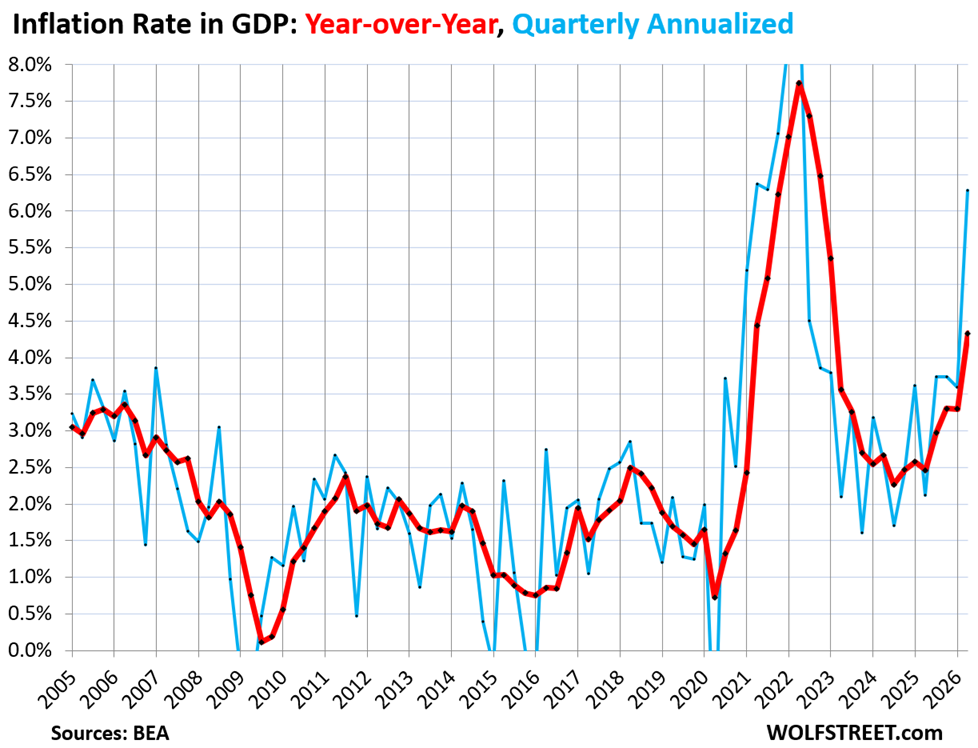
Overall inflation in GDP (“GDP deflator”), which tracks inflation in the entire economy, soared by 6.3% in Q2 from Q1 annualized, the worst since Q2 2022 (blue line in the chart below).
Year-over-year, GDP inflation jumped by 4.3%, the worst since Q1 2023 (red line). So sure, energy prices spiked in Q2, though they starting falling halfway through Q2. But wait… the core measure of inflation in GDP, which excludes energy and food, also spiked by the most since Q2 2023. More in a moment.
Without energy and without food, inflation in GDP jumped by 4.4% in Q2 from Q1 annualized, the worst since Q1 2023 (blue line in the chart below).
Year-over-year, GDP inflation without energy and food, jumped by 3.8%, the worst since Q2 2023 (red in the chart below).
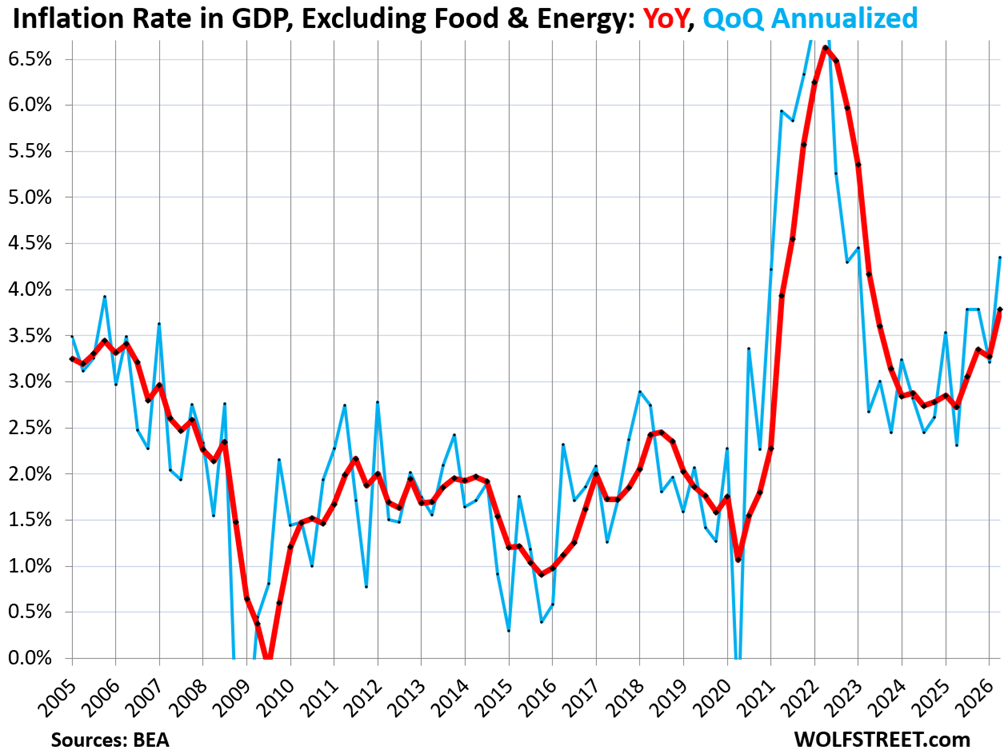
Both of these measures – overall inflation in GDP and core inflation in GDP – show red-hot inflation across the US economy for all participants in the economy. And on a year-over-year basis, these inflation rates have been accelerating sharply for four quarters in a row. This isn’t just a new thing that happened with the war in Iran.
The Fed doesn’t use these overall measures of inflation in the US economy as yardstick for its inflation target of 2%. It uses the PCE price index, which is a measure of consumer price inflation. But the quarterly PCE price index, also released today by the Bureau of Economic Analysis, shows a similar trajectory and level.
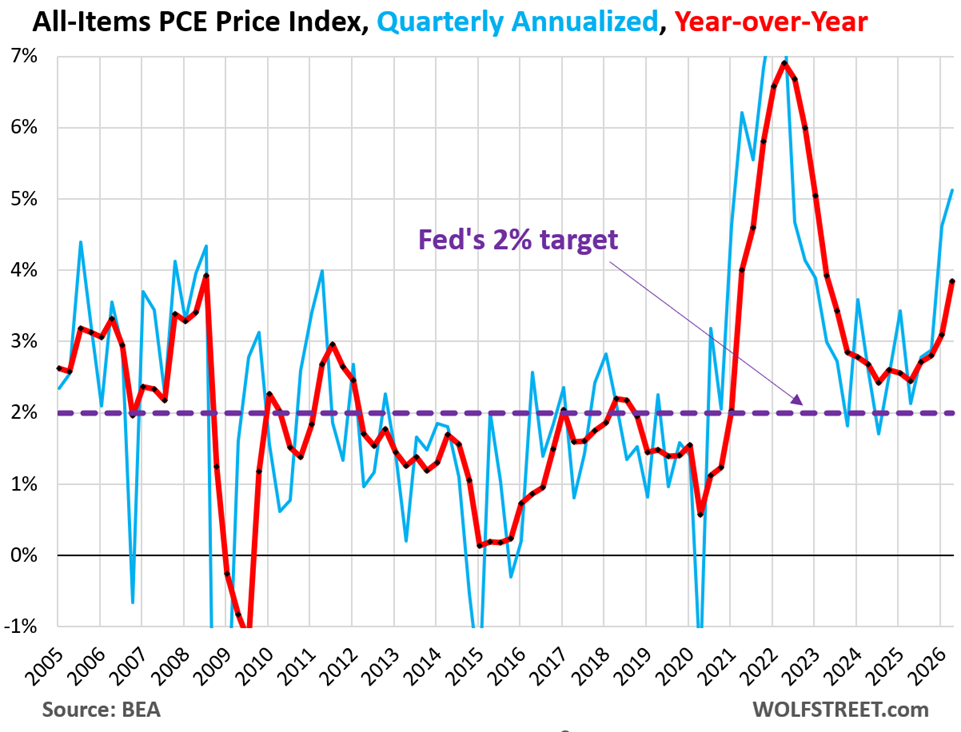
The consumer-oriented quarterly PCE price index jumped by 5.1% annualized in Q2 from Q1, the second worst increase since Q1 2022, according to BEA data today. This is a subset of the GDP inflation data above, focusing on prices of goods and services that consumers pay.
Year-over-year, the quarterly PCE price index jumped by 3.8%, the worst since Q2 2023.
So energy was one of the drivers, though energy prices were already dropping in the second portion of Q2. But energy wasn’t the only driver – see the “core” PCE price index which excludes energy. And the year-over-year acceleration further way from the Fed’s 2% target started a year ago.
The quarterly “core” PCE price index, which excludes energy and food, rose by 3.4% annualized in Q2, the second worst quarter-to-quarter increase since Q1 2024, the worst increase having been the prior quarter.
Year-over-year, the quarterly “core” PCE price index jumped by 3.3%, the worst increase since Q2 2023.
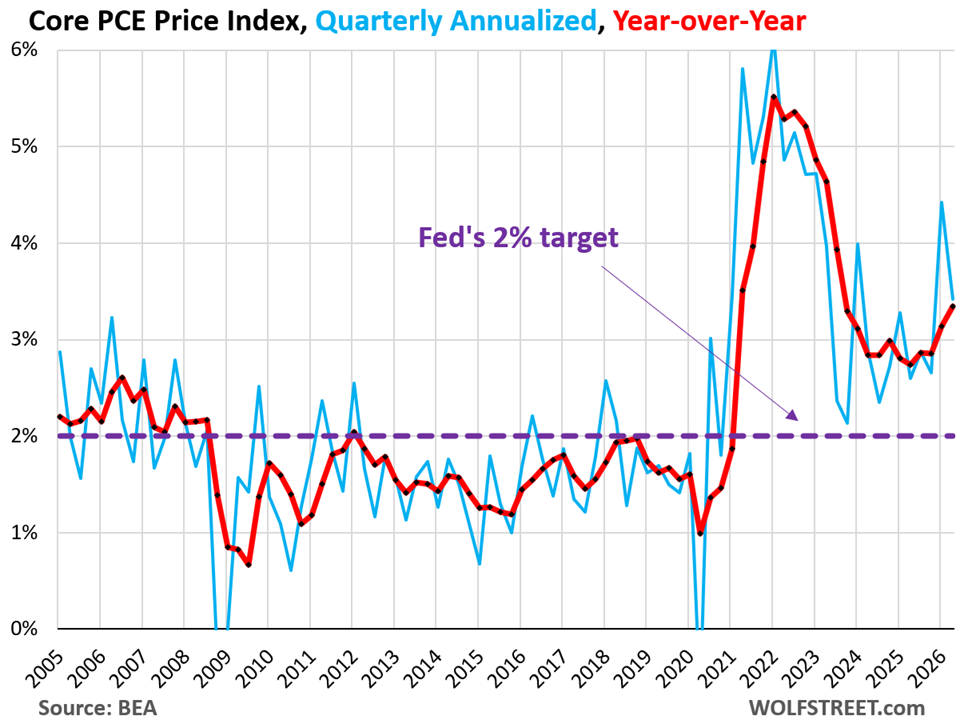
This is quarterly consumer price inflation, and it’s really bad, even without energy. But businesses and governments face even higher inflation rates, and so the overall inflation rates for the US economy are currently higher – see the top two charts – than consumer inflation rates.
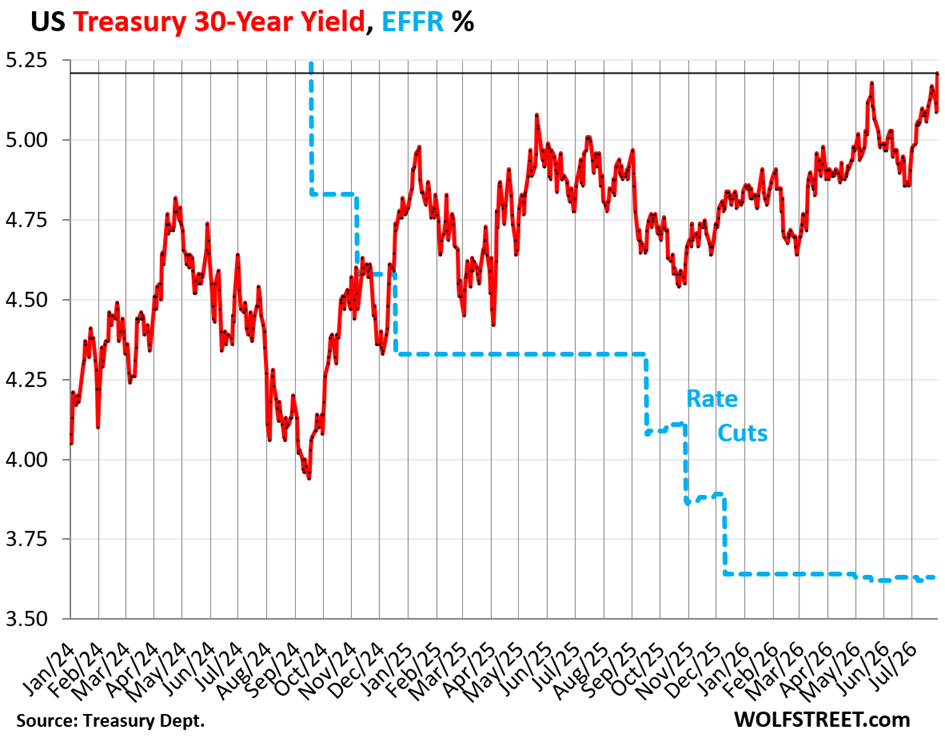
The FOMC members need to stop playing games and coalesce into a big majority to crack down on this situation, lest the bond market figures out what is going on in here… Oops, highest 30-year Treasury yield since 2007.
Enjoy reading WOLF STREET and want to support it? You can donate. I appreciate it immensely. Click on the mug to find out how:


Meanwhile on farms across America, low crop prices are a real problem. Maybe people need to eat more soybeans (and drive more small fuel efficient cars) lmao
Meanwhile, on farms across America, the government is subsidizing beef and eggs in unsustainablie arid lands and deserts like crazy, just as it always has.
Headline today: Water hauling is the new chore no rancher asked for.
No one’s complaining about big government ag subsidies in MAGA ranch territory. Oh, but they’re complaining about government.
We had initiatives to push for more cheese and milk everywhere when the industries were failing. Soybeans are high protein and high fiber. You can deep fry tofu into delicious appetizers. Edamame should be more common than french fries and a fraction of the price.
many farmers are living quite high on the hog. they are doing fine. they have been trained by the federal government to whine for more money. just travel thru farm country and open your eyes.
“The Fed needs to coalesce and crack down on inflation lest the bond market figures out what’s going on in here… Oops.”
Yeah, not gonna hold my breath. The FED has decided to LET INFLATION RIP. They’ve been allowing – encouraging – it for over 6 years. They are inflationists.
Warsh can’t change 18 years of poor policy making in two meetings. What he did however was stop telling markets what the fed is going to do. The decision alone helps. Legislative branch however is beyond repair. Doesn’t matter who’s there if everything is off of politics and nothing is about account management.
Since the fed is more concerned about politics and trends than they are about the current circumstance (inflation is getting outta hand), I am holding my breath watching and cheering the snail known as the bond market.
I enjoy reading the columnists that relied on Fed guidance, gentle leaking, etc…to write their columns. They seem to realize the fodder for their articles is disappearing.
Interesting. Can you suggest a few? I might enjoy reading the change too.
You can add Walsh to the list of inflationists. His wife is a billionaire. He could care less about or retiree.
His wife is also the daughter of one of Trump’s bigger donors. No nepotism there huh? But he’s still better than Powell.
Just make an effort to look at the democratic side of the ledger and you will find just as much inbreeding, if not more.
Walsh? Who’s Walsh?
From the government’s fiscal perspective as long as the increase in tax receipts exceeds, what’s the problem?
At this point, again from the government’s fiscal perspective (and disregarding inflation) is raising the FFR going to solve the debt servicing problem? Or make servicing the an even bigger challenge?
Will raising public sector tax revenues (at the expense of the private sector economic activity) solve anything? Or is it possible that raising tax rates will actually lower total public sector receipts?
From the government’s fiscal perspective, what’s more toxic, inflation over 2% and a reduction in the debt/GDP ratio? Or a slowing economy that raises it?
We’ve got ourselves in a real pickle, haven’t we?
So what’s the solution? Labeling our President an orange grifter? Even if he is and Joe Biden and Obama were saints in comparison, does that help? Not in my view.
So far I haven’t seen one viable solution on offer, so here’s mine.
Raise tax revenues by lowering (over time) the charitable and non-profit tax deductions to zero.
Cutting public sector spending would also help under some scenarios, wouldn’t it? Anyone rlse remember when the public sector employees salaries and benefits were about the same as those of the private sector?
> Or is it possible that raising tax rates will actually lower total public sector receipts?
Ah, the Laffer curve. It’s a thing at much, much higher rates than we have now. So to answer your question, no, increased revenues are the most likely outcome of raising tax rates.
It looks like the Bond Market has already figured it out.
MBS spiked up after the recent Fed meeting, and conventional mortgages are already being quoted at 7%.
On the other hand, this is now a pretty steep yield curve. . .
One would think that “they” already recognize that the value of the US dollar has declined
Love is the only remedy known to mankind the always wins.
“I know [Warsh] would love to see lower interest rates, but he’s got a board, and it’s a political board, and they want to keep rates up.” -Potus
There’s not going to be any “cracking down on inflation” in the near term. Only 3 board members are willing to risk voting for an increase.
I commented about 2 months ago that the Warsh Fed will turn, but slowly, and they wouldn’t actually raise rates until either shortly before or after the midterm elections. Don’t want to get blamed for tipping the election!
So far that analysis has been working – this is the usual way the Fed changes direction:
First they signal that they’re done lowering rates.
Then they signal that they might consider raising rates. Toss in a few dissenting votes favoring rate hikes to show how serious they are. (And this time, they added that they want the bond market to start thinking for itself… which means rates go up without the Fed doing anything.)
Now they’ve signaled that the next move will in fact be a raise, and Warsh already has almost half the votes he needs to get a raise at the next meeting.
In September, they’ll start to actually raise. The impact on the economy is slow and the move has been telegraphed, so this won’t tank the economy before the election.
After the election, they’ll do whatever they actually need to do, and they’ll have the cover of their research committee reports as well.
Bond Yields at 19-Year High Send Warsh Credibility Warning…
Yep, and today the 30 year interest rate up again to 5.275%.
Still the highest 30-year interest rate since 2007, but if it hits 5.5%, that’ll be highest since 2004.
And 6.0% will be highest since 2000!
But can FED actually raise interest cosidering debt servicing costs?
If Congress cut expense and raised taxes enough to dramatically reduce the budget deficit, would the Fed need to raise rates?
“If Congress cut expense and raised taxes enough to dramatically reduce the budget deficit, would the Fed need to raise rates?”
Has not happened for *55* years.
How many lifetimes does it take for Americans to understand what their “government” has become?
Every one of those years indicates that DC prefers inflationary suicide to institutional restraint.
Incorrect. Politicians of both parties climbed all over one another to work to balance the budget from ~1980-2000. There was no real debate about whether to balance the budget; the only debate was “more taxes” or “less spending”.
With tight-fisted republican Congress and Clinton as Pres, budget nearly got balanced in late 1990s. (Some say it even was balanced, but they overlooked a few loose ends.)
That era only ended in 2001 with Dick “Deficits Don’t Matter” Cheney’s reign as V.P.
We’ve fallen a long, long way since then…
For the average person, raising taxes, is inflation. People will say, “well we will only tax the “rich”” – makes for a nice statement, but the reality is there is not enough money there to make a difference. A significant increase in revenues would have to come from the bottom 70% or 80%. that might help solve inflation by destroying demand, but I’m not sure how constructive that would be.
Big spending cuts are also off the table. At best a spending freeze might work, but that would mean sticking with it for 4 or 5 years. Does anyone imagine our “democracy” is capable of that ?
No, we will continue as we are. Muddle through while our very capable financial engineers pull levers and invent new levers and foreign policy mines the provinces for their wealth as unobtrusively as we can.
It could easily go on for decades are all blow up in 2 years.
Huh? What country’s Congress are you talking about?
But can the Fed continue to hide the cost of ever increasing national debt?
Artificially low rates subsidizes debt creation. And the proof is the continued fiscal irresponsibility of the federal government.
It’s gotta hurt before they stop the insanity.
$9 Trillion national debt for the first 234 years……then added $30 Trillion in the next 16 years. And where were interest rates when all this happened? historic lows.
Look at the tax receipts to interest pay out ratio. When it reaches 50% then the authorities will do something. As was the case back in the 80s. In one of Wolfs charts the ratio is currently about 35%. So there is plenty of wiggle room and coupled with lots of hot air emanating from the new windy city before anything needs to done.
Things are a lot different now compared to the mid 80s at least in terms of housing costs. Seems like housing, land was a lot more affordable to common people back then and I think the country is a lot healthier with low or moderate housing costs, culture wise, for discretionary sectors.
I would love to see Wolf give us an opinion on how with the bond market dictating consumer rates that are high right now, how does the Fed raising rates and sucking more money out of the federal government to service short term debt help relieve inflation? If inflation is being caused by non-consumer consumption ie; AI spending, oil prices beyond it’s control and irresponsible debt financed federal spending, does the Fed even have a game to play in the current inflation scenario?
Inflation is caused by deficit spending which is done massively by both major “parties” if you think there is a difference. If people strongly disapprove of inflation, they can vote libertarian, which is for a balanced budget. The people on the fed, who it would help for people to realize are nominated and confirmed by the uni-party, the same “parties” that massively deficit spend, could do more QT, but maybe they are mostly doing what the people that put them there want?
No that won’t raise interest rates in response to the measures commonly recognized as indicative of the very thing we are discussing
Miran said it’s transitory this time. I stand by my call that they are going to cut rates.
Miran is gone.
So, Personal Saving Rate (PSAVERT) fell to Jun 2026: 2.7%
Why do so many believe that interest rate fiddling controls inflation? The evidence is weak to non-existent. To control inflation you have to understand the cause. We usually take the attitude that it’s some magic that is beyond our understanding. This is crap. Sure, the economy is complex, but prices don’t rise because the moon was aligned with Venus.
I’ve thought for years now that most of the inflation we’ve seen post 2022 (after the COVID stimulus wore off) has been people “spending their stock gains.”
I said in mid 2023 that inflation won’t get under control as long as the stock bubble is alive. I still believe that 3 years later.
Go tell that to people who lived through the 70’s & early 80’s with Volcker.
The problem as noted by Wolf many times is the debt.
The Fed is stuck between a rock & hard place.
$40T in debt is not high FFR friendly.
Read the new Planet Money book. Excellent chapter on inflation. If it gets too high, it can become a self re-enforcing phenomenon, driven mostly by consumer belief and expectations. Becomes very difficult for the government to do anything about it at that point.
Prior to 2008 the Fed’s mechanism for “interest rate fiddling” was tightening up reserves, limiting the credit supply, and literally sucking money out of the economy, making it hard to borrow-and-spend. That reduces demand and thus inflation. But it wasn’t interest rates alone doing the work.
The method used since 2008 separates interest rates from credit-supply management. But interest rates alone do little to fight inflation when the “ample reserves” policy still delivers abundant credit. And current interest rates are barely above inflation (if at all).
Even worse, when credit supply doesn’t contract, higher rates simply mean that net-debtors pay more to net-creditors. Net creditors are generally wealthy and net debtors poor. So high rates without credit constraints simply means the poor pay more to the rich, and that exacerbates wealth inequality.
P.S. Economists need to study reality, instead of inaccurate oversimplified textbook models of systems that no longer exist. The 1971 departure from the gold standard, and the 2008 departure from using reserve balances and credit-supply to control interest rates, both completely changed how markets respond to policy changes. The economic discourse has not kept up. As Keynes put it, policymakers remain slaves to defunct economists.
My Property tax bill just went from $9,600/yr to $10,700/yr with more increases in the works do to increased assessments. Blue Cross medical premiums just went up nearly 10% YoY. Same for everything else in my monthly budget for necessities. I’ve been posting these numbers on this site for months.
I’ve been saying this for months on this site that Bond markets will determine fed policy. The 30 year bond is signaling a raging inflation on the way. The fed is asleep at the wheel like it has been in the past. Walsh was just confirmed as the new Fed Chair and he’s already caved into the brain dead policies of his predecessors. The bond vigalantees are salivating.
It doesn’t look like Congress is going to react until the bond vigilantes are actually at the gates, like January 6 style.
They’re going to be in there voting on a $2 trillion defense bill and someone’s going to say “does anyone else hear hoofbeats”?
The Bond Markets job, it’s purpose, is to make money.
The Feds job is stable prices.
The Fed is not doing its job, and the bond market is not going to do the Feds job. The Fed is going to turn a festering problem into a crisis by its incompetence. Maybe that is what they want.
The chart Wolf posted about on the 30Year Bond says it all. Great chart!
These updates are extremely useful and informative. Thanks Wolf!
The rates on the 10yr and the 30yr are higher than before the last 3 cuts.
Is this proof the Fed is “pushing on a string”?
The Fed seems bent on altering economic reality.
Approx. 9.2M students are either late or in default on their student loan. Inflation is just another nail in their financial future…for many you would have to invert Dylan’s lyric/song “its not dark yet, but it’s getting there.
The problem is that many of these student loan borrowers now think that these loans aren’t loans but gifts that they blew for years back in the day, and that will be forgiven once again. Biden should have never ever started that.
Apple heads for $460 billion wipeout with its stock seeing worst post-earnings drop in 13 years
The fed needs to coalesce because if they don’t, at some point the population will.
“But wait….there’s more!” – The late Billy Mays
So Warsh has only been on the job a couple of months, but this data clearly shows he’s going to drag his feet along with most of the FMOC.
Status quo, Powell 2.0, Johnny come late to the party
He doesn’t have a majority for anything but maintaining the status quo.
The fed does not need to do anything. There is no disfunction in the .gov debt market. Higher prices will result from inflation as should be the case.
We ought to be thankful that it appears the fed will finally remove it’s foot from the scale. The thumb is a problem for another day.
“Don’t look up!!!” Do not notice the lower SPR!– other MAGA cultists. 😂😂😂
SPR Gets Drained to Dump Crude Oil on Global Markets: US Exports of Crude Oil & Petroleum Products Spike
Crude oil exports hit a record of 5.7 MMb/d in May, exports of ultra-low sulfur diesel hit a record 1.54 MMb/d, etc.
Recent trend of stocks up rates down appears to be broken.
That half a point rate cut by Powell
Is looking worse by the day.
There’s no room to “hike rates”. The whole idea is silly and will do nothing to counter war- and oil-driven inflation. A hike will collapse all kinds of bubble-icious sectors: housing, AI, stocks. And it will send longer-dated Treasury yields soaring, something governments just CAN’T afford.
Perhaps you are new here. Keep reading Wolf’s articles, and you might realize that by the Fed keeping short term rates too low, this has the effect of raising longer term rates. His articles explain why this can happen.
the night of his speech,vasaline stock jumped
“Inflation in the Overall Economy, Hitting Consumers, Businesses, and Governments, Was Really Bad in Q2“.
It’s like driving through Yellowstone park and hitting a bison at 55 mph. It’s not like the ten year old in the back seat is going to say “Dad, did we hit a bump in the road?” The inflation is like hitting the bison – catastrophic and unmistakable. But ‘slowing down’ for inflation doesn’t lessen its impact.
Looks like the Fed’s not even thinking about thinking about approaching that 2% inflation target.
I see what you did there. Golf clap.
Actually, my bad. There’s some ambiguity there so might be wrong kind of clap. You get a real clap for that one. Respect.
Price inflation has now become a permanent feature of American life. This will probably continue until the US dollar loses its reserve currency status. The feckless Fed can’t do anything to stop this, even if it wanted to (it doesn’t). But many of the 70 million Boomers are sitting in their overpriced homes, either paid for or with 3 percent mortgages. Or they are out there on the road, driving their new Tesla sedan or their new Toyota Sienna Hybrid. It looks like the Social Security COLA for 2027 will be 3.8 percent. Don’t worry, be happy!
The government printing press and Tariffs
End of story
I don’t know what is keeping the bond market from crashing and taking the stock market along with it