
The US added 1.51 million housing units (new construction minus demolitions) in 12 months, homes for 3.5 million people. The population grew by 757,000. And vacant housing units continued to surge.
By Wolf Richter for WOLF STREET.
The total US housing stock grew by 1.507 million housing units (new construction minus demolitions) over the past 12 months through Q2, to a total of 149.45 million housing units, according to the Census Bureau today. These are single-family homes, townhomes, duplexes, ADUs, etc., and units in multifamily buildings, such as condos and apartments.
With an average household size in the US of 2.3 people per housing unit, this addition of 1.507 million housing units over the 12 months provided homes for an additional 3.47 million people.
But population growth has faded amid a crackdown on illegal immigration. For the 12-month period through July 2026, the US population is estimated to increase by only 757,000 people, according to separate data from the Census Bureau earlier this year.
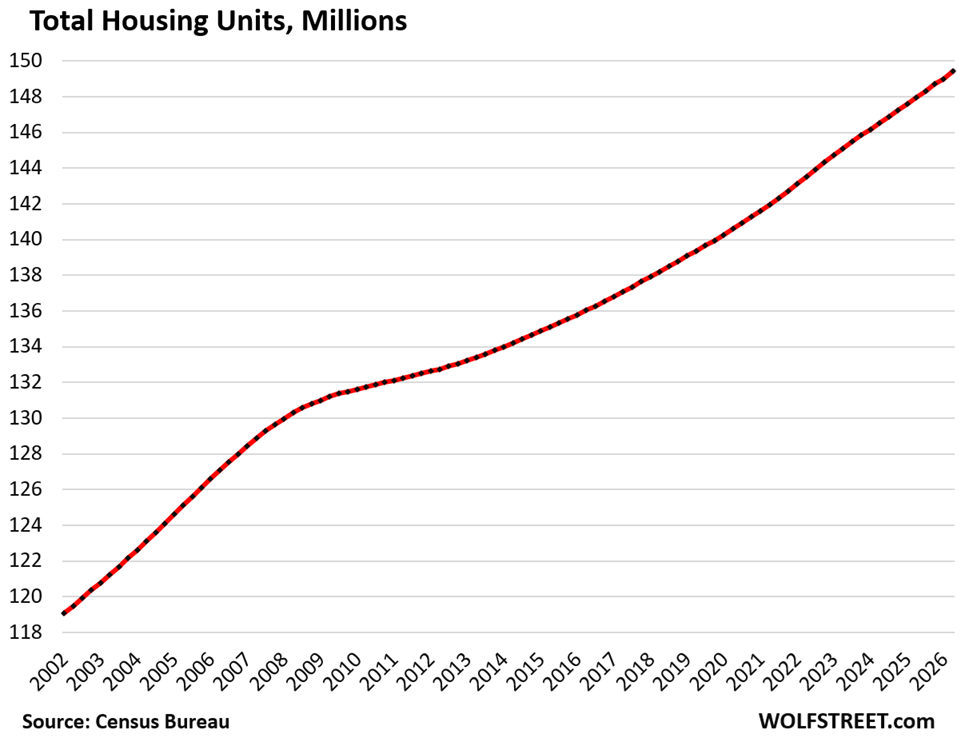
Over the past five years, the total US housing stock grew by 7.51 million housing units (new construction minus demolitions). At the average household size, this addition provides housing for 17.3 million more people.
But over the five-year period through July 2026, the US population is estimated to have grown by 10.4 million people, including the two-decade-record surge in 2023 and 2024 (my analysis).
In other words, over this five-year period, the housing stock has grown substantially faster than the population, and this is showing up in the data on vacant housing units.
The vacant housing stock.
There were 15.64 million vacant housing units in Q2. Of them, 12.22 million were “year-round vacant,” or 8.2% of the total housing stock. And 3.44 million were “seasonal vacant.”
“Year-round vacant” does not mean that they were vacant for an entire year, but are intended for occupancy at any time of the year, as opposed to housing units that are intended for seasonal occupancy (“seasonal vacant”).
Year-round vacant are classified in these categories:
- Vacant for rent
- Vacant for sale
- Rented or sold but new tenants/owners not moved in
- Held off the market:
- For occasional use
- Temporarily occupied by persons with usual residence elsewhere
- Vacant for other reasons
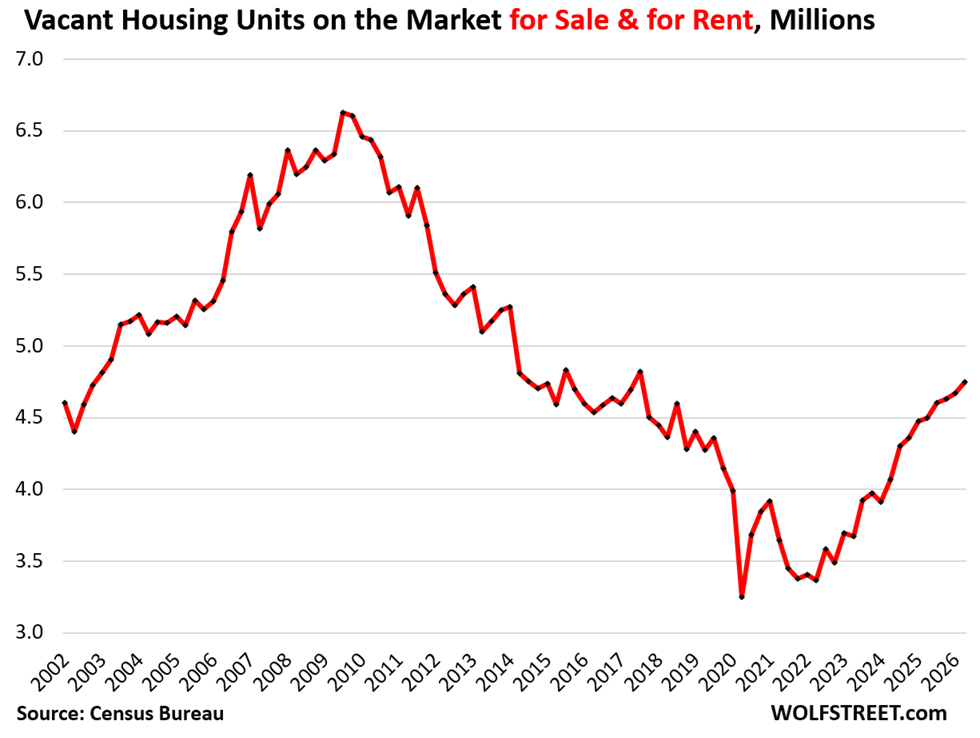
Vacant, on the market for sale or for rent rose year-over-year by 5.5%, or by 249,000 housing units, to 4.75 million vacant units for sale and for rent, the highest since Q3 2017.
Over the past five years, vacant-year-round units for rent and for sale surged by 1.10 million units.
There are some documented shifts from for-sale inventory that doesn’t sell and then gets put on the rental market, which shifts the number of vacant units for sale to the category of vacant units for rent. And we can see some of the shifts in a moment.
If the owners actually succeed in renting out the unit, they became what the industry calls “accidental landlords,” and their units shift from the vacant housing units list to the occupied housing units list.
Year-round vacant units also get pulled off the market and are held off the market for variety of reasons, which shifts housing units into the category of “Held off the market.”
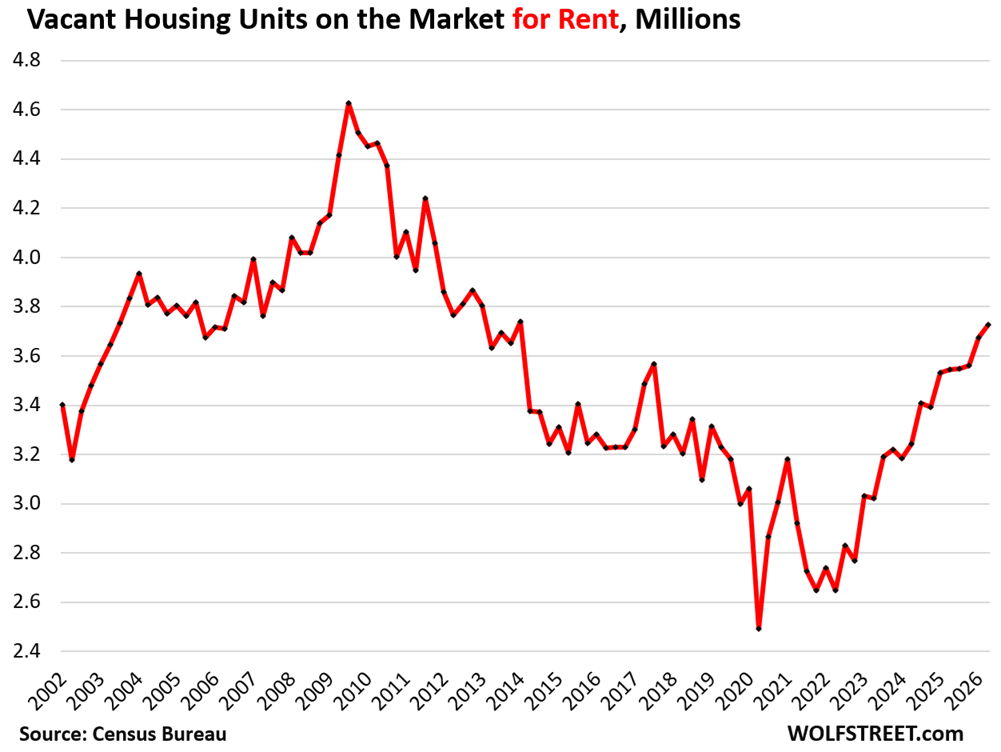
Vacant on the market for rent – including by “accidental landlords” that tried to sell their home – rose year-over-year by 181,000, or by 5.1%, to 3.73 million, the most since 2013.
Over the past five years, year-round vacant units for-rent rose by 807,000.
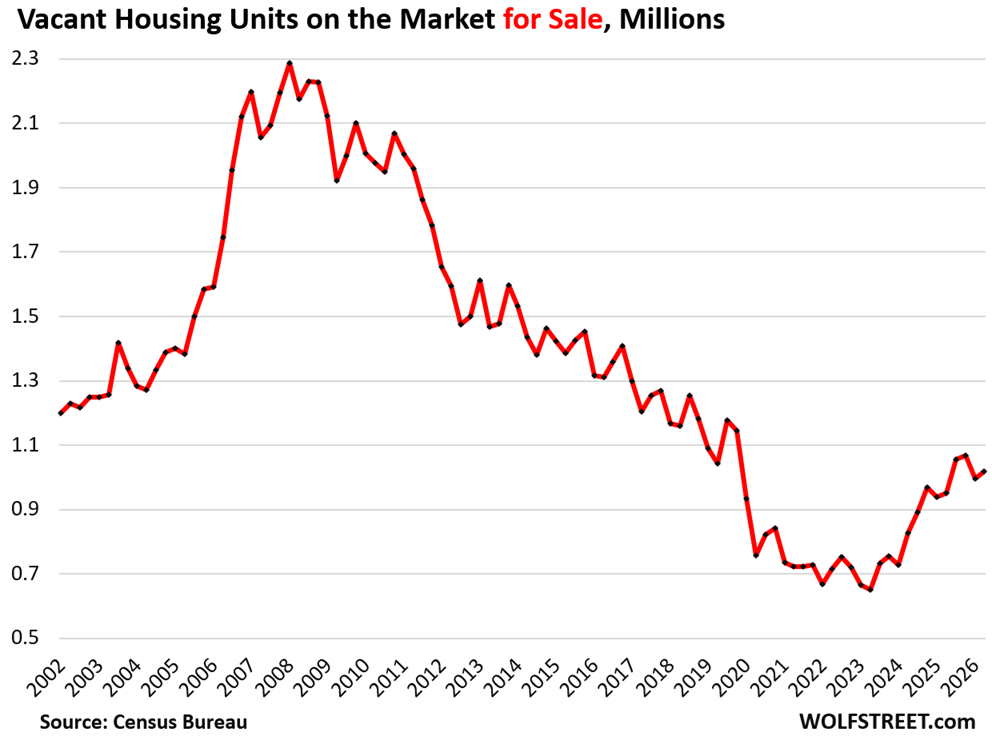
Vacant on the market for sale jumped year-over-year by 7.2% or by 68,000 to 1.02 million units that are vacant and for sale.
Note: This does not include homes that are for sale but occupied. Those units are on the “occupied housing units” list.
None of these data are seasonally adjusted, so we see some seasonality in the for-sale units.
Over the five-year period, vacant for-sale units surged by 41%, or by 297,000.
And remember:
- A portion of the overall for-sale units are “occupied” and are not included on this “vacant year-round” list but on the “occupied” list. These are just vacant for sale units.
- A portion of what used to be vacant for-sale housing units are now vacant for-rent units, as these “accidental landlords” shifted their properties into the vacant for-rent chart above.
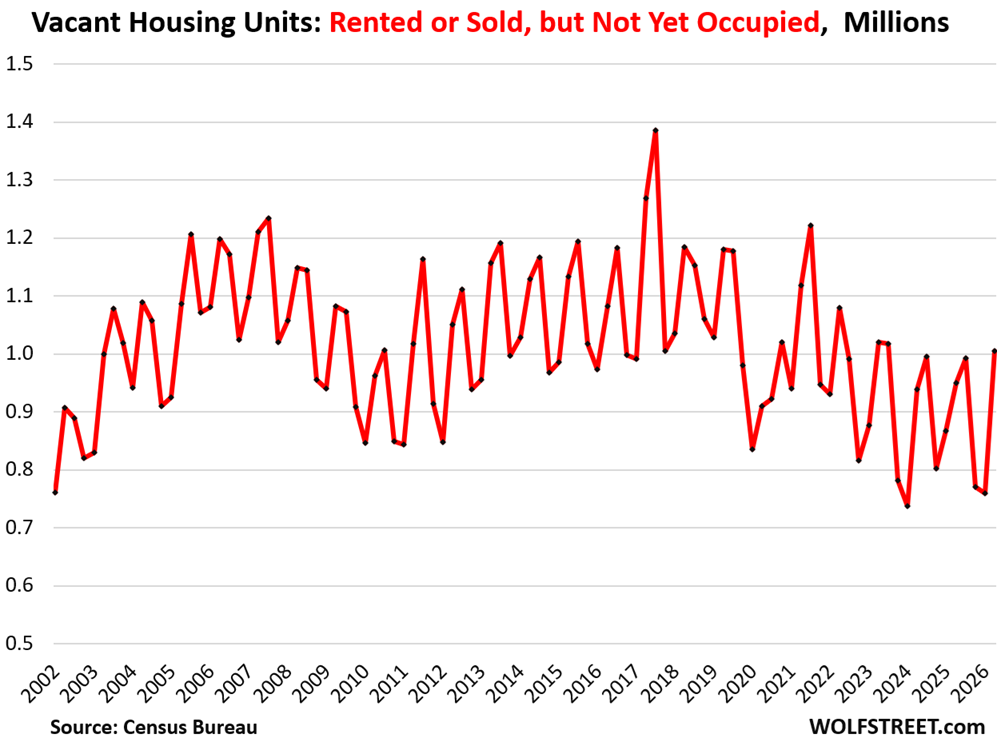
Vacant but rented or sold and not yet occupied rose 5.8% year-over-year to 1.00 million housing units. Over the past five years, the number fell by 10%.
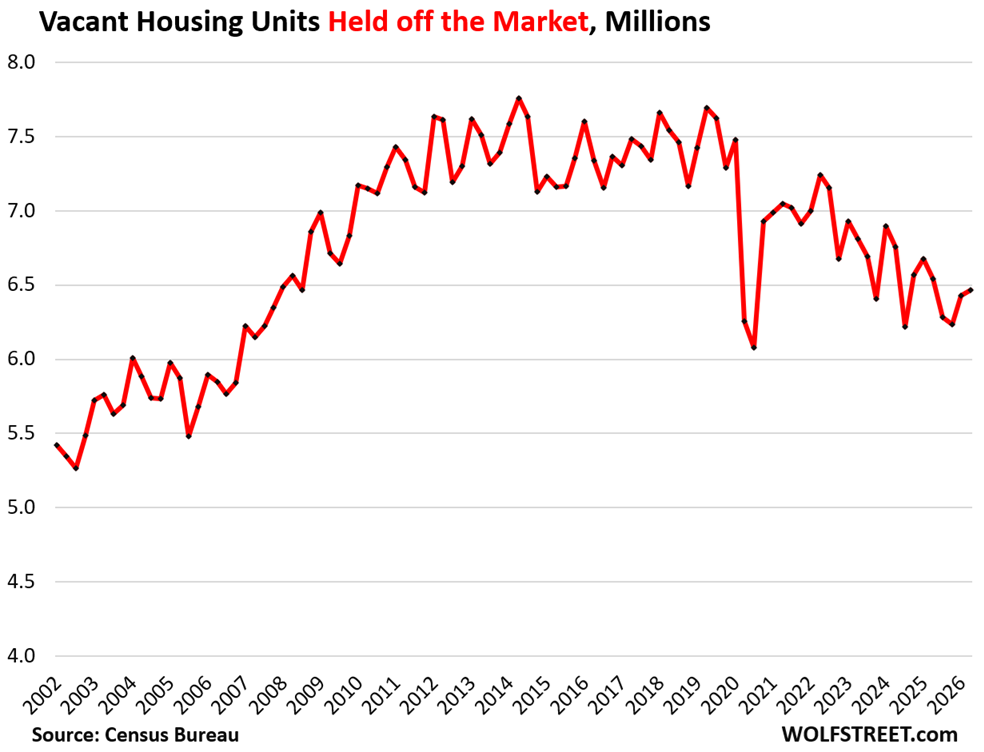
Vacant and held off the market: Of those 12.22 million year-round vacant housing units, 6.55 million were held off the market for a variety of reasons, a portion of which constitutes the vacant shadow-inventory that will show up on the for-sale or for-rent market at some point – and some of it has already shown up.
Included in this count of “held off the market” vacant housing units are those held for occasional use, those temporarily occupied by persons with usual residence elsewhere, and those that are “vacant for other reasons” (such as for settlement of an estate or held off the market for personal reasons of the owner).
As the number of housing units that were vacant for-sale and vacant for-rent surged over the past five years, the count of year-round vacant “held off the market” units has shrunk. In other words, part of this shadow inventory became actual for-sale or for-rent inventory over the years and shifted into those two categories.
Some related points based on separate data that boil down to this: Bring on the new construction:
In the South, inventory for sale of new single-family homes was up 71% from 2019, while sales were down 8%. In the West, inventory of new single-family homes was up by 22% from 2019 and sales were down by 50%. Homebuilders are very motivated to make deals. Read: New Single-Family Home Prices Drop Further amid once again Growing Inventory Glut and Declining Sales.
And on the rental market, the gap between single-family rents and multifamily rents has widened massively. A look at 14 big markets. Read: Single-Family & Multifamily Rents in Face of an Onslaught of New Supply & Fading Population Growth.
Enjoy reading WOLF STREET and want to support it? You can donate. I appreciate it immensely. Click on the mug to find out how:


Where it is not showing up is in foreclosures and builders going broke because they are still financed by banks who today do not have to show the bad loans.
This is total b.s. Another example of bad policy from the Fed. and the economic distortion they create.
It is showing up. You’re just not paying attention here.
It has been showing up for 4 years in multifamily commercial real estate where big landlords defaulted on billions of dollars on debt and lost the properties to lenders and investors. I covered some of that here. Including charts.
Homebuilders have been cutting prices and throwing incentives at the market, thereby slashing their gross margins, profits, stock prices, etc., but selling their homes in decent numbers. And I covered that here almost monthly, including this week, and that article is linked at the bottom of the article above. All you have to do is click on it. I put it there for a reason.
It is HOMEOWNERS of EXISTING homes that cannot sell and that are hanging on to their homes trying to put them on the rental market, etc. See the article above. The “accidental landlords.” Or that cannot move because they cannot sell at the price they want. They all can sell if they cut price enough.
At what point will the big home builders become unprofitable or do they have more levers to pull to prevent that such as continue to reduce the size of the homes, build with even cheaper materials, fancy financing, etc.?
This started a few years ago. Wolf has been covering it.
The big home builders are lowering the price point through smaller homes and fewer upgrades. The homebuilders understand the price at which they can move houses.
Homeowners are still in lala land. They are trying to hold out for prices from years ago before interest rates went up.
If the price was right… the home would sell.
It seems the prices are not right yet.
Also, I thought about being a landlord in the past, but the carry costs have become so high that it does not seem reasonable to me anymore.
Also Covid gutted landlords… I know a handful of people that lost their asses…Mostly to Covid rules abuses that were supported by non-landlords
In Atlanta area there are many vacant houses of all ages tied up in government bureaucracy.
Commenting from Dunwoody. How do I find these?
“Vacant, on the market for sale or for rent rose year-over-year by 5.5%, or by 249,000 housing units, to 4.75 million vacant units for sale and for rent, the highest since Q3 2017.”
So ignoring the averaged assessed value (i.e., how affordable are they), this kind of blows the whole narrative of there aren’t enough houses in the US.
What we have instead is an extremely well documented situation of way overpriced homes that there’s simply no economic catalyst like a recession to force owners into radically lowering prices & wheeling & dealing.
Sounds about right. Thanks, NAR, for perpetuating a big fat lie. There’s enough housing to go around, but the fact that we can’t seem to find ourselves in a big economic slowdown is the real culprit.
It’s all part of that more money, higher stock market, everything will continue to inflate until it doesn’t, whenever that’s going to be, mantra.
YOLO!!!
I think the people pushing that narrative can be correct, to a point. I happen to live in one of the top five fastest growing states. In my region, I would describe the market as “quiet” but by no means stagnant. When a property is priced competitively it sells. Unfortunately, there are many home owners that bought properties as investments or for short-term rentals who are now trying to sell their properties for significantly above market. These properties sit and sit… and give an impression that the market is softer than it really is. A lot depends on what market segment you look at. “Starter homes” have high availability with big home builders regularly building 500 homes on 250 of rural farmland. Nicer, larger property on land or a lake is much harder to come by.
I agree, but I am talking about a macro level.
Virtually every state could us more starter homes.
The problem, of course, is that land & the price to build homes in most areas doesn’t support builders committing to a much lower profit margin than what they’re used to.
The whole point to all of this is that it’s been SO LONG since we’ve had a real sustained recession that NOBODY is being forced to cut prices. There’s been no real pain for the top 20% that drive the country, while the bottom 20% have been getting hammered for years.
Almost every problem we have nowadays can be traced to the no new recession phenomenon.
It’s a great time to buy a house ™ – Lawrence Yun, circa 2001, 2007, 2013, 2018, 2022, 2026, 2031, 2037….
Interesting. Bring on the builders and see prices moderate! Has the 2.3 people per household number also been going down fast with demographic and preference changes?
I don’t have the numbers, but even as households have fewer children, the numbers of adult children living with parents, or multi-generational households, has increased significantly. I’m pretty certain I read that children living with parents is at an all-time high.
All of that is included in the number of persons per household.
Why should I buy a house when it’s going to lose value or stay flat in the next few years? Fed owned MBS are going to be on the books for years. Getting rid of them would drop prices, but no one who owns a home wants the prices to drop.
I own homes in so cal and I really want the peices to come down by 50 percent
Not for me but for the general society
Truly admirable stance, but you are one of the very few exceptions. Especially if you own more than two houses!
I know home ownership taxes don’t come down easily, but some costs should go down too if house value drops sufficiently, right? And that m *would* be a real boon for many owners.
That sentiment used to be rare but might be gaining popularity.
When those home prices go up, almost every service, product, and tax associated with homes goes thru the roof.
How or when were they acquired?
A 50% cut is large and many folks just can’t take that regardless of the good it could do.
One neighbor inherited their house. They could take a 50% cut on value and it would not affect them. The other bought 10 yrs ago and they’d lose a lot.
Thats a CA problem in that they allowed inheritance of tax basis, totally distorting the market.
That’s Prop 19 but I believe they modified it a bit a few years ago such that it is only valid if you move into the inherited property within one year and it becomes your primary residence. There is also a cap on the amount of value protected from reassessment. We are actually going through this right now as I am in So Cal and parents old house is in Bay Area but I nor my siblings want to move into it.
My corporate landlord required 3-5% annual rent cost increases. And the landscaping got lazy.
Renting is cheaper but creeps up on you.
Within a couple years my monthly cost creeped from 2700 to 3000. No end in sight. If revenues don’t climb people lose their jobs.
Rent doesn’t stay flat. Hard to shop around for an apartment or house for my family the way I do for auto insurance or onions.
Because it is cheaper than renting. I mean think about it – do you think landlords price their properties so that they lose money?
Rent can only go as high as the local market demands, otherwise it will just sit vacant and the landlord eats all the carrying costs.
I’ve only had one ~3.8% rental increase on my SFH rental in four years due to increased tax assessment — so less than 1% per year. Meanwhile, my rent is still — at an absolute minimum — $1,000 less per month compared to buying a similar home in my market; but realistically, probably more like $1,500-$2,000 less if you actually account for repairs/needed improvements. That’s not insignificant, especially if you’re investing the difference.
My landlord knows he can’t get more money out of me (I have a 2500HD and a SUV — I’ll just move!) and he knows if he raises outside of the market, it will just sit there.
I’ve been trapped and anchored by a house before. Unless prices fall precipitously, I don’t feel the need to be an owner ever again.
I wonder how many of these homes are in a status I call “vacant and awaiting demolition?” I can think of 3-4 in my area that were sitting empty for years and were finally pushed over in the past twleve months.
Houses to be demolished would be additional. They are not included in this vacant housing data. The categories for “year-round vacant” that are included are specific. Read them.
I wonder the same. I happen to live in a market with a lot of lake housing that is quite expensive – with vacant 3/4 acre lots now selling for more than $750,000. There are a lot of older family homes where the parents (or grandparents) built the house, and the kids either can’t agree to sell, or simply don’t want to – and yet don’t have the money, or can’t agree on how to maintain the property. People are truly just sitting around watching $500K or more rot into the dirt. Why? I don’t know.
If the rent is “too damn high”, what does that say about the cost of home buying???
The cure, as Wolf often says, for high prices, IS high prices.
When home drop enough in price, people will buy them accordingly.
YMMV….
Where the vacant properties are matters a lot. There are plenty of rust belt areas with so many vacant homes they’ve had to bulldoze entire neighborhoods to try and stabilize their city finances and clean up derelict houses. Here’s something you can spend 5 minutes on: open Google maps go to satellite view and scroll over to Detroit and zoom in and you’ll see some entire city blocks with only 1 or 2 houses still standing. There are still cities losing population and haven’t yet torn down all their vacant homes. Presumably they transition slowly over time from vacant for rent/sale to “held off market” before the demolition crews come out. Meanwhile, there are other cities that are objectively not building enough housing units for the population growth they have seen. Then lastly you have a couple outliers (I believe Austin is the biggest example) where vacancies are up simply because of the sheer volume of new construction where they can’t lease/sell all the new properties fast enough to keep the vacancy rate from climbing. You can have a housing shortage AND a housing surplus at the same time if you have lots of housing available in cities with few jobs like Cleveland while having nowhere near enough housing in low-build-high-job-growth cities like San Francisco and New York. So people can be looking at their local market or the national statistics on home prices and think that housing is in short supply while there is all these vacant properties that literally no one wants sitting in crime ridden neighborhoods in cities that are shrinking.
It would be interesting to see this data crossed with regional data. Could be run down inner city units. Could be overbuilding in the south.
Aaron,
Decrepit, or abandoned, or to-be-demolished houses ARE SPECIFICALLY EXCLUDED HERE. They’re NOT part of the vacant inventory. This is the third comment of this type. Quit twisting everything into BS.
Dave
but in the South is also where the most demand is.
Not to pick on examples to prove a point, but according to BLS numbers for May 2026, Cleveland has an unemployment rate of 3.1% while San Franscisco has an unemployment rate of 3.6%.
https://www.bls.gov/eag/eag.oh_cleveland_msa.htm
https://www.bls.gov/eag/eag.ca_sanfrancisco_msa.htm
You can repeat this exercise for other high cost versus low cost cities and put together similar patterns. There are plenty of good jobs. Flyover country is the place to build wealth, not the places where you get on a lifelong treadmill of debt in pursuit of $800k 2BR condos.
This mantra that cheaper places must have “fewer jobs” won’t die. Usually when I point out the data people say they must be worse jobs then. But is it really worse if you can buy a house, own a car, etc? Easier to adjust the narrative than change one’s mind I guess.
Whatever is causing the difference, it’s not some kind of dust bowl situation forcing people to migrate to California to find any kind of work. If it’s a job and a house you want, you’re much better off in Cleveland versus San Francisco! And if anything goes wrong, like a few months of unemployment, you’re a lot less likely to end up homeless because the rent/payment isn’t $5,000 a month.
I remember reading – years ago, admittedly – that median incomes in LA and Indianapolis were nearly identical. Cost of living, not so much. Yes, cue comments about climate, ocean, culture, etc.
I’m a fan of the Midlife Stockman channel on YouTube. It’s about a guy who cleans up very messy yards in and around Detroit.
In most episode, there’s a run-down house that’s surrounded by a yard that got out of control during the first Trump administration. Or something like that.
While I admire Midlife’s initiative, I can’t help thinking that a lot of these properties are nothing more than bulldozer bait.
And, given how thick the greenery can grow, why not let these lots go back to wilderness? Or, in time, use them for forestry?
I’m guessing that crashing the value of existing housing will help lower asking rents and both decreasing will help lower the shelter component of the inflation rate. But will cost of services for houses decrease? Or will repairs and insurance increase in proportion to the value of the underlying property?
The housing shortage narrative is becoming less and less convincing.
There is definitely a structural shift.
Thank you Wolf!
It has been fake for a long time. Listings move much faster now that they’re all online. This shows up in the data. A false narrative of “low inventory” was created out of this when it has really not been true – econimica used to do articles on this (the data showing no real shortage of homes) even back in the 2010s.
The problem in the US is price, not availability or supply – after housing costs exploded in 2020-2024.
The ‘too few houses’ narrative is a huge factor in the midterm elections. Housing is the top issue for younger adults. So, politicians promising more housing will get elected, then what? Pay builders to build, after figuring out they won’t build more than they already are because it wouldn’t be profitable? Subsidies to first-time homeowners? Debt to the moon, no, Mars!
Subsidies to builders who agree to provide and maintain at least some lower rents IS happening at this time in the Pinellas County area of Florida.
There is now also a program to provide down payment assistance to folx here, with the cost added as a no interest loan and lien to be paid when property is sold.
Both are attempts to provide housing for all the folx who actually do the work here.
Going to be interesting to see how it turns out long term, eh?
Wolf, which of these categories would a property fall into if it was posted on AirBNB or VRBO? It’s not for rent on monthly terms, but it is still for rent in a sense. It spends most days of the month vacant, but it’s not vacant. It is not available for someone to make their address, but it is still used for generating rents. It is both rented and for-rent/vacant at the same time.
It would be neither in “vacant for rent” nor in “vacant for sale” – those are the two key categories here.
Depending on how the owner deals with them, they could be in “seasonal vacant” or in a subcategory of “vacant held off the market” such as “Units Occupied by Persons With Usual Residence Elsewhere.”
The one critical piece of information not in this data is how many of these homes are located in depressed areas where more people are moving out than in. It’s hard to say home prices are going to collapse without that data point.
NOBODY here said home prices will “collapse.” get our mind out of the gutter
Fed day.
Guessing they’ll do nothing.
Will be interesting to see if the bond market gets antsier.
Definitely another Strongly Worded Statement with no action should result in rising long-term rates and further steepening of the yield curve.
For housing, the higher mortgage rates will be another reason not to buy or sell one’s house.
Task Forces will continue until morale improves.
Yes, but the S&P Cotality Case-Shiller U.S. National Home Price Index (CSUSHPINSA) is still climbing.
Prices have shifted depending on regional economic conditions. Prices will come down if Reserve balances with Federal Reserve Banks remain depressed. They are still down 163,831m from last July. It’s only been restrictive for one year.
Dow tumbles 800 points ahead of midday trade
Zillow increased the estimated price of my home again.
This stinks because I know this means more property taxes. I have no intention ever selling my home but the ever higher property tax is driving me crazy. I saw a smaller house sold for similar price which is probably why Zillow hiked the estimate. It’s insanity people buying houses with inflated valuation right now. When will the economic crisis hit?
It’s a bit of a confusing why published stats for vacant SFR show over 15,000,000 vacant homes, which seems like a very large potential inventory number that should help hold prices in check. Meanwhile, the corporate media continues to print countless articles about a housing shortage. Sometimes it makes me wonder if the National Relator Association spreads the same kind of fabrications as the diamond industry.
I am an accidental landlord. After a 1031 Exchange, I currently own a duplex in Southwest Florida. Both sides are occupied, but I had to drop rents. Slightly negative cashflow, but slowly building equity and a nice depreciation on my taxes.
Anecdotally, there are many For Rent / For Sale signs around here and tons of luxury towers being built.
Rusty –
When you see “many For Rent / For Sale signs around here and tons of luxury towers being built” …
… that means supply is hitting your market, which will lower prices.
So you might not be building equity again for a while…
Also, the depreciation credits can get eaten up by maintenance costs… do you have a monthly allocation to a maintenance reserve?
Bagehot’s Ghost Thanks for asking.
>do you have a monthly allocation to a maintenance reserve?
I mostly pay as I go. In the past year a roof repair, HVAC maintenance. etc.
There is a reserve fund at the property management company but really pennies. I pay for HomeServe and a separate home warranty.
I can’t help but think how bad an investment real estate will be from this point forward.
1) Demographic graying and below-replacement birthrates will lead to a lot more homes coming up for sale than there will be qualified buyers over the next 20 years.
2) Notes like the subheading of this article: “The US added 1.51 million housing units (new construction minus demolitions) in 12 months, homes for 3.5 million people. The population grew by 757,000.” We are already overbuilding.
3) Rent/price, Wage/price, and rent/own ratios that are comically out of whack with historical norms, suggesting prices will eventually converge to fundamentals.
4) Higher and higher insurance premiums, driven by rising construction costs (adios immigrants!), more frequent hurricanes, bigger and more complex house designs, and worse construction techniques and materials.
5) No more tailwind from falling mortgage rates. In past years, landlords could refi as rates fell and boost their monthly income even amid low inflation. The next 10 years might see a reversal of that trend.
6) Higher maintenance costs for newer homes increasingly built from plastic, glue, sawdust, foam, and cardboard instead of dimensional lumber and bricks.
7) The combination of AI and WFH is increasingly negating the need for knowledge workers to live in an expensive city and commute to a desk in a capital-intensive office building where they work on a computer terminal, while drawing a salary high enough to cover their own high costs. Once all this economic activity moves on, what is left of cities? Well, they become even less appealing.
8) We haven’t had a real recession since 2008-2009. The two month COVID blip with stimmie checks has not prepared people for sustained 8-10% unemployment rates. If renters are already stretched to the max when they do have jobs, LL’s are going to have their hands full when maybe 10-15% of their renters lose their source of income. And when the properties still taking in rents can’t cover the properties going through a 4-month eviction process, the little empires start to crumble.
good points. Only thing is – to your point number 1 – what if suddenly we are back to a full on “open borders” situation. I am thinking that there is a very high probability that the gates will be flung wide open in the not too distant future.
Real estate is likely going to fall 80% when this is all over and said.
Doesn’t help that home builders have no reason to stop building or selling – they can eat market share from the existing homeowners until the markets begin to crash and existing homeowners default on HELOCs/other debts.
When existing homeowners realize they’re screwed, don’t have stock market gains to use any more, and find themselves with issues due to HELOCs they’re taking out (something Wolf has covered previously), there will be an epic, generational crash.
Great article! Thanks for this one.