
Bond Vigilantes dissolved long ago into ambient air. But these auction yields make Bessent nervous.
By Wolf Richter for WOLF STREET.
The US government sold $742 billion of Treasury securities during the week, spread over nine auctions.
Of them, $585 billion were Treasury bills with maturities from 4 weeks to 26 weeks, spread over six auctions. Three of these auctions were over $100 billion each. Most of these sales replaced maturing T-bills.
And $157 billion of the auction sales were 3-year and 10-year Treasury notes and 30-year Treasury bonds. The 10-year notes sold at the highest auction yield since 2007. The 30-year bonds sold at the highest auction yields since 2001.
| Treasury note and bond auctions this week: | |||
| Notes & Bonds | Auction date | Billion $ | Auction yield |
| Notes 3-year | Aug-11 | 73 | 4.291% |
| Notes 10-year | Aug-12 | 53 | 4.683% |
| Bonds 30-year | Aug-13 | 31 | 5.216% |
| Notes & bonds | 157 | ||
The Bond Vigilantes dissolved long ago into ambient air whence they’d come. But these auction yields make Bessent nervous, enough so that he attempted to bail out the yen so that the Japanese authorities wouldn’t have to sell Treasuries to raise the USD-cash to buy yen in order to prop up the yen. Bessent was worried that by selling Treasuries, the Japanese would push Treasury yields even higher.
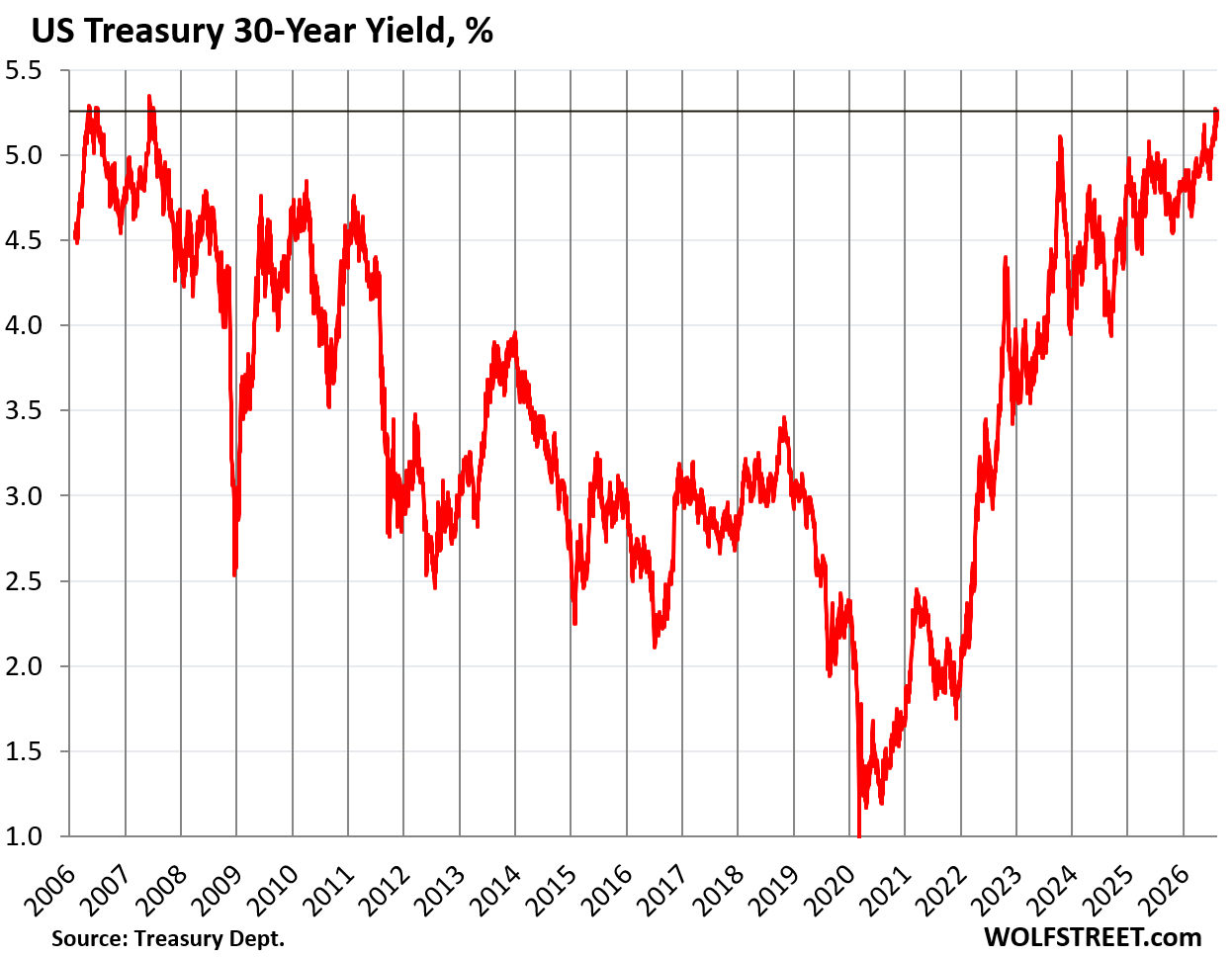
The 30-year Treasury bonds sold at auction on Thursday with a yield of 5.216%, the highest auction yield since the 30-year auction in August 2001.
But, but, but… August 2001 was the last 30-year bond auction until 2005, as big budget surpluses were on the horizon, and the long-bond was no longer needed. But in 2005, when the big surpluses on the horizon had turned out to have been a mirage, and the deficits had re-exploded, the 30-year bond was reintroduced. During that four-year gap with no 30-year bond auction, long-term yields were mostly higher than currently, and if there had been 30-year bond auctions during that gap, this week’s auction yield of 5.216% would have likely been the highest since 2004, and not since 2001. Just quibbling.
In the secondary market, the 30-year yield closed at 5.26% on Friday, after having traded as high as 5.28% on Tuesday and as low as 5.19% briefly Thursday morning in a kneejerk reaction to the CPI report before the auction, but largely reverted just in time for the auction.
These 5.20%-plus yields are the highest secondary-market yields since 2007. The chart shows the last 14 years of the 40-year bond bull market (when yields fall, bond prices rise), and the first 6 years of the bond bear market (when yields rise, bond prices fall).
Thirty years is a long time for things to go wrong, for inflation to go haywire, for the fiscal situation of the federal government to deteriorate further, producing a pile-up of new debt to fund it all, and for the debt to become manageable only through higher inflation. Those are real risks over the next 30 years.
And bond buyers want to be compensated for those risks by demanding a higher yield. But there is a lot of disagreement between buyers and sellers about how much risk there really is since no one knows the future, which is what makes a market.
How big are the losses six years into the bond bear market? Investors who bought 30-year bonds at auction in 2020 at less than 1.5% yield should have seen the same risks but were blinded by the Fed’s QE and by wild and woolly hopes of negative interest rates and ended up with massive losers in their portfolios.
For example, the 30-year bond that was sold at auction in August 2020, maturing in August 2050, with a coupon interest rate of 1.38% (CUSIP 912810SP4), is currently quoted at a price of about 46 cents on the dollar, in other words, 54% below face value. But at this price, today’s buyers get a yield to maturity of 5.39%.
By February 2021, bond yields were already rising, and the losses are smaller – but still huge. For example, the Treasury Department, at a recent buyback auction, paid 54 cents on the dollar for 30-year bonds originally sold at auction in February 2021 at a yield of 1.93% (the Treasury Department conducts two buyback auctions per week, spread across maturities, each auction totaling $2 billion currently).

Buyers and sellers of long-term bonds react to fears about inflation, about a lax Fed when inflation does take off, and about the debt-pileup and the new supply of debt that the market has to absorb, likely at a higher yield to create enough demand.
The Fed hasn’t been helping at all: By cutting rates even as inflation remained high in 2024, and by cutting rates further in late 2025 even as inflation had already begun to accelerate again, the Fed signaled to the bond market that it would give this inflation some room to run, that it would “look through” this inflation for a while, before trying to step in. And now it’s August, inflation is higher than it was a year ago, and the Fed still hasn’t stepped in.
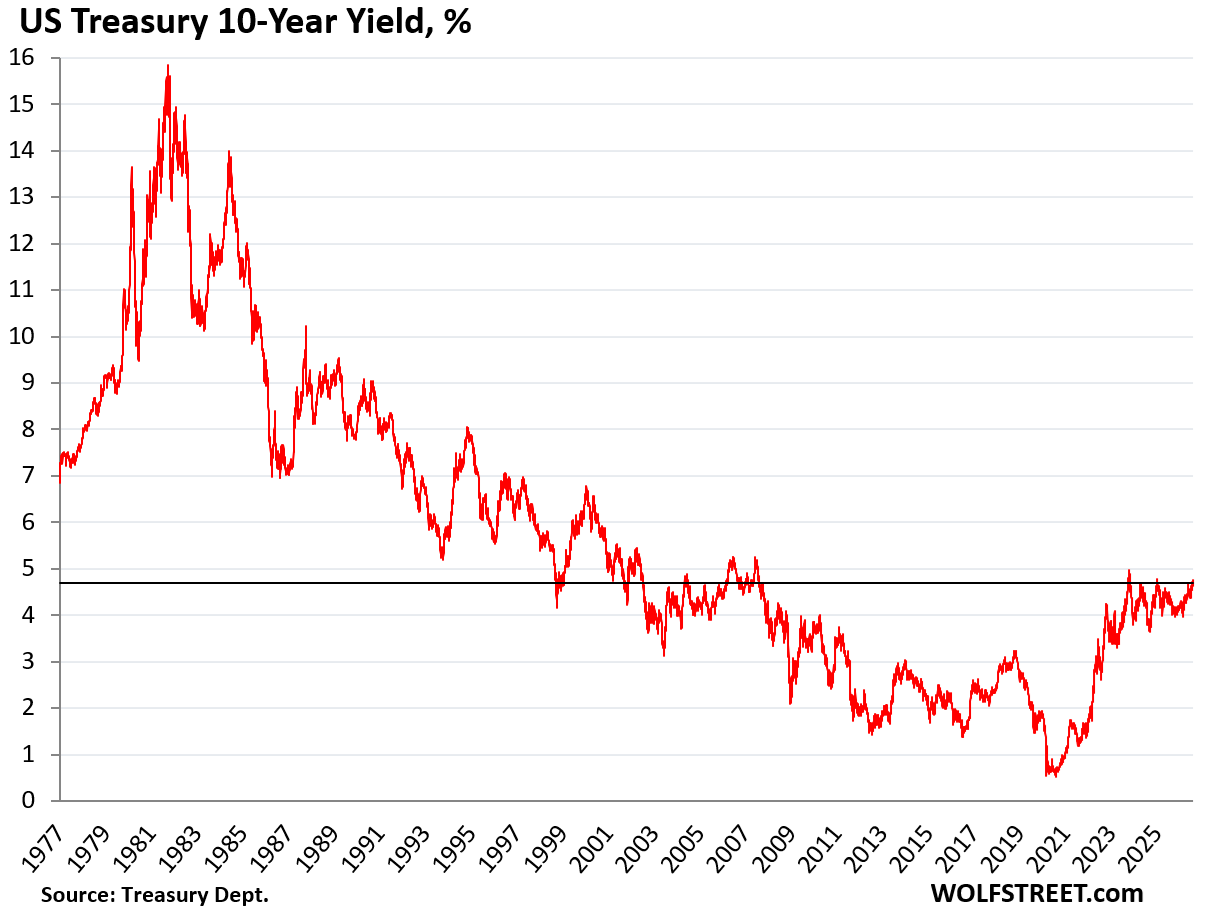
The 10-year Treasury notes sold at auction on Wednesday at a yield of 4.68%, the highest auction yield since the auction in August 2007.
In the secondary market, the yield did a quick kneejerk drop after the headline of the CPI came across before bouncing back, and it closed on Friday at 4.70%.
Here we’re looking at the last four years of the brutal bond bear market through late 1981, then the 40-year bond bull market through August 2020, followed by the six years of the current bond bear market.
The government sold $585 billion of T-bills this week, at auction yields that have come down some since the no-rate-hike FOMC meeting on July 29. But compared to a month ago, they barely changed: some ticked up a couple of basis points, others ticked down a couple of basis points, and two were unchanged. And all were up substantially from June and prior months.
Yields of T-bills react to the Fed’s policy rates and to expectations of the Fed’s policy rates in the near future. They’re less influenced by inflation and supply fears – unlike long-term Treasury securities.
| Treasury bill auctions this week: | ||||
| Type | Auction date | Billion $ | High Rate | Investment Rate |
| Bills 4-week | Aug-13 | 118 | 3.625% | 3.686% |
| Bills 6-week | Aug-11 | 101 | 3.670% | 3.737% |
| Bills 8-week | Aug-13 | 107 | 3.665% | 3.737% |
| Bills 13-week | Aug-10 | 98 | 3.735% | 3.823% |
| Bills 17-week | Aug-12 | 77 | 3.755% | 3.855% |
| Bills 26-week | Aug-10 | 84 | 3.830% | 3.960% |
| Total T-bills | 585 | |||
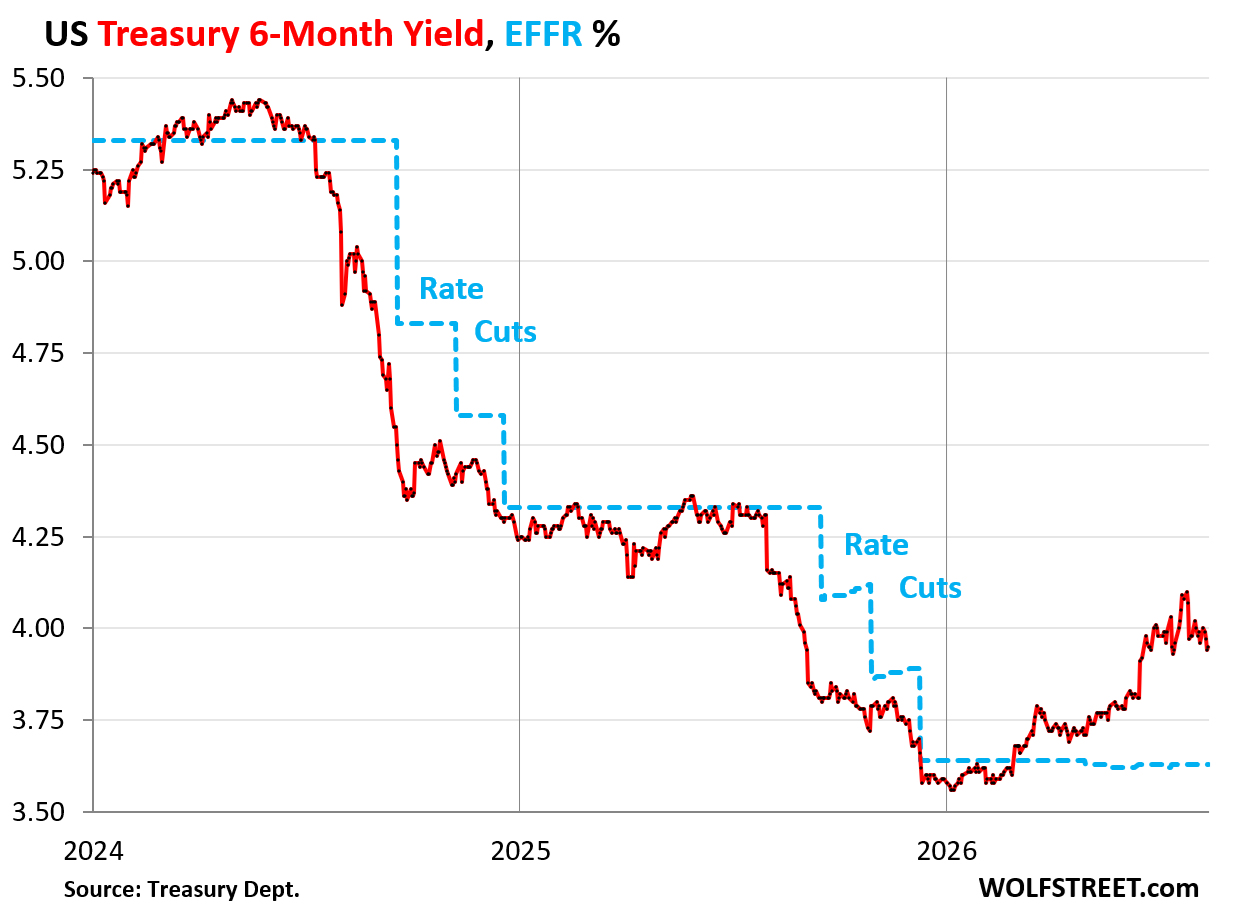
The $84 billion of 26-week T-bills cleared the auction on Monday at a “high yield” of 3.830% or at an “investment rate” of 3.96%, the same as a month ago, but down by about 12 basis points from the auction just before the no-rate-hike FOMC meeting when 6-month T-bills had sold at an investment rate of 4.08%.
In the secondary market, the 6-month Treasury yield closed on Friday at 3.95%, according to Treasury Department calculations (that calculation method is close to the “investment rate” at the T-bill auctions).
The 6-month yield is 32 basis points above the Effective Federal Funds Rate (EFFR, blue, 3.63%), which the Fed targets with its policy rates. So the expectations of a rate hike within its window have remained intact.
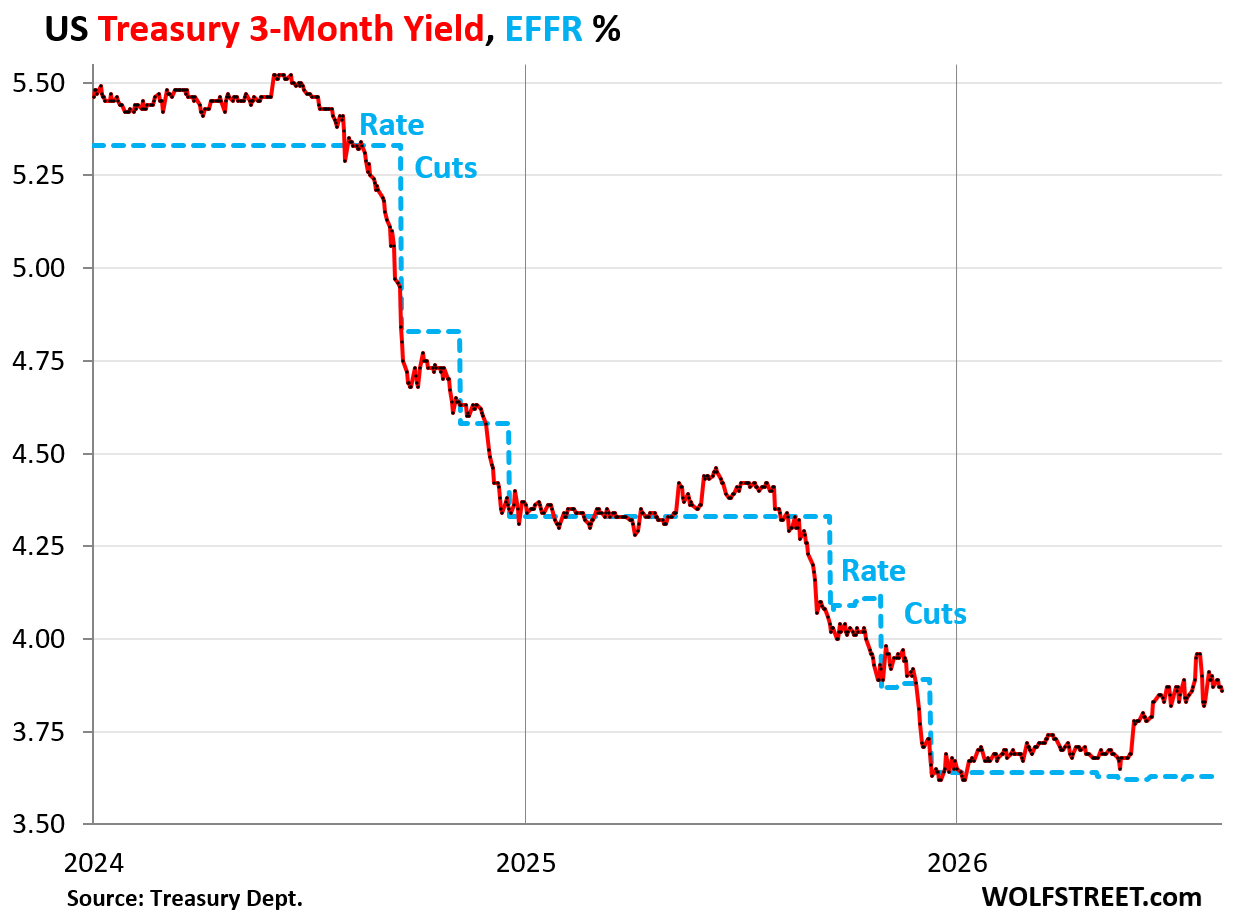
The $98 billion of 13-week T-bills cleared the auction at a “high yield” of 3.735% or at an “investment rate” of 3.823%, the same as a month ago, but down from the auction just before the July no-rate-hike FOMC meeting.
Note the mini-spike just ahead of the FOMC meeting to reflect the expectation of a rate hike at the July meeting, and the drop-back when that rate hike didn’t come.
In case you missed it: The Fed Cuts its Reserve Management Purchases (RMPs) to Zero, Starting August 14
Enjoy reading WOLF STREET and want to support it? You can donate. I appreciate it immensely. Click on the mug to find out how:


Mission accomplished, but what will they do when they run out of Euros to sell?
The only solution to the yen is big and fast BOJ rate hikes, not that pussyfooting around with a mini hike once a year; and much more QT for much longer. They can put a solid floor under the yen if they want to. And it seems the BOJ will speed up its rate hikes, but doing two a year is not speeding up; they need to go back-to-back 50 basis points each time minimum until policy rates are higher than in the US. And they need to do QT by the truckload.
Japan needs to lower its unlimited transaction deposit insurance.
Japan is undergoing a new generation of militarization. The defense spending is going from 1% of GDP historic to a 2% “NATO standard;” even though NATO is on the other side of the planet from Japan.
I live in Tokyo. Japan would probably be safer located in Europe than where it is close to North Korea and China with territory conflicts with both Russia and China. The country is seriously preparing for the possibility of being drawn into any armed conflict between China and Taiwan and the 2022 Defense Buildup Program is the most significant change in defense planning since the end of WWII.
How is idiot Koizumi (the Kamala Harris of Japan) going to become prime minister if he is not in the headline every day?
Maybe the BOJ is worried about how higher interest rates will impact the carry trade.
Wolf,
Agree. Thats only long lasting solution for Japan and its people.
Thats what they should have done from last 2 years. But we know that will put immense pressure on US Treasuries and yields will go higher.
Can US handle that? Can our ATH ALL indices handle that? I doubt.
Bessent is making sure that doesn’t happen by hook or crook.
So doubt BOJ will have any spine to do whats needed.
Do you think the size of Japan’s public debt is limiting the ability of the BOJ to raise interest rates? Does the maturity mismatch of their balance make it more difficult to raise rates quickly?
Higher interest rates will only affect the bonds that are maturing and that need to be replaced at higher rates, and with the addition to the debt where new bonds are sold. Only the interest of short-term debt changes quickly with rate hikes. So the vast majority of the existing debt will not change interest rates for years, and so the average interest rate on the debt will come up some but slowly.
The BOJ doesn’t care about any maturity mismatch on its balance sheet, and that’s not keeping it from hiking rates. But it lives in a country where the government had gotten used to borrowing for free, and so there is a lot of political opposition to hiking rates. And if it weren’t for the collapse of the yen, the BOJ would not hike rates at all. They thought they’d figured out how endlessly free money worked, but then the yen collapsed, and they were forced to go back to the drawing board – hence QT and higher rates.
And what’s the odds the BOJ does that?
The odds are high that they will some more hike rates and that they will continue QT. The odds are low that they will hike rates fast and by enough, and that they will do enough QT, so the yen will continue to be a washrag.
But won’t that disrupt and end the gravy train ? I mean the cary trade.
Once the currency goes to hell, such as the yen, other priorities go on the back burner.
haha – good one
“The only solution to the yen is big and fast BOJ rate hikes”
But since Japan’s federal debt to GDP ratio is like 250%+, rate hikes blow the crap out of Japan’s fiscal budget (result, huge deficits). You can’t accumulate huge federal debts without insanely restricting macro-economic levers at some pt.
Politically lobotimized central bankers around the world behaved (for decades) as though they could finance multi-decade fiscal deficits with printed money/zeroed interest rates with no consequences, ever.
Perpetual fiscal deficits papered over with printed money were a doomed enterprise when they launched decades ago.
The inevitable Apocalypse was going to arrive sometime.
Politicians can’t repeal reality – only make things much worse by ruthlessly lying to their publics about it.
The Federal Reserve and US Treasury will have look in their “warehouse “ and see what other currencies they can use. The BOJ could use their IMF reserves…SDR’s
PS: Maybe a Yen Dollar swap…
The US dare not have a recession. And the trend towards lower savings bears keeping track of.
I wouldn’t think the US would want the Japanese to hike interest rates in a fast and furious manner due to the yen carry trade. Not sure how big the carry trade is, heard a figure close to 13 trillion though. But imagine what markets would do if there was 1 trillion in deleveraging. It would strengthen the yen and crash a bunch of other assets, especially US ones and that is not allowed. The stock market never be permitted to go down.
1. Sometimes I wonder about the mental health of a person writing comments on a sunday morning.
2. Did you ever noticed that the rates go down very quickly but raises slow, low and reluctantly?
3. Is it a good time to buy bond index funds? like BND or JNk?
4. what about Vanguard High-Yield Corporate Inv (VWEHX)?
@Old Cobalt Programmer
Hey, some of us are working in the Salt mines M-F. Sunday is when we get to lounge around and comment on here.
I think you mean “COBOL programmer” (COmmon Business Oriented Language)…just saying.
There’s a story behind that from years ago. Let Cobalt Programmer tell you how that name came about. I can’t remember exactly. It seems it had something to do with another commenter mixing up COBOL and cobalt).
Rear Admiral Grace Hopper is the person who led the invention of COBOL back in the day and it still used particularly in programming government computers.
Several years ago, one of the commentor mentioned that Cobol programmers are need to fix the bugs in legacy systems. Unfortunately, he used “Cobalt” programmer. So I made it my name. Apart from this name, you will find van down by the river, swamp creature, Micheal engels.
Japan is an island. I lives off exports. The lower the Yen the more it sells abroad.
Perhaps the US would do a gold yen swop. The gold and land holdings in the West are about the only things it has left worth a darn. Our currency is fast depreciating, and inflation is the name of the game.
“Japan is an island.”
It’s a big group of Islands.
“I lives off exports.”
No, that’s outdated. Over the past five years, Japan has had huge trade deficits in large part due to IMPORTS, where a weak yen is devastating.
“…these auction yields make Bessent nervous…” In the context of what overall long-term economic policy for the common good, which presumably is in his job description to work toward? Nervous relative to what? Or is this more of a near-term whack-a-mole mentality? And how much can the Treasury actually do at a macro scale over the long-term? What would seem to matter is some metric like “Federal Surplus or Deficit [-] as Percent of Gross Domestic Product (FYFSGDA188S)” published by the St. Louis Fed (https://fred.stlouisfed.org/series/FYFSGDA188S) in determining how much return investors in U.S. debt require to cover their risk. I guess he is trying to help Congress to be able to continue to write checks funded by debt, and not have it be pushing on a rope, where for every dollar of additional spending, investors in U.S. debt demand a payday loan level of interest. If the deficit to GDP continues its monotonic trend, one would think that it will take more that the Treasury being anxious, and taking whatever short-term actions it can to address the problem.
Bessent is in charge of the Treasury Department. He is not in charge of the White House and Congress. The deficits are decided by Congress, and the White House has a lot to do with them. Bessent has no bearing on those decisions by Congress and the White House. Bessent’s job is to stfu up about the deficits and to fund this government spending/deficits no matter what, in two ways: collecting taxes (IRS, a division of the Treasury Department) and borrowing at the lowest possible interest expense. The lowest possible interest expense is part of the “common good,” whereof you speak, I suppose.
How large is the yen carry trade? If it unwinds, which financial assets, apart from US Treasuries, will be affected?
Anyone curious/concerned about our Treasury Sec being a former employee of one of the biggest currency bears in history (Geo Soros)?
Why would that even matter? He does understand bond markets and currency markets, unlike Yellen.
Wolf, I don’t remember if you’ve covered Beyond Meat, but it is now down 99.8% from its all time high.
https://wolfstreet.com/2019/06/10/was-this-the-very-minute-of-peak-insanity-in-ipo-stocks/
🤣❤️ Thanks, Harvey, for this blast from the past.
Volvo, Beyond Meat blew up before I had my Imploded Stocks (born in early 2022).
There are a lot of articles that mention the collapse of BYND from years ago.
Maybe people want their meat to be meat, and their vegetables to be vegetables.
And not a concoction of stuff and things, oils, and processed stuff…..To make it hopefully taste like the meat that they would prefer not to eat, for whatever reason they may have.
Maybe ?
My opinion…
Nothing beats real bacon… tofurkey sucks
All or nothing here…..Just my humble opinion
Haha
Hi Huck,
I am always seeking ways to help Uncle Sam out of his fiscal jam and voila, I found your post an inspiration to save the Federal and State Governments billions. Currently SNAP costs the government about $110B and Medicaid and Medicare trillions more. The Medicare and Medicaid programs are expensive in no small measure because SNAP as currently defined buys obese folks Ding-Dongs and Ho-Ho’s so the won’t be hungry and sugary drinks because the cans can be emptied out and returned for the bottle refund.
What a waste. But you made the solution obvious. Replace SNAP with K-Rations, C-Rats and MRE’s. Simple.
https://press.uchicago.edu/Misc/Chicago/751120.html
https://www.richmondfed.org/publications/research/econ_focus/2024/q1_q2_federal_reserve
OBC:
Not sure how you extracted that from my post.
Haha
No point in being mean, plus the distribution for MREs is an added expense, more government jobs.
Your goal is not novel and bills have been proposed to limit sugary food. Surprise! They have been shot down by industry lobbyists. Processed food is where the money is. Your only hope is to support legislators at state and national level who don’t take corporate $$$$. They will need your help.
This is a good time to ask the candidates you are eligible to vote for what is their stance on the issue. That way it will get on their radar.
But these yields are still way too low.
Bitch BitchCottonelle is a walking corpse and the fraud is bigger than Herbalife.
Any fool buying the debt now is going to be deeper than Aquaman when the real poop hits the real fan in a few years.
I understand the benefits to Japan of borrowing at lowest rate possible.
I understand the positives and negatives of yen values relative to other currencies on imports and exports.
I struggle with what positives come to Japan or its citizens from foreigners borrowing in Japan, swapping yen for a foreign currency and then the foreigners invest in non yen assets? I.e. the carry trade.
The demand to borrow yen is what props up the yen. It would be worth a lot less, and Japanese interest rates would be a lot higher, if there wasn’t this great low-risk money factory called the carry trade.
To some extent, the carry trade is self-perpetuating. High demand for yen kept Japanese rates low, which supported the economy of Japan, which kept the yen range-bound, which kept the yen as an attractive currency to borrow in. Japan obtained both currency stability and low interest rates, which is part of why the lost decades did not include long recessions and falling living standards.
Love it. So many different paper/digital games to play. Meanwhile, in the real world, if you want to actually build something physical or eat, you need energy and real resources. Whether or not the western world likes it, RISK and the premium to actually deliver those required resources is being repriced. This really sucks if you are an isolate island…
Interesting times.
And the 30 year breaks out nicely higher on Monday. At some point people will notice and it will matter. For the bond bulls buying 10’s 20’s and 30’s….they have a long time to try and recover. Those pensions holding 10’s bought in 2021, it’s a lost decade for a crap load of retirees who are no doubt ignorant of why their IRA ism slacking.
Nice to see Bessent coming out with the new and improves YCC for longer USA bonds, upping the amount to at least double what it was before. Even promising to keep it going until the mid-terms, so it’s definitely not politically motivated!
Wouldn’t be nice to keep forcing primary dealers to keep buying long bonds every auction and tell them not to dump them right away. Give them an easy hidden out, it’s what pals do, lol
“with the new and improves YCC”
You’re wallowing in BS.
Read this:
https://wolfstreet.com/2026/08/19/bessent-doubles-yellens-hocus-pocus-treasury-buybacks-swapping-old-cheap-debt-at-a-discount-for-new-expensive-debt/
I liked the article. More informed than my own ideas. I also like the AI generated ads to support the site and avoid a paywall. My donation is coming after my divorce lawyer stops asking for $10k top-ups
And please feel free to not post this response