
But inflation thrived in housing, electronics (hit by the AI boom), medical services, auto repair, used vehicles, etc.
By Wolf Richter for WOLF STREET.
The all-items CPI (which includes food and energy) barely inched up (+0.07%) in July from June, after the negative reading in the prior month. The “core” CPI (excludes food and energy) rose by only 0.22%, after a negative reading in the prior month. The core services CPI rose by only 0.23%, according to data from the Bureau of Labor Statistics today.
All of them were held down on a month-to-month basis by a motley collection of standout factors:
The CPI for hotels and motels plunged by a massive 3.3% in July from June, after having already plunged by 2.8% in June from May. This pulled down the core services CPI, the core CPI, and the all-items CPI. And it caused the CPI for “shelter” to be nearly flat (+0.1%). Shelter accounts for 35% of total CPI. But the CPI for Rent (+0.3%) and the CPI for Owner’s Equivalent of Rent (+0.3%), the big components in Shelter, accelerated in July from the June pace.
The CPI for Motor Vehicle Insurance dropped by 0.3% in July from June, after plunging in the prior two months. But it’s still up by about 50% since January 2022! This pulled down the core services CPI, the core CPI, and the all-items CPI.
The CPI for gasoline plunged by 2.9% in July from June, after having already plunged in June, from the spike in the prior months. Gasoline accounts for about half of the overall energy CPI. But the CPI for electricity ticked up, and the CPI for utility natural gas jumped. And so the energy CPI plunged by 1.5% in July from June, which pulled down the all-items CPI.
The CPI for “food at home” dipped by 0.1% in July from June, pushed down by a drop in prices of beef (-0.8%), pork (-1.5%), and chicken (-0.7%), finally. I saw my first hopeful “sale” sign on ground beef along with a lower price the other day, but we’ll continue boycotting beef at these ridiculous prices, even if they’re a little lower, and enjoy other delicious animal proteins instead. So maybe we’re not alone and demand has finally tapered off enough to bring down prices.
Pork chops (-2.8%), yummy, especially bone-in. Fresh whole chicken (-0.8%), amid articles recently about a “chicken glut.” Let there be gluts! Egg prices (-0.5%) continued to fall from their spike through March 2025. The CPI for roasted coffee (-0.4%) dipped for the second month in a row. Coffee futures, which impact consumer coffee prices down the road, have dropped by 23% since their peak in November. So there’s hope.
But prices of fish and lots of other food categories rose, and so it was a mixed bag, so to speak.
This tiny increase of the CPI for food at home (+0.1%) held down the all-items CPI.
But inflation was alive and well elsewhere.
AI boom hit consumer electronics: Prices of items with lots of semiconductors in them jumped in July from June: Computers & peripherals (+3.5%), smartphones (+1.1%), TVs (+1.7%), other video equipment (+2.1%).
The CPI for “food away from home” rose by 0.3% in July from June, at the high end of the recent range. This CPI covers prices at restaurants, delis, cafeterias, etc.
CPIs related to motor vehicles: The used vehicle CPI rose at the fastest pace in four months (+0.4%). The CPI for motor vehicle parts and equipment jumped (+0.6%) as did the CPI for auto maintenance and repairs (+0.6%) on top of the big jumps in the prior two months. But the CPI for new vehicle edged up only 0.1%.
The CPI for medical care services jumped by 0.6%, the biggest increase in months.

And year-over-year…
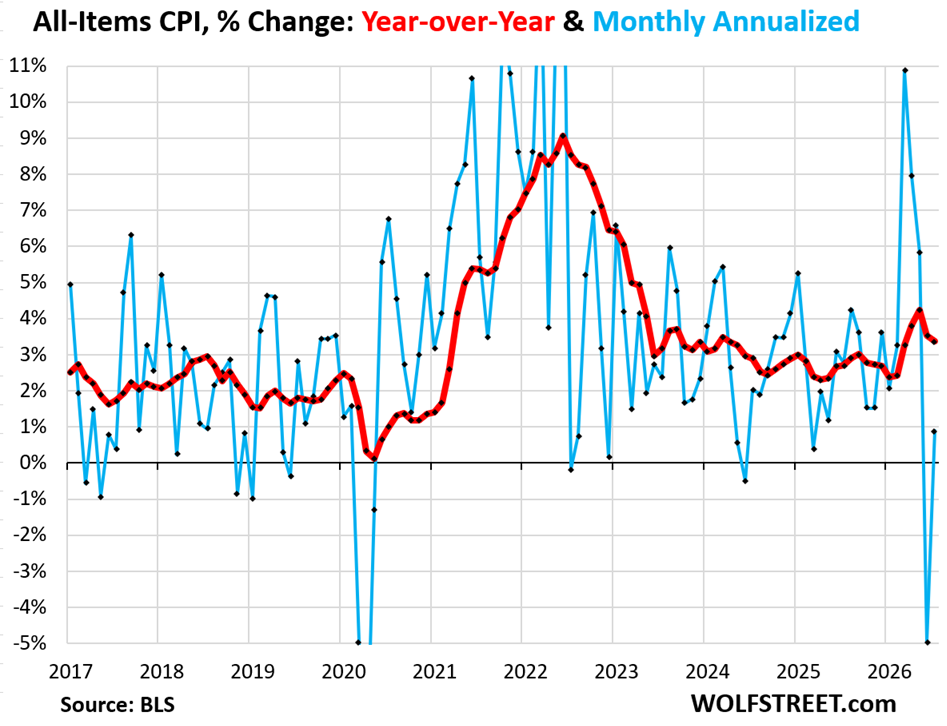
The all-items CPI (includes food and energy) inched up 0.07% in July from June after the drop in the prior month, hammered down by the effects described above (blue line in the chart).
Year-over-year, it rose by 3.4%, a slight deceleration from the prior month.
Since January 2020, the all-items CPI has soared by 30%.
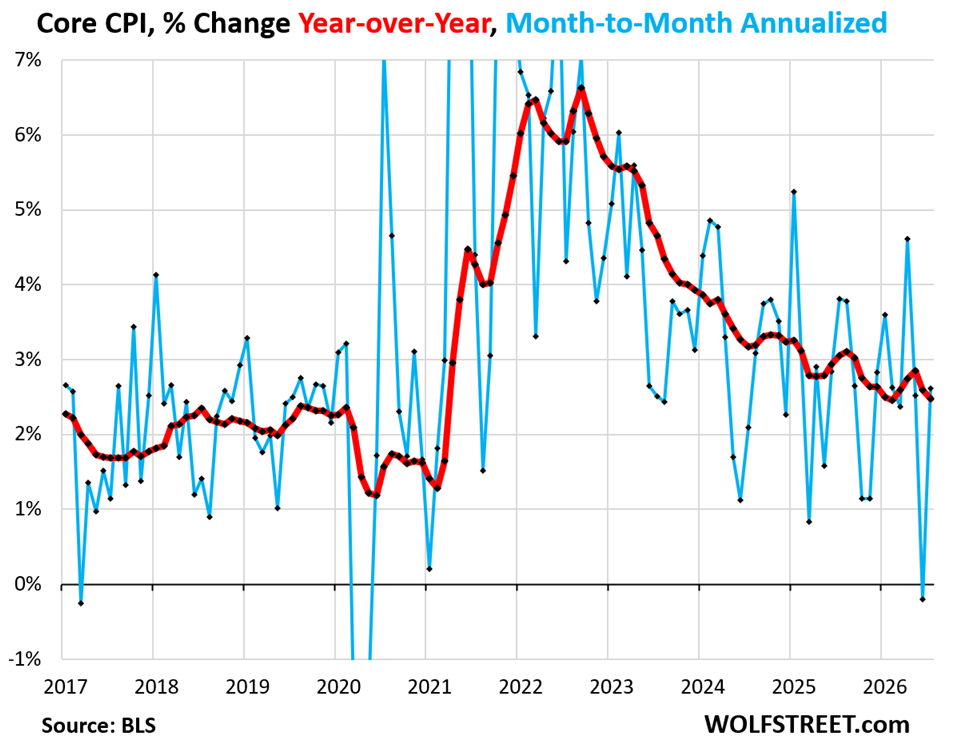
The core CPI (excludes food and energy) rose by 0.22% in July from June (blue line in the chart below).
Year-over-year, it rose by 2.5%, a slight deceleration from the prior month (red line).
Since January 2020, the core CPI has soared by 27%.
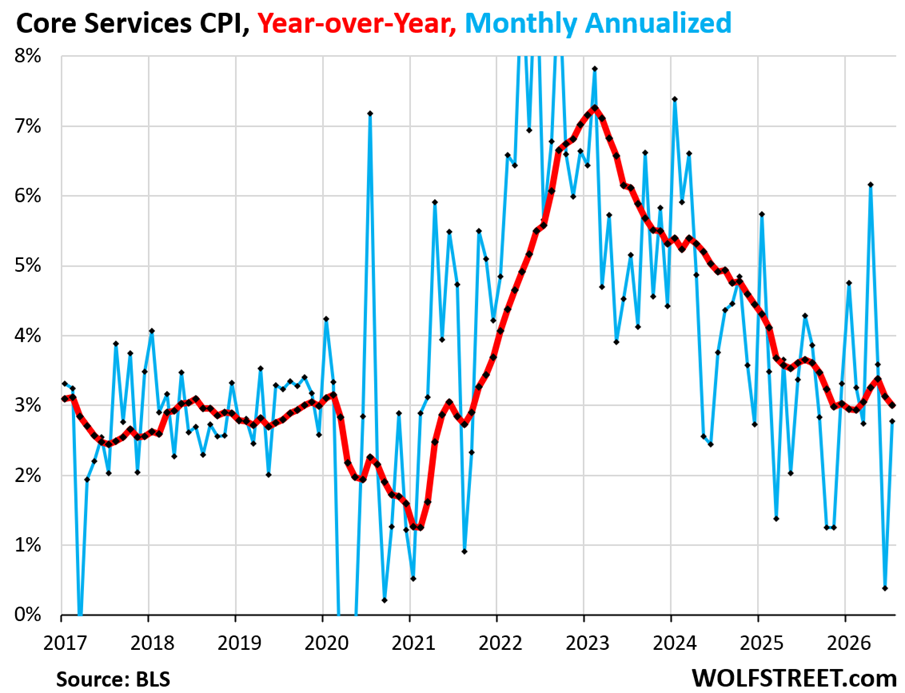
The core services CPI, which excludes energy services such as electricity, rose by 0.23%, held down by the plunge of the CPI for hotels and motels and the drop in motor vehicle insurance.
Year-over-year, it rose by 3.1%, a deceleration from the prior month (red line).
Since January 2020, the core services CPI has soared by 30%.
Its two biggest components: The CPI for Rent rose by 0.3% month-to-month, and by 2.9% year-over-year, both an acceleration from the prior month; the CPI for Owners Equivalent of Rent (OER) rose by 0.3% month-to-month and by 3.2% year-over-year, roughly the same pace as in June.
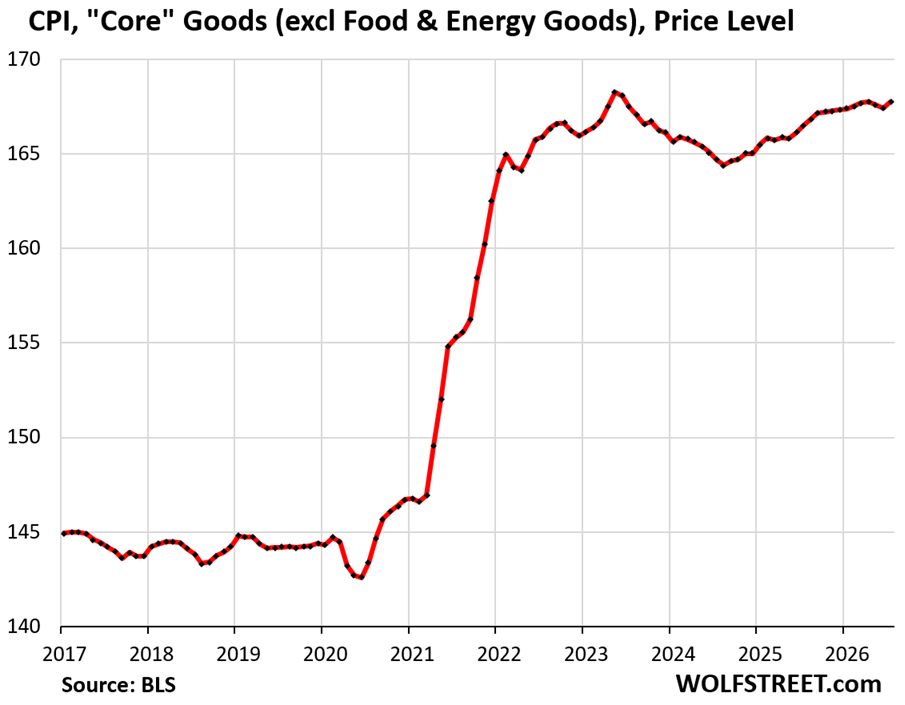
The “core goods” CPI (all goods except food & energy goods) rose by 0.2% in July from June.
Year-over-year, it rose by 0.8%, roughly at the same pace as in June.
Since January 2020, the core goods CPI has risen by 16%.
This chart shows the price level of the core goods CPI, not the percentage change:
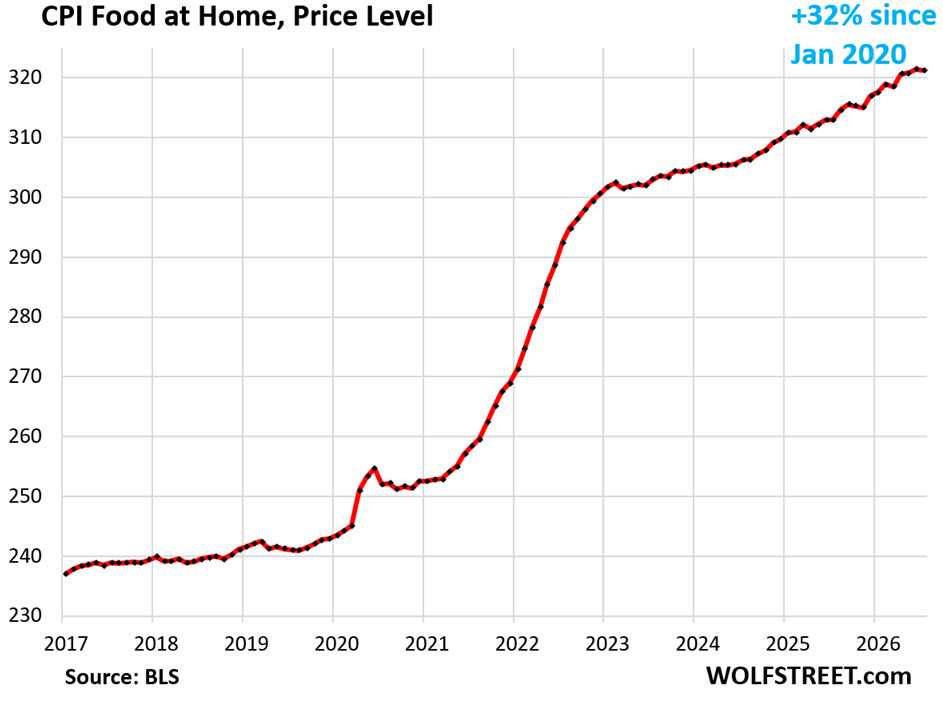
The CPI for food at home ticked down by 0.07% in July from June. This index tracks food bought at grocery stores and markets to be consumed off premise.
Year-over-year, it rose by 2.7%.
This chart shows the price level of the CPI for food at home, not the percentage changes. Since January 2020, it has risen by 32%:
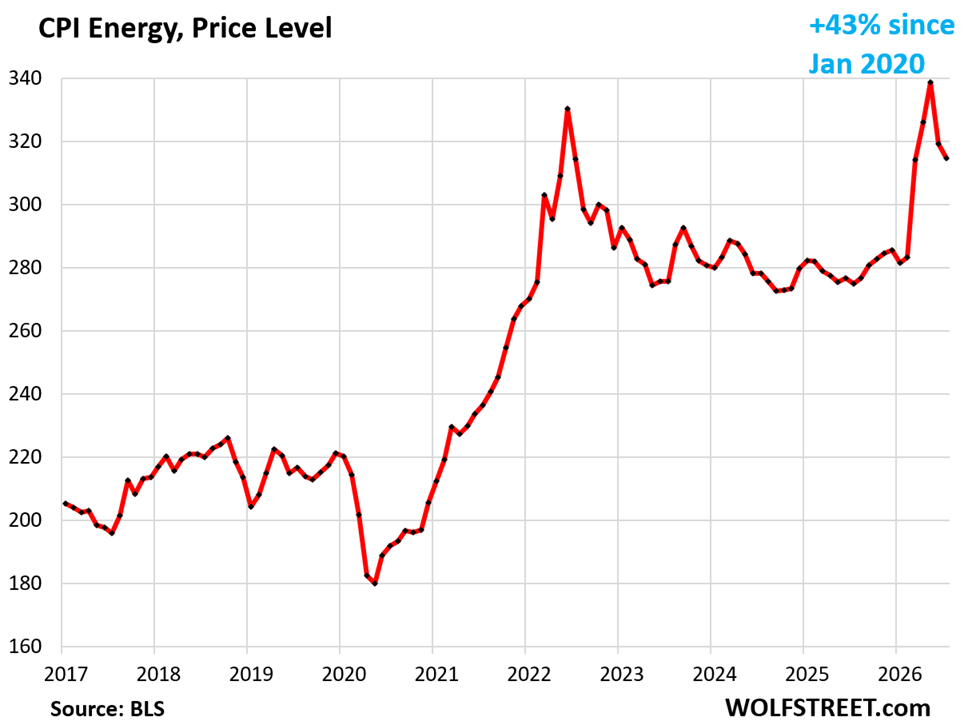
The CPI for energy plunged by 1.5% in July from June, driven by the plunge in gasoline prices, though prices for electricity and utility natural gas piped to the home rose.
Year-over-year, it was still up by 14.4%. And since January 2020, it has soared by 43%. The chart shows the price level, and not the percentage change.
Enjoy reading WOLF STREET and want to support it? You can donate. I appreciate it immensely. Click on the mug to find out how:


I have heard a lot of people complaining about the state of hotels and motels. I wonder if that is part of the reason for lowering prices. They don’t clean much and just spray a bunch of fragrance in the room, at least the lower end ones do that my retiree friends stay at. I have talked to several people besides myself who no longer want to stay at them because of it. Lots of people are allergic to that fragrance too.
Good to hear about food prices coming down. I am all for avoiding food waste but those prices are ridiculous. I feel like I have to weigh every food item purchase almost the way I would a non food item purchase.
Higher gas prices & heat wave reduced the demand for hotels is my guess.
The shoulder seasons are shifting to become the prime time to travel if you don’t have kids.
Was probably world cup related. Jack it up for it, lower it after. No way that food price drop is sustained. Esp given the fertilizer fiasco and supply of agricultural labor. This whole hodge podge is a hot mess, with few of the factors keeping the number down this month anything but blips.
Food prices are not coming down in any meaningful sense. They are basically stabilizing at their new price discovery level, much to the chagrin of the general populace including myself.
Feels like beef doubled in price in the last 2-3 months. They now sell bad quality beef for more. This is in SF. There is no way I beleive beef went down.
“Feels like” is always the best data point when the brain fails.
Beef prices “nearly doubled” since 2020 is about correct. But they haven’t risen recently. Beef prices are obscene, which is why we quit buying it quite a while ago. I’m a meat-eater, but there’s lots of good stuff out there that isn’t beef, and whose prices haven’t budged much.
Go to TJ and look at the 80/20 ground beef special. First special in a long time. Sure, 80/20 ground beef is the worst beef out there, but it’s always the worst beef out there. You can buy free-range chicken thighs, skinless boneless, for $4.99 a pound, same as years ago, and they’re absolutely delicious! Why even mess with ground beef? Let the meatpacker oligopoly and the ranchers eat all their beef on their own.
TJ has vacuum-sealed “beef” with color added. I usually don’t buy ground beef or other mistery meat. I’m not an expert on that.
I cook at home, I know all the prices firsthand. I’ve bought normal, fresh beef almost daily for years, and it has really gone up in price over the last 2 to 3 months. I don’t have a spreadsheet, but I believe my eyes before statistics.
I just checked my old Chicago supermarkets where I shopped and 2 out of 3 had ground beef at $4.99 a pound, on sale. That is significantly down.
Red meat is not good for us, but when you find a restaurant that makes a delicious, but kicking HAMBURGER you can’t give that up.
And McDonald’s uses between 700 to 800 million pounds of ground beef a year in the U S and up to 2 billion worldwide according to industry analysis.
Thank you Wolf.
Zero percent chance Warsh is giving rate hike before election. I will go even further and say Warsh is not giving any rate hikes for next 2.5 years (until Trump is in office). With On again and OFF again Oran war which is going to last for another 2 years minimum, we will continue to see up swing and down swing. Its just a big SHOW!!
There are 12 voters on the FOMC, of which 3 voted for a rate hike last time. Warsh needs to have at least 7 votes for a rate hike, or for changing anything. He does not have a majority for anything other than maintaining the status quo. None of his ideas can be implemented without a majority. People need to wrap their brains around this.
Agree with your comment Wolf and I am fully aware majority will drive decision when it comes to interest rate. This is Warsh’s Fed now and even you have mentioned it in few of your articles that he is creating his own stamp on it. I said Warsh will not give rate hike knowing he will need majority and it’s really Fed’s majority decision so no dispute there. I still stand by prediction – We will not see rate hike. I hope I am wrong.
If Fed ends up doing amazing job then Warsh is going to get the credit and deservedly so but he will also take heat if nothing changes.
Market will tank, and they will be cutting rates into rising food prices. The fed soviet will kick the can across the rubicon this time.
The FOMC voting members who are also regional Federal Reserve Bank presidents do not have the democratic process of Senate confirmation to answer to the people in any way. Put another way, the main control of the economy is not a government “of the people, by the people;” it is not a democracy or a republic, but an authoritarian control mechanism answerable elsewhere. The Iron Curtain or many regimes the USA currently vilified operate(d) without democratic input. Until the question of who these bank presidents answer to and what guidelines they operate under, then no meaningful prediction can be made of the FOMC’S economic direction or purpose beyond vague cliches of full employment or monetary stability.
Nope. There are 7 Federal Reserve Governors on the FOMC, including the Chair. They’re government employees, nominated by the Prez and confirmed by the Senate, democratically. They ALWAYS can form a majority vote on the 12 voting member FOMC. Only 5 of the 12 voting FOMC members are presidents of the regional Federal Reserve Banks.
The Federal Reserve will follow whatever the US Treasury markets set a to interest rates over the coming 2 years and they are headed up – way up.
Are SRT (short term rentals) in the hotel category? Not sure how large that business is but with more inventory in the market the per night rate for SRT is lower this year than last at least in the Branson MO area
Branson, MO….. LoL
I am having a problem with the data that shows housing costs rising given I following housing in Texas, Tennessee, Washington state, South Dakota, Florida, and New Hampshire. House prices are going down in all those states. And I thought I saw on here that many cities are having rent reductions.
Housing costs (rents, which is what CPI measures) are rising in lots of other markets, including San Francisco where they’re exploding, in the gigantic markets of Chicago, New York City, and others, and in much of the middle of the US.
Four of the states you list are at the center of the housing downturn: Florida, Texas, Washington, and Tennessee (Nashville). But there are 46 other states in the US.
In terms of single-family and multi-family rents, you can get a good look here:
https://wolfstreet.com/2026/07/21/single-family-multifamily-rents-in-face-of-an-onslaught-of-new-supply-fading-population-growth/
Watching the home price decline is going to be like watching paint dry. We pulled forward a decade worth of normal housing price increases into a few short years, thanks to ZIRP. It’s going to be 4-7 more years before we find a bottom.
Well sure they were going to ‘tame’ inflation for July. Your ‘motley’ grouping of items fits the pattern.
July, August, September are the months COLA is calculated for SS, along with union wage increase and the few remaining pensions with COLA.
It’s been nearly the same pattern every year since Reagan and Volcker changed the formula that had been in place for decades. Stealing trillions of dollars from retirees, union workers, children who lost a parent, over the past 5 decades.
BS lie. In 2021, the peak of CPI inflation was right at the COLA period, triggering the largest COLA in 40 years (8.7%).
Just repaired the old auto.
My dealership put in these plastic towers that automatically record your tires alignment, tread depth and perhaps balance?
Like a 100k upgrade to the main drive up of the dealership.
How did I learn about these new marvels? From Google, not from any of the service advisors. Because what did the service advisor do for my service visit.
Literally sat there and sent me updates via text. Did not mention the new system. Did not mention what my car needed. I had to go find him over and over.
So the network of dealers gets this new system network wide. But refuses to use it because they might have to lift a finger. Meanwhile I have to research what my car actually needs because their recommendations are so corrupt and wrong that they are just blatantly trying to do unnecessary repairs.
Fun times.
I am sorry for your problems with dealership. But you’re painting the ‘network’ (whatever that is) with a pretty broad brush, aren’t you?
When we moved back to Michigan in 2003 we had an unpleasant experience with the local Ford dealer whose service department botched an intermittent miss on three occasions.
Back then I asked some acquaintances and the Toyota was the most recommended among local dealers. So I traded in the Ranger for a Tacoma. Twenty-plus years later that Taco has over 300K miles. I checked the oil once otherwise the dealer’s service department has done it all.
There’s more to this story but my point is to our family the connection we’ve established with the local dealership over the years is more important than any other consideration including money.
Buy the best from the best and you only cry once.
I recommend you consider an independent mechanic if unhappy with the service you’re getting from the dealer.
This is why car people prefer independent mechanics, if the dealer has a good mechanic they won’t keep them very long, the rest of them are apprentices who in my experience sometimes lack the talent to even fill oil properly. Independent mechanics can be terrible too, it’s a matter of finding the right one but then you can take all your vehicles there.
“Independent mechanics” send difficult jobs on recent-model vehicles to the dealer because they have no clue what’s going on, cannot diagnose the problem, don’t even have the equipment to diagnose the problem, aren’t trained to deal with it, and don’t want to mess with it.
Independent shops are great for standard-issue parts-replacement jobs when a vehicle is out of warranty, such as struts, steering knuckle, tires, brakes, leaking hoses, that kind of stuff. I would not take my car to a dealer for that after the warranty expires.
If you have a 30-year old car, if you fix it at all, rather than getting rid of it, if something simple breaks like a U-joint, a power-steering hose leaks too badly, or you need the brakes done, have a shade tree mechanic work on it the cheapest way possible, because if you spend $500, you just spent the value of the entire car, and it’s not worth it.
The cost of hotels and motels skyrocketed due to the pandemic. Any name brand hotel that provides breakfast is well over $150 a night if not $200 depending on the location. If your just passing through on a road trip, it’s a waste. My two requirements are clean and quiet. A quick look at the recent reviews for clean and quiet is enough to find out if a cheap motel is ok.
And, the cost of domestic flights is out of touch. I tried to book a flight from Albuquerque to Oakland two weeks in advanced to attend a friend’s party. It was $450 per person. If you try to book a few days before the flight the price was $900 a ticket!! If you want a deal, you now have to book at least four weeks out. Maybe it’s a way to gouge business travelers.
Some cheap motels give free donuts and coffee. Mid-price (e.g. Hampton) gives free breakfast. Higher end has a restaurant and charges you for breakfast, no free breakfast!
I just noticed today in store and online the synthetic motor oil I buy at wally world has gone up 6-7 bucks a 5 quart jug from just 2-3 months ago.I then 3 months ago bought about 16 jugs,glad I did.
I highly recommend you look up and watch the following video on YouTube. The title of the videos is “The Shocking Truth About Pennzoil Platinum…” The name of the YouTube channel is “The Motor Oil Geek”. It shows that it was uploaded 4 days ago. For engine oil, if good quality or and price are important to you it should be worth watching. The information is very in-depth, relevant to recent geo-political and economic events, covers detailed information about the industry, the oil itself, and some other things.
People love Costco’s brand of oil.
Prob that whole blowing up the Middle East that has the oil going up!
R&T: 3-Year Old Porsche 911s Are Nearly $100,000 Pricier Today Than in 2019, Study Finds
The 911’s huge increase is just one of a few big surges in value for used luxury cars.
Totally irrelevant.
Not really as prices of previously owned luxury cars have been rising substantially over the past few years and the amounts they have been going up make other price increases seem irrelevant.
Yeah, from an enthusiast’s or collector’s point of view. But so few of these cars are sold, amid the 40 million regular used cars sold per year, that’s it’s “irrelevant” for the economy and inflation.
Plunge in gas prices? In July?
My perception was that all thru July gas prices were creeping up. Literally did a long road trip over that time period- and same place on my return was 50cents higher than on the way out. I was buying gas a lot and it was only going up.
Weird.
I googled this and got a weird response – “while the broader government CPI basket reported a retroactive technical decline early in the month, retail gas prices absolutely spiked across the country in July. The national retail average jumped from $3.80 at the beginning of July to roughly $4.09 by the end of the month. ” This included a “Mid month spike between July 9 and July 23, when the national average shot up by nearly 25 cents in a matter of days as gas stations scrambled to price in the threat of a global oil shortage”.
okay, so I really don’t see the plunge
Are we allowed to say that the government is manipulating so many things, especially data, to buy time and play tricks to avoid any interest rate increases. There is widespread manipulation going on and interest rates is only one area of focus, but it is a major one. It’s not just data that is being manipulated to manipulate the economy either, but that is one of the major tools of manipulation. After so long with it so blatant, if we are not openly allowed to say it then we should all be considered extremely dumb or weak. I’m tired of the truth being shouted down by the mouthpieces.
It infuriates me when I have to waste my time on f**kng AI slop that people drag into here to argue.
1. so the retail price of gasoline started falling in early June and fell through early July and then rose a little and by the time of the survey date was still down from a month earlier. This is EIA weekly gas station retail-price data nationwide (EIA also breaks it down by region).
2. Retail price of gasoline nearly always spikes in June/July, as July is peak driving season. Only your AI slop doesn’t know that. And the EIA’s data going back decades reflects that, and you can check it out, and I have posted those charts here before.
3. CPI used the EIA’s data but uses seasonal adjustments to make up for the seasonal fluctuations. The opposite happens over the winter, and seasonal adjustments go the opposite way.
Hi grimp,
Just curious. Did google AI explain why the pricing phenomenon you observed occurred? Was it related to the 3-2-1 crack spread? The regional refining and distribution system? The WTI crude price and Cushing tank levels? Were there other of the almost infinite number of exogenous variables at play? Regulations? Seasonal influences? Boil it down to the bare minimum and the definite answer is maybe or maybe not.
Wolf suggests today’s CPI narrative masks deeper underlying pressure. Bloomie meanwhile suggests otherwise.
I’m not sure of the data behind the pricing you mentioned. My best guess is it was wrong. Anyone can believe whatever they want. So much uncertainty can try one’s soul, can’t it?
Maybe in times like these it’s best to ignore the noise and find refuge in the things you can control. There is least one thing I know with absolute certainty. Our local Meijer’s had limes on sale today. Therefore I believe it’s time to squeeze a couple more and have another margarita. On-the-rocks, no-salt, extra tequila.
Best wishes to all and warmest regards to Mr. Richter.
Meanwhile the TNX is consolidating over 4.6%and the TYX over 5.2%
It may be the only rate increase we see under Warsh?
Just look at the 30 year bond yield. You can publish all the numbers you want, but the 30 year yield just keeps going up. It went up 0.24 in the last few weeks. The FED did not put rates up and jawboned about a September rate cut, but the 30 year went up 1/4 point anyway.
The big question: can the FED and the Treasury find a way to put off an economic reconning this time. They might if GDP explodes and/ or borrowing declines. Running the economy hot just might work, at least our borrowings are not 250 percent of GDP like in Japan, and we know what happens then!