
Why we keep an eye on the housing-debt-to-income ratio.
By Wolf Richter for WOLF STREET.
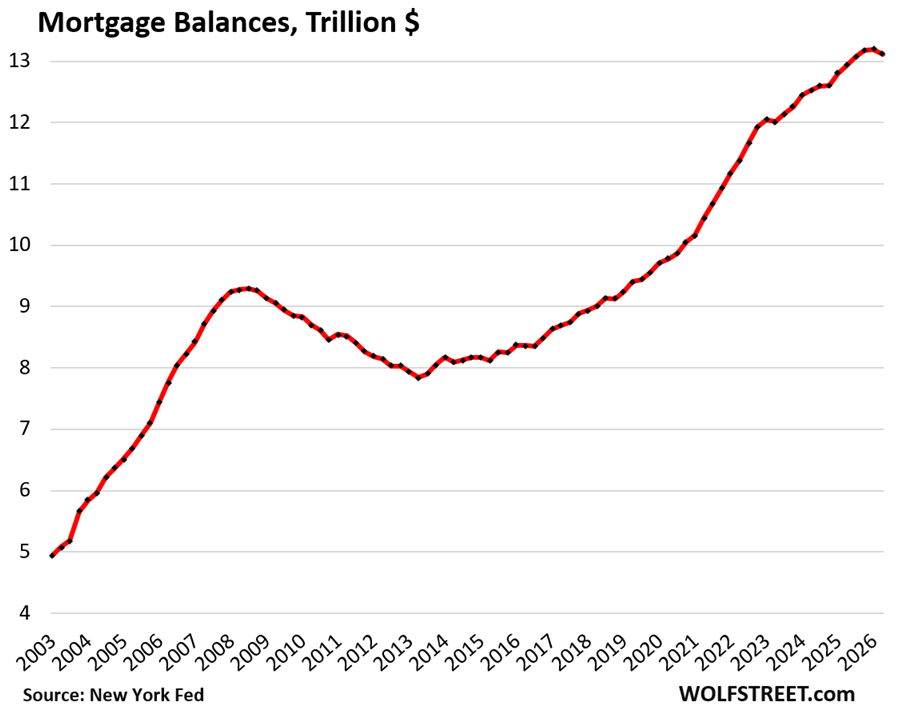
Mortgage balances fell by $74 billion (-0.6%) in Q2, to $13.12 trillion, according to the Household Debt and Credit Report from the New York Fed, which gets the data from Equifax. The unusual decline “was due to a temporary gap in the reporting of mortgages on credit reports due to a transfer of servicing,” the New York Fed explained.
This technical issue came on top of stalled mortgage originations as sales of existing homes sank deeper into the mud and as sales of new homes fizzled despite large-scale incentives and lower prices by homebuilders.
Year-over-year, mortgage balances rose by $187 billion, or by 1.4%, the smallest year-over-year percentage gain since 2016.
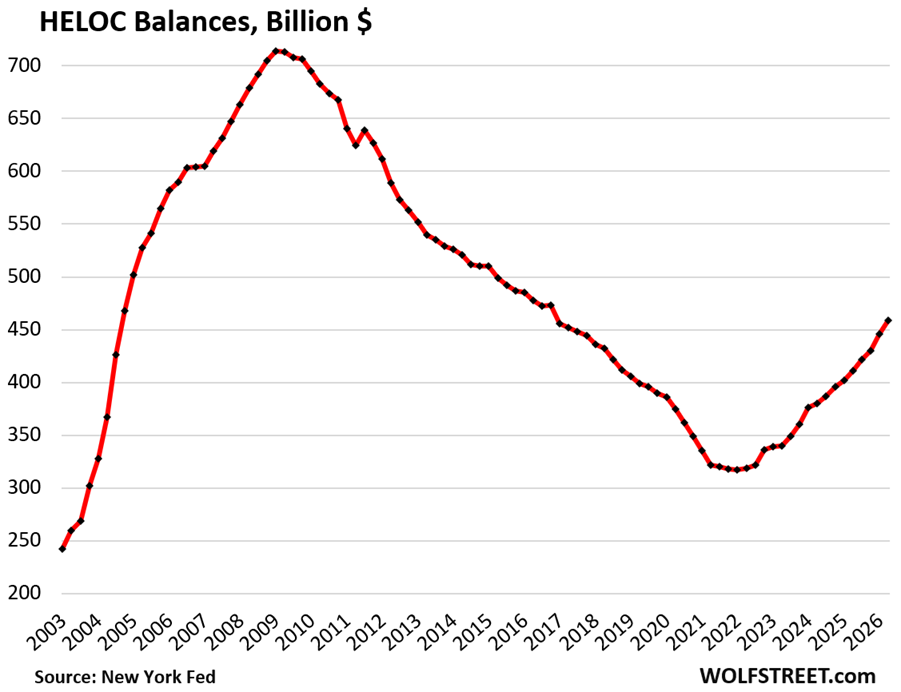
But here come the HELOCs: +45% since Q1 2021.
Balances of Home Equity Lines of Credit spiked by 2.8% in Q2, and by 11.6% year-over-year, to $459 billion.
Since Q1 of 2021, the low point, HELOC balances have surged by 45%.
These are actual balances drawn on HELOCs and do not include the unused portion of those lines of credit.
HELOC v. cash-out refinancing. If homeowners want to draw cash out of the home’s equity, thereby adding leverage to the home, they can choose between refinancing the existing 3% mortgage with a larger 6% mortgage; or keeping the 3% mortgage and adding a much smaller HELOC at 8% or 9%. And for many homeowners, that math has been tilting in favor of HELOCs, and HELOC balances have surged.
A HELOC is a second-lien loan on the home that increases leverage and that, if defaulted on, can lead to foreclosure and loss of the home, even if the first-lien mortgage is current, which is why HELOCs add an additional layer of risk for homeowners, lenders, and the mortgage market, and they did some additional damage during the Housing Bust and Mortgage Crisis.
The burden of housing debt and risk of default.
A debt-to-income ratio is a standard metric to evaluate the burden of a debt and the credit risk. For “housing debt” we combine all mortgages and HELOCs. And for income, we use disposable income (released by the Bureau of Economic Analysis).
Disposable income consists of after-tax wages, plus income from interest, dividends, rentals, farm income, small business income, transfer payments from the government, etc.
But it excludes capital gains, which is where the wealthy make most of their money. Excluded are thereby income from stock-based compensation plans and capital appreciation where billionaires make their billions.
Disposable income has grown over the years because the number of households has grown over the years, and in addition, the income per household has grown, and so total household income has grown faster than housing debt over the years, and the burden of this housing debt on household income has declined over the years.
So the housing-debt-to-income ratio dipped in Q2 to 57.4%, the third-lowest on record, behind only Q2 2020 and Q1 2021 when government payments rained down upon households and distorted disposable income beyond recognition. In 2007, at the beginning of the Mortgage Crisis, it had gone over 90%.
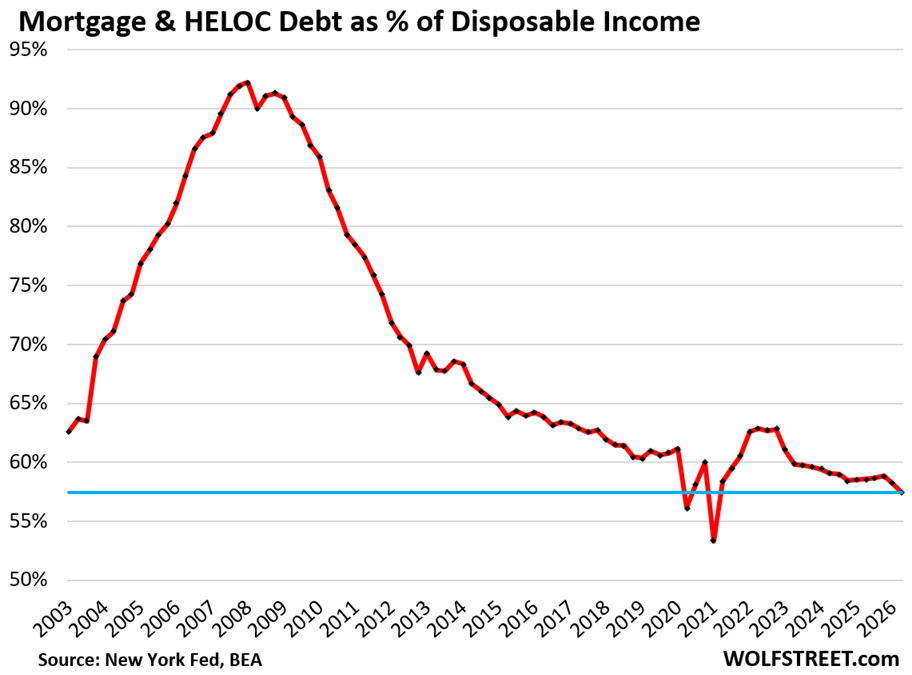
Why we keep an eye on this ratio. The chart above depicts the foundation of the Mortgage Crisis: Consumers piled on housing debt and became way overleveraged because home prices had exploded, and households kept chasing after them with ever bigger mortgages, and others used the soaring home prices to turn their homes into elephantine ATMs, drawing cash out by refinancing the home or by obtaining a HELOC, and housing debt grew far faster than disposable income, and the ratio spiked through 2007, when the ratio exceeded 90% and all heck was breaking loose.
The surging debt-to-income ratio was a warning sign starting in 2004 – one of many – of things to come.
There will always be defaults and foreclosures, and they ebb and flow with economic conditions, such as unemployment. But a widespread mortgage crisis doesn’t come out of nowhere; it builds with overleverage. And that’s not happening now.
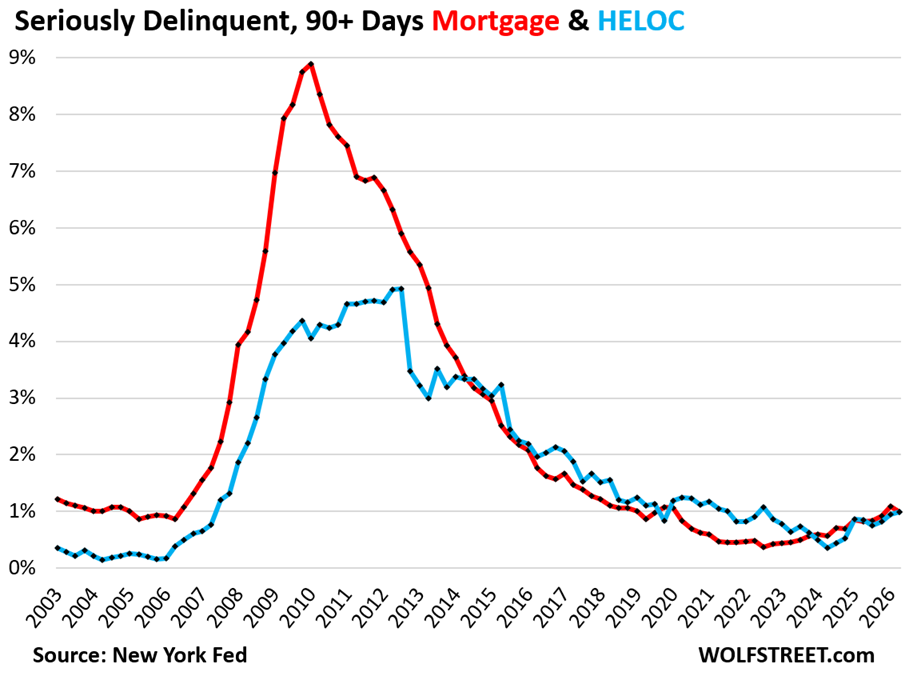
The 90-plus day delinquency rate dipped for mortgages and edged up for HELOCs, after the near-0% levels during the pandemic’s forbearance programs that removed the delinquency status from delinquent mortgages.
The balances of mortgages that were 90 days or more past due at the end of Q2 dipped to 0.99% of total mortgage balances outstanding (red in the chart below);
The balances of HELOCs that were 90 days or more past due ticked up to 0.99% of total HELOC balances (blue).
Both are roughly where they’d been during the Good Times in 2018 and 2019.
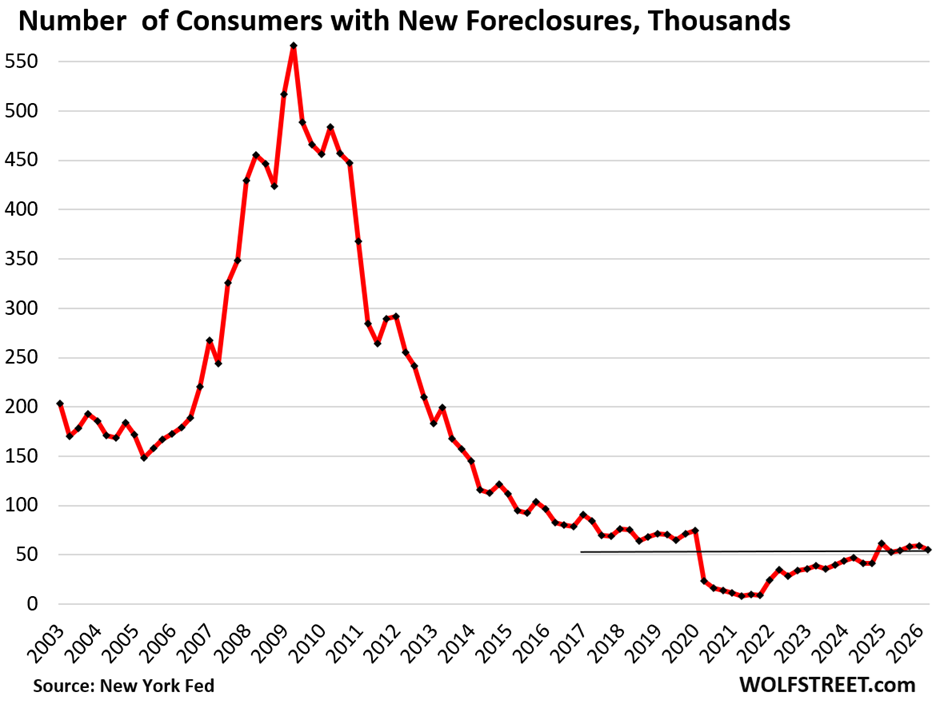
New foreclosures ticked down to 55,160 in Q2. During the era of mortgage forbearance, foreclosures were essentially impossible; like serious delinquencies, they’d dropped to near-zero.
Foreclosures have risen from these near-zero lows but have remained below the low end of the Good Times in 2018-2019, and far below the number of foreclosures in prior years.
What could drive up serious delinquency rates and foreclosures on a large scale are the three factors that drove up delinquency rates during the Housing Bust:
- Overleverage – see the housing-debt-to-disposable-income ratio above. That’s always the key. Borrowers who are not overleveraged rarely default.
- Home prices that plunge back to earth, after having exploded, when people, especially mom-and-pop landlords, including accidental landlords, default on a property that would sell for far less than the outstanding mortgage balance. Mortgages that are deeply underwater are a precondition for any large wave of foreclosures; if home prices don’t plunge, a stressed borrower can usually sell the home, pay off the delinquent mortgage, and maybe walk away with a little cash.
- An unemployment crisis. But during the Housing Bust, the unemployment crisis started a couple of years after the Housing Bust had begun and was a result of the Financial Crisis that was in part a result of the Housing Bust.
Every default has its own reasons and complications, and they happen all the time, but not on a large scale. The banking system and the legal system deal with those routinely, and so there are foreclosures, but the numbers are small, and these costs are priced into the mortgage rates and fees, and money is still being made, and the economy rolls on. It only becomes a problem for the overall economy when it takes on a very large scale, as it did last time.
Reminder: Who’s on the hook? Mostly taxpayers.
About 65% of all mortgages outstanding, including nearly all subprime mortgages, are in one form or another guaranteed by the US government, and that portion of the mortgage risk has been transferred from banks to taxpayers – one of the most fundamental changes coming out of the Financial Crisis.
The government entities – GSEs (Fannie Mae and Freddie Mac) and government agencies (Ginnie Mae, FHA which insures subprime mortgages with low down payments, VA, etc.) – buy mortgages from lenders, package them into Mortgage-Backed Securities, and the sell the MBS to investors. If a mortgage turns into a loss, the issuer of the MBS makes MBS holders whole and takes the loss. These “agency” MBS have a similar credit risk to Treasury securities, near zero.
Investors are on the hook for 15% of the mortgages. These are mortgages that didn’t qualify for government backing and that were securitized and sold as “private-label” MBS to bond funds and pension funds around the world.
About 4,000 banks and over 4,000 credit unions are on the hook for less than 20% of the total housing debt (Federal Reserve data). A big mortgage meltdown will cause them some pain but won’t threaten to topple the financial system, like it did last time.
And in case you missed it: Household Debts, Debt-to-Income Ratio, Delinquencies, Foreclosures, Collections & Bankruptcies in Q2 2026
Enjoy reading WOLF STREET and want to support it? You can donate. I appreciate it immensely. Click on the mug to find out how:


Sorry, the consumers are sitting on so much equity, it doesn’t matter.
Agree alot of equity, but housing market in my area is now stable and as the author said similar scenario leading into 2005 and 2006. What goes around comes around. I have a few friends who are mortgage officers and people are refinancing out of 3% morthages to 6.5-7% to get out of debt. Inventory counts are going up and homes are sitting on the market longer. The calm before the storm, maybe not as bad as last time or maybe it doesnt happen, but it feels like the early 2000’s again. All I did for 7 years was foreclosure appraisals for Fannie Mae.
Dbh
How do you like the new Fannie Mae Appraisal form that requires 70 pages to fill out vs 20 for the 2005 form? And requires detailed information on all the Comps used to justify the subject’s value. Ripe for lawsuits down the road.
I’ve had heloc for 2 years now
have to pay $50 year and if I don’t use after 5 years like $400 fee
current balance $0
offered 4.99% for 12 months to entice me to use
@dbh – which market ? It sounds like a tier 2 city with few tech jobs.
Not sorry. That’s what the article says in terms of the overall housing market.
But not homeowners who bought near the peak in certain markets, such as…
https://wolfstreet.com/2026/08/11/sales-of-existing-single-family-homes-sink-deeper-into-mud-supply-jumps-to-10-year-high-condo-supply-at-14-year-high/
You have stated many times previously that foreclosures are very low historically. That may well be true. Today however you state “But here come the HELOCs: +45% since Q1 2021.
Balances of Home Equity Lines of Credit spiked by 2.8% in Q2, and by 11.6% year-over-year, to $459 billion.”
My take on it is this – foreclosures may be fairly low presently, but looking at your statements above, they won’t be for long. People taking loans against their hone equity is a BAD sign.
If I’m interpreting Wolf correctly, this is not necessarily a bad sign. As he points out, many people are getting HELOC’s rather than moving or refinancing the whole mortgage to a higher rate. Debt to income ratios are still low, wages are up or stable, and delinquency rates are low. People have equity and they have income – and they are leveraging with HELOC’s.
Suppose the money is used to repair or improve the home, and the homeowner can afford to pay it down. Why would this be inherently bad?
“About 4,000 banks and over 4,000 credit unions are on the hook for less than 20% of the total housing debt”
Any idea how often private credit and private equity invest in MBS? I would expect it to be low in the grand scheme of things, but then again I don’t know who typically fronts the money for DSCR loans, etc.
1. The banks and credit unions hold 20% of the actual mortgages, not MBS.
2. Your question is unrelated to banks and credit unions. So in general, private credit makes risky high-interest-rate loans to businesses. PE makes risky high-interest-rate loans to businesses and also makes risky equity investments in businesses. They don’t invest in MBS, which are low risk.
3. There are special mortgage REITS (publicly traded) that buy “agency” MBS, fund those purchases in the repo market using agency MBS as collateral, and make money on the spread. But they’re using “agency” MBS (because that’s the only kind you can use in the repo market), and those are backed by the government.
I wonder if that use of HELOCs is about to increase. I see a lot of discussion about using a HELOC to pay for college because the interest rates are often lower than the federal “Parent Plus” or many private loans to parents and the new limits on federal loans further limit borrowing options for some families that are willing to take out large amounts of debt for college. Is there any data on what HELOCs are actually used for?
HELOCs are replacing cash-out refis. The use of those funds has not changed. It’s a financial calculus: which is cheaper and more convenient to do for what you need.
HELOC use is a direct replacement for a cash out refi for anyone with a ZIRP rate. Anyone who bought during that period, is financially stable, and wants a low interest leveraged loan is best served by a HELOC. The 401k loan is another method, but a HELOC is easier, less risky, and more flexible.
That HELOC balances chart, rather than showing the pandemic frying pan pattern, looks more like a ladle. Interesting stuff.
“A Heloc can lead to foreclosure and loss of the home, even if the first-lien mortgage is current”
Question for Wolf:
Is that the one difference between a Heloc and a second trust?
The other being the Heloc is a line of credit where as a second trust gives the borrower the money up front in a lump sum?
Any other differences?
US Set to Pay Most for 30-Year Debt in Quarter Century…
Treasury market facing reckoning?
Homebuyer Demand Drops to Record Low…
My awful neighbor is about 36 months behind on their mortgage after 4 years. No idea how they keep hanging on, but they literally make a full time job out of gaming the system. It is a FHA loan. I have seen multiple Notice of Pendency of Proceeding to Foreclose Mortgage filed with the county and still nothing.
I think I will buy and donate to someone I know or bulldoze it when they get the boot.
The Pike,
Good luck with buying a defaulted Fannie mortgage, like the one at 2717 Kerlikowske in Benton Harbor. After the default on a $160K loan, FNH hired a agency connected builder from Lansing who came out, tore down the old one built a replacement that is currently on the market by their preferred RE Agent for the now discounted price of $399K.
Government follies like this used to make me angry but has morphed into annoyance, then acceptance, until now, as days turned into months and then years with no buyers in sight, amusement.
We get the government we deserve, don’t we?
https://beacon.schneidercorp.com/Application.aspx?AppID=346&LayerID=4427&PageTypeID=4&PageID=2617&Q=805112220&KeyValue=11-10-3120-0005-00-9
https://www.zillow.com/homedetails/2717-Kerlikowske-Rd-Benton-Harbor-MI-49022/73856223_zpid/
@The Pike – Which city, if you dont mind ? Its anonymous here.
@Wolf says, “HELOCs are replacing cash-out refis.” In the last month I have heard of two guys in their 60’s taking out HELOCs to bridge the cap until their parents die and they can sell the family home worth millions…
More and more people accepting that home prices aren’t going to collapse. The slow grind continues of coming to terms with current prices and rates.
In real terms, home prices keep slowly falling.
Probably another 5 or 10 years before the national conversation no longer includes talking about high home prices?
At the rate that real home prices are falling, will take decades for prices to come down to a more normal level, because wages are not keeping up with inflation.
To make prices align with wages on anything less than a generational timescale, you need prices to outright collapse.
There seems to be a battle to prevent large price drops going on.
House A) built in 2023 3000 sqft for 1.5 million,
And a quarter mile away
House B) built in 1996 3000 sqft for 400k. Decent renovation
Someone is wrong. And will be wrong in a major way.
Maybe the Government doesn’t care anymore because AI will save us all and kill us all at the same time. Or at least be able to get mail to Navy ships at war.
@SomeGuy – Yes. Price drops are being prevented by propping up home prices via seller incentives. The crooked new home builders dont drop price. Instead, they give you low interest rate for 2-3 years. Old home sellers also offer concessions to buy down rates. I am sure there are more crooked practices which prevent easy price discovery.
Excellent article as always from Wolf. But…
Why is she sitting on the wall, looking out?!?! She walked up appearing interested in looking over the wall. Climbed up the wall with the pitchfork ominously point up. Now casually sits gazing into the distance, no longer interested whats behind the wall. The block appears a bit unstable, but not imminent collapse. These paywall pictures are fascinating!! Will the wall collapse?!? Is she so enlighted by what she saw that she can only gaze into the distance, trying to process the beauty?!?
Wait for the next episode. She will watch from her perch as all hell will break loose.
Will we see inflation (CPI or PPI) explode from behind the wall?
Will (bond) yields come blasting through?
Will a horde of bond vigilantes topple the wall?
Does the wall come crashing down only for all the kings horses and all the kings men (aka FED and Treasury) to try to put it together again?
The analogies are endless!! Waiting with bated breath.
I have owned 5 houses in the past 37 years. My current, retirement home is paid off. My cute, small bungalow in SW Florida is worth a quarter of a million dollars according to Zillow and the Property Appraiser’s office. I retired 20 months ago and recently toyed with the idea of using a cash-out home equity loan to buy either investment property or a small existing business. However, I don’t feel comfortable with the idea of losing the house in case the investment or the business fails. Me and my dogs might find myself living under a bridge and I am too old for that. I am watching real-estate prices in my neighborhood and in my immediate area. I also crunch hypothetical numbers on spreadsheets, but at the end of the day it is still a gamble. I also have an MBA, so it’s not like I would be going into it blindly. The biggest reason for not using the equity in this house is because my daughter gets this house in my will should I pass on. This house, with it’s 100% equity is her future backstop in life. That’s what parents do. For now, I am making improvements and updates to increase the value of this property. I’m just a caretaker at this point of my life. Cheers.
I didn’t see this in the article, sorry if I missed it: Who is on the hook for HELOCs in case of default, banks, taxpayers, or someone else?
Banks. But the amounts are not big.
The issue with HELOCs is that they’re 2nd lien loans, and if you default on the HELOC but maintain your mortgage in good standing, you can still get foreclosed and lose the house, and then both loans create losses for whoever holds them, and additional risks for the homeowner if they live in one of the 38 full recourse states.
And even in non-recourse states, such as California, HELOCs are full recourse, so your personal assets are at risk as well.
Thanks! Also, I appreciate your site.
EXACTLY!Spot on
I wonder if you subtracted credit card debt, student loan debt, auto loan debt, and medical debt how much disposable income would really be leftover?
What I’m suggesting is maybe the 2007 debt was one-dimensional – mostly piled into housing. And maybe today’s situation is just as perilous but the leverage is diversified.
Here is the total consumer debt, answers your question:
https://wolfstreet.com/2026/08/11/household-debts-debt-to-income-ratio-delinquencies-foreclosures-collections-bankruptcies-in-q2-2026/
Is there a view that take a holistic approach to get a full view at income levels as it relates to total debt as a % if income (mortgage/HELOC, Credit Cards, Auto, Student Loan, etc) for incomes <$75k, $<150k, $250k, +$250k?
Granted it will be an average but will give a full picture of the US consumer, debt, and crystallize where and why segments are behaving or adjusting to inflation and overall economy.
I've always tried to piece this together off separate cuts of data but haven't seen anything that brings it all together?
Thanks in advance
Yes. I linked it in the article above, and I published it the day before:
https://wolfstreet.com/2026/08/11/household-debts-debt-to-income-ratio-delinquencies-foreclosures-collections-bankruptcies-in-q2-2026/
I had both a 1st and (2nd HELOC) and then a heart attack in 2014.I said I swear I’ll pay these off and FU@K them.These people are brutal,they do not give a CR@P about you just their money. 12 years later DONE! never again. I shall eat cat food and dog food before I take another loan with a bank,ANY BANK!!
Seems to me HELOCs are being used to get cash out of home equity rather than selling the house and risking price discovery not in the seller’s favor.
Of course the obvious problems with this are in fact obvious: it imposes a repayment obligation where before there was not one, and it puts banks on the hook again.
When the market starts going down for any reason and banks realize that they are on the hook for losses due to them lending against equity that did not in truth exist, there will be a nearly immediate crash in housing as banks rush to recover their equity and a lot of bankrupt existing-home owners who will also lose their personal property like stocks.