
Spooked by inflation, deficits, hocus-pocus shows, competition from the AI debt binge, and getting casually thrown under the bus by Trump’s free-money promise.
By Wolf Richter for WOLF STREET.
It was a brutal four-day week in the bond market and mortgage market, with yields surging across the board to price in more rate hikes, more inflation — two nasty inflation prints this week, the PPI and the CPI — more supply of Treasury debt to pile on top of the $40 trillion, more fiscal deficits, more competing debt issued by the AI hyperscalers, more whatever. And then Trump threw the whole bond market under the bus. The 1-year to 7-year maturities made the biggest moves: Their yields spiked by 22 to 26 basis points in those four days.
At the 3-year Treasury auction on Tuesday, it took a yield of 4.474% to sell all $58 billion of notes. In the secondary market, the 3-year yield then spiked by 25 basis points in three days and on Friday closed at 4.72%.
Since late February, the 3-year yield has spiked by 108 basis points – one heck of a majestic spike. The Fed rarely hikes policy rates just once. It usually does so in a series. And the three-year yield is now counting on 3 or 4 rate hikes to come: It’s 106 basis points above the Effective Federal Funds Rate (blue, 3.63% currently), which the Fed targets with its policy rates.
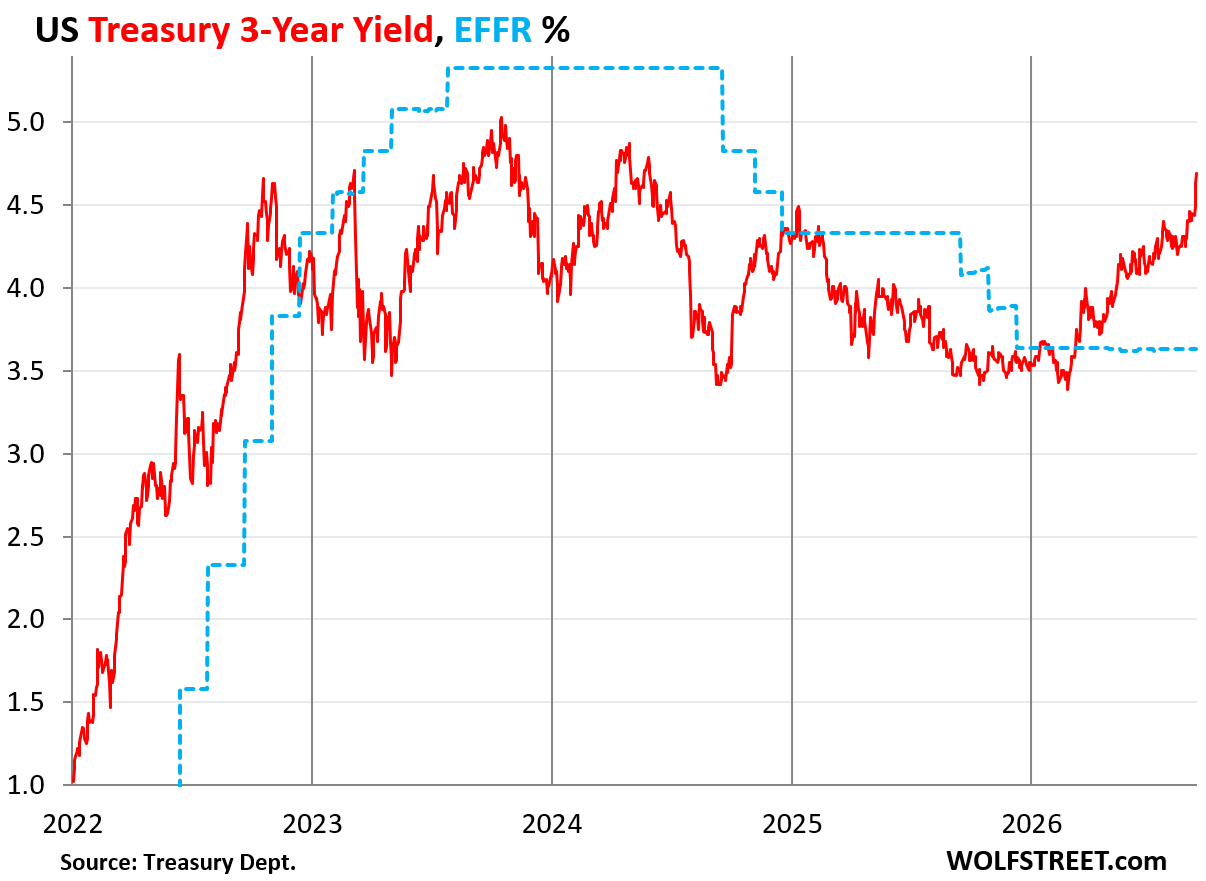
That’s the bond market in action without forward guidance from the Fed: Instead, buyers and sellers are steered by the data as they see it, and by how they think the Fed would or should react to that data.
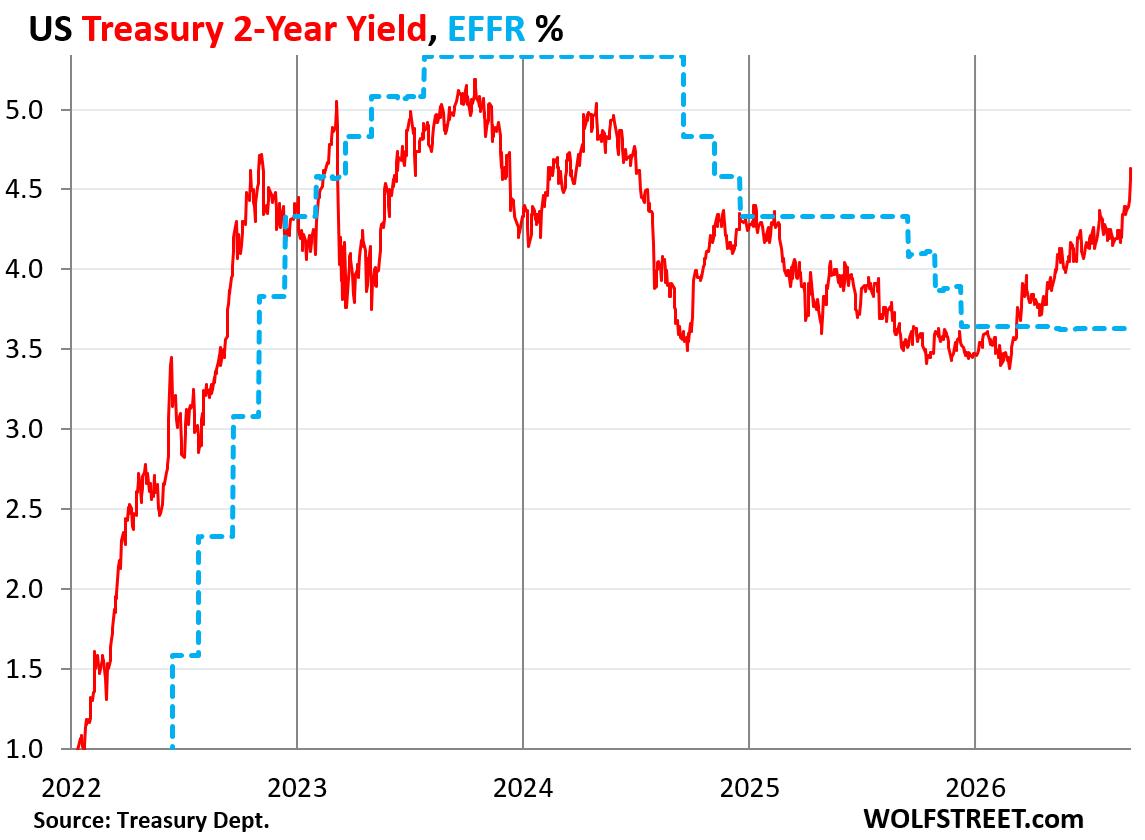
The 2-year Treasury yield, which is one of the most important input data points for the Fed and its rate decisions, got even wilder, without auction this week, spiking by 26 basis points this week, and by 126 basis points since late February, to 4.63%, the highest since July 2024.
The buyers and sellers at this end of the bond market had flipped essentially from 1 rate cut in February, to 4 rate hikes on Friday.
Right or wrong, there’s going to be a lot of volatility in the bond market – and Fed boss Warsh, who despises forward guidance and wants the bond market to do its job, is secretly nodding in approval about this process of price discovery between buyers and sellers, rather than a bond market cowed and manipulated by the Fed’s forward guidance.
At the 10-year Treasury auction on Wednesday, it took a yield of 4.834%, the highest auction yield since August 2007, to sell all $39 billion of notes.
Then in the secondary market, the 10-year yield surged to 4.97% by late Thursday and on Friday clung to it, the highest yield since the intraday high of 5.02% on October 23, 2023, and before then, the highest since July 2007.
The worst inflation in 40 years forced the Fed to ease out of financial-repression mode in 2022 that it had been in since 2008. So it hiked its policy rates from near-0% and began to unload securities from its massive balance sheet, and yields began to rise across the board.
But a 10-year yield of 5% is not high, compared to the decades before the Fed’s financial repression.
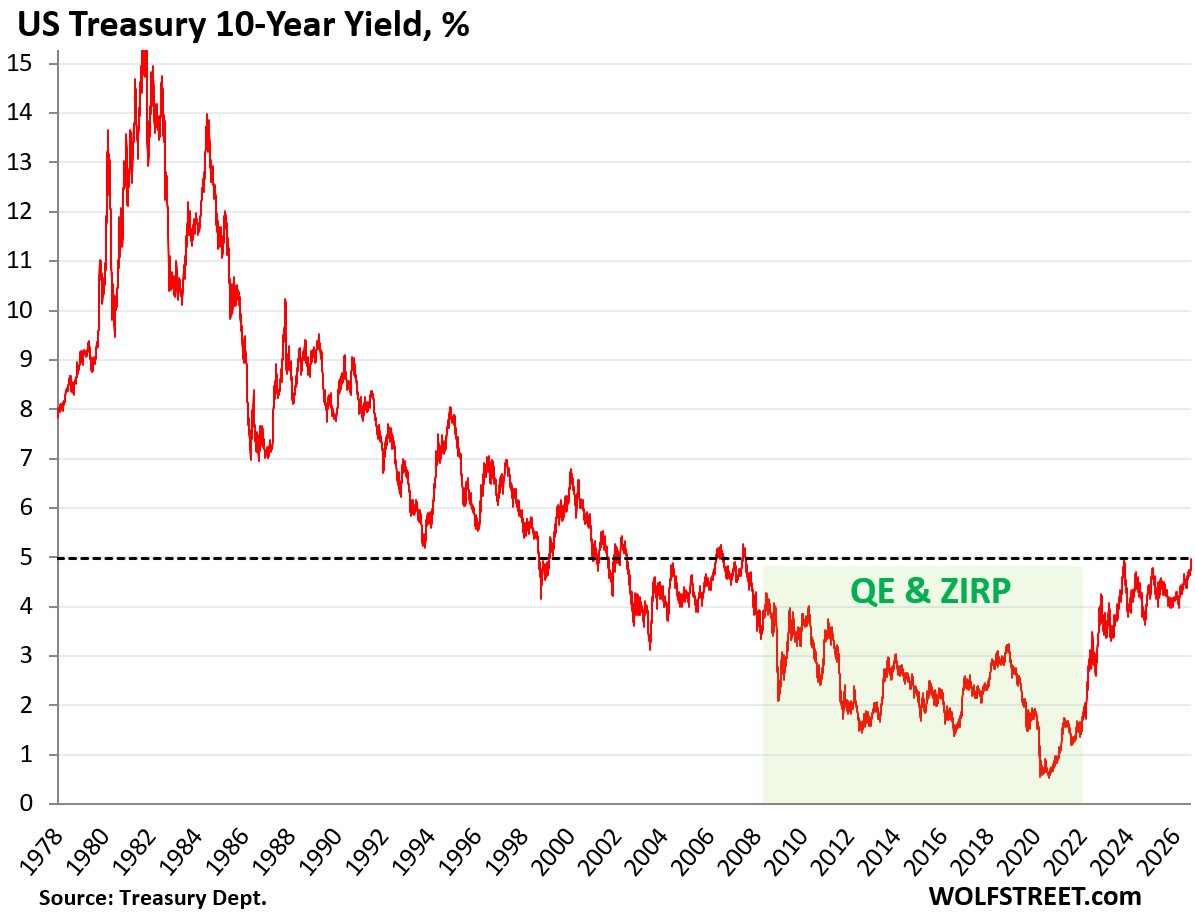
Rising yields mean falling bond prices for existing bond holders. Especially those who’d believed the Fed’s forward guidance and bought long-term securities in 2020 and 2021 have gotten bloodied as these securities’ market value plunged by about half.
But potential buyers, sitting nearby on the fence, are licking their chops because bond yields are finally normalizing after 14 years of financial repression.
The 10-year yield is now 134 basis points above the EFFR (3.63%). Back in October 2023, when the 10-year yield spiked to 5% briefly, it was below the EFFR (5.33% at the time), and T-bills sold at auction with a yield of around 5.5%. Back then, the yield curve was inverted, with long-term yields lower than short-term yields.
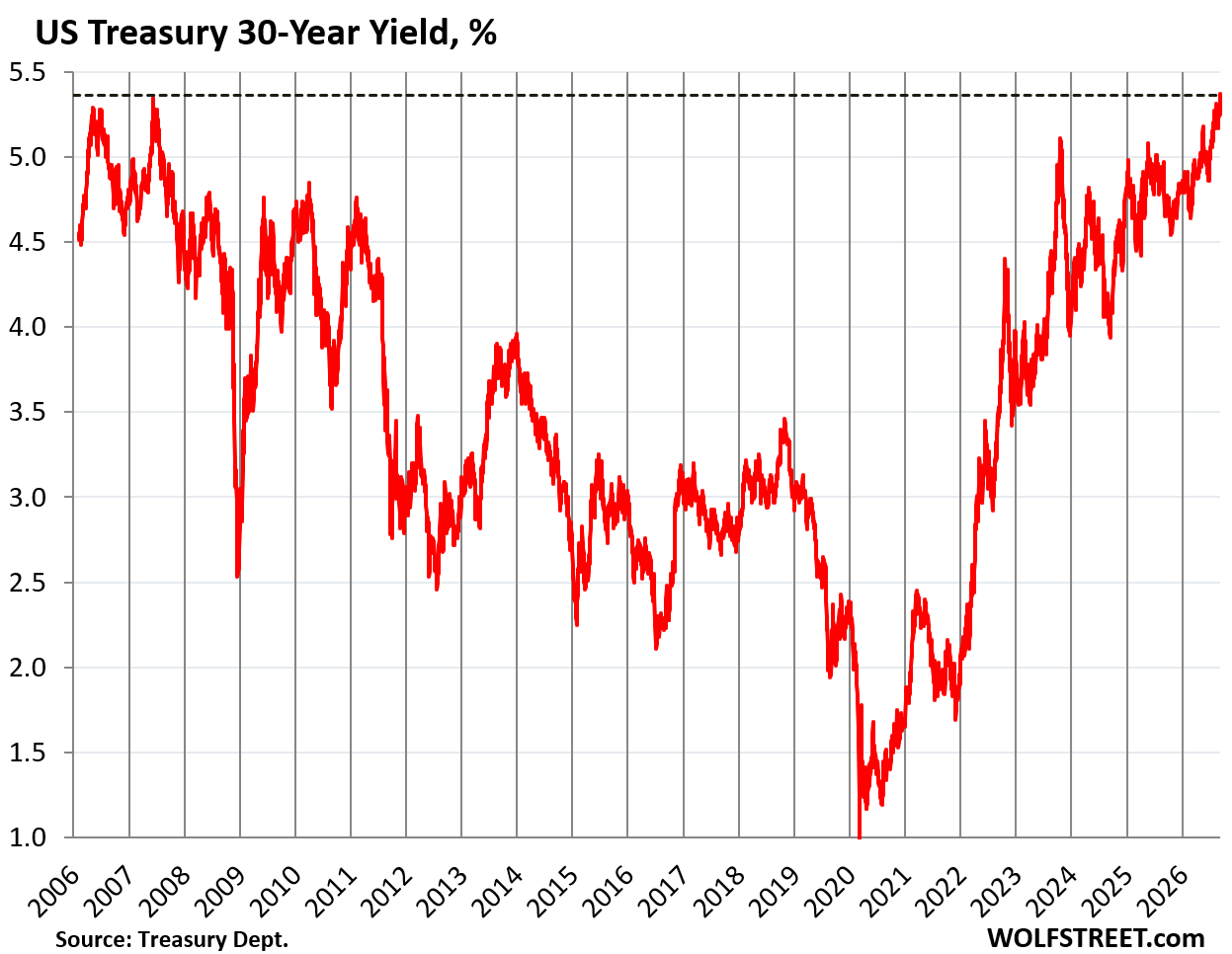
At the 30-year Treasury auction on Thursday, it took a yield of 5.308%, the highest auction yield since August 2001, to sell all $22 billion of bonds.
In the secondary market, the 30-year yield rose to 5.36% by Friday evening.
The whole thing was made worse by Trump’s free-money promise ($5,000 for every adult American), which, if implemented, would add $1.3 trillion to the deficit and debt and would provide lots of fuel for further inflation.
That Trump would so casually throw the entire $40-trillion bond market under the bus with his left hand was an additional nightmare for the bond market.

Made worse by the Treasury buyback auction. Bessent had announced the buyback auctions in mid-August, which we called a hocus-pocus show at the time. The purpose was to manipulate down long-term Treasury yields.
On Wednesday, the government provided the details – it would offer to buy back $6 billion of 40 different issues of 20-year and 30-year bonds that would mature at dates ranging between May 2040 and August 2046. But Treasury yields jumped even more as the market had hoped a higher maximum, or no maximum at all.
Then on Thursday, when the buyback auction took place, yields jumped further. Sellers bid the lowest percentage of face value they were willing to accept for their bonds, and the lowest percentage (biggest haircut) won.
The biggest accepted haircut was for a 20-year bond that was issued in August 2020, maturing in August 2040, with a coupon interest rate of 1.125%. It sold at an average of 59.95% of face value.
The smallest haircut went to sellers of a 20-year bond that was issued in May 2025, maturing in May 2045, with a coupon interest rate of 5.0%. It was accepted at 95.84% of face value.
But sellers were high-balling the government, wanting to get higher prices than the government was willing to pay. Of the $10.5 billion offered, the government bought back only $5.2 billion, below the $6 billion cap. Given the discounts that the government obtained, it ended up paying substantially less than $5.2 billion to buy back those bonds.
The fundamental problem with the Treasury buyback auctions is that the government cannot print money, only the Fed can, and that the government has to eventually borrow every dime that it spends on buybacks, thereby replacing larger amounts of older low-interest-rate debt with smaller amounts of new higher-interest rate debt, with the net effect that the debt declines a little bit, while the total interest payments may rise a little bit.
Bloodbath in the mortgage market. The 30-year fixed mortgage rate tracks the 10-year Treasury yield, but is higher, and the spread between them varies. So the same dynamics played out in the mortgage market as in the Treasury market. Mortgage-backed securities (MBS) sold off sharply, and mortgage rates spiked.
The average 30-year fixed mortgage rate spiked by 23 basis points this week, and by 37 basis points in two weeks, and by 112 basis points since late February, to 7.12% on Friday, the highest since February 2025, according to the daily measure by Mortgage News Daily.
By casually throwing the bond market under the bus with this free-money promise, Trump also threw the mortgage market under the bus (chart via Mortgage News Daily).
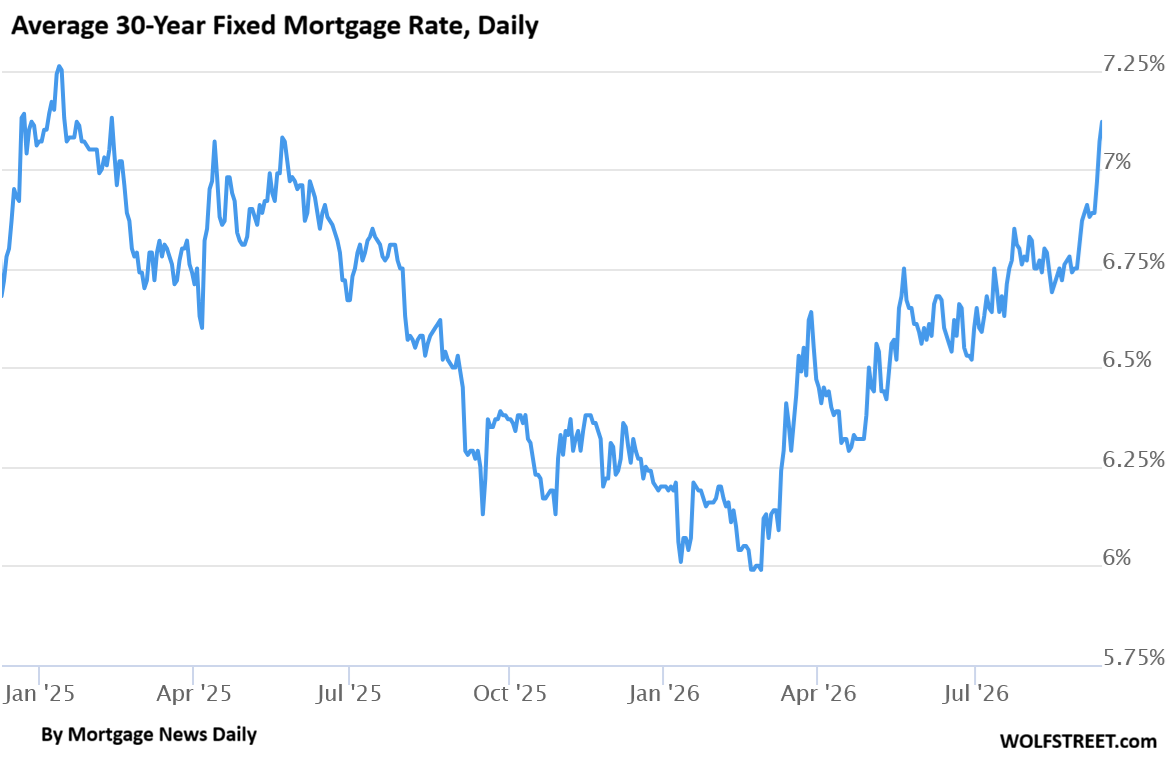
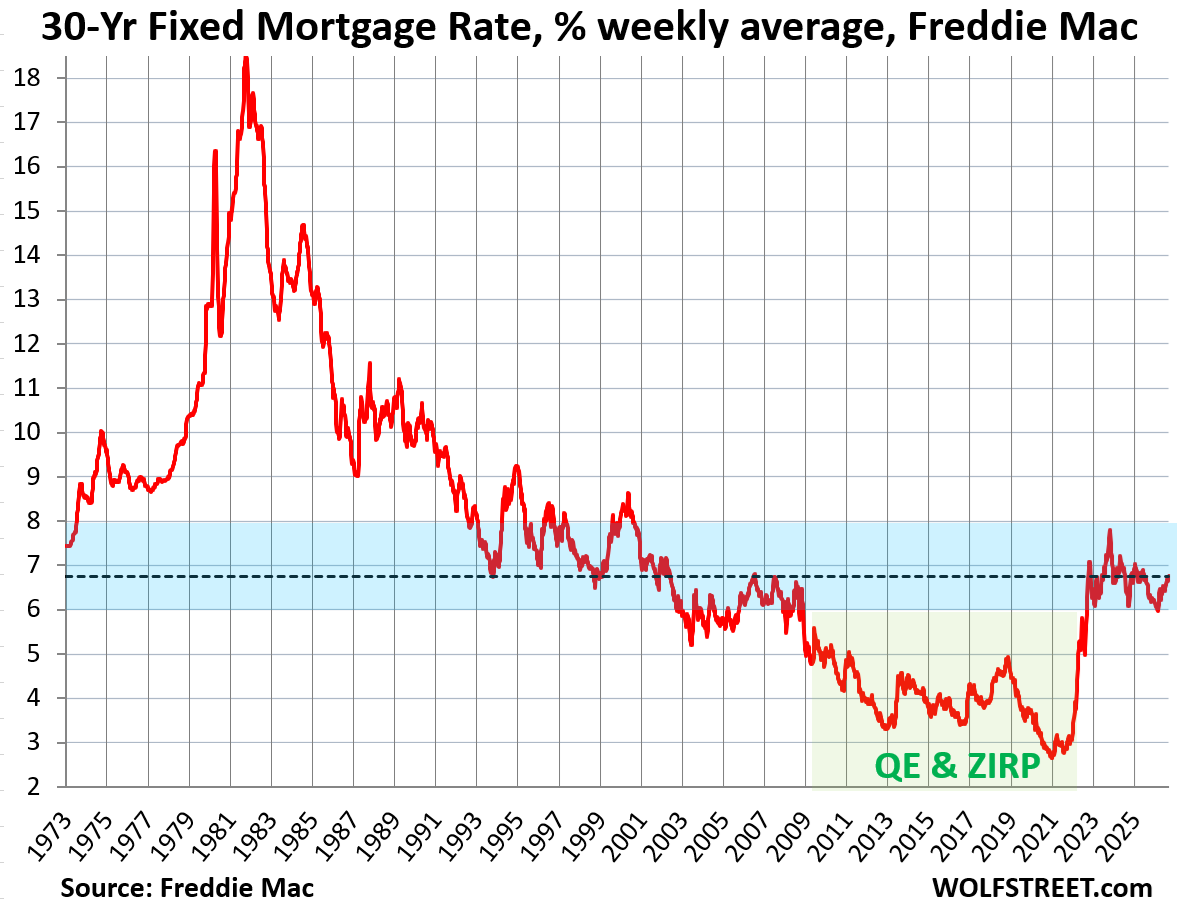
Mortgage rates around 7% are not high in a historical context. They’re only high in the context of financial repression. Compared to certain other periods, they’re low.
Freddie Mac’s measure for the 30-year mortgage rates is a weekly average through Wednesday, thereby still missing the spike on Thursday and Friday. The weekly average though Wednesday rose to 6.76%. But the long-term chart shows the drift: the 7% range is not high compared to the rates that prevailed before 2008, before the Fed’s financial repression (green box). Mortgage rates peaked at over 18% in 1981.
Enjoy reading WOLF STREET and want to support it? You can donate. I appreciate it immensely. Click on the mug to find out how:


Nice to see the bond market finally worried about the govt. not controlling inflation + having to borrow $2 trillion every year.
yes but the bonds being issued are unlikely too compensate anyone for taking any risk beyond six months
I hope I am wrong
“… bonds being issued are unlikely too compensate anyone for taking any risk beyond six months.”
Not sure this is true for traders, asset allocators, or investors who need to spend income each year.
Watching rates grind higher is always interesting!
“Watching rates grind higher is always interesting!”
Watching rates be *allowed* to grind higher is always interesting (“Where’s ZIRPy?”)
It isn’t like the path of fiscal degeneracy is anything new for the US. It has been going on for over 50 years.
And explicit ZIRP money printing was invoked over 15 years ago to strangle otherwise naturally rising interest rates.
What exactly changed in the last 60-90 days to make bond buyers finally give a tiny crap?
For the Fed to hesitate to print even more money to set a phony ceiling on USD interest rates?
Musk’s magic money machines only effective intervention left?
I mean,
Way to do way gooder right before the midterms kids!
as Letterman might have said.
Hahaha
“But a 10-year yield of 5% is not high, compared to the decades before the Fed’s financial repression.”
And we can say conversely, $40T is high, like a Mount Everest of debt. Given that we’re approaching 7% annual interest expense to debt ratio, rates matter nowadays a lot more than 10-15 years ago. And I’m not arguing for lower rates.
Just wondering how high that 7% will jump when a nasty recession arrives.
It’ll go down when a nasty recession arrives.
Look at Debt to GDP and at the interest payments as percent of tax receipts:
https://wolfstreet.com/2026/08/27/quarterly-update-on-the-ugly-fiscal-condition-of-the-us-in-q2-2026/
In your second chart what is concerning and seems under appreciated by the government is that when interest rates spike how fast the government interest payments as a percent of tax receipts spike as well. As you have also noted the move to short term borrowing will only amplify this trend. So while the debt appears manageable now, that may not be the case as rates rise quickly and more short term debt is issued over long term. Just look how fast that percent changed in 2024.
Andrew, great point and agreed. Additionally, the first graph gives me pause because during a recession, tax receipts can plummet. Assuming that the points in the figure are quarterly data, in 2008, tax receipts plummeted from approximately $375 billion to $290 billion in the next quarter.
Tax receipts lingered low for a few more quarters and then gradually increased.
I trust we can all agree on this worst case scenario: tax receipts fall precipitously, yields skyrocket, Congress keeps spending profligately, and GDP decreases. So, to avoid having this become reality, the natural question is how do we prevent this outcome?
The government’s finances will look a lot worse in a recession. Everyone knows that. That’s why this deficit is so shocking, that it’s 6% of GDP during the good times! But a run-of-the-mill recession lasts a few quarters and isn’t a big deal, as we saw with the Dotcom Bust recession. The Financial Crisis didn’t start out as a recession, it started out with a mortgage crisis that pushed the banking system to the brink, which then eventually triggered a big recession. Now most mortgages are guaranteed by the government and will not push banks to the brink.
Thanks for these three charts, Wolf.
First one. Tax receipts are going up faster than government interest payments.
Second one. Government interest payments as a percent of tax receipts in the early 80s where way higher than today.
Third one. Debt as a percentage of GDP was quite a bit higher in in 2022 than today.
There is hope. Can Pres. Trump run the economy 🔥 hot enough to greatly improve these numbers? I think he can.
Yes he can. But, rural gas prices to $5 and scared and angry rural citizens over data centers in their back yard will sink Republicans like the Titanic.
what is troubling in this chart is that the ratio has gone sideways for 5 years, despite all of the inflation during that span. So letting it run hot has not helped bring the ratio down. Turning up the temperature even more is a recipe for instability.
I know, Wolf, I’m familiar with all your stats which are fantastic.
All I’m pointing out is that we’ve arrived at the point where the debt is a very big noose around America’s neck. I sincerely hope Warsh sticks with his plan to raise rates as far as necessary to tame inflation. Not sure if that’s going to be 50, 75 or possibly 100 BP, but I think we can all agree that it will take more than next week’s piddly 25 BP rate hike to do the job.
I’m also looking forward to short-term rates spiking just as the Treasury continues to move towards bills. I’d love to see interest expense spike in the next 12 months. I’d love to see a 25% market correction by the end of the year. We need all the bad news we can find to get Congress to start doing something about it’s spending problems.
Isnt this the contradiction FED and Treasury face. Raise rates to fight inflation while simultaneously Treasury is looking for inflation to “manage” the debt in terms of different ratios (debt to GDP, interest expense as a pct of revenues etc).
Are FED and Treasury really in conflict ? Is it really possible that Warsh and Bessent don’t understand ? Is it really possible that on top of it all Trump is really so ignorant of the consequences ?
I’m ready to believe it but simultaneously ready to wonder otherwise.
danf-fifty-one
The Fed is not going to raise rates high enough to bring GDP inflation down to 2%. If it raises rates at all, it will be just barely enough to keep GDP inflation between 3-5%.
This is GDP inflation, it’s inflation not only for consumers but also for businesses and governments; it’s the inflation metric that matters for this discussion:
These three charts are like the whole damn show.
It really makes more sense to focus an entire post (multiple posts) on them and their constituent component parts (which all have their enlightening stories to tell) than to just periodically toss them into the middle of discussions of other (admittedly related) topics.
casOneTwoSeven
The fact that you don’t ever read ANY articles here doesn’t mean I don’t post them.
I post those articles quarterly, every quarter, and most recently did so on Aug 27, and I even linked the article in my comment above, so here it is again. CLICK ON IT AND READ IT:
https://wolfstreet.com/2026/08/27/quarterly-update-on-the-ugly-fiscal-condition-of-the-us-in-q2-2026/
It was a brutal four-day week
As the morning sun brings the pain of sobriety
Overpriced assets are becoming more expensive with each upward tick of the interest rates
between harmony and chaos, the boundaries of human civilization
The status of the reserve currency is at stake, for God’s sake.
It does seem very very chaotic right now. It would help things in all sectors, not just financial, to see some professional and intelligent leadership, plus accountability take hold. But powerful insiders are still reaping their profits and supporting the status quo with actual dollar contributions and public approval. Or through silence.
History might one day show a ‘this is when’ moment. Maybe there is a prediction spread on this? ha
Debt per tax receipts chart is very interesting. And here is my ‘However’. It reminds me of someone taking on more and more personal debt because “We can afford it, honey. Honest, I just got another pay raise. We’re good”. Juggle the bills, call the bank, swear at the bank manager, defend the downward credit rating….all good until the job loss moment. In this case a one day recession. There is always a tipping point.
Got preps? I do, hope it’s enough.
Looking forward to seeing how quickly the 30YFRM can get back up to 8.03% from 10/19/2023.
Dang –
“As the morning sun brings the pain of sobriety”
Perhaps you should drink less…
Current bank credit is growing:
Q2 2026: 6.5% annualized
Q1 2026: 7.1%
Q4 2025: 5.0%
Q3 2025: 6.0%
Q2 2025: 6.9%
6mo T-bill yields are higher than the IOR rate. This makes bills more attractive than excess reserves. This inverts the historical QE relationship where the IOR was well above 6mo T-bills. This is expansionary, not a sterilized administered rate.
Those tax receipts smooth over a lot of ills, thanks to a booming stock market. Good thing a stock market can go up forever (sarc). A huge drop in the stock market looks like it takes 25% or more out of the tax receipts.
Too bad the three charts shown above don’t all start the x axis in the 70’s, would be interesting to see the interplay between them in the 1980’s.
And another thing. Starting to look more like these bond buybacks are to help out the primary dealers, given that the May 2025 20yr had a relatively high dealer takedown. Need to clean up their balance sheets before expecting them to clean up more weak auctions going forward I guess. Because $6B at a time doesn’t do much to move the overall bond market.
Primary dealers have zero problems selling bonds at market prices, and that’s what the Treasury paid, as you can see from the discounts and yields. But primary dealers might also have been stocking up a little for the buyback auctions.
The U.S. national debt grew by roughly $8.4 trillion to $8.5 trillion (often cited close to $9 trillion depending on the exact accounting window) during President Joe Biden’s term as POTUS .This increase came from a combination of pandemic relief, mandatory spending, rising interest rates, and previously enacted legislation. Don’t worry about student loan repayments, we will get them socialized too. I never felt March 2020 was doomsday in America, but looks like a bunch of folks in DC primed the inflation fears with good ole cash. Trump get to eat the blame for the $40 Trillion all of a sudden. Sad too see so many economists come out now trying to proclaim Armageddon is here. So much political theater.We really have some folks that truly want the US economy to fail and fall hard, Elon just said if the USA fails the whole world fails.
Leave political parties out of this discussion. They are Uniparty.
Congress is failing.
Years ago, maybe around the 2008 financial crisis, many commentators said Congress , and both parties, and politicians as a whole, will not and can not fix the financial debacle our country is in. Back then the words were “ kicking the can down the road “. The concensus was it will take the bond market, the creditors, the so called vigilantes to stop the “ can kicking “.
Should not be this way, but maybe that is the only wat to stop this government deficit spending.
Is that solution here now? Is it starting? Will the bond market finish the job? Then what?
Who was president in March 2020 again?
Trump’s first administration and Biden’s administration added virtually identical quantities to US debt (~$8 trillion each).
Trump 2 has added $3 trillion in just a single year, on a pace to hit $11 trillion over a full term.
How again is it not Trump’s responsibility for adding $11 trillion out of the $40 trillion, more than any other single president?
Unless you want to say it’s not the fault of the president, but in that case, why is it Biden’s fault for his chunk?
The armageddon I saw in 2020 was the free $.
The second I heard about it: I groaned.
I had figured it may take some time, but it came home to roost within a couple years.
Yes: I received and utilized it. They literally gave me no choice (as they have my account and routing numbers!).
The other huge damage was PPP and SBA forgiveness etc. each program was abused and poorly administered to result in free money for those who needed it least.
The same as it ever was!
In the 14 years of financial repression, record amounts of debt were issued globally.
With the velocity of the “normalization” of the rate curves over the previous three years there has to be astronomical losses throughout the ecosystem.
Yet, except for a few banks, FRB\SVB etc. I havent seen the widespead carnage one would expect.
Every day I ask who is holding all of this underwater debt, PE, Bank balance sheets, govt accounts, indiv? Do they all just collect their coupons and mark to par? For every homeowner paying 3 percent who is on the other side. Banks HTM? Does PE keep valuations at 2022 levels?
Every month rates stay “normal” seems to be another month closer to the day of truth.
Or are the tech innovations so great this doesnt matter.
Yours truly.
Confused
You can find the amount held by banks on public call report data on the line called “ unrealized losses”. Make sure you look at both AFS and HTM unrealized losses.
Yes, these losses are in every bond owner portfolio. Not just government bonds. And by the way, the losses are in all forms of term debt held by investors, including loans.
When you figure out the size of the losses and how widespread….you will then know and understand the abyss that FED Bernanke and Sec of Treasury Paulson shared with Congressional leaders in 2008.
I’ve read today that for the $1.5 trillion they invested in AI over the past three years, the overall productivity actually fell slightly. AI Productivity Paradox they call it. Anyone tried asking an AI system to open the pod bay doors please?
Excellent question. TFPTB just keep inventing more and more exotic instruments in which they collateralize and hide the increasing debt until they pull the string that unravels it all. Meanwhile…they are position to short and clean up the pieces of the NWO.
Hey Wolf, have you recently rerun the CMBS numbers factoring in higher rates and turnovers? Banks have managed to hold their hands over their ears for a magnificently long time but I imagine they can’t ignore how loud the music is now.
Banks have been selling their bad CRE loans to get them off their books so that they can make new loans with today’s interest rates and valuations. Shedding the old bad loans been going on for several years. They didn’t do it all at once, but gradually, quarter after quarter. And transaction volume has picked up over the past year or two, as the market has become more liquid at much lower prices.
Who are the suckers…err, I mean buyers of such debt?
All kinds of distressed-debt funds, real estate funds, property developers, investment banks… they buy the loans at a huge discount and, if the owner has stopped making payments, will foreclose on the property. So they’ll get the property at a very low cost and can do something with it. That’s how this mess is getting cleaned up.
The Fed needs to raise rates 50 Bps this week, they are so far behind the curve. The media says they won’t move on rates in October because it is too close to the election. The Fed says they are not political but that is unbelievable. December is too long to wait for another 25 Bps increase. Rip the band aid off !
Which means they will probably wait until December, then uncork a chintzy 25 basis point hike and bloviate excessively about how serious they are about taming inflation. These clowns are full of sh!t.
Not political? The Chairman get replaced with the elections.
That’s not right. They get replaced (or renominated) when their 4-year terms expire.
What is not represented here is unemployment, which if one looks at a plot versus time shows that it spiked from ~5% to ~10% as a result of the 2008 financial crisis, and did not return to that baseline until 2016. Taking ~2000 as a baseline of full employment of ~ 4%, we hit that level just before the pandemic, and are now back to that baseline, after the massive juicing of the economy via government debt. The question would seem to be if we have all of the worker bees busy, should we see GDP go up dramatically? What is the payback for driving toward full employment? Or are we effectively doing a kind of guaranteed basic income for political purposes, but the effect on GDP is expected to be minimal?
I can see the bond market saying “OK, if you are going to use debt to maintain full employment, then unless that employment is productive, we demand higher return on the debt, since you are just doing a form of guaranteed basic income.”
I think it’s more like “if full employment is the best you can do even when borrowing 6% of GDP every year, then your economy must be very structurally weak.”
The medical analogy is the patient who only stays alive while being injected with adrenaline. They are not healthy.
The bond market should get “spooked”. Look at the fiscal deficits the last 5 years:
2025: -1,774,684
2024: -1,815,377
2023: -1,687,467
2022: -1,374,171
2021: -2,773,594
The projected FY 2026 federal deficit: $1.9 trillion.
Year‑by‑year AI expenditures (2020–2026):
2020 — $156.5 billion
Worldwide AI revenues (software, hardware, services) totaled $156.5 billion.
2021 — $383.3 billion
AI market revenues rose to $383.3 billion, a 20.7% increase from 2020.
2022 — $432.8 billion
Global AI spending grew 19.6% year‑over‑year to $432.8 billion.
2023 — $154 billion (AI‑centric systems only)
IDC reports $154 billion spent specifically on AI‑centric systems (a narrower category). Broader total‑market figures for 2023 were not provided in the sources.
2024 — $252.3 billion (corporate AI investment)
Corporate AI investment reached $252.3 billion, including private investment, M&A, and minority stakes. This is not total global spending, but a major subset.
2025 — ~$1.48 trillion
Gartner forecasts worldwide AI spending at $1.48 trillion in 2025.
2026 — ~$2.59 trillion
Worldwide AI spending is projected to reach $2.59 trillion, driven heavily by infrastructure (servers, semiconductors, cloud).
It’s little wonder that interest rates have been driven up by the demand for loan funds.
Year‑by‑year comparison (2020–2026)
2020
Net private saving: Pandemic surge; quarterly values exceeded $2T SAAR (inferred from BEA series behavior).
Fiscal deficit: –$3.1T (FY2020).
2021
Net private saving: Still elevated, though declining from 2020 peak.
Fiscal deficit: –$2.8T (FY2021).
2022
Net private saving: Falls sharply as consumption normalizes; well under $1.5T SAAR.
Fiscal deficit: Improves to –$1.38T (FY2022).
2023
Net private saving: Continues declining; roughly $0.8–1.0T SAAR (inferred from series trajectory).
Fiscal deficit: Worsens to –$1.7T (FY2023).
2024
Net private saving: Remains low; under $1T SAAR.
Fiscal deficit: Roughly –$1.6T (FY2024 preliminary).
2025–2026 (latest quarterly data)
Net private saving:
Q2 2025: $1.14T SAAR
Q3 2025: $1.01T SAAR
Q4 2025: $0.87T SAAR
Q1 2026: $0.92T SAAR
Q2 2026: $0.65T SAAR
Fiscal deficit: FY2025–26 still projected above $1.9T (OMB/Treasury updates).
Net private personal savings, households and businesses, is in a downtrend.
The greatest protection for wealth has been precious metals. When I started driving circa 1965 a gallon of gas cost 31 cents, a quarter and six cents. Today a silver dime will buy that same gallon.
Metals are just another absurdly overpriced asset class with extremely high and dangerous downside volatility.
One thing is sure, God willing I live a few more years, now 77 years old. We will watch the unfolding of World debt and sift through the ashes. Precious metals might be puddled at the bottom of the heap.
So Cal Beach Dude, a little correction, American were allowed to own gold in January 1975. It was available in Krands, Mexico pesos, Swiss francs, and many others. It was selling sub $200 per ounce all year long. Worked out well for buyers at today’s market price. It turns out not to be the “ancient relic” proclaimed by the market makers.
The inflation adjusted gold price in Jan 1975 was $1130 per ounce. If you bought an ounce then, here’s what it was worth after adjusting for inflation at various times afterward:
Jan 1976: $800 (-30% in one year)
Jan 1980: $2700 (+ 140% overall, +20% per year)
Jan 1989: $1100 (no change in 14 years)
Jan 2001: $500 (-55% overall, -3% per year)
Jan 2007: $1100 (no change in 32 years)
Jan 2012: $2600 (+130% overall, +2.3% per year)
Jan 2017: $1700 (+50% overall, +1% per year)
Jan 2026: $5000 (+340% overall, +3% per year)
Today: $4300 (+280% overall, +2.6% per year)
It’s just another investment. You can win or you can lose. Nothing magical about it.
I don’t think you should be using 60-year-old gas. Probably bad for the fuel injection system.
Ha Ha, the joke’s on you, I got the coins in the 60’s and 70’s and 80’s and 90’s when it was too cheap.
Gold coins weren’t even legal in the US until 1986 and that was a huge mistake by the Reagan Treasury.
Bob,
When I drove over the pass into the city of angels in a ”driveaway” car full of hitch hikers who had ”chipped in” what they could and saw the gas war price of $0.10, I thanked the gas gods for enabling me to return the car to Seattle as was my duty.
That was in 1970, when hitchhiking was still relatively safe and so was picking up folx who needed low cost or free rides, etc.,
Now, in spite of the frequent mention of ”hedonic” improvements, IMO just the very opposite is true for our young folx, shameful far damn shore…
While it is easy to blame politicians, until WE focus on the ”character” of the wannabe and incumbent politicians rather than their promises, WE are going to get what WE deserve, such as this astronomical debt, etc., etc..
“That was in 1970, when hitchhiking was still relatively safe and so was picking up folx who needed low cost or free rides, etc.”
Uh, I’m not so sure about that. It seems that a large percentage of the deranged serial killers were operating along the CA highways and byways in the 60s and 70s. These days, you don’t hear about any.
My Spidey Sense is tingling that something is about to break.
“Bloodbath in the mortgage market” doesn’t capture the whole image yet. As Wolf pointed it out several times, the RE market is like a slow moving iceberg. For 3…4 years now we are at or below the minimum number of transactions. 4 Mil / year is barely the DDDD ( death, diamonds, divorce, diapers….etc). Last year we finished somewhere around 3.9 Mil transactions. But existing home owners will not change their minds, they will not suddenly decide to rapidly reduce asking price, the human mind cannot accept “defeat” because the large mass of sellers are not businessman like the builders are. So my prediction is that this will drag on for another good few years. High mortgage rates, high asking prices, very low number of transactions but still slow decrease of prices. In the meantime inflation, home insurance and property taxes are going to chew away on everything. It’ll eventually balance out, but this is not going to be a fast process even if recession hits us.
Totally agree.
And how do RE price decreases occur when the cost of materials, labour, and financing continue to rise for new builds? Certainly WR has in the past outlined how very large home building companies have jiggled financial incentives to move their product, but this has a limit and in smaller markets different builders do the work.
I totally agree with your conclusion, but add that if such a whole scale drop in RE prices eventually hits, we (in all countries) will be in such a financial mess normal everyday people will not have enough money to buy these homes. I think it will be more like the ‘jingle mail’ days when people just walked away from their homes and the investment funds and rich scooped up supply on the cheap. More rentals. Decline is uneven. We might even look back in these days of excess everything as the good old times.
Heating oil expected to rise 30% this winter and electricity sure isn’t going down….just to add on to taxes and insurance.
Regarding “Tax Receipts vs. Interest Payments”
I don’t hear anybody else talking about this or showing these kinds of charts. Maybe I haven’t looked hard enough. I find these charts interesting and informative.
Would you say that future administrations are now basically locked into maintaining tariffs, since tariffs have become crucial for keeping the tax receipts ahead of interest payments?
Would the receipts vs. interest charts look very different if tariff revenue were subtracted out?
The Supreme Court order the US Treasury to refund nearly all of the tax receipts collected via Trump’s illegal US tariffs and that is now being done.
Speaking of spooking debt-purchasers– has anybody tried signing up for this new ID.me? TreasuryDirect says we’re going to need this in order to access our accounts after 10/28/2026 but I can’t even *find* TreasuryDirect under ID.me’s Treasury services to add to my “wallet”.
I’ve lowered our auto-rollovers to the next 3 months cuz I don’t want to get locked away from a hypothetical home’s down-payment by this exciting, new feature. Hoping one of you guys can laugh at me and then direct me to how this works. Otherwise, the short-term govt debt market is gonna be a couple 100k lighter and I’ll be looking for CD advice.
try calling the TD help line. In the past I’ve found the customer service helpful.
844-284-2676
You may have better luck getting to it
from the Treasury Direct side, try clicking
on the “Secure Sign In” button on the
Treasury Direct login page. I think that
ought to send you out to where ever you
need to be on the id.me website for login,
or sign up, or whatever.
I don’t like the idea of the id.me stuff, nor
do I have a phone, so I am expecting
that I’ll just cash out my Treasury Direct
holdings before the id.me thing becomes
mandatory. So expect the rates on short
term T-Bills to have some additional
upward pressure for the next four weeks.
The loss of my I-Bonds seems a shame
though.
It’s hard to see the value in LT bonds when ST bonds are an alternative that yields almost as much for a lot less risk, particularly when the ST rate is set to increase.
The case for LT is that a recession is long overdue, and we have the catalyst in place – an asset price bubble.
In the short term, look at a chart of 10y yields and find me a spot where it went up like this and then didn’t suddenly correct.
Yeah, I guess I’ll keep my T-Bills on auto-roll and see where the notes and bonds are headed.
Politicians are willing to destroy the entire country to try to save asset price bubbles for the wealthy.
Oh please…enough of MSN spin. Politicians are willing to continue to issue massive debt to buy votes and retain power. Nothing more, nothing less.
I think y’all are saying the same thing and don’t realize it.
Depth :
“People of privilege will always risk their complete destruction rather than surrender any material part of their advantage.”
John Kenneth Gailbraith
I wonder if the scale of NVIDIA’s investments mirror QE/ZIRP by the Fed and are somewhat responsible for the bump via the same mechanism as a few years ago.
The vast majority of these AI companies are being given huge sums of money at zero interest just like the banks used to be…
Oil Jumps as Shutdown of Saudi Pipeline Deepens Energy Crisis…
5% Treasury Yield Raising New Risks for Markets, Economy…
ZITRON warns AI Bubble: They don’t know what they’re ‘investing’ in!
Altman delays IPO over ‘safety concerns’…
TRILLION DOLLAR TECH SCHEMES BECOME CAMPAIGN ISSUE…
The dotted line in the 10-year graph shows the major pivot point, just above current levels, at about 5.2%.
I imagine we’ll get a breather there, maybe even refusal and consolidation.
Once we have a definitive close above that level: Watch Out!
I agree. Yields are overdue for a pullback. The line does not go straight up forever. Never has.
The repression of interest rates by central bankers around the world for so long will have serious consequences. We all knew that compression of that “spring” for so long (kicking the can) will only make matter worse. Well, here comes the “worse” part. You can avoid reality, but you cannot avoid the consequences of avoiding reality…
Hedge accordingly.
Well, the run from 4.74% to 5.0% didn’t take very long, just two weeks. The chart is strongly hinting at 5.25% to 5.29% as the next target range. Whether the selloff will continue unabated or not is not known, so the question of how long it takes to hit the target is also unknown. Assuming the yield does rise to the target, if 5.25% doesn’t get the attention of tech stock buyers, I’m not sure what will.
I do not think the bond market took Trump seriously with the whole $5,000 check thing.
If R’s hold both houses of Congress, which I think they will, what is Trump’s incentive to make good on that promise? How does it pass Congress, when Trump is a lame duck on his last 2 years, and inflation is everyone’s top issue?
Remember when he said he would privatize Fannie and Freddy and a bunch of people piled into the stock? Still hasn’t happened. Remember MelaniaCoin and TrumpCoin and those collectable Trump shoes? He gets a kick out of selling things that have no value, such as promises.
Everyone who has put money down on Trump rhetoric has lost it. I would not expect the entire multi-trillion dollar Treasuries market to take the same bait. Rising rates have some other cause(s).