
The housing market, wrecked by ultralow mortgage rates, will stay wrecked for longer.
By Wolf Richter for WOLF STREET.
Mortgages with rates below 4% – primarily products of the period of maximum interest rate repression by the Fed in 2020-2022 – have tightened their grip on homeowners, as they face mortgage rates over 7% currently.
Mortgages with rates below 3% edged down by just 10 basis points to a share of 19.2% of all mortgages outstanding in Q2. It took a whole year to trim the share by just 1 percentage point, from 20.2% in Q2 last year (red in the chart below). So that process has essentially stalled.
The share of 3% to 3.99% mortgages edged down by just 20 basis points in Q2, to a share of 29.9% (blue), according to data by the Federal Housing Finance Agency.
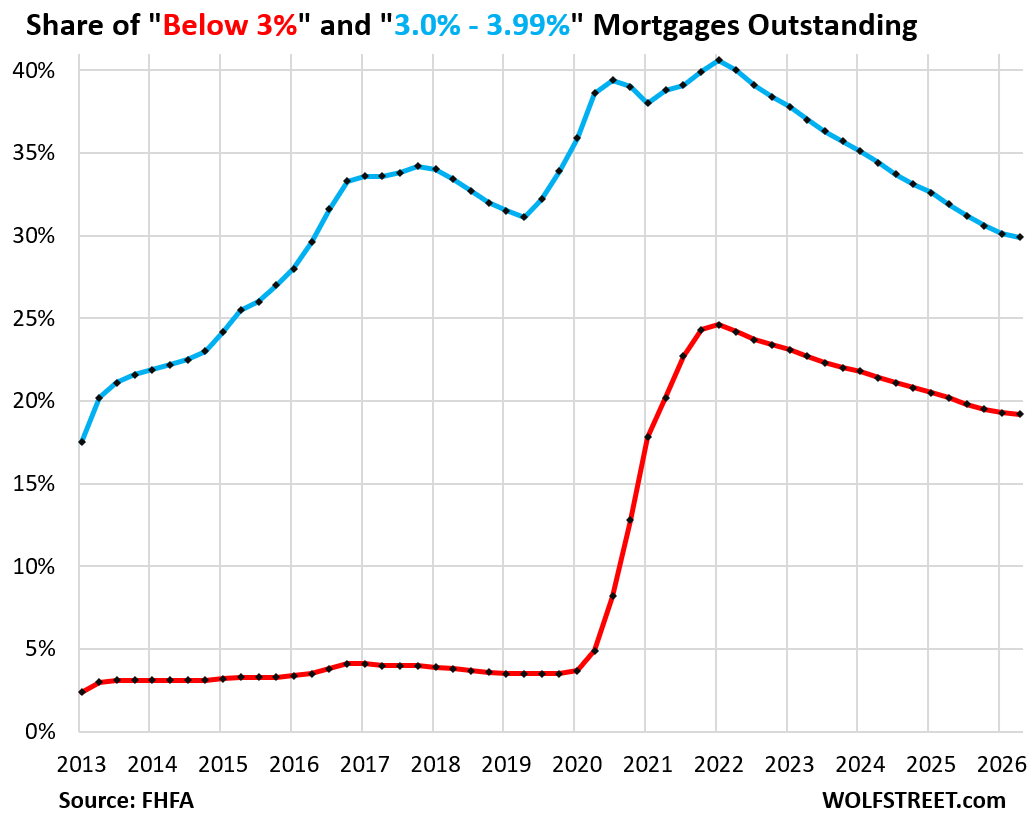
All types of mortgages are included, from 30-year fixed-rate mortgages, via 15-year fixed-rate mortgages, to Adjustable-Rate Mortgages.
These ultra-low-rate mortgages have become a huge gift from the Fed. Homeowners might not move, when they would otherwise move, because they don’t want to replace that 3% mortgage with an over-7% mortgage, and so sales of existing homes have plunged by about 25% from pre-pandemic times and have remained at those levels for four years.
From early 2020 through Q1 2022, the Fed had purchased trillions of dollars of mortgage-backed securities and Treasury securities with newly created money, and it cut its policy rates to near-0% and kept them there, all of it to impose all-out interest rate repression on the economy.
This act pushed mortgage rates to historic lows, which created enormous demand for homes, which caused home prices to explode by about 50% in two years, and more in many markets. It caused other asset prices to explode as well, and it caused inflation to explode, eventually to over 8%, the worst inflation in 40 years, while mortgage rates were at 3% — so negative “real” mortgage rates. It triggered a tsunami of refinancing into these low-rate mortgages. And now, very understandably, homeowners are clinging to their low-interest-rate mortgages for dear life and have thereby put the housing market on ice.
Life happens nevertheless – a job in a new city, death, divorce, more kids, nightmare neighbors, the need for a house without stairs, that sort of thing – and people sold their homes and paid off those mortgages since early 2022. But that process has come to a near-halt now, ensuring that the housing market will remain frozen.

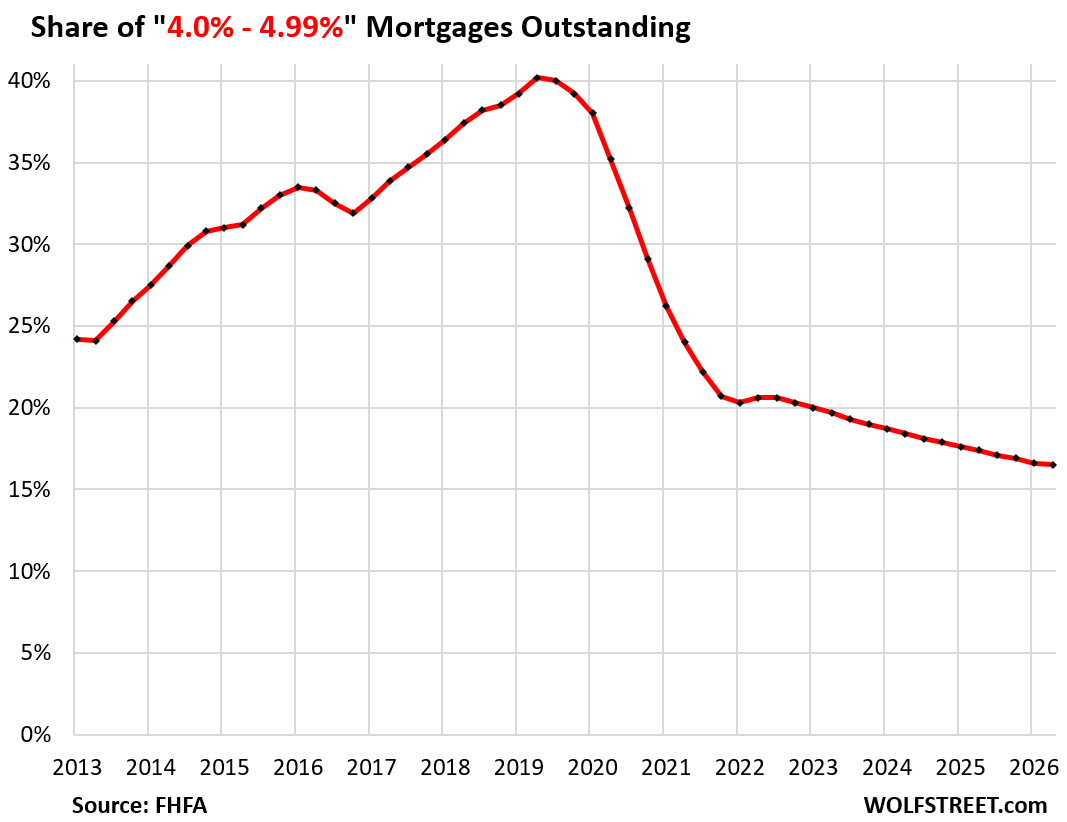
The 4.0% to 4.99% mortgages edged down by 10 basis points to a share of 16.5%, the lowest share in the FHFA’s data going back to 2013, and down from the peak in 2019 of 40%.
Those mortgages are still attractive and worth clinging to, compared to today’s 7%-plus mortgages.
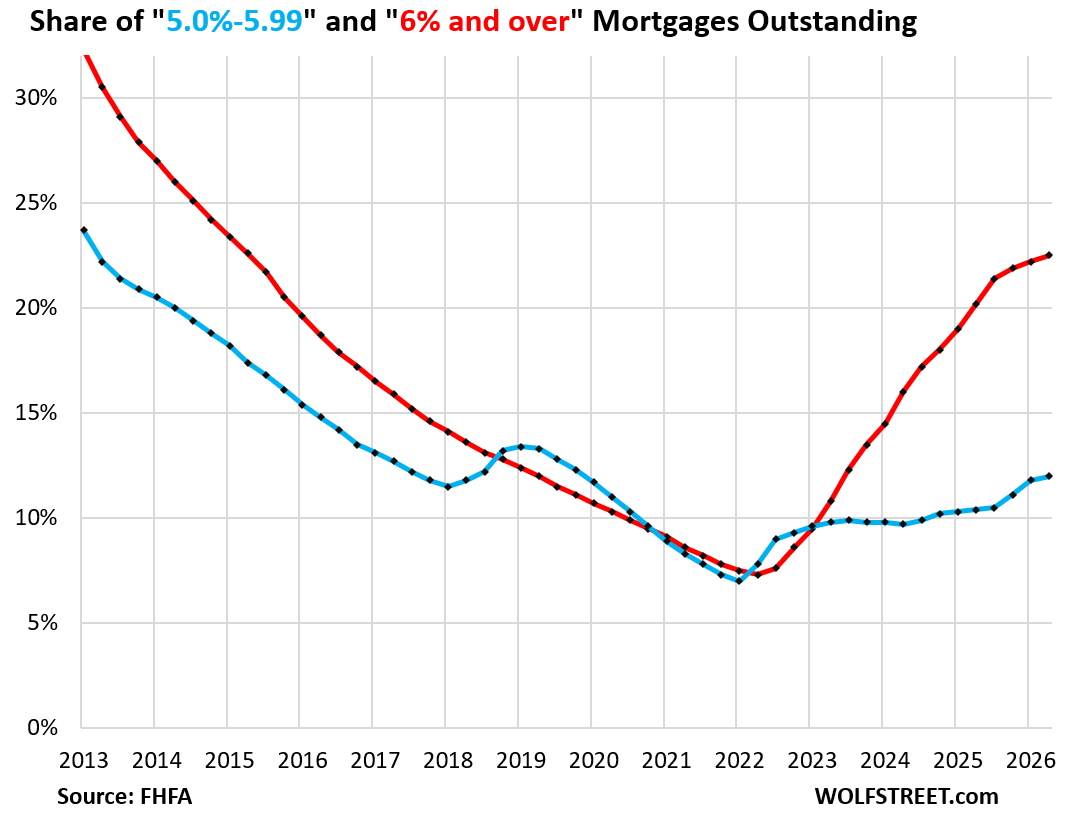
The share of 5.0% to 5.99% mortgages increased to 12.0% of all mortgages outstanding in Q2, the highest since Q1 2020 (blue in the chart below).
In Q2, there were still regular 15-year mortgages offered in this range, and some people chose them if they could afford the higher payment, because they would save a lot of interest over the life of the mortgage.
But in recent weeks – which will show up in the Q3 data – regular 15-year mortgages moved into the 6%-plus category as mortgage rates have surged across the board.
The share of 6%-plus mortgages rose to 22.5% of all mortgages outstanding, the highest since Q2 2015, up from a share of 7.3% in Q2 2022 (red in the chart). The bulk of mortgages originated currently fall into this category.
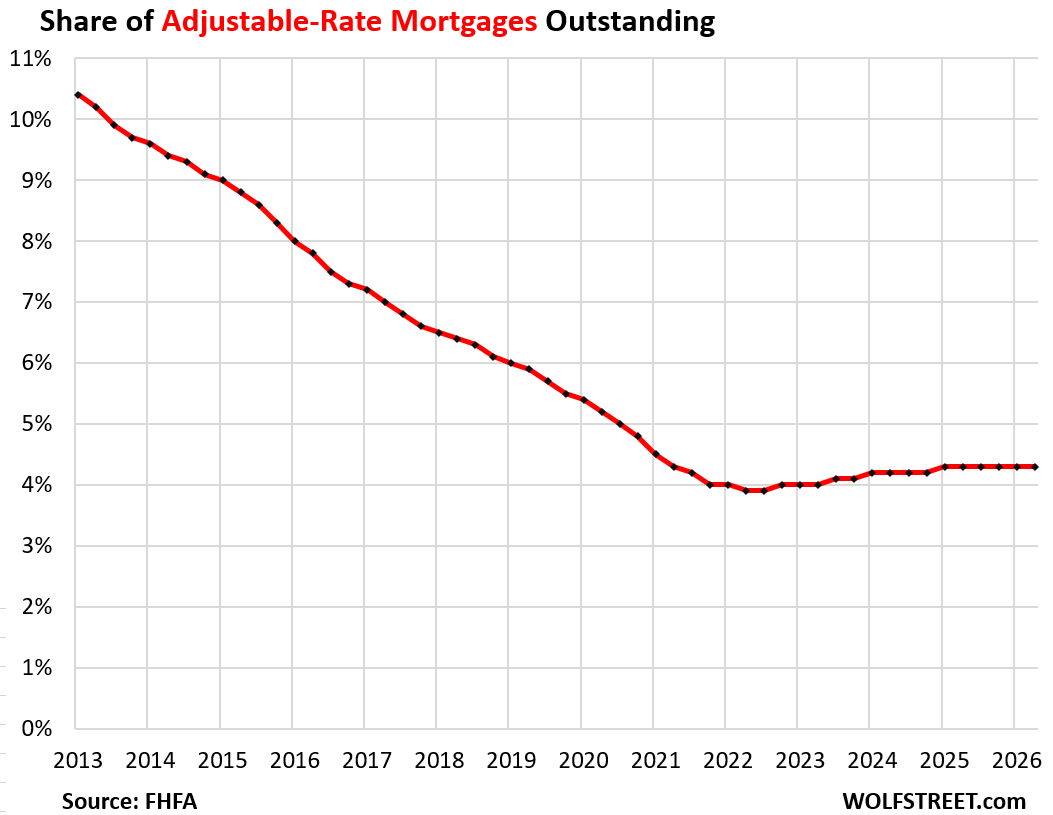
Adjustable-Rate Mortgages remained unchanged at a share of 4.3% of all mortgages outstanding, down from over 10% at the beginning of the FHFA data in 2013.
Some ARMs had rates below 3% even before 2020, and were included in the below-3% mortgages, which is one of the reasons the share of below-3% mortgages was above 0% even before 2020.
Homeowners with ARMs that were originated when rates were ultra-low experienced payment shock when their mortgage rates adjusted to the higher current rates. But the share of ARMs outstanding is very low, and don’t affect enough people to pose a systemic issue.
And home prices have soared in many markets since 2020, so if a borrower with an ARM gets payment shock and cannot make the payment, they can often sell the home, pay off the mortgage with the proceeds, and walk away with cash to re-figure things out.
Enjoy reading WOLF STREET and want to support it? You can donate. I appreciate it immensely. Click on the mug to find out how:


A $1,000, 30-year, 3% bond will drop to $550ish when rates rise to 7%. Can we apply similar math to the “value” of a million-dollar house bought with a 30-year, 3% mortgage that is now on the market in a 7% interest-rate environment?
Exactly. People are holding onto assets that are losing value because they can afford the low monthly payment…
You people that completely ignore the utility of a home as, uhh, I don’t know, a place to live, are hilarious.
I agree…gotta live somewhere!
You ignore the possibility (current reality) that renting is cheaper than buying in many markets…
But they already bought a house….so they aren’t choosing between renting and buying but rather staying in a low mortgage, or renting or buying at a high mortgage.
For many there is an upside to selling their house by choice
Exactly exactly.
20 years of ZIRP idiocy (2002-2022, with small pauses and big implosions) basically converted US home ownership into the equivalent of bond speculation on margin. The DCF dynamics are fairly close to being identical.
Brought to you by the Fed.
Of course, ZIRP (let’s just call it money printing because that is what made it possible) had the extra “benefit” for DC of funding/empowering the continuation of their multi-decade imbecilities.
Does that bond have granite countertops, stainless steel appliances and an open floor plan? 😄
No…but it does have property taxes.
Probably not because of cash buyers in the high end of housing. But in normal priced homes a haircut for sure but because of inflation with labor and materials. New built homes cost more keeping up values of existing homes from crashing. For now.
“Data save” today with Labor participation rate increased saving the unemployment rate from going down and 10 year yield from rising. 5.15% closing yield is support and 5.34% is now inter day daily resistance. Looking forward to wolf’s take on labor participation later today.
so here is what I told my son who would like to move up into better housing(ie 2nd home – he has 4% and $800 mortgage with lots equity)
hunt for FHA/VA existing loans of for sale homes – approach seller with idea that you will assume LOAN – WHICH btw FHA/VA allow as long as you QUALIFY
then you get to keep their 4% loan with less than 30 years left
This is so delusional. I can’t believe people live this way.
You should hunt for a house that fits your needs, budget, and will make you happy. You spend over half your life there.
Actually it’s smart. With the average house price to income ratio, choosing a cheaper home or assuming a mortgage equates to making a practical choice.
The bank is the bond holder and the one losing value in this situation, not the homeowner.
Not quite, but you calculate what would require the same monthly payment at both interest rates. It turns out a 7% mortgage allows you to finance 2/3 what a 3% mortgage does at the same interest rate.
There is a little thing called inflation. At some point the physical rebuild cost comes into play. Your scenario is only valid when comparing payments. That is probably more useful in comparing rent to own scenarios.
The New York times has had an excellent and thorough online calculator that takes into account all those things and more since the first housing bubble.
Of course. Well, similar if not identical. So if you hold to maturity, it is as if you had originally bought the house for $550k (valuation based property taxes notwithstanding)
No wonder people are holding on to these then, at least until the actual prices fall more than 50%?
Great repot, Wolf. I haven’t seen this type of analysis anywhere else.
Kinda reminds me of that old bumper sticker – “the only way you’ll take my gun is to pry it from my cold, dead fingers.” Substitute the sub-4% mortgages for the gun.
Who can blame the holders of those mortgages for keeping them? Anyone can use one of the online financial sites to calculate how much more they’d pay to switch to a current rate mortgage. A sobering difference – more than enough to make people tolerate a home that has some drawbacks for their current living situation.
People will part with those mortgages only when they absolutely must – the life change must be severe. Not an inconvenience, but a structural life change. Cosmetic life changes (like their son Billy wants his own bedroom instead of sharing one with his brother) won’t do it in this environment.
I suppose the Fed decision makers would argue they did not know at the time (2020 – 2022) how severe and long lasting the pandemic would be, and that repressing interest rates to that level helped many people keep their jobs through the pandemic period. What would the economy have done without that interest rate repression? Tough to call.
The politicians were scared of seeing 1930’s style breadlines and taking blame. So, we get interventionist policies going all the way back to the GFC. The government picked winners and losers. Losers were anyone looking for a house. Winners were those that could refinance into a 2.75%. I bought a couple years ago at 6% something. My neighbor who’s been in his place 10 years is getting a new pool right now. Good for him, he won. Pool company gets paid. Good for them.
But the idea that these decision-makers didn’t have a concept of the ramifications of these policies, that other decision-makers caused… Nah, come on. 90% of the readers of this site called what was coming. Wolf laid out multiple times how the housing market would break and it more or less did, just like he mentioned it would. If he can nail it, there’s no way in the world these policy makers didn’t know what was coming when they have the direct information and real-time data. They knew. Everything these guys touch turns to crap. The next ‘crises’ will be the same… Here comes some government entity (probably the FED) to lay a big turd.
They get no credit whatsoever.
Lol breadlines. They dont care about the poor. They care about tge people who really pay their salary, and that is the rich. Asset values will be protected at all costs.
You give the ” decision-makers” too much credit. Just because they ended up in those positions, you assume that they are the best prepared, most educated, brightest minds in the nation. Have you ever considered that they might be below average intelligence? …. and they ended up there because of totally different reasons than their high IQ? Unrelated, but fitting if you extrapolate, here’s one of my favorite quotes: “Democracy is not the highest goal… because democracy basically means government by the people, of the people, for the people, but the people are retarded…”
The issue is not the low rates, that made sense for a limit period of time, but how long they suppressed rates. Way longer than necessary. Not just hindsight, the economy was fine and they still kept ultra low rates.
Yep. It looks like variable rate mortgages are also making a comeback. Where have we seen this before?
Nothing new under the sun folks.
They’ve been running at very low levels, see last chart.
Yes, low, but increasing.
What’s a mortgage?
Should I get one?
Mort is derived from Latin, meaning “dead”.
Gage is from Old French, meaning “pledge” i.e. “security”.
In today’s modern world, people will be paying their debts until they are dead.
The Grim Reaper comes for you, the Grim Repo’er to take’th away the rest.
If the market is efficient, the prices should quickly reduce to reflect the higher mortgage prices and reflect current affordability. This is probably just taking time and the market remains inefficient. But, over long-term the house prices will adjust. That has been the hope, I guess
Not at the real estate agents have anything to do with that… They are loving these huge commissions. And I only see very small price drops, and most Holmes, our price close to a million. They aren’t even worth half of that. Some sitting on the market well over ninety days. That should be a clue. Drop your price and stop being greedy!
we’re all gonna feel effects if prices decline in 1/2
since it costs A LOT MORE to fix/build
doing remodel now – son laughed when I told him budget
he said double it – he does high end kitchens and baths
and given insurance costs which reflect cost of rebuilding
I see price decline of 20% ok, 30% gonna kill off many an industry
My wife and I are ignorant about investing, and just simple working class folks; I’m 79, and 100% service connected disabled Vietnam veteran; my wife is 72. We managed to buy a new one story, wheelchair friendly home in (Covid period) December 2000 on a 30 year, zero down, 100% assumable VA loan at 2.50% loan, that we did a one time (free for VA loans) adjustment down to 2.25%, a year later (without changing any other terms). We thought ahead to buy a floor plan with a ‘moter-in-law’ quarters so when I’m dead, she can rent that one bedroom small full bath living room to someone for income, or maybe free for a care giver. My thinking was when she is unable to live there, she can keep it as her income producing rental investment, or sell with the advantage of what is left of the assumable part of the mortgage. CURIOUS from you if we made good decisions?
Thank you for your service. I served then too. Nice job on the house and financing. Good luck to you.
Jim,it seems like you had some solid ideas/thinking of the future and followed thru well.
A friend of mine ended up in a extra unit in a home for short money for cutting the lawn etc. for a older couple,as the years went by he was needed more and more and cut back to part time work as they then covered all food and untilities etc.He ended up becoming a great cook for them along with general basic care of house cleaning etc.,i.e. a member of the family.
The couple had lost their only kid many years earlier in a auto accident and they basically became his second parents and he their son.
They died a few years back and he still lives there as they left him their home.He as time passed did some work to keep them in their home and as a carpenter I helped out,they always asked what I was owed and said a case of beer will do it.Evey time I spent a day or so helping him restructure the home to accomadate them got 5 cases of Molson(I know,but drank Molson when I was young!).
I would perhaps consider ernting out now and getting to know who lives there and get a feel if they would be the right person to help out as you get older.
Hope you and the Missus have a long time enjoying your home.
here’s what you all missed
100% assumable VA loan at 2.50%
not new loan but an ASSUMABLE(yes you have to qualify for it though)
I think the thing to watch will be how this adjusts as we start to get to the longer term averages. I think the stat is that it is about 8-10 years a homeowner keeps a mortgage, so if by 2028/2030 we still see these numbers stalled, then it’s very possible that the lock in effect is truly real. Things that prompted people to move on that timeline (outside of the sudden divorce, death, etc), like kids aging out of the house, retirement, big career jumps, and more, then it could be truly interesting times. I don’t disagree that the lock in effect is real, I’m just curious what will happen once we hit that more “natural” settling point. We’re seeing it happen now where supply of existing homes is already disappearing, but could it be removed for decades? Or does 10(ish) years finally give enough time that people still want to move, and they have enough equity built up and house prices move up more slowly, that what they can take away is able to make the new loan more reasonable? Or, is it that the government has gotten us so addicted to cheap money that mortgage rates will be back down to 4 or 5 percent again soon in the future anyways…
You have a great point. These trendlines tell us how sticky these low rate mortgages are, but not the historical turnover on mortgages by age. That data isn’t available, but even if it was, it would be heavily distorted by refis. You’d need really good quality survey data over decades to get that kind of insight.
What really matters though is how many sub-4 mortgages are not moving solely due to their low housing costs and how much that distorts the housing market. I’m in a sub-4 myself, but we’re not moving because we like our home as our forever home, the rate is just an added bonus. Is the trendline flattening a product of normal 5+ year mortgage patterns? We assume no, but as my brother likes to say, don’t be the ass in assume.
Anecdotal, but I’ve seen a lot of major renovations over the past few years on my commute to work. I’m taking about adding a floor to a ranch and footprint additions.
I wonder how much of this is influenced by people who have locked in those mortgage rates in the 2020 era. After outgrowing (either in family size or their wealth) the home they purchased five years ago, they looked around and saw the new mortgage rates and perhaps they decided that it is better to spend money to upgrade their existing home rather they buying and moving.
This is happening quite a bit. We are at 2.75% with major equity in the home. After running the numbers in different ways, it was cheaper to get a home equity loan, spend all that to make the current home to our liking as opposed to selling and buying.
This analysis has been happening since the dawn of home equity loans and HELOCs, but today the answer is pretty clear.
The real losers are the MBS holders who bought the low interest mortgages and are stuck with low returns…
Still investing in my money pit. I will likely never turn a profit, but at least it was a forced savings asset;-)
Bingo. I explained this to my brother back in 2008-2011 when the recession was happening. He was doing math and comparing what happened leading up to the recession to his future if he bought a home. I showed him the real math and proved to him buying a depreciated house will be cheaper than renting. His argument was “a home is not an asset” and it told him I agree and that it’s a forced savings account. You will get some, most, or more of your money back depending on how long you keep it for and what the market is doing when you sell.
People are going to have to realize that their home is not now worth what it was worth in 2020. Once they get that through their thick heads, things will “normalize” in the housing market. It WILL happen- demographics alone guarantee it will happen. Sorta reminds me of banks- these people are sitting on unrealized losses. At some point they will have to sell, and the loss becomes real, but as long as they did not buy at the peak they will still probably do OK. Those that bought at the peak, and who agreed to forgo inspections and other due diligence, are screwed. But that’s life.
Or maybe their home is worth exactly the same. A place to live with a known monthly cost. Then if there is a cost to move, do another place be better?
Maybe more people start thinking about if there really is a benefit by moving. Does life really get better by changing job and move?
It could be that the “normalizing” is a shift to look more like countries where a lot of people live in the same house most of their lives.
Howdy Prisoners ” I am from the Govern ment and here to help “. Hope you Youngins are learning….. Learn about HELOCs and Prosper. You will have to pull up your bra straps and take a chance. Good Luck.
Looks like the government did help… About 30% of homeowners who were able to lock down once-in-a-lifetime interest rates on houses they otherwise wouldn’t have been able to afford. Sure, the rest of us are paying the price, but that’s no different than my taxes going to pay for someone’s Medicare.
Reagan was an idiot. Let me know when his followers turn down social security, or FEMA disaster relief, or Federal deposit guarantees, or… The list goes on. Last I checked his presidential library is maintained by the government too, so even in death, Reagan hasn’t stopped suckling from those “dangerous” government officials trying to help him.
🤣 Need a tip jar for this. ^^^^
Agree, like totally dude or dudette with your ”Reagan was an idiot.” comment.
This was SO obvious to anyone paying attention to his ordering of the helicopters to spray tear gas, possibly including Agent Orange onto thousands of law abiding folx in ”southside” area of Berkeley because a couple of other idiots, likely ”plants” were doing some damage in the streets south of the campus of CAL.
Ray gun was governor of CA at the time, and clearly wanting to ”make his chops” as a so called conservative, but in fact, as SO many on BOTH SIDES, a reactionary.
Until and unless USA VOTERS are sufficiently educated to understand the vast and continuing differences between conservatives and liberals and the reactionaries of right and left, WE the People will continue to get ”hosed” by both of those extreme folx as should be SO clearly obvious today.
What does Reagan have to do with anything?
Home builders can not sell homes at these mortgage rates. But the demand for homes is still rising, so home rents go up and home prices do not decline. Interesting way to look at the problem!
Homebuilders do a pretty good job selling homes in this environment by cutting prices, buying down mortgage rates, and throwing incentives into the mix, thereby gutting their gross margins, profits and stock prices. But they’re selling homes somewhere near pre-pandemic levels.
They also have a lot of inventory for sale because they’re in the business of building homes, and so they will continue to be aggressive. Homeowners just haven’t figured it out yet.
https://wolfstreet.com/2026/09/24/what-the-infamous-housing-shortage-looks-like-inventory-of-new-single-family-homes-balloons-sales-crawl-prices-sag/
What about the “Single-Lot Home Builders” like Thomas James (the nation’s largest, according to their website). I live in an apartment in a neighborhood where they and other single-lot builders buy the 100-year-old crappy house for $2 to $2.25M, tear it down, and build a $5M house in its place. There are two on my street alone and at least half a dozen within walking distance. Half completed, the other half soon to be completed. None of them sold. What does a company like that do? I’m assuming the carrying costs are high and they can’t just wait it out like the majority of homeowners seem to be able to. I’ve seen them drop prices by a couple of hundred thousand dollars, but that doesn’t move the needle on a $5M+ house. How does this play out for a builder like that?
they will eventually figure out what it takes to sell those houses. They’re just trying to delay and maybe they’re waiting for mortgage rates to go back to 3% or 4% 🤣
Big fat profits are not guaranteed in business. Sometimes, big fat losses are what you get.
Perhaps counterintuitively: multi-million dollar homes become less sensitive to mortgage rates.
A family buying a $1m house probably needs a mortgage.
A family buying a $5m house probably pays cash.
Major Hawaii homebuilder came online here with new product in 2023. Managed to offload some homes at $1.3-4m. Been reducing prices since….
Now offering same homes at sub $1m with mortgage rate incentives AND 5% commission to Buyer’s agent. My how the worm has turned.
Concerning the home builders “buying down rates”, are those products classified as ARMs? If not, what are they? Are there statistics on how many loans fall into the ” buy down” category? I suspect that sme/many of these buydowns will go bust when they adjust to current rates.
They have different deals. A typical deal is a 30-year fixed rate mortgage with a lower rate for the term of the mortgage. Buildings go on the expectation that the mortgage will be paid off in X years (maybe 10 years) when people move on average.
Another typical mortgage is a fixed rate with a promotional teaser rate, such as for two years. And then the rate shifts up.
They have other products too. Buyers can pick and choose. Or get a price cut if they pay cash.
I’m in the construction industry on the paint side, just heard from someone that a home builder in central FL was offering free pools on new construction. They will always find a way to unload their inventory, homeowners just can’t match that. Expect by lowering price.
I think this is why Berkshire is investing heavily into homebuilders. They’re willing (and are forced) to make a deal and actually sell homes. They might steal a lot of buyers from delusional sellers of existing homes. I know one delusional seller personally and it’s sad.
All Govt was very afraid of total collapse during the GFC and Covid. Their responses were understandable for the events even though people trash them in hindsight. The real problem is the 30 year mortgage term allowing the lock in to even happen in the first place, not the fact that people took advantage of it.
In Canada the usual term is 5 years. If you think rates will rise you can refi, but there is a penalty to do so which means you get the calculator out. Apparently there are terms up to 10 years, but I have never met anyone who had one. When I had a mortgage I usually did the 5 year term for the security of being able to budget. I would have taken a 30….maybe? Not in the 80s :-)
Shorter terms allow the housing market to adapt faster to interest rate changes. There are fewer lottery winners. Fewer stay puts. Having said that we have done well in my lifetime owning a home, mostly because of sweat equity and renovations. (Carpenter). It set us up to retire early as I have had no mortgage payment after age 45.
In BC housing prices are still high but mostly because people choose to live here. Location location. This is especially true on Vancouver Island. And employment forecasts are beyond positive. Squamish LNG plant currently under construction, Kitimat LNG expansion with German investment and First Nations ownership stake was announced just this past Monday….making it the 2nd largest LNG plant in the World. (Asia Market) And, a new west coast oil pipeline is now set to begin construction within a year as it has just received the designation of National Priority. This additional oil will also go to Asia as opposed through the US. Housing prices will remain high here as a result. Most of this construction work are camp jobs, huge wages but families stay there they are. More projects on the way with European, Asian, and Indian investors.
GTA here. I had a 10Y fixed on my first home (2003-2013) probably in hindsight I should have went variable. Home prices in the GTA were just coming out of the bottoming process of the late 90’s so my mortgage was small (~$250K) relative to mortgages now. Back then a 3300 sq foot house in Mississauga was ~$450K! What a time.
Those people that took on ~$800K+ mortgages the past 8-10 years are playing with fire especially now with renewals coming in. Seems our banks are extending the amortization periods — lots of people are just paying expensive rent to the bank to pretend they own it.
Unfortunately a lot of people swapped back into variable on this last renewal cycle when they should have been going into 3-5Y fixed if the rate was <4%.
Just sold my house in Hawaii that had a 2.5% conventional. There’s more to life than money.
Had to transfer for work and did the landlord thing. Hated it even though I had great tenants. Sold the house and in escrow on a new house with a 6.8% rate. I can afford it so who cares.
You get one life to live and I feel sorry for all those people living in houses that no longer fit their need simply because they don’t want to lose a good rate.
They couldn’t care less about the rate, it’s the total monthly that keeps them there. Unlike you, they couldn’t move and afford a new house at current rates.
I salute your courage and thinking.
I always tell my friends: It takes a lot of courage to live your life and be happy.
Most people are more focused on accumulating
“The share of 6%-plus mortgages rose to 22.5% of all mortgages outstanding” phheeewww that surprises me its that high.
You’ll need to make 72% gain on price to break even at 6% rate. Thats not accounting for every other expense it has.
In 30 years though with the way inflation is going? Maybe
Weimar Boy Powell and his buddies at the FED figured out a way to f**k the housing market and young people for decades. Total scumbags.
This is the worst thing Powell and his cronies did to Young Americans.
Supporting stock market is one thing but supporting high home prices was worst decision.
One can live without stocks but needs home to live in and feel grounded/sheltered in one’s own home.
Yep and now a lot of them are socialists that want to eat the rich.
Welp, the reality is the cheap financing is a set of handcuffs. In the long term, housing will turn much more often as those stuck become unstuck by life choices. So large ironies become manifest. I see a tremendous number of large 3k sq ft houses occupied by a widow. And when she goes either to assisted living or the final exit, those houses get sold to much higher occupancy. But those costs of maintaining, including taxes and etc impact that final value as well.
But given how expensive smaller living quarters in assisted living are, so many will chose to extend and pretend based on those cheap financing cost.
Now, it is possible, as mentioned above, to arbitrage the cheaper financing through renting, but those aggravations and frictions of remote ownership of a rental are real. But the contrast is how fast the equity builds, especially if the refi was into say, a 15 year in 2020 at dirt cheap rates. Now, buy at the next destination, and when it becomes good enough, flip the equity into the next property, and viola, much cheaper monthly costs.
In short, housing will continue to be a sore point until wages swamp housing costs. So, the replacement costs are going to be fairly high (but homebuilders are increasingly forcing costs down), and that will also slowly add inventory.
Houses are not going to be great “investments”, but will return to a cost with some long term gains, but a much more balanced return.
Wages, wages, wages. It will dictate so much of the politics and economics of the next decade, especially as taxes increase, and this time capital will take the hit from taxes.
The era of tax cuts is really over, instead it will be how fast you can run ahead of the taxes needed to maintain society.
Going to be interesting to see what happens to property taxes. There’s been a generation of people in some places benefiting from their taxes based on the low low purchase price while everyone else that bought lately pays way more. Might be more and more voters wanting to move to market based property taxes as prices drop
Abolish properties taxes for ONE primary residence so Americans can actually realize unencumbered home ownership.
Agreed
How to deal with the revenue shortfall? Raise the sales tax? Jack-up property taxes on businesses, landlords, and vacation homes? Defund the police?
jackup property taxes on landlords = shortage of affordable rentals
Raise sales tax and raise income tax.
LOL! I’ve lived long enough to know that if you take away property taxes, government will find a myriad of taxes and fees and burdensome regulations to replace the lost revenue, and then some. Enjoy the single sunk cost as a way to avoid a life where you spend more time a week on satisfying a bureaucracy than sleeping.
In Texas property tax has to do with the current appraisal value based on sales or new homes, ie, the neighbor who just built a 1.4 Million home down the street effects the taxes on my 23 year old home. Basically an unrealized gain tax.
We brag about no income tax however our property taxes are some of the highest in the nation
You can write them off if you have a mortgage and a good bit of interest.
The deduction for the interest basically pays your property taxes in a round about way last time I looked.
So if that is correct, and assuming a person is in the 33% Federal tax bracket, does that mean “pay a dollar of interest to save 33 cents”?
people shouldn’t be clinging to their mortgages, they should be clinging to their wallets
Wolf – with mortgage rates going UP and UP and UP, what direction do you think home prices will go?
Hint – it’s not up and it’s not right or left if that were possible. There’s only ONE direction.
In 2017, several years prior to the pandemic and the precipitous drop in interest rates, I purchased my tiny, retirement bungalow here in SW Florida on a 15 year loan at 3.99%. This was my 5th house since 1989, when I was paying 10.5% on a 30 year loan. Some of my newer neighbors bought there homes during the pandemic and got those rock-bottom rates under 4%. However, they now also trapped in these houses.
My neighborhood is mostly small homes for working class people and retirees like me. The people who want to move to larger houses can’t, because they would not only have to deal with 7% plus mortgage rates on homes in my area that still continue to gain in market value despite the sluggish market. Additionally, here in Florida we a homestead exemption and a save-our-homes cap on property values. When moving from a current homestead to a new residence, those exemptions and discounts reset to the current market value of the new residence.
So, for a lot of Floridians, this becomes a triple whammy. Rates that are twice what the got for their homes during the pandemic. Having lived through the 70s, 80s and 90s when mortgage rates were mostly in the double digits, I can’t really sympathize with people reluctant to bite the bullet at 7.5%. However, if they are forced to move, because of life changes, such as a new job, a divorce or a growing family then their options are limited. Either stay where you are and get home construction loan to add on to your house for a growing family. If you are going through a divorce or moving for a new job, then options get tougher and all those tax breaks reset and one gets walloped in the new year with taxes set at the full market value of the new residence.
Interest rates are not the problem. Home prices, taxes and insurance are the problem. Despite having endured 3 hurricanes in the 9 years I’ve lived in SW Florida and paying 5400/year in insurance on my tiny bungalow the value of my property continues to rise. In 9 years, my tax bill has jumped from 2000/yr to 3500/yr. Florida has amendment 3 on the ballot aimed at property tax relief to the tune of a 250k exemption to phased in over 3 years if it secures 60% of the vote. You know which way I’m going to be voting. Cheers.
If life last and death pass, I will be hanging on too my 2.75% until the fat lady sings, or that dreaded dirt nap comes. Those below 3% rate are like passing on generational wealth and having your own equity bank account. HVAC, exterior paint, and new roof all are in pretty far distance future as my home is 12 years old. The demand or craving for over inflated housing, taxes, and insurance has plummeted, only those with real wealth are able to cut their throats to blow their noses at 7.5%. Advice for Gen Z rent the cheapest apartment with friends, lease to cheapest car if you cannot buy a used beater. Stay out of the insurance Ponzi scheme, and eat healthy.
The lock-in effect makes a lot of sense. When someone has a mortgage under 4%, moving isn’t just about finding a better house—it means taking on a dramatically higher monthly payment. Until rates come down or home prices adjust enough to offset that difference, I can see homeowners choosing to renovate or simply stay put.
In Texas foreigners have left the country and their mortgages behind leaving the banks holding the bag. Boomers are dying off and inheritors want to off load their overpriced homes. Both have very high property taxes. It is going to give.
Does the data include mortgages on investment properties or only government backed mortgages?
These are all residential mortgages. If you own a house with a mortgage that you rent out, it’s included.