
Those changes in methodology knocked the PCE price index down, but even the new-and-improved version remained far above the Fed’s target.
By Wolf Richter for WOLF STREET.
Today was the day for the annual revisions of the PCE price index by the Bureau of Economic Analysis (BEA). This is the inflation index that the Fed favors for its 2% inflation target. The revisions are undertaken every year, and the data is revised each year for the past five years.
What’s different today is that the BEA also included changes of its methodology for three subcategories of the PCE price index. The first two slashed the “core services” PCE price index; and the third slashed the “core goods” PCE price index:
- Portfolio management and investment advice services
- Legal services
- Computer software and accessories.
The year-over-year “core services” PCE price index was slashed by 34 basis points for July as a result of these methodological changes and other revisions, from an old increase for July of +3.69% year-over-year, to a new-and-improved increase for July of +3.35% year-over-year. And in August, based on this new methodology, the core services PCE price index also increased by +3.35%. Blue = old year-over-year inflation rates; red = new-and-improved year-over-year inflation rates:
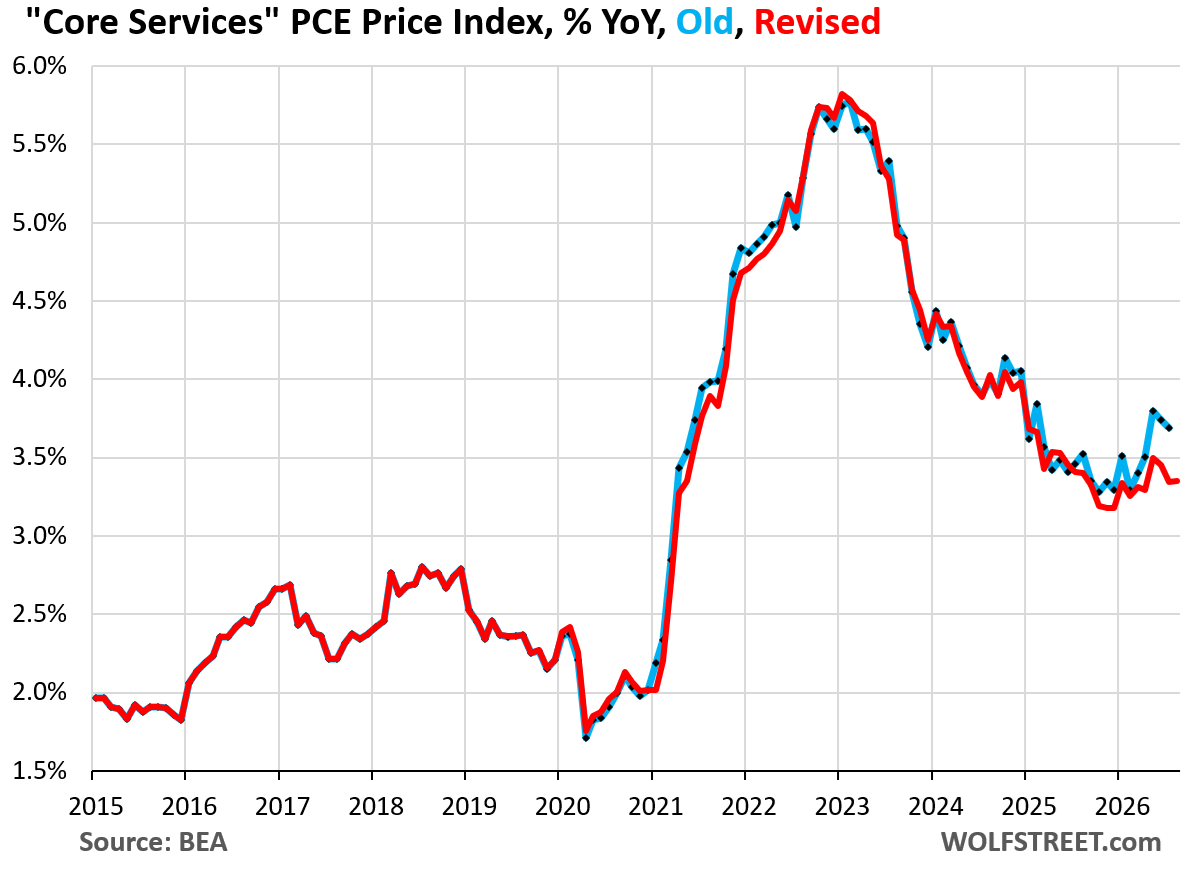
Core services account for over 60% of consumer spending. They include housing, healthcare, travel, lodging, transportation services (airline fares, etc.), insurance of all kinds, auto repair and maintenance, communication (cellphone services, broadband, etc.), subscriptions, financial services, recreational activities, memberships, etc.
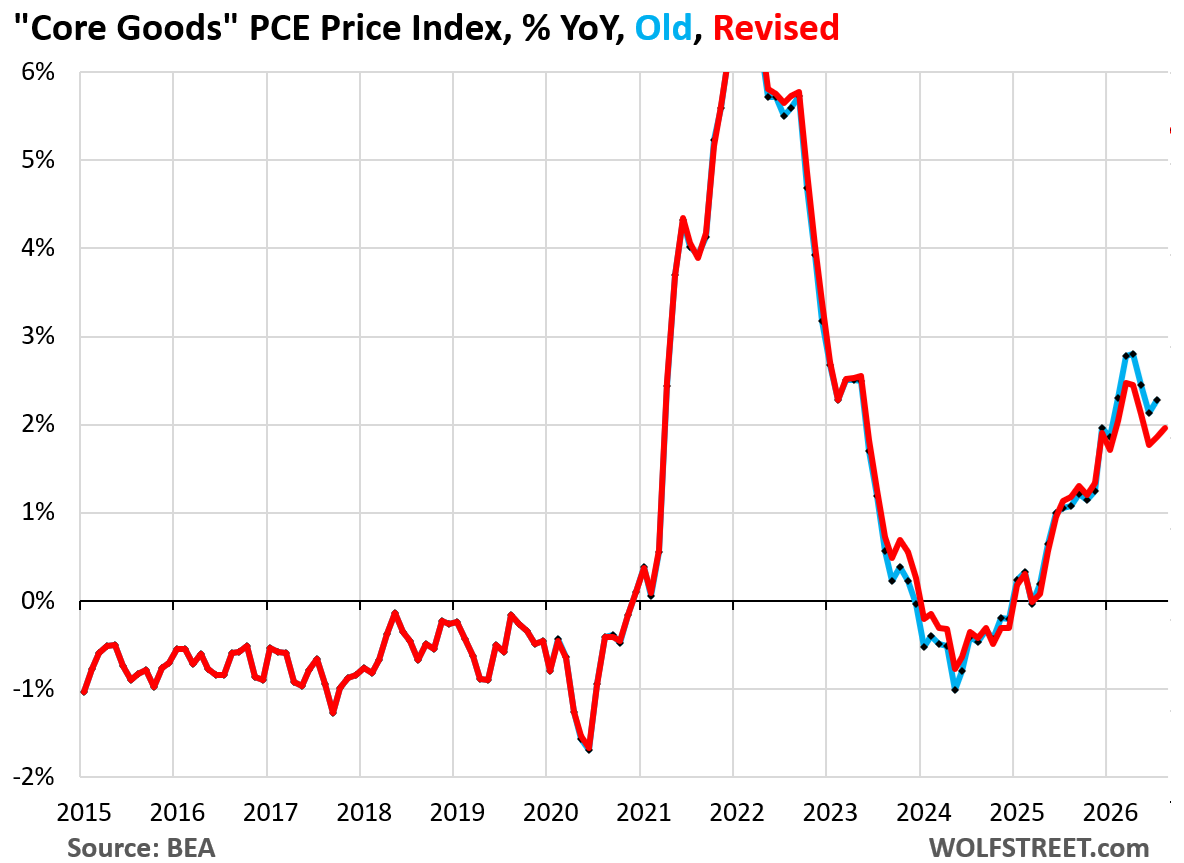
The “core goods” PCE price index rose by 1.97% year-over-year in August.
But July’s year-over-year inflation rate was slashed by 43 basis points to +1.85%, from the originally reported +2.28%, due to the changes of the methodology for the subindex, “Computer software and accessories.”
Under the old method, the subindex for “computer software and accessories” had spiked by 21.2% year over year in July, driven by the side-effects of the AI investment boom. Today, the new-and-improved July inflation rate for “computer software and accessories” was +12.3%.
Blue = old year-over-year inflation rates; red = new-and-improved year-over-year inflation rates.
Despite those changes in methodology, inflation remained hot.
These reductions of the “core services” PCE price index and the “core goods” PCE price index due to the changes in methodology then pulled down the “core” PCE price index, and the all-items PCE price index, which are the inflation measures that the Fed uses as yardstick for its 2% inflation target.
Despite those changes in methodology, inflation remained substantially above the Fed’s 2% target, with the revised core PCE price index at 3.01% and the all-items PCE price index at 3.4%.
The PCE price index is an alternative to the Consumer Price Index (CPI) by the Bureau of Labor Statistics, whose August data was already released on September 11.

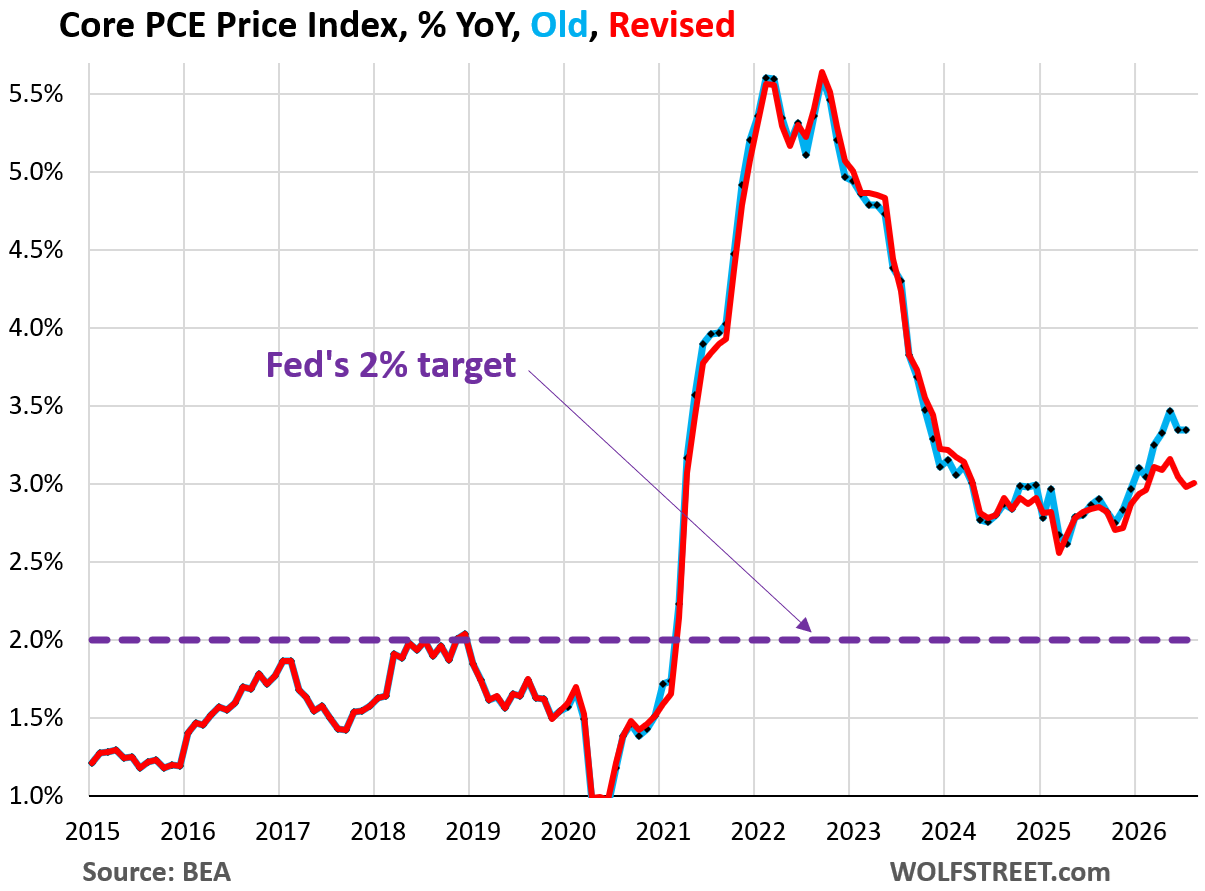
The core PCE price index – which excludes energy and food – rose by 0.25% in August from July.
But July’s previously reported 0.25% month-to-month increase was cut in half today by the new methodology to +0.12%.
Year-over-year, the core PCE price index rose by 3.01% in August. And July’s year-over-year increase was cut by 37 basis points, to +2.98% from the originally reported +3.35% (in the chart below, blue = old year-over-year inflation rates; red = new revised year-over-year inflation rates).
The Fed uses the core PCE price index as one of the yardsticks for its 2% inflation target (dotted purple line) because it provides a view of inflation beyond the spike and subsequent plunge of energy prices. The core PCE price index has been above target since March 2021. The closest it got to target was the new-and-improved +2.6% in April 2025.
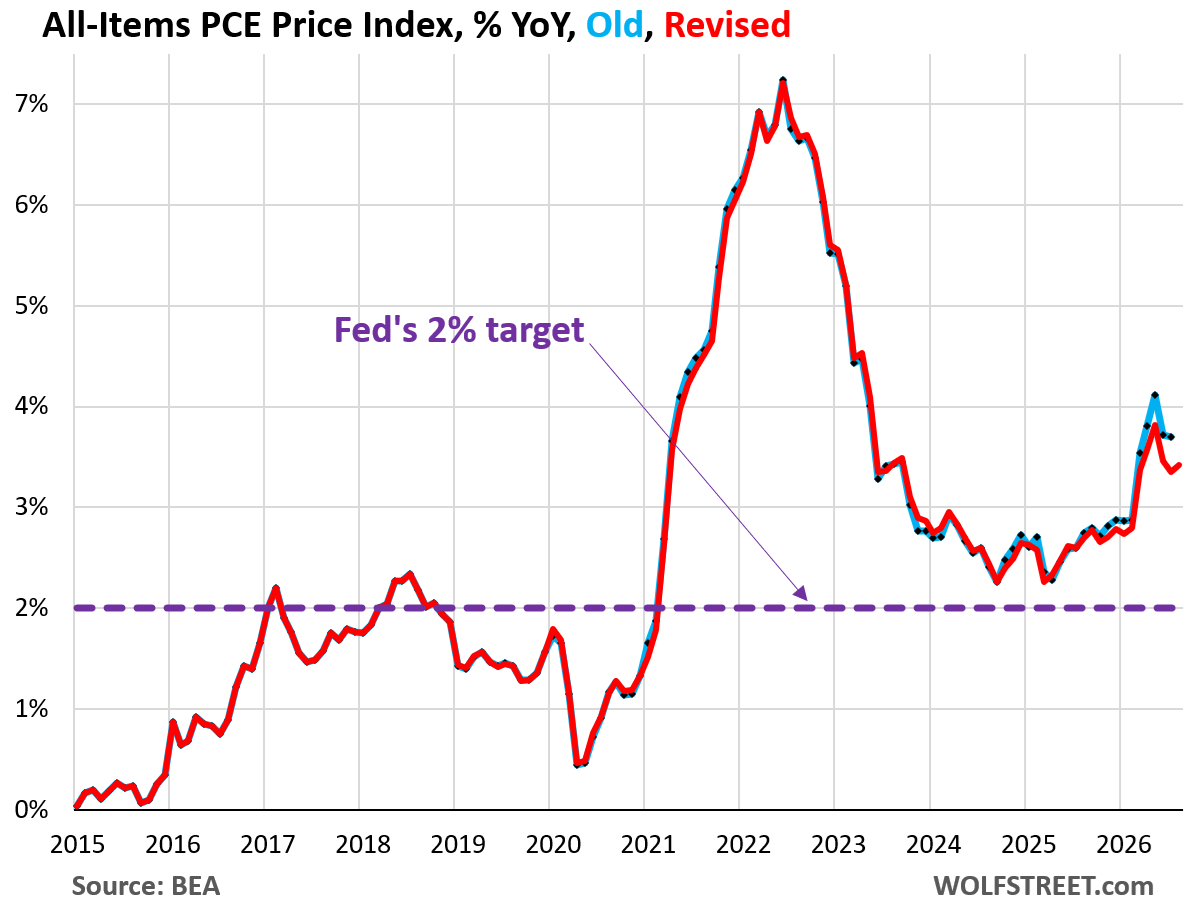
The all-items PCE price index rose by 0.31% in August from July, and July’s original month-to-month increase of +0.16% was cut to +0.05%.
Year-over-year, the new-and-improved PCE price index accelerated to 3.42% in August, from the revised 3.36% in July. But the revisions slashed July’s increase by 34 basis points from the originally reported +3.70%.
It is almost funny how inflation, by even this new-and-improved measure, has moved away from the Fed’s 2% inflation target (dotted purple line) since April 2025 while the Fed ignored it and cut its policy rates three times later that year (blue = old year-over-year inflation rates; red = new revised year-over-year inflation rates).
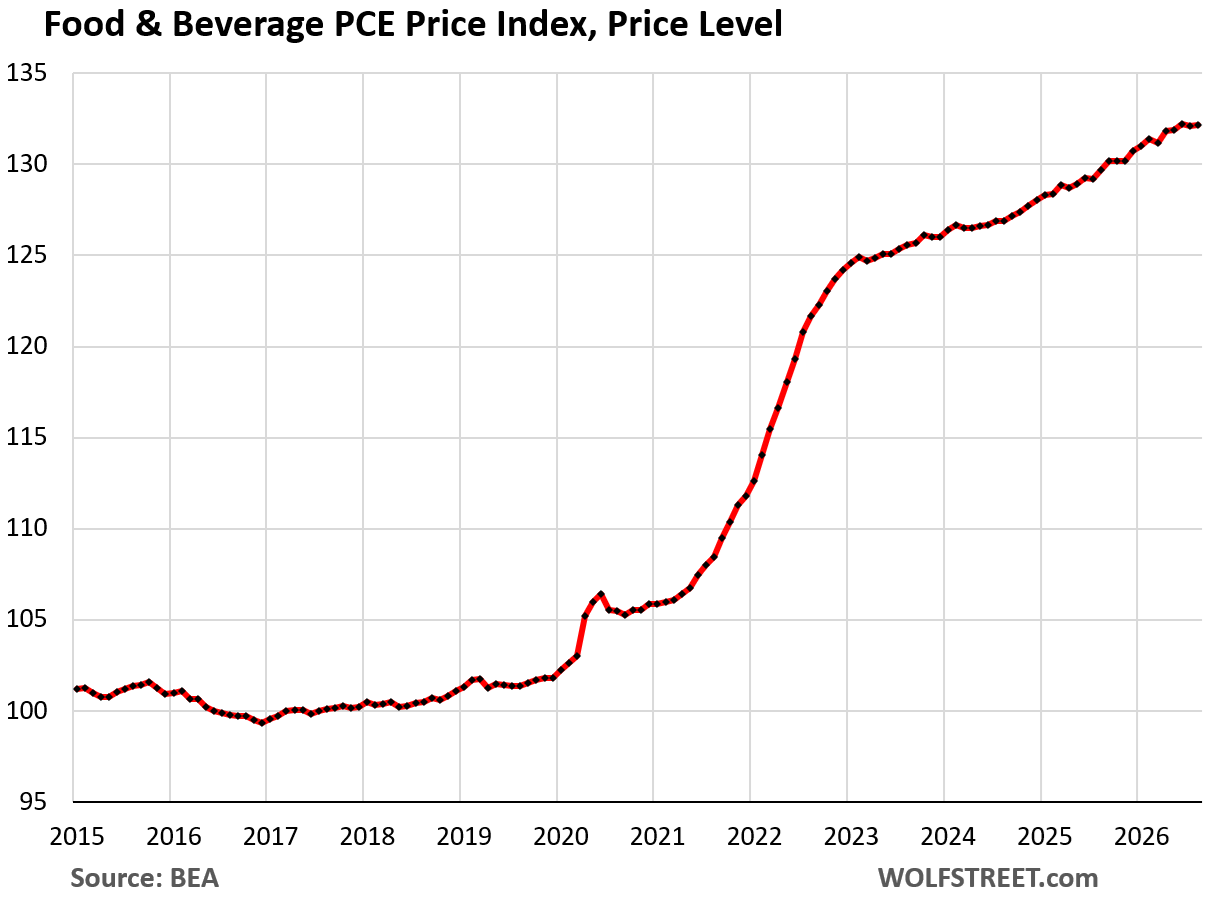
The food & beverage PCE price index was not revised. In August, it rose by 1.9% year-over-year.
This chart shows the price level, not the year-over-year percentage change.
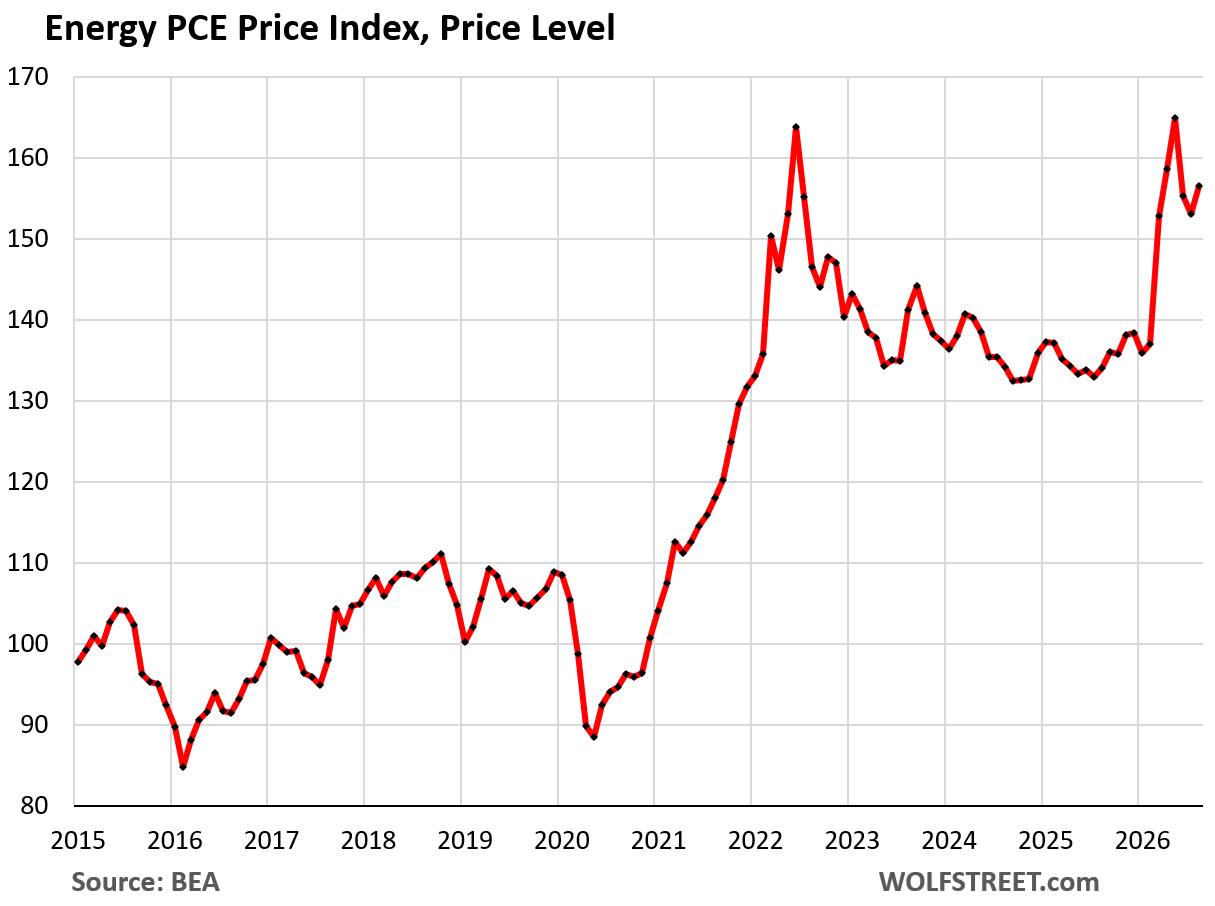
The energy PCE price index was not revised. It spiked by 16.8% year-over-year in August. These are energy goods and services that consumers pay for directly, such as gasoline, utility natural gas, electricity, heating oil, etc.
The subindex for gasoline spiked by 27.8% year-over-year in August.
This chart shows the price level, not the year-over-year percentage change.
Enjoy reading WOLF STREET and want to support it? You can donate. I appreciate it immensely. Click on the mug to find out how:


I trust Wolf’s articles which are data and evidence based. Wolf is clearly calling inflation is still hot.
CNBC headline says – “Fed’s preferred inflation much lighter than expected”.
Stock market is rallying today. I honestly do not believe we will ever see data driven recession or bull markets ever again. Feels like, everything is manipulated and big banks and firms will move stock in a direction they want.
We have inflation through the roof, bond yields have reached decades high and stock market is absolutely unfazed because it is last day of the quarter and market has to reach certain point to close the books and take profit.
Wolf,
Keep doing what you are doing!! News/Articles we can trust.
“…and stock market is absolutely unfazed because…”
Yes, but the bond market is sagging, and longer-term yields are surging. The 10-year yield is now at 5.30% and the 30-year yield at 5.65%.
the higher rates are putting pressure on weaker companies who are finding refi isn’t feasible
therefore distress sales coming along with bankruptcies
I heard 15% rates on lower rated bonds/hedge lending is already here
heck if can lose $42B on $4.6B revenue – AI bonds could become toxic
and lots of data centers likely NOT going to get built
Just curious Wolf, at the current yield, will it be enough for you to start buying 30yrs or wait until 6%? Given how things are unfolding, where do you think the ceiling will be with long term yield?
I’ve started nibbling on 10-year and 30-year TIPS (too early) late last year, gradually adding. I wrote about it in the comments last year a few times.
I’m going to nibble at the regular 10-year Treasury auction next week, if it keeps it up.
I’ve started kicking the tires at my broker for stuff someone is desperate to unload.
I’m almost certain yields will rise from here, and that those early buys will lose market value. But I cannot reconstruct a bond portfolio in one day at the top.
The bond market performance is a matter of perspective.
Oligarch’s and their Government Influence: The bond market sagging translates into there is a limit to how much one can squeeze from a buyer for bonds denominated in excessively created dollars (inflation).
Oligarch’s surging interest rate as just the mathematical “flip side” to bond market sales. However, for the Proletariat, such surging yields are the only hope to stop inflation.
dow closed down 440 pts? seems like market has been going sideways at best. plenty of noise but no sudden changes.
The dow doesn’t count. Heck, now that the S&P500 is so heavily technology weighted, it barely counts anymore. We should probably all just watch VTI instead.
What are your thoughts on the changes they made? A better measurement or a lame attempt?
There were real issues with the methodology of those three categories, which caused the PCE price index to separate fairly dramatically from the CPI recently, and run hotter than the CPI, when it normally runs a little cooler since it’s a broader index that includes more stuff and has much less emphasis on OER.
Those changes brought the PCE price index roughly in line again with the CPI.
But I would rather that the BLS fixes the CPI by replacing the huge weight of OER with the actual costs of homeownership, and by replacing the methodology of the health insurance index by something that actually tracks health insurance premiums.
Mr Wolfman, your observations regarding OER and health insurance index ring true.
OER should include mortgage interest, property taxes, property insurance, …; but how do you account for the benefit of real estate appreciation…?
Health Insurance is now one of my most significant personal budget items (it wasn’t a few decades ago).
Ultimately, it seems like the data we receive from our kings will always be skewed low; they are motivated to tell us that inflation is lower than it really is.
Is the Wolfman thinking how to monetize a free market solution that provides economic data we can believe?
Just paid $12 for 12 pack of pop. Inflation going to make me skinny again. No more pop. I’m finally cutting out some off this over valued junk.
I just paid $1.49 for a dozen grade A large eggs, down from the $6 to $8 range not long ago. My favorite coffee got less expensive too. And ground beef has come down a little, bought the first special in a long time. You’re fooling yourself by using one item to judge inflation, because according to the three items I just mentioned we’d have massive deflation 🤣
But yes, I totally agree, stop drinking pop. It’s an unhealthy waste of money. Tap water is good. If it tastes funny where you are, squirt a little lemon into it.
My well water has a consistency of 90% water. 8% iron. 2% Radon. Maybe I’ll develop super powers and my super power will be Deflation-Man. I can schwakathoonkle the inflation rates for the Fed. Ker-CHOW!
and friend and I had 2 burgers this weekend
paid $40 + tip
my wife got upset because I turned down lunch at restaurant today
called me cheap
By Minnesota state law, all municipal tap water must have between 0.5 to 0.9 mg per liter of fluoride in it. In Minneapolis, their website proudly states, “We add a small amount of fluoride to our drinking water.” My tap water, which comes from the Mississippi river at its north side entrance into Minneapolis, has 0.75 mg/L in it.
Fluoride? Hell no. Not in my drinking water or coffee. An AquaTru (the brand name) Carafe reverse osmosis filter with an “Alkaline VOC filter” that adds trace amounts of calcium and magnesium is the way to go for drinking water, and good coffee IMO.
Or, use Wolf’s technique, “If it tastes funny where you are, squirt a little lemon into it.”
On a serious note, a reverse osmosis filter will also remove PFOA & PFOS “forever chemicals”. The Mississippi is remarkable free of these, but much of the eastern half of the Twin Cities has a lot of them in the aquifers and wells. Minnesota Mining and Manufacturing (3M) is headquartered on the east side of St. Paul.
It used to be a quirk of geology if the local population got enough trace minerals. Today we can get enough of it through various means.
Flouride is not a problem. Over here it is added to table salt instead of the drinking water. Whatever.
I don’t know your local building code, but imo, every house should have a water filter where your connected to the main. Those filters are for the bigger stuff like sand or lime that accumulated in pipes and sometimes get loose. Mainly to protect your internal plumbing from mechanical problems.
Those filters should be cleaned (maintained) at least yearly. There are also filters that can backflush automatically and require less maintenance.
I’m a bit sceptical about more localised filters, say a RO filter under your sink. In isolation, they work. But, the protection against mikrobiological contamiation is flowing water. A filter adds surface. And it might protect that tap but bakteria can travel against the flow and contaminate other places. And because the water in a filter under your sink is warmer, the environment for bakteria is also “better”.
Though as your in the US, the water has more chlorine in it so that is an additional layer of protection.
toby,
The AquaTru I use is a countertop unit that has no connection to the cold water supply line.
I chose to avoid drinking fluoride to the best of my ability. I do use it in my toothpaste though.
Having the trace minerals helps my coffee maker, and it makes better tasting coffee.
“Chlorine and chloramine are common disinfectants added to tap water during municipal treatment, but even trace amounts can negatively affect coffee flavor. They often produce sharp, bitter, or chemical-tasting notes in brewed coffee.
Even if you can’t taste chlorine in your drinking water, it can still impact extraction and intensify bitterness in your cup. Fortunately, most water filters, particularly those with activated carbon, can effectively remove chlorine and other water treatment compounds before brewing.”
Yes, I’m having a small cup of French Roast coffee for my after dinner beverage as I type this reply.
Rather than do the right thing and stop inflation, they – all of the a$$clowns running the government – are going to redefine what inflation is. It’s a sick, sick county.
Monkeys outta the bottle bro
And the bond market responded today. Hopefully the bond market continues to respond rationally as the government continues to “make adjustments”. The bond market also needs to pay more attention to the “lack of downward adjustment” to the fiscal deficit spending rate in an overheated economy.
The government is cooking the books again.
The problem with this drive-by one-liner is that it’s dumb and makes rational discussions of the real issues impossible.
There were real issues with the methodology of those three categories, which caused the PCE price index to separate fairly dramatically from the CPI recently, and run hotter than the CPI, when it normally runs a little cooler since it’s a broader index that includes more stuff and has much less emphasis on OER.
Those changes brought the PCE price index roughly in line again with the CPI.
Yes Wolf, but what if we are not in normal times (which I would suggest we are not due to the inflationary pressures of tariffs, higher interest rates and AI) and in those adjusted categories, companies are finding it difficult to pass on their higher input costs to their customers. If that is true, it’s important information and government statistics should not try to cover that up.
Neither the adjustments nor what I said has anything to do with what you said. Re-read my comment.
Its a matter of trust. And trust is a currency. And the current administration has very little of it.
Have you written an article about what the issues were with the methodology for the 3 items you listed (Portfolio management, Legal services, Computer software)? I’d be interested in reading you take on what the issues were, and what exactly they changed to fix them. Thanks.
The way they collect data from various sources to approximate an inflation figure for these categories gives me a headache. This stuff is incredibly technical, complex, and arcane. In some of these things, I have trouble seeing the logic. There are simple summaries, and they’re not useful, including the AI summaries. I would have to spend hours trying to write a readable piece about it that even I can understand and that practically no one will read. And it doesn’t really matter.
Methodologies are changed all the time by just about everyone that produces something with a methodology. It’s part of the beast.
If the BLS ever changes its methodology in CPI by replacing its ridiculous OER with actual expenses of homeownership, there will be a huge hue and cry about it. But I really want it to do that.
The BLS changed its methodology in CPI for the new and used vehicle CPI a few years ago, switching to buying private sector data from JD Power, instead of using its own dealer surveys. I covered it at the time. It was a huge improvement, and it caught the gigantic price spike in 2021-2023 perfectly. But when it switched, there was also a HUGE hue and cry that the BLS is doing this to manipulate down the figures…
the Fed’s target…we hear that statement as if its proven model. Seems like we have a great deal of comfort in assuming that 2% – has somehow analytically been arrived at through decades of economic success with this target. It would seem that this is an arbitrary target that a group of individuals in the 80’s and 90’s decided was a perfect place for the economy to stay. In reality, in order to achieve 2% the unemployment rate needs to be very high – over 5% or 6% or more…which creates a need for rate reductions and then the hike towards more growth and inflation. Could it be that we need to rethink this the next decade and use our newly gained knowledge (since 1990) to better approach the balancing of the growth and inflation cycles?
2% is a compromise: It’s low enough to where it doesn’t change behavior in the economy by businesses and consumers; and high enough to stay away from deflation and help a little dealing with the national debt.
Understood that 2% is a compromise…but its still arbitrary and look no further than your chart depicting 2014-2019 (precovid) I do not want to return to those “good ole days of low inflation” as there were very limited opportunities for growth and China was eating our lunch.
Yes 2% target is arbitrary and no one important has ever said otherwise.
We know that 5% inflation is too high, and -1% deflation is too low, so targeting a whole number right in the middle is close enough to whatever the mathematical ideal would be.
As I see it, the Fed’s 2% target is appropriate.
Due to the complexity of our economy, i think that picking a target below 2% would run the risk of deflation (which seems undesirable).
Reducing our national debt by inflating our currency is a form of theft; it steals from those who save; and it gives to those who choose to live in debt.
Any function that always grow is some kind of exponential function heading to infinity. That 2% yearly inflation is low enough to not make it glaring obvious. Prices will not double that fast people really notice and start to act accordingly.
Still it allow for credit expansion and interests on money. Taming inflation is possible, just switch to a monetary system with a constant amount of money. That bring a different set of problems, different limits to politics and shift who benefit from the arrangement of the monetary system.
The 2nd qtr. gross domestic product has been revised higher, now @8.5%.
The FED is still running the economy hot.
yes, nominal GDP, sizzling. Inflation, sizzling.
I read the update today on the Fed’s ignorance and lackadaisical attitude towards spies at the FED. It appears the only “shrooms” are us plebes. Good to know the taxpayers are kept in the dark while spies roam free at the FED. If it wasn’t for Wolf we would be completely in the dark.
“Then, in a report published last week, the OIG revealed that another Division of International Finance employee (same division as Rogers!) retiring in July 2024 potentially walked out with FOMC-classified information after generating 279 data-loss alerts in the final 90 days, 139 of them involving potentially sensitive FOMC material. The same employee had a history of copying FOMC files to unencrypted USB drives and emailing them to a personal address, and had traveled to a Fed-designated restricted country in June 2024. The Fed only found out a year later, and never opened a formal misconduct probe. The OIG blamed “a collective lack of action across multiple divisions.”
I’m sorry, but the law enforcement resources you requested have been reassigned to ensure all the dishwashers and roofers in your town have the right paperwork.
If the Fed gets hacked and is forced to default on treasury bonds, that is a small price to pay compared to the risk that your lettuce might be picked by somebody without the right paperwork.
“Corn Tumbles to 5-Week Low After US Stocks Data” — TradingEconomics
This news is excellent. I recently finished off a big bag of frozen cut corn that had been in my freezer for quite a while that I had bought from a local grocery store that is under the Kroger food extortion umbrella corporation.
Guys, pro-tip. Get the Elote seasoning and sprinkle it all over the corn. You can add other stuff like butter and some certain types of cheese, maybe some cilantro and other things if you want to make it more fancy. It’s stupid easy. Just boil or microwave the frozen corn, no real work or much time or thinking required. Who cares if it’s not exactly like the authentic esquites or elote from a street food cart. Suggested beer pairings include 211 Steel Reserve or whatever 30-pack is on sale at the grocery store.
I’m not letting McDonald’s push their AI dynamic pricing inflation into my digestive tract.
Lol sounds like you will be pushing a lot of gas out of your digestive tract
Someone please correct me if my take is misguided / too simplistic. It seems that the bond market is slightly pulling back from a possibility of a rate hike in October (1M, 3M, 6M all down from yesterday’s recent highs), however the 10Y and 30Y have both reached another 52 week high. This implies that the bond market anticipates higher long term inflation even if near term there are lower expectations (for today, at least) for the Fed to hike the EFFR to combat inflation, correct?
You’re looking at it the right way.
I don’t think the Fed will hike in October before the midterms. That would be unheard of. It would be like a provocation. They’re not going to do that. They’ve been over target for 5.5 years, and this one meeting doesn’t change that. If they’re in a hurry, they can hike by 50 basis points in December to catch up, but they won’t do that either. They’ll hike by 25 basis points in December unless something big changes.
The bond market, when it’s allowed to run free, has its own understanding of inflation. The inflation indices are just part of it.
Wolf, to what extent do you think the the Fed under Warsh would allow the bond market to guide them? I’m not learned enough to have a studied opinion on Warsh’s reluctance toward forward guidance, but it seems like a breath of fresh air to let the market “fun free” as you’ve talked about. Is the cart now fully behind the horse?
I have no idea how the Fed will approach this. Right now, long-term yields are back in the normal range, with above normal inflation, above normal nominal economic growth (+8.4% nominal GDP growth in Q2), and massive deficits. This calls for higher long-term yields. I think Warsh understands this, I’m not sure where the other 11 FOMC members stand on this. They liked their loosey-goosey monetary policies that led to this.
35 bp? Interesting. I had assumed increments of 25bp.
Bond market still selling off, they don’t seem to buy the inflation can be adjusted away idea.
Given how hedge funds like betting against each other when the herd starts all going the same way, the $2T in highly leveraged treasury bets stored in the Cayman’s might start looking like a tempting piggy bank to smash on the floor.
Could be one of those “break the pound” type trades that gets talked about for generations
Oh good! All the Soros paid-protester gigs have been drying up lately. I have vacation home payments to make dammit!
I’m curious what you think of the revisions to real income? I wouldn’t call Bonddad conspiratorial, but even he is blinking at this revision.
“real” income is adjusted for inflation. And inflation was adjusted downward quite a bit, so real income would go up quite a bit, based on the inflation adjustment. The revision of real GDP today had the same effect. Everything that’s adjusted to inflation got adjusted upward today.
In addition, nominal consumer spending (not adjusted for inflation) was also adjusted higher. And nominal GDP (3rd revision today) was adjusted higher. This strong performance of the economy was in part why bond yields jumped today. Q3 GDP is going to look pretty good.
This is what money flows are saying:
07/1/2026 ,,,,, 0.247 peak
08/1/2026 ,,,,, 0.149
09/1/2026 ,,,,, 0.061
10/1/2026 ,,,,, 0.069
11/1/2026 ,,,,, 0.065
Even with the distortion in saved demand deposits from the flight to liquidity, real gross domestic product should fall in the last half of the year. But inflation remains high.
30 yr mortgage hit 7.6% today.
Look out below for sellers….
haha, just try harder dating that rate…wonder if RE agents still preaching that gospel to prospective buyer now…rate will be back down in no time…
I’ve never met anyone who thinks government data has been overstating inflation lately. (goes without saying… I’ve never met Donald Trump)
Much bigger issue is the government’s methodology for tracking price changes in shelter and health insurance. But I don’t expect any serious deliberations over that under the current regime.
There are actually quite a few economists who’ve been saying for years that the government inflation measures (CPI especially) are overstating actual inflation. I generally don’t listen to them, but they’re out there.
When I was the chief economist for a trade association, we never fudged the statistics on our industry. Instead, the bias was in what got published or not. If the unfudged stats reflected poorly on the industry, our research didn’t get published. This didn’t happen often, but it was inherent.
N=3 is too low to make inferences! But my gut feeling about today’s 3 methodology revisions is simply to note that all three LOWERED measured inflation. Had any revisions that might have INCREASED inflation been proposed by the methodologists, management may have decided to kick those down the road…
By my calculations, and I stand to be corrected…
we are 14% above a 2% inflation trendline from 2020 to today
That would mean we have an extra 7 years of 2% inflation ALREADY plugged into today’s prices.
And might suggest we need no inflation for several years to get back on that trend line.
Depends on your starting point:
Starting from 1990 (when the 2% target was invented), 2% per year would be a PCE index of 123
Starting from 2000, 2% per year would be a PCE index of 124
Starting from 2010, 2% per year would be a PCE index of 124
Starting from 2020, 2% per year would be a PCE index of 119
Actual PCE index = 131.6
So we are approximately 6% too high over the 16, 26, and 36 year horizons (and 11% over the 6 year horizon). That’s actually fairly impressive, since it means that the average rate since 1990 was 2.2% against a target of 2%, which probably within the margin of error for how inflation can possibly be measured.
I’m guessing they’re pretty happy with that in the long term, and in the short term are happy to just focus on getting it back down to 2%.
PCE 2% annual increases
8/20 104.8
8/21 106.8
8/22 108.9
8/23 111
8/24 113.2
8/25 115.4
8/26 117.7
We should be 117.7, we are actually 131.5
circa 14% over the “target trend line”
The 2% was instituted as policy by Bernanke, as I recall. And if you’re going back in time for a pleasant starting point, why didnt you go to 1980?
During the U.S. Golden Age in Capitalism, 1955-1964, the CPI increased at an annual rate of 1.4 percent.
I love love love that people point to this period as the golden years!
“The top federal marginal income tax rate in the United States was 91 percent for most of the 1950s.”
“The 1950s featured significant government support programs, building upon the New Deal while expanding into new infrastructure, housing, and social welfare areas.”
I can’t argue whether these are good or bad changes but to me the perception is the real problem. People hardly, if at all, believe the numbers, and to adjust them down, will have people trust everything even less. In the end likely doesn’t matter as people are helpless against the whims of the bureaucrats anyway.
Hopefully voters will vote out the crooked career politicians who caused this mess over the past 25+ years. How the hell are people still voting for Mitch “Weekend At Bernie’s” McConnell?
Mr. Richter — thank you for a clear explanation of the recent PCE revisions. Your analysis raises important questions about how inflation is measured and interpreted. I would encourage you to consider another dimension in this discussion, either here or in a future article: the role of fiscal policy as a major source of aggregate demand.
The public sector is not only a large source of direct spending; it also influences aggregate demand through government outlays and the tax code. Large deficits can increase aggregate demand, while tax reductions and targeted tax expenditures can encourage additional private spending or investment. Recent analyses, including work from the Congressional Budget Office and Federal Reserve research, indicate that fiscal measures enacted in 2025 increased near-term demand and put upward pressure on prices, while demand forces played a major role in the pandemic-era inflation surge.
A deeper issue is what happens after an initial crisis resolves. Emergency spending and temporary tax relief can stabilize an economy during a shock, but some temporary tax provisions have repeatedly been extended rather than allowed to expire, leaving a lasting fiscal footprint after the original emergency has passed.
This raises a central question that receives less attention than the Fed’s rate path or statistical adjustments: how much of today’s persistent aggregate demand is being sustained by structural fiscal policy — through both direct outlays and persistent tax provisions — and how should monetary policymakers account for those fiscal forces when assessing the path back to 2 percent inflation?
Thank you again for the thoughtful piece.
I’ve been following this site for 6 years and have learned a ton. I’m still no expert, but at this point I just can’t see how they get down to the 2% target without a recession/high unemployment. Demand is still high (as you lay out in the consumer spending articles). Might we have been in better place today if the Fed had gone far enough to trigger a recession in 2022, instead of attempting the soft landing?
Thanks for your efforts Wolf!
Good question. Deficits at 6% of GDP are like a permanent yet unsustainable emergency stimulus program, and yet real GDP growth has remained in the 2% range for the last 3 years.
Would you buy shares or bonds from a company growing its debt at 6% per year and its revenue at 2%, and no plausible plan to do better?
Presumably, if the deficit was cut from 6% to just 4% of GDP, then 2% GDP growth would fall to near zero. This patient is only being kept alive by the adrenaline drip.
Perhaps you do not mind inflation because the only why to get to the 2 percent we all talk about is to have a depression. And the one US way out of a depression is lots of money printing and government spending, and guess what, more inflation than before. This is a built in word problem.
If we accept at face value that Core PCE is legitimately 3.0%, as the FOMC will do, then the following things are true:
1) We are not in an inflation crisis. It’s only 1% above target. Emergency measures that risk recession are not justified.
2) The Fed Funds Rate at 3.75% to 4% is above the rate of inflation, and therefore mildly restrictive. This can be expected to slowly push inflation down toward the target over the course of months. At a 4.25% upper range it would happen even faster.
Put these points together and you have maybe one more 25bp hike, or maybe none. Market expectations for another 100bp are wrong.
We also might have an October 2023 style yield collapse, because the whole rationale for rates rising was that inflation was out of control and lots of rate hikes were on the way. This report contradicts that narrative.
So maybe we should go long into bonds, because October 2023 is about to repeat itself in October 2026?
“Still, I currently estimate the target range needs to rise an additional 50 basis points or more to appropriately balance the outlook and risks for our dual mandate goals,” she said. “We must restore price stability.”
The economy is strengthening and the labor market is well balanced, she said. And though inflation is falling as transitory factors fade, it does not look like it will go much lower than 2.5% without further rate hikes. Dallas Fed President Logan recent sentiments, looking forward to 4.25 to 4.50 in my Vanguard 401k money market fund. The monthly dividend payout for September was 3.75. Keep hiking until we see a 30% to 40% in housing values here in Colorado. Let kill it for once and for all. Americans will keep spending regardless. $185 trillion in wealth just doesn’t sit still.